Full public teaching and readers are free without an account. A free learner account is required for saved LMS progress and recorded assessment. Completion and any course-completion certificate depend on the configured LMS conditions. Full course outline and access routes.
Lesson 1
A validated bake belongs to a defined product and process
Explain what process validation establishes and when a changed pie needs technical review.
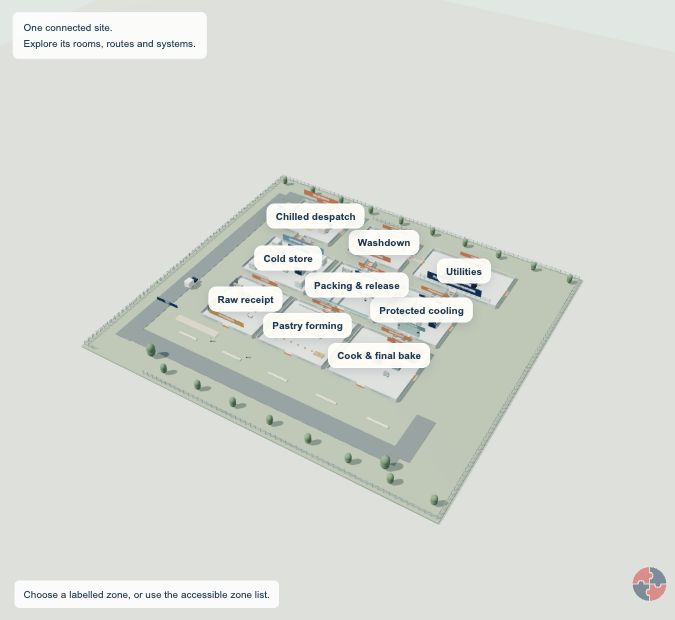
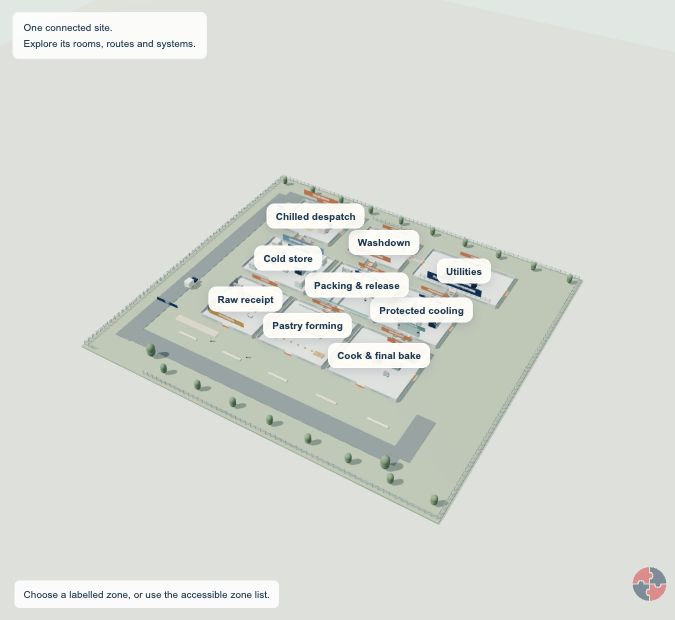
Actual whole-site SHAREsimulate pie factory model. This overview supplies layout context; inspect the lesson schematic and stated case for this zone.
A validated bake belongs to a defined product and process
Cooking control concerns the product throughout the process, not simply the number on the oven display. The approved arrangement must achieve the required food-safety outcome for the actual pie, filling, size, starting condition, equipment and loading pattern. A validation establishes the capability of that defined arrangement. Routine production must then remain within it and generate the evidence the food-safety plan requires.
In the fictional factory, a deeper pie is scheduled on the programme used for a smaller product. Its pastry colour looks familiar, and the operator expects the same outcome. The relevant question is whether the approved process covers this product and configuration. Hold the change for the competent technical review rather than inventing a longer bake or assuming that an attractive crust proves the filling received the required treatment.
Separate the settings from the outcome. Air temperature, conveyor speed, loading, product measurements and recorded checks can describe different parts of the control. Each has an intended meaning and acceptance rule. The approved procedure determines what is monitored, where and how it is measured and what happens if the evidence fails. Do not swap one reading for another because it is easier to obtain.
The process must also fit the intended use. A product sold ready to eat cannot rely on a consumer doing an uncommunicated additional safety step. A product intended for further cooking needs the appropriate validated basis, information and controls for that route. The responsible team determines the real product category and applicable requirements; this awareness course cannot make that classification from a model view.
For practice, compare two cards: an unchanged product within its approved process and a modified filling or loading arrangement outside that evidence. State which can follow routine control and which needs review. Record the product identity, change, missing evidence and decision owner. Use the current product-specific limits and method rather than a generic cooking example as a universal industrial bake instruction.
How does HACCP make food safety manageable?
A food business should identify significant biological, chemical, physical and allergen hazards and operate proportionate HACCP-based procedures. A staff welfare kitchen is not automatically a food business; establish the actual activity and legal status before imposing a commercial HACCP pack.
HACCP should be proportionate. A small workplace kitchen may use a simple documented safe-method system, while a catering operation or care setting may need detailed process controls, checks and verification. The point is not paperwork; it is knowing where loss of control would make food unsafe.
Critical control points often include cooking, chilling, hot holding, cooling and reheating. Not every check is critical, but every important check should have an action if it fails.
HACCP is not a complicated binder for specialists only. At its best, it is a simple way of thinking: what could make this food unsafe, where can that happen, what control prevents it, how do we know the control worked, and what do we do if it did not?
For a staff kitchen, the answer may be simple cleaning, labelling and fridge checks. For a commercial kitchen, care home or event caterer, the answer should include approved suppliers, delivery checks, cooking standards, hot holding, cooling, reheating, allergen controls and manager verification.
HACCP questions
Question
Why it matters
Evidence
QuestionWhat food is handled?
Why it mattersRisk differs between wrapped biscuits and cooked rice, meat, dairy or ready-to-eat foods.
EvidenceMenu, food list and supplier details.
QuestionWho may eat it?
Why it mattersVulnerable groups need tighter controls.
EvidenceService profile and vulnerability assessment.
QuestionWhere can hazards enter?
Why it mattersContamination can occur at delivery, storage, preparation, service or waste.
EvidenceProcess flow and task observation.
QuestionWhich controls are critical?
Why it mattersSome controls are essential to make the food safe.
EvidenceHACCP plan or safe method sheet.
QuestionWhat happens if a check fails?
Why it mattersA failed temperature or allergen check must trigger action.
EvidenceCorrective action record and food disposal decision.
QuestionHow is the system verified?
Why it mattersRecords can be completed without real control.
EvidenceManager checks, audits and inspection findings.
Why does temperature control matter for food safety?
Set validated cooking, chilling, cooling, hot-holding and reheating controls for the food and jurisdiction. Avoid treating one temperature as a universal UK legal rule: Scottish commercial reheating law has a distinct 82°C route with exceptions, while other nations use different requirements and guidance.
Temperature control is one of the most familiar food safety topics, but it is often misunderstood. The question is not only whether a fridge number was written down. The question is whether the food was received, stored, cooked, cooled, reheated and served in a way that prevents harmful microbial growth.
Equipment reliability matters. Fridges, freezers, hot cupboards, probes and dishwashers should be checked, cleaned, calibrated where required and repaired promptly.
Temperature control examples
Control point
What can go wrong
Good practice evidence
Control pointDelivery
What can go wrongHigh-risk food arrives warm or damaged.
Good practice evidenceSupplier approval, delivery check and rejection record.
Control pointChilled storage
What can go wrongFridge overloaded, door left open or failed unit ignored.
Good practice evidenceTemperature log, action note and maintenance response.
Control pointCooking
What can go wrongCentre of food does not reach safe temperature.
Good practice evidenceProbe checks, cooking record and trained staff.
Control pointCooling
What can go wrongLarge containers cool too slowly.
Good practice evidencePortioning, blast chilling or timed cooling record.
Control pointReheating
What can go wrongFood reheated unevenly or repeatedly.
Good practice evidenceReheat standard, probe evidence and discard rule.
Control pointHot holding
What can go wrongFood drops below safe holding temperature.
Good practice evidenceHot-hold checks and time limits.
The plan changes to a deeper pie, but the available approved bake evidence describes only the previous product and loading configuration.
Decision and explanation
A competent review establishing that the approved process covers the changed product and configuration.
Validation has a defined scope. Product appearance and production pressure cannot extend that scope to an unassessed change.
Lesson 2
A signed printout must still be reliable evidence
Distinguish monitoring, corrective action and verification when bake evidence is incomplete.
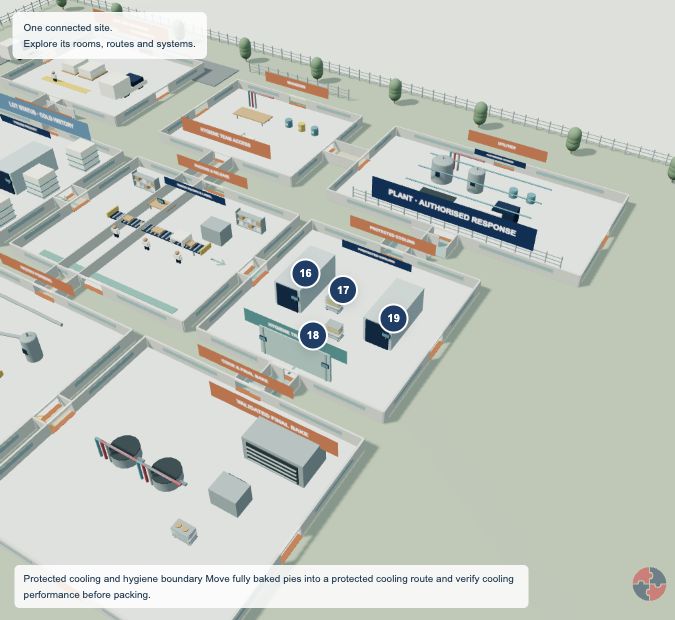
Actual SHAREsimulate FOOD-Z04 model zone. The fictional case supplies the facts; the picture does not establish live plant or product conditions.
A signed printout must still be reliable evidence
A process record supports a decision only when its identity, measurement and result are reliable. A signature shows that someone signed; it does not prove that the correct sensor worked, the required observation occurred or the record belongs to this batch. Make the link from the product and approved process to the actual evidence before deciding that a bake met its requirements.
The model shows an oven printout accepted despite incomplete approved bake evidence. The appropriate response is to control the affected lot and describe the precise gap. A missing portion of the trace, an incorrect programme identity and a measurement fault are different problems. Preserve the original information and refer the disposition to the authorised food-safety process rather than filling blank entries from memory.
Monitoring observes the defined control during production. Corrective action addresses a failure and the affected product. Verification checks that the food-safety system is operating as intended. These functions support one another but are not interchangeable. A later supervisor review cannot invent a missing historical product measurement, while a repaired sensor does not by itself establish the history of the lot processed during its fault.
Measuring equipment needs the suitability and checks required for its role. Follow approved hygienic measurement methods, safe access and the relevant equipment assurance arrangements. A damaged probe, wrong position or mistaken timestamp can create confidence in a result that answers the wrong question. Do not reach into an operating oven or expose yourself to hot equipment to obtain a record; use the defined safe method.
In the exercise, review a short fictional batch record containing one confirmed result, one unconfirmed interval and an earlier satisfactory equipment check. Mark what each establishes. Document a correction that retains the original evidence, names the missing information and maintains product control. Your learning output should make the uncertainty legible to the next shift instead of turning a clean-looking document into a substitute for a justified decision.
What food safety records should a business keep?
Records should prove that significant food safety controls are being completed, checked and corrected when they fail.
Food records should be quick to complete but meaningful. They should show the control, the result, the person checking it and the action taken when the result is outside the expected standard. Records that show perfect ticks every day but no defects, no corrective action and no manager review may be weaker than they look.
For higher-risk catering, records should also help managers identify patterns: repeated fridge failures, poor probe calibration, missed cleaning, supplier problems, complaints, allergen queries or staff training gaps.
Food safety evidence register
Record
What it proves
Review trigger
RecordFood safety management system
What it provesHazards, controls, monitoring and corrective actions are defined.
Review triggerMenu, process, supplier or premises change.
RecordTemperature records
What it provesCritical storage, cooking, cooling and hot-holding controls are checked.
Review triggerOut-of-range reading or equipment fault.
RecordCleaning schedule
What it provesCleaning tasks are allocated and verified.
Review triggerFailed inspection, pest activity or complaint.
RecordTraining matrix
What it provesFood handlers and supervisors are competent for their role.
Review triggerNew starter, role change or incident.
RecordAllergen matrix
What it provesAllergen information is current and communicated.
Review triggerSupplier, recipe or menu change.
RecordMaintenance records
What it provesEquipment affecting food safety is kept reliable.
Review triggerRepeated defect or breakdown.
RecordIncident and complaint log
What it provesLearning is captured and actioned.
Review triggerIllness complaint, allergen near miss or enforcement feedback.
Specific official context: GOV.UK food hygiene for businesses; Government HACCP food safety management; Food Standards Scotland guidance; FSA government allergen guidance2026. Food examples require the actual food-business status, nation, food category and validated safe methods. Current government HACCP management guidance covers hazard identification, critical controls/limits, monitoring, corrective action, verification and records for food businesses; specialist meat-plant scope differs. FSA government allergen guidance updated 17 July 2026 applies England/Wales/NI; accurate ingredients, food-format labels, changes and cross-contact controls. GB assimilated law/NI movement or EU routes require actual product review.
How does HACCP make food safety manageable?
A food business should identify significant biological, chemical, physical and allergen hazards and operate proportionate HACCP-based procedures. A staff welfare kitchen is not automatically a food business; establish the actual activity and legal status before imposing a commercial HACCP pack.
HACCP should be proportionate. A small workplace kitchen may use a simple documented safe-method system, while a catering operation or care setting may need detailed process controls, checks and verification. The point is not paperwork; it is knowing where loss of control would make food unsafe.
Critical control points often include cooking, chilling, hot holding, cooling and reheating. Not every check is critical, but every important check should have an action if it fails.
HACCP is not a complicated binder for specialists only. At its best, it is a simple way of thinking: what could make this food unsafe, where can that happen, what control prevents it, how do we know the control worked, and what do we do if it did not?
For a staff kitchen, the answer may be simple cleaning, labelling and fridge checks. For a commercial kitchen, care home or event caterer, the answer should include approved suppliers, delivery checks, cooking standards, hot holding, cooling, reheating, allergen controls and manager verification.
HACCP questions
Question
Why it matters
Evidence
QuestionWhat food is handled?
Why it mattersRisk differs between wrapped biscuits and cooked rice, meat, dairy or ready-to-eat foods.
EvidenceMenu, food list and supplier details.
QuestionWho may eat it?
Why it mattersVulnerable groups need tighter controls.
EvidenceService profile and vulnerability assessment.
QuestionWhere can hazards enter?
Why it mattersContamination can occur at delivery, storage, preparation, service or waste.
EvidenceProcess flow and task observation.
QuestionWhich controls are critical?
Why it mattersSome controls are essential to make the food safe.
EvidenceHACCP plan or safe method sheet.
QuestionWhat happens if a check fails?
Why it mattersA failed temperature or allergen check must trigger action.
EvidenceCorrective action record and food disposal decision.
QuestionHow is the system verified?
Why it mattersRecords can be completed without real control.
EvidenceManager checks, audits and inspection findings.
The sensor has been repaired, but the affected batch’s required bake evidence remains incomplete.
Decision and explanation
Equipment repair supports future readiness; the earlier batch still needs an authorised evidence-based disposition.
Current equipment readiness and past product history are different questions. Preserve the gap and assess the affected product using the approved process.
Lesson 3
Cooling performance depends on the actual load
Relate rack spacing, capacity and product history to the validated cooling arrangement.
Actual SHAREsimulate FOOD-Z04 model zone. The fictional case supplies the facts; the picture does not establish live plant or product conditions.
Cooling performance depends on the actual load
Cooling is a process with a defined starting condition, loading arrangement and required product outcome. The chiller display describes part of that process; it does not prove that every pie followed the approved history. Closely packed racks can change airflow and cooling performance, especially when the load differs from the configuration used to establish the method. More available floor space is not evidence of more safe capacity.
In the model, tightly packed racks fill the blast chiller beyond the approved loading pattern. Preserve the relevant batch and loading information and prevent further departures from the method. The responsible food-safety team needs reliable product time-temperature evidence and the validated requirements to assess disposition. Do not release on the basis that the outside of the trays feels cold.
Plan flow before the oven output creates pressure at the cooling door. Production scheduling, rack availability, chiller readiness and protected transfers must work together. A delay upstream or an equipment breakdown may require a controlled change to production, rather than forcing more hot product into the same space. Improvised temporary holding can create a different uncontrolled history and requires its own authorised assessment.
When a cooling concern occurs, identify the distinct histories. A correctly loaded earlier cycle and an overloaded later cycle may need different decisions. Include the actual loading pattern, timing, product identity, equipment evidence and any interruptions. Moving racks after the event can improve the current arrangement while leaving the earlier exposure unresolved. Reaching a satisfactory final reading does not necessarily demonstrate an acceptable complete cooling history.
For the practical activity, assemble a plan from cards for oven output, available racks, approved load, protected transfer and verified cycle evidence. Introduce one delay and decide which operation must pause. Explain how the plan protects product and people moving hot racks, without supplying a universal cooling duration or temperature. The acceptable limits belong to the actual validated product/process and the applicable national requirements.
Why does temperature control matter for food safety?
Set validated cooking, chilling, cooling, hot-holding and reheating controls for the food and jurisdiction. Avoid treating one temperature as a universal UK legal rule: Scottish commercial reheating law has a distinct 82°C route with exceptions, while other nations use different requirements and guidance.
Temperature control is one of the most familiar food safety topics, but it is often misunderstood. The question is not only whether a fridge number was written down. The question is whether the food was received, stored, cooked, cooled, reheated and served in a way that prevents harmful microbial growth.
Equipment reliability matters. Fridges, freezers, hot cupboards, probes and dishwashers should be checked, cleaned, calibrated where required and repaired promptly.
Temperature control examples
Control point
What can go wrong
Good practice evidence
Control pointDelivery
What can go wrongHigh-risk food arrives warm or damaged.
Good practice evidenceSupplier approval, delivery check and rejection record.
Control pointChilled storage
What can go wrongFridge overloaded, door left open or failed unit ignored.
Good practice evidenceTemperature log, action note and maintenance response.
Control pointCooking
What can go wrongCentre of food does not reach safe temperature.
Good practice evidenceProbe checks, cooking record and trained staff.
Control pointCooling
What can go wrongLarge containers cool too slowly.
Good practice evidencePortioning, blast chilling or timed cooling record.
Control pointReheating
What can go wrongFood reheated unevenly or repeatedly.
Good practice evidenceReheat standard, probe evidence and discard rule.
Control pointHot holding
What can go wrongFood drops below safe holding temperature.
Good practice evidenceHot-hold checks and time limits.
A simple HACCP food flow follows the food from purchase to service and identifies where contamination, growth, survival or allergen error can occur.
Food safety becomes easier to teach when the process is shown as a journey. At each stage the business should know the hazard, the control, the check and what action is taken if the check fails.
For low-risk staff refreshments, the flow may be simple. For cooked food, chilled high-risk food, buffets or vulnerable consumers, the flow needs more explicit control and evidence.
Example HACCP flow from purchase to service
Stage
What can go wrong
Control and evidence
StagePurchase
What can go wrongUnapproved supplier, damaged packaging, incorrect allergen information or high-risk product selected.
Control and evidenceApproved supplier list, specification, allergen data and purchasing rule.
StageDelivery
What can go wrongFood arrives warm, late, damaged, contaminated or past use-by date.
Control and evidenceDelivery check, temperature check, rejection rule and record.
StageStorage
What can go wrongRaw and ready-to-eat foods mix, fridge overloaded, allergens not segregated or stock rotation fails.
Control and evidenceSegregated storage, date labelling, fridge records and stock rotation.
StagePreparation
What can go wrongCross-contamination, poor hand hygiene, dirty equipment or allergen cross-contact.
Control and evidenceZoning, handwashing, cleaning, separate utensils and supervision.
StageCooking
What can go wrongFood is not cooked through or probe is inaccurate.
Control and evidenceCooking standard, probe check, calibration and corrective action.
StageHolding or cooling
What can go wrongFood spends too long at unsafe temperature.
Control and evidenceHot-hold checks, cooling method, time limits and discard rule.
StageService
What can go wrongWrong meal served, allergen information miscommunicated or buffet contaminated.
Control and evidenceService briefing, allergen check, clean utensils and customer communication.
Specific official context: GOV.UK food hygiene for businesses; Government HACCP food safety management; Food Standards Scotland guidance; FSA government allergen guidance2026. Food examples require the actual food-business status, nation, food category and validated safe methods. Current government HACCP management guidance covers hazard identification, critical controls/limits, monitoring, corrective action, verification and records for food businesses; specialist meat-plant scope differs. FSA government allergen guidance updated 17 July 2026 applies England/Wales/NI; accurate ingredients, food-format labels, changes and cross-contact controls. GB assimilated law/NI movement or EU routes require actual product review.
Applied case
The chiller air display is satisfactory, but an extra tightly packed rack has been added outside the approved loading arrangement.
Decision and explanation
Reliable product history assessed against the validated cooling arrangement and limits.
Capacity and airflow affect the product process. A satisfactory air display alone cannot validate an unapproved loading pattern.
Lesson 4
Protect cooked food from the environment above it
Respond to condensate without treating moisture-source repair as product release.
Actual SHAREsimulate FOOD-Z04 model zone. The fictional case supplies the facts; the picture does not establish live plant or product conditions.
Protect cooked food from the environment above it
After a protective cook, exposed food needs protection from its surroundings. Water collecting above a cooling route can carry contamination onto product, packaging or contact equipment. The appearance of clear water does not establish its source or suitability. Look at the route from the moisture source to the product and ask which batches were exposed, when and under what conditions.
The model shows condensate dripping onto uncovered cooked pies. Protect the product stream and control the potentially affected lots promptly. Identify the location, time window and contact evidence without putting a person under unsafe equipment or into an unassessed cleaning task. Do not simply cover the latest rack and assume earlier product is satisfactory. Record what was observed and what remains uncertain.
The cause can involve the building, ventilation, process moisture, cooling equipment or changed operating conditions. Competent investigation should establish and correct that cause while maintaining hygienic work controls. A temporary catch container can itself become an overflow or contamination source; any interim arrangement needs a suitable assessed method and defined monitoring. An unplanned sheet suspended above food is not automatically a safe remedy.
Engineering work introduces its own risks to workers and food. Isolate or protect the relevant area, manage tools and materials, prevent debris or cleaning chemicals entering the line and complete the required safe and hygienic handback. Stopping the drip demonstrates one improvement. It does not determine the disposition of pies already exposed or prove that contaminated contact surfaces have been restored.
For the exercise, use a simple overhead-to-product diagram. Mark the source, transfer route, exposed lot and immediate protective action. Add two decision cards: the evidence required to reopen the route and the evidence required to release affected food. Keep those decisions distinct and state their owners. No bacteriological result, sampling frequency or repair interval is invented here; the competent site process defines the appropriate investigation and verification.
What hazards does food safety control?
Food safety controls biological, chemical, physical and allergenic hazards that can make food unsafe.
The four hazard groups should be explained in human terms. Biological hazards can make people acutely ill. Chemical hazards can contaminate food through cleaning products, pest control chemicals or maintenance substances. Physical hazards can injure someone immediately. Allergens can cause severe reactions even when the premises look clean and well-run.
The strongest food safety cultures avoid blame-heavy shortcuts. If a fridge temperature is wrong, food has been left out, a supplier changes ingredients or staff are unsure about allergens, the system should make it normal to stop, segregate, check and record the decision.
How harm occursAllergic reaction or anaphylaxis where information or cross-contact fails.
Control focusAccurate information, separation, cleaning and staff communication.
Hazard typeProcess failure
ExamplesUndercooking, poor cooling, broken refrigeration or reheating failure.
How harm occursPathogens survive or multiply.
Control focusCritical limits, monitoring, corrective action and verification.
Specific official context: GOV.UK food hygiene for businesses; Government HACCP food safety management; Food Standards Scotland guidance; FSA government allergen guidance2026. Food examples require the actual food-business status, nation, food category and validated safe methods. Current government HACCP management guidance covers hazard identification, critical controls/limits, monitoring, corrective action, verification and records for food businesses; specialist meat-plant scope differs. FSA government allergen guidance updated 17 July 2026 applies England/Wales/NI; accurate ingredients, food-format labels, changes and cross-contact controls. GB assimilated law/NI movement or EU routes require actual product review.
Specific official context: FSA government allergen guidance2026; Food Standards Scotland guidance. Food examples require the actual food-business status, nation, food category and validated safe methods. Current government HACCP management guidance covers hazard identification, critical controls/limits, monitoring, corrective action, verification and records for food businesses; specialist meat-plant scope differs. FSA government allergen guidance updated 17 July 2026 applies England/Wales/NI; accurate ingredients, food-format labels, changes and cross-contact controls. GB assimilated law/NI movement or EU routes require actual product review.
Applied case
The drip has been repaired, but an uncovered rack was beneath it and the exposed-lot assessment remains open.
Decision and explanation
The route can be assessed for reopening separately from the authorised disposition of exposed product.
Correcting the source is necessary evidence for restoration, not retrospective proof about exposed food. Complete the separate hygienic and product decisions.
Lesson 5
Keep hygiene entry and hidden cleanability working together
Investigate contamination pathways and repeated findings without unsafe cleaning access.
Actual SHAREsimulate FOOD-Z04 model zone. The fictional case supplies the facts; the picture does not establish live plant or product conditions.
Keep hygiene entry and hidden cleanability working together
A hygiene lobby controls a transition between activities with different contamination status. Its purpose is achieved when the real hand, clothing, footwear and equipment movements follow the approved arrangement. A worker who touches raw-area equipment then enters the cooked zone can carry contamination even when the corridor looks orderly. Observe the action and the contact route rather than judging the person.
Restore the required entry conditions and assess any affected product or equipment through the food-safety process. The response should also ask why the route failed: missing supplies, unclear separation, inadequate changing space, rushed work or an exception that the procedure did not address. Repeating a reminder while leaving the same obstacle in place is unlikely to make the transition dependable.
Hidden contamination sources create a related problem. The model includes repeated hygiene findings beneath a hard-to-clean frame on the cooked line. A series of results needs investigation of trends, equipment design, access and the actual cleaning method. A visually improved exposed surface does not establish that the difficult location is controlled. Avoid declaring a specific organism or outbreak from a scene cue without the necessary evidence.
Safe access is part of effective cleaning. Guards, electrical equipment, stored energy, hot surfaces and awkward reach must be addressed by the authorised method before work. Competent engineering and hygiene teams should agree how necessary access is achieved without defeating safeguards or spreading contamination. Reassembly, debris control and the subsequent verification programme must remain connected to the release decision.
Practise by placing pathway cards from raw handle to hand, lobby, cooked-area control and exposed food. Then add a second route from the inaccessible frame to the line. Propose a source or design improvement and specify how its effectiveness would be checked during normal production. A credible answer combines workable separation, safe cleanability and evidence of sustained control rather than relying on the next favourable snapshot.
Which contamination pathways should hygiene controls interrupt?
A hygiene system should break the chain between dirty work, the worker, welfare areas, vehicles, homes and other people.
Good hygiene design starts by asking where contamination can travel. Dust on gloves can move to a sandwich, a steering wheel or a phone. Wet PPE can hold biological contamination. Contaminated RPE can be stored in a clean locker. Shared tools can spread oils, chemicals or biological material. Food and drink in a dirty area can turn skin contamination into ingestion exposure.
These pathways are predictable, so they should be controlled through layout, welfare, storage, cleaning, laundry, supervision and worker briefing. If the only control is telling people to wash their hands, the system is too weak for anything beyond very low-risk work.
Pathway
How it causes harm
Control standard
Hands to mouth
Dust, chemicals, oils or biological material move from hands, gloves, phones or cigarettes into the body.
No eating/drinking in dirty areas, handwashing before breaks and clean storage for food and phones.
Skin contamination
Wet work, cement, solvents, oils, disinfectants or biological material damage skin or enter through damaged skin.
Avoid contact, suitable gloves, washing, skin checks and early reporting.
Contaminated PPE/RPE
Dirty gloves, coveralls, masks or respirators contaminate skin, lockers, vehicles or clean areas.
Doffing method, cleaning/replacement, separate storage and RPE hygiene checks.
Shared tools and vehicles
Contamination moves through handles, cabs, steering wheels, radios, tablets or shared workstations.
Clean/dirty rules, wipe-down schedule and clean hands before entering cabs or offices.
Welfare failure
No water, soap, towels, toilets, changing or eating areas makes safe hygiene unrealistic.
Planned welfare, daily checks, defect escalation and temporary provision for mobile sites.
Poor changing/storage
Workwear contaminates personal clothing or goes home for domestic washing.
Separate lockers, laundry route and controls for contaminated clothing.
Food/drink in contaminated areas
Eating, drinking or smoking where contaminants are present creates ingestion exposure.
Clean eating areas, supervision and clear boundary between work and welfare.
How should foodborne illness be controlled at work?
GOV.UK provides an England, Wales and Northern Ireland food-business route. For Scotland, use Food Standards Scotland (FSS) fitness-to-work guidance and the local authority; keep food-handler exclusion separate from worker-exposure controls.
Prevent contamination by excluding symptomatic open-food handlers, separating raw and ready-to-eat work, applying verified cooking and chilling controls, and checking cleaning and hand hygiene. Protective clothing supports these controls but cannot replace them. HSE hierarchy of controls
Food Standards Agency guidance says a person with diarrhoea or vomiting should normally stay away from working with or around open food until 48 hours after symptoms stop naturally. Check FSA or government food-safety guidance advice for specific infections and medicines that can mask symptoms. Some infections or vulnerable settings need different or longer restrictions and public-health advice; a non-infectious explanation also needs competent consideration. The rule is a food-handling decision, not a diagnosis or a blanket ban on all alternative duties.
Use the HSE hierarchy for this task: eliminate the hazard where possible, substitute, use engineering controls, organise the work and use suitable PPE for residual risk. The exact choices require a task-specific assessment and competent verification. HSE hierarchy of controls
How do the same controls apply to other material hazards?
Each row applies elimination, substitution, engineering, administrative checks and residual personal protection to the work hazard. The five HSE levels are elimination, substitution, engineering controls, administrative controls and PPE; supervision and inspection support the administrative arrangements. A higher control may be infeasible only after the specific task and alternative have been assessed.
Hazard
Eliminate, substitute, engineer
Admin, PPE, owner and check
Failure, stop and direct sources
Raw ingredient crossing into ready-to-eat food
Eliminate an unnecessary raw-handling step or use a verified ready-to-eat ingredient; test the substitute for allergen and supplier risk. If raw food remains, physically separate zones, boards, equipment and storage flow.
Food-safety lead checks supplier traceability, zone boundaries and observed handling before each service; train and supervise cleaning and handwashing. Aprons/gloves support but cannot replace separation. administrative supervision and checking make the engineered split dependable.
Eliminate an unsafe batch or process step where feasible; substitute a verified supplier/menu if the kitchen cannot maintain control. Provide working cook/chill equipment, monitoring alarms and protected storage as engineered barriers.
Food-safety lead validates time/temperature steps and checks actual readings, probes, alarms and corrective records; retrain after a changed recipe or failure. Protective clothing cannot restore an unsafe temperature history. administrative supervision and checking operate and verify the system.
Use the FSA/FSS food-process controls for consumer safety: soap-and-water handwashing after toilet use or illness, separation of raw and ready-to-eat food, and the assessed HACCP critical limit, corrective action and named food-release decision. Gloves or hand gel do not replace handwashing. The HSE/HSENI exposure-control hierarchy addresses the separate risk to workers; it is not a renamed food-safety standard. Food Standards Scotland: food handlers’ fitness to work
Applied case
A lobby shortcut and repeated findings under a frame are both reported.
Decision and explanation
Investigating the actual pathways and access/design problems, correcting them and verifying sustained control.
Look for the work conditions that permit transfer or defeat cleaning. Correct and verify the system while preserving worker safety and affected-product control.
Lesson 6
Shelf life is supported by evidence, not appearance
Explain why date changes and changed product protection require authorised assessment.
Actual whole-site SHAREsimulate pie factory model. This overview supplies layout context; inspect the lesson schematic and stated case for this zone.
Shelf life is supported by evidence, not appearance
A use-by date communicates a safety boundary for the product under its specified conditions. It must have an appropriate evidence basis connected to the actual formulation, process, packaging, storage and intended use. A pie that still looks or smells acceptable does not demonstrate that its microbiological safety remains acceptable. Sensory quality and food-safety evidence answer different questions.
In the model, unsold packs are proposed for a later date because they appear unchanged. Prevent the unauthorised date change and keep the disputed lot controlled. Ask for the approved shelf-life basis, product identity and complete relevant history. The responsible technical process must assess disposition; the delivery target, cost of waste or absence of complaints cannot validate an extension.
Changes can alter the evidence boundary before anybody edits a date. A different filling, larger pie, modified cooling pattern or new packaging may change the product/process that the shelf-life work covered. The competent team must assess the change and applicable requirements. Do not assume that keeping the same recipe name preserves the same evidence or that a new date code creates a new production history.
Jurisdiction and destination matter, particularly for ready-to-eat products and microbiological requirements. The factory must use current advice and the applicable food-law route for its nation and market, including any relevant GB–NI arrangements. This course gives no universal pie shelf life, sampling criterion or date-extension method. The awareness decision is to recognise the missing authority and evidence and keep the product protected while it is resolved.
For practice, assemble a fictional product dossier with formulation identity, validated process, pack specification, storage conditions, lot history and authorised date basis. Introduce a changed pack and explain which link needs review. Write a handover that preserves the actual original date and hold status. A useful outcome can be a justified non-release decision; course points, favourable appearance or a later check cannot rewrite the earlier product history.
Why does temperature control matter for food safety?
Set validated cooking, chilling, cooling, hot-holding and reheating controls for the food and jurisdiction. Avoid treating one temperature as a universal UK legal rule: Scottish commercial reheating law has a distinct 82°C route with exceptions, while other nations use different requirements and guidance.
Temperature control is one of the most familiar food safety topics, but it is often misunderstood. The question is not only whether a fridge number was written down. The question is whether the food was received, stored, cooked, cooled, reheated and served in a way that prevents harmful microbial growth.
Equipment reliability matters. Fridges, freezers, hot cupboards, probes and dishwashers should be checked, cleaned, calibrated where required and repaired promptly.
Temperature control examples
Control point
What can go wrong
Good practice evidence
Control pointDelivery
What can go wrongHigh-risk food arrives warm or damaged.
Good practice evidenceSupplier approval, delivery check and rejection record.
Control pointChilled storage
What can go wrongFridge overloaded, door left open or failed unit ignored.
Good practice evidenceTemperature log, action note and maintenance response.
Control pointCooking
What can go wrongCentre of food does not reach safe temperature.
Good practice evidenceProbe checks, cooking record and trained staff.
Control pointCooling
What can go wrongLarge containers cool too slowly.
Good practice evidencePortioning, blast chilling or timed cooling record.
Control pointReheating
What can go wrongFood reheated unevenly or repeatedly.
Good practice evidenceReheat standard, probe evidence and discard rule.
Control pointHot holding
What can go wrongFood drops below safe holding temperature.
Good practice evidenceHot-hold checks and time limits.
Records should prove that significant food safety controls are being completed, checked and corrected when they fail.
Food records should be quick to complete but meaningful. They should show the control, the result, the person checking it and the action taken when the result is outside the expected standard. Records that show perfect ticks every day but no defects, no corrective action and no manager review may be weaker than they look.
For higher-risk catering, records should also help managers identify patterns: repeated fridge failures, poor probe calibration, missed cleaning, supplier problems, complaints, allergen queries or staff training gaps.
Food safety evidence register
Record
What it proves
Review trigger
RecordFood safety management system
What it provesHazards, controls, monitoring and corrective actions are defined.
Review triggerMenu, process, supplier or premises change.
RecordTemperature records
What it provesCritical storage, cooking, cooling and hot-holding controls are checked.
Review triggerOut-of-range reading or equipment fault.
RecordCleaning schedule
What it provesCleaning tasks are allocated and verified.
Review triggerFailed inspection, pest activity or complaint.
RecordTraining matrix
What it provesFood handlers and supervisors are competent for their role.
Review triggerNew starter, role change or incident.
RecordAllergen matrix
What it provesAllergen information is current and communicated.
Review triggerSupplier, recipe or menu change.
RecordMaintenance records
What it provesEquipment affecting food safety is kept reliable.
Review triggerRepeated defect or breakdown.
RecordIncident and complaint log
What it provesLearning is captured and actioned.
Review triggerIllness complaint, allergen near miss or enforcement feedback.
Specific official context: GOV.UK food hygiene for businesses; Government HACCP food safety management; Food Standards Scotland guidance; FSA government allergen guidance2026. Food examples require the actual food-business status, nation, food category and validated safe methods. Current government HACCP management guidance covers hazard identification, critical controls/limits, monitoring, corrective action, verification and records for food businesses; specialist meat-plant scope differs. FSA government allergen guidance updated 17 July 2026 applies England/Wales/NI; accurate ingredients, food-format labels, changes and cross-contact controls. GB assimilated law/NI movement or EU routes require actual product review.
Applied case
Packs still appear acceptable near their use-by date, and a supervisor proposes a new later date without technical evidence.
Decision and explanation
Prevent the unauthorised change and seek an evidence-based disposition through the responsible food-safety process.
Appearance, complaints and a changed storage setting cannot establish a new shelf-life basis. Preserve the history and the authorised decision boundary.
Lesson 7
Final bake accepted without validated lethality
Explain the decision using the observed condition, the harm route and the evidence needed for release.
Actual whole-site SHAREsimulate pie factory model. This overview supplies layout context; inspect the lesson schematic and stated case for this zone.
Understand the activity and how harm develops
The bake must deliver the validated food-safety effect throughout the product, not only brown its surface.
Validation considers the recipe, size, loading pattern, coldest relevant location and process variation. Monitoring must use the established criteria and reliable instruments. An oven display is not automatically the temperature reached by every pie.
Control follows the food through receipt, storage, preparation, processing and dispatch. Monitoring tells the operator whether a defined control is being met; an uncertain lot needs an authorised disposition. Appearance, smell or a commercial deadline cannot demonstrate food safety.
Recognise the evidence boundary
Question
Case evidence
What is observed?
An oven printout is signed although the approved bake evidence is incomplete.
How can harm occur?
Inadequate processing can leave harmful microorganisms in ready-to-eat pies.
What information is needed?
Request the approved product process and reliable evidence for the affected bake lot.
Protect, manage and verify
Purpose
Practical application
Immediate protection
Hold affected product for the authorised food-safety assessment under the HACCP plan.
Accountable work arrangement
The food-safety lead and authorised production or intake manager decide lot disposition using the approved specification, traceability and control records. If the described protection is absent, defective or cannot be verified, keep the affected activity restricted while the responsible person resolves it. Use the current inspection evidence; the title alone is not the verdict.
Release verification
Release only after the responsible person documents a justified disposition and lot scope.
Apply this at work
Explain the decision using the observed condition, the harm route and the evidence needed for release.
Why does temperature control matter for food safety?
Set validated cooking, chilling, cooling, hot-holding and reheating controls for the food and jurisdiction. Avoid treating one temperature as a universal UK legal rule: Scottish commercial reheating law has a distinct 82°C route with exceptions, while other nations use different requirements and guidance.
Temperature control is one of the most familiar food safety topics, but it is often misunderstood. The question is not only whether a fridge number was written down. The question is whether the food was received, stored, cooked, cooled, reheated and served in a way that prevents harmful microbial growth.
Equipment reliability matters. Fridges, freezers, hot cupboards, probes and dishwashers should be checked, cleaned, calibrated where required and repaired promptly.
Temperature control examples
Control point
What can go wrong
Good practice evidence
Control pointDelivery
What can go wrongHigh-risk food arrives warm or damaged.
Good practice evidenceSupplier approval, delivery check and rejection record.
Control pointChilled storage
What can go wrongFridge overloaded, door left open or failed unit ignored.
Good practice evidenceTemperature log, action note and maintenance response.
Control pointCooking
What can go wrongCentre of food does not reach safe temperature.
Good practice evidenceProbe checks, cooking record and trained staff.
Control pointCooling
What can go wrongLarge containers cool too slowly.
Good practice evidencePortioning, blast chilling or timed cooling record.
Control pointReheating
What can go wrongFood reheated unevenly or repeatedly.
Good practice evidenceReheat standard, probe evidence and discard rule.
Control pointHot holding
What can go wrongFood drops below safe holding temperature.
Good practice evidenceHot-hold checks and time limits.
An oven printout is signed although the approved bake evidence is incomplete. The next production or dispatch step is waiting for a decision.
Decision and explanation
Hold affected product for the authorised food-safety assessment under the HACCP plan.
Surface browning does not demonstrate the required treatment at the critical product location. Recording alone leaves this harm route active: Inadequate processing can leave harmful microorganisms in ready-to-eat pies. This retains control of the affected work or product while the required evidence is established. Release only after the responsible person documents a justified disposition and lot scope.
Lesson 8
Cooling capacity exceeded
Explain the decision using the observed condition, the harm route and the evidence needed for release.
Actual SHAREsimulate FOOD-Z04 model zone. The fictional case supplies the facts; the picture does not establish live plant or product conditions.
Understand the activity and how harm develops
An overloaded cooling system may leave cooked filling or pies in conditions that allow harmful microbial growth.
Validate the cooling process for the actual product depth, batch size, rack spacing and equipment capacity. A finished cooling timestamp without a representative product history cannot demonstrate that the required cooling profile was achieved.
Control follows the food through receipt, storage, preparation, processing and dispatch. Monitoring tells the operator whether a defined control is being met; an uncertain lot needs an authorised disposition. Appearance, smell or a commercial deadline cannot demonstrate food safety.
Recognise the evidence boundary
Question
Case evidence
What is observed?
Tightly packed racks fill the blast chiller beyond the approved loading pattern.
How can harm occur?
Slow or uneven cooling can permit microbial growth in cooked pies.
What information is needed?
Compare actual load and product time-temperature evidence with the validated cooling process.
Protect, manage and verify
Purpose
Practical application
Immediate protection
Hold uncertain lots and restore the validated loading and cooling arrangement.
Accountable work arrangement
The food-safety lead and authorised production or intake manager decide lot disposition using the approved specification, traceability and control records. If the described protection is absent, defective or cannot be verified, keep the affected activity restricted while the responsible person resolves it. Use the current inspection evidence; the title alone is not the verdict.
Release verification
The authorised release decision must use reliable product history and approved limits.
Apply this at work
Explain the decision using the observed condition, the harm route and the evidence needed for release.
Why does temperature control matter for food safety?
Set validated cooking, chilling, cooling, hot-holding and reheating controls for the food and jurisdiction. Avoid treating one temperature as a universal UK legal rule: Scottish commercial reheating law has a distinct 82°C route with exceptions, while other nations use different requirements and guidance.
Temperature control is one of the most familiar food safety topics, but it is often misunderstood. The question is not only whether a fridge number was written down. The question is whether the food was received, stored, cooked, cooled, reheated and served in a way that prevents harmful microbial growth.
Equipment reliability matters. Fridges, freezers, hot cupboards, probes and dishwashers should be checked, cleaned, calibrated where required and repaired promptly.
Temperature control examples
Control point
What can go wrong
Good practice evidence
Control pointDelivery
What can go wrongHigh-risk food arrives warm or damaged.
Good practice evidenceSupplier approval, delivery check and rejection record.
Control pointChilled storage
What can go wrongFridge overloaded, door left open or failed unit ignored.
Good practice evidenceTemperature log, action note and maintenance response.
Control pointCooking
What can go wrongCentre of food does not reach safe temperature.
Good practice evidenceProbe checks, cooking record and trained staff.
Control pointCooling
What can go wrongLarge containers cool too slowly.
Good practice evidencePortioning, blast chilling or timed cooling record.
Control pointReheating
What can go wrongFood reheated unevenly or repeatedly.
Good practice evidenceReheat standard, probe evidence and discard rule.
Control pointHot holding
What can go wrongFood drops below safe holding temperature.
Good practice evidenceHot-hold checks and time limits.
Tightly packed racks fill the blast chiller beyond the approved loading pattern. The next production or dispatch step is waiting for a decision.
Decision and explanation
Hold uncertain lots and restore the validated loading and cooling arrangement.
This retains control of the affected work or product while the required evidence is established. The authorised release decision must use reliable product history and approved limits. Recording alone leaves this harm route active: Slow or uneven cooling can permit microbial growth in cooked pies. Changing airflow and loading can make the assumed cooling performance worse.
Lesson 9
Condensate drips onto exposed cooked pies
Explain the decision using the observed condition, the harm route and the evidence needed for release.
Actual SHAREsimulate FOOD-Z04 model zone. The fictional case supplies the facts; the picture does not establish live plant or product conditions.
Understand the activity and how harm develops
Condensation above exposed cooked pies can carry contamination back onto food after its protective process.
Prevent dripping through appropriate ventilation, insulation, equipment layout and maintenance. Investigate the origin and any affected product. Wiping the visible drip does not establish that earlier exposed pies are acceptable.
Control follows the food through receipt, storage, preparation, processing and dispatch. Monitoring tells the operator whether a defined control is being met; an uncertain lot needs an authorised disposition. Appearance, smell or a commercial deadline cannot demonstrate food safety.
Recognise the evidence boundary
Question
Case evidence
What is observed?
Water collects above the cooling route and drips onto uncovered baked pies.
How can harm occur?
Condensate can transfer contamination to ready-to-eat product.
What information is needed?
Trace the drip source and identify exposed lots and the time window.
Protect, manage and verify
Purpose
Practical application
Immediate protection
Protect the product, hold affected lots and repair the moisture source hygienically.
Accountable work arrangement
The food-safety lead and authorised production or intake manager decide lot disposition using the approved specification, traceability and control records. If the described protection is absent, defective or cannot be verified, keep the affected activity restricted while the responsible person resolves it. Use the current inspection evidence; the title alone is not the verdict.
Release verification
Verify the cause is corrected and food-safety disposition is documented before reopening.
Apply this at work
Explain the decision using the observed condition, the harm route and the evidence needed for release.
Specific official context: FSA government allergen guidance2026; Food Standards Scotland guidance. Food examples require the actual food-business status, nation, food category and validated safe methods. Current government HACCP management guidance covers hazard identification, critical controls/limits, monitoring, corrective action, verification and records for food businesses; specialist meat-plant scope differs. FSA government allergen guidance updated 17 July 2026 applies England/Wales/NI; accurate ingredients, food-format labels, changes and cross-contact controls. GB assimilated law/NI movement or EU routes require actual product review.
Applied case
Water collects above the cooling route and drips onto uncovered baked pies. The next production or dispatch step is waiting for a decision.
Decision and explanation
Protect the product, hold affected lots and repair the moisture source hygienically.
This retains control of the affected work or product while the required evidence is established. Verify the cause is corrected and food-safety disposition is documented before reopening. Removing the current drip does not resolve the exposure already received by the food. Recording alone leaves this harm route active: Condensate can transfer contamination to ready-to-eat product.
Lesson 10
Hand and clothing transfer through the hygiene lobby
Explain the decision using the observed condition, the harm route and the evidence needed for release.
Actual SHAREsimulate FOOD-Z04 model zone. The fictional case supplies the facts; the picture does not establish live plant or product conditions.
Understand the activity and how harm develops
Hands, clothing and footwear can carry raw-area contamination across a hygiene lobby into cooked-food production.
Design a sequence people can actually follow, including visitors and engineers. Handwashing, clothing changes and material segregation serve different functions. Gloves become transfer surfaces too; putting on gloves does not clean hands or clothing.
Control follows the food through receipt, storage, preparation, processing and dispatch. Monitoring tells the operator whether a defined control is being met; an uncertain lot needs an authorised disposition. Appearance, smell or a commercial deadline cannot demonstrate food safety.
Recognise the evidence boundary
Question
Case evidence
What is observed?
A worker touches raw-area equipment then enters the cooked area without the required change.
How can harm occur?
Contaminated hands or clothing can carry microorganisms into protected production.
What information is needed?
Observe the crossing and compare it with the site hygiene-entry procedure.
Protect, manage and verify
Purpose
Practical application
Immediate protection
Restore the specified hand, clothing and equipment controls before entry.
Accountable work arrangement
The food-safety lead and authorised production or intake manager decide lot disposition using the approved specification, traceability and control records. If the described protection is absent, defective or cannot be verified, keep the affected activity restricted while the responsible person resolves it. Use the current inspection evidence; the title alone is not the verdict.
Release verification
Verify the boundary works during real movements and assess any affected product.
Apply this at work
Explain the decision using the observed condition, the harm route and the evidence needed for release.
Specific official context: FSA government allergen guidance2026; Food Standards Scotland guidance. Food examples require the actual food-business status, nation, food category and validated safe methods. Current government HACCP management guidance covers hazard identification, critical controls/limits, monitoring, corrective action, verification and records for food businesses; specialist meat-plant scope differs. FSA government allergen guidance updated 17 July 2026 applies England/Wales/NI; accurate ingredients, food-format labels, changes and cross-contact controls. GB assimilated law/NI movement or EU routes require actual product review.
Applied case
A worker touches raw-area equipment then enters the cooked area without the required change. The next production or dispatch step is waiting for a decision.
Decision and explanation
Restore the specified hand, clothing and equipment controls before entry.
This retains control of the affected work or product while the required evidence is established. Verify the boundary works during real movements and assess any affected product. Gloves can carry contamination across the same boundary as unwashed hands. Recording alone leaves this harm route active: Contaminated hands or clothing can carry microorganisms into protected production.
Lesson 11
Persistent contamination hidden beneath equipment
Explain the decision using the observed condition, the harm route and the evidence needed for release.
Actual SHAREsimulate FOOD-Z04 model zone. The fictional case supplies the facts; the picture does not establish live plant or product conditions.
Understand the activity and how harm develops
Food debris and moisture in an inaccessible machine area can support contamination that routine surface cleaning misses.
Design for access, cleaning and drainage without exposing people to moving parts. Verify cleaning at the relevant hard-to-clean locations and use the environmental monitoring plan to investigate trends. A clean outer cover does not demonstrate a clean niche beneath it.
Control follows the food through receipt, storage, preparation, processing and dispatch. Monitoring tells the operator whether a defined control is being met; an uncertain lot needs an authorised disposition. Appearance, smell or a commercial deadline cannot demonstrate food safety.
Recognise the evidence boundary
Question
Case evidence
What is observed?
Repeated hygiene failures occur at a hard-to-clean frame below the cooked line.
How can harm occur?
A persistent contamination source can repeatedly contaminate ready-to-eat pies.
What information is needed?
Review trend results, hygienic access and the authorised investigation plan.
Protect, manage and verify
Purpose
Practical application
Immediate protection
Hold implicated production as assessed and arrange safe access and effective corrective cleaning.
Accountable work arrangement
The food-safety lead and authorised production or intake manager decide lot disposition using the approved specification, traceability and control records. If the described protection is absent, defective or cannot be verified, keep the affected activity restricted while the responsible person resolves it. Use the current inspection evidence; the title alone is not the verdict.
Release verification
Use the approved verification programme to confirm sustained control, not appearance alone.
Apply this at work
Explain the decision using the observed condition, the harm route and the evidence needed for release.
Specific official context: FSA government allergen guidance2026; Food Standards Scotland guidance. Food examples require the actual food-business status, nation, food category and validated safe methods. Current government HACCP management guidance covers hazard identification, critical controls/limits, monitoring, corrective action, verification and records for food businesses; specialist meat-plant scope differs. FSA government allergen guidance updated 17 July 2026 applies England/Wales/NI; accurate ingredients, food-format labels, changes and cross-contact controls. GB assimilated law/NI movement or EU routes require actual product review.
Applied case
Repeated hygiene failures occur at a hard-to-clean frame below the cooked line. The next production or dispatch step is waiting for a decision.
Decision and explanation
Hold implicated production as assessed and arrange safe access and effective corrective cleaning.
This retains control of the affected work or product while the required evidence is established. Use the approved verification programme to confirm sustained control, not appearance alone. Recording alone leaves this harm route active: A persistent contamination source can repeatedly contaminate ready-to-eat pies. The product may never reach the retained soil and creates additional chemical exposure without resolving the niche.
Lesson 12
Use-by date extended without evidence
Explain the decision using the observed condition, the harm route and the evidence needed for release.
Actual whole-site SHAREsimulate pie factory model. This overview supplies layout context; inspect the lesson schematic and stated case for this zone.
Understand the activity and how harm develops
A use-by date needs evidence for the actual product, process and storage conditions.
Shelf-life validation must consider the relevant hazards and foreseeable variation; it is not established by taste or smell. A process, recipe, pack or storage change can invalidate previous evidence. Keep the uncertain lot under control pending authorised disposition.
Control follows the food through receipt, storage, preparation, processing and dispatch. Monitoring tells the operator whether a defined control is being met; an uncertain lot needs an authorised disposition. Appearance, smell or a commercial deadline cannot demonstrate food safety.
Recognise the evidence boundary
Question
Case evidence
What is observed?
A supervisor proposes a later date because unsold packs still look acceptable.
How can harm occur?
Unsafe shelf-life extension can expose consumers to microbial hazards.
What information is needed?
Request the approved product shelf-life basis and full lot history.
Protect, manage and verify
Purpose
Practical application
Immediate protection
Prevent unauthorised date changes and hold the disputed product.
Accountable work arrangement
The food-safety lead and authorised production or intake manager decide lot disposition using the approved specification, traceability and control records. If the described protection is absent, defective or cannot be verified, keep the affected activity restricted while the responsible person resolves it. Use the current inspection evidence; the title alone is not the verdict.
Release verification
Only the authorised food-safety process can decide disposition using validated evidence.
Apply this at work
Explain the decision using the observed condition, the harm route and the evidence needed for release.
What food safety records should a business keep?
Records should prove that significant food safety controls are being completed, checked and corrected when they fail.
Food records should be quick to complete but meaningful. They should show the control, the result, the person checking it and the action taken when the result is outside the expected standard. Records that show perfect ticks every day but no defects, no corrective action and no manager review may be weaker than they look.
For higher-risk catering, records should also help managers identify patterns: repeated fridge failures, poor probe calibration, missed cleaning, supplier problems, complaints, allergen queries or staff training gaps.
Food safety evidence register
Record
What it proves
Review trigger
RecordFood safety management system
What it provesHazards, controls, monitoring and corrective actions are defined.
Review triggerMenu, process, supplier or premises change.
RecordTemperature records
What it provesCritical storage, cooking, cooling and hot-holding controls are checked.
Review triggerOut-of-range reading or equipment fault.
RecordCleaning schedule
What it provesCleaning tasks are allocated and verified.
Review triggerFailed inspection, pest activity or complaint.
RecordTraining matrix
What it provesFood handlers and supervisors are competent for their role.
Review triggerNew starter, role change or incident.
RecordAllergen matrix
What it provesAllergen information is current and communicated.
Review triggerSupplier, recipe or menu change.
RecordMaintenance records
What it provesEquipment affecting food safety is kept reliable.
Review triggerRepeated defect or breakdown.
RecordIncident and complaint log
What it provesLearning is captured and actioned.
Review triggerIllness complaint, allergen near miss or enforcement feedback.
Specific official context: GOV.UK food hygiene for businesses; Government HACCP food safety management; Food Standards Scotland guidance; FSA government allergen guidance2026. Food examples require the actual food-business status, nation, food category and validated safe methods. Current government HACCP management guidance covers hazard identification, critical controls/limits, monitoring, corrective action, verification and records for food businesses; specialist meat-plant scope differs. FSA government allergen guidance updated 17 July 2026 applies England/Wales/NI; accurate ingredients, food-format labels, changes and cross-contact controls. GB assimilated law/NI movement or EU routes require actual product review.
Applied case
A supervisor proposes a later date because unsold packs still look acceptable. The next production or dispatch step is waiting for a decision.
Decision and explanation
Prevent unauthorised date changes and hold the disputed product.
Recording alone leaves this harm route active: Unsafe shelf-life extension can expose consumers to microbial hazards. A taste test cannot demonstrate control of pathogens or establish a safe revised shelf life. This retains control of the affected work or product while the required evidence is established. Only the authorised food-safety process can decide disposition using validated evidence.
Lesson 13
The bake looks right, but the evidence chain is incomplete
Integrate process capability, cooling history, post-cook protection and shelf-life authority.
Actual whole-site SHAREsimulate pie factory model. This overview supplies layout context; inspect the lesson schematic and stated case for this zone.
The bake looks right, but the evidence chain is incomplete
A fictional ready-to-eat pie run reaches packing during a delayed shift. The approved bake specification matches the product, but a required part of its batch evidence is missing. A later cooling cycle was loaded more tightly than the approved pattern. Condensate was seen above one exposed rack, while another covered rack remained on a protected route. The dispatch supervisor suggests giving the delayed stock a later date to preserve the customer order.
Begin with a clear controlled state. Stop uncertain release, identify the relevant batches and retain their actual histories. Keep food under the approved protective conditions while assessment proceeds. Record the evidence gaps and observations without declaring every product unsafe or assuming that the protected rack shares the exposed rack’s history. The response should protect consumers while allowing reliable distinctions to remain useful.
For the bake, establish exactly which evidence is missing and why. The approved process describes capability for this product, but the actual run still needs its required monitoring and records. Preserve the original printout and available equipment information. A later satisfactory test or a normal-looking crust cannot recreate a missing historical result. The responsible team must decide the affected scope and a justified disposition through the food-safety plan.
For cooling, reconcile the actual load, product identities, relevant times, interruptions and reliable product evidence against the validated arrangement. A satisfactory chiller display does not settle an unapproved load pattern. Restoring the correct rack spacing now protects subsequent operation but does not demonstrate the earlier cooling history. Resolve any missing information rather than assigning a permitted delay from memory or using an unrelated catering example.
For the condensate, trace the source-to-product route and its time window. Protect the line, arrange a safe hygienic repair and assess the exposed rack and any affected contact equipment. Preserve evidence that another rack remained protected if that can be established. Complete source correction, cleaning and hygienic restoration before reopening the route, while keeping the exposed-product disposition as a separate authorised decision.
Challenge the date proposal explicitly. A later label would conceal delay rather than establish a validated shelf-life basis. The actual product, process, packaging, storage and history must support its date under the applicable national and market requirements. Prevent the unauthorised alteration and record why it remains unresolved. Only a suitable technical assessment can justify a changed arrangement; the learning exercise cannot authorise it.
Your final handover should list each batch or rack, what is known, what remains held, the missing evidence and the responsible decision owner. Include the route and equipment conditions that must be maintained and the communication needed if supplied product is implicated. Use fictional records only. A strong answer links process capability, demonstrated control and post-process protection, while showing that production pressure cannot replace the evidence needed for release.
How does HACCP make food safety manageable?
A food business should identify significant biological, chemical, physical and allergen hazards and operate proportionate HACCP-based procedures. A staff welfare kitchen is not automatically a food business; establish the actual activity and legal status before imposing a commercial HACCP pack.
HACCP should be proportionate. A small workplace kitchen may use a simple documented safe-method system, while a catering operation or care setting may need detailed process controls, checks and verification. The point is not paperwork; it is knowing where loss of control would make food unsafe.
Critical control points often include cooking, chilling, hot holding, cooling and reheating. Not every check is critical, but every important check should have an action if it fails.
HACCP is not a complicated binder for specialists only. At its best, it is a simple way of thinking: what could make this food unsafe, where can that happen, what control prevents it, how do we know the control worked, and what do we do if it did not?
For a staff kitchen, the answer may be simple cleaning, labelling and fridge checks. For a commercial kitchen, care home or event caterer, the answer should include approved suppliers, delivery checks, cooking standards, hot holding, cooling, reheating, allergen controls and manager verification.
HACCP questions
Question
Why it matters
Evidence
QuestionWhat food is handled?
Why it mattersRisk differs between wrapped biscuits and cooked rice, meat, dairy or ready-to-eat foods.
EvidenceMenu, food list and supplier details.
QuestionWho may eat it?
Why it mattersVulnerable groups need tighter controls.
EvidenceService profile and vulnerability assessment.
QuestionWhere can hazards enter?
Why it mattersContamination can occur at delivery, storage, preparation, service or waste.
EvidenceProcess flow and task observation.
QuestionWhich controls are critical?
Why it mattersSome controls are essential to make the food safe.
EvidenceHACCP plan or safe method sheet.
QuestionWhat happens if a check fails?
Why it mattersA failed temperature or allergen check must trigger action.
EvidenceCorrective action record and food disposal decision.
QuestionHow is the system verified?
Why it mattersRecords can be completed without real control.
EvidenceManager checks, audits and inspection findings.
Why does temperature control matter for food safety?
Set validated cooking, chilling, cooling, hot-holding and reheating controls for the food and jurisdiction. Avoid treating one temperature as a universal UK legal rule: Scottish commercial reheating law has a distinct 82°C route with exceptions, while other nations use different requirements and guidance.
Temperature control is one of the most familiar food safety topics, but it is often misunderstood. The question is not only whether a fridge number was written down. The question is whether the food was received, stored, cooked, cooled, reheated and served in a way that prevents harmful microbial growth.
Equipment reliability matters. Fridges, freezers, hot cupboards, probes and dishwashers should be checked, cleaned, calibrated where required and repaired promptly.
Temperature control examples
Control point
What can go wrong
Good practice evidence
Control pointDelivery
What can go wrongHigh-risk food arrives warm or damaged.
Good practice evidenceSupplier approval, delivery check and rejection record.
Control pointChilled storage
What can go wrongFridge overloaded, door left open or failed unit ignored.
Good practice evidenceTemperature log, action note and maintenance response.
Control pointCooking
What can go wrongCentre of food does not reach safe temperature.
Good practice evidenceProbe checks, cooking record and trained staff.
Control pointCooling
What can go wrongLarge containers cool too slowly.
Good practice evidencePortioning, blast chilling or timed cooling record.
Control pointReheating
What can go wrongFood reheated unevenly or repeatedly.
Good practice evidenceReheat standard, probe evidence and discard rule.
Control pointHot holding
What can go wrongFood drops below safe holding temperature.
Good practice evidenceHot-hold checks and time limits.
Records should prove that significant food safety controls are being completed, checked and corrected when they fail.
Food records should be quick to complete but meaningful. They should show the control, the result, the person checking it and the action taken when the result is outside the expected standard. Records that show perfect ticks every day but no defects, no corrective action and no manager review may be weaker than they look.
For higher-risk catering, records should also help managers identify patterns: repeated fridge failures, poor probe calibration, missed cleaning, supplier problems, complaints, allergen queries or staff training gaps.
Food safety evidence register
Record
What it proves
Review trigger
RecordFood safety management system
What it provesHazards, controls, monitoring and corrective actions are defined.
Review triggerMenu, process, supplier or premises change.
RecordTemperature records
What it provesCritical storage, cooking, cooling and hot-holding controls are checked.
Review triggerOut-of-range reading or equipment fault.
RecordCleaning schedule
What it provesCleaning tasks are allocated and verified.
Review triggerFailed inspection, pest activity or complaint.
RecordTraining matrix
What it provesFood handlers and supervisors are competent for their role.
Review triggerNew starter, role change or incident.
RecordAllergen matrix
What it provesAllergen information is current and communicated.
Review triggerSupplier, recipe or menu change.
RecordMaintenance records
What it provesEquipment affecting food safety is kept reliable.
Review triggerRepeated defect or breakdown.
RecordIncident and complaint log
What it provesLearning is captured and actioned.
Review triggerIllness complaint, allergen near miss or enforcement feedback.
Specific official context: GOV.UK food hygiene for businesses; Government HACCP food safety management; Food Standards Scotland guidance; FSA government allergen guidance2026. Food examples require the actual food-business status, nation, food category and validated safe methods. Current government HACCP management guidance covers hazard identification, critical controls/limits, monitoring, corrective action, verification and records for food businesses; specialist meat-plant scope differs. FSA government allergen guidance updated 17 July 2026 applies England/Wales/NI; accurate ingredients, food-format labels, changes and cross-contact controls. GB assimilated law/NI movement or EU routes require actual product review.
Applied case
The product matches the approved bake, but part of its run evidence is missing; one cooling load and one condensate-exposed rack need distinct assessments. A later date is proposed without supporting evidence.
Decision and explanation
Keep each identified uncertain scope controlled, resolve its evidence and prevent the unsupported date change.
Validation, actual run evidence, cooling, environmental protection and shelf life are connected but distinct. Preserve their scopes and obtain the appropriate authorised dispositions.
Lesson 14
Take a verified action into the workplace
Connect one actual task to an owner, evidence and a clear release or escalation decision.
Actual whole-site SHAREsimulate pie factory model. This overview supplies layout context; inspect the lesson schematic and stated case for this zone.
Turn awareness into a practical question
Awareness for manufactured pies, including ready-to-eat product protection. The course supplies no cooking schedule, cooling allowance, microbiological criterion or shelf-life extension. Use validated product-specific arrangements and the applicable UK-nation/market requirements.
Choose one relevant operation from the course. Describe the person or product at risk, the mechanism of harm and the exact condition that needs controlling. Separate an observation from a conclusion. A display, signature, badge or clean appearance answers only a limited question.
Use the included practice resources to prepare a fictional task brief, risk review or verification question. Decide which competent role owns the decision and which evidence must be available before work or product is released. Keep food disposition and worker protection as distinct decisions where both apply.
At work, use your actual approved arrangements. Report uncertainty and preserve the relevant hold, restriction or safe state while it is resolved. Confirm that the action addressed the original harm route and check whether another shift, product, cleaning task or maintenance change could reintroduce it.
Course completion records awareness learning. It does not establish practical competence, certify a food business, validate a recipe, extend shelf life or authorise maintenance, chemical work or emergency entry.
How does HACCP make food safety manageable?
A food business should identify significant biological, chemical, physical and allergen hazards and operate proportionate HACCP-based procedures. A staff welfare kitchen is not automatically a food business; establish the actual activity and legal status before imposing a commercial HACCP pack.
HACCP should be proportionate. A small workplace kitchen may use a simple documented safe-method system, while a catering operation or care setting may need detailed process controls, checks and verification. The point is not paperwork; it is knowing where loss of control would make food unsafe.
Critical control points often include cooking, chilling, hot holding, cooling and reheating. Not every check is critical, but every important check should have an action if it fails.
HACCP is not a complicated binder for specialists only. At its best, it is a simple way of thinking: what could make this food unsafe, where can that happen, what control prevents it, how do we know the control worked, and what do we do if it did not?
For a staff kitchen, the answer may be simple cleaning, labelling and fridge checks. For a commercial kitchen, care home or event caterer, the answer should include approved suppliers, delivery checks, cooking standards, hot holding, cooling, reheating, allergen controls and manager verification.
HACCP questions
Question
Why it matters
Evidence
QuestionWhat food is handled?
Why it mattersRisk differs between wrapped biscuits and cooked rice, meat, dairy or ready-to-eat foods.
EvidenceMenu, food list and supplier details.
QuestionWho may eat it?
Why it mattersVulnerable groups need tighter controls.
EvidenceService profile and vulnerability assessment.
QuestionWhere can hazards enter?
Why it mattersContamination can occur at delivery, storage, preparation, service or waste.
EvidenceProcess flow and task observation.
QuestionWhich controls are critical?
Why it mattersSome controls are essential to make the food safe.
EvidenceHACCP plan or safe method sheet.
QuestionWhat happens if a check fails?
Why it mattersA failed temperature or allergen check must trigger action.
EvidenceCorrective action record and food disposal decision.
QuestionHow is the system verified?
Why it mattersRecords can be completed without real control.
EvidenceManager checks, audits and inspection findings.
Why does temperature control matter for food safety?
Set validated cooking, chilling, cooling, hot-holding and reheating controls for the food and jurisdiction. Avoid treating one temperature as a universal UK legal rule: Scottish commercial reheating law has a distinct 82°C route with exceptions, while other nations use different requirements and guidance.
Temperature control is one of the most familiar food safety topics, but it is often misunderstood. The question is not only whether a fridge number was written down. The question is whether the food was received, stored, cooked, cooled, reheated and served in a way that prevents harmful microbial growth.
Equipment reliability matters. Fridges, freezers, hot cupboards, probes and dishwashers should be checked, cleaned, calibrated where required and repaired promptly.
Temperature control examples
Control point
What can go wrong
Good practice evidence
Control pointDelivery
What can go wrongHigh-risk food arrives warm or damaged.
Good practice evidenceSupplier approval, delivery check and rejection record.
Control pointChilled storage
What can go wrongFridge overloaded, door left open or failed unit ignored.
Good practice evidenceTemperature log, action note and maintenance response.
Control pointCooking
What can go wrongCentre of food does not reach safe temperature.
Good practice evidenceProbe checks, cooking record and trained staff.
Control pointCooling
What can go wrongLarge containers cool too slowly.
Good practice evidencePortioning, blast chilling or timed cooling record.
Control pointReheating
What can go wrongFood reheated unevenly or repeatedly.
Good practice evidenceReheat standard, probe evidence and discard rule.
Control pointHot holding
What can go wrongFood drops below safe holding temperature.
Good practice evidenceHot-hold checks and time limits.
Records should prove that significant food safety controls are being completed, checked and corrected when they fail.
Food records should be quick to complete but meaningful. They should show the control, the result, the person checking it and the action taken when the result is outside the expected standard. Records that show perfect ticks every day but no defects, no corrective action and no manager review may be weaker than they look.
For higher-risk catering, records should also help managers identify patterns: repeated fridge failures, poor probe calibration, missed cleaning, supplier problems, complaints, allergen queries or staff training gaps.
Food safety evidence register
Record
What it proves
Review trigger
RecordFood safety management system
What it provesHazards, controls, monitoring and corrective actions are defined.
Review triggerMenu, process, supplier or premises change.
RecordTemperature records
What it provesCritical storage, cooking, cooling and hot-holding controls are checked.
Review triggerOut-of-range reading or equipment fault.
RecordCleaning schedule
What it provesCleaning tasks are allocated and verified.
Review triggerFailed inspection, pest activity or complaint.
RecordTraining matrix
What it provesFood handlers and supervisors are competent for their role.
Review triggerNew starter, role change or incident.
RecordAllergen matrix
What it provesAllergen information is current and communicated.
Review triggerSupplier, recipe or menu change.
RecordMaintenance records
What it provesEquipment affecting food safety is kept reliable.
Review triggerRepeated defect or breakdown.
RecordIncident and complaint log
What it provesLearning is captured and actioned.
Review triggerIllness complaint, allergen near miss or enforcement feedback.
Specific official context: GOV.UK food hygiene for businesses; Government HACCP food safety management; Food Standards Scotland guidance; FSA government allergen guidance2026. Food examples require the actual food-business status, nation, food category and validated safe methods. Current government HACCP management guidance covers hazard identification, critical controls/limits, monitoring, corrective action, verification and records for food businesses; specialist meat-plant scope differs. FSA government allergen guidance updated 17 July 2026 applies England/Wales/NI; accurate ingredients, food-format labels, changes and cross-contact controls. GB assimilated law/NI movement or EU routes require actual product review.
Applied case
The shift action log says “training completed, issue closed”. It records no condition check, product disposition or task owner.
Decision and explanation
The accountable person verifies the task-specific control and records the justified decision.
Learning supports the decision; evidence that the relevant control works is needed before the responsible person closes the action.