
Chilled pie production and food safety / Validated cooking, cooling and product protection
Chilled pie production and food safety · SH-PIE-03Validated cooking, cooling and product protection
Free online training · Approximate learning time: 130–200 minutes · Self-paced
Link process capability, actual batch evidence and protection after cooking.
Full public teaching and readers are free without an account. A free learner account is required for saved LMS progress and recorded assessment. Completion and any course-completion certificate depend on the configured LMS conditions.
Who this course is for
Cooking, cooling, hygiene, technical, engineering and product-release teams.
Follow the actual FOOD oven, blast chiller, protected route and hygiene boundary. Explain what validation proves, what the run record must show and why later repairs or acceptable appearance cannot rewrite a product’s history.
Awareness for manufactured pies, including ready-to-eat product protection. The course supplies no cooking schedule, cooling allowance, microbiological criterion or shelf-life extension. Use validated product-specific arrangements and the applicable UK-nation/market requirements.
Learning outcomes
- Distinguish process validation, production monitoring and verification.
- Evaluate changes, incomplete bake evidence and unapproved cooling loads.
- Trace post-cook contamination and plan safe hygienic restoration.
- Recognise the evidence and authority needed for shelf life and affected-product disposition.
Course outline
Understand the validated product and process
- A validated bake belongs to a defined product and processExplain what process validation establishes and when a changed pie needs technical review.
- A signed printout must still be reliable evidenceDistinguish monitoring, corrective action and verification when bake evidence is incomplete.
Monitor and respond to process deviations
- Cooling performance depends on the actual loadRelate rack spacing, capacity and product history to the validated cooling arrangement.
- Protect cooked food from the environment above itRespond to condensate without treating moisture-source repair as product release.
Control cooling and environmental exposure
- Keep hygiene entry and hidden cleanability working togetherInvestigate contamination pathways and repeated findings without unsafe cleaning access.
- Shelf life is supported by evidence, not appearanceExplain why date changes and changed product protection require authorised assessment.
- Final bake accepted without validated lethalityExplain the decision using the observed condition, the harm route and the evidence needed for release.
- Cooling capacity exceededExplain the decision using the observed condition, the harm route and the evidence needed for release.
- Condensate drips onto exposed cooked piesExplain the decision using the observed condition, the harm route and the evidence needed for release.
Maintain hygiene boundaries and cleanability
- Hand and clothing transfer through the hygiene lobbyExplain the decision using the observed condition, the harm route and the evidence needed for release.
- Persistent contamination hidden beneath equipmentExplain the decision using the observed condition, the harm route and the evidence needed for release.
- Use-by date extended without evidenceExplain the decision using the observed condition, the harm route and the evidence needed for release.
Assess dates and the complete release evidence
- The bake looks right, but the evidence chain is incompleteIntegrate process capability, cooling history, post-cook protection and shelf-life authority.
- Take a verified action into the workplaceConnect one actual task to an owner, evidence and a clear release or escalation decision.
Activities, model practice and assessment
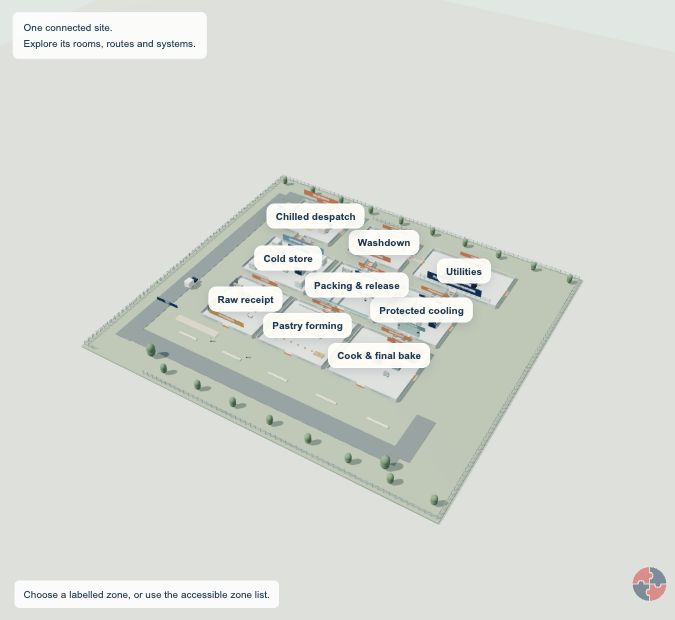
Work through 5 required applied activities and 3 model-practice pauses, with explanatory feedback and independent lesson decisions. Complete 6 distinct model mission sequences across those pauses. Use the actual fictional pie factory model or its equivalent accessible route to complete the required decision sequences; launching the model alone does not complete practice.
The 20-question assessment requires at least 80% plus every designated critical safety answer. Complete the required activities, practice and lesson checks. Points and badges cannot offset a critical safety error.
Use the LMS for confirmed save/resume and recorded results. Any certificate follows its configured passed-completion and grade conditions.
Open the public interactive practice copy; public practice is separate from the LMS record.
Sources and learning provenance
Original fictional cases are paired with public SHAREhub teaching and structured topic records. Use the applicable jurisdiction and primary guidance for live work.
- FSA: managing food safety
- Government: Hazard Analysis and Critical Control Point
- FSA MyHACCP: prerequisite requirements
- Government: cooking food safely
- Government: food-business chilling and freezing
- FSA: avoiding cross-contamination
Topic sections, source identities and versions
| Public topic | Chunk and version | Jurisdiction and sources |
|---|---|---|
| food-safety · haccp | food-safety--haccp 20261016-letter-review-1 | England, Wales, Northern Ireland, Scotland food-business-guidance-hazard-analysis-and-critical-control-point-haccp, foodstandards-publications-cooksafe-guide |
| food-safety · temperature | food-safety--temperature 20261016-letter-review-1 | England, Wales, Scotland, Northern Ireland govuk-food-hygiene-businesses-chilling-and-freezing, foodstandards-downloads-guidance-on-temperature-control-legislation-pdf |
| food-safety · records | food-safety--records 20261016-letter-review-1 | England, Wales, Northern Ireland, Scotland govuk-food-hygiene-businesses, food-business-guidance-hazard-analysis-and-critical-control-point-haccp, foodstandards-running-a-food-business-food-hygiene, food-business-guidance-allergen-guidance-for-food-businesses |
| food-safety · haccp-flow | food-safety--haccp-flow 20261016-letter-review-1 | England, Wales, Northern Ireland, Scotland govuk-food-hygiene-businesses, food-business-guidance-hazard-analysis-and-critical-control-point-haccp, foodstandards-running-a-food-business-food-hygiene, food-business-guidance-allergen-guidance-for-food-businesses |
| food-safety · hazards | food-safety--hazards 20261016-letter-review-1 | England, Wales, Northern Ireland, Scotland govuk-food-hygiene-businesses, food-business-guidance-hazard-analysis-and-critical-control-point-haccp, foodstandards-running-a-food-business-food-hygiene, food-business-guidance-allergen-guidance-for-food-businesses |
| food-safety · controls | food-safety--controls 20261016-letter-review-1 | England, Wales, Northern Ireland, Scotland food-business-guidance-hazard-analysis-and-critical-control-point-haccp, food-business-guidance-allergen-guidance-for-food-businesses, foodstandards-running-a-food-business-food-hygiene |
| personal-hygiene-and-wellbeing · contamination-pathways | personal-hygiene-and-wellbeing--contamination-pathways 2.0 | Great Britain source-hse_coshh, source-hse_skin_at_work, source-hse_workplace_facilities |
| occupational-foodborne-illness · technical-model | occupational-foodborne-illness--technical-model 2.3 | Great Britain, Northern Ireland gov-food-hygiene, gov-staff, gov-running, fsa-fitness, hse-hierarchy, gov-traceability, fss-fitness |
Course SH-PIE-03 · version 2026.10.20.1. .
Questions about this course
Is this training free?
Full public teaching and readers are free without an account. A free learner account is required for saved LMS progress and recorded assessment. Completion and any course-completion certificate depend on the configured LMS conditions.
How long should I allow?
Approximately 130–200 minutes, including teaching, lesson checks, required activities, model or accessible practice and one assessment attempt. Individual pace, review and retries vary. Save and resume in the LMS.
Can I learn without a 3D-capable browser?
Yes. The complete HTML reader provides the teaching. Required model practice has an equivalent accessible decision route in the interactive course. Use the LMS route for recorded learning.
What is required to pass?
Complete the required learning, activities, practice and lesson decisions. The 20-question final assessment requires at least 80% plus every designated critical safety answer. Points cannot compensate for a critical safety error. Follow the feedback before retrying.
Does this authorise factory operations?
Awareness for manufactured pies, including ready-to-eat product protection. The course supplies no cooking schedule, cooling allowance, microbiological criterion or shelf-life extension. Use validated product-specific arrangements and the applicable UK-nation/market requirements. This independent course does not award an external qualification or replace competent task assessment, practical training or site authorisation.