SHARE Knowledge Hub
Nitrogen oxides and lung injury
Nitrogen dioxide and related nitrogen oxides can be generated by silage, combustion, welding and chemical processes. Inhalation can injure the lower airways and lungs, sometimes with serious symptoms after a delay. Identify the source, prevent entry or release, monitor and ventilate where the task assessment requires it, and treat suspected exposure as urgent even when a worker initially feels better.
Understanding Nitrogen oxides and lung injury
Nitrogen dioxide and related nitrogen oxides can be generated by silage, combustion, welding and chemical processes. Inhalation can injure the lower airways and lungs, sometimes with serious symptoms after a delay. Identify the source, prevent entry or release, monitor and ventilate where the task assessment requires it, and treat suspected exposure as urgent even when a worker initially feels better.
Why this matters at work
Explain the credible exposure and timing to emergency clinicians and do not rely on a symptom-free interval as clearance. Keep the worker away from further exposure and follow trained emergency arrangements, including urgent help for breathing difficulty. Clinical services decide observation and treatment. Preserve the chemical, task, co-exposure and initial symptom history so delayed deterioration can be considered without the worker having to reconstruct it alone.
Exhaust can contain nitrogen oxides, carbon monoxide, carbon dioxide and particles at the same time. Oxygen can remain near normal while a toxic contaminant is harmful. Source load, fuel, maintenance, outlet position and ventilation or recirculation determine exposure, including away from the engine. A road-emission description is not an indoor-work exposure assessment. Prevent unnecessary indoor running and assess the actual enclosed or partly enclosed work state; a sensor that lacks the relevant channel cannot resolve that hazard.
How organisations manage this in practice
Sensor range, selectivity, interferences, temperature, humidity and sampling configuration determine whether a detector can answer the safety question. A mobile worker may approach a plume not represented by a fixed detector. Gas can also change while work proceeds, so a pre-task reading may need continuing monitoring and a defined withdrawal response. The complete arrangement must detect and communicate the hazardous state in time for the planned action; an instrument’s presence or calibration date alone does not establish that performance.
Entrances, clamp edges, low voids and sheeted areas can expose people without a conventional deep-silo entry. Newly filled material and later disturbance both need consideration. Exclusion, remote work and a clear communication system are stronger than asking people to recognise brown gas. Include children, visitors and animals in access arrangements where relevant. The emergency response must prevent instinctive unprotected entry. A generic confined-space policy is useful only when it is applied to the actual farm geometry and changing task.
Fresh silage processes can create nitrogen dioxide and other hazardous atmospheres, including near clamp walls, low points and under sheeting. Disturbance and emptying can change conditions, and absence of a visible cloud cannot demonstrate absence of dangerous gas. Older descriptions of a transient period do not supply a universal safe-entry countdown. Keep the toxic-gas risk distinct from farmer’s lung and from nitrogen oxygen-displacement hazards; the source, effects and monitoring questions differ even at the same farm.
Keep clear when the atmosphere is uncertain
Nitrogen-oxide exposure can arise from agricultural and industrial tasks. Do not use colour, smell, a short symptom-free period or the edge of a clamp as evidence that the air is safe.

Identify source
Assess the actual process, including silage, combustion and welding where relevant. Keep the scene’s context distinct from a complete source inventory.
Avoid affected area
Avoid the exposure-generating task or affected area where possible. Plan a safer repair position or method before committing people.
Atmosphere uncertain means hold
The boundary depends on competent assessment of the actual conditions, rather than a fixed coloured radius in an illustration.
Symptoms may be delayed
Lack of immediate symptoms does not settle the exposure question. Follow the incident and medical advice route after suspected exposure.
Appropriate medical help
Give responders the relevant substance, task and exposure information. Do not wait for a guessed “safe interval” or diagnose from appearance.
Competent release
Verify the atmosphere, controls and task arrangements through the assessed route before work resumes.
Withdraw and obtain appropriate help under the site emergency arrangements. No ventilation duration, approach distance or medical waiting period is supplied by this sketch.
What lung injury is possible?
Inhaled nitrogen dioxide irritates and injures the respiratory tract; a significant exposure can cause pulmonary oedema and longer-term small-airway damage.
What lung injury is possible?


Read the complete visual as text
- Inhaled nitrogen dioxide irritates and injures the respiratory tract;…: Inhaled nitrogen dioxide irritates and injures the respiratory tract; a significant exposure can cause pulmonary oedema and longer-term small-airway damage.
- Cough, chest tightness, breathlessness and eye or throat irritation…: Cough, chest tightness, breathlessness and eye or throat irritation may occur. Serious lung injury can develop or worsen after an apparently quieter period. “Silo-filler’s disease” refers to a nitrogen-oxide inhalation injury around newly filled silage, not the allergy called farmer’s lung. The particular exposure, concentration, duration and other gases affect outcome; a worker cannot judge safety from smell or a single symptom check. Sources: GOV.UK oxides of nitrogen delayed injury , GOV.UK oxides of nitrogen delayed injury .
Cough, chest tightness, breathlessness and eye or throat irritation may occur. Serious lung injury can develop or worsen after an apparently quieter period. “Silo-filler’s disease” refers to a nitrogen-oxide inhalation injury around newly filled silage, not the allergy called farmer’s lung. The particular exposure, concentration, duration and other gases affect outcome; a worker cannot judge safety from smell or a single symptom check. Sources: GOV.UK oxides of nitrogen delayed injury, GOV.UK oxides of nitrogen delayed injury.
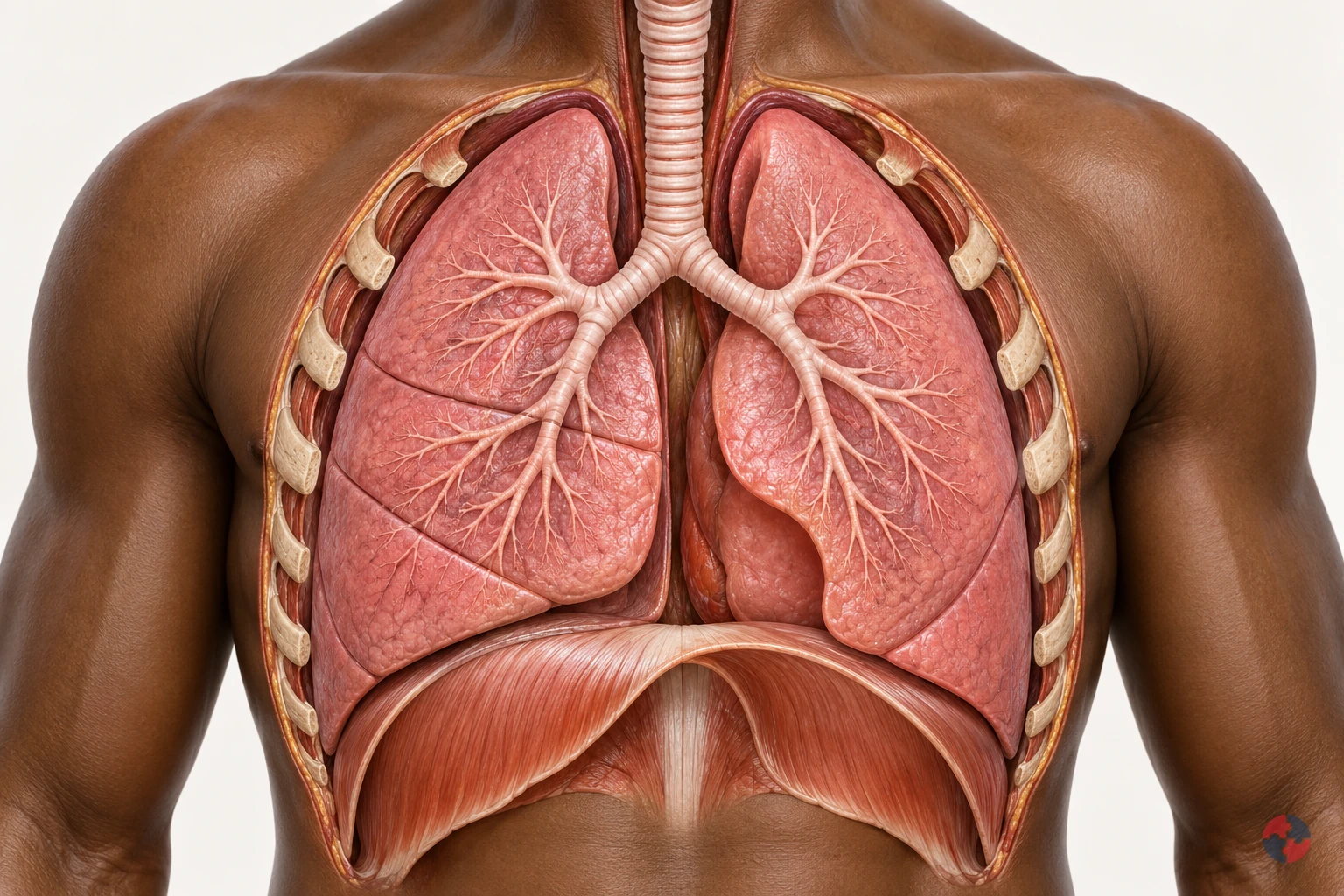

How do the lungs work, and how can workplace exposures affect breathing?
Interactive anatomy · Respiratory tract and lungs · Updated 2026-10-23
Read all anatomy and process explanations without the viewer
Simplified education, not diagnosis, a lung-function or oxygen-saturation test, an exposure calculator or a fitness-to-work assessment. No breath-holding challenge, breathing-rate score or personal health-data collection. Ordinary particle filters do not protect against every gas or oxygen deficiency. COPD and coal-dust topics may reuse normal anatomy only until separate mechanisms are reviewed.
Nose and mouth
Air enters and leaves here. The nose and mouth connect the outside air with the respiratory passages. Air moves through these openings on both the inward and outward breath. Follow the route towards the windpipe before looking at the smaller branches. The illustrated flow is air, a mixture of gases, rather than pure oxygen passing directly into blood. Frimley Health NHS Foundation Trust: How your lungs work · Central and North West London NHS Foundation Trust: How do we breathe?
Trachea
The windpipe carries air into the chest. The trachea, commonly called the windpipe, carries air down towards the chest. It divides into the two main bronchi that supply the lungs. Locate this shared passage before following either branch. Its role is to conduct air towards the gas-exchange regions and provide an outward route for the next exhalation. Frimley Health NHS Foundation Trust: How your lungs work
Bronchi
A main branch carries air into each lung. The two main bronchi take air from the windpipe into the right and left lungs. They divide into progressively smaller branches, distributing the breath through the lungs. Use the split as a landmark before following one highlighted route. These are air passages, distinct from the blood vessels that run through the same organs. Frimley Health NHS Foundation Trust: How your lungs work · University Hospitals of North Midlands NHS Trust: My lung surgery: about your lungs
Bronchioles
Smaller branches distribute air. Bronchioles are smaller branches of the airway system inside the lungs. Their branching routes lead towards clusters of alveoli, where the breath reaches the gas-exchange surface. Follow one branch to its end, using the others as context. This simplified route represents part of a much larger network supplying the lungs together. Frimley Health NHS Foundation Trust: How your lungs work
Alveoli
Tiny air sacs provide a gas-exchange surface. Alveoli are tiny air sacs at the ends of the small airway routes. Their close relationship with surrounding capillaries allows oxygen to pass towards blood and carbon dioxide towards alveolar air. Connect the highlighted cluster with the enlarged gas-exchange view. The enlargement changes the scale so the air space and neighbouring blood vessel can be distinguished. Frimley Health NHS Foundation Trust: How your lungs work · Central and North West London NHS Foundation Trust: How do we breathe?
Air–blood barrier
A thin boundary separates air from blood. The thin alveolar and capillary walls separate air in the sac from blood in its neighbouring vessel. Oxygen and carbon dioxide cross this boundary in opposite directions. Locate the tissue between the two spaces in the enlarged view. Blood cells remain in the vessel; the model does not represent an open connection through which air and blood mix. Central and North West London NHS Foundation Trust: How do we breathe?
Pulmonary capillaries
Small blood vessels pass beside the air sacs. Pulmonary capillaries are small blood vessels beside the alveoli. Blood moving through them receives oxygen and releases carbon dioxide across the thin exchange boundary, then continues through the circulation. Follow the labelled gas routes separately from the blood cells. These cells stay inside the capillary rather than moving into the air sac. Central and North West London NHS Foundation Trust: How do we breathe?
Diaphragm
This muscle helps make room for a breath. The diaphragm is a broad, dome-shaped breathing muscle beneath the lungs. It contracts and flattens downwards during inhalation, helping increase the space in the chest. During a quiet exhalation it relaxes towards its dome shape. Compare it with the rib cage: their changing positions help move air without the lung tissue acting as a contracting muscle. Cambridge University Hospitals NHS Foundation Trust: Breathing techniques to ease breathlessness: muscles involved
Rib cage and breathing muscles
Chest movement changes the space around the lungs. The rib cage protects the chest organs and moves with the breathing muscles. Expansion upwards and outwards helps increase chest space during inhalation; relaxation reduces that space during a quiet exhalation. Compare this movement with the diaphragm below the lungs. Together these structures provide the mechanics that allow air to move through the airways. Central and North West London NHS Foundation Trust: How do we breathe? · Cambridge University Hospitals NHS Foundation Trust: Breathing techniques to ease breathlessness: muscles involved
Pleura
Two thin layers surround the lungs and line the chest. The pleura has two thin layers around the lungs and inside the chest wall. A small amount of fluid between them allows the surfaces to slide with less friction as breathing changes the chest space. Locate this outer covering separately from the internal air sacs; it is not the thin air–blood exchange boundary. Blackpool Teaching Hospitals NHS Foundation Trust: Pleural clinic
Open the complete process transcript
The process, step by step
1 · Make space
Breathing in begins with a change in the space inside the chest. The diaphragm, a dome-shaped muscle beneath the lungs, contracts and moves downwards. Muscles around the ribs help lift the chest upwards and outwards. As the lungs expand with this changing space, air can enter through the airways. Locate the diaphragm and rib cage together rather than treating the lungs as muscles that pull themselves open. The model separates the movement into a teaching step so you can follow its purpose. In the body, chest movement, airflow and blood circulation are connected parts of a continuing process. Central and North West London NHS Foundation Trust: How do we breathe? · Cambridge University Hospitals NHS Foundation Trust: Breathing techniques to ease breathlessness: muscles involved
What to watch: Locate the diaphragm beneath the lungs and the rib cage around them; compare their positions with the space occupied by the lungs.
Why it matters: Changing the chest space draws air into the lung passages. The breathing muscles supply the movement, while the lungs expand with the chest to receive the next breath.
Explore this step: Select the diaphragm and rib cage in turn, then explain how their movement helps air enter without the lungs contracting like muscles.
2 · Move air
Air entering through the nose or mouth travels down the trachea, or windpipe, towards the chest. The trachea divides into the two main bronchi, with one route supplying each lung. Follow this continuous passage in the whole-chest view before moving into the smaller branches. The moving air is a mixture of gases, including oxygen; it is not a stream of pure oxygen travelling straight into the blood. These larger airways carry the breath towards the places where gas exchange happens. The same connected passages also provide the outward route when air is breathed out. Frimley Health NHS Foundation Trust: How your lungs work
What to watch: Start at the nose and mouth, follow the trachea downwards and find the split into the right and left main bronchi.
Why it matters: The larger passages distribute air to both lungs and connect the outside air with the smaller branches inside. Gas exchange takes place further along the route, rather than within the windpipe.
Explore this step: Trace the route to each lung and distinguish the tubes carrying air from the separate vessels carrying blood.
3 · Reach the air sacs
Inside each lung, the bronchi divide into smaller branches called bronchioles. These passages distribute air towards clusters of tiny air sacs, the alveoli. Follow one branch in the close-up and connect its end with an air-sac cluster, using the other branches as surrounding context. These routes distribute the breath throughout the lungs rather than supplying only one working air sac. A real lung contains many branching routes and air sacs operating together. This distribution brings air close to a large network of small blood vessels, preparing for the exchange shown in the next view. Frimley Health NHS Foundation Trust: How your lungs work
What to watch: Follow one smaller airway to the cluster of air sacs at its end, keeping the other branches as surrounding context.
Why it matters: Branching delivers air throughout the lungs instead of to one large chamber. The many air sacs bring the inhaled gases close to blood vessels where oxygen and carbon dioxide can cross.
Explore this step: Trace one complete branch to its air sacs, then explain how the many branches distribute air throughout the lungs.
4 · Change scale
The lesson now changes from a branching airway to an enlarged air–blood interface. An alveolus contains air; beside it runs a capillary containing blood. Their very thin walls form the boundary across which gases can move. Locate the air space, the separating tissue and the inside of the vessel before following any gas symbols. The magnified view represents a tiny part of the same lung, not a separate organ or a hole that joins air and blood into one space. The enlargement helps explain how the two systems can exchange gases while keeping their contents separate. Central and North West London NHS Foundation Trust: How do we breathe?
What to watch: Find the air inside the enlarged alveolus, the thin separating boundary and the neighbouring capillary with blood cells inside it.
Why it matters: A close boundary allows gases to cross between alveolar air and capillary blood. Keeping the two spaces separate lets ventilation and circulation cooperate without blood cells entering the air sac.
Explore this step: Identify the air space and blood-vessel space, then point to the boundary each gas must cross between them.
5 · Exchange gases
At the air–blood boundary, oxygen moves from the alveolar air into the capillary blood. At the same time, carbon dioxide carried back from the body moves from the blood into the air sac. The two gases cross in opposite directions; blood cells stay within the vessel. Follow each labelled symbol separately so that exchanging gases is not confused with mixing the air and blood together. Blood then carries oxygen onwards towards the heart and the body’s tissues. The teaching symbols simplify continuous gas movement, and their size, colour and speed do not represent a measurement. Central and North West London NHS Foundation Trust: How do we breathe?
What to watch: Follow the O₂ symbol towards the capillary and the CO₂ symbol towards the air sac, while locating the blood cells within the vessel.
Why it matters: Oxygen can be carried onwards for use by the body, while carbon dioxide returns to the airways for removal. Both transfers connect the breath with the continuing circulation of blood.
Explore this step: Trace the two gas routes in opposite directions and explain why a blood cell should remain inside the capillary.
6 · Breathe out
During a quiet breath out, the diaphragm and other breathing muscles relax. The diaphragm returns towards its dome shape, chest space decreases and air moves back along the airways to the nose or mouth. This outgoing air carries carbon dioxide that crossed from the blood into the alveoli. Trace the route in reverse without reversing the direction of blood circulation: oxygen-carrying blood continues towards the heart while another breath prepares to enter. The model presents a single cycle to explain the relationship. It does not show breathing as a series of separate events in which circulation stops between steps. Central and North West London NHS Foundation Trust: How do we breathe? · Cambridge University Hospitals NHS Foundation Trust: Breathing techniques to ease breathlessness: muscles involved
What to watch: Compare the diaphragm and chest with the inhalation step, then follow the outward airway route from the lungs to the nose or mouth.
Why it matters: Exhalation removes air containing carbon dioxide from gas exchange. Meanwhile, blood circulation continues carrying oxygen onwards, linking this breathing cycle with the needs of the rest of the body.
Explore this step: Trace the outward air route and the onward blood route separately, then describe why they are connected processes with different pathways.
Read the practice situations and all answer explanations
Sources and how the model is made
The opening images are AI-generated anatomical illustrations. The interactive 3D models and labelled SVG diagrams use original procedural artwork. These teaching images are not medical scans or diagnostic tools. Source references support the learner explanations and do not grant artwork rights.
- Frimley Health NHS Foundation Trust: How your lungs work — Normal airway branching, air sacs and capillary gas exchange; factual text only.
- Central and North West London NHS Foundation Trust: How do we breathe? — Thin alveolar/capillary walls, opposing gas transfer, circulation and chest mechanics. No illustrations or exercises copied.
- Cambridge University Hospitals NHS Foundation Trust: Breathing techniques to ease breathlessness: muscles involved — Diaphragm movement and breathing-muscle context only; this module does not prescribe breathing exercises.
- HSE: Health risks from welding — Welding-related airway irritation, possible deeper injury and irritant asthma; not a universal pattern for every gas.
- HSE: Asthma: an overview — Sensitisation, later triggering and work aggravation. Legacy labelling language and statistics are not reused.
- HSE: Advice for employers: occupational asthma — Exposure prevention, controls and health surveillance only; legacy legislation wording is not reused.
- NHS: Silicosis — Silica-associated inflammation/fibrosis, varying latency, irreversible damage and possible progression after exposure stops.
- HSE: Why is asbestos dangerous? — Asbestosis, mesothelioma and pleural disease are distinct; long disease latency.
- HSE: Construction dust: cutting paving blocks, kerbs and flags — Task design, source suppression/extraction, suitable RPE and checking controls; not a generic dust safe-dose rule.
- NHS: Shortness of breath — Emergency recognition of severe breathing difficulty and 999; emergency advice is outside the activity.
- NHS: Asthma — Narrowed/swollen airways, symptoms and clinical diagnosis; no medication doses or treatment plan reproduced.
- University Hospitals of North Midlands NHS Trust: My lung surgery: about your lungs — Right/left lung lobe counts and airway anatomy; no source image copied.
- Blackpool Teaching Hospitals NHS Foundation Trust: Pleural clinic — Pleural layers and the small lubricating fluid layer outside lung tissue; no procedural teaching included.
- HSE: Asphyxiation hazards in welding and allied processes — Oxygen-deficient spaces and need for independent air supply; no unprotected entry or rescue.
- HSE: Respiratory protective equipment at work — RPE selection must match the contaminant and conditions; filtering protection is not a supply of oxygen.
- HSE: Flour dust and risks to bakers — Flour sensitisation and practical reduction of dusty handling; exposure-limit numbers are not reused.
- Health and Safety Executive: Asbestos essentials — Task planning, training and competent asbestos work arrangements for the maintenance exposure example; not permission to disturb unknown material or a licence/classification decision.
- Health and Safety Executive: Welding fume: protect your workers — Alternative joining, fume reduction, LEV, suitable RPE and maintained controls for the welding-fume example. No unprotected exposure or rescue procedure.
How should a job and atmosphere be assessed?
Identify how nitrogen oxides are generated, where they can accumulate, who can enter and what additional oxygen-deficiency or other gas hazards exist.
Review the task, fuel or chemical reaction, enclosure, ventilation and likely changing conditions. In a silo or confined space, avoid entry where possible and use a competent confined-space plan, suitable gas testing, ventilation, communications and rescue arrangements. The instrument must be appropriate for the gases of concern and calibrated; an oxygen reading alone does not rule out toxic NO2. For routine emissions, a hygienist may need personal exposure measurements and comparison with the actual EH40 entry. Sources: HSE confined spaces guidance, HSENI EH40 workplace exposure limits.
EH40 fourth edition lists nitrogen dioxide at 0.5 parts per million (ppm), or 0.96 mg/m³, averaged over eight hours, and 1 ppm, or 1.91 mg/m³, over 15 minutes. These are air-exposure benchmarks for a known gas, not a clearance to enter a silo or ignore oxygen deficiency and mixed gases. HSENI approves EH40 for NI. Check the HSE EH40 nitrogen-dioxide entry and HSENI approval.
How can the hierarchy of controls reduce nitrogen-oxide exposure and lung injury?
Prevent generation or entry first, then contain or extract emissions and verify atmosphere before and during necessary work.
What controls should precede respirators? — part 1 of 2


Read the complete visual as text
- Prevent generation or entry first, then contain or extract…: Prevent generation or entry first, then contain or extract emissions and verify atmosphere before and during necessary work.
- Choose electric rather than combustion equipment indoors where suitable,…: Choose electric rather than combustion equipment indoors where suitable, keep exhaust outside occupied spaces, and use engineered capture for welding or process emissions. At silage clamps, avoid exposure to gases trapped under sheeting and at low points. A confined-space system should include isolation, gas testing, ventilation, a standby arrangement and a rescue plan before entry. RPE choice depends on the assessed atmosphere; an ordinary filter respirator cannot make an oxygen-deficient space safe. Sources: HSE confined spaces guidance , HSENI confined spaces guidance .
- Stop work for a gas alarm, changing atmosphere, failed…: Stop work for a gas alarm, changing atmosphere, failed ventilation, symptoms or missing rescue arrangements. Keep unprotected workers out, including would-be rescuers.
What controls should precede respirators? — part 2 of 2


Read the complete visual as text
- HSE places elimination and substitution before engineering controls, administrative…: HSE places elimination and substitution before engineering controls, administrative measures and PPE. Apply that order to the task, then check whether the selected controls work in use.
- Keep physical controls effective through inspection, maintenance and action…: Keep physical controls effective through inspection, maintenance and action when a check fails. A reminder or retraining alone cannot compensate for failed ventilation, an unsuitable detector or an uncertain atmosphere.
- For this gas task, SHARE’s ERICPD prompt maps to…: For this gas task, SHARE’s ERICPD prompt maps to the actual decisions: Eliminate unnecessary entry; Reduce generation through a suitable lower-emission or electric alternative; Isolate people by separating the source and routing exhaust safely; Control residual exposure through specified ventilation, testing and assessed access; select atmosphere-suitable PPE; and sustain the system through Discipline, meaning maintenance, verification and learning. Engineered isolation sits within HSE’s engineering level, and continued checking supports every selected level; these are not two competing legal ladders. HSE five-level control hierarchy .
Choose electric rather than combustion equipment indoors where suitable, keep exhaust outside occupied spaces, and use engineered capture for welding or process emissions. At silage clamps, avoid exposure to gases trapped under sheeting and at low points. A confined-space system should include isolation, gas testing, ventilation, a standby arrangement and a rescue plan before entry. RPE choice depends on the assessed atmosphere; an ordinary filter respirator cannot make an oxygen-deficient space safe. Sources: HSE confined spaces guidance, HSENI confined spaces guidance.
Stop work for a gas alarm, changing atmosphere, failed ventilation, symptoms or missing rescue arrangements. Keep unprotected workers out, including would-be rescuers.
HSE places elimination and substitution before engineering controls, administrative measures and PPE. Apply that order to the task, then check whether the selected controls work in use.
How can the ERICPD hierarchy of controls reduce nitrogen-oxide exposure and lung injury?

| Five-level hierarchy | Task-specific measure, feasibility and owner | Verification, failure and stop point |
|---|---|---|
| Eliminate | Avoid silo or clamp entry by inspecting and repairing from outside the gas-affected area; remove an unnecessary inspection or maintenance task that generates gas. The task owner checks feasibility before scheduling. | Revised work method and field observation; stop if the task changes and requires unassessed entry. Control sources: HSE; HSENI. |
| Substitution | Replace a fuel-powered indoor tool with a suitable electric tool, checking electrical and fire risks; for process heat, the engineer evaluates a lower-emission technology. | Commissioned alternative and exposure check; stop if exhaust is still entering occupied space. Control sources: HSE; HSENI. |
| Engineering controls | Separate people from a fresh silage clamp edge, route exhaust outside and capture welding or process gas at source. For necessary enclosed work, a competent person specifies ventilation and gas testing for NO2 and co-hazards. | Check detector calibration, airflow and atmosphere at the work position; alarm, failed ventilation or uncertain gas identity stops work. Control sources: HSE; HSENI. |
| Administrative controls | Use a confined-space entry plan only after avoidance and engineering choices. A supervisor controls access, communications, standby and trained rescue; a permit records live conditions, not a permanent clearance. | Observed drill and live monitoring record; no rescue capability or changed atmosphere means no entry. Control sources: HSE; HSENI. |
| PPE | A competent specialist selects respiratory protection for the measured atmosphere and task. A filter mask is not suitable for oxygen deficiency; supplied-air or breathing apparatus may be required in an authorised emergency system. | Fit, cylinder and pre-use checks by trained users; loss of supply or fit triggers immediate withdrawal under the rescue plan. Control sources: HSE; HSENI. |
How can the ISO 45001 hierarchy of controls reduce nitrogen-oxide exposure and lung injury?

| Five-level hierarchy | Task-specific measure, feasibility and owner | Verification, failure and stop point |
|---|---|---|
| Eliminate | Avoid silo or clamp entry by inspecting and repairing from outside the gas-affected area; remove an unnecessary inspection or maintenance task that generates gas. The task owner checks feasibility before scheduling. | Revised work method and field observation; stop if the task changes and requires unassessed entry. Control sources: HSE; HSENI. |
| Substitution | Replace a fuel-powered indoor tool with a suitable electric tool, checking electrical and fire risks; for process heat, the engineer evaluates a lower-emission technology. | Commissioned alternative and exposure check; stop if exhaust is still entering occupied space. Control sources: HSE; HSENI. |
| Engineering controls | Separate people from a fresh silage clamp edge, route exhaust outside and capture welding or process gas at source. For necessary enclosed work, a competent person specifies ventilation and gas testing for NO2 and co-hazards. | Check detector calibration, airflow and atmosphere at the work position; alarm, failed ventilation or uncertain gas identity stops work. Control sources: HSE; HSENI. |
| Administrative controls | Use a confined-space entry plan only after avoidance and engineering choices. A supervisor controls access, communications, standby and trained rescue; a permit records live conditions, not a permanent clearance. | Observed drill and live monitoring record; no rescue capability or changed atmosphere means no entry. Control sources: HSE; HSENI. |
| PPE | A competent specialist selects respiratory protection for the measured atmosphere and task. A filter mask is not suitable for oxygen deficiency; supplied-air or breathing apparatus may be required in an authorised emergency system. | Fit, cylinder and pre-use checks by trained users; loss of supply or fit triggers immediate withdrawal under the rescue plan. Control sources: HSE; HSENI. |
Keep physical controls effective through inspection, maintenance and action when a check fails. A reminder or retraining alone cannot compensate for failed ventilation, an unsuitable detector or an uncertain atmosphere.
For this gas task, SHARE’s ERICPD prompt maps to the actual decisions: Eliminate unnecessary entry; Reduce generation through a suitable lower-emission or electric alternative; Isolate people by separating the source and routing exhaust safely; Control residual exposure through specified ventilation, testing and assessed access; select atmosphere-suitable PPE; and sustain the system through Discipline, meaning maintenance, verification and learning. Engineered isolation sits within HSE’s engineering level, and continued checking supports every selected level; these are not two competing legal ladders. HSE five-level control hierarchy.
What should happen after suspected inhalation?
Move to uncontaminated air if safe, call emergency services through the site plan and arrange urgent medical assessment because lung injury can worsen later.
Do not allow an unprotected rescue entry. Give clinicians the suspected gas, process, time, symptoms and available monitoring readings, including possible co-exposures. A worker who feels better after leaving should still follow urgent clinical advice after a credible significant exposure; the team must not decide that the danger has passed from a short symptom-free interval. Isolate the source and preserve monitoring and equipment data for investigation. Sources: GOV.UK oxides of nitrogen delayed injury, GOV.UK oxides of nitrogen delayed injury.
Get medical help immediately for suspected harmful exposure. Call 999 for suspected poisoning, collapse, stopped breathing, severe breathing difficulty or seizure; do not drive yourself to A&E. Move to clean air only if safe and keep others away from the source. Do not enter to rescue without the trained arrangement. NHS poisoning: immediate help supports the immediate action; the older mechanism source is not a current treatment protocol. No symptom-free observation or return-to-work interval is set here.
Which duties apply in GB and NI?
COSHH and confined-space duties require a location-specific assessment and effective controls; GB and NI have separate instruments and regulator routes.
Great Britain applies COSHH 2002 and the Confined Spaces Regulations 1997; Northern Ireland has its own COSHH 2003 and confined-space rules. Check the current EH40 entry for the specific oxide and averaging period; HSENI approves EH40 for NI. A WEL does not authorise entry into a dangerous atmosphere or replace emergency planning. Relevant occupational disease or dangerous-occurrence reporting requires a separate fact-specific GB or NI check. Sources: HSE COSHH control measures, HSENI COSHH guidance, HSE confined spaces guidance, HSENI confined spaces guidance.
What should a supervisor verify?
Check source control, detector suitability, atmosphere, ventilation, communication and rescue readiness at the work stage when people are exposed.
Record pre-entry tests and repeat or continuous monitoring when the atmosphere may change. Verify exhaust routing, extraction, detector calibration and alarm response. Observe that no one works alone where the rescue plan requires a standby person. Close a defect only after a competent person verifies the control under normal operating conditions. Follow up any exposure with occupational-health advice and a review of the failed barrier.
How could BuildOut Ltd respond at a silage clamp?

In this farm-maintenance example, work pauses when a gas concern appears under a newly sheeted clamp.
BuildOut silage-clamp response — part 1 of 3


Read the complete visual as text
- 1. Task and setting: A contractor is asked to repair equipment by a newly filled, sheeted silage clamp where gas can collect along an edge.
- 2. People and prerequisites: The manager needs the silage age, task plan, exclusion, suitable gas assessment and emergency response; nearby farm staff need briefing.
- 3. Before the task: The task is planned from outside the affected area; the manager checks where gas may collect and whether access can be eliminated.
BuildOut silage-clamp response — part 2 of 3


Read the complete visual as text
- 1. Check during work: A worker notices irritation near an edge. Everyone withdraws to clean air; access is stopped and the competent person reassesses the atmosphere and method.
- 2. Stop, hold or refer: Symptoms, an alarm, uncertain atmosphere or absent rescue provision keep the job on hold; nobody enters to rescue without trained equipment.
BuildOut silage-clamp response — part 3 of 3


Read the complete visual as text
- 1. Completion and hand-back: The repair proceeds only with a revised safe method, verified controls and manager release; affected people receive medical advice.
- 2. Retained evidence: Keep the task assessment, detector checks, exposure/clinical referral, revised method, briefing and restart approval.
BuildOut silage-clamp response
Task, material and setting: A contractor is asked to repair equipment by a newly filled, sheeted silage clamp where gas can collect along an edge.
People and prerequisites: The manager needs the silage age, task plan, exclusion, suitable gas assessment and emergency response; nearby farm staff need briefing.
Before: The task is planned from outside the affected area; the manager checks where gas may collect and whether access can be eliminated.
During: A worker notices irritation near an edge. Everyone withdraws to clean air; access is stopped and the competent person reassesses the atmosphere and method.
Hold or stop: Symptoms, an alarm, uncertain atmosphere or absent rescue provision keep the job on hold; nobody enters to rescue without trained equipment.
Completion and hand-back: The repair proceeds only with a revised safe method, verified controls and manager release; affected people receive medical advice.
Evidence: Keep the task assessment, detector checks, exposure/clinical referral, revised method, briefing and restart approval.
Transfer to indoor combustion: A maintenance contractor proposes a fuel-powered unit in a partly enclosed plant room where other trades are working. The manager first tests whether the task can use non-combustion equipment or move outside; if combustion is unavoidable, a competent assessor identifies nitrogen dioxide, carbon monoxide and oxygen risks, selects appropriate instruments and verifies exhaust and ventilation. An alarm, symptom or loss of exhaust holds the room for everyone, not just the operator; restart follows a documented atmosphere and method review. HSE confined-space guidance supports the enclosure and rescue boundary. HSE engine-exhaust guidance provides the task-specific source.
What skills must people demonstrate?
Workers must recognise NOx sources and stop conditions; supervisors and specialists must show measurement, entry and rescue decisions within their scope.
A farm worker should identify a hazardous clamp edge and withdraw. A maintenance supervisor should challenge a fuel engine indoors or an untested enclosure. A competent tester must select and use the right detector, while the rescue team must be equipped and trained before an entry task begins. Assess these practical decisions and review after a false alarm, exposure, process change or poor drill.
| Role | Learning to test | Competence evidence | Assessor and record | Reassess when |
|---|---|---|---|---|
| Nearby worker | NOx source and withdrawal awareness | Recognises fresh-silage or exhaust risk and alerts others | Supervisor; briefing check | Changed access or source |
| Task operator | Ventilation, detector response and stop action | Observed pre-use check and withdrawal | Supervisor; task record | New gas source or alarm |
| Competent tester / rescuer | Gas selection, calibration, rescue method | Instrument check and realistic rescue drill | Technical lead; competence record | Detector change or failed drill |
| Supervisor / permit owner | Avoid-entry and changing-atmosphere decisions | Documented hold, monitoring and release | Manager; permit review | Atmosphere change or exposure |
| Manager / adviser | Source control and assurance | Ventilation design, audit sampling and corrective closure | Senior dutyholder; review record | Process or enclosure change |
What belongs in the risk register?
Capture source, work phase, occupied space, mixed-gas concern, control, monitoring, stop trigger, owner and response evidence.
Separate fresh-silage release from diesel exhaust and welding rather than filing all as “NOx”. Link to the gas assessment, ventilation design, detector maintenance, entry permit if used, rescue drill, worker briefing and exposure incident review. A permit signed before conditions change is not proof of a safe atmosphere now.
Does a management standard set NO2 exposure limits?
Use the applicable substance-specific legal exposure-limit source, not management-system certification, to identify the NO2 WEL; see the assessment values and reference periods.
Use the system to keep atmosphere checks, maintenance and learning accountable, then verify the actual gas control and rescue arrangements in the field. An audit certificate cannot make an untested space safe. HSE management-system guidance supports assigning detector-maintenance ownership and checking that defects are closed before the affected work resumes.
For example, the management system names the detector-maintenance owner, records a failed functional check, holds the affected task and checks the repair before release. Certification cannot supply the substance limit or make an untested atmosphere safe.
How should a supervisor decide when a gas reading is incomplete?
A reading answers only the question the instrument was designed and used to measure; unresolved gas hazards keep the task on hold.
Consider an illustrative repair beside a newly filled silo. A contractor presents an oxygen reading and asks to enter briefly to free a jam. The supervisor first asks whether the repair can be completed from outside. An oxygen result does not establish the concentration of nitrogen dioxide or exclude other process gases. Identify the source, possible migration and the actual space before selecting a measurement method. See HSE confined spaces guidance.
The competent assessor needs the instrument identity, gases it detects, suitability for the expected atmosphere, functional checks, sampling locations and the conditions during sampling. A measurement taken at the doorway before a source starts is a different evidence item from one that represents the worker's breathing location while the process runs. This is a planning example, not a universal detector specification or clearance concentration. See HSE COSHH control measures.
If the hazard cannot be characterised, the contractor does not make up an alarm value or rely on a disposable dust mask. Keep people out, stop or separate the source where feasible and obtain specialist assessment of ventilation, monitoring and rescue. The supervisor records the missing information, the person resolving it and the hold decision, rather than completing a permit with an unexplained tick. See HSE COSHH control measures.
Decision basis: HSE confined spaces guidance. HSE COSHH control measures. The scenario and suggested records are illustrative; apply the source within its stated jurisdiction and the assessed work.
What changes invalidate an earlier atmosphere assessment?
A changed source, ventilation arrangement, work position or task can invalidate the conditions under which the assessment was accepted.
In the silo example, opening a different access hatch, starting a nearby engine or moving the repair below the original sampling point changes the question being assessed. Stop the affected work and tell the assessor exactly what changed. A previously acceptable result should not be copied into a new job as if it covered every operating condition. See HSE confined spaces guidance.
Hand-back requires the process owner to identify the repaired or redesigned barrier and the competent assessor to verify the new work conditions. Record where monitoring applies, what triggers withdrawal and how communication and rescue remain available. Clinical advice after suspected exposure is a separate decision: a supervisor cannot clear an exposed worker because the space now tests acceptably. See HSENI confined spaces guidance.
Decision basis: HSE confined spaces guidance. HSENI confined spaces guidance. The scenario and suggested records are illustrative; apply the source within its stated jurisdiction and the assessed work.
Can you explain the three decisions after suspected inhalation?
Separate removal from the hazardous area, clinical assessment of the person and verification of the task before any restart.
Learning check: a worker says the irritation has eased and offers to finish the repair. The appropriate answer is to prevent further exposure and obtain prompt clinical advice, explaining the suspected nitrogen-oxide source and any available exposure details. An improvement in how the person feels does not establish that delayed lung injury has been excluded. See GOV.UK oxides of nitrogen delayed injury.
Learning check: a colleague wants to enter to fetch the worker's tools. The appropriate answer is to protect the area and use the assessed safe method; an urgent intention does not remove the atmosphere hazard. Unplanned entry can create another casualty. The site must have suitable emergency arrangements rather than relying solely on the arrival of emergency services. See HSE confined spaces guidance.
For assessment, ask the learner to identify the gas source, explain why oxygen testing alone is insufficient and name the person who can accept the control evidence. A recited gas abbreviation is awareness; demonstrating the actual stop, communication and hand-back sequence is task competence. The older government health summary supports the delayed-injury mechanism, not a current workplace treatment protocol. See HSE confined spaces guidance.
Decision basis: GOV.UK oxides of nitrogen delayed injury. HSE confined spaces guidance. The scenario and suggested records are illustrative; apply the source within its stated jurisdiction and the assessed work.
Which terms matter?
Distinguish the gas from the injury and the atmosphere test.
| Term | Expansion or meaning | Use here |
|---|---|---|
| NOx | Nitrogen oxides | Family including NO and NO2. |
| NO2 | Nitrogen dioxide | Key lung-irritant gas here. |
| COSHH | Control of Substances Hazardous to Health | Separate GB and NI instruments. |
| WEL | Workplace exposure limit | Substance-specific air benchmark. |
| RPE | Respiratory protective equipment | Must suit the actual atmosphere. |
| HSE | Health and Safety Executive | Great Britain workplace regulator; use its guidance within scope. |
| HSENI | Health and Safety Executive for Northern Ireland | Northern Ireland workplace regulator; NI duties have separate instruments. |
| GB | Great Britain | England, Scotland and Wales; distinguish the NI legal route. |
| NI | Northern Ireland | Use the Northern Ireland legislation and regulator route. |
| EH40 | HSE workplace exposure limits publication | Read the actual substance, units, averaging period and notations. |
| PPE | Personal protective equipment | Residual personal protection supporting stronger source controls. |
| ERICPD | Eliminate; Reduce; Isolate; Control; PPE; Discipline | SHARE planning prompt; Discipline means maintaining controls, not blame. |