SHARE Knowledge Hub
Movement, Activity and Wellbeing
Movement can support health, and UK adult guidance gives practical activity and strength goals. At work, employers should first make tasks, breaks and routes safe, then offer voluntary, inclusive choices without collecting unnecessary health data. Great Britain and Northern Ireland have distinct work and equality duties.
Understanding Movement, Activity and Wellbeing
Movement can support health, and UK adult guidance gives practical activity and strength goals. At work, employers should first make tasks, breaks and routes safe, then offer voluntary, inclusive choices without collecting unnecessary health data. Great Britain and Northern Ireland have distinct work and equality duties.
Why this matters at work
Review the work pattern and workstation together. Enable changes of activity and posture, usable breaks and movement that suits the individual. A standing desk may be one option but prolonged static standing can also cause discomfort. The assessment should consider tasks, workload, space, equipment, accessibility and whether people can actually interrupt screen work without losing essential support or being penalised.
Coordinate site-authorised competence, fatigue, cover and barriers for actual high-consequence work. A wellbeing scheme cannot establish emergency-role fitness or permit a safety-critical post to be uncovered. Industry labels do not establish regime scope; escalate unavailable controls. Clinical, permit, entry and restart decisions remain separate.
How organisations manage this in practice
Select actual GB or NI territory, activity and dutyholders before using safety, management, handling, DSE, welfare or other law. Safe work and effective arrangements remain necessary; a walking scheme or compulsory fitness score does not discharge duties. Current provisions and amendments need appropriate scoped review.
Offer voluntary, accessible opportunities while improving work design. NHS adult activity guidance describes public-health aims, including aerobic activity, strengthening and reducing prolonged sitting. It is not an individual prescription, a work performance threshold or evidence that someone is fit for a hazardous task. NHS advises speaking to a GP before starting when someone has been inactive for some time or has a medical condition or concern; managers should signpost without prescribing activity. Consult workers about barriers such as workload, breaks, accessible routes, changing facilities and shift patterns. Provide different participation options and avoid ranking bodies, weight or medical status. Record programme decisions and safety arrangements without collecting unnecessary personal health data. Evaluate whether access and participation are fair and whether work demands undermine the opportunity. An activity scheme cannot replace assessment of manual handling, repetitive work, fatigue or workstation hazards. Review the programme after concerns, incidents or changes, using worker feedback and practical access measures rather than promising a particular clinical outcome or productivity gain.
Agree practical changes with the worker and supervisor, such as alternating suitable tasks, adjusting meeting patterns or creating an accessible movement opportunity. There is no universal interval in this answer that makes every workstation safe. Check whether the changes occur during busy periods, including home or hybrid work, and whether reported discomfort improves. Persistent or concerning symptoms need appropriate occupational-health or clinical advice rather than an exercise instruction from a manager. Keep action records proportionate and confidential. Movement promotion supports wellbeing, but it does not replace suitable equipment, ergonomic assessment, workload control or individual adjustments.
Offer movement and recovery choices that fit different work demands
A voluntary movement offer should work for someone who prefers a seated or lower-intensity option and someone whose job already involves heavy physical effort. Ask about practical barriers such as reliable breaks, accessible space, fatigue and recovery. Changing work design or providing a useful rest opportunity may help more than adding a step-count campaign.
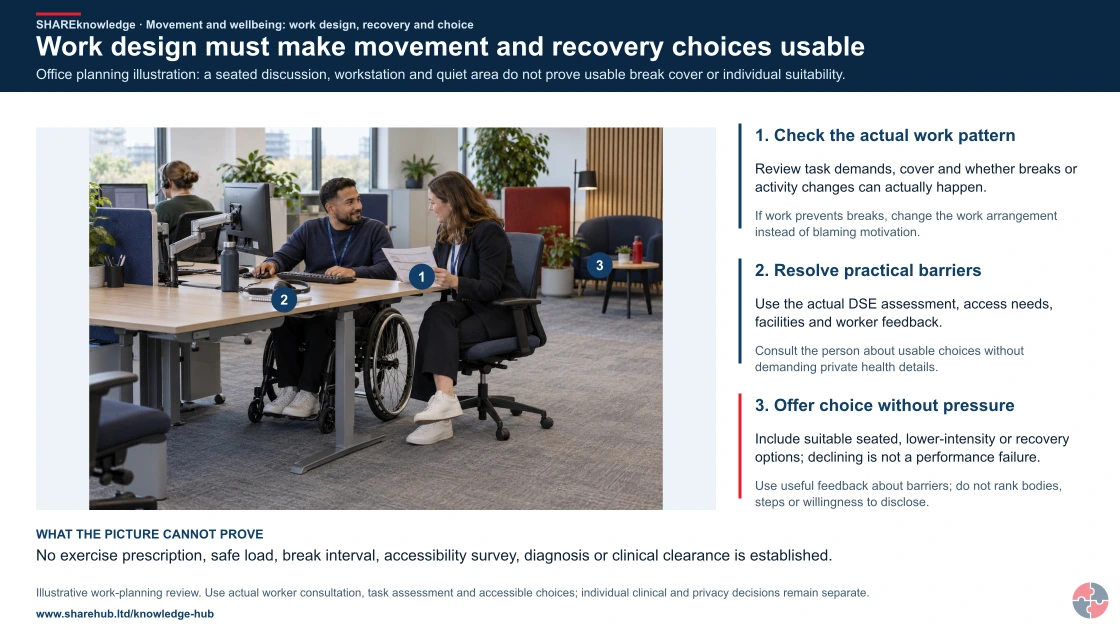
Work design must make movement and recovery choices usable
Full written explanation
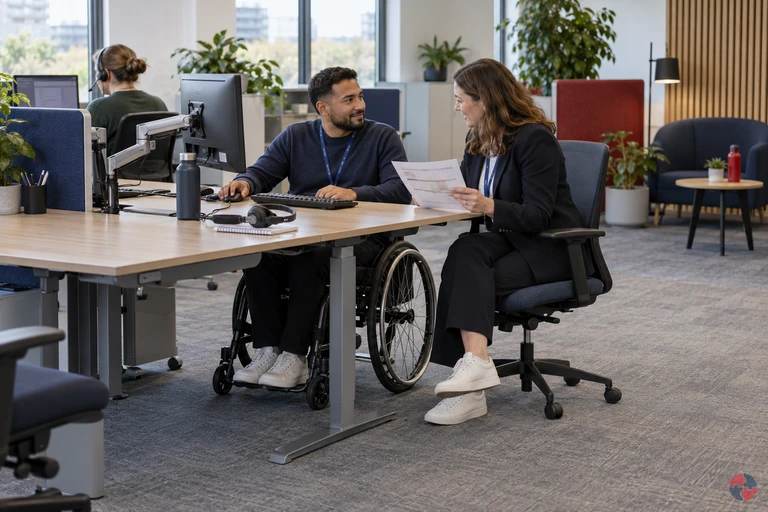
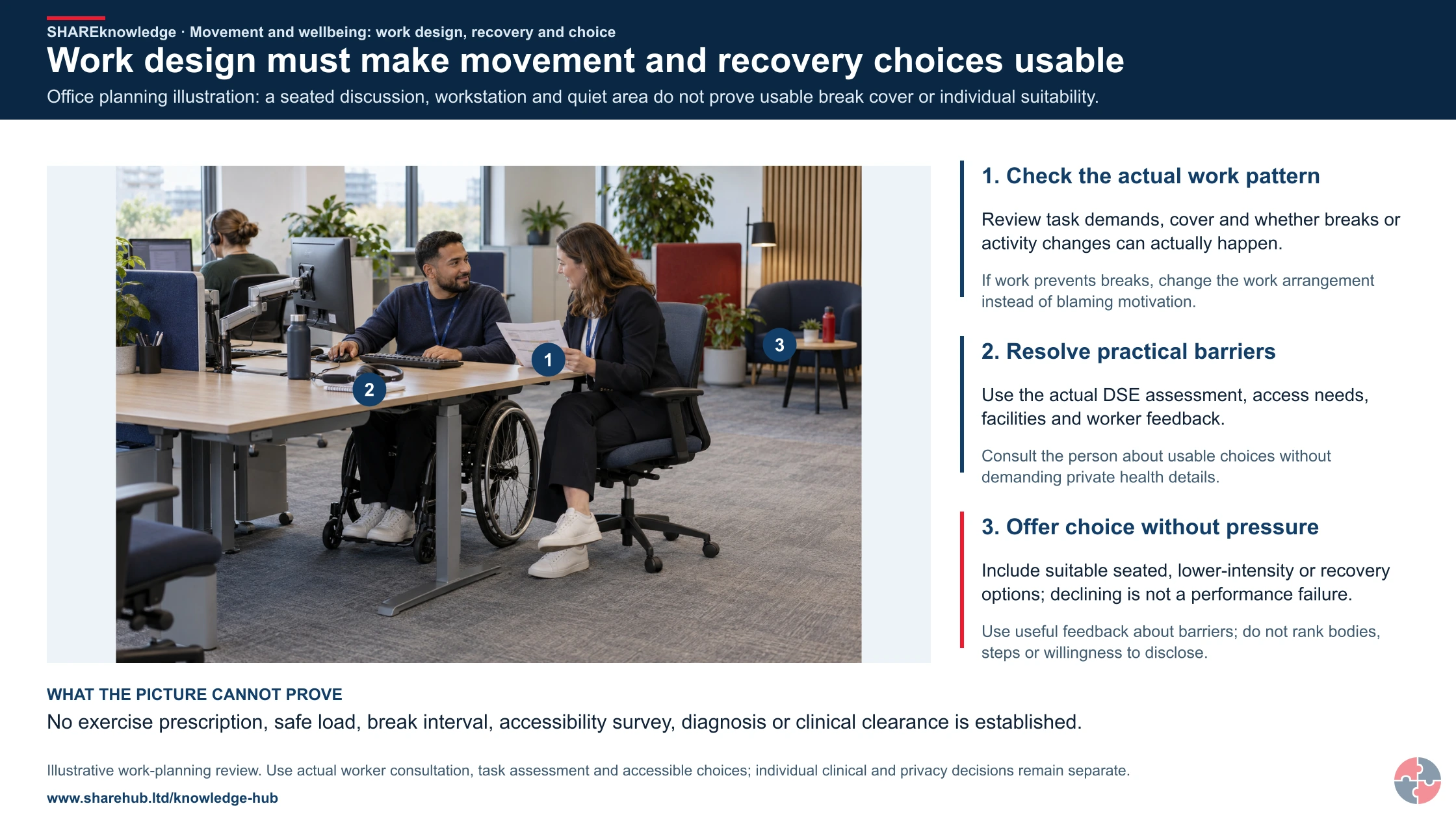
A new realistic British customer-service office illustration shows a colleague using a wheelchair at an adjustable workstation and another colleague discussing inert work-cover papers. A headset, neighbouring workstation and quiet seating area remain connected in the same scene. Numbered questions identify actual work pattern and cover, workstation/access barriers and voluntary movement or recovery choices. The scene does not diagnose a condition, prescribe an exercise, establish an accessible route or prove a suitable DSE assessment. An existing outdoor walking scene remains one optional context only. A second native delivery-work comparison explains why physical workload and recovery need reviewing before additional activity is offered.
Office planning illustration: a seated discussion, workstation and quiet area do not prove usable break cover or individual suitability.
- Check the actual work pattern. Review task demands, cover and whether breaks or activity changes can actually happen.
- Resolve practical barriers. Use the actual DSE assessment, access needs, facilities and worker feedback.
- Offer choice without pressure. Include suitable seated, lower-intensity or recovery options; declining is not a performance failure.
Change the pathway
- A reminder does not create cover. If work prevents breaks, change the work arrangement instead of blaming motivation.
- One option will not fit everyone. Consult the person about usable choices without demanding private health details.
- Keep support separate from scoring. Use useful feedback about barriers; do not rank bodies, steps or willingness to disclose.
Evidence check: No exercise prescription, safe load, break interval, accessibility survey, diagnosis or clinical clearance is established.
Keep voluntary activity separate from work controls and individual clinical advice
Primary references: HSE GB DSE work routine and breaks · HSENI DSE work design · HSE GB actual manual-handling demands
Open the complete HD image (new tab)Download image
Keep voluntary activity separate from work controls and individual clinical advice
Primary references: HSE GB DSE work routine and breaks · HSENI DSE work design · HSE GB actual manual-handling demands
At Riverside, offer several ways to participate and a clear choice to decline without penalty. Use optional feedback about access and usefulness rather than individual targets or health disclosures. Keep public-health activity guidance separate from employment performance expectations and individual clinical exercise advice. A manager should not prescribe exercise to a worker or use activity data to judge disability.
Riverside: the same campaign needs different options
Illustrative example. An office worker needs an accessible seated option while a maintenance worker already has a high physical workload.
Decision. The wellbeing lead offers voluntary choices, protected breaks and recovery, with worker feedback on whether the offer fits.
Evidence to check. Accessible options, realistic break cover, consultation and optional feedback about barriers and usefulness.
Hold or escalation point. Do not penalise declining, require activity targets or gather personal health data for performance scoring.
Follow-up. Review participation barriers and work demands without turning lower uptake into a judgement about individual motivation.
Make movement and recovery accessible to the actual job
A screen-based job, mixed duties and physically demanding work need different choices. Workplace activity should be inclusive and separate from compulsory personal fitness targets.
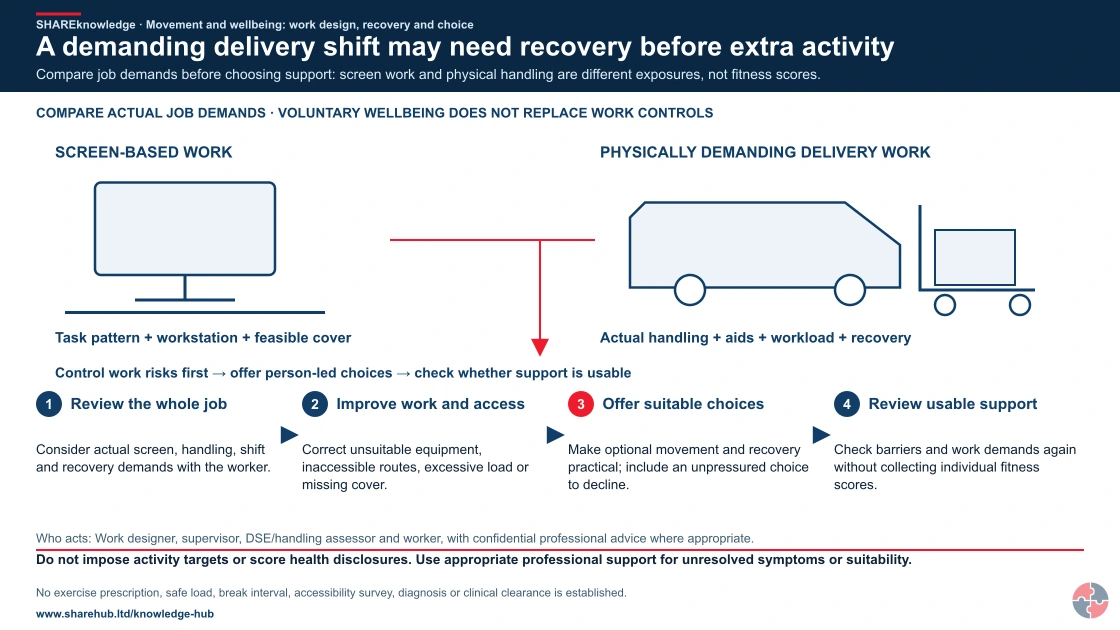
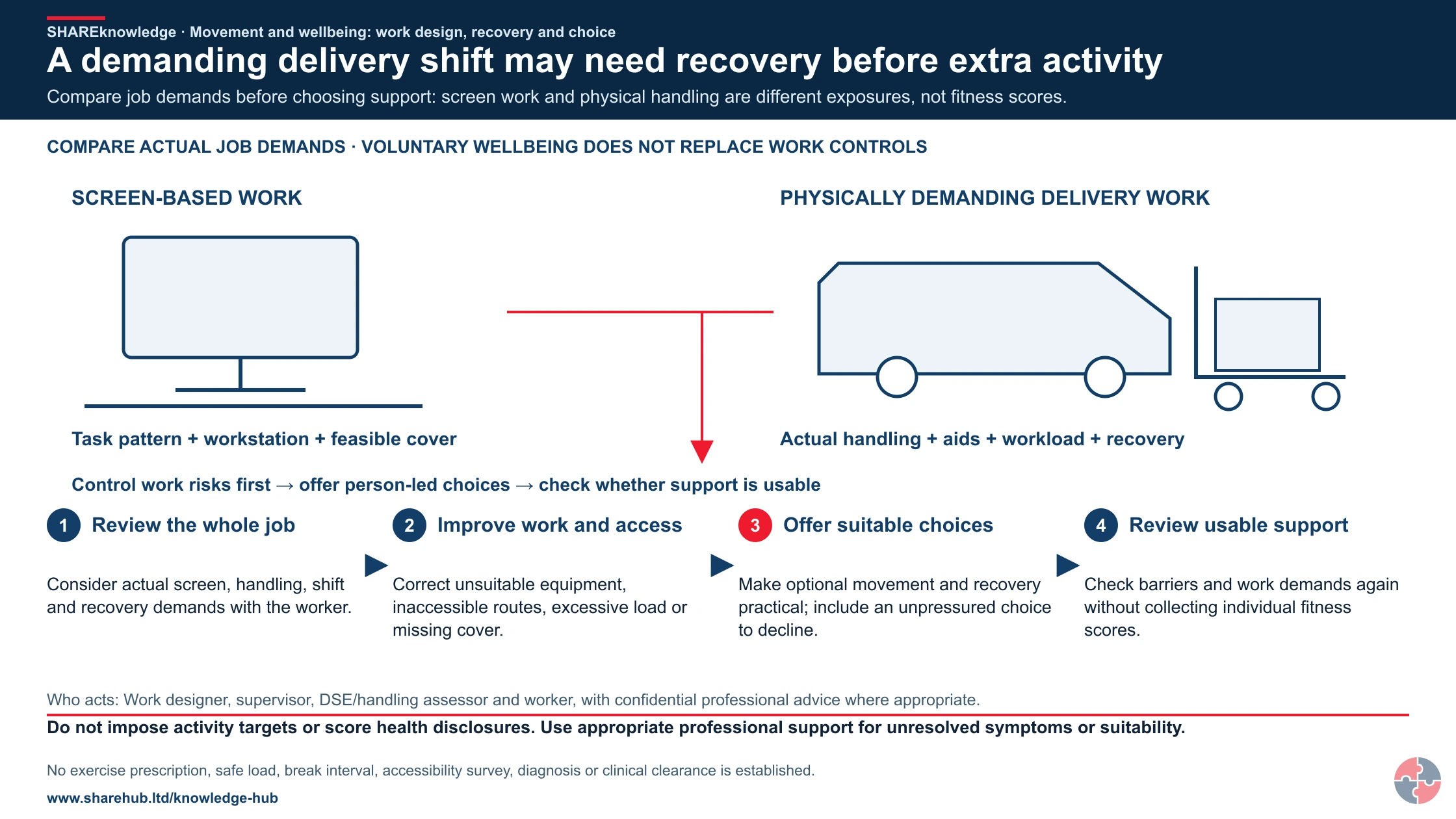
A demanding delivery shift may need recovery before extra activity
Full written explanation
A complete native comparison separates sustained screen-work demands from the handling and physical demands of a delivery shift. The screen-work branch connects work organisation, workstation assessment and feasible activity changes; the delivery branch connects actual load/task design, handling aids, workload and usable recovery. Both feed a person-led choice of appropriate optional support after work risks are controlled. The diagram does not prescribe an exercise routine, exposure schedule, safe load, clinical return or personal fitness standard. Voluntary wellbeing offers do not replace work controls, reasonable individual support or confidential professional advice where appropriate.
Compare job demands before choosing support: screen work and physical handling are different exposures, not fitness scores.
- Review the whole job. Consider actual screen, handling, shift and recovery demands with the worker.
- Improve work and access. Correct unsuitable equipment, inaccessible routes, excessive load or missing cover.
- Offer suitable choices. Make optional movement and recovery practical; include an unpressured choice to decline.
- Review usable support. Check barriers and work demands again without collecting individual fitness scores.
When the evidence does not fit: Do not impose activity targets or score health disclosures. Use appropriate professional support for unresolved symptoms or suitability.
Who acts: Work designer, supervisor, DSE/handling assessor and worker, with confidential professional advice where appropriate.
Changed workplace
Desk-based business: Make changes of activity and breaks feasible; optional activity cannot fix unsuitable work design.
Demanding delivery work: Review actual handling effort, workload and recovery before adding activity demands.
Evidence check: No exercise prescription, safe load, break interval, accessibility survey, diagnosis or clinical clearance is established.
Keep voluntary activity separate from work controls and individual clinical advice
Primary references: HSE GB DSE work routine and breaks · HSENI DSE work design · HSE GB actual manual-handling demands
Open the complete HD image (new tab)Download image
Keep voluntary activity separate from work controls and individual clinical advice
Primary references: HSE GB DSE work routine and breaks · HSENI DSE work design · HSE GB actual manual-handling demands

Screen-based work
Make activity changes and breaks practically available through work design and suitable equipment.
Mixed duties
Review the whole pattern, facilities and access, including disabled workers and people using mobility aids.
Physically demanding work
Assess load and recovery rather than assuming more activity is always beneficial.
Check worker experience
Offer appropriate voluntary support and review whether arrangements are usable across shifts; do not score bodies, steps or willingness to disclose health information.
Read the complete task-specific control examples
ERICPD is a planning cross-map: Discipline verifies and sustains every control. ESEAP compares effectiveness. A label does not authorise the task; retain the owner, evidence and stop or change decision.
Movement, Activity and Wellbeing · ERICPD
- Eliminate
- Remove unnecessary continuous screen tasks or automate repetitive data steps where feasible.
- Reduce
- Rotate to genuinely varied tasks with different posture and demands, without increasing workload.
- Isolate
- Provide adjustable workstation equipment and accessible routes appropriate to each worker.
- Control
- Plan breaks or changes of activity and realistic staffing; offer optional movement opportunities.
- PPE
- No generic PPE corrects poor screen-work design; any medical aid is an individual clinical matter.
- Discipline
- Review DSE symptoms, assessment actions and break availability without collecting campaign health scores.
Movement, Activity and Wellbeing · ESEAP
- Elimination
- Remove unnecessary continuous screen tasks or automate repetitive data steps where feasible.
- Substitution
- Rotate to genuinely varied tasks with different posture and demands, without increasing workload.
- Engineering controls
- Provide adjustable workstation equipment and accessible routes appropriate to each worker.
- Administrative controls
- Plan breaks or changes of activity and realistic staffing; offer optional movement opportunities.
- PPE
- No generic PPE corrects poor screen-work design; any medical aid is an individual clinical matter.
What is this page for?
This page explains voluntary physical activity and movement opportunities at work, alongside the separate duty to control work-created health and safety risks. It does not prescribe exercise or assess an individual’s fitness.
UK Chief Medical Officers give public-health activity guidance; employers should make work safer and participation inclusive, without turning a health guideline into an employee performance target. People with symptoms, illness, recent surgery or concerns should seek appropriate clinical advice before changing activity.
CMO supports UK public-health outcomes and recommendations; NI government activity guidance supplies NI health signposting. Detailed anatomy, hormonal pathways, nutrition/hydration mechanisms and individual clinical or work-performance predictions in this teaching require direct current government evidence and named clinical review; no task-safety credit is given to personal fitness.
Why does movement matter for health and wellbeing?
Movement matters because the body and mind are built to work as connected systems: muscles, joints, heart, lungs, energy, sleep, mood and confidence all influence each other.
Any movement can matter
Walking, stretching, stair use, active travel, manual tasks, gardening, sport and structured exercise all sit on the activity spectrum.
Sedentary work needs design attention
Long, uninterrupted sitting can contribute to discomfort, stiffness and poorer metabolic health, so work should include changes of activity where reasonably practicable.
Activity helps the mind as well as the body
Movement can support mood, sleep, stress regulation, confidence, concentration and mental clarity.
Healthy routines start gently
One step, a short walk, a few bodyweight movements or a small active break can be a better start than an unrealistic programme.
Inclusion matters
Wellbeing initiatives should work for different ages, bodies, disabilities, cultures, shifts, caring responsibilities and starting points.
Privacy is a control
Health and fitness data can be sensitive; collect little, explain why, restrict access and avoid using wellbeing information against people.
What counts as physical activity?
Physical activity is any body movement that uses energy; it is much wider than gyms, formal exercise or sport.
Fitness is not one thing. Cardiovascular fitness affects how the heart and lungs support sustained activity. Strength supports lifting, carrying, posture and joint protection. Flexibility and mobility support comfortable movement. Balance and coordination help prevent trips, falls and loss of control. Recovery capacity influences how well a person copes with repeated work demands.
For everyday wellbeing, activity can include a short walk, swimming, cycling, gardening, dancing, stretching, carrying shopping, bodyweight exercises, active play, sport, stairs, household tasks, resistance training or structured cardio. The helpful question is not 'does this count as fitness?' but 'does this help the person move safely, build confidence and feel better over time?'
| Concept | Plain meaning | Everyday or workplace relevance |
|---|---|---|
| Physical activity | Any movement that uses energy. | Walking, using stairs, moving between tasks, active breaks, manual tasks or active travel. |
| Exercise | Planned, structured activity intended to improve or maintain fitness. | Can be encouraged through voluntary schemes but should not be imposed as a condition of ordinary wellbeing. |
| Cardiovascular fitness | How well the heart, lungs and circulation support sustained effort. | Relevant to stamina, physically demanding work and recovery from exertion. |
| Strength | The ability of muscles to produce force. | Relevant to manual handling, posture, joint support and injury prevention. |
| Flexibility and mobility | The ability to move joints and soft tissues comfortably. | Relevant to awkward postures, DSE discomfort, reaching, kneeling and recovery. |
| Balance and coordination | The ability to remain stable and control movement. | Relevant to slips, trips, falls, ladders, uneven ground and ageing workforce support. |
| Sedentary behaviour | Long periods of sitting or very low movement while awake. | Relevant to screen work, driving, control rooms and call-centre work. |
| Work ability | How well current health, confidence, recovery and task demands fit together. | Relevant to safety-critical tasks, return to work, rehabilitation and reasonable adjustments. |
How can movement support everyday health?
Physical activity supports many body systems at once, which is why small improvements can affect energy, resilience and day-to-day functioning.
Regular movement helps the cardiovascular system, muscles, joints, bones, balance, metabolism, lungs and sleep. For work, that can show up as better stamina, fewer aches linked with inactivity, better recovery after physical tasks and more confidence moving around a site or workplace.
The mental health benefits are just as important. Activity can help people regulate stress, build routine, improve sleep quality, increase social contact and experience a sense of progress. It should still be framed carefully: activity is not a cure-all, and people with mental health conditions may need clinical, occupational health or psychological support as well.
| Benefit area | How activity can help | Everyday or workplace example |
|---|---|---|
| Heart and circulation | Supports cardiovascular health and stamina. | Active travel, walking routes and movement-friendly breaks. |
| Muscles and joints | Supports strength, posture, mobility and joint function. | Task rotation, stretching prompts and manual handling design. |
| Metabolic health | Helps the body use energy and manage long periods of inactivity. | Breaking up prolonged sitting in DSE or control-room work. |
| Sleep and recovery | Can support sleep quality and recovery patterns. | Shift teams build realistic activity into routines rather than relying on tired workers to attend late sessions. |
| Mood and confidence | Can support self-efficacy, positive routine and social connection. | Inclusive walking groups, team activity options and non-competitive wellbeing campaigns. |
| Work ability | Can support stamina and functional capacity where physical tasks are part of the role. | Return-to-work plans that rebuild tasks gradually with occupational health advice where needed. |
How does movement support muscles, joints, heart and lungs?
Physical activity is a whole-body topic: movement, structure, oxygen, circulation, energy and recovery all influence each other.
Muscular and structural health gives the body its working frame. Stronger muscles help protect joints, support posture, stabilise the spine and make everyday tasks easier. Good mobility helps joints move through usable ranges. Balance and coordination help the body control movement on stairs, uneven ground, wet floors, ladders, plant rooms, warehouses and construction sites.
Cardiovascular and aerobic health is the engine that supports sustained activity. The heart, blood vessels and lungs work together to move oxygen around the body and clear waste products from working muscles. When aerobic capacity improves, people often notice that walking, climbing stairs, carrying equipment or recovering after exertion feels easier.
Fuel and hydration matter because the body cannot perform well on movement alone. Regular food, enough fluid and suitable recovery support energy, concentration, temperature regulation and muscle function. Workplace design influences this more than people admit: break timing, drinking water, canteen options, shift length, heat, workload and access to food storage all affect whether people can fuel activity sensibly.
| Body system | What it does | Why it matters at work |
|---|---|---|
| Muscles | Produce movement, support posture and protect joints. | Strength helps lifting, carrying, climbing, standing, walking and recovery from physical tasks. |
| Joints and connective tissues | Allow movement and transfer force through the body. | Mobility and controlled loading reduce avoidable strain from awkward or repetitive tasks. |
| Core and trunk | Stabilise the spine, pelvis and shoulders during movement. | Core control supports manual handling, balance, posture and force transfer. |
| Heart and circulation | Deliver oxygen and nutrients through the bloodstream. | Better cardiovascular capacity supports stamina and recovery during demanding work. |
| Lungs and aerobic system | Bring oxygen into the body and support sustained effort. | Aerobic fitness helps with stairs, walking routes, active jobs and physical resilience. |
| Nervous system | Controls balance, coordination, reaction and movement skill. | Relevant to slips, trips, machinery interaction, fatigue and safe task performance. |
| Fuel and hydration | Provide energy, fluid balance and temperature support. | Poor hydration or skipped meals can worsen fatigue, headache, concentration and recovery. |
| Recovery | Allows tissues, energy systems and the mind to restore. | Shift design, sleep opportunity and rest days affect performance and injury risk. |
CMO supports UK public-health outcomes and recommendations; NI government activity guidance supplies NI health signposting. Detailed anatomy, hormonal pathways, nutrition/hydration mechanisms and individual clinical or work-performance predictions in this teaching require direct current government evidence and named clinical review; no task-safety credit is given to personal fitness.
How does movement support mood, sleep and stress?
Physical activity can support wellbeing, including sleep, stress and social connection. Claims about the precise brain-chemistry or attention mechanism need separate clinical evidence.
Many people describe feeling clearer after a walk, workout or active break. Endorphins are one proposed explanatory pathway in the teaching. The cited public-health guidance does not establish that mechanism for this workplace example; direct current government evidence and clinical review remain held. Other proposed pathways include stress hormones, circulation, sleep rhythm and attention; their precise effects are not established by the cited public-health source and require separate clinical evidence.
The workplace value is practical. A short walk after a difficult meeting, a movement break during screen-heavy work, or a planned stretch between physical tasks can help people reset, reduce tension and return with better focus. The effect is not magic and it is not the same for everyone, and a general public-health benefit does not prove an individual attention improvement or safe-task performance. Work design can offer suitable movement opportunities without relying on such a prediction.
Mental health wording must stay careful. Exercise can support wellbeing and may complement treatment, but it should not be used to dismiss anxiety, depression, trauma, burnout, addiction, chronic fatigue, pain, disability or other health conditions. Supportive activity is useful when it is voluntary, realistic and free from stigma.
| Mechanism | What it can mean in plain English | Good workplace support |
|---|---|---|
| Endorphins | Proposed chemical pathway: detailed endorphin effects are held for direct current government evidence and clinical review. | Encourage realistic movement options such as walking breaks, active travel or inclusive classes. Detailed physiological mechanism held for direct current government evidence and clinical review; no concentration or safety credit. |
| Stress regulation | Movement can help the body come down from tension and mental load. | Allow decompression after high-pressure work where operationally possible. |
| Blood flow and alertness | Movement can help people feel less sluggish during sedentary tasks. | Use short, frequent changes of activity for DSE-heavy roles. Detailed physiological mechanism held for direct current government evidence and clinical review; no concentration or safety credit. |
| Sleep support | Regular activity can help sleep patterns for some people. | Avoid unrealistic wellbeing sessions that clash with shift recovery needs. |
| Confidence and agency | Small achievable activity goals can improve a sense of control. | Use voluntary, inclusive goals rather than competitive ranking. |
| Social connection | Group activity can reduce isolation for some workers. | Offer accessible, low-pressure options and avoid excluding remote or shift workers. |
CMO supports UK public-health outcomes and recommendations; NI government activity guidance supplies NI health signposting. Detailed anatomy, hormonal pathways, nutrition/hydration mechanisms and individual clinical or work-performance predictions in this teaching require direct current government evidence and named clinical review; no task-safety credit is given to personal fitness.
What are the main ways people can be active?
A useful wellbeing approach recognises different forms of activity rather than equating health with gym attendance.
Some workers will enjoy sport or formal exercise. Others will benefit more from practical movement built into the day: walking meetings, moving between tasks, active commuting, taking stairs where safe, stretching, gardening, cycling, swimming, strength activity or balance work. Workplaces should make the range visible so people can choose what fits their health, culture, confidence and schedule.
Physical activity also includes activity during work, but heavy work is not automatically healthy. Repetitive manual work, high force, awkward postures and poor recovery can create musculoskeletal harm. The aim is balanced movement and controlled physical demand, not simply more exertion.
| Activity type | Examples | What to consider |
|---|---|---|
| Light activity | Gentle walking, standing tasks, stretching, mobility movement. | Useful for breaking up sitting and returning gradually after illness or injury. |
| Moderate activity | Brisk walking, cycling, active commuting, swimming, dancing or recreational sport. | Often realistic for voluntary workplace wellbeing. |
| Vigorous activity | Running, fast cycling, competitive sport, harder swimming sessions or high-intensity exercise. | Should remain voluntary and suitable for the individual. |
| Strength activity | Resistance exercises, carrying, climbing stairs, heavy gardening. | Supports muscle and bone health; work tasks still need manual handling assessment. |
| Balance activity | Balance exercises, tai chi, controlled movement activities. | Useful for ageing workforce and fall prevention support. |
| Flexibility and mobility | Stretching, range-of-motion movement, warm-up and recovery routines. | Helpful where work involves static posture or repeated movement. |
| Incidental movement | Walking to printers, stairs, task variation, site walk-rounds. | Small changes can be easier to sustain than formal programmes. |
| Occupational physical work | Manual handling, cleaning, construction, care work, warehousing. | Needs risk control, recovery, equipment and staffing rather than being assumed beneficial. |
How can people start from where they are?
A strong activity journey usually starts small, builds consistency, then progresses effort, strength, skill and recovery over time.
For many people, the first useful target is not a gym programme. It is one step: a short walk, a few extra minutes standing, a gentle mobility routine, using stairs where safe, or a sit-to-stand movement from a chair. Consistency matters more than intensity at the beginning because the body adapts to what it can repeat.
Progression can then move from walking to brisk walking, from bodyweight movement to light resistance, and from informal activity to structured cardio, swimming, sport or strength sessions. The principle is gradual overload: slightly more time, pace, resistance, range or complexity when the current level feels manageable. Sudden jumps in volume or heavy loads increase the chance of soreness, injury or discouragement.
Compound strength patterns are useful foundations because they train the main muscle groups and the core together. Squats develop legs, hips and trunk control. Pressing movements such as bench press and shoulder press develop chest, shoulders, arms and upper-body stability. Hip-hinge movements such as deadlifts develop posterior-chain strength through the hips, back and legs. These can be excellent when taught and progressed correctly, but they need suitable technique, appropriate loading, safe equipment and supervision where the person is new, returning from injury or unsure.
| Stage | Examples | Good practice |
|---|---|---|
| Start with one step | Short walks, gentle stretching, chair-based movement, sit-to-stand, light mobility. | Make it easy, repeatable and pain-free; focus on habit and confidence. |
| Build everyday movement | More walking, stairs where safe, active breaks, walking meetings, light household or site movement. | Add frequency before intensity. |
| Move to brisk aerobic work | Brisk walking, cycling, swimming, dancing or low-impact cardio. | Increase pace gradually and keep the person able to recover. |
| Add bodyweight strength | Squats to a chair, wall press-ups, step-ups, bridges, planks or loaded carries where suitable. | Control technique and use easier versions first. |
| Add light resistance | Resistance bands, light dumbbells, kettlebells, machines or cable exercises. | Progress slowly and avoid max-effort lifting early. |
| Use structured cardio | Cardio machines, interval walking, cycling, rowing or circuit-style sessions. | Match intensity to current fitness, health and recovery. |
| Develop compound lifts | Squat patterns, bench press, shoulder press, deadlift or hinge patterns. | Use coaching, correct setup, warm-up, technique control and suitable loads. |
| Maintain and review | Blend aerobic, strength, mobility, balance, hydration and recovery. | Review comfort, progress, barriers and any warning symptoms. |
What do UK physical activity guidelines broadly recommend?
The current CMO HTML guidance encourages daily activity. Adults aged 19–64 aim for 150 minutes moderate or 75 minutes vigorous activity weekly, an equivalent mixture or shorter very-vigorous activity, plus strength on at least 2 days. Reduce long sedentary periods where physically possible; there is no prescribed sitting-time limit here. These are public-health recommendations, not a workplace quota. UK CMO report
The adult guidance is usually summarised around three practical themes: accumulate regular moderate or vigorous activity, do strengthening activity, and minimise long periods of sedentary time. It also recognises different life stages, disabled adults, pregnancy, postpartum recovery and older adults.
A workplace page should not turn these guidelines into a performance target for staff. Use them as a public-health anchor and then translate them into realistic work design: movement breaks, active travel support, inclusive facilities, recovery-aware shifts, suitable equipment and voluntary wellbeing choices.
| Guideline theme | Plain English meaning | Workplace translation |
|---|---|---|
| Be active every day | Regular movement supports physical and mental health. | Create daily opportunities for movement rather than one-off campaigns. |
| Some activity is better than none | The biggest gains may come from moving from inactivity to some activity. | Support small, accessible steps and avoid all-or-nothing messaging. |
| Include moderate or vigorous activity | Adults should build activity that raises effort according to their ability. | Promote voluntary options such as walking, cycling or sports without pressure. |
| Develop or maintain strength | Strength supports muscles, bones and function. | Offer inclusive strength information and control manual work separately. |
| Reduce sedentary time | Long uninterrupted sitting should be minimised where physically possible. | Plan DSE breaks, changes of activity and movement-friendly routines. |
| Adapt for life stage and health | Pregnancy, disability, ageing and health conditions may change safe activity. | Use inclusive options, individual conversations and professional advice where needed. |
UK public-health guidance;2019 recommendations with current10 July 2026 HTML update. These are not work quotas or clinical instructions.
For people 65+, include strength, balance and flexibility on at least 2 days. Build gradually toward150 minutes moderate activity; already-active people may use75 minutes vigorous activity or a mixture. Individual capability matters and less activity can still benefit health.
How can sedentary time be reduced gently?
Screen-work risk should be assessed and work organised with breaks or changes of activity; movement opportunities can help, but they do not replace a suitable DSE workstation and workload plan. HSE DSE guidance HSENI DSE guidance
Display screen equipment work can concentrate people in long periods of static posture. HSE guidance is clear that work should be planned so DSE users have breaks or changes of activity. Short, frequent breaks or task changes are usually more helpful than infrequent long breaks, and movement should be realistic within the job.
Standing desks can help some people vary posture, but they are not a complete control. A better approach combines suitable workstation set-up, eye and eyesight arrangements, task variation, microbreaks, walking where practical, workload planning and manager behaviour that does not treat movement as lack of productivity.
| Issue | Practical control | Evidence to check |
|---|---|---|
| Long uninterrupted sitting | Plan short frequent breaks or changes of activity. | DSE assessment, work routine, worker feedback and observation. |
| Static posture | Encourage posture variation, stretching and suitable workstation adjustment. | DSE training and workstation checks. |
| High screen intensity | Rotate tasks where possible and plan non-screen activities. | Workload review and task design. |
| Remote work | Include home DSE setup, breaks and communication norms. | Home DSE assessment and manager check-in. |
| Call-centre or control-room work | Design cover arrangements so people can move without losing service cover. | Staffing plan and break records. |
| Driving work | Plan journeys, rest breaks and safe stopping points. | Route plan, fatigue management and vehicle-use policy. |
How can movement fit into everyday life?
Movement is easier to sustain when it attaches to ordinary routines rather than depending on a perfect exercise plan.
For many people, the useful shift is to look for natural points in the day: walking part of a journey, swimming once a week, using stairs where safe, stretching after screen work, taking a short walk after lunch, doing bodyweight movements at home, joining a local sport, dancing, gardening or taking a gentle recovery walk after a stressful day.
The best routine is the one the person can actually repeat. A ten-minute walk done regularly may be more valuable than an ambitious programme that disappears after a week. Confidence grows when activity is achievable, enjoyable and connected to personal reasons: energy, mood, sleep, strength, health, independence, social connection or simply feeling a little clearer.
| Route | Examples | Why it can work |
|---|---|---|
| Travel | Walking part of a commute, cycling, parking further away, getting off one stop earlier. | Builds movement into an existing journey. |
| Home routine | Bodyweight squats, sit-to-stand, stretching, gardening, cleaning or short mobility routines. | Low cost and flexible. |
| Social activity | Walking with a friend, team sport, dance, swimming group or community class. | Adds connection and motivation. |
| Workday rhythm | Active breaks, stairs, walking meetings, moving between tasks or stretching after screen work. | Breaks up sedentary time. |
| Structured exercise | Cardio machines, strength sessions, swimming, classes, running or cycling. | Useful when someone wants a planned route and can progress safely. |
| Recovery activity | Gentle walking, mobility, stretching or low-intensity swimming. | Can support stress regulation and return after busy or tiring periods. |
How can workplaces encourage movement without pressure or judgement?
Make work routines, breaks and facilities supportive, and keep optional activity choices free from pressure, ranking or health disclosure. Fix screen, manual-work, workload and access hazards through ordinary risk control rather than asking people to compensate by exercising.
Good support starts with work design: breaks that can be taken, manageable workload, safe routes, good welfare, accessible changing facilities, drinking water, task variation and managers who model healthy behaviour. Campaigns and challenges can help, but they should sit behind these basics rather than distract from them.
Avoid programmes that rank individuals publicly, pressure people to disclose health conditions, imply weight loss is the main aim or favour already-active workers. Use anonymous feedback and broad participation measures instead of intrusive personal tracking wherever possible.
| Support option | Good practice | Risk to avoid |
|---|---|---|
| Movement-friendly work routines | Build movement into task planning, meetings and DSE breaks. | Leaving movement to personal willpower during unrealistic workloads. |
| Active travel support | Cycle storage, lockers, showers, route information and flexible start arrangements where possible. | Assuming everyone lives close enough or feels safe cycling or walking. |
| Voluntary activity initiatives | Offer walking groups, step-free options, team events and accessible alternatives. | Public leaderboards that shame or exclude people. |
| Facilities and environment | Safe stairs, clear routes, welfare, drinking water and inclusive changing spaces. | Poor access, poor lighting or unsafe lone movement routes. |
| Manager conversations | Discuss functional barriers and support, not weight or appearance. | Medical interrogation or personal judgement. |
| Anonymised measurement | Measure programme reach and feedback without unnecessary health data. | Collecting individual health metrics without a clear lawful reason. |
For work design, HSE DSE guidance covers screen-work assessment and breaks, while HSE Management Standards address work-related stressors; neither is replaced by a step challenge.
How can the hierarchy of controls reduce sedentary work and barriers to physical activity?
Use ERICPD and the five-level hierarchy to remove or reduce work-created hazards. Provide movement choices as an inclusive wellbeing opportunity after safe work design, never as a replacement for it.
HSE GB and separate NI guidance support their stated work risks; campaign, conversation and review tools are practical illustrations, not universal statutory templates. Individual clinical instructions and legal/privacy decisions remain held.
A call-centre schedule keeps workers seated for long blocks with poor workstation fit. The employer must address work design and DSE risk; voluntary walking cannot repair a bad workstation.
A lunch walking challenge crosses a busy delivery entrance and excludes some disabled staff. Voluntary participation does not make the route or campaign design acceptable.
How can the ERICPD hierarchy of controls reduce sedentary work and barriers to physical activity?

| Hazard and harm route | ERICPD → five-level control | Task intervention and feasibility | Owner, test and evidence | Failure and stop decision |
|---|---|---|---|---|
| Screen work with long static posture | Eliminate → Elimination | Remove unnecessary continuous screen tasks or automate repetitive data steps where feasible. Source: official guidance. | Work designer tests real task and worker feedback. | Continuous exposure unchanged: do not claim elimination. |
| Same scenario | Reduce → Substitution | Rotate to genuinely varied tasks with different posture and demands, without increasing workload. Source: official guidance. | Supervisor trials schedule and checks fatigue. | Variation merely moves screen work to another worker: redesign. |
| Same scenario | Isolate → Engineering | Provide adjustable workstation equipment and accessible routes appropriate to each worker. Source: official guidance. | DSE assessor observes setup in use and records adjustments. | Unusable setup or inaccessible route: stop imposed arrangement. |
| Same scenario | Control → Administrative | Plan breaks or changes of activity and realistic staffing; offer optional movement opportunities. Source: official guidance. | Manager checks roster and worker feedback. | Breaks cannot be taken in practice: change staffing. |
| Same scenario | PPE → PPE | No generic PPE corrects poor screen-work design; any medical aid is an individual clinical matter. Source: official guidance. | Ergonomics lead records no PPE credit for DSE control. | Plan relies on a wearable or brace instead of fit: reject. |
| Same scenario | Discipline → Administrative assurance | Review DSE symptoms, assessment actions and break availability without collecting campaign health scores. Source: official guidance. | Health and safety lead verifies closed actions. | Symptoms or missed breaks recur: reopen work-design review. |
| Optional workplace walking group with unsafe route | Eliminate → Elimination | Remove the route through delivery traffic or remove the unsafe event location. Source: official guidance. | Event lead walks route with affected users. | Traffic conflict remains: cancel that route. |
| Same scenario | Reduce → Substitution | Offer a suitable accessible, low-pressure alternative to the unsafe route; consult participants and verify access before the voluntary event. | Accessibility lead trials options with volunteers. | Only one unsuitable route exists: do not run challenge. |
| Same scenario | Isolate → Engineering | Provide physical separation and accessible crossings where a route is used. Source: official guidance. | Facilities lead inspects barriers and surface. | Crossing or surface unsafe: close route. |
| Same scenario | Control → Administrative | Make participation opt-in, check weather and access, and set an emergency contact plan without health ranking. Source: official guidance. | Campaign lead checks briefing and anonymous feedback. | Pressure or unsafe weather undermines consent/safety: pause. |
| Same scenario | PPE → PPE | Suggest suitable personal clothing or footwear for the individual choice, but do not rely on it to fix a hazardous route. Source: official guidance. | Event lead confirms route design independently. | PPE is the only answer to traffic or slips: reject. |
| Same scenario | Discipline → Administrative assurance | Review anonymous feedback, access barriers and near misses; change the programme without ranking workers or recording unnecessary personal health data. | Programme owner records changes without personal health data. | Repeat concern or unwanted disclosure: suspend and redesign. |
How can the ISO 45001 hierarchy of controls reduce sedentary work and barriers to physical activity?

| Hazard and harm route | ERICPD → five-level control | Task intervention and feasibility | Owner, test and evidence | Failure and stop decision |
|---|---|---|---|---|
| Screen work with long static posture | Eliminate → Elimination | Remove unnecessary continuous screen tasks or automate repetitive data steps where feasible. Source: official guidance. | Work designer tests real task and worker feedback. | Continuous exposure unchanged: do not claim elimination. |
| Same scenario | Reduce → Substitution | Rotate to genuinely varied tasks with different posture and demands, without increasing workload. Source: official guidance. | Supervisor trials schedule and checks fatigue. | Variation merely moves screen work to another worker: redesign. |
| Same scenario | Isolate → Engineering | Provide adjustable workstation equipment and accessible routes appropriate to each worker. Source: official guidance. | DSE assessor observes setup in use and records adjustments. | Unusable setup or inaccessible route: stop imposed arrangement. |
| Same scenario | Control → Administrative | Plan breaks or changes of activity and realistic staffing; offer optional movement opportunities. Source: official guidance. | Manager checks roster and worker feedback. | Breaks cannot be taken in practice: change staffing. |
| Same scenario | PPE → PPE | No generic PPE corrects poor screen-work design; any medical aid is an individual clinical matter. Source: official guidance. | Ergonomics lead records no PPE credit for DSE control. | Plan relies on a wearable or brace instead of fit: reject. |
| Same scenario | Discipline → Administrative assurance | Review DSE symptoms, assessment actions and break availability without collecting campaign health scores. Source: official guidance. | Health and safety lead verifies closed actions. | Symptoms or missed breaks recur: reopen work-design review. |
| Optional workplace walking group with unsafe route | Eliminate → Elimination | Remove the route through delivery traffic or remove the unsafe event location. Source: official guidance. | Event lead walks route with affected users. | Traffic conflict remains: cancel that route. |
| Same scenario | Reduce → Substitution | Offer a suitable accessible, low-pressure alternative to the unsafe route; consult participants and verify access before the voluntary event. | Accessibility lead trials options with volunteers. | Only one unsuitable route exists: do not run challenge. |
| Same scenario | Isolate → Engineering | Provide physical separation and accessible crossings where a route is used. Source: official guidance. | Facilities lead inspects barriers and surface. | Crossing or surface unsafe: close route. |
| Same scenario | Control → Administrative | Make participation opt-in, check weather and access, and set an emergency contact plan without health ranking. Source: official guidance. | Campaign lead checks briefing and anonymous feedback. | Pressure or unsafe weather undermines consent/safety: pause. |
| Same scenario | PPE → PPE | Suggest suitable personal clothing or footwear for the individual choice, but do not rely on it to fix a hazardous route. Source: official guidance. | Event lead confirms route design independently. | PPE is the only answer to traffic or slips: reject. |
| Same scenario | Discipline → Administrative assurance | Review anonymous feedback, access barriers and near misses; change the programme without ranking workers or recording unnecessary personal health data. | Programme owner records changes without personal health data. | Repeat concern or unwanted disclosure: suspend and redesign. |
How can this support a wellbeing campaign?
A good campaign gives people permission, ideas and practical support; it does not make movement feel like a test.
A movement campaign can work well when it uses positive, ordinary language: moving more, sitting less, building strength, protecting joints, supporting heart and lung health, improving mood, sleeping better and starting from where you are. It should give people options rather than one model of success.
Campaigns can include weekly themes, short talks, posters, team prompts, walking routes, swimming or sport signposting, DSE movement reminders, hydration messages, active-travel support and voluntary group activities. The most important design principle is choice: nobody should feel exposed, ranked or judged.
| Campaign element | What it can include | Good design choice |
|---|---|---|
| Start small message | One step, five minutes, gentle stretching or short walking. | Emphasise confidence and consistency. |
| Move more routes | Walking routes, stairs where safe, active breaks and walking meetings. | Make movement easy to choose. |
| Strength basics | Bodyweight movements, resistance bands, squats, pushes, hinges and core control. | Offer safe beginner versions and technique signposting. |
| Cardio and lungs | Brisk walking, cycling, swimming, sport, dancing or cardio machines. | Show varied options for different preferences. |
| Fuel and hydration | Water access, food timing and recovery reminders. | Link activity to energy rather than weight. |
| Inclusive options | Seated, low-impact, adapted, remote and shift-friendly activities. | Avoid one-size-fits-all challenges. |
When should someone seek medical advice before changing activity?
NI government gradual-activity and emergency-care signposting; current individual clinical instructions remain held.
Most people can start gently, especially with low-intensity movement such as walking, mobility or light everyday activity. However, a person should seek medical advice where they have worrying symptoms, a significant health condition, recent surgery, pregnancy-related concerns, chest pain, unexplained breathlessness, dizziness, fainting, severe pain, a recent heart event, or uncertainty about safe activity.
The same principle applies at work. Managers should not prescribe exercise or judge health. If health, medication, fatigue, injury, disability or safety-critical work creates uncertainty, use qualified advice and focus on functional support rather than personal fitness standards.
| Situation | Why advice may help | Supportive response |
|---|---|---|
| New symptoms | Chest pain, dizziness, fainting or unexplained breathlessness need proper assessment. | Encourage medical advice and avoid pushing activity. |
| Long-term condition | Activity may need adapting to the person's condition and treatment. | Support gradual, person-led activity and professional input where needed. |
| Injury or pain | Some movement helps recovery, but the wrong load can worsen harm. | Use physiotherapy, GP or occupational health advice where appropriate. |
| Pregnancy or recent birth | Activity can be beneficial but needs to fit the person's stage and symptoms. | Signpost to health professional advice and avoid assumptions. |
| Safety-critical work | Health or fatigue may affect safe performance. | Use role demands, confidential advice and reasonable adjustments. |
| Low confidence or anxiety | People may need reassurance and gentle options. | Offer choice, privacy and non-competitive routes. |
Severe or potentially life-threatening symptoms need 999 immediately; do not delay emergency help for exercise or a manager decision. Other new chest pain, unexplained breathlessness or dizziness need prompt appropriate clinical assessment. Individual clinical instructions remain held.
What makes activity inclusive and realistic?
Inclusive activity support recognises that people differ in health, confidence, culture, disability, age, body size, gender, pregnancy, caring duties and working pattern.
A well-meaning campaign can still exclude people. Step challenges may disadvantage wheelchair users, people with fatigue conditions, some disabled workers, some pregnant workers, remote workers or those on long shifts. Gym discounts may help some employees and do nothing for others. Competitive messaging can motivate some people and make others disengage.
Design for choice. Offer different activity routes, different intensity levels, quiet options, accessible formats, flexible timings and privacy. Ask people what barriers they experience before launching a scheme. Make clear that participation is voluntary and that reasonable adjustments remain available.
| Group or situation | Potential barrier | Better design choice |
|---|---|---|
| Disabled workers | Activity challenges may assume walking, steps or standard gym access. | Offer adapted activities and avoid step-only measurement. |
| Pregnant or postpartum workers | Needs and comfort may change quickly. | Use supportive signposting and individual adjustment conversations. |
| Shift workers | Timing may clash with recovery, childcare or fatigue. | Offer flexible options and avoid sessions only after long shifts. |
| Remote workers | May be excluded from site-based activity. | Provide remote-friendly options and check workload norms. |
| Workers with pain or fatigue | Pressure to join can worsen symptoms or anxiety. | Use low-pressure, optional movement and occupational health advice where needed. |
| Cultural or religious needs | Mixed spaces, clothing, timing or facilities may create barriers. | Consult respectfully and offer varied options. |
What can go wrong when wellbeing campaigns are poorly designed?
Poorly designed wellbeing campaigns can create injuries, exclusion, data protection problems, discrimination and distrust.
The aim is to promote health, not to turn wellbeing into performance management. Risk increases when schemes are competitive, public, compulsory, poorly risk assessed or linked to personal health tracking. It also increases when employers ignore the work factors that reduce activity, such as unmanageable workload, poor breaks, fatigue, unsafe routes or lack of facilities.
Physical activity events also need ordinary risk assessment. Sponsored walks, charity sports, cycling events, gym sessions, outdoor activity days and team challenges can involve travel, weather, medical needs, safeguarding, lone participation, slips, trips, dehydration or emergency response issues.
| Risk | How harm can happen | Control |
|---|---|---|
| Injury during activity events | Poorly planned sessions may exceed ability or ignore medical limits. | Voluntary participation, suitable activity choice, briefing and event risk assessment. |
| Stigma or body shaming | Messaging focused on weight or appearance can damage trust and mental wellbeing. | Use health, energy, movement and inclusion language. |
| Discrimination | One-size-fits-all schemes can disadvantage disabled, pregnant, older or shift workers. | Equality review and reasonable adjustments. |
| Data protection breach | Health or activity data may be collected without necessity or transparency. | Data minimisation, privacy notice and restricted access. |
| False reassurance | A step challenge may distract from DSE, workload or manual handling risks. | Keep wellbeing separate from mandatory risk controls. |
| Presenteeism | People may feel pressured to appear active or well. | Make support voluntary and confidential. |
Which work, equality and privacy duties are separate from voluntary activity?
There is no general requirement to make staff exercise. GB and Northern Ireland have separate work-health and disability routes; UK CMO activity recommendations are health guidance, not employment duties.
If personal health or wearable data is proposed, document the lawful purpose, minimise data and apply the current government data-protection guidance on staff records. A fitness campaign should not become a medical assessment or a substitute for a reasonable adjustment.
Control DSE, manual-work, fatigue and access hazards through the relevant work rules. In GB the Equality Act 2010 is the main employment equality route; Northern Ireland uses separate disability discrimination law and NI government employment guidance. Keep optional activities accessible and avoid assumptions about health or ability.
| Jurisdiction | Boundary or duty | What it means in practice | Evidence to keep |
|---|---|---|---|
| GB | Health and Safety at Work etc. Act 1974 | GB general work-health and welfare duties. | Safe work design and risk controls. |
| GB | Management Regulations 1999 | GB risk assessment and preventive arrangements. | DSE, workload and access assessments. |
| GB | Display Screen Equipment Regulations 1992 | GB DSE user risk assessment and work routine. | Workstation assessment and break arrangements. |
| NI | Display Screen Equipment Regulations (NI) 1992 | Separate NI DSE user assessment and work routine. | NI workstation assessment and break arrangements. |
| NI | Health and Safety at Work (NI) Order 1978 | Separate NI general work-health duties. | NI work-risk and welfare controls. |
| NI | NI Management Regulations 2000 | Separate NI risk-assessment arrangements. | NI risk assessment and review. |
| GB | Equality Act 2010 | GB equality and reasonable-adjustment route. | Accessible programme and adjustment decision. |
| NI | NI Direct disability employment rights; detailed legal/privacy application remains held. | Separate NI disability and reasonable-adjustment route. | NI discussion and appropriate support. |
| UK | GOV.UK staff-records guidance; detailed legal/privacy application remains held. | UK handling of workers’ health data. | Lawful purpose, minimisation and restricted access. |
For public-health context, UK CMO guidance is advice for people and policy, not a compulsory work target.
For workplace design, HSE DSE guidance addresses GB display-screen work; HSENI DSE guidance addresses NI work, and HSE stress standards address GB work-related demands and support.
How should privacy and personal health information be handled?
A voluntary movement programme normally needs little identifiable health data. Use anonymous feedback and participation totals where possible, explain any collection purpose and keep agreed adjustments confidential.
Health information is sensitive. If a workplace wants to understand whether a campaign is useful, anonymous feedback, participation totals and general barrier themes are usually enough. Individual step counts, weight, medical conditions, diagnoses, medication, exercise history or wearable data should not be collected unless there is a clear, lawful, transparent and proportionate reason.
Workers should know what information is being collected, why, who can see it, how long it will be kept and whether participation is voluntary. In most wellbeing campaigns, the safest design is to keep personal health information out of the campaign entirely.
| Privacy point | Good practice | Avoid |
|---|---|---|
| Participation | Make activities voluntary and avoid pressure from managers. | Implied compulsory participation. |
| Measurement | Use anonymous totals or general feedback where possible. | Public leaderboards showing individual health behaviour. |
| Health information | Collect only what is necessary for a clear purpose. | Collecting diagnoses, weight, medical history or wearable data casually. |
| Access | Limit access to people with a real need to know. | Sharing health comments across managers or teams. |
| Communication | Explain privacy before the campaign begins. | Changing the purpose of collected data later. |
| Adjustments | Record agreed support confidentially where needed. | Forcing people to disclose private conditions to join in. |
UK staff-record security, appropriate trained access and need-based retention support practical records. Wearable consent/lawful basis, medical confidentiality and individual legal/clinical decisions remain held.
What should a workplace record if it runs a wellbeing campaign?
A workplace should usually record campaign planning, inclusion checks and improvement actions, not individual fitness data.
Most movement campaigns do not need personal exercise records. Better evidence includes the campaign plan, privacy check, accessibility review, risk assessment for any organised events, anonymous feedback, communication materials and actions taken to remove practical barriers.
Where the campaign identifies work-related problems, such as DSE discomfort, poor breaks, manual handling issues or inaccessible facilities, those should be managed through the proper risk assessment or action tracking route.
| Record | What it should show | Owner |
|---|---|---|
| Campaign plan | Purpose, audience, messages, dates, voluntary nature and inclusion checks. | Wellbeing lead. |
| Privacy check | What data is collected, why, access control and retention. | HR, data protection lead or wellbeing lead. |
| Accessibility review | How the campaign works for different bodies, disabilities, shifts and remote workers. | Wellbeing lead and worker representatives. |
| Activity event risk assessment | Route, supervision, weather, emergency arrangements and accessibility. | Event organiser. |
| DSE or work routine actions | Workstation or break issues identified through the campaign. | Line manager or DSE assessor. |
| Anonymous feedback | Barriers, preferred support and improvement ideas. | Wellbeing lead. |
| Action tracker | Practical improvements, owners, dates and review. | Management team. |
Who needs competence to support movement at work?
Test managers on work design, inclusion and privacy; leave individual exercise prescription to the person and appropriate health professional.
| Role | Learning to test | Competence demonstration | Assessor and record | Reassessment trigger |
|---|---|---|---|---|
| All workers | Understand voluntary options, personal choice and safe route reporting. | Find an accessible option and reporting contact. | Team lead records briefing. | Programme or route change. |
| Managers | Protect breaks and avoid health judgements or coercion. | Review a schedule and supportive conversation scenario. | HR/safety lead observes. | Workload or team change. |
| DSE assessors | Distinguish work-design controls from personal exercise advice. | Observe workstation and agree action. | Competent ergonomics lead signs assessment. | Task, equipment or symptom change. |
| Campaign leads | Plan accessible opt-in activities and minimal data collection. | Trial route, alternative and privacy notice. | Equality/privacy leads approve plan. | Event, route or data-use change. |
| Occupational health advisers | Give confidential individual functional advice within professional scope. | Review referral and adjustment boundary. | Clinical lead governs record. | New condition or work demand. |
How could Riverside Leisure Ltd promote movement and wellbeing?

Riverside Leisure Ltd can use its own leisure environment to promote everyday movement while avoiding pressure, privacy breaches and unfair expectations.
Riverside Leisure Ltd
Riverside Leisure Ltd is a leisure, hospitality and activity business used by SHARE to show how health and wellbeing topics apply in a practical organisation.
Riverside starts by separating its public leisure offer from worker wellbeing. Staff are not expected to look athletic, join classes or share personal activity data. The campaign message is simple: movement can start with one step, and people can choose walking, swimming, sport, stretching, bodyweight exercises, active travel or gentle recovery activity.
The wellbeing lead runs an anonymous barrier survey and finds that some workers want discounted swimming and gym access, but others need reliable breaks, safe cycle storage, more predictable rotas, footwear advice, better manual handling aids, DSE movement prompts and a private route to ask for support. The campaign is therefore built around choice, energy, confidence, mood, sleep, muscles, heart and lung health rather than weight loss.
Riverside also protects personal information. It does not collect individual step counts, weight or medical information for the campaign. Managers are briefed to encourage participation without pressure and to signpost people towards GP, occupational health or HR support where health, injury, disability, fatigue or work ability needs a private conversation.
| Campaign step | What Riverside does | Evidence |
|---|---|---|
| Listen | Uses anonymous feedback to understand barriers to movement, breaks, confidence and inclusion. | Survey summary and worker-representative notes. |
| Design | Creates options for walking, swimming, stretching, active breaks, sport, strength basics and shift-friendly routines. | Campaign plan and accessibility check. |
| Brief | Trains managers on voluntary participation, privacy, inclusive language and signposting. | Manager briefing record. |
| Support | Improves break cover, cycle storage, rota planning, DSE prompts and low-pressure activity signposting. | Action tracker and facilities checks. |
| Check | Uses anonymous feedback and practical observations rather than personal fitness data. | Wellbeing review and action close-out. |
| Learn | Reviews whether remote, shift, disabled, pregnant, older and less confident workers felt included. | Equality and inclusion review. |
| Improve | Adjusts the campaign when feedback shows some groups need quieter, lower-impact or more flexible options. | Updated campaign plan. |
How can BS EN ISO 45001 support movement, activity and wellbeing management?
A voluntary occupational health and safety system can help plan inclusive movement opportunities while keeping work-risk control, consent and privacy separate from health promotion.
HSE public guidance supports practical management themes in Great Britain. ISO clause mapping, conformity and certification claims remain held for current licensed-text and specialist review; this page does not establish compliance or certification.
What are the warning signs that a campaign is becoming exclusionary?
Weak campaigns often show up as good intentions that leave some people feeling judged, exposed or unable to join in.
Warning signs matter because they show where activity support is becoming superficial or unsafe. A workplace can run a popular campaign while still leaving people stuck at screens, rushing breaks, handling loads poorly, hiding pain or feeling judged.
The test is whether the campaign improves the conditions that shape health: workload, breaks, task design, facilities, culture, privacy, inclusion and access to support.
| Warning sign | How it can manifest | Potential harm |
|---|---|---|
| People cannot take breaks | Calendars, call queues or production pressure stop movement. | Stiffness, fatigue, DSE discomfort and lower concentration. |
| Wellbeing equals competitions | Step counts and leaderboards dominate the programme. | Exclusion, shame, stress or disengagement. |
| Managers ask medical questions casually | Health details are discussed in open offices or team meetings. | Loss of trust and data protection risk. |
| Health is judged by appearance | People are judged by age, weight, diagnosis, disability or body shape. | Stigma, discrimination and loss of trust. |
| Manual work is treated as exercise | Heavy or repetitive work is assumed to keep people fit. | Musculoskeletal harm and poor recovery. |
| Remote and shift workers are left out | Activities happen only on site during office hours. | Unequal access and poorer engagement. |
| Private health issues become public | People feel they must disclose pain, fatigue, disability or pregnancy details to explain non-participation. | Privacy harm, stress and disengagement. |
How does this topic support professional learning?
Movement and wellbeing links to health literacy, sedentary work, mental wellbeing, musculoskeletal health, inclusion and privacy-aware management.
For professional development, the important distinction is between supportive wellbeing awareness and occupational health decision-making. A wellbeing campaign can encourage healthy routines; it should not become a medical assessment, performance judgement or replacement for risk control.
A strong workplace answer should identify practical barriers, voluntary support, inclusive options, privacy, DSE and sedentary work, manual task design, reasonable adjustments and signposting. For example, an office scenario may focus on screen work and movement breaks, while a leisure or construction scenario may focus on active work, fatigue, recovery and musculoskeletal risk.
Good professional practice combines health literacy with humility: encourage movement, design better work, protect privacy and let people start from where they are.
| Area | What to know | How to apply it |
|---|---|---|
| Occupational health | Work and health influence each other. | Use functional advice and avoid diagnosis-led management. |
| Work ability | Work ability is task-specific, not a judgement of lifestyle. | Define role demands and use confidential advice where needed. |
| Sedentary work | Static work needs breaks or activity changes. | Connect DSE assessment to actual work routine. |
| Musculoskeletal risk | Movement can help, but poorly controlled manual work harms. | Use manual handling controls, equipment and task design. |
| Equality and inclusion | Workers need different routes to activity and support. | Apply reasonable adjustments and avoid one-size-fits-all schemes. |
| Data protection | Health information is sensitive. | Collect little, explain purpose and restrict access. |
What do the acronyms and key terms mean?
Acronyms should be explained so wellbeing, health and safety, HR and occupational health language remains accessible.
| Acronym | Meaning | Plain English use |
|---|---|---|
| CMO | Chief Medical Officer | Senior public-health medical adviser; UK CMO guidance is used for physical activity recommendations. |
| DSE | Display Screen Equipment | Screen-based workstations such as computers, laptops and other display screens. |
| GP | General Practitioner | A doctor who can advise on personal health issues and medical treatment. |
| HSE | Health and Safety Executive | Great Britain workplace health and safety regulator. |
| ICO | Information Commissioner's Office | UK regulator for data protection and information rights. |
| OH | Occupational Health | Specialist work-health advice focused on functional ability, adjustments and work-related health. |
| GB | Great Britain | GB work-health and equality context. |
| NI | Northern Ireland | Separate work-health and disability-employment rules. |
| ERICPD | Eliminate, Reduce, Isolate, Control, PPE, Discipline | Teaching aid for work-hazard controls. |
Reader navigation, terms and proposed documents only; no linked-page evidence, instructional asset or reuse approval is implied.