SHARE Knowledge Hub
Endometriosis and workplace wellbeing
Endometriosis can cause fluctuating pelvic pain, heavy periods, fatigue and other symptoms that affect work differently for each person. A manager should respond to the worker’s functional needs, protect privacy, check safe work and welfare access, and review practical adjustments without trying to diagnose or requiring unnecessary disclosure. Clinical questions belong with the worker’s healthcare team.
Understanding Endometriosis and workplace wellbeing
Endometriosis can cause fluctuating pelvic pain, heavy periods, fatigue and other symptoms that affect work differently for each person. A manager should respond to the worker’s functional needs, protect privacy, check safe work and welfare access, and review practical adjustments without trying to diagnose or requiring unnecessary disclosure. Clinical questions belong with the worker’s healthcare team.
Why this matters at work
Steel, cement and other heavy-industry work may combine heat, protective clothing, climbing, noise, moving plant and remote welfare. The hazard is the exposure and the task, not the worker's condition. A person who needs a break from a high-heat area may require a controlled exit, replacement operator and safe plant state. Leaving a crane, furnace or mobile machine without a handover could harm others.
Review near misses and rework without assuming illness caused them. The garage may need better task planning, equipment maintenance or a second check; the worker may need temporary functional support. Both can be true. Sources: HSE task assessment; HSE individual work risk; HSE adjustments.
How organisations manage this in practice
Review after the worker reports a material change in function, treatment or recovery; after a job, shift, route or supervisor changes; when a control fails; after a near miss; or when official law or guidance changes. The worker need not provide a full medical update on a fixed cycle merely to keep a basic welfare measure. Agree a proportionate review frequency and a way to bring it forward.
A practical response includes adequate welfare and break coverage, safe task allocation, consultation, trained managers, emergency arrangements and a way to raise concerns without penalty. For a safety-critical task, management should ask how pain or fatigue interacts with the task and whether the existing barriers are reliable. An adjustment to one person's shift cannot excuse an unguarded machine or inadequate staffing affecting everyone.
Agree actions, cover, communication and what happens if symptoms change. Verify that equipment, seating, facilities and task changes are ready before the person returns. Review the arrangement with the worker under realistic work conditions and change it where it is ineffective. Supportive work changes and safe primary controls remain necessary for everyone; the worker should not have to compensate for poor guarding or unavailable relief by managing symptoms better. Keep clinical records separate and make any task restriction explicit, proportionate and subject to an accountable review rather than an open-ended assumption of unfitness.
Trial arrangements around the person’s actual work
Before the rota trial, Riverside’s counter worker has unpredictable relief, long standing and delayed toilet access. The manager arranges predictable cover, usable seating and a clear relief call. At review the worker reports that seating helps but the busiest handover still delays breaks; the manager moves cover to that period and checks the next shift with the worker.
- Choose and review adjustments — Agree practical changes based on function and worker feedback.
- Check welfare and access — Make breaks, seating and toilet access usable during the shift.
- Follow the existing rota example — Use the confidential plan, trial and review route.
An office or mobile worker may instead need appointment flexibility, accessible toilets along the route or a change to travel and meeting patterns. Agree the relevant trial rather than copying one package across roles. Record the arrangement, owner and review trigger; ordinary management records do not need reproductive or treatment details.
Content amended 19 October 2026 by the SHARE Knowledge Hub editorial team. This records an editorial content change; the existing technical-review and approval status still applies.
Trial support through the real customer-facing shift
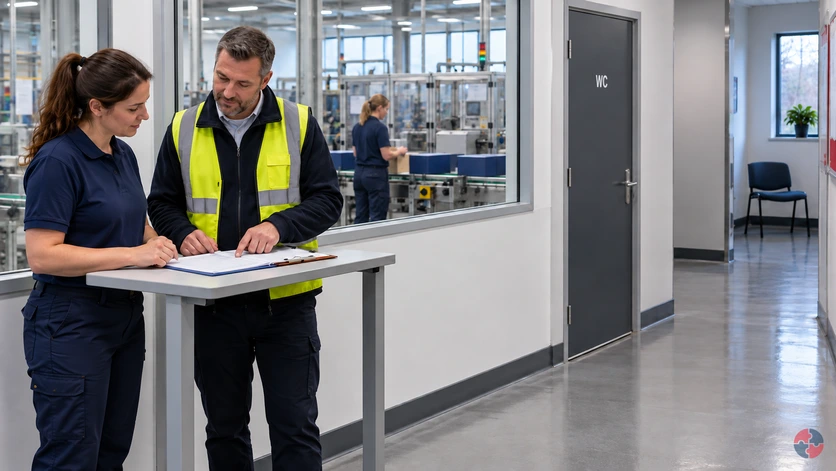
Seating, accessible facilities, relief cover and appointment flexibility need to be usable during busy work. Support should follow the individual’s functional needs and be reviewed privately.
Make welfare access and relief cover work during the real shift
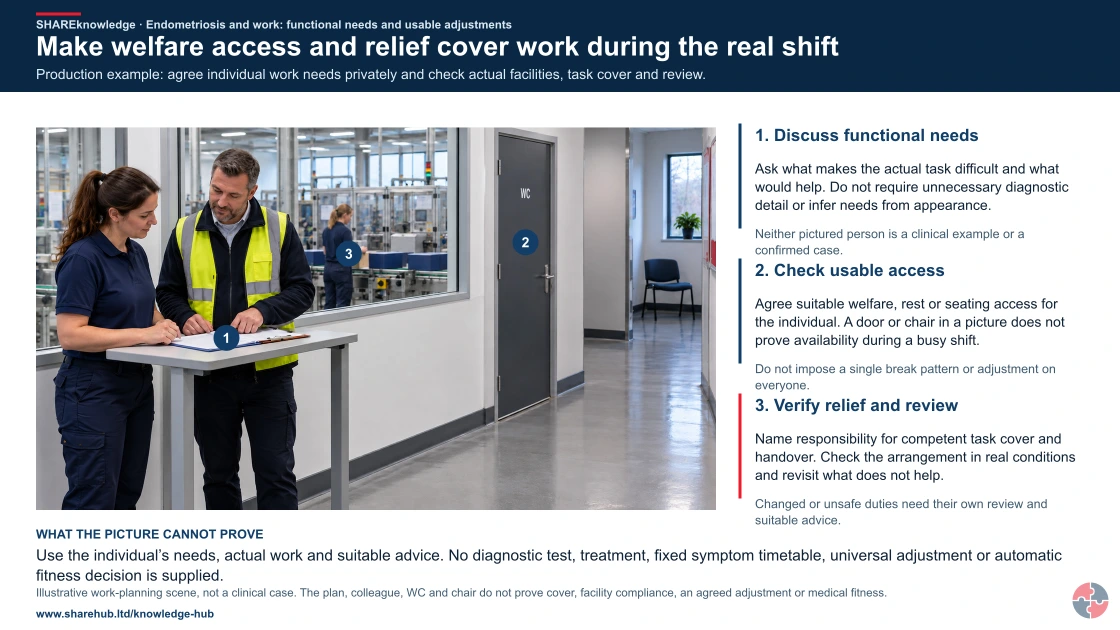
Full written explanation
Production example: agree individual work needs privately and check actual facilities, task cover and review.
- Discuss functional needs. Ask what makes the actual task difficult and what would help. Do not require unnecessary diagnostic detail or infer needs from appearance.
- Check usable access. Agree suitable welfare, rest or seating access for the individual. A door or chair in a picture does not prove availability during a busy shift.
- Verify relief and review. Name responsibility for competent task cover and handover. Check the arrangement in real conditions and revisit what does not help.
Change the pathway
- A plan is not a diagnosis. Neither pictured person is a clinical example or a confirmed case.
- Support must be individual. Do not impose a single break pattern or adjustment on everyone.
- No automatic task clearance. Changed or unsafe duties need their own review and suitable advice.
Evidence check: Use the individual’s needs, actual work and suitable advice. No diagnostic test, treatment, fixed symptom timetable, universal adjustment or automatic fitness decision is supplied.
Individual work needs, usable welfare and private adjustment review
Primary references: NHS: individual endometriosis information and qualified help · Acas: individual reasonable adjustments (GB)
Open the complete HD image (new tab)Download image
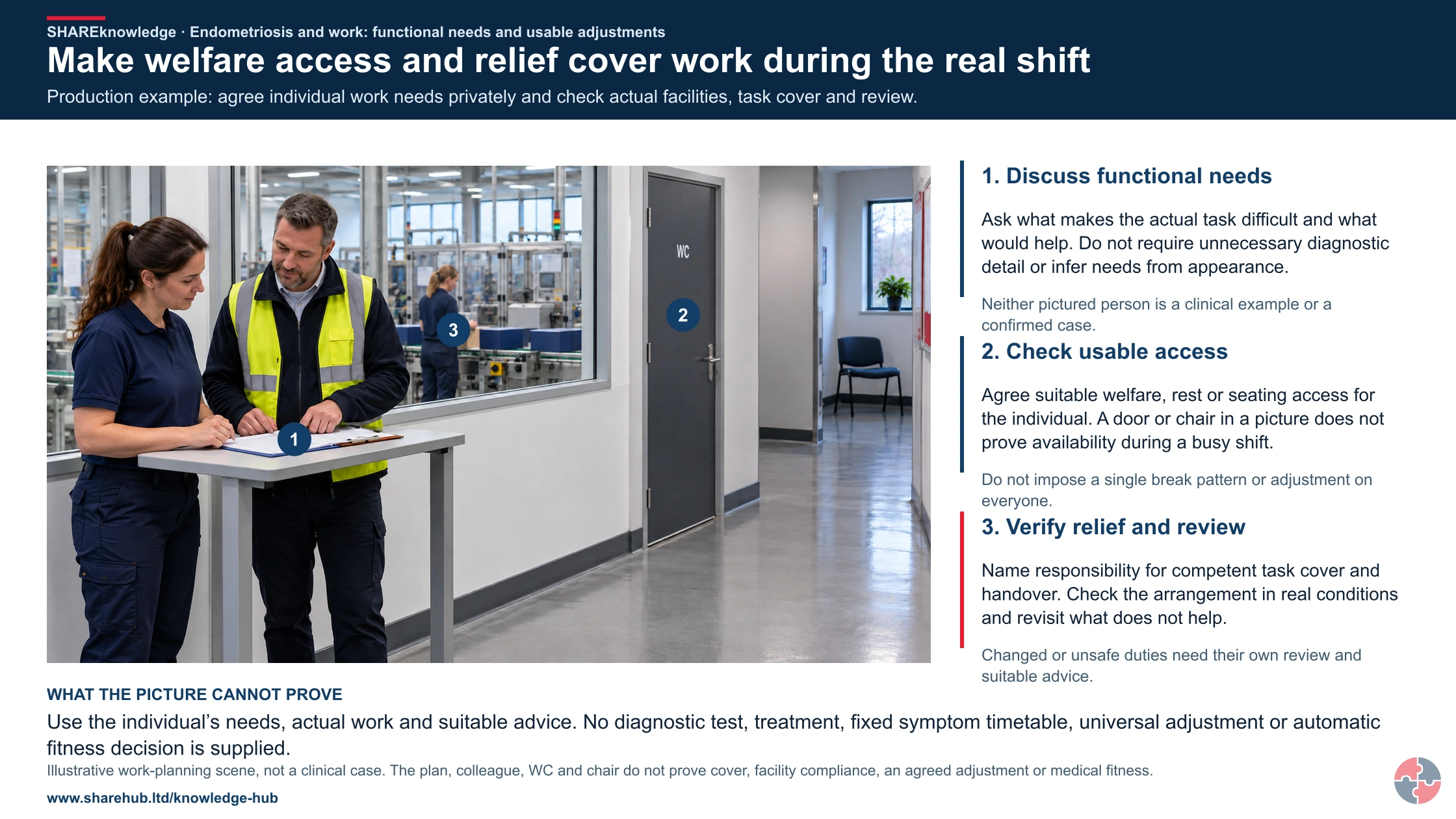
Individual work needs, usable welfare and private adjustment review
Primary references: NHS: individual endometriosis information and qualified help · Acas: individual reasonable adjustments (GB)

Ask about work needs
Discuss what makes the task difficult without requiring unnecessary diagnostic detail.
Agree the trial
Consider suitable seating, toilet/rest access, flexible cover and appointment arrangements with named responsibilities.
Check actual use
Review the busiest shift as well as quiet periods and revise a trial that does not help.
The example is a workplace support route, not a diagnostic test, treatment plan or assumed fitness decision.
What is the health and advice boundary for endometriosis at work?
This page is workplace guidance and does not replace NHS, GP, specialist, occupational health, legal or HR advice.
What is the health and advice boundary for endometriosis at work?


Read the complete visual as text
- This page is workplace guidance and does not replace…: This page is workplace guidance and does not replace NHS, GP, specialist, occupational health, legal or HR advice.
- Endometriosis can involve significant pain and long-term health impact.…: Endometriosis can involve significant pain and long-term health impact. A public workplace page can explain common symptoms, work effects and support principles, but it cannot diagnose a person, recommend treatment or decide employment rights in an individual case.
- If symptoms are severe, changing, difficult to manage or…: If symptoms are severe, changing, difficult to manage or affecting everyday life, the worker should use appropriate healthcare routes. If work may be unsafe because of pain, medication, fatigue or sudden deterioration, the employer should manage the immediate work risk and seek competent advice where needed.
Endometriosis can involve significant pain and long-term health impact. A public workplace page can explain common symptoms, work effects and support principles, but it cannot diagnose a person, recommend treatment or decide employment rights in an individual case.
If symptoms are severe, changing, difficult to manage or affecting everyday life, the worker should use appropriate healthcare routes. If work may be unsafe because of pain, medication, fatigue or sudden deterioration, the employer should manage the immediate work risk and seek competent advice where needed.
What should a manager do first when endometriosis affects work?
Ask privately which work tasks or conditions are difficult, agree immediate support and safe work, then review adjustments with the worker. Do not diagnose, ask for detailed reproductive history or assume every person has the same symptoms.
A worker says severe pelvic pain makes long standing and fixed breaks difficult. The manager checks seating, predictable breaks and toilet access, adjusts the rota where workable, records only needed work information and agrees a review date.
What are the key facts about endometriosis at work?
The key facts are that symptoms can be severe, fluctuating, private and work-relevant without being visible.
Symptoms vary
Two people with endometriosis may need very different support.
Pain can be disabling
Severe pelvic pain can affect standing, movement, concentration, sleep and safe work.
Fatigue is common
Poor sleep, pain and treatment effects can reduce stamina and attention.
Privacy matters
Workers may avoid disclosure because symptoms are intimate and often stigmatised.
Facilities matter
Toilet access, washing facilities, rest space and flexible breaks can be practical controls.
Adjustments should be reviewed
Needs may change with flare-ups, treatment, surgery, medication or life stage.
What is endometriosis?
Endometriosis is a condition where tissue similar to womb lining grows in other places and can cause long-term pain and other symptoms.
NHS guidance explains that endometriosis is often found around the womb, ovaries, fallopian tubes and pelvis, and can sometimes affect organs such as the bowel or bladder. Symptoms can happen around periods or at other times.
Workplaces do not need to understand every clinical detail to support someone well. They do need to understand that endometriosis can be painful, unpredictable, tiring, sensitive to discuss and capable of affecting work in practical ways. See NHS endometriosis.
| Area | What it can mean | Workplace relevance |
|---|---|---|
| Pain | Pelvic, lower tummy, back or pain linked to bowel/bladder function. | May affect standing, lifting, driving, concentration and shift length. |
| Bleeding | Heavy periods or bleeding patterns. | May require toilet access, hygiene facilities and flexibility. |
| Fatigue | Extreme tiredness linked to symptoms, sleep loss or treatment. | May affect stamina, attention and recovery. |
| Treatment | Medication, appointments, scans, surgery or specialist care. | May require appointment flexibility and phased return. |
| Emotional impact | Stress, low mood, anxiety, fertility concerns or frustration from delayed diagnosis. | May affect confidence, communication and wellbeing. |
The NHS describes cells similar to womb-lining cells growing elsewhere; symptoms and work impact vary. The manager should not infer a diagnosis, treatment, fertility status or disability decision from symptoms. See NHS endometriosis.
What symptoms and patterns may affect work?
Symptoms may affect work through pain, bleeding, fatigue, bowel or bladder effects, treatment and emotional strain.
NHS guidance lists symptoms including severe period pain, heavy periods, pelvic pain, pain when passing urine or stool, pain during or after sex, extreme tiredness, difficulty getting pregnant and low mood or anxiety. Symptoms can overlap with other conditions, which is why diagnosis and treatment belong with healthcare professionals.
For managers, symptoms should be treated as prompts for support, not proof of a condition. The practical workplace question is what the person is finding difficult and what could reasonably reduce the barrier. See NHS endometriosis.
| Symptom or pattern | Possible work effect | Support consideration |
|---|---|---|
| Severe pain | Difficulty standing, moving, concentrating or completing long shifts. | Flexible duties, seating, breaks or adjusted pace. |
| Heavy bleeding | Anxiety about leakage, hygiene or being unable to leave a workstation. | Easy toilet access and dignity in uniform/PPE. |
| Bowel or bladder symptoms | Need for frequent or urgent toilet use. | No unreasonable restriction on toilet breaks. |
| Fatigue | Reduced stamina, slower recovery and increased error risk. | Shift review, rest breaks and phased return. |
| Treatment appointments | Repeated medical appointments or procedures. | Appointment flexibility and fair absence handling. |
| Medication effects | Drowsiness, nausea or reduced concentration for some people. | Review safety-critical tasks and driving where relevant. |
How can endometriosis affect safe and healthy work?
Endometriosis can affect safe work where pain, fatigue, medication or restricted access to facilities creates risk or distress.
Most support is about work design rather than removing someone from work. A worker may be entirely capable of their role with modest adjustments such as flexible start times, short breaks, remote work on flare days, seating, welfare access, reduced travel, temporary duty changes or predictable cover for medical appointments.
Safety-sensitive work needs extra care. If the role involves driving, machinery, working at height, lone work, public conflict, emergency response or high-consequence decisions, the employer should review whether symptoms or medication could temporarily affect safe performance.
| Work factor | Question to ask | Possible action |
|---|---|---|
| Shift length | Do symptoms worsen during long or inflexible shifts? | Adjust shifts or provide recovery time. |
| Toilet access | Can the person access facilities quickly and privately? | Review staffing, cover and location. |
| Physical demands | Does the role require prolonged standing, lifting or travel? | Adjust tasks or provide seating. |
| Temperature and uniform | Do clothing, heat or PPE worsen discomfort or dignity concerns? | Consider uniform flexibility where safe. |
| Safety-critical duties | Could pain, fatigue or medication affect safe judgement? | Temporarily adjust duty or seek OH advice. |
| Appointments | Are treatment appointments being handled fairly? | Agree appointment and absence process. |
How can the hierarchy of controls improve screen-work conditions through agreed workplace adjustments?
Use source and work-design controls first; support and procedures cannot replace prevention.
Verify controls: Setting up a hybrid workstation


Read the complete visual as text
- Actual task: A worker requests changes to screen work because symptoms affect comfort and concentration. Agree the functional work needs and suitable advice privately; the hierarchy addresses work design, not elimination of the condition.
- Evidence to check: both workstation assessments, equipment adjustment and realistic activity changes
- Stop or hold condition: worsening symptoms, unusable equipment or work patterns that prevent agreed adjustments
- Release evidence and owner: worker and manager confirm a workable setup and review date
Adjustments should be discussed with the worker because symptoms are personal and variable. The same person may need different support during a flare-up, after surgery, during treatment changes or while waiting for specialist care.
Where endometriosis has a substantial and long-term effect on normal day-to-day activities, the worker may be disabled under equality law. Employers should avoid waiting for perfect medical certainty before considering practical support.
How can the ERICPD hierarchy of controls improve screen-work conditions through agreed workplace adjustments?

| Control level | Control for this activity | Owner and verification | Stop / restart decision |
|---|---|---|---|
| Eliminate | Remove duplicate screen entry and unnecessary prolonged desk tasks from the workflow. | Task owner verifies that the proposed change removes the named hazardous step, including foreseeable cleaning, maintenance and work transferred elsewhere. | If the hazardous step remains, keep it within the task assessment and select the stronger feasible remaining controls. |
| Reduce, including substitution | Replace laptop-only work with a suitable separate display and input arrangement after trying it with the user. | The user trials the actual display, keyboard, pointing device and docking arrangement at both regular locations; the manager checks that adjustments and task changes remain usable. | Reject an alternative if its performance is unproved or its new hazards are unresolved. |
| Isolate | Provide a usable work area separated from storage and trip hazards so the worker can change posture safely. | Supervisor checks the actual boundary, affected people and connected work; verify separation or isolation before allowing access. | Hold or stop for worsening symptoms, unusable equipment or work patterns that prevent agreed adjustments. |
| Control: physical safeguards | Adjust chair, screen, keyboard and desk to the user and task; provide a suitable docking arrangement at both regular locations. | Competent equipment/process owner checks both workstation assessments, equipment adjustment and realistic activity changes. | Hold or stop for worsening symptoms, unusable equipment or work patterns that prevent agreed adjustments. |
| Control: work method and response | Agree manageable meeting blocks, access to suitable welfare, changes of activity and a private adjustment review. Seek appropriate functional advice for any safety-critical duty rather than assuming a diagnosis determines capacity. | Supervisor confirms the work limits, competent cover, communication and stop/restart authority with the people doing this activity. | Hold work when the agreed limits, competent cover or effective communication cannot be maintained. |
| PPE | No PPE prevents posture-related back pain; suitable seating and task design belong to workplace controls. | Assessor confirms whether personal protection is needed and checks suitability, condition, compatibility and any required fit evidence. | Do not use unsuitable protection or rely on PPE to continue after an essential source control fails. |
| Discipline | Check adjustments after location, equipment or workload changes and confirm that the agreed breaks remain possible. | Release only after worker and manager confirm a workable setup and review date. Retain verification and unresolved restrictions at handover. | Keep the task on hold until required reinstatement evidence and unresolved defects are accepted by the responsible owner. |
How can the ISO 45001 hierarchy of controls improve screen-work conditions through agreed workplace adjustments?

| Control level | Control for this activity | Owner and verification | Stop / restart decision |
|---|---|---|---|
| Elimination | Remove duplicate screen entry and unnecessary prolonged desk tasks from the workflow. | Task owner verifies that the proposed change removes the named hazardous step, including foreseeable cleaning, maintenance and work transferred elsewhere. | If the hazardous step remains, keep it within the task assessment and select the stronger feasible remaining controls. |
| Engineering controls | Replace laptop-only work with a suitable separate display and input arrangement after trying it with the user. | The user trials the actual display, keyboard, pointing device and docking arrangement at both regular locations; the manager checks that adjustments and task changes remain usable. | Reject an alternative if its performance is unproved or its new hazards are unresolved. |
| Engineering controls | Provide a usable work area separated from storage and trip hazards so the worker can change posture safely. | Supervisor checks the actual boundary, affected people and connected work; verify separation or isolation before allowing access. | Hold or stop for worsening symptoms, unusable equipment or work patterns that prevent agreed adjustments. |
| Engineering controls | Adjust chair, screen, keyboard and desk to the user and task; provide a suitable docking arrangement at both regular locations. | Competent equipment/process owner checks both workstation assessments, equipment adjustment and realistic activity changes. | Hold or stop for worsening symptoms, unusable equipment or work patterns that prevent agreed adjustments. |
| Administrative controls | Agree manageable meeting blocks, access to suitable welfare, changes of activity and a private adjustment review. Seek appropriate functional advice for any safety-critical duty rather than assuming a diagnosis determines capacity. | Supervisor confirms the work limits, competent cover, communication and stop/restart authority with the people doing this activity. | Hold work when the agreed limits, competent cover or effective communication cannot be maintained. |
| PPE | No PPE prevents posture-related back pain; suitable seating and task design belong to workplace controls. | Assessor confirms whether personal protection is needed and checks suitability, condition, compatibility and any required fit evidence. | Do not use unsuitable protection or rely on PPE to continue after an essential source control fails. |
| Administrative controls | Check adjustments after location, equipment or workload changes and confirm that the agreed breaks remain possible. | Release only after worker and manager confirm a workable setup and review date. Retain verification and unresolved restrictions at handover. | Keep the task on hold until required reinstatement evidence and unresolved defects are accepted by the responsible owner. |
Illustrative leisure-centre role: long standing, fixed breaks and a distant toilet make pain flares hard to manage. Agree changes with the worker; this is not a medical treatment plan. See Acas reasonable adjustments at work.
What should managers do when endometriosis is raised?
Managers should respond privately, respectfully and practically, focusing on work impact rather than medical detail.
A useful conversation starts with belief and dignity. The manager can ask what work is making symptoms harder, what has helped before, whether any tasks feel unsafe during flare-ups, what flexibility would help and what information the worker is comfortable sharing.
Managers should not ask intrusive questions about sexual health, fertility, gynaecological history or treatment unless the worker chooses to share relevant work-impact information. If specialist advice is needed, use occupational health with clear referral questions. See Acas reasonable adjustments at work.
Acas informs GB adjustment practice; NI disability employment duties use the NI legislation and Equality Commission NI guidance. Conversation prompts are an illustrative SHARE method; protect health data under UK-wide law.
| Prompt | Purpose | Boundary |
|---|---|---|
| What are you finding difficult at work? | Identifies practical barriers. | Do not ask for intimate medical detail. |
| Are there particular times, tasks or shifts that make symptoms harder? | Finds patterns that work can influence. | Avoid assumptions about reliability. |
| Would any temporary or longer-term adjustments help? | Opens support options. | Agree review dates. |
| Are any tasks unsafe for you during flare-ups or medication changes? | Controls immediate safety risk. | Seek OH advice where needed. |
| What information are you comfortable sharing and with whom? | Protects confidentiality. | Share only on a need-to-know basis. |
| When shall we review this? | Keeps support live. | Document actions, not unnecessary clinical detail. |
A person may need clinical assessment even without a confirmed diagnosis. The NHS advises GP contact when symptoms affect everyday life, work or relationships; urgent symptoms need the appropriate medical route. See Acas reasonable adjustments at work.
Which workplace facilities and work design details matter?
Facilities matter because toilet access, washing, rest space and dignity can determine whether someone can manage symptoms at work.
Workplace welfare requirements may sound basic, but for endometriosis they can be central. Restricted toilet breaks, distant facilities, no washing facilities, inflexible cover, unsuitable uniforms or lack of rest space can turn manageable symptoms into distress, absence or presenteeism.
Work design should also consider travel between sites, field work, customer-facing roles, lone work and shift patterns where access to facilities or support may be limited. See HSE workplace facilities.
Acas informs GB adjustment practice; Northern Ireland welfare and disability duties use the NI regulations and Equality Commission NI guidance. These are illustrative site checks, not a universal clinical prescription.
| Area | What good looks like | Evidence |
|---|---|---|
| Toilet access | Workers can use toilets promptly and privately. | Welfare inspection and manager briefing. |
| Washing facilities | Clean, accessible facilities are available. | Facility checks. |
| Rest space | A suitable place to rest where needed. | Rest provision and local arrangements. |
| Uniform/PPE | Uniform does not create avoidable dignity or symptom issues. | Uniform review where concerns are raised. |
| Cover arrangements | Breaks and appointments are possible without conflict. | Rota and staffing review. |
| Field work | Travel and remote sites include welfare planning. | Job planning and worker consultation. |
What training is needed for endometriosis and workplace wellbeing?
Training should raise awareness, improve manager confidence and protect dignity without turning managers into clinicians.
All workers may benefit from general awareness about reproductive health, dignity, stigma and support routes. Managers need more detailed training on private conversations, adjustments, absence handling, occupational health referral, confidentiality and avoiding discriminatory assumptions.
HR, wellbeing and safety teams need deeper competence in policy design, equality, welfare facilities, work-related stress, privacy and how to evaluate whether support is effective.
| Role | Learning | Demonstration | Assessor | Record | Reassess when |
|---|---|---|---|---|---|
| Workers | Know how to raise work needs privately | Find the contact route | People lead | Induction check | Route changes |
| Line managers | Discuss function without diagnosis | Role-play a private conversation | HR lead | Support note | Concern |
| Facilities | Keep toilets, seating and rest usable | Inspect actual route | Facilities lead | Check log | Layout change |
| Occupational health | Advise on work function when needed | Scope referral and recommendations | Clinical lead | Confidential referral | Changed role |
| HR and privacy | Assess adjustments and minimal records | Check policy and access | Privacy lead | Decision log | New data use |
| Leaders | Review barriers and fairness | Sample anonymised outcomes | Independent lead | Review record | Repeated barriers |
Which legal duties apply to endometriosis and workplace wellbeing?
Select the law by site nation, activity and duty. The Great Britain instruments in this table do not automatically apply in Northern Ireland.
| Where | Instrument | Practical boundary |
|---|---|---|
| Great Britain | Health and Safety at Work etc. Act 1974 | GB general work-safety duties |
| Northern Ireland | Health and Safety at Work (Northern Ireland) Order 1978 | NI general work-safety duties |
| Great Britain | Management of Health and Safety at Work Regulations 1999 | GB risk assessment and prevention arrangements |
| Northern Ireland | Management of Health and Safety at Work Regulations (Northern Ireland) 2000 | NI risk assessment and prevention arrangements |
| Great Britain | Workplace (Health, Safety and Welfare) Regulations 1992 | GB toilets, washing, rest and workplace facilities |
| Northern Ireland | Workplace (Health, Safety and Welfare) Regulations (Northern Ireland) 1993 | NI toilets, washing, rest and workplace facilities |
| Great Britain | Equality Act 2010 | GB disability and reasonable-adjustment duties where legal test is met |
| Northern Ireland | Disability Discrimination Act 1995 (NI application) | NI disability employment duties as amended |
| United Kingdom | UK GDPR | Personal and special-category health data protection |
| United Kingdom | Data Protection Act 2018 | UK data protection framework |
This page explains work support, not a medical diagnosis or a legal finding about disability. Seek appropriate clinical or occupational-health advice for personal care and specialist legal advice for a disputed adjustment decision.
Keep only the worker health information needed for a lawful work purpose, restrict access and review retention. The ICO worker-health guidance is under review after the Data (Use and Access) Act 2025, so use current UK GDPR and Data Protection Act 2018 text for a precise legal decision. UK GDPR DPA 2018
How should endometriosis support appear in a wellbeing risk register?
The risk register should treat endometriosis support as part of dignity, welfare, wellbeing and work-design control.
This topic is not about recording named workers in a general risk register. The register should identify organisational barriers: limited toilet access, poor manager confidence, inflexible absence triggers, stigma, poor welfare facilities, lack of occupational health access or safety-critical work that is not reviewed during symptom flare-ups.
Individual details should be handled privately through appropriate HR, occupational health or management records with data protection controls.
| Risk or barrier | Control | Assurance evidence |
|---|---|---|
| Managers lack confidence | Manager training and conversation prompts. | Training records and feedback. |
| Restricted toilet access | Welfare review and cover arrangements. | Inspection and worker consultation. |
| Stigma prevents disclosure | Awareness, privacy and dignity messaging. | Survey themes and engagement. |
| Unsafe duties during flares | Temporary task adjustment and OH advice where needed. | Adjustment record and review. |
| Poor absence handling | Health-aware absence and return-to-work process. | Case review and HR guidance. |
How could Riverside Leisure Ltd support endometriosis and workplace wellbeing?

Riverside Leisure Ltd could support endometriosis by combining dignity, flexible work design, welfare access, manager training and confidential review.
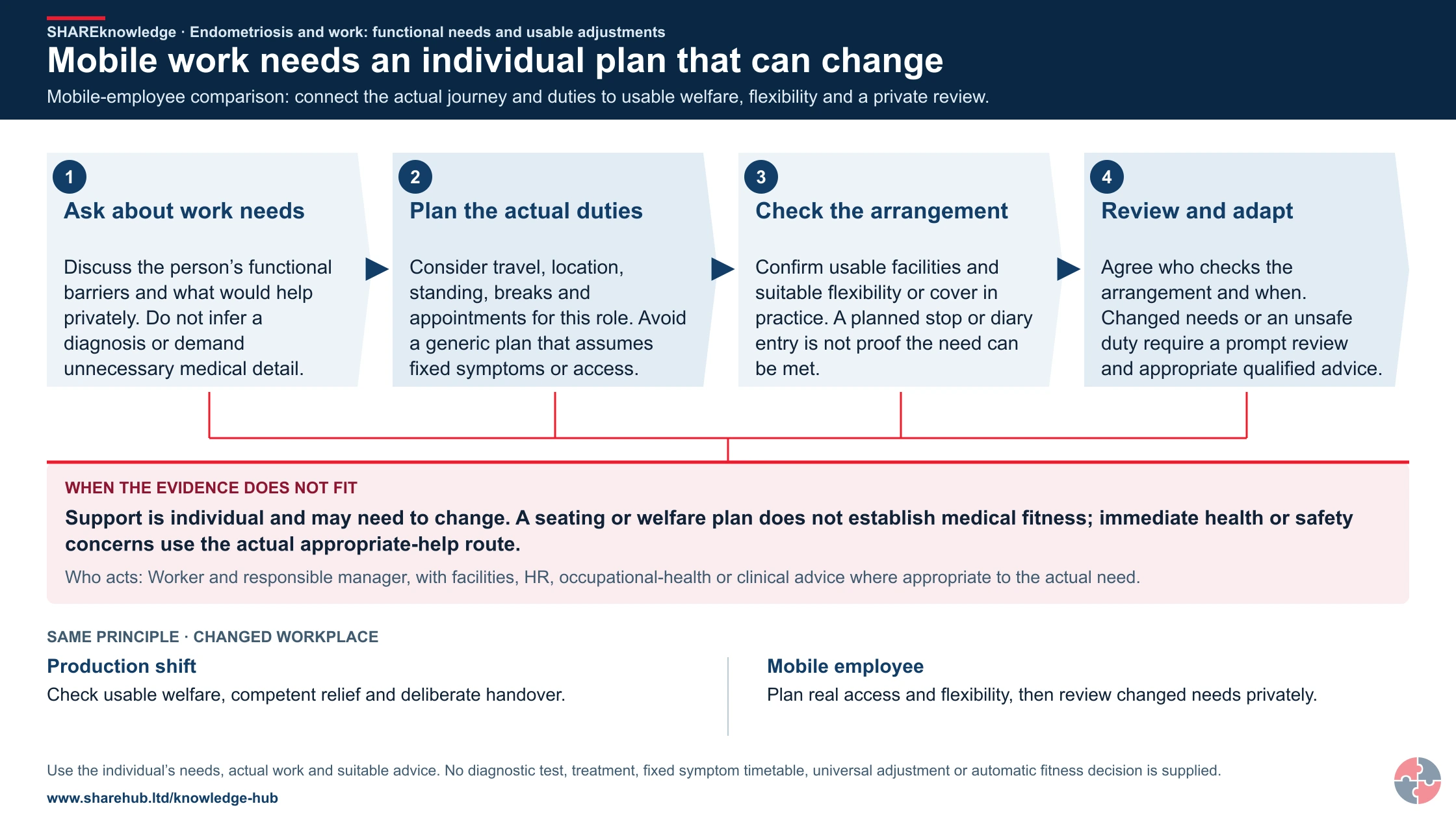
Mobile work needs an individual plan that can change
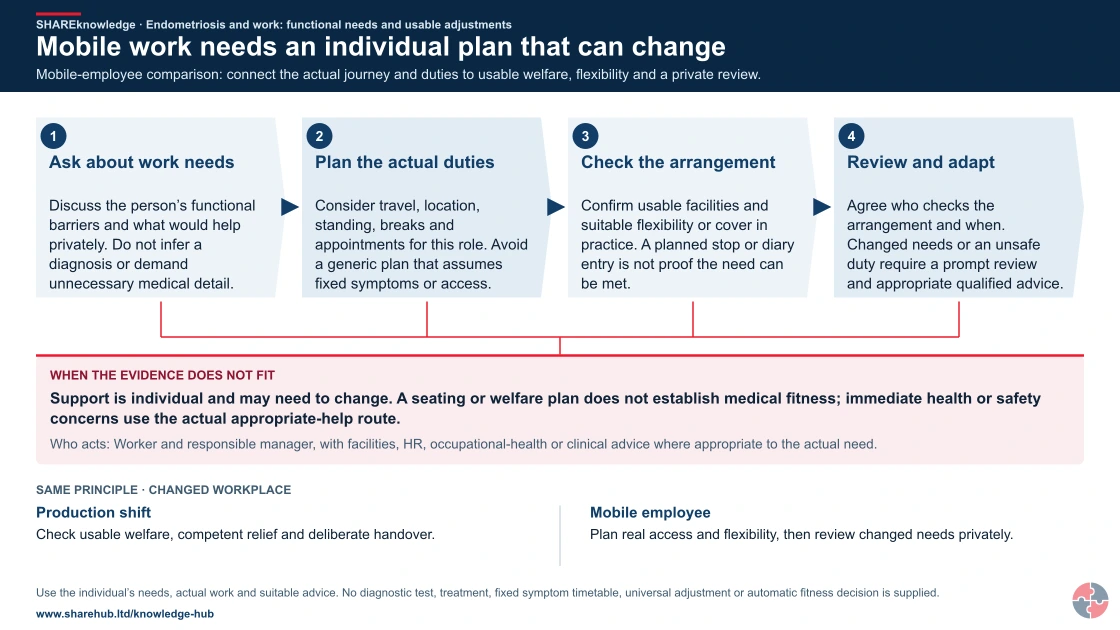
Full written explanation
A complete four-check mobile-work review links individual functional needs, actual travel/task demands, usable welfare and cover arrangements, and review after a change. Support is not a diagnosis, treatment plan or medical fitness decision. The current customer-facing and workstation examples remain separate; adjustments must be tailored to the individual and actual work.
Mobile-employee comparison: connect the actual journey and duties to usable welfare, flexibility and a private review.
- Ask about work needs. Discuss the person’s functional barriers and what would help privately. Do not infer a diagnosis or demand unnecessary medical detail.
- Plan the actual duties. Consider travel, location, standing, breaks and appointments for this role. Avoid a generic plan that assumes fixed symptoms or access.
- Check the arrangement. Confirm usable facilities and suitable flexibility or cover in practice. A planned stop or diary entry is not proof the need can be met.
- Review and adapt. Agree who checks the arrangement and when. Changed needs or an unsafe duty require a prompt review and appropriate qualified advice.
When the evidence does not fit: Support is individual and may need to change. A seating or welfare plan does not establish medical fitness; immediate health or safety concerns use the actual appropriate-help route.
Who acts: Worker and responsible manager, with facilities, HR, occupational-health or clinical advice where appropriate to the actual need.
Changed workplace
Production shift: Check usable welfare, competent relief and deliberate handover.
Mobile employee: Plan real access and flexibility, then review changed needs privately.
Evidence check: Use the individual’s needs, actual work and suitable advice. No diagnostic test, treatment, fixed symptom timetable, universal adjustment or automatic fitness decision is supplied.
Individual work needs, usable welfare and private adjustment review
Primary references: NHS: individual endometriosis information and qualified help · Acas: individual reasonable adjustments (GB)
Open the complete HD image (new tab)Download image
Individual work needs, usable welfare and private adjustment review
Primary references: NHS: individual endometriosis information and qualified help · Acas: individual reasonable adjustments (GB)
A field decision from start to hand-back — part 1 of 3


Read the complete visual as text
- 1. Task and setting: A leisure-centre worker has fluctuating pelvic pain and difficulty with fixed breaks and long standing.
- 2. People and prerequisites: Worker, manager, facilities and people lead; discuss function privately and identify real task demands.
- 3. Before the task: Check seating, toilet and rest access, rota flexibility and safe performance of any critical task.
A field decision from start to hand-back — part 2 of 3


Read the complete visual as text
- 1. Check during work: Agree changes with the worker without asking for unnecessary clinical detail; use occupational health for functional advice if needed.
- 2. Stop, hold or refer: An acute safety concern follows the site safety or urgent medical route, not an assumption based on diagnosis.
A field decision from start to hand-back — part 3 of 3


Read the complete visual as text
- 1. Completion and hand-back: Review the trial with the worker, revise work design and keep only needed records.
- 2. Retained evidence: Worker-agreed plan, facilities check, rota trial and review date.
Riverside Leisure Ltd
Riverside Leisure Ltd is a make-believe leisure and holiday operator with public-facing, shift-based roles across gyms, swimming pools, cafes and outdoor activities.
Riverside recognises that reproductive health symptoms can affect customer-facing and safety-sensitive work. Its wellbeing risk register identifies barriers such as restricted toilet breaks on poolside duty, rota inflexibility, long periods standing, uniform concerns, appointment difficulty, lone closing duties and manager discomfort discussing reproductive health.
The business introduces a reproductive health support pathway. Workers can request a private conversation with a trained manager or HR contact, use the EAP, ask for occupational health referral, or request adjustments. Managers are trained to focus on work impact and privacy rather than medical detail.
Practical controls include flexible breaks, cover for toilet access, seating where compatible with the role, temporary non-poolside duties during severe flares, appointment flexibility, phased return after procedures, uniform adjustments where safe, remote administration tasks where possible and review dates after flare-ups or treatment changes.
Riverside checks effectiveness through worker feedback, absence themes, manager confidence sampling, welfare inspections, occupational health referral quality and leadership review. It treats repeated issues as potential work-design failures, not as proof that affected workers are unreliable.
| Management area | How Riverside manages it | Evidence |
|---|---|---|
| Assess | Identifies role barriers such as toilet access, standing, rota and public-facing work. | Wellbeing risk register and worker consultation. |
| Communicate | Explains reproductive health support and privacy routes. | Policy, induction and intranet guidance. |
| Train | Trains managers on dignity, adjustments, privacy and OH referral. | Training matrix and scenario notes. |
| Implement | Uses flexible breaks, duty changes, appointment support and welfare checks. | Adjustment records and rota notes. |
| Check | Reviews absence themes, facilities and worker feedback. | Management review and welfare inspections. |
| Improve | Updates policy and work design where barriers repeat. | Action tracker and leadership minutes. |
A field decision from start to hand-back
Task, material and setting: A leisure-centre worker has fluctuating pelvic pain and difficulty with fixed breaks and long standing.
People and prerequisites: Worker, manager, facilities and people lead; discuss function privately and identify real task demands.
Before: Check seating, toilet and rest access, rota flexibility and safe performance of any critical task.
During: Agree changes with the worker without asking for unnecessary clinical detail; use occupational health for functional advice if needed.
Hold or stop: An acute safety concern follows the site safety or urgent medical route, not an assumption based on diagnosis.
Completion and hand back: Review the trial with the worker, revise work design and keep only needed records.
Evidence: Worker-agreed plan, facilities check, rota trial and review date.
How does this topic support study and professional development?
This topic helps learners apply wellbeing, equality, welfare, confidentiality and manager competence to a real health issue.
For NEBOSH General Certificate learners, endometriosis is relevant to worker welfare, consultation, health and safety arrangements, vulnerable workers, welfare facilities, work-related stress and manager competence. Strong answers should focus on practical controls and support, not diagnosis.
For Diploma-level professionals, the topic can be used to examine organisational culture, psychosocial risk, equality, health data governance, absence management, worker participation and assurance. A good professional response is respectful, evidence-led and privacy-aware.
| Learner or role | What to understand | Practical application |
|---|---|---|
| All staff | Dignity, awareness and support routes. | Avoid stigma and know how to seek support. |
| Managers | Functional impact, privacy and adjustments. | Hold a private, practical conversation. |
| NEBOSH NGC | Welfare, wellbeing, consultation and risk assessment. | Recommend facilities and flexible support. |
| NEBOSH Diploma | Culture, governance, equality and data protection. | Audit whether support is effective and fair. |
| HR/wellbeing lead | Policy, absence, adjustments and OH referral. | Design a support pathway. |
How can management arrangements support this topic?
HSE’s Plan–Do–Check–Act guidance helps assign ownership, deliver controls, check evidence and improve weak arrangements. Apply the relevant legal duties and task-specific technical evidence separately.
Official management guidance: HSE Managing for health and safety (HSG65)
What are the warning signs that endometriosis support is poor?
Warning signs include stigma, privacy breaches, inflexible facilities, poor manager confidence and absence processes that ignore health impact.
Poor support often shows up through silence. Workers may hide symptoms, avoid requesting breaks, take annual leave for medical appointments, struggle through pain or leave the organisation rather than disclose a sensitive condition.
These warning signs can cause harm by delaying healthcare, worsening pain or fatigue, increasing presenteeism, damaging trust and creating avoidable safety risks where symptoms affect attention or physical capability.
| Warning sign | How harm can develop | Improvement |
|---|---|---|
| Managers dismiss symptoms as normal period pain | Workers may delay support and lose trust. | Awareness training and policy guidance. |
| Toilet breaks are difficult | Pain, bleeding or dignity issues worsen. | Review cover, facilities and break rules. |
| Health details are shared casually | Privacy breach and loss of trust. | Need-to-know controls and manager training. |
| Absence triggers are applied rigidly | Health-related patterns may be mishandled. | HR review and reasonable adjustment consideration. |
| No phased return after surgery | Recovery may be undermined. | Use OH advice and phased planning. |
| Safety-critical tasks are not reviewed | Pain or medication may affect safe performance. | Temporary controls and review. |
What do the acronyms and key terms mean?
Acronyms and terms should be explained because reproductive health support often involves clinical, HR, safety and legal language.
| Term | Full expansion | Meaning here |
|---|---|---|
| EAP | Employee assistance programme | Employee Assistance Programme. |
| GP | General practitioner | General Practitioner. |
| HR | Human resources | Human Resources. |
| HSE | Health and Safety Executive | Health and Safety Executive. |
| ICO | Information Commissioner’s Office | Information Commissioner's Office. |
| MRI | Magnetic resonance imaging | Magnetic Resonance Imaging, a scan sometimes used in healthcare assessment. |
| NHS | National Health Service | National Health Service. |
| NICE | National Institute for Health and Care Excellence | National Institute for Health and Care Excellence. |
| OH | Occupational health | Occupational Health. |
| UK GDPR | United Kingdom General Data Protection Regulation | UK General Data Protection Regulation. |