
SHARE Knowledge Hub
How should chronic pain be managed at work?
Chronic pain can affect work tasks and may be aggravated by poorly designed lifting, repetition, static posture or fatigue. Managers should listen without diagnosing, assess the work, reduce physical and organisational barriers, and review adjustments with the worker. Clinical assessment and treatment stay with healthcare professionals; GB and NI equality duties differ.
Understanding How should chronic pain be managed at work?
Chronic pain can affect work tasks and may be aggravated by poorly designed lifting, repetition, static posture or fatigue. Managers should listen without diagnosing, assess the work, reduce physical and organisational barriers, and review adjustments with the worker. Clinical assessment and treatment stay with healthcare professionals; GB and NI equality duties differ.
Why this matters at work
Reduced hours can fail when the same output, deadlines or responsibility are compressed into less time. Rotation can fail when every task loads the same body region. Extra breaks can fail when cover or targets make them impossible. Homeworking can fail if it transfers the worker to poor equipment, isolation or constant availability. Choose measures against the actual barrier rather than assuming the arrangement's name proves benefit.
Use the baseline task assessment, then consider the worker-task interaction and the effects of proposed changes on everyone involved. HSE does not require a separate disability assessment automatically; the existing assessment should be reviewed when a health condition or disability becomes relevant. Avoid blanket policies and assumptions about capacity. Consult the person because they understand the movements, durations, variability and recovery patterns that matter to them.
How organisations manage this in practice
The workplace role is to understand functional effects, control work hazards and enable appropriate care. Ask about activities, duration, sleep or concentration effects and desired work goals rather than seeking to prove pain through appearance or a single test. Encourage clinical advice for persistent or difficult-to-manage symptoms and respond appropriately to new concerning changes. Do not prescribe exercise, medicines or withdrawal. Agree practical measures and review their effectiveness with the worker and relevant professionals. Pain, diagnosis, occupational causation, disability status and fitness for a particular duty are related but distinct questions, each requiring the appropriate evidence and role.
Ask what immediate work support is needed and provide factual task and incident information to appropriate services without delaying care. Keep medical detail confidential. Chronic pain can coexist with a new acute injury or illness; the categories do not exclude one another. After urgent needs are addressed, review function and duties using current advice, and investigate any work hazard independently of the diagnosis. Record necessary restrictions, actions and review. A previous return plan, reassuring test or long history of pain does not establish that changed symptoms or a new task are safe.
Check delivery first: equipment supplied, duties changed, cover available, breaks usable and targets reduced where agreed. Then ask the worker whether the arrangement supports sustainable function and review relevant task safety, quality and recovery. One good shift or a lower absence count may not represent fluctuating symptoms. Avoid requiring a pain-free report as the only acceptable outcome or using self-report to prescribe treatment.
What are the key facts about chronic pain and work?
The key facts are that pain is individual, work can help or worsen it, and good management focuses on function, task design and sustainable adjustments.
This page is workplace guidance, not medical, legal or HR advice. Persistent, severe, worsening or unexplained pain should be discussed through NHS, GP, specialist care or occupational health routes as appropriate. Workplace records should focus on functional impact, agreed support, controls and review dates rather than unnecessary clinical detail.
What signs may affect work?
- Pain that affects sitting, standing, walking, gripping, lifting, reaching, driving, sleep or concentration.
- Flare-ups after repetitive tasks, awkward postures, heavy work, static work, cold conditions or high-pressure periods.
- Medication effects, fatigue, guarded movement, reduced pace, absence patterns or avoidance of tasks that previously felt manageable.
What should managers do first?
- Speak privately, ask what work is making harder and avoid asking the worker to prove pain.
- Review task demands, workstation, tools, manual handling, repetition, posture, breaks, workload and recovery.
- Agree adjustments, record actions clearly and use occupational health where function or safety decisions are uncertain.
When should work be reviewed?
- When pain affects safe movement, concentration, driving, machinery, work at height, manual handling or lone work.
- When flare-ups repeatedly follow particular tasks, shifts, postures, workloads or workstation arrangements.
- When return to work, medication effects, reasonable adjustments or fitness-for-work decisions need competent advice.
Pain is not always visible
A person may look well but still struggle with sitting, standing, concentration, lifting or recovery.
Work design matters
Posture, force, repetition, load, vibration, cold, pace, breaks and stress can all influence symptoms.
Early reporting is useful data
Pain reports should trigger task review before symptoms become disabling or absence becomes prolonged.
Function beats assumptions
Management decisions should focus on what the worker can do safely and sustainably, not stereotypes about diagnosis.
Adjustments need review
Pain can fluctuate, so controls should be trialled, checked and changed if they are not working.
Confidentiality is a control
Workers are more likely to ask for help when health information is handled respectfully and narrowly.
Test the whole task when an adjustment changes the demand
An adjustment can improve one demand and worsen another. Moving a worker away from lifting may increase static standing; moving to desk work may introduce prolonged sitting or screen demands. Compare the complete workday with the worker, including travel, task duration and recovery, rather than judging the change by the old risk alone.
Agree what the trial is meant to improve, who checks it and how the worker can request a change. Keep diagnosis, medication and treatment with clinical professionals. The supervisor needs relevant functional advice and practical controls, with a review that can amend or roll back the trial without treating continuing pain as lack of effort.
BuildOut: less lifting creates longer standing
Illustrative example. A worker with persistent pain moves from materials handling to a standing inspection task.
Decision. The supervisor checks the new demand with the worker and introduces an agreed mix of positions, suitable equipment and breaks.
Evidence to check. Observed task demands, worker feedback, relevant functional advice and the trial’s review and rollback arrangements.
Hold or escalation point. Do not make the trial permanent while it transfers the problem to another sustained demand.
Follow-up. Review both task effectiveness and symptoms affecting work, then amend the arrangement with the worker.
Trial a whole-task change with the worker
A packing-route redesign can change force, reach, frequency and handling. Check the full shift and the worker’s feedback, including unintended effects elsewhere.

Review the packing route with the person doing the work
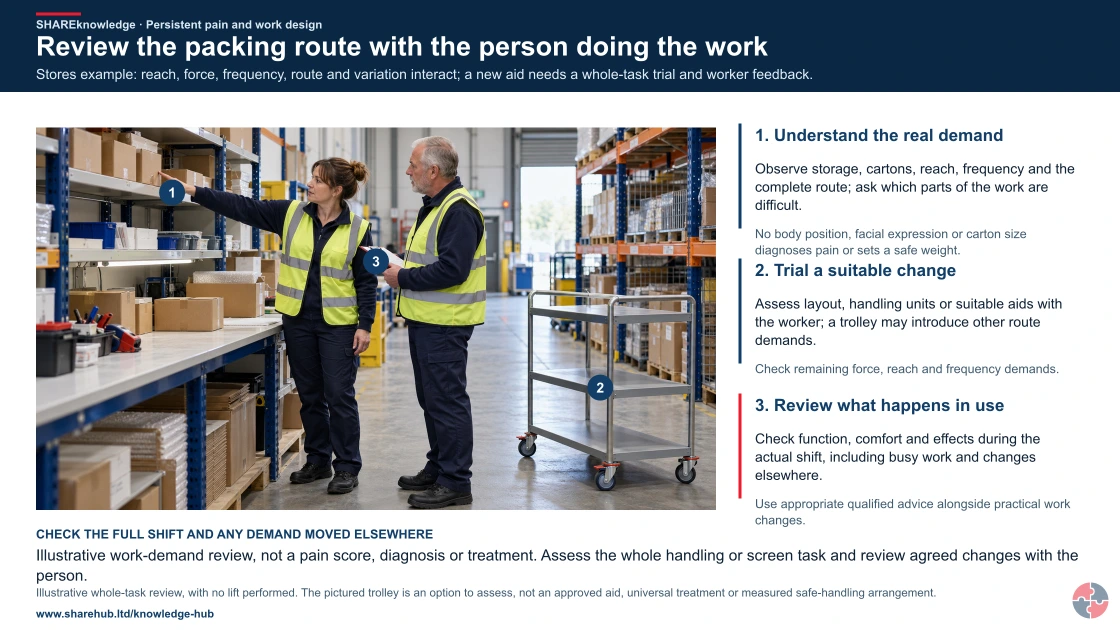
Full written explanation
Stores example: reach, force, frequency, route and variation interact; a new aid needs a whole-task trial and worker feedback.
- Understand the real demand. Observe storage, cartons, reach, frequency and the complete route; ask which parts of the work are difficult.
- Trial a suitable change. Assess layout, handling units or suitable aids with the worker; a trolley may introduce other route demands.
- Review what happens in use. Check function, comfort and effects during the actual shift, including busy work and changes elsewhere.
Change the pathway
- Do not judge from appearance. No body position, facial expression or carton size diagnoses pain or sets a safe weight.
- Check the complete system. Check remaining force, reach and frequency demands.
- Keep clinical interpretation separate. Use appropriate qualified advice alongside practical work changes.
Evidence check: Illustrative work-demand review, not a pain score, diagnosis or treatment. Assess the whole handling or screen task and review agreed changes with the person.
Complete whole-task adjustment and review context
Primary references: HSE: advice for workers with musculoskeletal disorders (GB) · HSE: screen-work routines and variation (GB) · Acas: reviewing agreed adjustments
Open the complete HD image (new tab)Download image
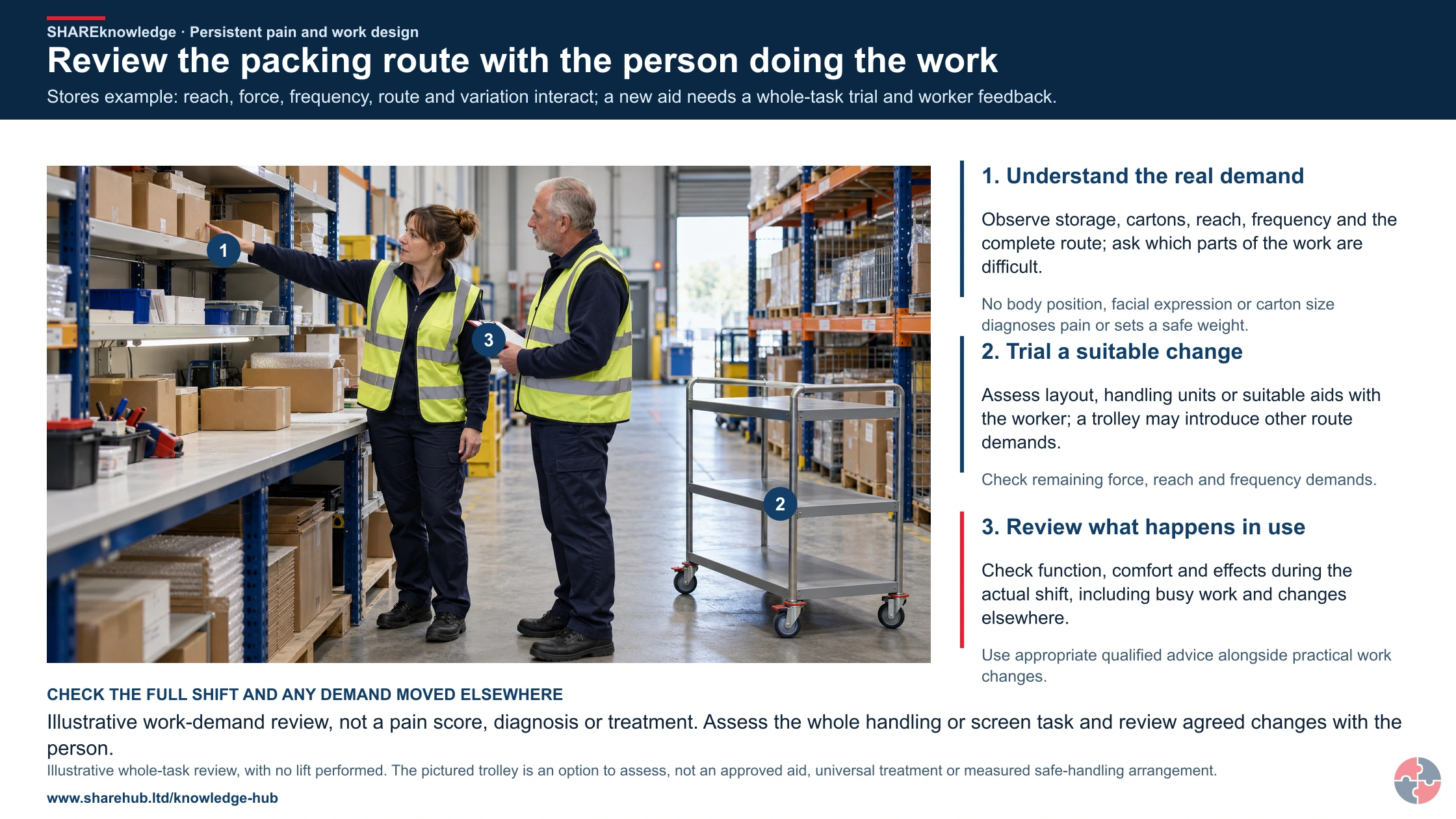
Complete whole-task adjustment and review context
Primary references: HSE: advice for workers with musculoskeletal disorders (GB) · HSE: screen-work routines and variation (GB) · Acas: reviewing agreed adjustments

Understand the demand
Observe cartons, reach, handling frequency, routes and task variation; ask which work is difficult.
Trial the change
Assess smaller handling units, layout or suitable aids with the worker; do not assume a new aid removes every demand.
Review the shift
Check actual use, comfort, function and effects on other tasks. Keep clinical interpretation separate.
No single posture or equipment item is a universal treatment. Reopen an adjustment that fails during busy work.
What is chronic pain and who assesses it?
Chronic pain lasts or recurs for more than three months; primary and secondary pain can coexist and need clinician-led assessment.
NICE NG193 distinguishes chronic primary pain, where no underlying condition adequately accounts for the pain or its impact, from chronic secondary pain due to an underlying condition. That clinical classification is not for a manager to make. Pain is real even when an injury is not obvious. A manager should ask how work is affected, which tasks can change, and whether occupational-health or clinical advice is needed. Check the direct source: NICE NG193 recommendations.
For care, NHS advice on getting help for pain starts with the GP and describes specialist support where appropriate. NICE NG193 covers assessment of chronic pain in people aged 16 and over; its treatment recommendations concern chronic primary pain. Do not apply them indiscriminately to secondary pain or turn them into manager-led treatment.
How can pain become chronic or work-limiting?
Pain can become chronic or work-limiting through tissue injury, long-term conditions, nervous system sensitisation, poor recovery, stress, sleep disturbance and repeated workplace loading.
Pain is an alarm and a lived experience, not a simple measure of tissue damage. Some pain relates to current tissue loading, inflammation or injury. Some persists after the original injury has healed. Some is influenced by nervous-system sensitivity, poor sleep, stress, fear of movement, deconditioning, workload or repeated exposure to awkward tasks.
Work can influence pain through dose and recovery. A task that is manageable once may become harmful when repeated all day without variation. Static sitting can be as problematic as lifting if posture is fixed and breaks are poor. Tools with poor handles can increase grip force; cold environments can worsen stiffness; pressure can increase muscle tension and fatigue.
This is why chronic pain management should combine health signposting with work design. The workplace cannot control every factor, but it can control many exposures: force, reach, repetition, posture, breaks, equipment, rota, supervision and the speed at which someone returns after absence.
| Mechanism | What it means | Work design response |
|---|---|---|
| Cumulative load | Repeated force, posture or movement exceeds recovery. | Reduce repetition, rotate tasks, improve tools and add breaks. |
| Static loading | Muscles stay active for long periods without movement. | Vary posture, provide adjustable seating and schedule micro-breaks. |
| Sensitisation | The nervous system responds more strongly to pain signals. | Avoid boom-and-bust workloads and use a worker-agreed phased return. |
| Poor sleep and fatigue | Reduced recovery increases pain sensitivity and error risk. | Review shifts, overtime, commute and workload timing. |
| Stress-pain interaction | Stress and pain can amplify each other. | Review demands, support, control and communication. |
| Fear of movement | People avoid movement and lose confidence or conditioning. | Use paced work duties with occupational-health advice where needed. |
NHS Cambridge University Hospitals pain explanation describes how pain may persist after healing and how sleep, stress and sensitivity can influence it. These are possible explanations, not proof that an individual has no ongoing tissue condition. New or changing symptoms need clinical assessment; work design should still remove harmful loads.
Which work factors can worsen chronic pain?
Work factors that can worsen chronic pain include poor manual handling, static posture, DSE setup, repetition, force, vibration, cold, workload, stress and insufficient recovery.
The task assessment should look beyond a single hazard label. Chronic pain may be affected by the way work is organised across the day: how often the task repeats, how much force is needed, whether the worker can vary posture, whether tools fit the hand, whether breaks are real, whether targets are realistic and whether the person has recovery time between demanding duties.
DSE work can worsen pain where the workstation is poorly adjusted, laptop use is prolonged, the worker has little movement variation or home-working setup is poor. Manual tasks can worsen pain where loads are heavy, awkward, frequent, held away from the body, carried over distance or combined with twisting and poor footing.
| Work factor | How it can affect pain | Prevention focus |
|---|---|---|
| Awkward posture | Increases strain on joints, muscles and soft tissues. | Redesign reach, height, layout and work position. |
| Repetition | Can overload tissues without recovery. | Task variation, rotation and automation. |
| Force and load | Heavy or forceful work can trigger flare-ups. | Mechanical aids, team handling and reduced load. |
| Static sitting or standing | Can increase stiffness, fatigue and discomfort. | Adjustable workstation and movement breaks. |
| Poor tools | Can increase grip force, vibration, contact stress or awkward wrists. | Better handles, maintenance and procurement standards. |
| Workload pressure | Can reduce breaks and increase muscle tension. | Realistic targets, support and work planning. |
| Cold or vibration | Can worsen stiffness, circulation issues or pain sensitivity. | Warmth, tool controls, exposure reduction and PPE. |
How should chronic pain and work be assessed?
Assess both the worker’s functional barriers and the actual task, without demanding a diagnosis or using pain intensity as a fitness test.
Discuss difficult tasks and useful changes privately. Observe force, load, repetition, reach, posture, duration, pace and recovery; include home DSE work and safety-critical duties where relevant. A task can aggravate pain without proving it caused the underlying condition. Use ergonomic and occupational-health advice for complex cases, and record a control, owner and review date rather than private clinical narrative.
On a small screen, scroll this table sideways to read all columns.
| Question | Evidence | Response |
|---|---|---|
| What work triggers difficulty? | Worker account and task observation. | Redesign load, posture, repetition or pace. |
| What is safety-sensitive? | Driving, machinery, height or critical decision demand. | Temporary task control and competent advice. |
| What is helping? | Worker feedback after trial change. | Retain, revise or remove adjustment by outcome. |
How can the hierarchy of controls reduce workplace demands that aggravate chronic pain?
The hierarchy reduces chronic pain risk by redesigning work, reducing load and improving equipment before relying on individual coping strategies.
For chronic pain, the hierarchy often means changing the work itself. Eliminate unnecessary manual handling, remove avoidable reaches, automate repetitive tasks, buy better tools, design adjustable workstations and reduce excessive pace. These controls are stronger than telling workers to stretch or take more care.
Administrative controls still matter: task rotation, work planning, breaks, phased return, training, early reporting and supervision. PPE is less central than for chemical hazards, but footwear, knee protection or thermal clothing may help where selected for a specific task and not used as a substitute for better design.
Choose the activity
How can the ERICPD hierarchy of controls reduce risks while moving cartons to a packing bench?

| Control level | Control for this activity | Owner and verification | Stop / restart decision |
|---|---|---|---|
| Eliminate | Arrange delivery at bench height and point of use so floor retrieval and a second manual lift are unnecessary. | Process owner verifies that the revised workflow achieves the required output and the hazardous step is genuinely removed. | If the hazardous step remains, retain a task assessment and select the stronger feasible remaining controls. |
| Reduce, including substitution | Replace heavy cartons with suitable smaller packs; check stability and total repetition before accepting the new pack size. | Process/technical owner validates the alternative, its compatibility and any new risks before adoption. | Reject the alternative if suitability is unproved or its new hazards are unresolved. |
| Isolate | Keep the unloading station away from vehicle movements and protect the clear route between pallet and bench. | Supervisor verifies the task boundaries and that the separation or isolation protects affected people and connected work. | Hold or stop for unstable load, failed aid, blocked route or pain during handling. |
| Control: physical safeguards | Provide a suitable pallet positioner or lifting aid and adjustable receiving surface; verify capacity and access with the real cartons. | Competent equipment/process owner checks load weight, working height, aid capacity and a full replenishment cycle. | Hold or stop for unstable load, failed aid, blocked route or pain during handling. |
| Control: work method and response | Agree replenishment quantities, handling limits and assistance before peak demand; do not use training to justify an excessive lift. | Supervisor confirms the limits, response, communication and restart authority with the people doing this activity. | Stop if the agreed method, communication, competent cover or task limits cannot be maintained. |
| PPE | Use grip and foot protection where contact hazards require it. A back belt does not control the load on the spine. | Assessor confirms whether PPE is needed and checks selection, condition, compatibility and any required face-fit evidence. | Do not rely on unsuitable or defective protection, or use PPE to continue after an essential source control fails. |
| Discipline | Inspect the aid and route each shift; review actual deliveries with workers when carton sizes or throughput change. | Release only after supervisor accepts the aid trial and revised delivery method. Retain the checks and unresolved restrictions at handover. | Keep the activity on hold while defects or required reinstatement evidence remain unresolved. |
How can the ISO 45001 hierarchy of controls reduce risks while moving cartons to a packing bench?

| Control level | Control for this activity | Owner and verification | Stop / restart decision |
|---|---|---|---|
| Elimination | Arrange delivery at bench height and point of use so floor retrieval and a second manual lift are unnecessary. | Process owner verifies that the revised workflow achieves the required output and the hazardous step is genuinely removed. | If the hazardous step remains, retain a task assessment and select the stronger feasible remaining controls. |
| Substitution | Replace heavy cartons with suitable smaller packs; check stability and total repetition before accepting the new pack size. | Process/technical owner validates the alternative, its compatibility and any new risks before adoption. | Reject the alternative if suitability is unproved or its new hazards are unresolved. |
| Engineering controls | Keep the unloading station away from vehicle movements and protect the clear route between pallet and bench. | Supervisor verifies the task boundaries and that the separation or isolation protects affected people and connected work. | Hold or stop for unstable load, failed aid, blocked route or pain during handling. |
| Engineering controls | Provide a suitable pallet positioner or lifting aid and adjustable receiving surface; verify capacity and access with the real cartons. | Competent equipment/process owner checks load weight, working height, aid capacity and a full replenishment cycle. | Hold or stop for unstable load, failed aid, blocked route or pain during handling. |
| Administrative controls | Agree replenishment quantities, handling limits and assistance before peak demand; do not use training to justify an excessive lift. | Supervisor confirms the limits, response, communication and restart authority with the people doing this activity. | Stop if the agreed method, communication, competent cover or task limits cannot be maintained. |
| PPE | Use grip and foot protection where contact hazards require it. A back belt does not control the load on the spine. | Assessor confirms whether PPE is needed and checks selection, condition, compatibility and any required face-fit evidence. | Do not rely on unsuitable or defective protection, or use PPE to continue after an essential source control fails. |
| Administrative controls | Inspect the aid and route each shift; review actual deliveries with workers when carton sizes or throughput change. | Release only after supervisor accepts the aid trial and revised delivery method. Retain the checks and unresolved restrictions at handover. | Keep the activity on hold while defects or required reinstatement evidence remain unresolved. |
How can the ERICPD hierarchy of controls reduce back strain during hybrid screen work?

| Control level | Control for this activity | Owner and verification | Stop / restart decision |
|---|---|---|---|
| Eliminate | Remove duplicate screen entry and unnecessary prolonged desk tasks from the workflow. | Process owner verifies that the revised workflow achieves the required output and the hazardous step is genuinely removed. | If the hazardous step remains, retain a task assessment and select the stronger feasible remaining controls. |
| Reduce, including substitution | Replace laptop-only work with a suitable separate display and input arrangement after trying it with the user. | The user trials the actual display, keyboard, pointing device and docking arrangement at both regular locations; the manager checks that adjustments and task changes remain usable. | Reject the alternative if suitability is unproved or its new hazards are unresolved. |
| Isolate | Provide a usable work area separated from storage and trip hazards so the worker can change posture safely. | Supervisor verifies the task boundaries and that the separation or isolation protects affected people and connected work. | Hold or stop for worsening symptoms, unusable equipment or work patterns that prevent agreed adjustments. |
| Control: physical safeguards | Adjust chair, screen, keyboard and desk to the user and task; provide a suitable docking arrangement at both regular locations. | Competent equipment/process owner checks both workstation assessments, equipment adjustment and realistic activity changes. | Hold or stop for worsening symptoms, unusable equipment or work patterns that prevent agreed adjustments. |
| Control: work method and response | Plan changes of activity and manageable meeting blocks; agree a route for reporting symptoms and reviewing adjustments. | Supervisor confirms the limits, response, communication and restart authority with the people doing this activity. | Stop if the agreed method, communication, competent cover or task limits cannot be maintained. |
| PPE | No PPE prevents posture-related back pain; suitable seating and task design belong to workplace controls. | Assessor confirms whether PPE is needed and checks selection, condition, compatibility and any required face-fit evidence. | Do not rely on unsuitable or defective protection, or use PPE to continue after an essential source control fails. |
| Discipline | Check adjustments after location, equipment or workload changes and confirm that the agreed breaks remain possible. | Release only after worker and manager confirm a workable setup and review date. Retain the checks and unresolved restrictions at handover. | Keep the activity on hold while defects or required reinstatement evidence remain unresolved. |
How can the ISO 45001 hierarchy of controls reduce back strain during hybrid screen work?

| Control level | Control for this activity | Owner and verification | Stop / restart decision |
|---|---|---|---|
| Elimination | Remove duplicate screen entry and unnecessary prolonged desk tasks from the workflow. | Process owner verifies that the revised workflow achieves the required output and the hazardous step is genuinely removed. | If the hazardous step remains, retain a task assessment and select the stronger feasible remaining controls. |
| Engineering controls | Replace laptop-only work with a suitable separate display and input arrangement after trying it with the user. | The user trials the actual display, keyboard, pointing device and docking arrangement at both regular locations; the manager checks that adjustments and task changes remain usable. | Reject the alternative if suitability is unproved or its new hazards are unresolved. |
| Engineering controls | Provide a usable work area separated from storage and trip hazards so the worker can change posture safely. | Supervisor verifies the task boundaries and that the separation or isolation protects affected people and connected work. | Hold or stop for worsening symptoms, unusable equipment or work patterns that prevent agreed adjustments. |
| Engineering controls | Adjust chair, screen, keyboard and desk to the user and task; provide a suitable docking arrangement at both regular locations. | Competent equipment/process owner checks both workstation assessments, equipment adjustment and realistic activity changes. | Hold or stop for worsening symptoms, unusable equipment or work patterns that prevent agreed adjustments. |
| Administrative controls | Plan changes of activity and manageable meeting blocks; agree a route for reporting symptoms and reviewing adjustments. | Supervisor confirms the limits, response, communication and restart authority with the people doing this activity. | Stop if the agreed method, communication, competent cover or task limits cannot be maintained. |
| PPE | No PPE prevents posture-related back pain; suitable seating and task design belong to workplace controls. | Assessor confirms whether PPE is needed and checks selection, condition, compatibility and any required face-fit evidence. | Do not rely on unsuitable or defective protection, or use PPE to continue after an essential source control fails. |
| Administrative controls | Check adjustments after location, equipment or workload changes and confirm that the agreed breaks remain possible. | Release only after worker and manager confirm a workable setup and review date. Retain the checks and unresolved restrictions at handover. | Keep the activity on hold while defects or required reinstatement evidence remain unresolved. |
Use HSE’s five-level hierarchy with ERICPD as a complementary teaching mnemonic. Engineering measures change the physical task or exposure pathway; administrative measures govern how work is done. The following scenario illustrates the choices and checks; it is not an equipment specification or clinical treatment plan.
Manual handling has its own legal sequence: avoid hazardous handling where reasonably practicable, assess unavoidable operations and reduce risk. Use HSE guidance in Great Britain and HSENI guidance in Northern Ireland. A lifting aid is a work control, not treatment for chronic pain.
Worked control choice: moving maintenance supplies
What reasonable adjustments may support chronic pain?
Reasonable adjustments should reduce barriers created by pain, work demands or the work environment and should be reviewed for effectiveness.
Adjustments do not have to be complicated. A different chair, sit-stand option, lighter tools, reduced carrying, task rotation, start-time flexibility, remote work, quiet workspace, reduced travel or written instructions can make work more sustainable.
Good adjustment planning is trial-based. Agree the adjustment, define what it is trying to achieve, give it a review date and ask the worker whether it is helping. If it does not work, amend it rather than assuming support has failed.
| Adjustment area | Examples | Review question |
|---|---|---|
| Workstation | Adjustable chair, sit-stand desk, monitor arm, alternative mouse or keyboard. | Is posture easier and pain reduced during screen work? |
| Manual tasks | Mechanical aids, reduced loads, team handling or alternative duties. | Has force, frequency or awkward handling reduced? |
| Hours and pacing | Flexible start, phased return, micro-breaks or shorter shifts. | Is the pattern sustainable without flare-ups? |
| Task mix | Rotate tasks, alternate sitting and standing, reduce repetitive work. | Is there enough variation and recovery? |
| Travel | Remote work, parking support, reduced travel or adjusted start time. | Does travel no longer consume most daily capacity? |
| Communication | Written priorities, fewer interruptions and regular check-ins. | Does the worker know what matters most and when to review? |
How should DSE be managed where chronic pain is present?
DSE should be managed by assessing workstation setup, posture, breaks, equipment, home working and the way screen work is organised.
DSE is often treated as a one-off form, but chronic pain needs a more practical review. The assessor should watch how the person actually works: laptop height, chair support, screen distance, mouse reach, phone use, document handling, glare, interruptions, workload and whether breaks are possible.
A home workstation can create pain even when the office setup is good. Hybrid workers may need equipment, guidance and a review of how long they work at kitchen tables, sofas or unsupported laptops.
| DSE issue | Why it matters | Control option |
|---|---|---|
| Laptop-only work | Can create neck, shoulder and wrist strain. | Separate screen or riser, keyboard and mouse. |
| Poor chair support | Can worsen back, hip or neck pain. | Adjustable chair, lumbar support and posture review. |
| Mouse or keyboard reach | Can increase shoulder, elbow or wrist discomfort. | Reposition equipment or use alternative devices. |
| Static screen time | Reduces movement variation. | Micro-breaks, task variation and prompts. |
| Home working setup | May lack suitable chair, desk or screen height. | Home DSE assessment and equipment provision where needed. |
| Workload and interruptions | Can stop breaks and increase tension. | Planning, focus time and realistic priorities. |
How should manual handling be managed where chronic pain is present?
Manual handling should be managed by reducing load, force, frequency, awkward posture, carrying distance and recovery gaps.
Manual handling assessment should consider the task, individual, load and environment. Chronic pain makes the individual factors especially important, but the answer should still be to redesign work where possible rather than expecting the worker to cope with poor handling tasks.
Useful controls include mechanical aids, smaller loads, better storage height, shorter carrying routes, team handling, task rotation, better footwear, improved housekeeping and planning deliveries so workers are not forced into rushed, awkward lifts.
| Handling factor | What to review | Practical control |
|---|---|---|
| Load | Weight, size, grip and predictability. | Reduce weight, split loads or use handling aids. |
| Posture | Twisting, bending, reaching and lifting from floor level. | Change storage height and layout. |
| Frequency | How often handling repeats during a shift. | Rotate tasks and reduce batch sizes. |
| Distance | How far loads are carried or pushed. | Improve layout, use trolleys and reduce travel. |
| Environment | Slips, slopes, cold, confined spaces or poor lighting. | Improve floor, route, temperature and access. |
| Individual capability | Pain, restrictions, fatigue and confidence. | Adjust duties and seek advice where needed. |
How should return to work be planned with chronic pain?
Agree a trial of suitable duties and review how the person functions; avoid a compulsory increase if symptoms or safety worsen.
Start with current functional capacity, practical task controls and any clinical or occupational-health recommendations. Agree hours, duties, equipment, breaks, review dates and a fallback if pain flares. NICE clinical treatment recommendations for chronic primary pain should not be turned into employer instructions to exercise or take medicine. Increased duties should follow safe tolerance and worker feedback, not a calendar target. Check the direct source: NICE NG193 recommendations.
How should pain-related information be handled?
Keep a restricted, purposeful record of work effects and agreed support; avoid unnecessary clinical detail.
Explain what will be recorded and shared. Health information requires an appropriate lawful basis, Article 9 condition, access controls and retention decision under UK GDPR. A supervisor may need to know a lifting restriction or modified shift, not medication history or diagnostic notes. Occupational health can hold clinical detail and share functional advice. Do not place a person’s health history in a general risk register.
Which duties are relevant to chronic pain at work?
Control work hazards under the correct GB or NI manual-handling and DSE rules, and apply the relevant equality and privacy law case by case.
In GB, HSE guidance supports the Manual Handling Operations Regulations 1992 and DSE Regulations 1992; in NI, HSENI identifies the separate NI 1992 instruments. Prevent or reduce risky handling and assess DSE user workstations. GB disability adjustments use the Equality Act 2010 and Acas; NI uses the Disability Discrimination Act 1995 and Equality Commission NI. Pain alone does not prove the legal disability test, but employers should explore support promptly. Clinical details are UK GDPR special-category data; managers usually need only restrictions and agreed changes. Check the direct source: HSE GB manual handling, HSENI NI manual handling.
On a small screen, scroll this table sideways to read all columns.
| Decision | Great Britain | Northern Ireland |
|---|---|---|
| Manual handling | GB 1992 Regulations; HSE guidance. | NI 1992 Regulations; HSENI guidance. |
| Display screen work | GB DSE Regulations; HSE guidance. | NI DSE Regulations; HSENI guidance. |
| Disability adjustments | Equality Act 2010; Acas. | DDA 1995; Equality Commission NI. |
| Health information | UK GDPR and ICO guidance. | UK GDPR and ICO guidance. |
How should chronic pain be reflected in risk management?
Chronic pain should appear in risk management where task design, ergonomics, workload or safety-critical duties could create harm or barriers.
A useful register does not label people as the risk. It describes work scenarios that could worsen pain or affect safe performance: repetitive packing, long DSE sessions, manual handling during stock delivery, prolonged standing, vehicle driving, work at height or return to full duties after absence.
Assurance should look at leading indicators: early discomfort reports, DSE actions not closed, manual-handling aids not used, repeated absence after particular tasks, high overtime or delayed adjustments.
| Scenario | Possible harm | Controls | Evidence |
|---|---|---|---|
| Prolonged screen work with poor setup | Neck, shoulder, wrist or back pain worsens. | DSE assessment, equipment and micro-breaks. | DSE records and worker feedback. |
| Manual handling during deliveries | Back, shoulder or joint flare-up. | Mechanical aids, reduced load and task rotation. | Manual-handling assessment and observation. |
| Return to full duties too quickly | Flare-up, absence and reduced confidence. | Phased return with changes guided by safe tolerance and worker feedback. | Return plan and review notes. |
| Pain affects safety-critical task | Distraction, slower movement or medication-related impairment. | Duty review, advice and temporary adjustment. | Risk assessment and OH referral. |
| Adjustment delays | Symptoms worsen while controls wait. | Action ownership and deadlines. | Action tracker and management review. |
How could BuildOut Ltd manage chronic pain and work?

BuildOut Ltd would manage chronic pain by treating early discomfort as work-design data and linking support to manual handling, tools, DSE, return-to-work and occupational health.
Trial screen-work changes and review the whole pattern
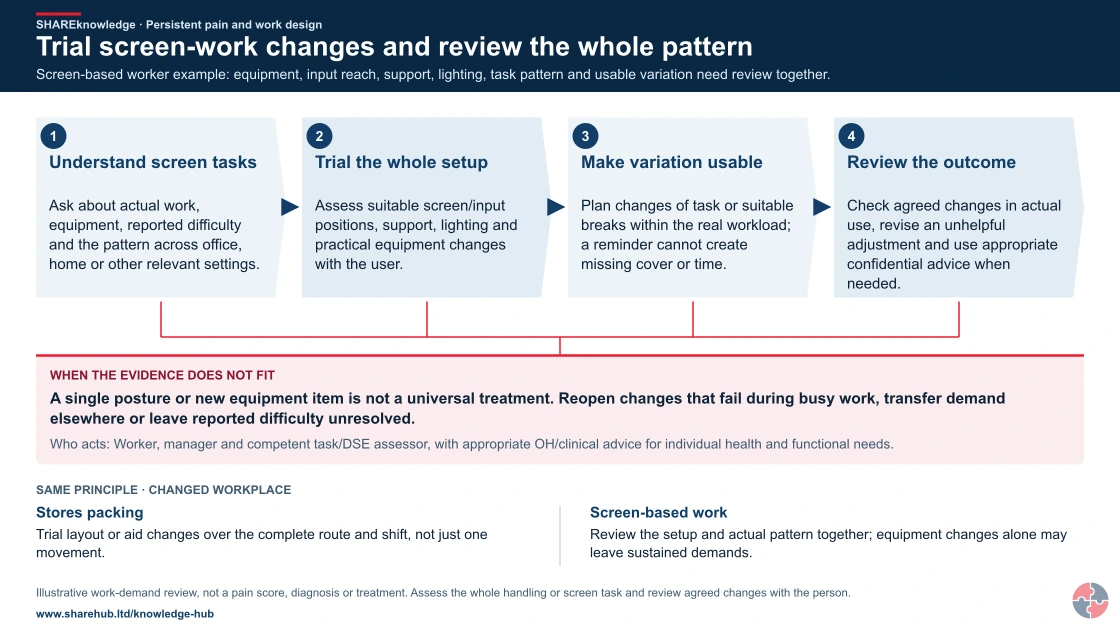
Full written explanation
Screen-based worker example: equipment, input reach, support, lighting, task pattern and usable variation need review together.
- Understand screen tasks. Ask about actual work, equipment, reported difficulty and the pattern across office, home or other relevant settings.
- Trial the whole setup. Assess suitable screen/input positions, support, lighting and practical equipment changes with the user.
- Make variation usable. Plan changes of task or suitable breaks within the real workload; a reminder cannot create missing cover or time.
- Review the outcome. Check agreed changes in actual use, revise an unhelpful adjustment and use appropriate confidential advice when needed.
When the evidence does not fit: A single posture or new equipment item is not a universal treatment. Reopen changes that fail during busy work, transfer demand elsewhere or leave reported difficulty unresolved.
Who acts: Worker, manager and competent task/DSE assessor, with appropriate OH/clinical advice for individual health and functional needs.
Changed workplace
Stores packing: Trial layout or aid changes over the complete route and shift, not just one movement.
Screen-based work: Review the setup and actual pattern together; equipment changes alone may leave sustained demands.
Evidence check: Illustrative work-demand review, not a pain score, diagnosis or treatment. Assess the whole handling or screen task and review agreed changes with the person.
Complete whole-task adjustment and review context
Primary references: HSE: advice for workers with musculoskeletal disorders (GB) · HSE: screen-work routines and variation (GB) · Acas: reviewing agreed adjustments
Open the complete HD image (new tab)Download image
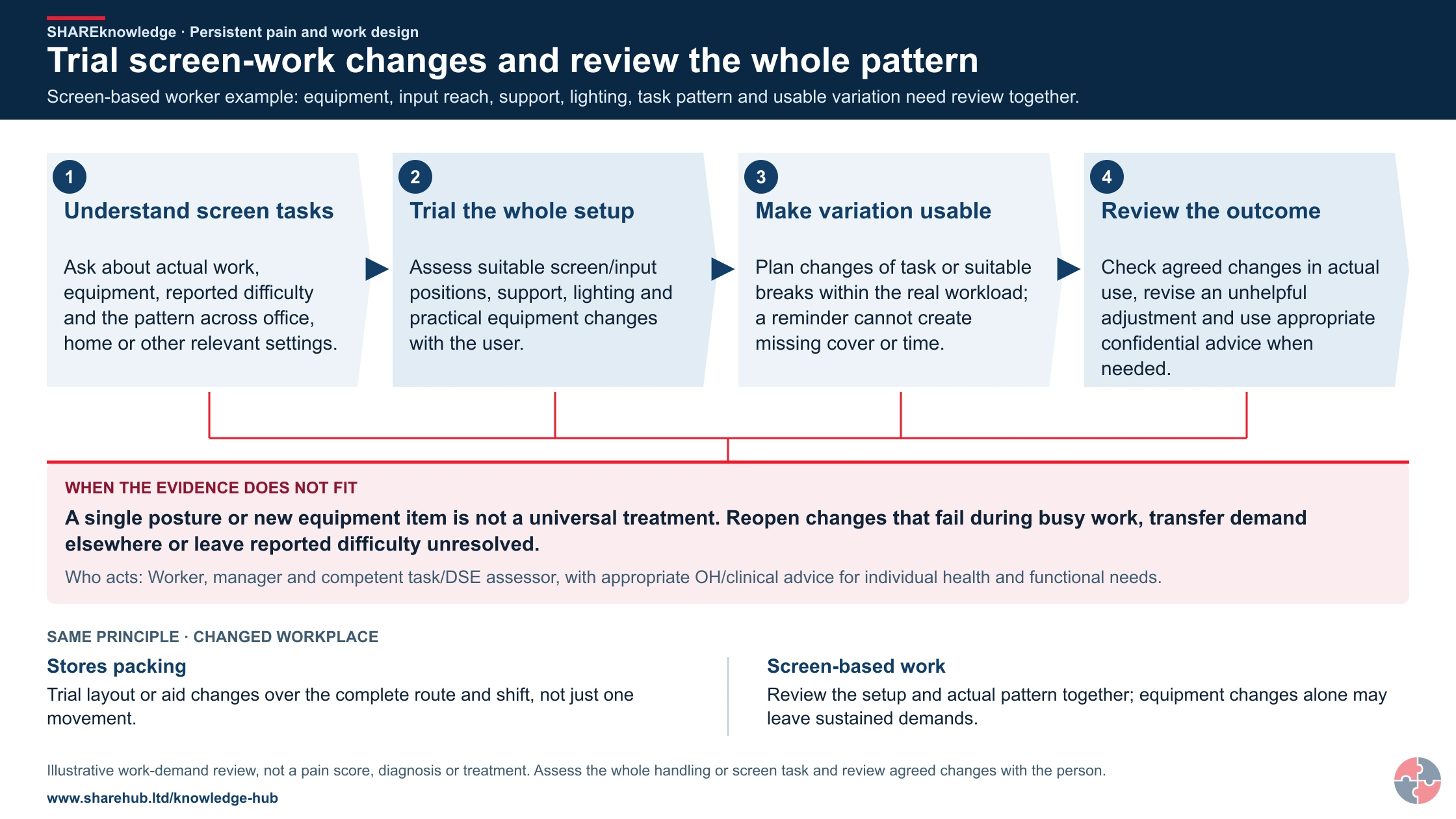
Complete whole-task adjustment and review context
Primary references: HSE: advice for workers with musculoskeletal disorders (GB) · HSE: screen-work routines and variation (GB) · Acas: reviewing agreed adjustments
BuildOut Ltd
A construction and property services business with site labour, supervisors, plant use, office design teams, maintenance, fit-out and subcontractors.
BuildOut sees chronic pain across several roles: labourers with back or shoulder pain, supervisors standing and walking long sites, plant operators sitting for long periods, designers using DSE and maintenance workers using awkward tools. The business does not treat these as isolated personal problems; it maps pain reports against tasks, equipment, working patterns and absence data.
The management system starts with assessment. Manual-handling tasks are reviewed for load, posture, frequency and environment. DSE assessments are refreshed for office and hybrid workers. Procurement checks whether tools increase grip force, vibration or awkward posture. Return-to-work plans use staged duties and review dates rather than sudden return to full workload.
BuildOut uses three assurance levels. Frontline supervisors complete short binary checks on handling aids, storage heights, breaks, task rotation and whether discomfort has been reported. The H&S adviser samples manual-handling and DSE assessments, checks action quality and reviews absence trends. Periodic external ergonomic or ISO-style audits test whether the controls are embedded and whether management review is improving task design.
| Management area | How BuildOut applies the control | Evidence and improvement |
|---|---|---|
| Assess and analyse | Links pain reports to task observations, manual handling, DSE, tools, workload and return-to-work cases. | Risk register, task assessments, DSE forms and absence trend review. |
| Implement controls | Uses handling aids, improved storage, tool changes, task rotation, seating and worker-agreed phased return. | Procurement records, inspection checks and worker feedback. |
| Train and communicate | Trains supervisors on early reporting, manual-handling principles, DSE, adjustments and private conversations. | Training matrix, toolbox talks and manager scenarios. |
| Check and audit | Runs frontline checks, H&S audits and specialist ergonomic reviews for higher-risk tasks. | Binary checklists, audit findings, ranked actions and close-out. |
| Manage competence | Defines competence for manual-handling assessors, DSE assessors and supervisors managing return to work. | Competence records and refresher triggers. |
| Learn and improve | Reviews pain reports after projects, tool changes, absence spikes and audit findings. | Management review, procurement changes and updated method statements. |
What should each role learn and demonstrate?
Learning must match the decisions people make, from recognising danger to checking that controls work.
Briefings should tell people how to act, but attendance alone does not show competence. Assess the real decision or task, record who assessed it and revisit after a material change, failed control or incident. A local authorisation is task-specific; no universal external certificate is implied.
On a small screen, scroll this table sideways to read all columns.
| Role and learning | Demonstration and assessor | Record and reassessment trigger |
|---|---|---|
| Manager: listen and trial. | Assess a pain report without diagnosis or disbelief; agree adjustment and review. | Functional plan and worker feedback. |
| Ergonomics assessor: task control. | Observe a lift and DSE workstation and remove avoidable load. | Task assessment and implementation check. |
| Safety lead: critical duties. | Review driving or machinery where function or medication effect is uncertain. | Temporary control and occupational-health advice. |
| HR/privacy lead: GB/NI route. | Compare adjustment law and test access to health records. | Dated decision and access audit. |
How does chronic pain support study and professional development?
Chronic pain helps learners connect ergonomics, occupational health, DSE, manual handling, reasonable adjustments and management systems.
For study, chronic pain is valuable because it shows the difference between hazard control and individual support. Learners should be able to explain how work factors can contribute to pain and how task design can reduce strain before symptoms become disabling.
Scenario questions may involve an office worker with neck pain, a warehouse worker with back pain, a site worker returning after injury or a manager dismissing pain as poor attitude. Good answers should include assessment, worker consultation, ergonomic control, adjustments, occupational health and review.
| Learning area | What to understand | How to apply it |
|---|---|---|
| Manual handling | Load, posture, frequency, environment and individual capability. | Reduce handling and redesign the task. |
| DSE | Workstation setup, posture, breaks and home-working arrangements. | Complete practical DSE review and close actions. |
| MSDs | How cumulative strain and poor recovery can affect health. | Use early reports as leading indicators. |
| Reasonable adjustments | How chronic pain may create disability-related barriers. | Consider flexible hours, equipment and phased return. |
| Human factors | How pain, fatigue and stress can affect attention and error. | Review safety-critical duties and workload. |
How can a management system sustain effective decisions?
Give each hazard or support route an owner, a control, a check and a response to failure.
Track task-design changes, worker feedback, flare-up response and adjustment completion. A policy or training attendance alone cannot show that load and posture were reduced. An owner should sample actual work and corrective actions, not accept a policy or certificate as evidence that the controls work.
The free GB regulator guide HSE Managing for health and safety (HSG65) explains a plan–do–check–act approach: assign controls and owners, involve workers, check work as done, and correct failures. For Northern Ireland, use HSENI risk assessment guidance for the local duty. A certificate alone does not demonstrate that a control works.
What warning signs show chronic pain is not being managed well?
Warning signs include repeated pain reports, delayed adjustments, poor DSE action close-out, manual-handling shortcuts and managers treating pain as attitude.
Warning signs should lead to review before harm escalates. If several people report discomfort from the same workstation, tool or handling task, that is a system signal. If one person keeps flaring after the same duty, the adjustment may be wrong or not implemented.
Poor culture is also a warning sign. Disbelief, jokes about pain, pressure to prove symptoms or punishment for early reporting will drive problems underground until absence or injury becomes harder to manage.
| Warning sign | How harm can develop | What to do |
|---|---|---|
| Pain reports are normalised | Workers continue until pain becomes disabling. | Investigate task design and controls. |
| DSE actions stay open | Neck, shoulder, wrist or back pain may worsen. | Assign owners and close actions. |
| Handling aids are not used | Manual load remains uncontrolled. | Check availability, training and supervision. |
| Return plan jumps too quickly | Flare-up and further absence can follow. | Use worker-agreed phased return and review. |
| Manager questions whether pain is real | Trust is lost and early reporting stops. | Train managers in supportive conversations. |
| Medication effects are ignored | Safety-critical work may be affected. | Review duties and seek competent advice. |
What acronyms are used on this chronic pain page?
Acronyms should be clear because ergonomic, HR and health terminology can be unfamiliar.
| Acronym | Meaning | Why it matters |
|---|---|---|
| MSD | Musculoskeletal disorder | Covers injuries or disorders affecting muscles, joints, tendons, ligaments, nerves and supporting structures. |
| DSE | Display screen equipment | Screen-based equipment such as computers, laptops and workstations. |
| OH | Occupational health | Specialist advice on health, function and work adjustments. |
| HR | Human resources | Supports fair process, absence and adjustments. |
| HSE | Health and Safety Executive | UK regulator and source of workplace safety guidance. |
| ICO | Information Commissioner's Office | UK data-protection regulator. |
| RAMS | Risk assessment and method statement | Common work planning document used for task controls. |