
SHARE Knowledge Hub
De Quervain's Tenosynovitis
De Quervain's tenosynovitis is a painful condition affecting tendons on the thumb side of the wrist. This page helps workers and managers recognise a reason to seek advice and review tasks that aggravate symptoms. It cannot diagnose the cause of wrist pain or prescribe treatment.
Understanding De Quervain's Tenosynovitis
De Quervain's tenosynovitis is a painful condition affecting tendons on the thumb side of the wrist. This page helps workers and managers recognise a reason to seek advice and review tasks that aggravate symptoms. It cannot diagnose the cause of wrist pain or prescribe treatment.
Why this matters at work
Do not confuse this disease category with carpal tunnel syndrome or HAVS, which have different reportable disease and associated-hazard criteria. Use the current HSE occupational-disease guidance at the time of decision. Where uncertainty remains, obtain competent advice rather than telling a worker the condition is or is not reportable by default.
Job rotation reduces risk only when the alternate work uses different muscles, posture, force and vibration. Create a task-exposure matrix and include both hands. Rotation can spread exposure to more people if badly designed and may require additional health surveillance.
How organisations manage this in practice
Isolate the hand from exposure through fixtures, clamps, jigs, automatic feeds, remote controls, torque-reaction arms, tool balancers and vibration-isolated handles or mounts designed for the equipment. The control should remove the need for forceful holding and maintain a neutral wrist.
Administrative controls include planned exposure, task allocation, suitable staffing, realistic work rate, breaks, maintenance, procurement standards, training, supervision, early reporting and health surveillance where required. They support engineering controls and are vulnerable to production pressure.
First, appoint an accountable owner and multidisciplinary team covering operations, engineering, procurement, maintenance, H&S, OH, HR, data protection and worker representatives. Inventory high-hand-force, repetitive, DSE and vibration tasks, existing cases, tools, surveillance and contractor interfaces.
Challenge why a powered hand tool or forceful grip is needed. Product and process design often offers the largest reduction: change fastener, tolerance, joint, packaging, material, access or quality control. Prevention through procurement is more reliable than limiting worker time around a poor design.
The engineer owns the redesign; operations owns a realistic pace and relief plan; maintenance owns fixture and consumable condition. Verification should compare the demanding task variant before and after the change, include worker feedback and check that faster processing has not increased repetition. Keep the trial conditions, accepted variants, remaining restrictions and review date. This is a practical application of ergonomics guidance, not a clinical causation finding.
Who can use this page?
Workers can use it to explain symptoms and request support. Supervisors and managers can use it to review demands and adjustments without attempting a diagnosis. Safety advisers, occupational health teams and learners can connect individual needs with the assessment of upper-limb demands.
How should the whole packing task be checked after a change?
Review force, grip, thumb movement and pace across the whole task. A change is useful when the worker can use it without moving the strain to another step; clinical assessment and treatment remain separate.
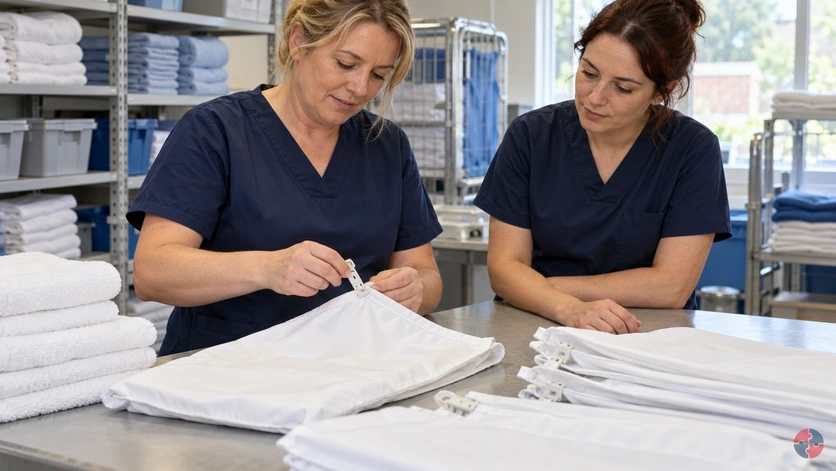
Review thumb demand without labelling a diagnosis
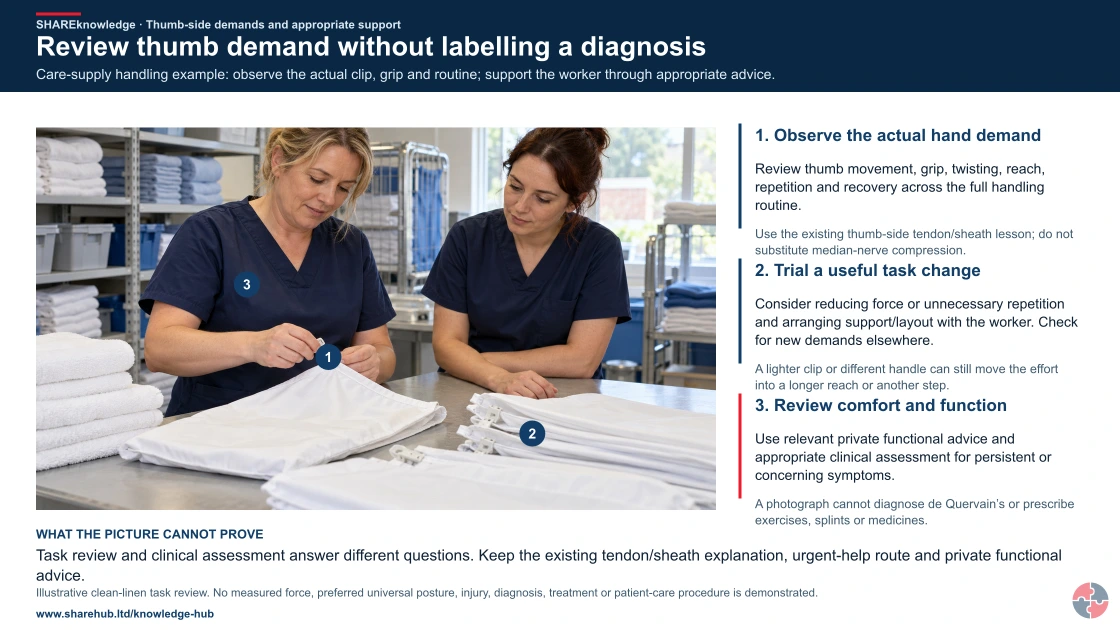
Full written explanation
Care-supply handling example: observe the actual clip, grip and routine; support the worker through appropriate advice.
- Observe the actual hand demand. Review thumb movement, grip, twisting, reach, repetition and recovery across the full handling routine.
- Trial a useful task change. Consider reducing force or unnecessary repetition and arranging support/layout with the worker. Check for new demands elsewhere.
- Review comfort and function. Use relevant private functional advice and appropriate clinical assessment for persistent or concerning symptoms.
Change the pathway
- Keep the mechanism specific. Use the existing thumb-side tendon/sheath lesson; do not substitute median-nerve compression.
- Do not judge the aid alone. A lighter clip or different handle can still move the effort into a longer reach or another step.
- No painful test or generic treatment. A photograph cannot diagnose de Quervain’s or prescribe exercises, splints or medicines.
| TASK DEMAND | CHANGE TO TRIAL | CHECK THE WHOLE CYCLE |
|---|---|---|
| Repeated grip / thumb use | Assess a lower-demand tool or method | Observe force, movement and worker feedback |
| Carton moved farther away | Trial the aid and layout together | Check reach and the return movement |
| Peak pace / little recovery | Review task mix, pace and recovery | Check whether the different work reduces demand |
Evidence check: Task review and clinical assessment answer different questions. Keep the existing tendon/sheath explanation, urgent-help route and private functional advice.
Existing symptom, clinical assessment and urgent-help guidance
Primary references: HSE: upper-limb task assessment and trialling changes (GB) · NHS: tendon symptoms and appropriate help
Open the complete HD image (new tab)Download image
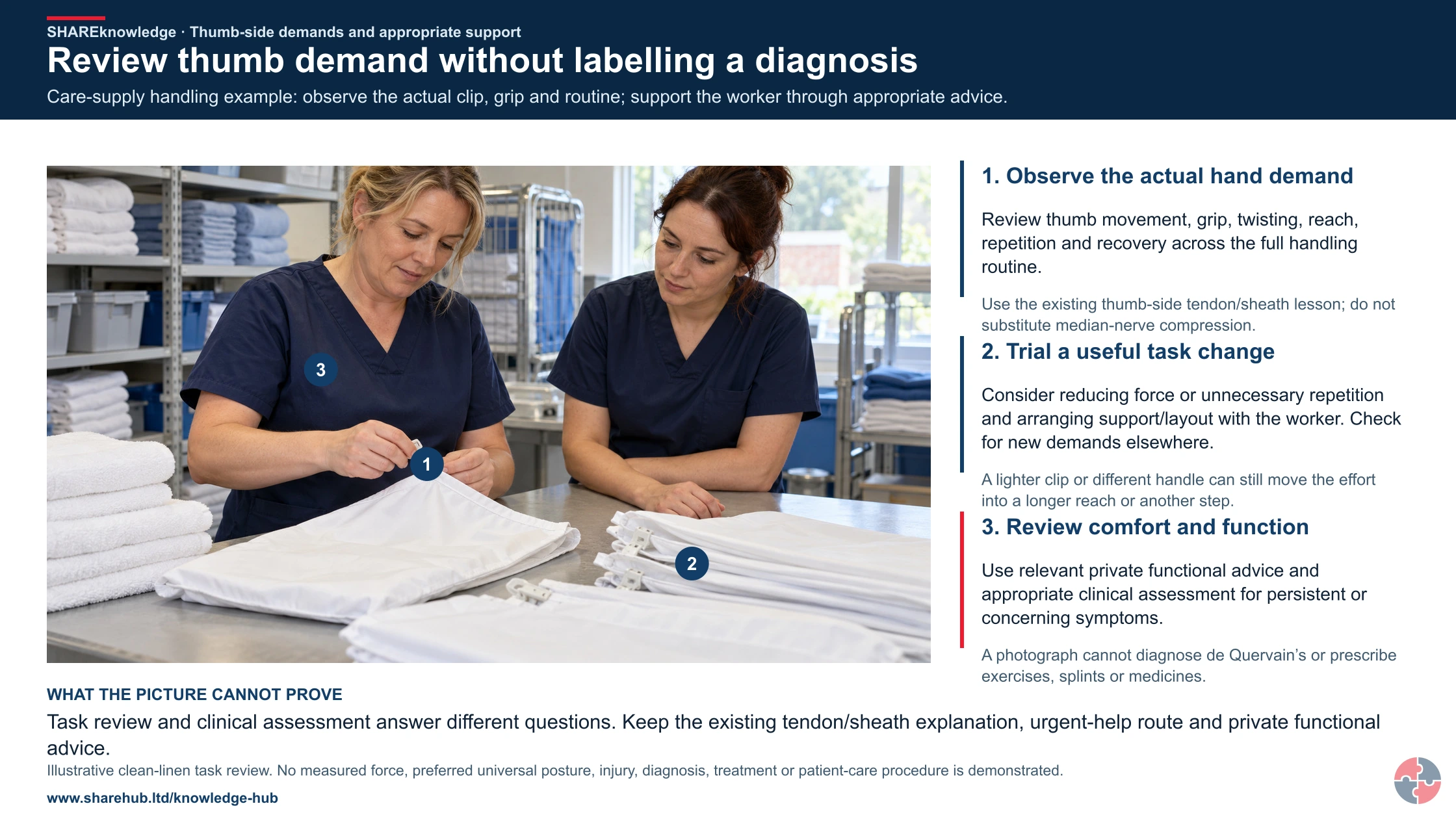
Existing symptom, clinical assessment and urgent-help guidance
Primary references: HSE: upper-limb task assessment and trialling changes (GB) · NHS: tendon symptoms and appropriate help
A packing aid that creates a new awkward reach
Illustrative example. A new dispenser reduces thumb movement but places cartons farther away.
Decision. Trial a revised position and workflow with the worker rather than accepting the aid on its own.
Evidence to check. Worker feedback, observed reach and force, task frequency and the return movement.
Hold or escalation point. Reconsider a change that increases discomfort or transfers loading elsewhere.
Follow-up. Check again during normal peak demand and use the confidential support route when needed.
How can a work trial reduce demands on the thumb and wrist?
A work trial can reduce repeated thumb movement, forceful gripping and awkward wrist positions by changing how the task is arranged. Agree the trial with the worker, check its effect during normal work and seek appropriate health advice about persistent symptoms.
The existing anatomy explains tendon/sheath location and normal glide. The work trial addresses grip, support and reach without diagnosing the source of symptoms.

Understand the task
Observe thumb use, grip, reach, duration and repetition through the actual packing cycle.
Trial an adjustment
Assess support and layout changes with the worker, checking that the change does not create another demand.
Review function
Ask about comfort and function and use appropriate clinical assessment of persistent or concerning symptoms.
No hand silhouette provides an injury grade or a universal exercise/treatment instruction.
Which symptoms should prompt appropriate advice?
Pain near the base of the thumb may extend towards the forearm. Gripping, lifting or thumb and wrist movement may aggravate it. Similar symptoms can have other causes, so a clinician should assess the situation rather than a workplace checklist labelling it as de Quervain's.
Speak to a GP or an appropriate NHS musculoskeletal service about persistent symptoms or restricted function. For severe pain or a suspected tendon rupture, NHS guidance advises urgent help through 111. Use the local urgent-care route if 111 is not available where you are.
Do not force painful self-tests, copy another person's exercise programme or use this page to choose medicines or injections. A clinician or pharmacist can advise on suitable treatment; rehabilitation and work advice should fit the individual.
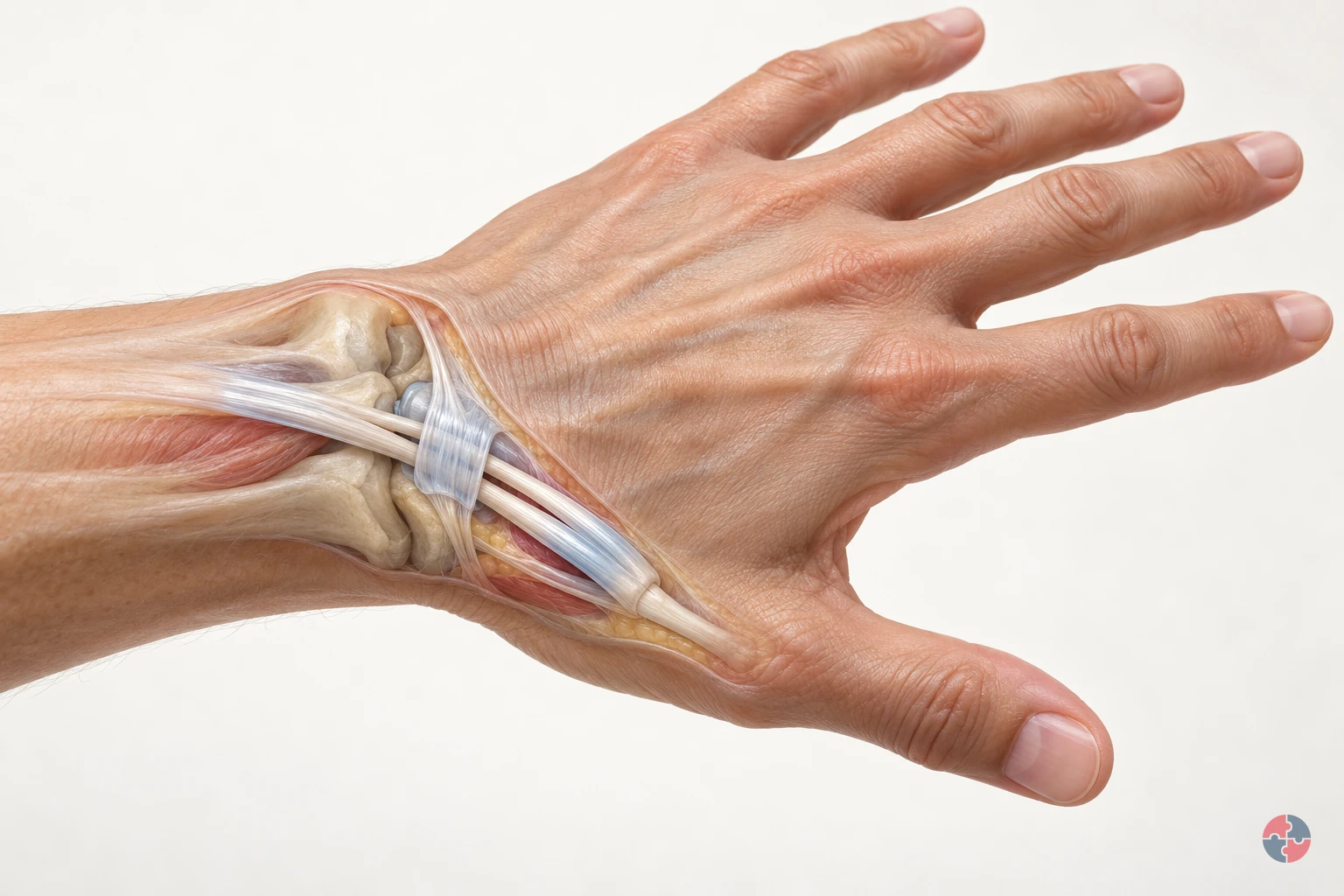

How does a working hand move, and what changes in nerve and tendon problems?
Interactive anatomy · Tendons, nerves and cushioning tissues · Updated 2026-10-23
Read all anatomy and process explanations without the viewer
General anatomy and example mechanisms, not diagnosis, treatment choice or fitness-for-work assessment. These are examples of mechanisms. Similar symptoms can have different causes. Self-provocation or nerve-tapping tests Exercise or stretching prescriptions Automatic symptom classification or a generic RSI lesion Treatment, return-to-work clearance or a task-based diagnosis Unreviewed shoulder, medial-elbow or trigger-finger damage overlays The prepatellar-bursitis route requires the dedicated labelled front-of-knee inset. A wrist/shoulder substitute is not suitable. Prompt-help text remains outside the model and scenarios.
Forearm flexor muscles
These muscles contract and pull through tendons to bend the fingers and thumb. The forearm flexor muscles generate the pull transmitted through tendons into the fingers and thumb. As the illustrated grip closes, follow the muscle region towards those slender connections. Their action bends the finger joints; the tendon transfers the pull rather than generating it. The visible shape change makes this relationship clearer and does not measure muscle effort. Gloucestershire Hospitals NHS Foundation Trust: Flexor Tendon Injuries
Flexor tendons
These tendons carry muscle force into the hand. Flexor tendons connect forearm muscles with bones in the hand. Their glide lets a muscle’s pull bend the finger joints while guided paths keep the tendons near the skeleton. Nine flexor tendons pass through the carpal tunnel. Compare their mechanical role with the nearby median nerve, which carries signals rather than pulling on bone. Gloucestershire Hospitals NHS Foundation Trust: Flexor Tendon Injuries · Whittington Health NHS Trust: Carpal Tunnel Syndrome
Tendon sheath
The sheath surrounds the tendon and supports smooth glide. A tendon sheath surrounds and supports a tendon as it glides. Along the fingers, pulley structures help keep the tendon close to the bones so its pull acts along a guided route. Watch the tendon move relative to its surroundings. A sheath is part of that supporting passage, not another muscle producing the same pull. Gateshead Health NHS Foundation Trust: Trigger Finger/Thumb Release Surgery
Carpal bones
Eight small carpal bones make up the wrist. Their curved arrangement forms the bony side of the carpal tunnel. The transverse carpal ligament closes the tunnel across the palm side. King’s College Hospital NHS Foundation Trust: Carpal tunnel syndrome — patient information · Kent Community Health NHS Foundation Trust: Carpal tunnel syndrome guide for patients
Transverse carpal ligament
This strong ligament spans the palm side of the wrist. It forms the roof above the median nerve and flexor tendons. Separating layers in the model helps reveal these relationships. King’s College Hospital NHS Foundation Trust: Carpal tunnel syndrome — patient information · Whittington Health NHS Trust: Carpal Tunnel Syndrome
Median nerve
The median nerve carries signals for feeling and some thumb movement. The median nerve carries sensory information from the thumb, index and middle fingers and part of the ring finger, and helps control some thumb muscles. Follow its branches beyond the shared wrist passage. The cyan travel cue represents communication; it is not a visible electrical flash, a nerve-speed measurement or a map for diagnosing altered sensation. NHS: Carpal tunnel syndrome · Kent Community Health NHS Foundation Trust: Carpal tunnel syndrome guide for patients · Whittington Health NHS Trust: Carpal Tunnel Syndrome
Thumb tendon: APL
Abductor pollicis longus helps move the thumb away from the hand. APL passes along the thumb side of the wrist through the first dorsal compartment. Follow it towards the base of the thumb. Ashford and St Peter’s Hospitals NHS Foundation Trust: De Quervains · Wrightington, Wigan and Leigh Teaching Hospitals NHS Foundation Trust: De Quervain’s Syndrome
Thumb tendon: EPB
Extensor pollicis brevis helps straighten the thumb. EPB travels beside APL through the first dorsal compartment on the thumb side of the wrist. Ashford and St Peter’s Hospitals NHS Foundation Trust: De Quervains · Wrightington, Wigan and Leigh Teaching Hospitals NHS Foundation Trust: De Quervain’s Syndrome
First dorsal compartment
A small passage on the thumb side of the wrist guides APL and EPB. The tendons normally glide through their sheath here. This is the location of the De Quervain’s example; the carpal tunnel lies on the palm side. Ashford and St Peter’s Hospitals NHS Foundation Trust: De Quervains · Wrightington, Wigan and Leigh Teaching Hospitals NHS Foundation Trust: De Quervain’s Syndrome
Outer elbow tendon attachment
Forearm tendons attach to bone near the outside of the elbow. Forearm extensor tendons attach near the bony point on the outside of the elbow, the lateral epicondyle. These muscles extend and help steady the wrist during gripping. Link the closer attachment view with the tool task to see why an elbow structure matters during hand use. Pain here does not establish a torn or detached tendon. NHS: Tennis elbow · Berkshire Healthcare NHS Foundation Trust: Advice and resources: Lateral elbow tendinopathy · Newcastle Hospitals NHS Foundation Trust: Tennis elbow
Prepatellar bursa
A fluid-containing sac helps reduce friction at the front of the kneecap. The prepatellar bursa lies between the kneecap and the overlying soft tissues, outside the knee joint. Its fluid-containing structure helps cushioning and smooth glide over bone. Compare the closer view with the worker’s knee contact in the floor task. The normal view locates the sac; it does not diagnose inflammation or measure pressure during kneeling. NHS: Bursitis · Leeds Community Healthcare NHS Trust: About pre-patella bursitis
Open the complete process transcript
The process, step by step
Watch muscles pull and tendons glide
The forearm muscles provide much of the pull that closes the fingers around an object. When these muscles contract, their tendons transmit force into the hand and pull on the finger bones, bending the joints. The tendons glide along guided paths rather than pulling away from the fingers like loose cords. Follow the muscle-to-tendon connection as the illustrated grip closes, then follow the return movement as the hand opens. The model enlarges this motion so that you can connect the movement at the fingers with the working structures farther up the forearm. Gloucestershire Hospitals NHS Foundation Trust: Flexor Tendon Injuries · Gateshead Health NHS Foundation Trust: Trigger Finger/Thumb Release Surgery
What to watch: Look from the forearm muscle bellies towards the slender flexor tendons, then follow their paths into the fingers around the handle.
Why it matters: Tendons transfer a muscle’s mechanical pull to bone, allowing joints to move. Guided tendon paths help direct that pull through the hand; the nerve has a different role in signalling.
Explore this step: Pause during the grip and trace one tendon from its forearm muscle towards the finger.
Watch tendon glide through the wrist
The carpal tunnel is a passage at the wrist, with a bony boundary formed by the carpal bones and a strong ligament spanning the palm side. Nine flexor tendons and the median nerve pass through this shared space. The tendons transmit the pull that helps bend the fingers and thumb; the nerve carries signals. Follow the tendon movement beneath the ligament roof and compare it with the nerve’s position. The cutaway separates the layers for learning, but these structures normally remain close together within a connected wrist. King’s College Hospital NHS Foundation Trust: Carpal tunnel syndrome — patient information · Kent Community Health NHS Foundation Trust: Carpal tunnel syndrome guide for patients · Whittington Health NHS Trust: Carpal Tunnel Syndrome
What to watch: Find the carpal bones and ligament roof, then compare the flexor tendons with the median nerve passing through the same wrist passage.
Why it matters: The tunnel brings several structures through a compact part of the wrist. Understanding their different functions explains why tendon glide and nerve signalling must be explored separately even though they occupy nearby space.
Explore this step: Use the labels to identify the tunnel boundary, a tendon and the nerve without changing to an injury example.
Follow the nerve signal
The median nerve links part of the hand with the nervous system. It carries sensory information from the thumb, index finger, middle finger and part of the ring finger, and helps control some muscles at the base of the thumb. Follow the cyan travelling cue along the nerve and into its branches. This colour illustrates signalling; a real nerve does not visibly light up. Compare that pathway with the tendons beside it: tendons transfer mechanical pull, whereas the nerve carries information. The simplified branches are a teaching map, not a test of a person’s sensation. Kent Community Health NHS Foundation Trust: Carpal tunnel syndrome guide for patients · Whittington Health NHS Trust: Carpal Tunnel Syndrome
What to watch: Follow the cyan cue along the median nerve through the wrist into the palm, keeping the adjacent tendons in view.
Why it matters: Sensation helps the nervous system receive information from the hand, while motor signals contribute to thumb control. Distinguishing information from mechanical pull makes the coordinated hand function easier to understand.
Explore this step: Compare the nerve cue with tendon glide and explain which one represents information and which represents force transfer.
Follow the thumb tendons
Two tendons run along the thumb side of the wrist through the first dorsal compartment. They connect forearm muscles to the thumb and glide as the thumb changes position. Abductor pollicis longus, labelled APL, helps move the thumb away from the hand. Extensor pollicis brevis, labelled EPB, helps straighten it. Follow the two labelled paths rather than assuming they pass through the palm-side carpal tunnel. The model brings their movement and location into view so that the separate actions and their shared guiding passage can be understood together. Ashford and St Peter’s Hospitals NHS Foundation Trust: De Quervains · Wrightington, Wigan and Leigh Teaching Hospitals NHS Foundation Trust: De Quervain’s Syndrome
What to watch: Find APL and EPB beside the thumb side of the wrist, then follow both labelled paths through the first dorsal compartment.
Why it matters: Different tendon actions contribute to positioning the thumb for hand use. Their shared passage guides glide, but the two tendons retain different attachments and functions; they are not interchangeable parts.
Explore this step: Select each tendon in turn and connect its name with the thumb movement described in the explanation.
Follow the elbow during a tool task
A tool task involves more than the muscles that visibly close the fingers. Forearm extensor muscles also help hold the wrist steady while the hand grips. Follow these muscles back towards their tendon attachment near the bony point on the outside of the elbow, called the lateral epicondyle. Watch the technician’s illustrated grip and tool turn, then use the closer elbow view to connect the activity with this attachment. A moving tool does not demonstrate a damaged tendon: the normal task and the separate tissue example explain different things. NHS: Tennis elbow · Newcastle Hospitals NHS Foundation Trust: Tennis elbow
What to watch: Watch the hand grip the screwdriver, then follow the working forearm towards the tendon attachment on the outside of the elbow.
Why it matters: Wrist stability helps the hand grip and use an object, so a tendon attachment near the elbow can be involved in a hand task. Movement alone does not show injury or quantify the demand.
Explore this step: Switch between Work activity and Elbow cutaway and describe how the two views relate to the same task.
Locate the bursa in front of the kneecap
The prepatellar bursa is a small fluid-containing sac in front of the kneecap. It helps the overlying soft tissues move across the bone with less friction. First locate the front of the knee in the floor-laying task, then follow the linked closer view to the thin sac outside the knee joint. This shows where contact during kneeling relates to the anatomy; the bursa is not a cushion inside the joint. The normal location lesson remains separate from the example of bursal irritation, and the short model sequence does not predict when symptoms would occur. Leeds Community Healthcare NHS Trust: About pre-patella bursitis · NHS Musculoskeletal Matters Dorset: Prepatellar bursitis
What to watch: Locate the kneeling worker’s front-of-knee contact, then find the thin bursa between the kneecap and the overlying soft tissues in the close view.
Why it matters: Glide between soft tissue and bone is a different function from movement inside the knee joint. Locating the bursa makes the relevant contact area clear without inferring tissue damage from posture alone.
Explore this step: Compare Floor-laying task with Knee cutaway and identify which side of the kneecap contains the bursa.
Mechanisms and their limits
De Quervain’s: thumb tendon and sheath In De Quervain’s, the sheath around APL and EPB at the thumb side of the wrist can become swollen or thickened, making tendon glide painful. The comparison concerns the first dorsal compartment, not the carpal tunnel. The cause is not always clear. Repetitive work is a possible contributor, not proof of diagnosis. This lesson does not prescribe thumb tests, stretching, splints or treatment. Ashford and St Peter’s Hospitals NHS Foundation Trust: De Quervains · Wrightington, Wigan and Leigh Teaching Hospitals NHS Foundation Trust: De Quervain’s Syndrome
NHS: De Quervain’s information
De Quervain’s: thumb tendon and sheath — follow the anatomy
Look at: The tendon sheath on the thumb side of the wrist.
What changes: A swollen or thickened sheath can make tendon glide painful.
Why it matters: Gripping, lifting or moving the thumb may hurt at the base of the thumb and wrist.
What to do: Adjust repetition, grip and force, and seek appropriate assessment for persistent pain.
Thumb movement and the tendon sheath
A worker repeatedly grips and operates a handheld labelling tool with the thumb. An illustrative time jump separates normal thumb use from a hypothetical symptomatic sheath example. Playback time does not represent time to develop a tendon disorder. The cause may be unclear. The example does not prove that a tool or repetition caused the condition or prescribe a diagnostic thumb test.
Watch the thumb at work A handheld labelling tool calls for repeated thumb movement and grip. Check how the tool fits the hand and how much force its control needs. Health and Safety Executive: Upper limb disorders · Wrightington, Wigan and Leigh Teaching Hospitals NHS Foundation Trust: De Quervain’s Syndrome
Follow normal tendon glide APL and EPB slide through the first dorsal compartment as the thumb moves. This small passage is on the thumb side of the wrist. Wrightington, Wigan and Leigh Teaching Hospitals NHS Foundation Trust: De Quervain’s Syndrome
Compare a constrained sheath Swelling or thickening can reduce smooth tendon glide and cause local pain. The cause is not always clear; repetition alone does not establish it. Wrightington, Wigan and Leigh Teaching Hospitals NHS Foundation Trust: De Quervain’s Syndrome · Ashford and St Peter’s Hospitals NHS Foundation Trust: De Quervains
Reduce the thumb demand Trial a tool or method that needs less thumb force, improve hand fit and vary the task. Review symptoms with appropriate clinical or occupational-health support. Health and Safety Executive: Upper limb disorders · Wrightington, Wigan and Leigh Teaching Hospitals NHS Foundation Trust: De Quervain’s Syndrome
Read the practice situations and all answer explanations
UL-Q1: Which change should lead the review?
A packer repeats a forceful grip for long periods.
Only teach stretching. — Stretching alone leaves the work demands in place. Review the task, tools, layout and organisation with workers.
Review force, repetition, workstation fit, task duration and recovery opportunities. — Yes. Address the demands creating risk and check that changes work in practice. Early symptom reporting and suitable occupational-health advice also matter.
Use a wrist-posture score to diagnose the condition. — An ergonomic assessment helps identify work risks. It does not diagnose a medical condition.
Health and Safety Executive: Upper limb disordersUL-Q2: Which structure is central to the carpal-tunnel card?
Compare the three labelled locations in this teaching model.
The median nerve under pressure at the wrist. — Correct. Select UL-06 in the front-of-wrist view. It is a nerve-compression example.
The thumb-side sheath containing APL and EPB. — That is the thumb-side first dorsal compartment: UL-07 to UL-09 in the De Quervain’s view, not the carpal tunnel.
A swollen bursa in front of the kneecap. — That is UL-11 in the dedicated knee inset, relevant to prepatellar bursitis.
NHS: Carpal tunnel syndrome · Ashford and St Peter’s Hospitals NHS Foundation Trust: De Quervains · NHS: Bursitis · Leeds Community Healthcare NHS Trust: About pre-patella bursitisUL-Q3: What can this model tell them?
A learner notices pain at the outside of their elbow.
The animation proves a tendon has ruptured. — The model does not establish rupture or show a person’s tissues. Sudden severe injury or loss of function needs appropriate clinical advice.
This site may be relevant to lateral elbow tendinopathy, but an image cannot diagnose the person. — Correct. The location helps explain one example. Similar symptoms have different causes, and persistent or worsening symptoms deserve clinical advice.
All upper-limb pain is carpal tunnel syndrome. — Different nerves, tendons, joints and other structures can cause symptoms. The carpal-tunnel example is only one mechanism.
NHS: Tennis elbow · NHS: Tendonitis · Berkshire Healthcare NHS Foundation Trust: Advice and resources: Lateral elbow tendinopathySources and how the model is made
The opening images are AI-generated anatomical illustrations. The interactive 3D models and labelled SVG diagrams use original procedural artwork. These teaching images are not medical scans or diagnostic tools. Source references support the learner explanations and do not grant artwork rights.
- Health and Safety Executive: Upper limb disorders — Multiple work factors, task redesign, force/repetition/posture/duration, worker involvement and early reporting. Risk scores are not diagnosis.
- NHS: Carpal tunnel syndrome — Median-nerve pressure, potential sensory and functional effects, varied contributors and clinical assessment. No treatment or self-test generated.
- King’s College Hospital NHS Foundation Trust: Carpal tunnel syndrome — patient information — Bony tunnel boundary and transverse carpal-ligament roof. Text only, no third-party credited artwork copied. Printed review date September 2026 requires recheck at clinical sign-off; corroborates NHS anatomy.
- Ashford and St Peter’s Hospitals NHS Foundation Trust: De Quervains — APL and EPB actions and thumb-side first dorsal compartment. Indexed primary-page text rechecked, updated 28 April 2026; corroborated by directly retrieved UL8. No treatment recommendations or artwork copied.
- NHS: Tennis elbow — Outer-elbow location, tendon attachment and possible repeated gripping/twisting context. More precise tendinopathy wording corroborated by UL12/UL14; no blanket inflammation claim.
- NHS: Bursitis — Fluid-sac cushioning, inflammation and pressure-reduction context. Printed next-review date 30 October 2026 should be rechecked at sign-off.
- NHS: Tendonitis — General tendon role and urgent professional advice for severe pain or suspected rupture. Printed next-review date June 2026 is overdue: recheck before clinical approval. No treatment/exercise regimen reused.
- Wrightington, Wigan and Leigh Teaching Hospitals NHS Foundation Trust: De Quervain’s Syndrome — Directly retrieved January 2026 leaflet, expiry January 2028: APL/EPB, thumb-side first dorsal compartment and constrained sheath glide. Anatomy/mechanism only; no exercises or artwork copied.
- Gloucestershire Hospitals NHS Foundation Trust: Flexor Tendon Injuries — Directly retrieved: flexor tendons connect forearm muscles to finger bones and transmit their pull. Used for normal function only; no injury prognosis, treatment instructions or artwork reused.
- Gateshead Health NHS Foundation Trust: Trigger Finger/Thumb Release Surgery — Directly retrieved normal tendon/sheath distinction and guiding finger pulleys only. Printed review date September 2026 remains overdue; no trigger-finger overlay, surgical advice or exercise regimen reused.
- Ashford and St Peter’s Hospitals NHS Foundation Trust: Carpal Tunnel — Median-nerve sensory/motor role and flexor tendons within the tunnel. Indexed primary text verified, updated 28 April 2026; direct retrieval failed. Recheck live source at clinical sign-off.
- Berkshire Healthcare NHS Foundation Trust: Advice and resources: Lateral elbow tendinopathy — Painful forearm tendon attachment near the outside of the elbow and possible repetitive work demands. No treatment regimen, recovery prediction or artwork copied.
- Leeds Community Healthcare NHS Trust: About pre-patella bursitis — Dedicated bursa in front of kneecap, cushioning/glide, kneeling/direct injury/infection and urgent GP assessment for fever or feeling unwell. No treatment selection.
- NHS MyHealth Devon: Golfers & Tennis Elbow — Forearm tendon attachments and tendinopathy wording: not equated with simple inflammation. No rehabilitation or prognosis claims reused.
- NHS Musculoskeletal Matters Dorset: Prepatellar bursitis — Front-of-knee friction-reducing sac; prolonged kneeling, direct injury and infection as distinct possible causes. No medicine or cooling regimen reused.
- Kent Community Health NHS Foundation Trust: Carpal tunnel syndrome guide for patients — Directly retrieved, last edited 9 July 2025: eight carpal bones, ligament boundary, median-nerve sensory/motor role and tendon passage. Anatomy facts paraphrased only; no clinical regimen or artwork copied.
- Whittington Health NHS Trust: Carpal Tunnel Syndrome — Directly retrieved, updated 7 August 2025: nine tendons and median nerve in the carpal tunnel, nerve function and cautious attribution of work contribution. Normal anatomy corroborated by Sherwood Forest Hospitals NHS leaflet PIL202409-06-CTS; that leaflet has a September 2026 review date. No treatment recommendations or artwork reused.
- Newcastle Hospitals NHS Foundation Trust: Tennis elbow — Directly retrieved, last updated 3 November 2025: forearm tendons attach at the lateral epicondyle; these muscles extend the wrist and take part in gripping. Used for extensor anatomy and task explanation only; no treatment regimen, work-clearance advice or artwork copied.
- Health and Safety Executive: Lower limb disorders — Directly retrieved, updated 27 March 2025: repeated kneeling and knee bursitis; review working methods, mechanical aids, task variation, breaks, seating where possible, and suitable knee pads or matting. Used for prevention principles only; no numerical kneeling threshold, diagnosis or guarantee of protection.
How can work that aggravates symptoms be reviewed?
Observe the actual task with the worker: repeated thumb movements, forceful grip, twisting, sustained awkward wrist positions, tool design, work pace and recovery opportunities may be relevant. A painful task is a reason to assess and adjust the work, not proof that work caused the condition.
- Reduce unnecessary force and repetition through changes to the task, tools or equipment.
- Consider suitable handles, supports and ways of keeping the wrist in a more comfortable position.
- Adjust workload and recovery opportunities. Rotation only helps if the alternative work has genuinely different demands.
- Agree temporary adjustments with the worker and occupational health where appropriate, then review whether they help.
Do not assume that a splint, gloves or training alone will resolve an unsuitable task. Check the wider upper-limb risk assessment and other workers doing similar work.
How can a manager support the person while protecting their privacy?
Ask what tasks are difficult, what support would help and what functional advice is available. Keep clinical information confidential. Managers normally need relevant restrictions, adjustments and review arrangements rather than an entire medical history. Record agreed actions and check whether changes work in practice.
How could a repetitive packing task be adapted?
A worker reports thumb-side wrist pain during repeated gripping and twisting. The supervisor arranges a discussion and a task review, reduces the aggravating demands where feasible, and supports the worker to seek appropriate advice. The team tests an equipment change and checks its effects. This example is an adjustment process, not a diagnosis or treatment plan.
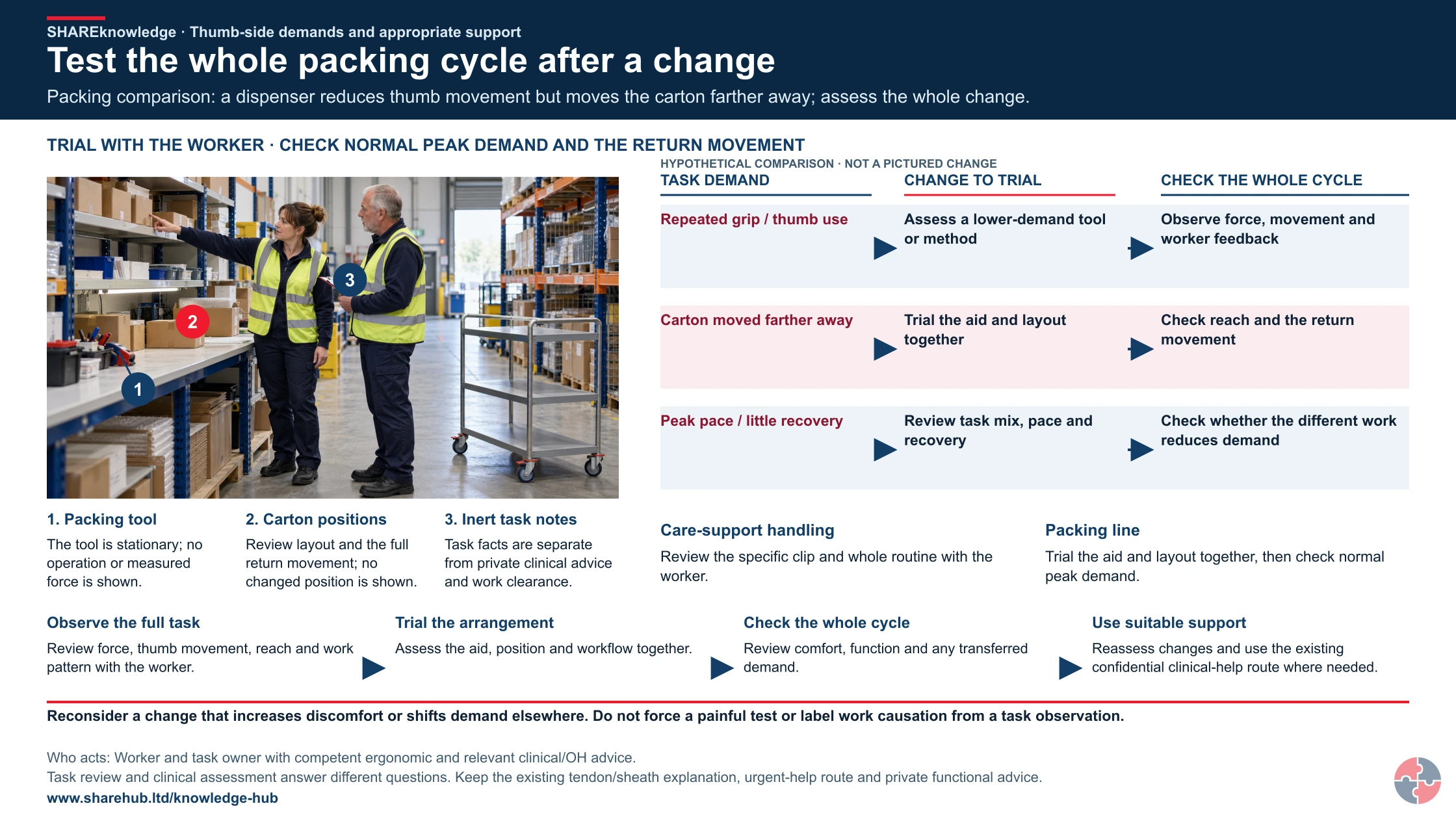
Test the whole packing cycle after a change
Full written explanation
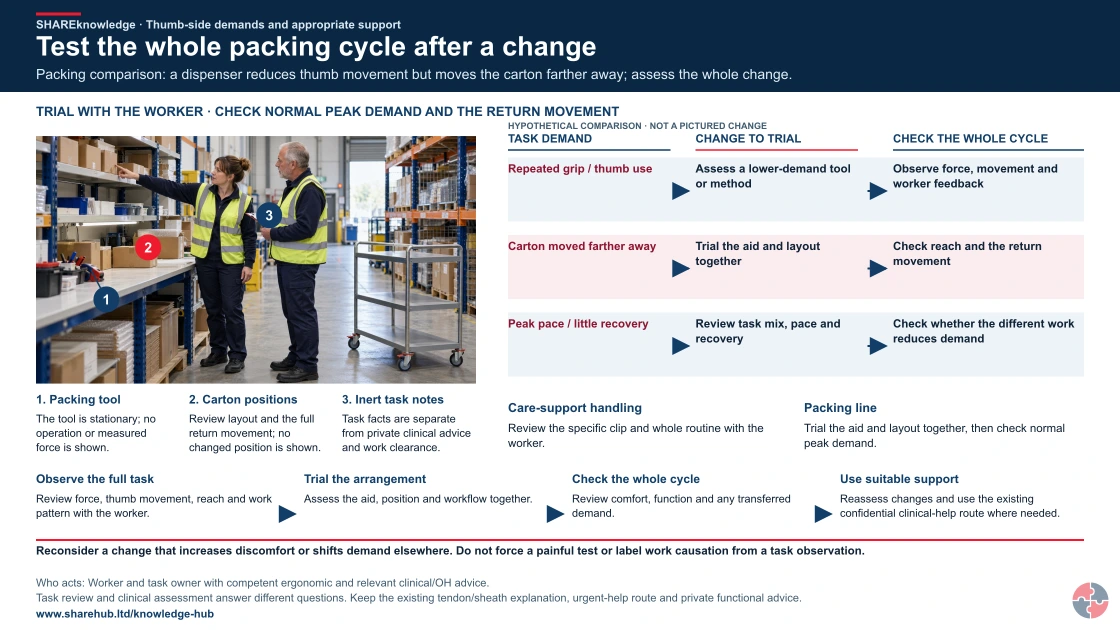
An illustrative stores-packing workface shows a stationary packing tool, cartons and two normal uninjured colleagues reviewing inert task notes. Picture key: 1 identifies the stationary packing tool; 2 identifies carton positions; 3 identifies inert task-review notes. These features locate tool, layout and whole-task questions. The photograph does not show a modified dispenser, a carton moved farther away, reduced thumb movement or a successful trial. It supplies no force, reach, posture, repetition or recovery measurement, symptom, clinical examination, diagnosis or work-causation finding. Beside this unchanged physical context, the complete hypothetical three-row comparison connects repeated grip and thumb use to assessment of a lower-demand tool or method and observation of force, movement and worker feedback; a carton moved farther away to trial of the aid and layout together and a check of reach and the return movement; and peak pace with little recovery to review of task mix, pace and recovery and a check of whether different work reduces demand. Each row has its own two relationships. The rows are work-factor comparisons, not stages of disease or a common clinical sequence. All three headers, nine cells and the full worker-trial and peak-demand band are included. Four separate complete checks retain their actual order: observe the full task; trial the arrangement; check the whole cycle; use suitable support. Their headings are unnumbered and separate from the physical picture key. Reconsider a change that increases discomfort or shifts demand elsewhere. Do not force a painful test or label work causation from a task observation. The full responsible roles, evidence boundary and both care-support and packing cases accompany the comparison. Task review and clinical assessment answer different questions. Appropriate personal advice, local urgent care and confidential support remain independent of trial results, manager decisions, paperwork and health-record sharing. No new anatomy, harm, symptom demonstration, diagnostic test, treatment, exercise, splint, medicine, device prescription, ideal posture, ergonomic threshold or work-release decision is supplied. Use the full topic for its existing thumb-side tendon/sheath explanation, clinical-help and source qualifications.
Packing comparison: a dispenser reduces thumb movement but moves the carton farther away; assess the whole change.
- Observe the full task. Review force, thumb movement, reach and work pattern with the worker.
- Trial the arrangement. Assess the aid, position and workflow together.
- Check the whole cycle. Review comfort, function and any transferred demand.
- Use suitable support. Reassess changes and use the existing confidential clinical-help route where needed.
When the evidence does not fit: Reconsider a change that increases discomfort or shifts demand elsewhere. Do not force a painful test or label work causation from a task observation.
Who acts: Worker and task owner with competent ergonomic and relevant clinical/OH advice.
Changed workplace
Care-support handling: Review the specific clip and whole routine with the worker.
Packing line: Trial the aid and layout together, then check normal peak demand.
Evidence check: Task review and clinical assessment answer different questions. Keep the existing tendon/sheath explanation, urgent-help route and private functional advice.
Existing symptom, clinical assessment and urgent-help guidance
Primary references: HSE: upper-limb task assessment and trialling changes (GB) · NHS: tendon symptoms and appropriate help
Open the complete HD image (new tab)Download image
Existing symptom, clinical assessment and urgent-help guidance
Primary references: HSE: upper-limb task assessment and trialling changes (GB) · NHS: tendon symptoms and appropriate help