SHARE Knowledge Hub
Anthrax
Anthrax is a very rare but serious infection linked mainly to infected animals, animal products or historically contaminated material. Stop disturbing a credible suspect source, keep people away, and obtain urgent medical and public-health advice for a possible exposure. Do not move or open a suspect animal carcass. Assess construction, animal-product and laboratory work by its actual task and location; treatment, testing and vaccination are specialist decisions.
Understanding Anthrax
Anthrax is a very rare but serious infection linked mainly to infected animals, animal products or historically contaminated material. Stop disturbing a credible suspect source, keep people away, and obtain urgent medical and public-health advice for a possible exposure. Do not move or open a suspect animal carcass. Assess construction, animal-product and laboratory work by its actual task and location; treatment, testing and vaccination are specialist decisions.
Why this matters at work
Assess possible human contact, including broken skin, dust, fluids and movement of clothing or tools, and arrange appropriate clinical and public health advice. Provide the animal, task, time, contact and symptom history without assuming infection. Record other potentially exposed people and avoid spreading material while help is coordinated. The reporting route and authority differ across the UK nations, so verify the actual location and current route. Preserve facts and access information safely, and keep the affected activity restricted until the responsible authorities and competent roles resolve the control and return decisions. A person feeling well immediately after contact does not settle the exposure question or authorise further carcass handling.
Start with a credible source and activity pathway rather than the word anthrax alone. Establish whether the concern involves an animal or carcass, untreated animal product, historic soil or building material, specimen, laboratory work, waste or suspicious package. Identify disturbance, dust or droplets, contact with broken skin, people present and material movement. Different sources need different competent assessment and response routes.
How organisations manage this in practice
Keep uncertainty from becoming exposure. Avoid unnecessary disturbance while obtaining the relevant material history and specialist advice. Assess neighbouring work, contractors, clean routes and other hazards as well as the specific organism concern. Low background incidence does not make every suspected pathway safe, while a historical association does not prove contamination. Choose proportionate controls and any justified testing through competent assessment. Plan incident reporting, exposure handover and return criteria before work. Do not infer vaccine, licence or containment requirements from a general hazard group label; the task, governing framework and actual authorisation conditions matter.
Sampling and decontamination require the appropriate competent specialist and authority input for the actual source and incident. Define what a sample must establish, relevant material history, likely distribution, laboratory capability, safe collection and transport and the criteria for interpreting results. Sampling can itself expose people and a few negative results may not establish absence in patchy contamination.
Check the date, scope, status and purpose of each source before applying an instruction. Human biological agent classification, animal pathogen controls, immunisation advice, import rules and a construction task assessment answer different questions. A saved leaflet or working link does not establish that every historical instruction remains current or applies to the proposed work.
What does this anthrax guide cover?
Use it for workplace recognition and escalation, not for diagnosing anthrax, handling a suspect culture or choosing medicines.
The UK risk is very low in ordinary work, but credible animal, product, building and land exposures deserve controlled action. It covers Great Britain and Northern Ireland with separate legal routes. Medical, veterinary and biosafety decisions require qualified advisers.
Match the suspect source to the responsible authority
A credible source history changes the plan; a job title alone does not. Distinguish a suspect carcass, animal product, historic animal-derived building material and laboratory material. Each needs its own responsible specialist or authority, while individual healthcare remains a separate urgent route.
Record what is known about the material and disturbance without taking an improvised sample. Keep source statements attributed: the current UKHSA position and an older HSE caveat must not be blended into an unsupported absolute rule. Specialist advice controls testing, clean-up and hand-back.
Unexpected animal-derived material in an old building
Illustrative example. A refurbishment crew finds an unrecorded animal-hair layer on a site with a relevant industrial history.
Decision. Stop disturbance, restrict access and refer the material/history to the competent project and specialist advisers.
Evidence to check. Retain the location, provenance evidence, disturbance undertaken and people potentially affected without moving the material.
Hold or escalation point. No worker-led sampling, sweeping or visual-only clearance.
Follow-up. Record specialist decisions and the revised method before the project owner authorises hand-back.
Who takes which decision?
Workers stop and report; a responsible lead controls the site; competent animal-health, clinical or biosafety specialists decide their own specialist steps.
| Question | Owner | Do not substitute |
|---|---|---|
| Suspect animal | Vet and APHA or DAERA. | Worker or contractor opening carcass. |
| Potential human exposure | Clinician and public-health service. | Supervisor prescribing treatment. |
| Historic material | Project lead with competent land or occupational adviser. | Crew collecting ad hoc sample. |
| Deliberate culture work | Laboratory biosafety lead. | General site procedure. |
What must people remember about anthrax?
Anthrax is rare, but a credible exposure or suggestive illness needs prompt action and specialist decisions.
| Question | Practical answer |
|---|---|
| Where from? | Usually infected animals, contaminated animal products or particular historic materials. |
| How exposed? | Spores may enter through broken skin, inhalation or ingestion; injection-related cases are a separate clinical route. |
| What first? | Stop disturbance, separate people from source, seek urgent clinical/public-health advice after credible exposure. |
| What not to do? | Do not move or open suspect carcasses, improvise sampling or start medicines without a clinician. |
What is anthrax?
Anthrax is a disease caused by Bacillus anthracis; durable spores in contaminated material are the main occupational concern.
It is primarily an animal disease. Human infection is uncommon in the UK but can be serious. The form of illness depends partly on the exposure route. This guide does not identify spores by sight or prescribe a clinical diagnosis.
History and activity determine the review route
A photograph cannot confirm anthrax. The general construction risk is very low; credible site or material history and the proposed disturbance determine the assessment. Do not treat all old plaster, soil or animal material as contaminated.
Building or land
Source and activity: a documented former animal-product process or suspect animal-derived building material is about to be disturbed.
Action and owner: pause the unexpected disturbance and give the site lead the available history, location and proposed work. A competent specialist decides proportionate assessment, controls and whether sampling is justified. Do not improvise sampling or cleaning.
Suspect livestock
Source and activity: an animal-health concern involves a live animal or carcass.
Action and owner: use the animal-health reporting route for the relevant nation. Do not move, skin or open a suspect carcass. Veterinary and statutory decisions remain separate from building work.
Person possibly exposed
Source and route: report the credible material/contact, task, timing and symptoms to the healthcare team.
Action and owner: use the human exposure response promptly; do not wait for material or laboratory confirmation before seeking appropriate clinical advice.
Keep source assessment, animal reporting and individual healthcare linked by factual information, not by an assumed diagnosis. Clinical testing, treatment and any return restrictions belong with the appropriate professionals.
Where can credible occupational exposure occur?
Look for a plausible infected-animal or historic animal-product link before choosing controls.
Different suspect sources have different routes


Read this visual as text
- BUILDING OR SOIL: Review reliable history, the actual material and the proposed disturbance; seek proportionate specialist assessment.
- SUSPECT ANIMAL: Use the veterinary and animal-health reporting route; do not open or move a suspect carcass.
- HUMAN EXPOSURE: Use prompt clinical and public-health advice with the exposure facts; workers do not diagnose anthrax.
| Setting | Credible question | Boundary |
|---|---|---|
| Animal care and carcasses | Was an animal unexpectedly ill or dead, and is official investigation needed? | Do not open or move a suspect carcass. |
| Hides, wool, hair, bones or drums | Is provenance and required treatment documented? | Not every imported animal product is contaminated. |
| Historic land or building | Was there a tannery, carcass burial or old animal-hair plaster? | Do not assume all old soil or plaster contains anthrax. |
| Laboratory | Is work deliberate or is a suspect sample being handled? | Specialist containment and approval apply. |
How can anthrax enter the body?
Spores can enter through broken skin, be inhaled in contaminated dust or be ingested; injection exposure is a separate clinical setting.
Cutaneous disease follows skin entry, particularly with contaminated animals or products. Inhalation can follow aerosolised contaminated material. Gastrointestinal and injectional disease are less relevant to ordinary construction tasks but matter to clinicians. Current UKHSA guidance (updated 7 April 2026) says anthrax is not transmitted person to person; ordinary coworker contact is not the exposure source to assume. An older, undated HSE occupational leaflet describes direct contact with an infected skin lesion as extremely rare. Follow any lesion-contact precautions specifically advised by the treating and public-health teams; do not impose or dismiss isolation from this page alone. Current UKHSA clinical guidance; HSE occupational leaflet.
Why can anthrax be serious?
Spores may establish infection after entering the body; severe disease can progress quickly and needs specialist treatment.
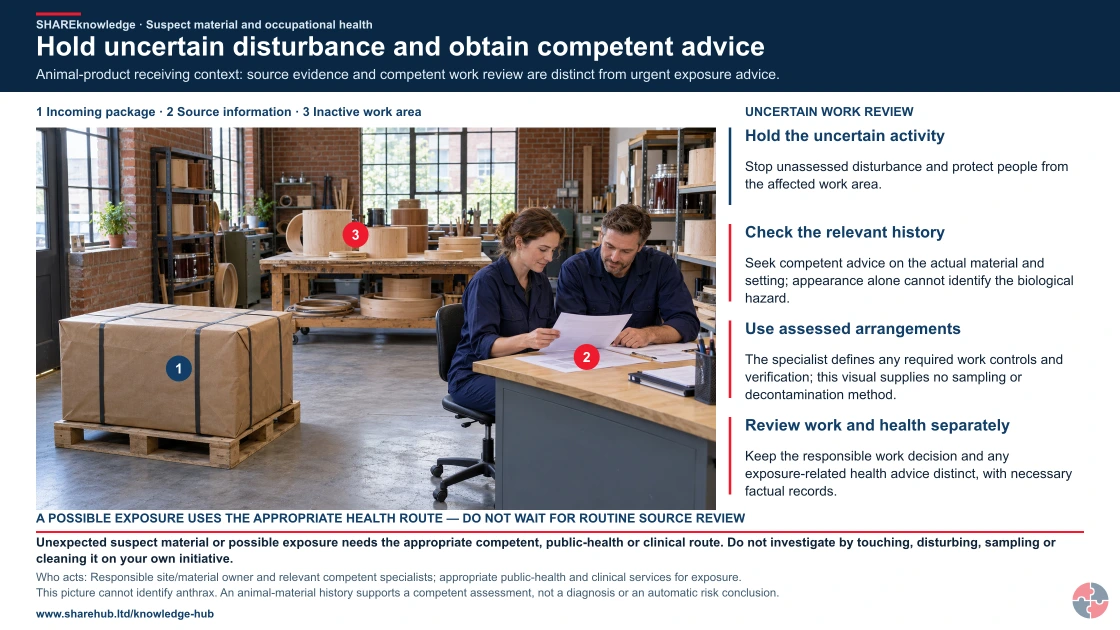
Hold uncertain disturbance and obtain competent advice
Full written explanation
An illustrative UK drum-making workshop receiving area shows an intact covered incoming package on a pallet, normal colleagues reviewing inert source-information papers at a separate desk, and an inactive wooden drum-frame workbench. The contents are concealed and cannot be identified from the picture. A single numbered key identifies the package, source papers and inactive work area; the four work-review headings are unnumbered. Hold uncertain disturbance, check reliable material and setting history with competent advice, use specialist-defined arrangements, and keep the work decision separate from exposure-related healthcare advice. Source information supports an assessment; a wrapped package, paper or the look of a workplace is not a diagnosis, contamination finding or permission to begin processing. Possible exposure uses the appropriate current public-health or clinical route without waiting for routine procurement or source review. No animal, carcass, hide, spore, aerosol, disease, anatomy, clinical harm, package opening or material handling is shown. The scene demonstrates no sampling, testing, cleaning, disinfection, decontamination, PPE selection or processing method. There is no visual clearance, automatic risk conclusion or new medical, animal-health or country-reporting rule.
Animal-product receiving context: source evidence and competent work review are distinct from urgent exposure advice.
- Hold the uncertain activity. Stop unassessed disturbance and protect people from the affected work area.
- Check the relevant history. Seek competent advice on the actual material and setting; appearance alone cannot identify the biological hazard.
- Use assessed arrangements. The specialist defines any required work controls and verification; this visual supplies no sampling or decontamination method.
- Review work and health separately. Keep the responsible work decision and any exposure-related health advice distinct, with necessary factual records.
When the evidence does not fit: Unexpected suspect material or possible exposure needs the appropriate competent, public-health or clinical route. Do not investigate by touching, disturbing, sampling or cleaning it on your own initiative.
Who acts: Responsible site/material owner and relevant competent specialists; appropriate public-health and clinical services for exposure.
Changed workplace
Historic refurbishment: Leave unexpected suspect material undisturbed while the history and competent advice are reviewed.
Animal-product business: Use reliable source information and competent assessment before the intended work; the image is not a processing method.
Evidence check: This picture cannot identify anthrax. An animal-material history supports a competent assessment, not a diagnosis or an automatic risk conclusion.
Primary references: UKHSA anthrax guidance — current public-health and testing context; no method supplied here · HSE anthrax — material-history assessment, task context and competent control review
Open the complete HD image (new tab)Download image
Primary references: UKHSA anthrax guidance — current public-health and testing context; no method supplied here · HSE anthrax — material-history assessment, task context and competent control review
Anthrax spores can persist in the environment and begin to germinate after entering suitable tissue. In inhalation disease, bacteria may multiply and release toxins that damage cells; severe illness can involve the bloodstream and lungs. The route of entry affects the pattern and timing of illness, so a mild early presentation does not settle an individual exposure decision. Clinical teams decide assessment and treatment; a workplace mechanism summary cannot estimate a dose or rule disease out.
What symptoms should prompt urgent advice?
After a credible exposure, an unusual evolving skin lesion or fever with worsening breathing illness warrants urgent medical assessment.
| Presentation | Possible features | Action |
|---|---|---|
| Cutaneous | Painless papule or blister progressing to swelling and dark-centred sore. | Urgent clinical assessment; cover and avoid direct lesion contact. |
| Inhalational | Initial non-specific flu-like illness, sometimes followed by rapid breathing deterioration. | Urgent assessment; 999 for severe breathing difficulty or collapse. |
| Gastrointestinal or injectional | Abdominal or soft-tissue illness in a relevant exposure setting. | Urgent clinical assessment with full exposure history. |
What should happen after possible exposure?
Stop exposure, keep others away, seek urgent clinical and public-health advice and preserve the facts needed for assessment.
| Stage | Action | Do not |
|---|---|---|
| Immediate | Stop disturbance, leave the suspect area, prevent further contact and inform the responsible lead. | Do not sweep, dry-brush or sample the material. |
| Medical | Arrange urgent clinical advice and state source, route, time and symptoms; use 999 for severe illness. | Do not self-prescribe antibiotics or delay care for confirmation. |
| Control and follow-up | Specialists decide testing, prophylaxis, clean-up and return to work; record exposed people and work details. | Do not reopen the task on a visual check alone. |
How can the hierarchy of controls reduce occupational exposure to anthrax?
Avoid suspect sources where possible, control disturbance and contact, provide hygiene and use task-specific PPE as a last layer.
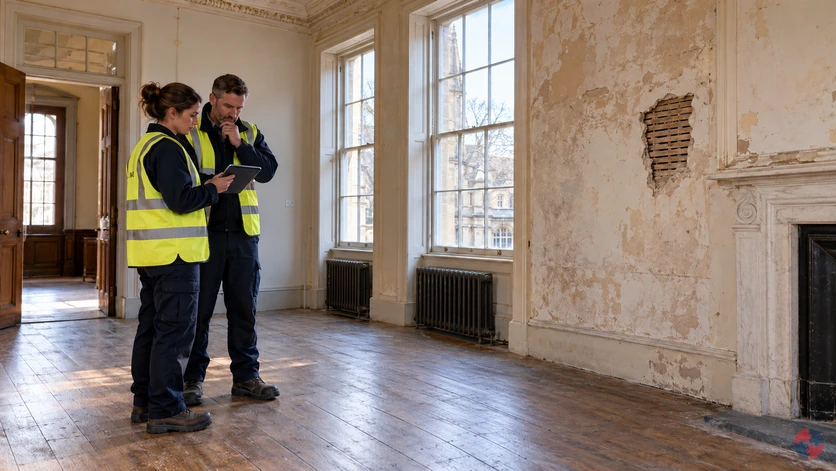
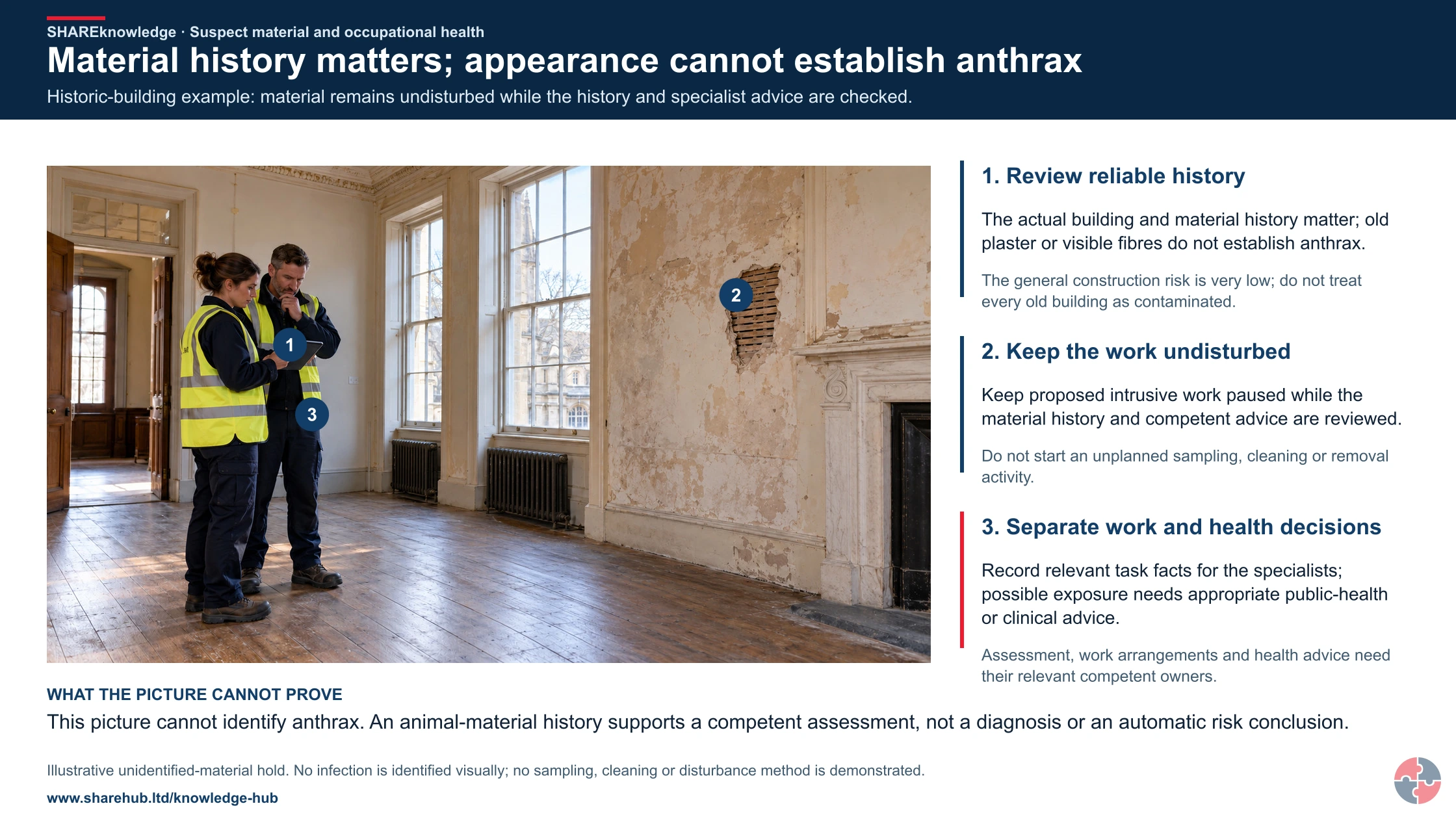
Material history matters; appearance cannot establish anthrax
Full written explanation
Historic-building example: material remains undisturbed while the history and specialist advice are checked.
- Review reliable history. The actual building and material history matter; old plaster or visible fibres do not establish anthrax.
- Keep the work undisturbed. Keep proposed intrusive work paused while the material history and competent advice are reviewed.
- Separate work and health decisions. Record relevant task facts for the specialists; possible exposure needs appropriate public-health or clinical advice.
Change the pathway
- Do not diagnose the material. The general construction risk is very low; do not treat every old building as contaminated.
- Avoid improvisation. Do not start an unplanned sampling, cleaning or removal activity.
- Use the appropriate authority. Assessment, work arrangements and health advice need their relevant competent owners.
Evidence check: This picture cannot identify anthrax. An animal-material history supports a competent assessment, not a diagnosis or an automatic risk conclusion.
Primary references: UKHSA anthrax guidance — current public-health and testing context; no method supplied here · HSE anthrax — material-history assessment, task context and competent control review
Open the complete HD image (new tab)Download image
Primary references: UKHSA anthrax guidance — current public-health and testing context; no method supplied here · HSE anthrax — material-history assessment, task context and competent control review
Source control and work method come before a mask. Obtain animal-health advice for suspect carcasses; check supply provenance for animal products; use land/building history before disturbance; restrict access and control dust where assessment identifies risk. Provide handwashing, protect cuts, avoid eating in contaminated work areas and plan safe removal of clothing and waste. Specialist advice determines decontamination and sampling.
During refurbishment involving old animal-hair plaster, the project manager first asks whether disturbance can be avoided and the material left safely in place. If work is needed, a competent specialist assesses the actual history and method; a different construction sequence can reduce disturbance, but an ordinary substitute product does not make existing suspect material harmless. Segregation, controlled removal and dust containment are engineering or physical Isolate/Control measures. A surveyed boundary, exclusion area and hygiene facilities protect adjacent people. The specialist sets the method and verifies its controls before release; the crew must not sweep, drill or sample suspect material on its own initiative.
The supervisor checks containment condition, washing facilities, waste route and task-specific protective clothing and RPE before work, with fit and maintenance matched to the assessed task. Briefing, access restriction and reporting are administrative layers; PPE cannot replace source control. ERICPD Discipline means maintaining containment, observing the method and learning from a breach. If unexpected animal material appears, containment fails, dust escapes or someone may have been exposed, stop, withdraw and use the competent animal-health, public-health and clinical escalation routes. No worker should infer from this example that every old plaster or brownfield site contains anthrax.
| Priority | Example | Evidence |
|---|---|---|
| Avoid | Do not handle a suspect carcass or start unassessed disturbance. | Stop and authority contact. |
| Assess and contain | Survey history, restrict access, choose controlled work and dust methods. | Task assessment and method. |
| Personal protection | Use suitable gloves, coveralls and task-specific RPE where assessment requires. | Selection, fit and training. |
| Verify | Check controls during work and before hand-back. | Inspections and release record. |
How can the ERICPD hierarchy of controls reduce occupational exposure to anthrax?

| ERICPD control level | Topic-specific example | Source and full task context |
|---|---|---|
| Eliminate | Avoid unassessed disturbance of suspect animal material. | Read the full task example, checks and stop points on this page. |
| Reduce | Use a competent assessment and a sequence that reduces disturbance. | Read the full task example, checks and stop points on this page. |
| Isolate | Segregate work and contain dust under the specialist method. | Read the full task example, checks and stop points on this page. |
| Control | Control access, hygiene, waste and the release decision. | Read the full task example, checks and stop points on this page. |
| PPE | Use task-assessed clothing and RPE after source controls. | Read the full task example, checks and stop points on this page. |
| Discipline | Check containment and stop on escape or unexpected suspect material. | Read the full task example, checks and stop points on this page. |
How can the ISO 45001 hierarchy of controls reduce occupational exposure to anthrax?

| ERICPD control level | Topic-specific example | Source and full task context |
|---|---|---|
| Eliminate | Avoid unassessed disturbance of suspect animal material. | Read the full task example, checks and stop points on this page. |
| Reduce | Use a competent assessment and a sequence that reduces disturbance. | Read the full task example, checks and stop points on this page. |
| Isolate | Segregate work and contain dust under the specialist method. | Read the full task example, checks and stop points on this page. |
| Control | Control access, hygiene, waste and the release decision. | Read the full task example, checks and stop points on this page. |
| PPE | Use task-assessed clothing and RPE after source controls. | Read the full task example, checks and stop points on this page. |
| Discipline | Check containment and stop on escape or unexpected suspect material. | Read the full task example, checks and stop points on this page. |
How should construction and demolition work be controlled?
Historic tanneries, burial areas and old animal-hair plaster justify a site-specific assessment; the general construction risk is very low. UKHSA reports no evidence of anthrax infection following environmental handling or development of brownfield sites, including abattoirs and tanneries. A documented livestock anthrax case is a stronger reason to seek specialist advice on site sampling; an old use label alone does not prove contamination.
Suspect historic material needs a proportionate hold


Read this visual as text
- An old animal-hair layer or previous land use does not prove anthrax contamination. Stop unexpected disturbance, retain safe information and obtain site-specific specialist advice; do not sample or clean suspect material on your own.
- STOP DISTURBANCE
- KEEP THE FACTS
- SEEK SPECIALIST ADVICE
Suspect Material on a Site
Two linked parts · 5 questions. Open Part 2 to complete the route.

Continue to questions 4–5 · Part 2 of 2


Read this visual as text
- Start: Historic land, animal-hair plaster or other potentially animal-derived material is discovered.
- Question 1: Is there a credible animal-derived source or relevant site history? Decision owner: Site lead with veterinary / public-health specialists.
- Yes: Obtain competent assessment of the actual material and planned disturbance. CONTINUE → QUESTION 2.
- No credible source: Continue suitable ordinary controls and revisit if facts change; do not label the material infected. OUTCOME → RECORD AND HAND OVER.
- Unknown: Keep uncertain disturbance held while history and competent advice are obtained. HOLD → OWNER RESOLVES BEFORE RESUMING.
- Question 2: Are material, proposed method and affected people assessed? Decision owner: Site lead with veterinary / public-health specialists.
- YES: The required evidence or condition is confirmed. CONTINUE → QUESTION 3.
- NO / UNKNOWN — HOLD: Do not sample or identify the material by appearance alone. HOLD → REPEAT QUESTION 2 AFTER CORRECTION.
- Question 3: Are the specialist method and dust/spread controls approved? Decision owner: Site lead with veterinary / public-health specialists.
- YES: The required evidence or condition is confirmed. CONTINUE → QUESTION 4.
- NO / UNKNOWN — HOLD: Hold work; no sweeping, dry brushing or ad hoc sampling. HOLD → REPEAT QUESTION 3 AFTER CORRECTION.
- Question 4: Has unexpected material, dust or control failure appeared? Decision owner: Site lead with veterinary / public-health specialists.
- YES — STOP / REFER: Stop, restrict access and seek specialist advice before continuation. STOP / REFER → APPROPRIATE RESPONSE.
- NO: No such warning is identified; continue the remaining checks. CONTINUE → QUESTION 5.
- UNKNOWN — PROTECT FIRST: Protect people and hold the affected work. Obtain the responsible specialist’s assessment; do not assume the warning is absent. HOLD → OWNER RESOLVES BEFORE RESUMING.
- Question 5: Is the work or recovery evidence accepted for hand-back? Decision owner: Site lead with veterinary / public-health specialists.
- YES: The required evidence or condition is confirmed. OUTCOME → RECORD AND HAND OVER.
- NO / UNKNOWN — HOLD: Retain the hold until the competent site decision is documented. HOLD → REPEAT QUESTION 5 AFTER CORRECTION.
- Outcome: Authorised method and hand-back, or continued hold with specialist investigation.
- Stop and escalation boundary: No ad hoc sampling, sweeping, dry brushing or restart on appearance alone.
Review land use and materials before breaking ground or stripping plaster. A competent person can choose proportionate investigation or precautionary controls. HSE advises waterproof cover for cuts, gloves, disposable coveralls, handwashing and no eating in the work area where spores are known or assumed. For removal of old animal-hair plaster, HSE specifies RPE with APF20, such as FFP3 or a P3 half-mask; tight-fitting equipment needs face fit and a clean-shaven seal. This is not a universal RPE rule for all anthrax situations.
| When | Check | Hold if |
|---|---|---|
| Before | History, material and risk method agreed. | Unidentified suspect material or no competent assessment. |
| During | Dust and contact controls, hygiene and access maintained. | Uncontrolled dust or failed protection. |
| After | Waste, cleaning and area release verified by the responsible lead. | No approved hand-back evidence. |
What changes for animal products, laboratories and suspicious items?
Each setting has a different authority and containment route; none calls for an improvised sample or cleanup.
Suspect Animal
Two linked parts · 5 questions. Open Part 2 to complete the route.

Continue to questions 4–5 · Part 2 of 2


Read this visual as text
- Start: An animal dies suddenly or shows signs that prompt a veterinary anthrax concern.
- Question 1: Protect the suspect animal area Decision owner: Site lead with veterinary / public-health specialists.
- ACTION: Keep people and animals away; do not move, skin or open the carcass. CONTINUE → QUESTION 2.
- Question 2: Where is the animal? Decision owner: Site lead with veterinary / public-health specialists.
- England / Scotland / Wales: Notify APHA immediately through the current official route. CONTINUE → QUESTION 3.
- Northern Ireland: Notify DAERA immediately through the current official route. CONTINUE → QUESTION 3.
- Unknown: Establish the location promptly while retaining the exclusion. HOLD → OWNER RESOLVES BEFORE RESUMING.
- Question 3: Could anyone have been exposed? Decision owner: Clinical service.
- YES — STOP / REFER: Arrange urgent clinical advice and pass the source, route and timing; severe illness needs 999. STOP / REFER → APPROPRIATE RESPONSE.
- NO: No such warning is identified; continue the remaining checks. CONTINUE → QUESTION 4.
- UNKNOWN — PROTECT FIRST: Protect people and hold the affected work. Obtain the responsible specialist’s assessment; do not assume the warning is absent. HOLD → OWNER RESOLVES BEFORE RESUMING.
- Question 4: Are movement, disposal and site actions under official direction? Decision owner: Site lead with veterinary / public-health specialists.
- YES: The required evidence or condition is confirmed. CONTINUE → QUESTION 5.
- NO / UNKNOWN — HOLD: No unapproved opening, cleaning demonstration or disposal. HOLD → REPEAT QUESTION 4 AFTER CORRECTION.
- Question 5: Keep human and animal decisions separate Decision owner: Site lead with veterinary / public-health specialists.
- ACTION: Record official animal-health instructions and the appropriate confidential human follow-up. OUTCOME → RECORD AND HAND OVER.
- Outcome: Official animal-health direction and separate human exposure assessment.
- Stop and escalation boundary: No unapproved movement, opening, disinfection demonstration or disposal.
The first safe action depends on what is suspected. An unexplained animal death belongs with veterinary and animal-health reporting, while hides or old animal-hair plaster need a task-specific dust and biological-agent assessment before disturbance. A laboratory isolate requires authorised containment; an unexplained powder or item calls for the site security and emergency route. Workers should preserve information and avoid opening, sampling or cleaning material on their own.
| Setting | First control | Specialist route |
|---|---|---|
| Suspect animal | Isolate; do not move, skin or open carcass. | APHA in GB or DAERA in NI and a vet. |
| Hides, wool and animal hair | Check provenance and handling method; minimise contact and dust. | Occupational hygiene and supplier assurance. |
| Deliberate laboratory work | Use current classification, approved containment and incident plan. | Laboratory biosafety lead and statutory notification where applicable. |
| Suspicious powder or item | Do not handle further; move people away and follow site emergency/security route. | Police and public-health responders determine response. |
What do real work decisions look like?
The hold point depends on the source: historic plaster, former animal sites, suspect carcasses, imported products, laboratories or a possible human exposure.
These are training cases, not authorisations to investigate or treat. The relevant competent authority directs any suspect carcass, clinical or specialist laboratory response.
1. Old animal-hair plaster during refurbishment
Task material and setting: BuildOut Ltd plans to strip old plaster known to contain animal hair; the outcome is controlled work without avoidable dust.
People and prerequisites: Refurbishment crew and adjacent occupants; survey and method are available.
Before: Check building history, the actual material and risk assessment; plan segregation, dust suppression and suitable waste route.
During: Use a controlled removal method, gloves, coveralls, washing and HSE task-specific APF20 RPE where old animal-hair plaster is removed; face-fit tight-fitting RPE.
Hold or stop: Unexpected suspect material, uncontrolled dust or failed segregation: stop and get competent advice.
Completion and hand back: Clean and release the area under the approved method, then confirm affected workers were briefed.
Evidence: Survey, assessment, RPE fit record, work checks and hand-back.
2. Groundworks on a former tannery site
Task material and setting: Historic records identify former animal-product processing before foundation excavation.
People and prerequisites: Groundworkers, plant operators and neighbouring trades; site history and soil advice are needed.
Before: Review land use and credible exposure pathways; a competent specialist chooses assessment, sampling or a precautionary approach.
During: Control dust and contact as the assessment specifies; maintain hygiene and prevent eating in the work area.
Hold or stop: Suspect remains or unplanned contaminated material: stop disturbance, restrict access and escalate; do not collect a casual sample.
Completion and hand back: Reassess the method and authorise restart only after controls are verified.
Evidence: Land-history review, assessment, work plan and stop/restart record.
3. Sudden unexplained death of livestock
Task material and setting: A contractor working at a farm is asked to move a newly dead animal before its cause is known.
People and prerequisites: Farm staff, contractor and vet; the relevant animal-health authority depends on nation.
Before: Keep people and animals away; seek veterinary and official advice promptly.
During: Do not move, skin or open a carcass suspected of anthrax; report immediately through APHA in GB or DAERA in NI.
Hold or stop: Any request to open, sample or clean the carcass without official direction is a stop point.
Completion and hand back: Only the competent authority directs investigation and disposal; assess and refer possible human exposures.
Evidence: Time, location, who was nearby and official report reference.
4. Imported hides in a small workshop
Task material and setting: A maker receives animal hides with uncertain provenance for a planned drum-making task.
People and prerequisites: Handlers, cleaners and others sharing the workspace; procurement documents and occupational advice are needed.
Before: Check provenance, import and disinfection evidence, and assess handling, dust and cuts before receipt or work.
During: Avoid uncontrolled dry handling; use the assessed containment, hygiene, gloves and waste arrangements.
Hold or stop: Missing provenance or suspicious product: hold the material and get specialist advice; do not improvise decontamination.
Completion and hand back: Release only when the product and work method are cleared by the responsible lead.
Evidence: Supplier evidence, assessment, training and hold/release decision.
5. Deliberate laboratory work with a biological agent
Task material and setting: A laboratory proposes work involving Bacillus anthracis or a suspect culture.
People and prerequisites: Specialist laboratory staff and biosafety lead; deliberate handling is distinct from incidental exposure.
Before: Confirm current agent classification, containment, competence and applicable notification before starting.
During: Use only an approved specialist laboratory procedure and incident plan; this page gives no cultivation or sampling method.
Hold or stop: No approval, compromised containment or unexpected release: stop, secure and activate the laboratory incident plan.
Completion and hand back: Competent biosafety lead controls response and authorised restart.
Evidence: Approval, containment assessment, notification and incident record.
6. Worker reports credible exposure and illness
Task material and setting: A worker disturbed suspect material and later develops fever or an unusual skin lesion.
People and prerequisites: Worker, supervisor and clinician; retain task and material details without delaying care.
Before: Stop further disturbance, keep others away and identify potentially exposed people.
During: Seek urgent clinical and public-health advice and clearly state the possible source and route; severe breathing difficulty or collapse needs 999.
Hold or stop: Do not wait for a test, self-prescribe antibiotics or send the worker back to the source.
Completion and hand back: Clinicians direct testing and treatment; employer reviews exposure controls and reporting duties.
Evidence: Time and source of exposure, symptoms, clinical referral and restricted occupational record.
Which duties and notifications apply in GB and NI?
General work-safety and COSHH duties have separate GB and NI instruments; animal disease, human disease and work-incident reporting are distinct routes.
In Great Britain, the Health and Safety at Work etc Act 1974, Management Regulations 1999 and COSHH 2002 frame work controls. Northern Ireland uses its 1978 Order, Management Regulations 2000 and COSHH 2003. Deliberate laboratory work has additional specialist requirements. A suspected animal case is immediately reportable to APHA in England, Scotland or Wales or DAERA in NI. Clinicians follow nation-specific human-disease notification; England lists suspected anthrax as urgent. GB RIDDOR requires a report of a disease attributable to occupational biological-agent exposure where reasonable evidence supports the work link; NI uses its own RIDDOR law and HSENI route. Do not equate a possible exposure with a diagnosed reportable disease.
| Issue | Great Britain | Northern Ireland |
|---|---|---|
| Work controls | HSWA 1974, Management 1999, COSHH 2002. | 1978 Order, Management 2000, COSHH 2003. |
| Suspect animal anthrax | Immediately report to APHA; do not move or open carcass. | Immediately report to DAERA; follow official direction. |
| Human disease | Clinician follows nation-specific public-health notification; England marks anthrax urgent. | Doctor follows NI public-health notification. |
| Occupational disease | GB RIDDOR biological-agent disease test. | NI RIDDOR 1997 and HSENI guidance. |
At the hold point: keep people and animals away from a suspect carcass, do not move or open it, and report immediately using the correct animal-health route below. A possible human exposure needs urgent clinical advice even without symptoms. Human-disease notification is clinician-led; a possible exposure is not automatically an occupational disease report.
| Nation | Suspected animal anthrax | Suspected human disease |
|---|---|---|
| England | Call APHA on 03000 200 301 immediately; confirm the live number on the linked APHA page. Check live official route | The treating clinician urgently notifies the local UKHSA health protection team through the current England route. Check live official route |
| Wales | Call APHA on 03003 038 268 immediately; confirm the live number on the linked APHA page. Check live official route | The treating clinician urgently notifies Public Health Wales through AWARe; its listed urgent phone is 0300 00 300 32. Check live official route |
| Scotland | Call APHA on 03000 600 704 immediately; confirm the live number on the linked APHA page. Check live official route | The treating clinician uses the local NHS board health protection team and current Public Health Scotland contact list. Check live official route |
| Northern Ireland | Call DAERA on 0300 200 7840 immediately, or use its current animal-health contact route. Check live official route | The treating doctor follows NI public-health notification and the Public Health Agency health-protection route. Check live official route |
Who decides testing, treatment and vaccination?
Only clinicians and public-health specialists should decide testing, antibiotic prophylaxis, treatment or vaccination from the individual exposure.
Possible Human Exposure
Two linked parts · 6 questions. Open Part 2 to complete the route.

Continue to questions 4–6 · Part 2 of 2


Read this visual as text
- Start: A worker reports credible contact with a suspect source, with or without symptoms.
- Question 1: Stop further exposure Decision owner: Site lead with veterinary / public-health specialists.
- ACTION: Secure the source and prevent others entering or handling suspect material. CONTINUE → QUESTION 2.
- Question 2: Is anyone collapsed or severely breathless or seriously ill? Decision owner: Emergency services.
- YES — STOP / REFER: Call 999 and follow emergency instructions. STOP / REFER → APPROPRIATE RESPONSE.
- NO: No such warning is identified; continue the remaining checks. CONTINUE → QUESTION 3.
- UNKNOWN — PROTECT FIRST: Protect people and hold the affected work. Obtain the responsible specialist’s assessment; do not assume the warning is absent. HOLD → OWNER RESOLVES BEFORE RESUMING.
- Question 3: Has urgent clinical and public-health advice been sought for credible exposure? Decision owner: Site lead with veterinary / public-health specialists.
- YES: The required evidence or condition is confirmed. CONTINUE → QUESTION 4.
- NO / UNKNOWN — HOLD: Do not wait for laboratory confirmation or use this guide to diagnose. HOLD → REPEAT QUESTION 3 AFTER CORRECTION.
- Question 4: Are source, route, time, symptoms and possible contacts recorded? Decision owner: Site lead with veterinary / public-health specialists.
- YES: The required evidence or condition is confirmed. CONTINUE → QUESTION 5.
- NO / UNKNOWN — HOLD: Preserve facts and uncertainty safely for the specialists. HOLD → REPEAT QUESTION 4 AFTER CORRECTION.
- Question 5: Are testing, treatment and site recovery directed by the appropriate specialists? Decision owner: Site lead with veterinary / public-health specialists.
- YES: The required evidence or condition is confirmed. CONTINUE → QUESTION 6.
- NO / UNKNOWN — HOLD: Do not self-prescribe, improvise prophylaxis or restart on an informal assurance. HOLD → REPEAT QUESTION 5 AFTER CORRECTION.
- Question 6: Record follow-up and reporting review Decision owner: Site lead with veterinary / public-health specialists.
- ACTION: Keep occupational facts, specialist site decisions and the applicable reporting assessment together. OUTCOME → RECORD AND HAND OVER.
- Outcome: Clinical handover, specialist site decision, occupational record and appropriate reporting assessment.
- Stop and escalation boundary: Do not wait for confirmation to stop exposure; do not self-prescribe or use this tree to diagnose.
UKHSA describes specialist testing and differing clinical presentations. Prompt antibiotics can be important in confirmed or clinically suspected illness, but this page deliberately gives no regimen, dose or waiting period. The Green Book does not make vaccine routine for every job title; specialist high-risk roles and unusual exposures need individual assessment. Employers should rapidly provide source and exposure facts and support referral.
How should anthrax be recorded in a risk register?
Record a credible source, exposure task, controls, owner, stop trigger and specialist hand-back, not a generic “anthrax everywhere” entry.
| Exposure | Control and owner | Trigger and evidence |
|---|---|---|
| Former tannery excavation | Project lead reviews land history and approved method. | Unexpected material: stop; assessment and release. |
| Animal-hair plaster | Refurbishment lead checks method, hygiene and APF20 RPE. | Failed dust control: stop; fit and work checks. |
| Animal products | Purchaser checks provenance; handler controls contact and dust. | Missing documentation: hold; supplier evidence. |
| Suspect animal | Farm lead isolates and calls official authority. | No carcass movement; report reference. |
How could BuildOut Ltd manage a credible anthrax risk?

BuildOut should use site history to plan a proportionate response and give crews a clear stop-and-escalate route.
Before renovating a former tannery and removing historic plaster, the project manager asks a competent adviser to review past uses and material evidence. The crew is briefed on where work can proceed, dust and contact controls, hygiene and the agreed hold point. The old animal-hair plaster method includes task-specific APF20 RPE and fit checks. When a subcontractor finds an unexpected animal-derived layer, work stops and the area is restricted. The project manager does not ask the crew to bag a sample. Specialist advice determines whether the method can resume, and the decision and hand-back are recorded.
| Owner | Control | Evidence |
|---|---|---|
| Project manager | Commission history review and control method. | Assessment and contractor briefing. |
| Supervisor | Check access, dust, hygiene and stop authority. | Work inspection and stop log. |
| Specialist adviser | Determine investigation and revised controls. | Advice and release decision. |
| Occupational-health lead | Coordinate urgent referral after credible exposure. | Restricted exposure and referral record. |
What awareness and competence are needed?
Workers need to recognise their credible source and stop point; only specialists should make laboratory, sampling, clinical or decontamination decisions.
| Role and learning | Practice on the actual task | Competence evidence and record | Assessor and reassessment trigger |
|---|---|---|---|
| Workers: recognise credible exposure | Identify suspect animal/product or disturbed material, stop, withdraw and report without sampling. | Observed scenario and correct isolation/report route. | Supervisor checks after material, site or task change. |
| Supervisors: hold and escalate | Secure affected work, record exposure facts and contact competent biosecurity/public-health routes. | Scenario exercise, exclusion record and handover. | Competent manager checks after incident or new exposure evidence. |
| Animal handlers and vets | Follow animal-reporting and carcass no-open/no-move controls for the nation. | Demonstrated case route and current agency contact. | Veterinary/biosecurity lead checks after agency guidance change. |
| Hygiene and laboratory specialists | Choose biological-agent controls and approved sampling/testing only within authorised scope. | Competence, approved plan and audit evidence. | Relevant specialist peer checks after new method or event. |
| Managers: assure worker follow-up | Keep COSHH biological assessment, PPE/engineering, health referral and notification routes distinct. | Approved assessment, action closure and confidential follow-up record. | Accountable lead reopens after credible exposure or law change. |
Record the practised stop, isolation and reporting decision, assessor and reassessment trigger. Awareness training does not authorise biological sampling, diagnosis or treatment.
How should the management system check controls?
Use task assessment, competent ownership, exposure response and verified corrective action; ISO 45001 is a voluntary framework, not an anthrax-specific legal approval.
| Stage | Decision | Evidence |
|---|---|---|
| Plan | Identify credible source and nation-specific duties. | History, source and task assessment. |
| Do | Brief and apply approved controls. | Method, protection and authority route. |
| Check | Observe controls, respond to unexpected material or exposure. | Inspection and incident facts. |
| Act | Revise method and verify hand-back. | Specialist approval and closure. |
What shows controls may be failing?
Unexpected animal-derived material, uncontrolled dust, poor hygiene, uncertain provenance or a worker with symptoms after credible exposure require reassessment.
Other warning signs include an unplanned carcass move, missing supplier evidence, damaged containment, unfit RPE for the specified plaster task, or a contractor who cannot name the stop route. Do not wait for an illness to correct a failed work control.
Standards named on this page are background context. Confirm the current edition, scope and exact requirements from an authorised copy before applying them. The open official sources below support the specific public-law and regulator guidance claims they are cited for.
What do the acronyms and key terms mean?
Keep the exposure, authority and legal terms distinct.
| Term | Meaning |
|---|---|
| APHA | Animal and Plant Health Agency, animal disease route in GB. |
| DAERA | Department of Agriculture, Environment and Rural Affairs, animal disease route in NI. |
| COSHH | Control of Substances Hazardous to Health, with distinct GB and NI regulations. |
| RPE / APF | Respiratory protective equipment / assigned protection factor. |
| RIDDOR | Work-related injury and disease reporting, under separate GB and NI regulations. |