
Car garage and accident repair / Electric and hybrid vehicle repair awareness
Car garage and accident repair · SH-GAR-03Electric and hybrid vehicle repair awareness
Free online training · Approximate learning time: 65–110 minutes · Self-paced
Recognise damaged-EV uncertainty and keep work within vehicle-specific competence and authorisation.
Full public teaching and readers are free without an account. A free learner account is required for saved LMS progress and recorded assessment. Completion and any course-completion certificate depend on the configured LMS conditions.
Who this course is for
Vehicle reception, recovery coordinators, workshop technicians and managers.
A collision-damaged hybrid arrives after recovery. Its auxiliary battery is disconnected and a booking note says “safe: will not start”. The estimator wants trim removed near an orange cable. No vehicle-specific damage assessment or competent work release is available, and the recovery restrictions are missing.
Independent awareness and decision learning for vehicle repair. Practical competence, EV high-voltage work, asbestos work and other specialist tasks require separate training and authorisation. GB baseline; check corresponding Northern Ireland duties and local arrangements.
Learning outcomes
- Recognise damaged-EV uncertainty and keep work within vehicle-specific competence and authorisation.
- Explain the harm pathway and who is exposed in the selected repair scenarios.
- Choose immediate protection, sustained controls and evidence for a safe release.
- Apply a fictional risk assessment, briefing and control-check exercise to the job.
Course outline
Understand the repair and the people
- Understand this repair environmentRecognise damaged-EV uncertainty and keep work within vehicle-specific competence and authorisation.
- Choose controls that fit the actual taskUse source guidance to distinguish control selection, work instructions and evidence of effectiveness.
Recognise the exposure and energy
- Treat collision damage as an uncertain energy stateOff is an operating state; verified safe conditions for the intended work require a competent, vehicle-specific process.
Choose and apply effective controls
- Coordinate fan maintenance with the work it protectsMaintenance is complete when safe conditions and the intended protective function are verified and handed back, not when tools are packed away.
Verify the working arrangement
- Act on damage before the next electrical test dateInspect the equipment in front of you; a past test never excuses a present defect.
Make the release decision
- Capstone: decide whether the job may proceedCombine the observations, restrictions and verification into one justified work decision.
- Take the learning into a real briefingTurn the selected control into a clear question, observation and review trigger.
Activities, model practice and assessment
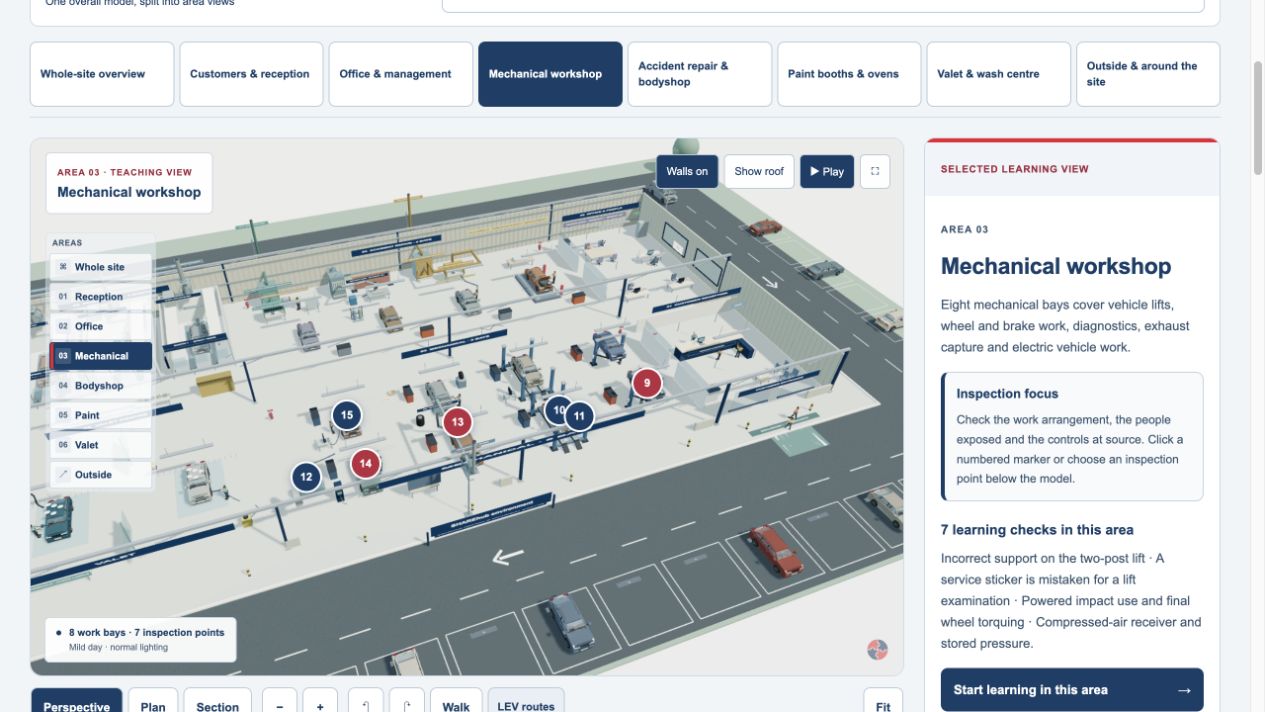
Work through 6 required applied activities and 3 model-practice pauses, with explanatory feedback and independent lesson decisions. Complete 3 distinct model mission sequences across those pauses. Use the actual fictional garage centre model or its equivalent accessible route to complete the required decision sequences; launching the model alone does not complete practice.
The 16-question assessment requires at least 80% plus every designated critical safety answer. Complete the required activities, practice and lesson checks. Points and badges cannot offset a critical safety error.
Use the LMS for confirmed save/resume and recorded results. Any certificate follows its configured passed-completion and grade conditions.
Open the public interactive practice copy; public practice is separate from the LMS record.
Sources and learning provenance
Original fictional cases are paired with public SHAREhub teaching and structured topic records. Use the applicable jurisdiction and primary guidance for live work.
- HSE: Electric and hybrid vehicles
- HSE: Safe maintenance and coordination
- HSE: Work using electrically powered equipment
Topic sections, source identities and versions
| Public topic | Chunk and version | Jurisdiction and sources |
|---|---|---|
| electric-vehicles · maintenance | electric-vehicles--maintenance 2.2 | Great Britain, Northern Ireland hse-ev, hse-hsg85, hse-indg231 |
| maintenance-inspection-and-testing-of-work-equipment-and-machinery · safe-maintenance | maintenance-inspection-and-testing-of-work-equipment-and-machinery--safe-maintenance 2.0 | Great Britain, Northern Ireland hse-maint, hse-l22 |
| portable-electrical-equipment · worked-example | portable-electrical-equipment--worked-example 2.0 | Great Britain, Northern Ireland source-hse_portable_appliance_testing_faq |
Course SH-GAR-03 · version 2026.10.20.1. .
Questions about this course
Is this training free?
Full public teaching and readers are free without an account. A free learner account is required for saved LMS progress and recorded assessment. Completion and any course-completion certificate depend on the configured LMS conditions.
How long should I allow?
Approximately 65–110 minutes, including teaching, lesson checks, required activities, model or accessible practice and one assessment attempt. Individual pace, review and retries vary. Save and resume in the LMS.
Can I learn without a 3D-capable browser?
Yes. The complete HTML reader provides the teaching. Required model practice has an equivalent accessible decision route in the interactive course. Use the LMS route for recorded learning.
What is required to pass?
Complete the required learning, activities, practice and lesson decisions. The 16-question final assessment requires at least 80% plus every designated critical safety answer. Points cannot compensate for a critical safety error. Follow the feedback before retrying.
Does this authorise garage operations?
Independent awareness and decision learning for vehicle repair. Practical competence, EV high-voltage work, asbestos work and other specialist tasks require separate training and authorisation. GB baseline; check corresponding Northern Ireland duties and local arrangements. This independent course does not award an external qualification or replace competent task assessment, practical training or site authorisation.