
Car garage and accident repair / Body repair: dust, welding, grinding and LEV
Car garage and accident repair · SH-GAR-04Body repair: dust, welding, grinding and LEV
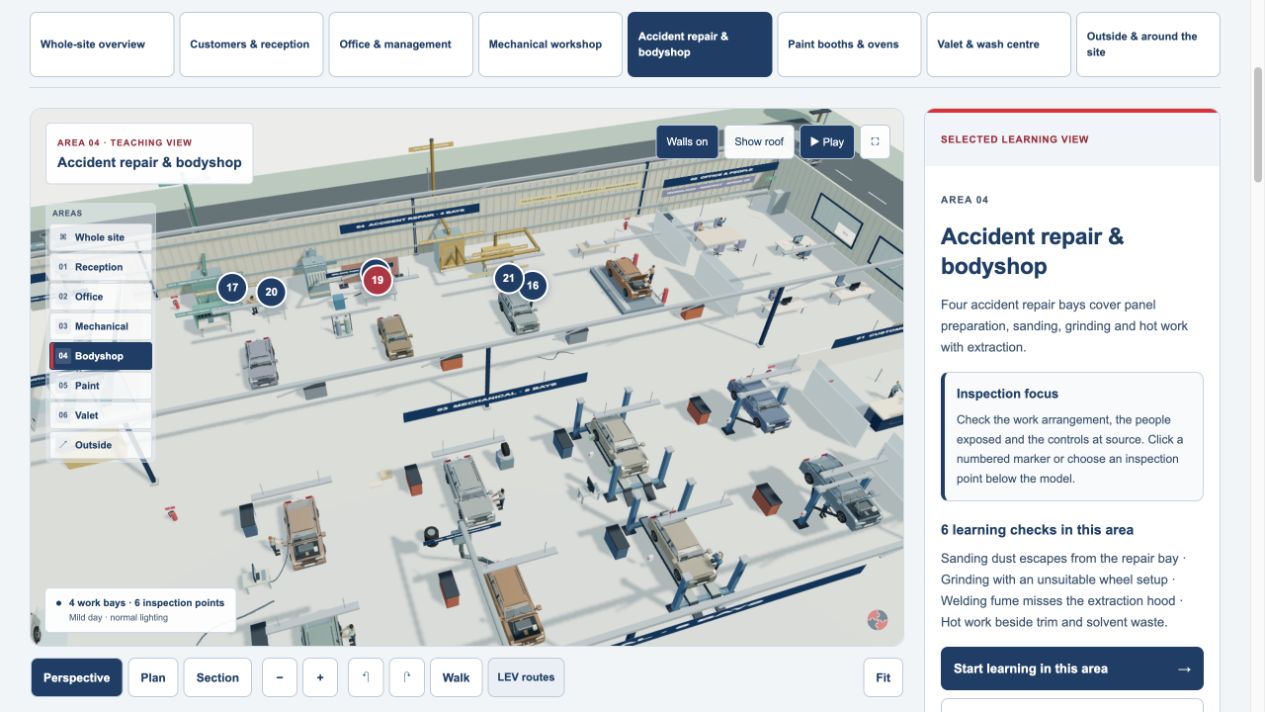
Free online training · Approximate learning time: 110–175 minutes · Self-paced
Control the entire exposure and fire pathway, from the repair surface to safe discharge.
Full public teaching and readers are free without an account. A free learner account is required for saved LMS progress and recorded assessment. Completion and any course-completion certificate depend on the configured LMS conditions.
Who this course is for
Body repair technicians, welders, workshop supervisors and maintenance planners.
A welder positions the extraction hood on the far side of their head. A grinder guard has been removed for access, solvent-soaked waste sits behind the panel and the extractor outlet faces a pedestrian path. The fan sounds normal and the repair is almost finished.
Independent awareness and decision learning for vehicle repair. Practical competence, EV high-voltage work, asbestos work and other specialist tasks require separate training and authorisation. GB baseline; check corresponding Northern Ireland duties and local arrangements.
Learning outcomes
- Control the entire exposure and fire pathway, from the repair surface to safe discharge.
- Explain the harm pathway and who is exposed in the selected repair scenarios.
- Choose immediate protection, sustained controls and evidence for a safe release.
- Apply a fictional risk assessment, briefing and control-check exercise to the job.
Course outline
Understand the repair and the people
- Understand this repair environmentControl the entire exposure and fire pathway, from the repair surface to safe discharge.
- Choose controls that fit the actual taskUse source guidance to distinguish control selection, work instructions and evidence of effectiveness.
Recognise the exposure and energy
- Body preparation: capture dust before it travelsDust control is successful when it prevents exposure during the real task, including exposure of neighbouring workers.
- Grinding: make the equipment fit the repairAn awkward repair is a reason to change the method or equipment, not a reason to remove its safeguards.
Choose and apply effective controls
- Welding fume: the source must stay inside the capture zoneFollow the contaminant from the weld to its final destination; a working hood is not the end of the assessment.
- Hot work: follow heat and sparks into hidden spacesA hot-work permit records agreed controls; it cannot make an uncontrolled fire pathway safe.
Verify the working arrangement
- Extraction must not move the exposure onto the pavementGood extraction protects the source operator, neighbouring workers and people at the discharge. Follow the contaminant all the way outside.
- Capture exhaust at the tailpipe and discharge it safelyEffective exhaust control follows the pollutant from its source to a safe destination; moving it elsewhere is not enough.
Make the release decision
- Capstone: decide whether the job may proceedCombine the observations, restrictions and verification into one justified work decision.
- Take the learning into a real briefingTurn the selected control into a clear question, observation and review trigger.
Activities, model practice and assessment
Work through 9 required applied activities and 3 model-practice pauses, with explanatory feedback and independent lesson decisions. Complete 6 distinct model mission sequences across those pauses. Use the actual fictional garage centre model or its equivalent accessible route to complete the required decision sequences; launching the model alone does not complete practice.
The 16-question assessment requires at least 80% plus every designated critical safety answer. Complete the required activities, practice and lesson checks. Points and badges cannot offset a critical safety error.
Use the LMS for confirmed save/resume and recorded results. Any certificate follows its configured passed-completion and grade conditions.
Open the public interactive practice copy; public practice is separate from the LMS record.
Sources and learning provenance
Original fictional cases are paired with public SHAREhub teaching and structured topic records. Use the applicable jurisdiction and primary guidance for live work.
- HSE: COSHH essentials for motor vehicle repair
- HSE HSG261: health and safety in motor vehicle repair
- HSE HSG17: safety in the use of abrasive wheels
- HSE: providing and using work equipment safely
- HSE: controlling risks from welding
- HSE MR6: hot work on painted panels
- HSE: welding and flamecutting in motor repair
- HSE: HSG258: discharge and stack siting, paragraphs 220–227
- HSE: Commissioning and verifying the complete LEV system
- HSE: Vehicle exhaust emissions
Topic sections, source identities and versions
| Public topic | Chunk and version | Jurisdiction and sources |
|---|---|---|
| dust · assessment | dust--assessment 20261016-letter-review-1 | Great Britain, Northern Ireland dust-src-004 |
| provision-and-use-of-work-equipment-puwer · control-hierarchy | provision-and-use-of-work-equipment-puwer--control-hierarchy 2.0 | source-hse_hierarchy_of_controls, source-hse_puwer_overview |
| lev-local-exhaust-ventilation · accident-repair-example | lev-local-exhaust-ventilation--accident-repair-example 2026-10-02-additive-1 | Great Britain, Northern Ireland lev-local-exhaust-ventilation-src-01 |
| permit-to-work-systems · control-hierarchy | permit-to-work-systems--control-hierarchy 2.0 | Great Britain source-hse_safe_isolation_of_plant_and_equipment_hsg253, source-hse_hierarchy_of_controls |
| lev-local-exhaust-ventilation · changed-process-acceptance | lev-local-exhaust-ventilation--changed-process-acceptance 2026-10-02-additive-1 | Great Britain lev-local-exhaust-ventilation-src-03, lev-local-exhaust-ventilation-src-01, lev-local-exhaust-ventilation-src-04 |
| ventilation-local-exhaust-ventilation-and-workplace-air-control · welding-example | ventilation-local-exhaust-ventilation-and-workplace-air-control--welding-example 20261019-V-review-1 | Great Britain, Northern Ireland source-hse_sources, source-hse_welding, source-hse_faq |
Course SH-GAR-04 · version 2026.10.20.1. .
Questions about this course
Is this training free?
Full public teaching and readers are free without an account. A free learner account is required for saved LMS progress and recorded assessment. Completion and any course-completion certificate depend on the configured LMS conditions.
How long should I allow?
Approximately 110–175 minutes, including teaching, lesson checks, required activities, model or accessible practice and one assessment attempt. Individual pace, review and retries vary. Save and resume in the LMS.
Can I learn without a 3D-capable browser?
Yes. The complete HTML reader provides the teaching. Required model practice has an equivalent accessible decision route in the interactive course. Use the LMS route for recorded learning.
What is required to pass?
Complete the required learning, activities, practice and lesson decisions. The 16-question final assessment requires at least 80% plus every designated critical safety answer. Points cannot compensate for a critical safety error. Follow the feedback before retrying.
Does this authorise garage operations?
Independent awareness and decision learning for vehicle repair. Practical competence, EV high-voltage work, asbestos work and other specialist tasks require separate training and authorisation. GB baseline; check corresponding Northern Ireland duties and local arrangements. This independent course does not award an external qualification or replace competent task assessment, practical training or site authorisation.