
Care home safety / Fire safety, evacuation and emergency readiness
Care home safety · SH-CARE-09Fire safety, evacuation and emergency readiness
Free online training · Approximate learning time: 110–170 minutes · Self-paced
Connect fire doors, escape routes, resident needs, staffing and ignition risks.
Full public teaching and readers are free without an account. A free learner account is required for saved LMS progress and recorded assessment. Completion and any course-completion certificate depend on the configured LMS conditions.
Who this course is for
All care-home staff, supervisors, facilities teams and managers responsible for emergency arrangements.
Connect fire doors, escape routes, resident needs, staffing and ignition risks. Work through person-centred teaching, original cases and independent decisions before the model-linked practice. Preserve dignity, individual choice and the applicable lawful care process.
Care-home safety awareness with a Great Britain workplace baseline. CQC, DHSC and cited residential-care examples apply to England where stated; confirm the relevant national regime. This course does not confer clinical, medicines, lifting, restraint, maintenance or emergency-response competence or authorisation.
Learning outcomes
- Recognise compromised compartmentation, routes and alarm perception.
- Check that evacuation arrangements match resident needs and available staff capability.
- Recognise emollient-related fabric fire risks and use the assessed emergency plan.
Course outline
Understand the person and activity
- The emergency plan has to work on the hardest shiftApply the emergency plan has to work on the hardest shift to the current person and task.
- Protection is a chain of physical and human controlsApply protection is a chain of physical and human controls to the current person and task.
Choose suitable controls and support
- A fire door must perform its intended functionDo not trade compartment protection for convenience.
- A walking gap may not be an evacuation routeCheck the actual assisted movement and equipment space.
Verify information and role boundaries
- An alarm needs an effective human responseVerify perception, assistance and capability on the actual shift.
- Emollient residue changes fabric fire riskControl ignition without changing treatment outside authority.
- Fire doors preserve the protected time and space for assistanceWhen a safety measure is routinely bypassed, correct the practical reason and verify that the protected function remains effective.
- Escape routes must fit assisted movement in practiceCheck escape as a complete assisted journey, including route geometry, doors, equipment parking and staffing.
- Match the night fire plan to the team who can actually deliver itTest emergency plans against the least-resourced realistic shift and the current dependency of the people who need assistance.
Practise the care-home decisions
- An alarm must lead to an effective warning and response for everyoneVerify warning systems by the protective action they produce for each intended user, including at night and during faults.
- Emollient residue changes the fire risk of fabricConnect medicines and skin care to fire prevention; risks can emerge where products, fabrics, ignition and assistance needs meet.
Defend the complete readiness plan
- Night readiness after several changesTest the protection chain against actual residents and capability.
- Take a verified action into the workplaceConnect one actual task to an owner, evidence and a clear release or escalation decision.
Activities, model practice and assessment
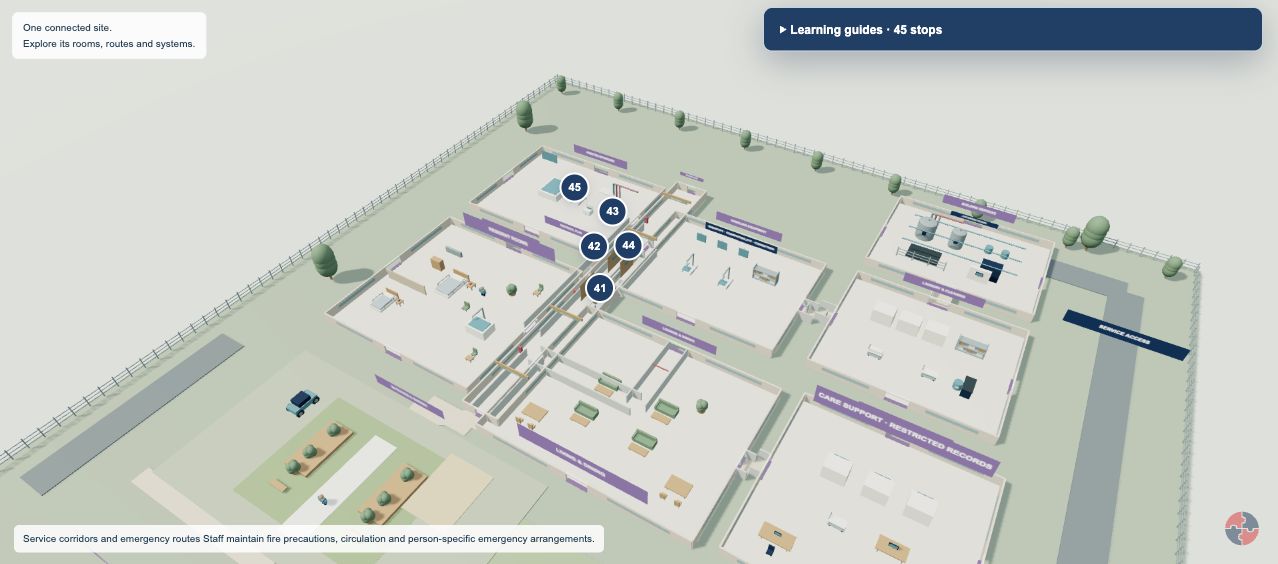
Work through 5 required applied activities and 3 model-practice pauses, with explanatory feedback and independent lesson decisions. Complete 5 distinct model mission sequences across those pauses. Use the actual fictional residential care home model or its equivalent accessible route to complete the required decision sequences; launching the model alone does not complete practice.
The 20-question assessment requires at least 80% plus every designated critical safety answer. Complete the required activities, practice and lesson checks. Points and badges cannot offset a critical safety error.
Use the LMS for confirmed save/resume and recorded results. Any certificate follows its configured passed-completion and grade conditions.
Open the public interactive practice copy; public practice is separate from the LMS record.
Sources and learning provenance
Original fictional cases are paired with public SHAREhub teaching and structured topic records. Use the applicable jurisdiction and primary guidance for live work.
- Government · Fire risk assessment for residential care premises
- MHRA · Emollient residue and fabric fires
- CQC · Consent in England
Topic sections, source identities and versions
| Public topic | Chunk and version | Jurisdiction and sources |
|---|---|---|
| emergency-procedures-and-first-aid-needs · coverage | emergency-procedures-and-first-aid-needs--coverage 2.2 | Great Britain, Northern Ireland hse-firstaid-needs, hse-firstaid-employer, hse-emergency, hseni-firstaid |
| fire-safety-fire-risk-assessment-and-emergency-controls · technical-model | fire-safety-fire-risk-assessment-and-emergency-controls--technical-model 20261016-letter-review-1 | Great Britain, England and Wales, England hse-fireandexplosion-workplace-htm, legislation-article-15, gov-fire-safety-risk-assessment-offices-and-shops-fire-safety-risk-assessment-offices-and-, gov-fire-safety-risk-assessment-means-of-escape-for-disabled-people-fire-safety-risk-asses, gov-workplace-fire-safety-your-responsibilities-fire-safety-equipment-drills-and-training |
| fire-safety-fire-risk-assessment-and-emergency-controls · decision-tool | fire-safety-fire-risk-assessment-and-emergency-controls--decision-tool 20261016-letter-review-1 | England, England and Wales gov-fire-safety-risk-assessment-offices-and-shops-fire-safety-risk-assessment-offices-and-, gov-publications-fire-safety-risk-assessment-factories-and-warehouses, gov-workplace-fire-safety-your-responsibilities-fire-safety-equipment-drills-and-training |
| fire-safety-fire-risk-assessment-and-emergency-controls · control-hierarchy | fire-safety-fire-risk-assessment-and-emergency-controls--control-hierarchy 20261016-letter-review-1 | Great Britain, England, England and Wales share-hierarchy-hse, gov-publications-fire-safety-risk-assessment-factories-and-warehouses, hse-welding-other-welding-risks-htm, hse-fireandexplosion-dsear-htm, gov-fire-safety-risk-assessment-offices-and-shops-fire-safety-risk-assessment-offices-and-, legislation-article-15, gov-fire-safety-risk-assessment-5-step-checklist-fire-safety-risk-assessment-5-step-checkl, hse-books-hsg168-htm, hse-fireandexplosion-dsear-background-htm, share-hierarchy-iosh |
| passive-fire-protection-layout-and-separation · critical-controls | passive-fire-protection-layout-and-separation--critical-controls 2.1 | Great Britain, Northern Ireland hse-pfp, ni-fire, ew-guide, scot-fire, hse-layout, hsg176 |
| human-behaviour-wayfinding-and-crowd-movement-in-fire · vulnerable | human-behaviour-wayfinding-and-crowd-movement-in-fire--vulnerable | England source-hse-fire-guide, source-eng-disabled-escape, source-eng-res-peep-law, source-eng-res-peep |
| fire-emergency-plans-business-continuity-and-environmental-impacts · evidence-pack | fire-emergency-plans-business-continuity-and-environmental-impacts--evidence-pack 20261016-letter-review-1 | England, Scotland, Great Britain gov-fire-safety-risk-assessment-offices-and-shops-fire-safety-risk-assessment-offices-and-, gov-publications-practical-fire-safety-guidance-existing-non-residential-premises-2, hse-workplace-health-emergency-procedures-htm |
| human-behaviour-wayfinding-and-crowd-movement-in-fire · alarm-response | human-behaviour-wayfinding-and-crowd-movement-in-fire--alarm-response | England source-hse-fire-guide |
| fire-emergency-plans-business-continuity-and-environmental-impacts · plan-content | fire-emergency-plans-business-continuity-and-environmental-impacts--plan-content 20261016-letter-review-1 | England, Scotland, Great Britain gov-fire-safety-risk-assessment-offices-and-shops-fire-safety-risk-assessment-offices-and-, gov-publications-practical-fire-safety-guidance-existing-non-residential-premises-2, hse-workplace-health-emergency-procedures-htm |
| emergency-procedures-and-first-aid-needs · testing | emergency-procedures-and-first-aid-needs--testing 2.2 | Great Britain, Northern Ireland hse-firstaid-needs, hse-firstaid-employer, hse-emergency |
Course SH-CARE-09 · version 2026.10.20.2. .
Questions about this course
Is this training free?
Full public teaching and readers are free without an account. A free learner account is required for saved LMS progress and recorded assessment. Completion and any course-completion certificate depend on the configured LMS conditions.
How long should I allow?
Approximately 110–170 minutes, including teaching, lesson checks, required activities, model or accessible practice and one assessment attempt. Individual pace, review and retries vary. Save and resume in the LMS.
Can I learn without a 3D-capable browser?
Yes. The complete HTML reader provides the teaching. Required model practice has an equivalent accessible decision route in the interactive course. Use the LMS route for recorded learning.
What is required to pass?
Complete the required learning, activities, practice and lesson decisions. The 20-question final assessment requires at least 80% plus every designated critical safety answer. Points cannot compensate for a critical safety error. Follow the feedback before retrying.
Does this authorise care operations?
Care-home safety awareness with a Great Britain workplace baseline. CQC, DHSC and cited residential-care examples apply to England where stated; confirm the relevant national regime. This course does not confer clinical, medicines, lifting, restraint, maintenance or emergency-response competence or authorisation. This independent course does not award an external qualification or replace competent task assessment, practical training or site authorisation.