Full public teaching and readers are free without an account. A free learner account is required for saved LMS progress and recorded assessment. Completion and any course-completion certificate depend on the configured LMS conditions. Open the course overview.
Lesson 1
Look at the work system behind individual behaviour
Recognise fatigue, stress, workstation and heat concerns in the work arrangement.
Look at the work system behind individual behaviour
Fatigue, stress and discomfort should prompt examination of workload, shift design, recovery, supervision and task demands. Avoid treating every concern as a personal failure. Use the reporting and support arrangements while controlling immediate safety exposure.
Connect fatigue, workload, induction and emergency readiness.
Follow the task through the area
A tired operator is asked to cover overtime
A worker reports poor alertness after extended work and is asked to cover another vehicle duty.
The control-room workstation does not fit
A worker monitors orders using a fixed workstation with long reach, glare and no suitable task variation.
Targets keep rising after staffing drops
Staff report missed recovery, conflicting priorities and pressure after vacancies increase.
A lone check without a response owner
A worker is asked to check remote stock after the normal team has left.
A new young worker gets an unfamiliar task
A young starter is asked to use unfamiliar equipment during a busy shift without confirmed suitable supervision.
The first-aid contact is absent on the late shift
The listed first aider is absent and the late-shift team has no confirmed replacement route.
A hot shift has no effective recovery cover
A hot period increases work strain while staff cannot leave their stations for planned recovery.
The fire assessment misses a changed stock layout
Returned electrical goods and extra packaging now occupy a former clear area. The fire assessment drawing predates the change, and visiting workers are using a different route.
Challenge the first impression
Immediate protection and longer-term changes have different purposes. Explore each level and check what is feasible for the actual site, task and people.
Name who owns the work, verify implementation and check effectiveness in real conditions. A learning result or request for control does not close an operational action.
What does fatigue management mean in practice?
Fatigue management means controlling the causes of fatigue through work design, staffing, recovery and decision-making standards.
A proper system does not rely on generic wellbeing advice alone. Sleep hygiene information can help, but it cannot compensate for a rota that gives poor recovery, a shutdown plan that relies on routine excessive hours, or a culture where workers feel they must drive home after a night shift even when they are struggling to stay awake.
The management task is to identify where alertness may reasonably degrade and to decide what controls are needed before harm occurs. That includes looking at the task, the person, the shift pattern, the journey, the environment, the workload, the staffing level and the consequences of error.
Fatigue can be acute after a long shift or poor sleep, cumulative after repeated inadequate recovery, or linked to circadian disruption from night work and early starts. All three can appear in the same person or team.
Fatigue management building blocks - Fatigue management building blocks
Building block
What it means
Why it matters
Policy
Sets responsibilities, limits and reporting expectations.
Gives managers authority to control fatigue before incidents.
Risk assessment
Identifies who is exposed and which tasks are safety critical.
Prevents generic controls being applied to high-risk work.
Roster design
Controls shift length, nights, quick returns and recovery.
Reduces foreseeable sleep loss and body-clock disruption.
Operational control
Manages actual hours, breaks, call-outs and exceptions.
Controls what happens in real work, not only the plan.
Worker involvement
Uses feedback from the people doing the work.
Reveals missed breaks, poor rest areas and impractical schedules.
Assurance
Checks indicators, audits and learning.
Shows whether arrangements work and improve.
Fatigue is the performance impairment along the pathway. The controllable source is the work demand or task exposure: extended hours, poorly timed shifts, insufficient break cover, high workload or hazardous work scheduled at a low-alertness time. A person or medical condition is not the workplace hazard.
Harm chain: a roster, call-out or workload pattern reduces recovery, which can narrow attention and slow response. A task hazard such as moving plant, machinery, hot liquid or a process alarm can then reach a person when a control step is missed. The outcome depends on the task and exposure; fatigue alone does not prove causation. HSE describes the performance pathway.
Fatiguing work patterns, pathways, injury and early stops
Work pattern and task
How harm reaches people
Plausible injury or ill health
Early sign and stop decision
Work pattern and taskNight shift and missed breaks during plant or driving
How harm reaches peopleSleep pressure slows reaction or causes a microsleep; vehicle energy can strike a person.
Plausible injury or ill healthHead or limb trauma, crush injury or fatal injury.
Early sign and stop decisionNodding, lane drift or missed pedestrian: stop driving or plant duty and arrange rested cover or safe travel.
Work pattern and taskExtended control-room duty or permit decisions
How harm reaches peopleNarrowed attention and memory can miss an alarm or isolation step; process or stored energy may reach people.
Plausible injury or ill healthDepending on process: skin burns, airway harm or impact injury.
Early sign and stop decisionRepeated check, missed alarm or confusion: stop critical decision, make safe and hand over to competent cover.
Work pattern and taskLate machine intervention or pressured kitchen close
How harm reaches peopleAn impaired check may miss a guard, moving part, wet floor or hot vessel.
Plausible injury or ill healthHand crush/cut injury, lower-limb or back slip injury, or skin burn.
Early sign and stop decisionUnsafe reach, stumble or repeated error: pause, secure the hazard and get relief.
Work pattern and taskRepeated overtime, high workload and poor recovery
How harm reaches peopleSustained demand can worsen tiredness, concentration and wellbeing; a clinician must assess unexplained symptoms.
Plausible injury or ill healthPersistent symptoms and work ability may deteriorate; do not infer a diagnosis.
Early sign and stop decisionReports persist or daily life is affected: adjust work and use local GP or occupational-health route.
Applied case
A busy shift includes a tired driver, a young starter, an overloaded supervisor and a lone stock-check assignment. First-aid coverage and the fire arrangements have changed.
Compare your decision
Fatigue, stress and discomfort should prompt examination of workload, shift design, recovery, supervision and task demands. Avoid treating every concern as a personal failure. Use the reporting and support arrangements while controlling immediate safety exposure.
Fatigue, stress and discomfort should prompt examination of workload, shift design, recovery, supervision and task demands. Avoid treating every concern as a personal failure. Use the reporting and support arrangements while controlling immediate safety exposure. Check the actual conditions and retain protection while gaps are resolved.
Lesson 2
Check who is present and what has changed
Match supervision, induction and lone-working controls to the person and task.
Check who is present and what has changed
A plan must match the shift that actually attends. Consider young or inexperienced workers, visitors, lone tasks, communication, first-aid needs and emergency responsibilities. A rota or policy written for another pattern of work may leave gaps.
Connect fatigue, workload, induction and emergency readiness.
Follow the task through the area
A tired operator is asked to cover overtime
A worker reports poor alertness after extended work and is asked to cover another vehicle duty.
The control-room workstation does not fit
A worker monitors orders using a fixed workstation with long reach, glare and no suitable task variation.
Targets keep rising after staffing drops
Staff report missed recovery, conflicting priorities and pressure after vacancies increase.
A lone check without a response owner
A worker is asked to check remote stock after the normal team has left.
A new young worker gets an unfamiliar task
A young starter is asked to use unfamiliar equipment during a busy shift without confirmed suitable supervision.
The first-aid contact is absent on the late shift
The listed first aider is absent and the late-shift team has no confirmed replacement route.
A hot shift has no effective recovery cover
A hot period increases work strain while staff cannot leave their stations for planned recovery.
The fire assessment misses a changed stock layout
Returned electrical goods and extra packaging now occupy a former clear area. The fire assessment drawing predates the change, and visiting workers are using a different route.
Challenge the first impression
Immediate protection and longer-term changes have different purposes. Explore each level and check what is feasible for the actual site, task and people.
Name who owns the work, verify implementation and check effectiveness in real conditions. A learning result or request for control does not close an operational action.
What is Display Screen Equipment?
Display Screen Equipment is work equipment with an alphanumeric or graphic display screen used for work.
DSE includes ordinary office screens, laptops, tablets, smartphones, multi-screen workstations, touchscreens, handheld devices and screen-based monitoring systems. It can appear in offices, warehouses, vehicles, reception desks, control rooms, home offices, leisure venues, healthcare settings, laboratories and construction management cabins.
The legal definition is broad because the risk is not tied to one type of technology. The same health mechanisms can arise from a desktop monitor, a laptop on a kitchen table, a tablet used for stock checks or a control-room screen if the person uses it for long periods without good setup, variation and recovery.
The specific GB DSE instrument has exclusions, including portable systems not in prolonged use, screens mainly intended for public operation, and some small data or measurement displays. A phone or tablet used for prolonged work should still be assessed against the actual statutory definition; excluded equipment can still create risks under wider health and safety duties.
A busy shift includes a tired driver, a young starter, an overloaded supervisor and a lone stock-check assignment. First-aid coverage and the fire arrangements have changed.
Compare your decision
A plan must match the shift that actually attends. Consider young or inexperienced workers, visitors, lone tasks, communication, first-aid needs and emergency responsibilities. A rota or policy written for another pattern of work may leave gaps.
A plan must match the shift that actually attends. Consider young or inexperienced workers, visitors, lone tasks, communication, first-aid needs and emergency responsibilities. A rota or policy written for another pattern of work may leave gaps. Check the actual conditions and retain protection while gaps are resolved.
Lesson 3
A tired operator is asked to cover overtime
Stop unsafe safety-critical duty, arrange competent cover and safe travel, and review the actual work and recovery pattern.
Read the scene evidence
A worker reports poor alertness after extended work and is asked to cover another vehicle duty.
Identify the condition separately from the exposed person and any possible outcome.
How the harm pathway develops
Fatigue during safety-critical vehicle work
A worker reports poor alertness after extended work and is asked to cover another vehicle duty.
How people can be exposed
Reduced alertness meets vehicle movement or another critical decision.
Possible harm
Errors, delayed reaction and possible harm to the operator or other people.
A worker reports poor alertness after extended work and is asked to cover another vehicle duty. The condition remains unresolved.
Protective response
Stop unsafe safety-critical duty, arrange competent cover and safe travel, and review the actual work and recovery pattern.
Select controls by how they prevent harm
Immediate protection and longer-term changes have different purposes. Explore each level and check what is feasible for the actual site, task and people.
Use the five-level hierarchy below. Inspection, instruction and supervision sustain every chosen control; they do not replace physical prevention.
Control level
Application to this case
Elimination
Remove excessive work demands through appropriate staffing and workload design.
Substitution
Use a suitable alternative schedule or task allocation with adequate recovery.
Engineering controls
Provide work systems that do not depend on an impaired person at a critical interface.
Administrative controls
Compare actual hours and breaks with the roster and act on fatigue reports without blame.
PPE
PPE or stimulants do not remove fatigue-related impairment.
Verify, communicate and hand back
Name who owns the work, verify implementation and check effectiveness in real conditions. A learning result or request for control does not close an operational action.
Explain the task-specific evidence, who must act and what restriction remains until it is resolved. A closed action or a course badge cannot establish a live site condition.
What does fatigue management mean in practice?
Fatigue management means controlling the causes of fatigue through work design, staffing, recovery and decision-making standards.
A proper system does not rely on generic wellbeing advice alone. Sleep hygiene information can help, but it cannot compensate for a rota that gives poor recovery, a shutdown plan that relies on routine excessive hours, or a culture where workers feel they must drive home after a night shift even when they are struggling to stay awake.
The management task is to identify where alertness may reasonably degrade and to decide what controls are needed before harm occurs. That includes looking at the task, the person, the shift pattern, the journey, the environment, the workload, the staffing level and the consequences of error.
Fatigue can be acute after a long shift or poor sleep, cumulative after repeated inadequate recovery, or linked to circadian disruption from night work and early starts. All three can appear in the same person or team.
Fatigue management building blocks - Fatigue management building blocks
Building block
What it means
Why it matters
Policy
Sets responsibilities, limits and reporting expectations.
Gives managers authority to control fatigue before incidents.
Risk assessment
Identifies who is exposed and which tasks are safety critical.
Prevents generic controls being applied to high-risk work.
Roster design
Controls shift length, nights, quick returns and recovery.
Reduces foreseeable sleep loss and body-clock disruption.
Operational control
Manages actual hours, breaks, call-outs and exceptions.
Controls what happens in real work, not only the plan.
Worker involvement
Uses feedback from the people doing the work.
Reveals missed breaks, poor rest areas and impractical schedules.
Assurance
Checks indicators, audits and learning.
Shows whether arrangements work and improve.
Fatigue is the performance impairment along the pathway. The controllable source is the work demand or task exposure: extended hours, poorly timed shifts, insufficient break cover, high workload or hazardous work scheduled at a low-alertness time. A person or medical condition is not the workplace hazard.
Harm chain: a roster, call-out or workload pattern reduces recovery, which can narrow attention and slow response. A task hazard such as moving plant, machinery, hot liquid or a process alarm can then reach a person when a control step is missed. The outcome depends on the task and exposure; fatigue alone does not prove causation. HSE describes the performance pathway.
Fatiguing work patterns, pathways, injury and early stops
Work pattern and task
How harm reaches people
Plausible injury or ill health
Early sign and stop decision
Work pattern and taskNight shift and missed breaks during plant or driving
How harm reaches peopleSleep pressure slows reaction or causes a microsleep; vehicle energy can strike a person.
Plausible injury or ill healthHead or limb trauma, crush injury or fatal injury.
Early sign and stop decisionNodding, lane drift or missed pedestrian: stop driving or plant duty and arrange rested cover or safe travel.
Work pattern and taskExtended control-room duty or permit decisions
How harm reaches peopleNarrowed attention and memory can miss an alarm or isolation step; process or stored energy may reach people.
Plausible injury or ill healthDepending on process: skin burns, airway harm or impact injury.
Early sign and stop decisionRepeated check, missed alarm or confusion: stop critical decision, make safe and hand over to competent cover.
Work pattern and taskLate machine intervention or pressured kitchen close
How harm reaches peopleAn impaired check may miss a guard, moving part, wet floor or hot vessel.
Plausible injury or ill healthHand crush/cut injury, lower-limb or back slip injury, or skin burn.
Early sign and stop decisionUnsafe reach, stumble or repeated error: pause, secure the hazard and get relief.
Work pattern and taskRepeated overtime, high workload and poor recovery
How harm reaches peopleSustained demand can worsen tiredness, concentration and wellbeing; a clinician must assess unexplained symptoms.
Plausible injury or ill healthPersistent symptoms and work ability may deteriorate; do not infer a diagnosis.
Early sign and stop decisionReports persist or daily life is affected: adjust work and use local GP or occupational-health route.
How should fatigue controls be checked and improved?
Assurance should check whether fatigue controls work in real operations and whether weak signals are acted on.
Fatigue assurance should use a three-line approach. First line checks happen in daily work: supervisors verify breaks, actual hours, handover quality and visible fatigue concerns. Second line checks by HSSE, HR or operational leaders compare records, rosters, overtime, reports and worker feedback. Third line audits test the management system and sample evidence from high-risk roles or sites.
The data should lead to decisions. If overtime rises, breaks are missed, workers stop reporting, near misses cluster around night shifts or driving events increase after long shifts, the system should change. Assurance that only counts completed forms will miss the point.
Supervisor checks real hours, breaks, handover and immediate fitness for safety-critical work.
Use simple yes/no prompts and act quickly when a worker says they are not safe to continue.
Second line
Managers, HSSE or HR review rosters, overtime, reports, absence, incidents and worker feedback.
Look for patterns and rank findings with named, time-bound actions.
Third line
Internal audit or external specialist review tests the fatigue management system.
Sample evidence from real shifts, shutdowns, call-outs and high-consequence tasks.
Management review
Leadership reviews trends and decides resources.
Treat staffing and recovery as risk controls, not optional welfare extras.
Use leading indicators such as actual hours, call-outs, missed breaks, staffing gaps, fatigue reports and completed corrective actions alongside near misses, driving events and incidents. Investigate patterns without presuming fatigue was the only cause or blaming a reporter. Review whether a control changed the real shift, not only the written policy.
Compare planned and actual duties, time-recording gaps, contractor hours, missed breaks and reports with field observations and worker feedback. Collect only necessary fatigue and health information, restrict access to confidential details and do not let an app, wearable or score declare fitness or become a disciplinary shortcut. Close corrective actions only after checking real-world effectiveness and recurrence; seek independent review for high-consequence or repeated failures.
Applied case
A worker reports poor alertness after extended work and is asked to cover another vehicle duty. At handover, someone says that assigning an action owner is enough to restart. Decide what is still needed.
Compare your decision
Name who owns the work, verify implementation and check effectiveness in real conditions. A learning result or request for control does not close an operational action.
Name who owns the work, verify implementation and check effectiveness in real conditions. A learning result or request for control does not close an operational action. Ownership and training support the control but do not demonstrate its effectiveness.
Lesson 4
The control-room workstation does not fit
Current DSE model · learning reference
Compare the setup and explain the change
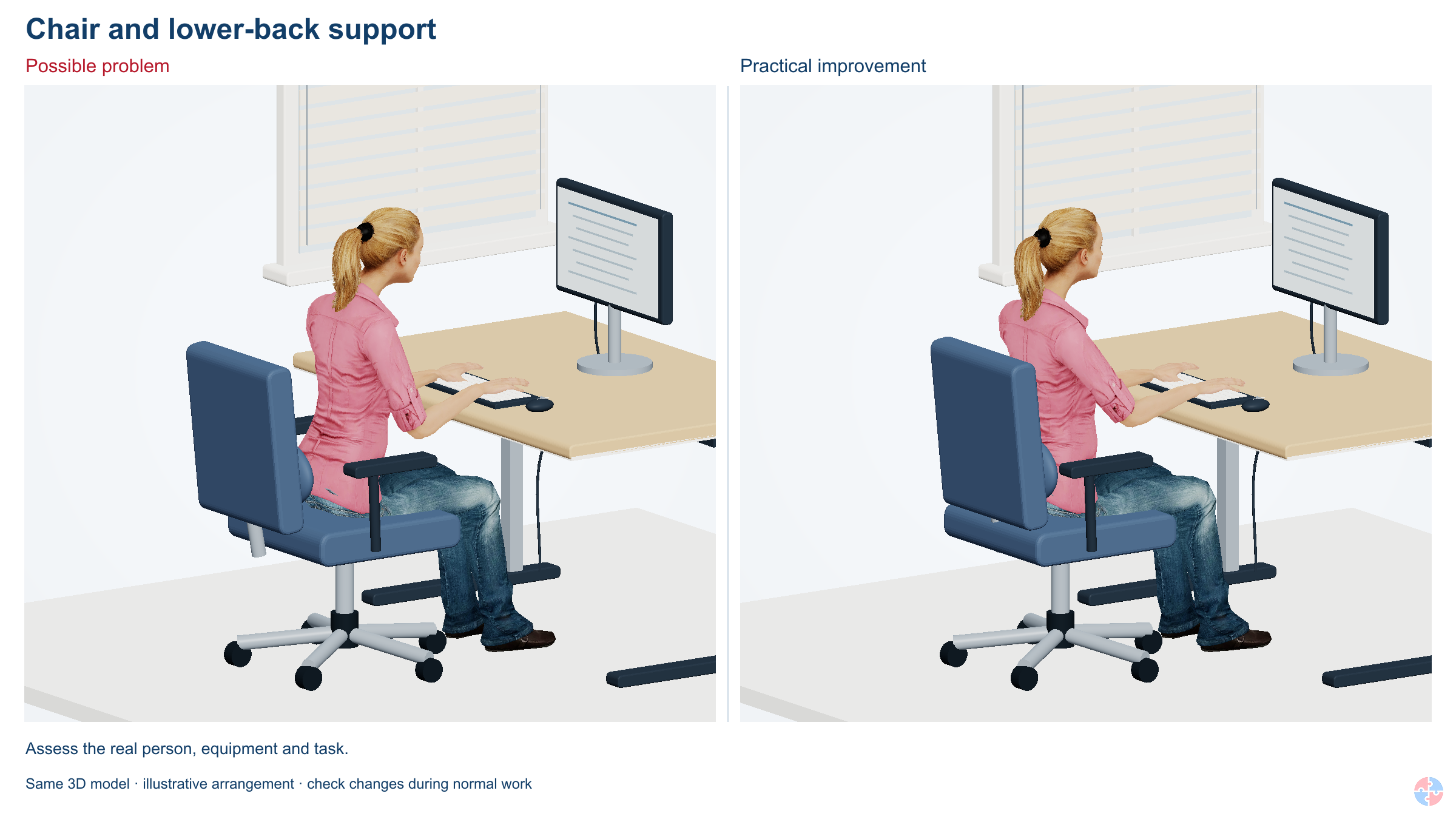
Actual renders from the current DSE simulator, comparing an example problem and an adjustment.
The backrest support moves away and the person leans forwards. Lack of comfortable support can make sitting harder to sustain and contribute to back discomfort. There is no single posture to hold all day. Adjust the backrest and sitting position, keep close to the work and vary posture. Ask for help if the chair cannot support you comfortably.
A worker monitors orders using a fixed workstation with long reach, glare and no suitable task variation. The condition remains unresolved.
Protective response
Review the workstation with the worker, make suitable adjustments and plan effective breaks or changes of activity.
Select controls by how they prevent harm
Immediate protection and longer-term changes have different purposes. Explore each level and check what is feasible for the actual site, task and people.
Use the five-level hierarchy below. Inspection, instruction and supervision sustain every chosen control; they do not replace physical prevention.
Control level
Application to this case
Elimination
Remove unnecessary duplicate screen tasks and avoidable sustained work.
Substitution
Compare suitable software and input methods that reduce effort and awkward interaction.
Engineering controls
Provide adjustable equipment, suitable layout and controlled lighting.
Administrative controls
Assess the user and task, provide instruction and check adjustments and recovery in use.
PPE
Personal accessories do not replace a suitable workstation and work design.
Verify, communicate and hand back
Name who owns the work, verify implementation and check effectiveness in real conditions. A learning result or request for control does not close an operational action.
Explain the task-specific evidence, who must act and what restriction remains until it is resolved. A closed action or a course badge cannot establish a live site condition.
What is Display Screen Equipment?
Display Screen Equipment is work equipment with an alphanumeric or graphic display screen used for work.
DSE includes ordinary office screens, laptops, tablets, smartphones, multi-screen workstations, touchscreens, handheld devices and screen-based monitoring systems. It can appear in offices, warehouses, vehicles, reception desks, control rooms, home offices, leisure venues, healthcare settings, laboratories and construction management cabins.
The legal definition is broad because the risk is not tied to one type of technology. The same health mechanisms can arise from a desktop monitor, a laptop on a kitchen table, a tablet used for stock checks or a control-room screen if the person uses it for long periods without good setup, variation and recovery.
The specific GB DSE instrument has exclusions, including portable systems not in prolonged use, screens mainly intended for public operation, and some small data or measurement displays. A phone or tablet used for prolonged work should still be assessed against the actual statutory definition; excluded equipment can still create risks under wider health and safety duties.
How can the ISO 45001 hierarchy of controls reduce posture and screen-work strain at home and in the office?
Start by removing avoidable repetitive screen work and redesigning the task, then provide adjustable equipment and a workable activity pattern; individual symptoms and needs govern the final setup.
In a call centre, automate duplicate entry where safe, adjust workstation and schedule non-screen tasks. A reception team may need a different approach because the screen and customer interface cannot be removed; verify the actual desk and shift pattern. Neither ordinary glasses nor PPE is a substitute for an effective workstation assessment.
A worker alternates between home and office screen work; assess both setups and agree adjustments without requesting a diagnosis.
How can the ERICPD hierarchy of controls reduce posture and screen-work strain at home and in the office?
ERICPD is a planning crossmap. Its prompts do not add a sixth rung or rank Isolate above engineering. Discipline verifies and sustains every control level.
Control level
Control for this activity
Owner and verification
Stop / restart decision
Eliminate
Remove duplicate screen entry and unnecessary prolonged desk tasks from the workflow.
Task owner verifies that the proposed change removes the named hazardous step, including foreseeable cleaning, maintenance and work transferred elsewhere.
If the hazardous step remains, keep it within the task assessment and select the stronger feasible remaining controls.
Reduce, including substitution
Replace laptop-only work with a suitable separate display and input arrangement after trying it with the user.
The user trials the actual display, keyboard, pointing device and docking arrangement at both regular locations; the manager checks that adjustments and task changes remain usable.
Reject an alternative if its performance is unproved or its new hazards are unresolved.
Isolate
Provide a usable work area separated from storage and trip hazards so the worker can change posture safely.
Release only after worker and manager confirm a workable setup and review date. Retain verification and unresolved restrictions at handover.
Keep the task on hold until required reinstatement evidence and unresolved defects are accepted by the responsible owner.
How can the ISO 45001 hierarchy of controls reduce posture and screen-work strain at home and in the office?
The hierarchy of controls in ISO 45001:2018 comes under Clause 8.1.2 (Eliminating hazards and reducing OH&S risks), which is located within Clause 8 ("Operation").
Task owner verifies that the proposed change removes the named hazardous step, including foreseeable cleaning, maintenance and work transferred elsewhere.
If the hazardous step remains, keep it within the task assessment and select the stronger feasible remaining controls.
Engineering controls
Replace laptop-only work with a suitable separate display and input arrangement after trying it with the user.
The user trials the actual display, keyboard, pointing device and docking arrangement at both regular locations; the manager checks that adjustments and task changes remain usable.
Reject an alternative if its performance is unproved or its new hazards are unresolved.
Engineering controls
Provide a usable work area separated from storage and trip hazards so the worker can change posture safely.
Release only after worker and manager confirm a workable setup and review date. Retain verification and unresolved restrictions at handover.
Keep the task on hold until required reinstatement evidence and unresolved defects are accepted by the responsible owner.
Applied case
A worker monitors orders using a fixed workstation with long reach, glare and no suitable task variation. At handover, someone says that assigning an action owner is enough to restart. Decide what is still needed.
Compare your decision
Name who owns the work, verify implementation and check effectiveness in real conditions. A learning result or request for control does not close an operational action.
Name who owns the work, verify implementation and check effectiveness in real conditions. A learning result or request for control does not close an operational action. Ownership and training support the control but do not demonstrate its effectiveness.
Lesson 5
Targets keep rising after staffing drops
Listen to workers, address immediate unsafe demands and agree practical changes to workload, staffing and support.
Read the scene evidence
Staff report missed recovery, conflicting priorities and pressure after vacancies increase.
Identify the condition separately from the exposed person and any possible outcome.
How the harm pathway develops
Harmful sustained work demands and inadequate support
Staff report missed recovery, conflicting priorities and pressure after vacancies increase.
How people can be exposed
Excessive demands continue with little control, support or clarity.
Possible harm
Possible work-related stress and effects on health and safe task performance.
Staff report missed recovery, conflicting priorities and pressure after vacancies increase. The condition remains unresolved.
Protective response
Listen to workers, address immediate unsafe demands and agree practical changes to workload, staffing and support.
Select controls by how they prevent harm
Immediate protection and longer-term changes have different purposes. Explore each level and check what is feasible for the actual site, task and people.
Use the five-level hierarchy below. Inspection, instruction and supervision sustain every chosen control; they do not replace physical prevention.
Control level
Application to this case
Elimination
Remove avoidable overload through resourcing and realistic work design.
Substitution
Compare a suitable work allocation or service plan with sustainable demands.
Engineering controls
Design usable systems and task interfaces that reduce unnecessary workload and conflict.
Administrative controls
Assess demands, control, support, relationships, role and change with workers and verify action.
PPE
Personal coping tools cannot compensate for harmful work demands.
Verify, communicate and hand back
Name who owns the work, verify implementation and check effectiveness in real conditions. A learning result or request for control does not close an operational action.
Explain the task-specific evidence, who must act and what restriction remains until it is resolved. A closed action or a course badge cannot establish a live site condition.
What is work-related stress?
Work-related stress is the adverse reaction people may have to excessive work pressure or demands. The employer should assess and change harmful work factors—demands, control, support, relationships, role and change—using worker input and follow-up checks. Individual support, occupational health or an employee assistance programme can help, but does not replace reducing the work cause. Managers should ask about work impact and needed support without diagnosing a condition or collecting unnecessary medical detail.
Best-practice guide · six simple steps
Best-practice guide: Stress
Start with the key actions, then explore value, a workplace example, harm, stronger controls and further help. Choose a step or use Previous and Next; the guide does not advance automatically.
Keep one card or the full set for social sharing, team briefings and learning. Each PDF contains one card per page. Read the full topic for explanations, questions and source links.
Read all six steps as text
1. What is work-related stress?
Work-related stress is the adverse reaction people may have to excessive work pressure or demands.
Control the task: Regular one-to-ones, trained supervisors and accessible help routes.
Verify before release: Workload dashboard and action tracker.
Work-related stress is the adverse reaction people may have to excessive work pressure or demands. The employer should assess and change harmful work factors—demands, control, support, relationships, role and change—using worker input and follow-up checks. Stress explains how work-related stress should be assessed and controlled as a health and safety risk, using HSE's Management Standards: demands, control, support, relationships, role and change.
Apply it: Which part of this plan would you check at the workface before authorising the task?
Use the evidence to improve the actual work arrangement.
Change at source: Resource plan, workload cap, demand triage and realistic deadlines.
Make it observable: Workload dashboard and action tracker.
Keep useful evidence: Team risk assessment, consultation, action owners, anonymised trends and minimal individual records.
Stress explains how work-related stress should be assessed and controlled as a health and safety risk, using HSE's Management Standards: demands, control, support, relationships, role and change. It separates ordinary pressure from harmful sustained stress, explains team and individual warning signs, gives manager decision prompts, shows what a suitable and sufficient stress risk assessment looks like, and links actions to workload, staffing, supervision, change, bullying, return to work and evidence. Team risk assessment, consultation, action owners, anonymised trends and minimal individual records.
Apply it: What evidence would show that the change improves this task, rather than only completing a record?
Fictional example: a practical application of the existing topic lesson.
Setting: Contact-centre work during vacancies and a new system; high targets, missed breaks, errors and turnover.
Act: Consult staff, check workload, control, abusive callers, target design, role clarity and change support.
Hold / review: Escalate immediate safety or crisis concerns through emergency/local support; pause unsafe safety-critical work.
Protect breaks, adjust targets and staffing, provide supervisor support and confidential individual routes. Review work factors and agreed adjustments at set dates; change controls if indicators do not improve.
Apply it: At which point would you hold this example, and what evidence would allow it to proceed?
4. Harmful demands can persist behind a support offer
Connect the task, the route to the person and the control that can fail.
Work cause: Demand, conflicting targets and poor support exceed available capacity.
Warning signs: Skipped breaks, errors, withdrawal and turnover prompt a work review.
Health impact: Sustained harmful pressure can affect health, judgement and attendance.
Assess work-related stress through the actual work factors: demands, control, support, relationships, role and change. Individual support can help, but the employer must also address harmful working conditions. Managers should discuss work impact and support without diagnosing the person.
Apply it: Which work factor will change, and how will workers help judge whether it improves?
5. Change the work factors before adding coping advice
Start with the stronger practicable options and verify their effect.
Demands: Match workload, staffing, priorities and deadlines to available capacity.
Control and support: Give workers input, suitable supervision and access to practical help.
Relationships: Act on bullying, conflict and abusive-caller risks.
Role: Resolve conflicting responsibilities and decision rights.
Change: Consult, communicate and support people through new systems.
Use all six HSE Management Standards as work-design prompts. Protect actual breaks and review the changed workload with staff. PPE does not control harmful work demands. Personal support and occupational-health routes complement prevention and suitable individual adjustments.
Apply it: Which change addresses the source of pressure, and what will the follow-up review check?
Simplified learning guide. Use the full topic, current official guidance and the actual work arrangements. Workplace scenarios labelled fictional are illustrative examples.
Stress is not simply being busy, having a challenging job or feeling pressure before a deadline. Pressure can be normal and sometimes motivating when it is proportionate, time-limited, supported and within a person's control. Stress becomes a workplace risk when demands exceed coping capacity for long enough, intensely enough or unpredictably enough to affect health, behaviour, attendance, judgement or safety.
HSE's approach treats work-related stress like other health and safety risks. Employers should identify the causes, decide who may be harmed, evaluate whether controls are good enough, act, record where required and review. The key risk factors are demands, control, support, relationships, role and change. These are work-design factors, not personality labels.
Stress management must lead to practical changes in work. It should not tell workers to become tougher while excessive workload, poor staffing, role conflict, bullying, isolated work, unclear priorities or badly communicated change remain untouched. Individual support matters, but it cannot substitute for preventing or reducing harmful work conditions.
How can the ISO 45001 hierarchy of controls reduce harmful work demands and stress risks?
Control classification: Temporary duties, task stopping/reallocation, paired staffing, support and cover are administrative work arrangements. This example specifies no separate engineered measure; none should be invented merely to fill a tier. These actions retain the immediate safety and competent-release boundaries in the main lesson. Read this correction with the source table. Retained overview and stage artwork requires the matching classification update.
Address work-created hazards at source, then agree proportionate task controls and personal support.
For stress, assess the work itself: staffing, scheduling, exposure, equipment or interpersonal conditions as applicable. Remove or reduce hazards where possible, then agree practical procedures and review whether they work. A personal health condition calls for clinical advice and suitable work adjustments, not a generic control or diagnosis by a manager. HSE hierarchy of controls
Document who will act, what triggers a pause or referral, and when the arrangement will be reviewed. Apply the correct GB or NI duties and site instructions.
For the contact centre, remove conflicting or unrealistic targets, adjust queues and call allocation to available trained capacity, provide cover for actual breaks, and implement abusive-caller escalation. Verify the changed workload with staff; do not treat attendance at coping training as proof of control. PPE does not address harmful demands. HSE stress risk assessment; HSE six work-design standards. ERICPD is a teaching prompt (Eliminate, Reduce, Isolate, Control, PPE, Discipline); Discipline means maintaining and checking controls.
How can the ERICPD hierarchy of controls reduce harmful work demands and stress risks?
ERICPD is a planning crossmap. Its prompts do not add a sixth rung or rank Isolate above engineering. Discipline verifies and sustains every control level.
Worked activity: Contact-centre workload and target conflict
Activity and exposure
Contact-centre work during vacancies and a new system; high targets, missed breaks, errors and turnover.
Before work
Consult staff, check workload, control, abusive callers, target design, role clarity and change support.
During the activity
Protect breaks, adjust targets and staffing, provide supervisor support and confidential individual routes.
Hold or stop
Escalate immediate safety or crisis concerns through emergency/local support; pause unsafe safety-critical work.
Hand-back and release
Review work factors and agreed adjustments at set dates; change controls if indicators do not improve.
Evidence to retain
Team risk assessment, consultation, action owners, anonymised trends and minimal individual records.
No separate physical hazard-isolation measure is specified here. Task reassignment, paired staffing, support and cover are work-organisation measures, addressed under Control.
How can the ISO 45001 hierarchy of controls reduce harmful work demands and stress risks?
The hierarchy of controls in ISO 45001:2018 comes under Clause 8.1.2 (Eliminating hazards and reducing OH&S risks), which is located within Clause 8 ("Operation").
ESEAP mapping crosswalk: these are retained ERICPD source rows, mapped to the five ESEAP levels. Read the control-classification correction for mixed physical and administrative measures; six source rows do not mean six ESEAP levels.
Staff report missed recovery, conflicting priorities and pressure after vacancies increase. At handover, someone says that assigning an action owner is enough to restart. Decide what is still needed.
Compare your decision
Name who owns the work, verify implementation and check effectiveness in real conditions. A learning result or request for control does not close an operational action.
Name who owns the work, verify implementation and check effectiveness in real conditions. A learning result or request for control does not close an operational action. Ownership and training support the control but do not demonstrate its effectiveness.
Lesson 6
A lone check without a response owner
Confirm whether the task is suitable for lone work and put effective communication, support and a named response in place before it starts.
Read the scene evidence
A worker is asked to check remote stock after the normal team has left.
Identify the condition separately from the exposed person and any possible outcome.
How the harm pathway develops
Work without a reliable route to timely help
A worker is asked to check remote stock after the normal team has left.
How people can be exposed
An injury, illness or other incident occurs where help is not close or reliable.
Possible harm
Delayed assistance can worsen the consequences of an incident.
A worker is asked to check remote stock after the normal team has left. The condition remains unresolved.
Protective response
Confirm whether the task is suitable for lone work and put effective communication, support and a named response in place before it starts.
Select controls by how they prevent harm
Immediate protection and longer-term changes have different purposes. Explore each level and check what is feasible for the actual site, task and people.
Use the five-level hierarchy below. Inspection, instruction and supervision sustain every chosen control; they do not replace physical prevention.
Control level
Application to this case
Elimination
Remove unnecessary lone work by scheduling the task with suitable support.
Substitution
Compare a suitable remote check or supported inspection method.
Engineering controls
Provide communication and access arrangements that work in the actual location.
Administrative controls
Assess task suitability, competence, check-ins and a tested response to missed contact.
PPE
A personal device does not provide rescue unless someone can and will respond.
Verify, communicate and hand back
Name who owns the work, verify implementation and check effectiveness in real conditions. A learning result or request for control does not close an operational action.
Explain the task-specific evidence, who must act and what restriction remains until it is resolved. A closed action or a course badge cannot establish a live site condition.
What does lone working mean?
A lone worker works without close or direct supervision and may be at greater risk because help is not immediately available.
Best-practice guide · six simple steps
Best-practice guide: Lone Working
Start with the key actions, then explore value, a workplace example, harm, stronger controls and further help. Choose a step or use Previous and Next; the guide does not advance automatically.
Keep one card or the full set for social sharing, team briefings and learning. Each PDF contains one card per page. Read the full topic for explanations, questions and source links.
Read all six steps as text
1. What does lone working mean?
A lone worker works without close or direct supervision and may be at greater risk because help is not immediately available.
Avoid / redesign: Do the inspection remotely or during a paired visit when feasible.
Control the task: Secure access, lighting and reliable communication/location technology.
A lone worker works without close or direct supervision and may be at greater risk because help is not immediately available. Lone work is work without close or direct supervision, where help may not be immediately available.
Apply it: Which part of this plan would you check at the workface before authorising the task?
Use the evidence to improve the actual work arrangement.
Change at source: Do the inspection remotely or during a paired visit when feasible.
Make it observable: Planner documents option; prohibited task cannot proceed alone.
Keep useful evidence: Lone worker register and task assessment.
Lone work is work without close or direct supervision, where help may not be immediately available. Decide if the task can be done alone at all, then assess its hazards, the worker’s competence and health needs, location, communication coverage and realistic rescue time. Lone worker register and task assessment.
Apply it: What evidence would show that the change improves this task, rather than only completing a record?
Fictional example: a worker plans a remote maintenance visit.
Assess: Check the task, location, contact arrangements and foreseeable emergency.
Decide: Do not allocate work alone when the assessment requires assistance.
Verify: Test contact, missed-check response and the route for summoning help.
Lone working can increase the consequences of an incident because help is less immediate. The planner checks competence, work limits, supervision and response arrangements. A phone alone is insufficient if the site has no reliable signal or no one acts on a missed check.
Apply it: What happens if the worker misses the agreed contact, and who takes action?
Connect the task, the route to the person and the control that can fail.
Incident: A fall, illness, violence or task failure can leave a person unable to call.
Delay: A missed contact may pass unnoticed without a named responder.
Consequence: Help can arrive too late when location, access and escalation are unresolved.
A fall, illness, violence or task failure can leave a person unable to call. A missed contact may pass unnoticed without a named responder. Help can arrive too late when location, access and escalation are unresolved. Use the full topic for the detailed mechanism, task limits and source scope.
Apply it: Where is this harm route present in the actual work, and which control breaks it before anyone is exposed?
Start with the stronger practicable options and verify their effect.
Eliminate: Do the inspection remotely or during a paired visit when feasible.
Reduce: Use a low-risk visual check instead of intrusive fault-finding.
Isolate: Secure access, lighting and reliable communication/location technology.
Control: Check-in clock, route, named responder, training and rescue drill.
PPE: Task-suitable protection for residual site hazards.
Eliminate: Do the inspection remotely or during a paired visit when feasible. Reduce: Use a low-risk visual check instead of intrusive fault-finding. Isolate: Secure access, lighting and reliable communication/location technology. Control: Check-in clock, route, named responder, training and rescue drill. PPE: Task-suitable protection for residual site hazards. Read the full control table for qualifications, ownership and verification. Use the actual task and applicable jurisdiction; existing technical approval remains unchanged.
Apply it: Which stronger option can be used here, and who will verify it before accepting the remaining risk?
Simplified learning guide. Use the full topic, current official guidance and the actual work arrangements. Workplace scenarios labelled fictional are illustrative examples.
Lone working includes obvious examples such as delivery drivers, security staff, cleaners, community workers, engineers, maintenance workers, home workers and people opening or closing premises. It also includes short periods where a person becomes isolated: working in a plant room, checking a remote store, visiting a client, driving between sites, carrying out a late maintenance task or working in a building after others have left.
Lone working is not automatically banned. The question is whether the risk can be controlled without direct supervision or immediate help. Some activities may be acceptable with communication, competence and emergency arrangements. Others should not be done alone, especially where rescue would be time-critical, violence risk is high, the task is safety-critical, conditions are uncertain or the worker's individual health factors make the risk different.
For home working, assess display screen equipment (DSE) risks proportionately. Where a location device is needed, Global Positioning System (GPS) data should be limited to the safety purpose. The Health and Safety Executive (HSE) issues guidance for Great Britain; the Health and Safety Executive for Northern Ireland (HSENI) issues guidance for Northern Ireland.
Reception, petrol station, warehouse, plant room, depot, out-of-hours office.
Can the worker get help quickly if injured, threatened or unwell?
Mobile lone work
Drivers, engineers, inspectors, home visitors, grounds teams.
Is the journey, location, communication and emergency response controlled?
Remote or isolated work
Rural sites, utilities, farms, water assets, empty buildings.
Can conditions change without anyone knowing and can rescue reach the person?
Home working
Home-based office work or remote administrative roles.
Are DSE, stress, isolation, supervision and contact managed proportionately?
Short-duration isolation
Task that becomes lone work temporarily during breaks, handover or overtime.
Has the assessment considered real work patterns, not just planned staffing?
What evidence shows lone working is controlled?
Evidence should show the assessment matches real lone work and that escalation works when tested.
Test the live chain: a worker can explain the task limit, the device works on site, the controller knows the check-in clock and a responder can reach the location. Sample a missed-check drill and its corrective actions.
Evidence
What it should show
Weakness to challenge
Lone-working risk assessment
Task, person, location, communication, emergency response and stop triggers.
One generic assessment for all lone workers.
Worker list or register
Who works alone, where, when and under what controls.
Home workers or occasional out-of-hours work not included.
Check-in records
Contact is made as planned and missed checks are escalated.
Missed check-ins closed with no explanation.
Emergency response test
The escalation route works out of hours and in remote areas.
Device works but response process is unclear.
Violence risk review
Public-facing and conflict risks are assessed.
Incident reports do not change staffing or controls.
Training and supervision
Workers know limits, emergency actions and dynamic stop decisions.
Online training only, no practical scenario test.
Applied case
A worker is asked to check remote stock after the normal team has left. At handover, someone says that assigning an action owner is enough to restart. Decide what is still needed.
Compare your decision
Name who owns the work, verify implementation and check effectiveness in real conditions. A learning result or request for control does not close an operational action.
Name who owns the work, verify implementation and check effectiveness in real conditions. A learning result or request for control does not close an operational action. Ownership and training support the control but do not demonstrate its effectiveness.
Lesson 7
A new young worker gets an unfamiliar task
Hold the unfamiliar task and arrange the age-appropriate assessment, restrictions, instruction and supervision.
Read the scene evidence
A young starter is asked to use unfamiliar equipment during a busy shift without confirmed suitable supervision.
Identify the condition separately from the exposed person and any possible outcome.
How the harm pathway develops
Unassessed task demands for an inexperienced young worker
A young starter is asked to use unfamiliar equipment during a busy shift without confirmed suitable supervision.
How people can be exposed
The person encounters equipment or other hazards beyond the assessed task and capability.
Possible harm
Possible injury from the task, equipment or surrounding movements.
A young starter is asked to use unfamiliar equipment during a busy shift without confirmed suitable supervision. The condition remains unresolved.
Protective response
Hold the unfamiliar task and arrange the age-appropriate assessment, restrictions, instruction and supervision.
Select controls by how they prevent harm
Immediate protection and longer-term changes have different purposes. Explore each level and check what is feasible for the actual site, task and people.
Use the five-level hierarchy below. Inspection, instruction and supervision sustain every chosen control; they do not replace physical prevention.
Control level
Application to this case
Elimination
Remove unsuitable hazardous tasks from the young worker’s duties.
Substitution
Choose a suitable lower-risk learning task within the applicable restrictions.
Engineering controls
Provide effective physical safeguards that do not depend on experience alone.
Administrative controls
Assess capability and applicable age and work restrictions and provide suitable instruction and supervision.
PPE
PPE does not compensate for an unsuitable task or absent supervision.
Verify, communicate and hand back
Name who owns the work, verify implementation and check effectiveness in real conditions. A learning result or request for control does not close an operational action.
Explain the task-specific evidence, who must act and what restriction remains until it is resolved. A closed action or a course badge cannot establish a live site condition.
What should managers record and check?
Evidence should show the tasks permitted today, the controls in place, who supervises and how understanding was checked. Test that evidence against real work and the young person’s account.
A proportionate risk-register entry names the affected people, task and setting, credible harm, young-person factors, controls and their owner, unresolved actions, and events that require review. Link the assessment to induction, observed competence, task limits, supervision cover, hours and relevant placement communications. Record significant assessment findings where the legal threshold applies; SHARE recommends a short usable plan even where a written assessment is not legally required.
Ask the young person to show the safe route and explain what happens if the supervisor is absent. Ask the supervisor to identify the next task the person may learn and the evidence needed first. Check that deliveries, contractors, changed shifts or informal “helping out” have not expanded the job.
Watch for task creep, imitation of shortcuts, hidden discomfort, fatigue, bullying or reluctance to ask questions. Review after a change, near miss, control failure or concern, and at locally chosen learning checkpoints. First-day or first-week conversations are useful planning choices, not universal statutory inspection frequencies. Keep sensitive health or support information separate from widely circulated task records.
What must be settled before the young person starts?
Make or review an assessment that accounts for young-person risks before employment starts. An existing assessment can be sufficient if it genuinely covers this person and the proposed work; a separate form is not automatically required.
Start with the work the person will do, observe and pass near, including breaks, deliveries, cleaning and unusual jobs. Assess the workplace layout, equipment, substances and physical or biological exposures, how work is organised, and the instruction required. Talk with the person and, where relevant, the organiser about experience, understanding and support needs. Keep personal information restricted to those who need it.
Confirm eligibility: establish age, school-leaving status, jurisdiction and any child-employment or equipment restriction.
Choose suitable tasks: identify what is allowed, what needs supervised training and what is excluded. Unknown substances or unclear exposure information are a hold point.
Resource the controls: put safe routes, guards, suitable tools, training, welfare and a named supervisor with cover in place.
Brief and check: explain hazards, task limits, reporting and emergencies in understandable language; observe a safe demonstration where appropriate.
Review in use: change arrangements when the task, person, equipment, conditions or evidence changes. A signed induction is not the end of assessment.
England: passing the school-leaving date and continuing education or training until 18 are separate questions. The continuing requirement can be met through full-time education, an apprenticeship, or at least 20 hours a week of work or volunteering alongside part-time education or training. Check the leaving date for the actual UK nation and any child-employment or placement permission separately. Record the age/status decision and a rota containing all applicable working time, rather than simply writing “16+”. GOV.UK school leaving age.
For children, give a parent understandable information about assessed risks and precautions before employment. For placements this may be conveyed through the school or organiser; verify it reaches the right person. Do not confuse parental consent with permission to undertake prohibited work.
A young starter is asked to use unfamiliar equipment during a busy shift without confirmed suitable supervision. At handover, someone says that assigning an action owner is enough to restart. Decide what is still needed.
Compare your decision
Name who owns the work, verify implementation and check effectiveness in real conditions. A learning result or request for control does not close an operational action.
Name who owns the work, verify implementation and check effectiveness in real conditions. A learning result or request for control does not close an operational action. Ownership and training support the control but do not demonstrate its effectiveness.
Lesson 8
The first-aid contact is absent on the late shift
Arrange suitable first-aid and emergency coverage for this shift and make the contact route clear before affected work proceeds.
Read the scene evidence
The listed first aider is absent and the late-shift team has no confirmed replacement route.
Identify the condition separately from the exposed person and any possible outcome.
How the harm pathway develops
A gap in emergency and first-aid response coverage
The listed first aider is absent and the late-shift team has no confirmed replacement route.
How people can be exposed
An incident occurs while workers cannot reach suitable help promptly.
Possible harm
Delay in appropriate assistance and emergency coordination.
The listed first aider is absent and the late-shift team has no confirmed replacement route. The condition remains unresolved.
Protective response
Arrange suitable first-aid and emergency coverage for this shift and make the contact route clear before affected work proceeds.
Select controls by how they prevent harm
Immediate protection and longer-term changes have different purposes. Explore each level and check what is feasible for the actual site, task and people.
Use the five-level hierarchy below. Inspection, instruction and supervision sustain every chosen control; they do not replace physical prevention.
Control level
Application to this case
Elimination
Remove avoidable response gaps through resilient staffing and work planning.
Substitution
Compare a suitable alternative work arrangement while coverage is restored.
Engineering controls
Provide accessible communication, equipment and facilities matched to the needs assessment.
Administrative controls
Assess actual shifts, absences, locations and tasks and practise clear response instructions.
PPE
A first-aid kit alone is not a complete response system.
Verify, communicate and hand back
Name who owns the work, verify implementation and check effectiveness in real conditions. A learning result or request for control does not close an operational action.
Explain the task-specific evidence, who must act and what restriction remains until it is resolved. A closed action or a course badge cannot establish a live site condition.
What are emergency procedures and first aid needs?
Emergency procedures describe what people do during foreseeable emergencies, and first aid needs describe the immediate-help provision required at work.
Emergency procedures should cover fire, serious injury, sudden illness, chemical release, violence, severe weather, power failure, confined-space incidents, equipment failure, explosion, medical emergency, missing person, lone-worker alarm, lift entrapment or other credible events for the workplace.
First-aid needs are determined through assessment. The answer is not copied from another business. A small office, a public leisure facility, a construction project, a fuel depot and a remote maintenance team will need different people, equipment, facilities and procedures.
Emergency and first-aid components - Emergency and first-aid components
Component
Purpose
Example
Emergency procedure
Tells people what to do during an event.
Evacuation, shelter or emergency call sequence.
First-aid needs assessment
Decides provision required.
Number of first aiders and equipment type.
Appointed person
Takes charge of arrangements.
Calls emergency services and checks kit.
First aider
Provides first aid within training.
Emergency First Aid at Work or First Aid at Work trained person.
Emergency drill
Tests whether procedures work.
Evacuation drill or medical-response scenario.
How can the ISO 45001 hierarchy of controls prevent knife injuries while planning suitable first-aid provision?
Remove or reduce the hazard first, then design reliable alarms, routes and cover for what remains.
Each control below names the actual intervention and check. First aid limits harm after an event; it cannot replace prevention or a working emergency route.
A kitchen uses a knife-injury scenario to connect prevention and first-aid planning. First aid addresses harm after an event; it does not replace suitable equipment, workholding and a safe preparation method.
How can the ERICPD hierarchy of controls prevent knife injuries while planning suitable first-aid provision?
ERICPD is a planning crossmap. Its prompts do not add a sixth rung or rank Isolate above engineering. Discipline verifies and sustains every control level.
Control level
Control for this activity
Owner and verification
Stop / restart decision
Eliminate
Buy suitable prepared ingredients or redesign preparation so the knife task is unnecessary.
Task owner verifies that the proposed change removes the named hazardous step, including foreseeable cleaning, maintenance and work transferred elsewhere.
If the hazardous step remains, keep it within the task assessment and select the stronger feasible remaining controls.
Reduce, including substitution
Choose a suitable safer cutting process or knife for the ingredient and work, checking any new machine or handling hazards.
Competent task/process owner validates suitability, compatibility and new hazards against the actual operating requirements before the alternative is adopted.
Reject an alternative if its performance is unproved or its new hazards are unresolved.
Isolate
Provide a separate preparation position and stable workholding so other people and the non-cutting hand stay outside the cutting path.
Release only after kitchen supervisor accepts suitable equipment and a workable preparation method. Retain verification and unresolved restrictions at handover.
Keep the task on hold until required reinstatement evidence and unresolved defects are accepted by the responsible owner.
How can the ISO 45001 hierarchy of controls prevent knife injuries while planning suitable first-aid provision?
The hierarchy of controls in ISO 45001:2018 comes under Clause 8.1.2 (Eliminating hazards and reducing OH&S risks), which is located within Clause 8 ("Operation").
Task owner verifies that the proposed change removes the named hazardous step, including foreseeable cleaning, maintenance and work transferred elsewhere.
If the hazardous step remains, keep it within the task assessment and select the stronger feasible remaining controls.
Substitution
Choose a suitable safer cutting process or knife for the ingredient and work, checking any new machine or handling hazards.
Competent task/process owner validates suitability, compatibility and new hazards against the actual operating requirements before the alternative is adopted.
Reject an alternative if its performance is unproved or its new hazards are unresolved.
Engineering controls
Provide a separate preparation position and stable workholding so other people and the non-cutting hand stay outside the cutting path.
Release only after kitchen supervisor accepts suitable equipment and a workable preparation method. Retain verification and unresolved restrictions at handover.
Keep the task on hold until required reinstatement evidence and unresolved defects are accepted by the responsible owner.
Applied case
The listed first aider is absent and the late-shift team has no confirmed replacement route. At handover, someone says that assigning an action owner is enough to restart. Decide what is still needed.
Compare your decision
Name who owns the work, verify implementation and check effectiveness in real conditions. A learning result or request for control does not close an operational action.
Name who owns the work, verify implementation and check effectiveness in real conditions. A learning result or request for control does not close an operational action. Ownership and training support the control but do not demonstrate its effectiveness.
Lesson 9
A hot shift has no effective recovery cover
Stop unsafe affected work, obtain appropriate help for symptoms and arrange suitable cooling, recovery, water access and cover.
Read the scene evidence
A hot period increases work strain while staff cannot leave their stations for planned recovery.
Identify the condition separately from the exposed person and any possible outcome.
How the harm pathway develops
Heat exposure combined with demanding work and unavailable cool recovery
A hot period increases work strain while staff cannot leave their stations for planned recovery.
How people can be exposed
Work rate, clothing and environmental heat overwhelm the available recovery arrangements.
Possible harm
Possible heat-related harm and reduced ability to work safely.
A hot period increases work strain while staff cannot leave their stations for planned recovery. The condition remains unresolved.
Protective response
Stop unsafe affected work, obtain appropriate help for symptoms and arrange suitable cooling, recovery, water access and cover.
Select controls by how they prevent harm
Immediate protection and longer-term changes have different purposes. Explore each level and check what is feasible for the actual site, task and people.
Use the five-level hierarchy below. Inspection, instruction and supervision sustain every chosen control; they do not replace physical prevention.
Control level
Application to this case
Elimination
Remove unnecessary heat exposure and excessive work rate through suitable task redesign.
Substitution
Compare a suitable cooler process, time or work location.
Engineering controls
Provide appropriate environmental control and accessible cool recovery and water facilities.
Administrative controls
Assess the task, people, conditions and clothing and make recovery possible through staffing and supervision.
PPE
Suitable clothing is one layer; PPE can also add heat load and must be assessed.
Verify, communicate and hand back
Name who owns the work, verify implementation and check effectiveness in real conditions. A learning result or request for control does not close an operational action.
Explain the task-specific evidence, who must act and what restriction remains until it is resolved. A closed action or a course badge cannot establish a live site condition.
What does heat, hydration and wellbeing mean in practice?
It means designing work so people can keep fluid balance, recover from heat load and maintain safe performance.
Hydration is the body's fluid balance. Heat, sweating, physical work, vomiting, diarrhoea, alcohol, some medicines and restricted access to drinks or toilets can increase dehydration risk. In work settings, dehydration is not only a health issue; it can reduce concentration, reaction time and judgement. HSE heat stress at work
Heat risk is more than the thermometer reading. HSE's thermal comfort material uses six broad factors: air temperature, radiant temperature, air movement, humidity, clothing and metabolic rate. That explains why the same day can be tolerable for an office worker but risky for someone cutting paving slabs in the sun while wearing respiratory protective equipment.
What evidence shows heat and hydration are managed?
Evidence should show that controls are planned before exposure and adapted when conditions change.
For normal workplaces, records may be simple: welfare checks, drinking water provision, worker feedback and corrective actions. For higher-risk hot work, evidence should be more structured and may include heat stress assessments, work-rest plans, PPE heat-burden review, supervisor checks and incident learning. HSE heat stress at work
If the same complaints return every summer, the evidence should not simply show that a reminder was sent. It should show what changed: blinds, ventilation, shift timing, break access, workload, plant insulation or welfare.
Evidence
What it can evidence
What to challenge
Heat stress assessment
Risk has been considered against task, environment and PPE.
A hot period increases work strain while staff cannot leave their stations for planned recovery. At handover, someone says that assigning an action owner is enough to restart. Decide what is still needed.
Compare your decision
Name who owns the work, verify implementation and check effectiveness in real conditions. A learning result or request for control does not close an operational action.
Name who owns the work, verify implementation and check effectiveness in real conditions. A learning result or request for control does not close an operational action. Ownership and training support the control but do not demonstrate its effectiveness.
Lesson 10
The fire assessment misses a changed stock layout
Restrict the changed arrangement and notify the premises lead. Request a competent fire-risk review of the actual work, stock, occupants, warning and escape before relying on the old plan.
Read the scene evidence
Returned electrical goods and extra packaging now occupy a former clear area. The fire assessment drawing predates the change, and visiting workers are using a different route.
Identify the condition separately from the exposed person and any possible outcome.
How the harm pathway develops
A changed storage and charging layout has not been checked against the fire and escape arrangements.
Returned electrical goods and extra packaging now occupy a former clear area. The fire assessment drawing predates the change, and visiting workers are using a different route.
How people can be exposed
People could encounter fire or smoke with warning, separation or escape arrangements that no longer suit the real occupancy and layout.
Possible harm
Fire or smoke could injure people or prevent safe evacuation.
Returned electrical goods and extra packaging now occupy a former clear area. The fire assessment drawing predates the change, and visiting workers are using a different route. The condition remains unresolved.
Protective response
Restrict the changed arrangement and notify the premises lead. Request a competent fire-risk review of the actual work, stock, occupants, warning and escape before relying on the old plan.
Select controls by how they prevent harm
Immediate protection and longer-term changes have different purposes. Explore each level and check what is feasible for the actual site, task and people.
Use the five-level hierarchy below. Inspection, instruction and supervision sustain every chosen control; they do not replace physical prevention.
Control level
Application to this case
Elimination
Remove avoidable combustible accumulation and the hazardous changed storage arrangement.
Substitution
Consider suitable lower fire-load materials or a safer returns process, checking the actual products and battery types.
Engineering controls
Provide verified fire separation, warning and escape protection suited to the premises and processes.
Administrative controls
Review the fire assessment after change, assign actions and owners, and brief all affected shifts and visitors.
PPE
PPE is not a substitute for warning, separation or escape; specialist fire response needs its own assessed arrangements.
Verify, communicate and hand back
Name who owns the work, verify implementation and check effectiveness in real conditions. A learning result or request for control does not close an operational action.
Explain the task-specific evidence, who must act and what restriction remains until it is resolved. A closed action or a course badge cannot establish a live site condition.
What should an assessor look for during a premises walk-through?
A walk-through should follow the fire from possible ignition to possible harm and escape.
The assessor should not inspect the premises as a random list. A useful walk follows the logic of fire: where could ignition occur, what fuel is nearby, how would smoke and heat move, who is present, how would warning reach them, which route would they use and what could fail?
This makes the assessment teachable for learners and practical for managers. It turns fire theory into visible conditions.
Fire walk-through prompts
Area to inspect
What to look for
Why it matters
Area to inspectEntrances and reception
What to look forVisitor control, alarm awareness, escape information and access for emergency services.
Why it mattersVisitors and contractors may not know what to do.
Area to inspectWork areas
What to look forIgnition sources, equipment, storage, housekeeping and staff knowledge.
Why it mattersMost fire hazards arise from normal work.
Area to inspectStores and waste
What to look forFire load, flammable goods, aerosols, cylinders, waste and separation.
Why it mattersFuel load influences fire growth.
Area to inspectEscape routes
What to look forObstruction, travel direction, lighting, signage, floor condition and final exits.
Why it mattersRoutes must remain usable in an emergency.
Area to inspectPlant and electrical rooms
What to look forAccess control, combustible storage, maintenance and isolation.
Why it mattersHigh ignition potential and critical services.
Area to inspectBoundary/shared areas
What to look forLandlord interfaces, shared alarms, common stairs and access routes.
Why it mattersResponsible persons must coordinate.
How should fire risk assessment principles and practice be assured?
Assurance should test whether the fire arrangement works in the building, at the time, with the people who may need it.
First-line assurance comes from daily checks, weekly tests, warden observations and immediate defect reporting. Second-line assurance reviews fire risk assessment actions, drills, maintenance, contractor records and repeat findings. Specialist assurance may include competent fire risk assessor review, fire alarm contractor reports, extinguisher servicing, emergency lighting testing and enforcement feedback.
The test is practical: if the alarm operates today, can everyone hear, understand, move, escape, account for vulnerable people and keep routes safe without relying on luck?
Fire Risk Assessment Principles and Practice assurance model
Assurance layer
What to check
What good looks like
Assurance layerFrontline checks
What to checkWorkers, supervisors and wardens check that fire risk assessment controls are present, usable and understood during normal work.
What good looks likeDefects are corrected or escalated before people rely on weak controls.
Assurance layerManager review
What to checkManagers review assessment actions, drills, inspections, contractor effects, training, maintenance and repeat weak signals.
What good looks likeAction ownership, resources and deadlines match the fire risk.
Assurance layerCompetent review
What to checkCompetent fire safety support reviews complex premises, technical assumptions, enforcement concerns or uncertainty.
What good looks likeAdvice is recorded, risk-ranked and converted into practical action.
Assurance layerLeadership review
What to checkSenior leaders review overdue high-risk actions, notices, significant impairments, insurance concerns and recurring failures.
What good looks likeImportant fire risks are visible in governance and business planning.
Returned electrical goods and extra packaging now occupy a former clear area. The fire assessment drawing predates the change, and visiting workers are using a different route. At handover, someone says that assigning an action owner is enough to restart. Decide what is still needed.
Compare your decision
Name who owns the work, verify implementation and check effectiveness in real conditions. A learning result or request for control does not close an operational action.
Name who owns the work, verify implementation and check effectiveness in real conditions. A learning result or request for control does not close an operational action. Ownership and training support the control but do not demonstrate its effectiveness.
Lesson 11
Shift handover: connect the hazards
Defend the stopping condition and the evidence needed for release.
Reconstruct the whole task
A busy shift includes a tired driver, a young starter, an overloaded supervisor and a lone stock-check assignment. First-aid coverage and the fire arrangements have changed.
The shift starts with fewer experienced staff and a first aider absent. The previous briefing is reused without checking the changed tasks and coverage.
Review the actual staffing, task risks, supervision and emergency needs; resolve gaps and communicate the changed arrangements before relying on them.
Build an evidence-led handover
Item
What the receiver needs
Task and location
Warehouse people, supervision and shift wellbeing — identify the affected people and boundaries.
Actual condition
The shift starts with fewer experienced staff and a first aider absent. The previous briefing is reused without checking the changed tasks and coverage.
Control and current restriction
Review the actual staffing, task risks, supervision and emergency needs; resolve gaps and communicate the changed arrangements before relying on them.
Verification and owner
Name the responsible role and the task-specific evidence. Keep unresolved matters open.
Use the documents as working tools
Map the task, people, exposure pathway, existing controls, missing evidence and review trigger. Use the fictional course case.
Prepare a five-minute task briefing. Ask a scenario question and check understanding, rather than relying on an attendance signature.
Find who owns the control, who can authorise release and how a worker escalates a defect. Check the actual local arrangements.
Compare a claim with an observation, a relevant record and a competent explanation. Record open actions and verify closure.
What should an assessor look for during a premises walk-through?
A walk-through should follow the fire from possible ignition to possible harm and escape.
The assessor should not inspect the premises as a random list. A useful walk follows the logic of fire: where could ignition occur, what fuel is nearby, how would smoke and heat move, who is present, how would warning reach them, which route would they use and what could fail?
This makes the assessment teachable for learners and practical for managers. It turns fire theory into visible conditions.
Fire walk-through prompts
Area to inspect
What to look for
Why it matters
Area to inspectEntrances and reception
What to look forVisitor control, alarm awareness, escape information and access for emergency services.
Why it mattersVisitors and contractors may not know what to do.
Area to inspectWork areas
What to look forIgnition sources, equipment, storage, housekeeping and staff knowledge.
Why it mattersMost fire hazards arise from normal work.
Area to inspectStores and waste
What to look forFire load, flammable goods, aerosols, cylinders, waste and separation.
Why it mattersFuel load influences fire growth.
Area to inspectEscape routes
What to look forObstruction, travel direction, lighting, signage, floor condition and final exits.
Why it mattersRoutes must remain usable in an emergency.
Area to inspectPlant and electrical rooms
What to look forAccess control, combustible storage, maintenance and isolation.
Why it mattersHigh ignition potential and critical services.
Area to inspectBoundary/shared areas
What to look forLandlord interfaces, shared alarms, common stairs and access routes.
Why it mattersResponsible persons must coordinate.
The shift starts with fewer experienced staff and a first aider absent. The previous briefing is reused without checking the changed tasks and coverage.
Compare your decision
Review the actual staffing, task risks, supervision and emergency needs; resolve gaps and communicate the changed arrangements before relying on them.
Review the actual staffing, task risks, supervision and emergency needs; resolve gaps and communicate the changed arrangements before relying on them.
Lesson 12
Your workplace transfer challenge
Turn one lesson into a bounded check with an owner and a review trigger.
Prepare a useful task briefing
Connect fatigue, workload, induction and emergency readiness.
Use the printable course workbook to describe one fictional task. State who could be exposed, the harmful mechanism, a higher-level control, the immediate restriction and the evidence needed to close the action.
Test understanding and inspect the arrangement
Check first-aid and fire arrangements against actual staffing and changes.
Ask the team what they would do if the control failed. Compare their answer with the actual arrangements and the source teaching. Check both what people understand and whether the physical control works.
Keep learning and operational authority clear
Independent warehouse awareness and decision practice for a GB baseline; check corresponding Northern Ireland duties and site arrangements. Completion is not practical competence, a licence or authority for specialist work.
The workbook is a practice document. Use the authorised workplace system for real risk assessments, permits, defect reports and audits. Video demonstrations can be added later; no missing video is required to complete this course.
Applied case
You are asked to prepare a toolbox talk and a check for the next shift. The current document says only: be more careful.
Compare your decision
Identify the task, responsible role, required evidence, restriction and trigger for review.
A useful action connects the work to its owner, evidence and a clear decision boundary.