Full public teaching and readers are free without an account. A free learner account is required for saved LMS progress and recorded assessment. Completion and any course-completion certificate depend on the configured LMS conditions. Open the course overview.
Lesson 1
Assess the complete cold-store visit
Recognise cold exposure, ice and entrapment hazards.
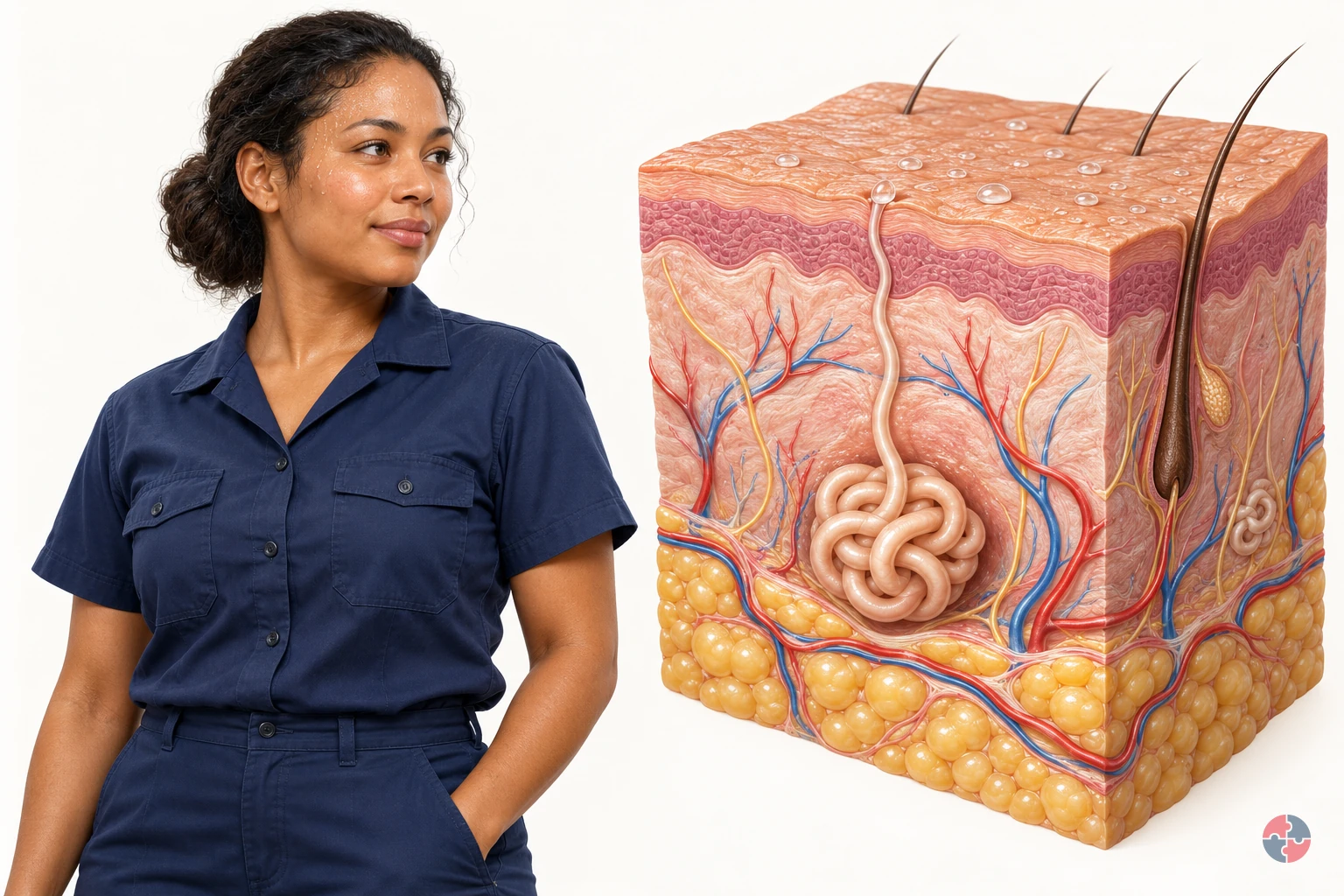
A worker and a separate enlarged skin section introduce sweating and the skin’s blood supply. Connect these structures to the work and environment described in the lesson.
Locate the sweat gland and skin vessels in the enlarged view. How should conditions, workload, clothing and recovery be managed together?
educational illustration · healthy anatomy; enlarged details and teaching colours.
Assess the complete cold-store visit
Consider the temperature, duration, physical workload, clothing, people, route condition and recovery facilities together. Include how a person will raise the alarm and leave if the door or power arrangement fails.
Control cold, ice, entrapment and refrigerant concerns.
Follow the task through the area
A cold-store release that does not work
A door-release defect is reported before a lone stock check in the cold store.
Ice at the cold-store threshold
Condensation and water entry are creating an icy patch at the store doorway.
Longer work in the cold store
A picking job has overrun and the planned warm recovery and cover have not happened.
A refrigeration fault has an uncertain release
An alarm or unusual release sign is reported around refrigeration equipment; the refrigerant identity and conditions are not yet established.
Challenge the first impression
Immediate protection and longer-term changes have different purposes. Explore each level and check what is feasible for the actual site, task and people.
Name who owns the work, verify implementation and check effectiveness in real conditions. A learning result or request for control does not close an operational action.
What does lone working mean?
A lone worker works without close or direct supervision and may be at greater risk because help is not immediately available.
Best-practice guide · six simple steps
Best-practice guide: Lone Working
Start with the key actions, then explore value, a workplace example, harm, stronger controls and further help. Choose a step or use Previous and Next; the guide does not advance automatically.
Keep one card or the full set for social sharing, team briefings and learning. Each PDF contains one card per page. Read the full topic for explanations, questions and source links.
Read all six steps as text
1. What does lone working mean?
A lone worker works without close or direct supervision and may be at greater risk because help is not immediately available.
Avoid / redesign: Do the inspection remotely or during a paired visit when feasible.
Control the task: Secure access, lighting and reliable communication/location technology.
A lone worker works without close or direct supervision and may be at greater risk because help is not immediately available. Lone work is work without close or direct supervision, where help may not be immediately available.
Apply it: Which part of this plan would you check at the workface before authorising the task?
Use the evidence to improve the actual work arrangement.
Change at source: Do the inspection remotely or during a paired visit when feasible.
Make it observable: Planner documents option; prohibited task cannot proceed alone.
Keep useful evidence: Lone worker register and task assessment.
Lone work is work without close or direct supervision, where help may not be immediately available. Decide if the task can be done alone at all, then assess its hazards, the worker’s competence and health needs, location, communication coverage and realistic rescue time. Lone worker register and task assessment.
Apply it: What evidence would show that the change improves this task, rather than only completing a record?
Fictional example: a worker plans a remote maintenance visit.
Assess: Check the task, location, contact arrangements and foreseeable emergency.
Decide: Do not allocate work alone when the assessment requires assistance.
Verify: Test contact, missed-check response and the route for summoning help.
Lone working can increase the consequences of an incident because help is less immediate. The planner checks competence, work limits, supervision and response arrangements. A phone alone is insufficient if the site has no reliable signal or no one acts on a missed check.
Apply it: What happens if the worker misses the agreed contact, and who takes action?
Connect the task, the route to the person and the control that can fail.
Incident: A fall, illness, violence or task failure can leave a person unable to call.
Delay: A missed contact may pass unnoticed without a named responder.
Consequence: Help can arrive too late when location, access and escalation are unresolved.
A fall, illness, violence or task failure can leave a person unable to call. A missed contact may pass unnoticed without a named responder. Help can arrive too late when location, access and escalation are unresolved. Use the full topic for the detailed mechanism, task limits and source scope.
Apply it: Where is this harm route present in the actual work, and which control breaks it before anyone is exposed?
Start with the stronger practicable options and verify their effect.
Eliminate: Do the inspection remotely or during a paired visit when feasible.
Reduce: Use a low-risk visual check instead of intrusive fault-finding.
Isolate: Secure access, lighting and reliable communication/location technology.
Control: Check-in clock, route, named responder, training and rescue drill.
PPE: Task-suitable protection for residual site hazards.
Eliminate: Do the inspection remotely or during a paired visit when feasible. Reduce: Use a low-risk visual check instead of intrusive fault-finding. Isolate: Secure access, lighting and reliable communication/location technology. Control: Check-in clock, route, named responder, training and rescue drill. PPE: Task-suitable protection for residual site hazards. Read the full control table for qualifications, ownership and verification. Use the actual task and applicable jurisdiction; existing technical approval remains unchanged.
Apply it: Which stronger option can be used here, and who will verify it before accepting the remaining risk?
Simplified learning guide. Use the full topic, current official guidance and the actual work arrangements. Workplace scenarios labelled fictional are illustrative examples.
Lone working includes obvious examples such as delivery drivers, security staff, cleaners, community workers, engineers, maintenance workers, home workers and people opening or closing premises. It also includes short periods where a person becomes isolated: working in a plant room, checking a remote store, visiting a client, driving between sites, carrying out a late maintenance task or working in a building after others have left.
Lone working is not automatically banned. The question is whether the risk can be controlled without direct supervision or immediate help. Some activities may be acceptable with communication, competence and emergency arrangements. Others should not be done alone, especially where rescue would be time-critical, violence risk is high, the task is safety-critical, conditions are uncertain or the worker's individual health factors make the risk different.
For home working, assess display screen equipment (DSE) risks proportionately. Where a location device is needed, Global Positioning System (GPS) data should be limited to the safety purpose. The Health and Safety Executive (HSE) issues guidance for Great Britain; the Health and Safety Executive for Northern Ireland (HSENI) issues guidance for Northern Ireland.
Reception, petrol station, warehouse, plant room, depot, out-of-hours office.
Can the worker get help quickly if injured, threatened or unwell?
Mobile lone work
Drivers, engineers, inspectors, home visitors, grounds teams.
Is the journey, location, communication and emergency response controlled?
Remote or isolated work
Rural sites, utilities, farms, water assets, empty buildings.
Can conditions change without anyone knowing and can rescue reach the person?
Home working
Home-based office work or remote administrative roles.
Are DSE, stress, isolation, supervision and contact managed proportionately?
Short-duration isolation
Task that becomes lone work temporarily during breaks, handover or overtime.
Has the assessment considered real work patterns, not just planned staffing?
Applied case
A lone stock check is planned in a cold room. Ice has formed near the doorway, the internal release is uncertain and a refrigeration alarm has not been explained.
Compare your decision
Consider the temperature, duration, physical workload, clothing, people, route condition and recovery facilities together. Include how a person will raise the alarm and leave if the door or power arrangement fails.
Consider the temperature, duration, physical workload, clothing, people, route condition and recovery facilities together. Include how a person will raise the alarm and leave if the door or power arrangement fails. Check the actual conditions and retain protection while gaps are resolved.
Lesson 2
Do not confuse an alarm with a diagnosis
Plan communication, release checks, work duration and recovery for actual conditions.
Do not confuse an alarm with a diagnosis
A refrigeration warning requires the relevant site response. The refrigerant, release and atmosphere cannot be established from a scene image or smell. Keep people away and follow the competent emergency arrangements; do not improvise a rescue entry.
Control cold, ice, entrapment and refrigerant concerns.
Follow the task through the area
A cold-store release that does not work
A door-release defect is reported before a lone stock check in the cold store.
Ice at the cold-store threshold
Condensation and water entry are creating an icy patch at the store doorway.
Longer work in the cold store
A picking job has overrun and the planned warm recovery and cover have not happened.
A refrigeration fault has an uncertain release
An alarm or unusual release sign is reported around refrigeration equipment; the refrigerant identity and conditions are not yet established.
Challenge the first impression
Immediate protection and longer-term changes have different purposes. Explore each level and check what is feasible for the actual site, task and people.
Name who owns the work, verify implementation and check effectiveness in real conditions. A learning result or request for control does not close an operational action.
Why are slips and trips a serious workplace risk?
A slip is a loss of grip; a trip is a foot caught by an obstruction or unexpected level change. Prevent both by selecting and maintaining suitable floors and routes, preventing contamination, clearing obstructions, controlling cleaning and verifying the surface is safe before reopening. A cone warns; it does not isolate a wet floor.
Best-practice guide · six simple steps
Best-practice guide: Slips and Trips
Start with the key actions, then explore value, a workplace example, harm, stronger controls and further help. Choose a step or use Previous and Next; the guide does not advance automatically.
Keep one card or the full set for social sharing, team briefings and learning. Each PDF contains one card per page. Read the full topic for explanations, questions and source links.
Read all six steps as text
1. Why are slips and trips a serious workplace risk?
A slip is a loss of grip; a trip is a foot caught by an obstruction or unexpected level change.
Control the task: Clear cables, waste, stock, hoses and uneven temporary materials.
Verify before release: Trying to manage a badly designed route with signs.
A slip is a loss of grip; a trip is a foot caught by an obstruction or unexpected level change. Prevent both by selecting and maintaining suitable floors and routes, preventing contamination, clearing obstructions, controlling cleaning and verifying the surface is safe before reopening. Slips and trips are among the most common workplace accident causes, but they should never be dismissed as clumsiness or chance.
Apply it: Which part of this plan would you check at the workface before authorising the task?
Use the evidence to improve the actual work arrangement.
Change at source: Specify suitable floor, drainage, stairs, lighting and route width.
Make it observable: Trying to manage a badly designed route with signs.
Keep useful evidence: Record weather trigger, barrier time, floor condition, repair owner, worker feedback and repeat incidents.
Slips and trips are among the most common workplace accident causes, but they should never be dismissed as clumsiness or chance. A slip usually occurs when the available friction between footwear and floor is too low for the movement being made, often because of contamination, unsuitable flooring, poor cleaning, worn footwear or weather. Record weather trigger, barrier time, floor condition, repair owner, worker feedback and repeat incidents.
Apply it: What evidence would show that the change improves this task, rather than only completing a record?
Fictional example: a practical application of the existing topic lesson.
Setting: Wet entrance at a public leisure centre during heavy rain.
Act: Wet leaves and rainwater carried through an entrance onto a smooth floor; no mat change or drainage response.
Hold / review: Do not reopen while the floor remains wet or the alternate route creates another hazard.
Close or physically separate the wet route, give a safe alternative, remove contamination and inspect matting and drainage. Repair the recurrent water source, choose suitable matting/flooring, brief cleaners and reopen after a dry-floor check.
Apply it: At which point would you hold this example, and what evidence would allow it to proceed?
4. Where do slips and trips controls commonly fail?
Connect the task, the route to the person and the control that can fail.
Source / exposure: Controls fail when workplaces normalise poor housekeeping, recurring contamination, weak cleaning and low-quality route inspections.
Possible consequence: A slip or trip failure often has a long warning period: near misses, complaints, cones left out daily, repeated cleaning of the same leak, worn stairs, pallets in walkways, or workers stepping over cables so often that nobody sees them anymore.
Control failure: A strong system treats those weak signals as design and management failures, not as worker clumsiness.
Controls fail when workplaces normalise poor housekeeping, recurring contamination, weak cleaning and low-quality route inspections.
Apply it: Who could be exposed, including other trades, cleaners, maintainers and people nearby?
Design: Specify suitable floor, drainage, stairs, lighting and route width. Prevent contamination: Stop leaks, fit drip trays, improve entrance matting and cover outdoor transitions. Remove hazards: Clear cables, waste, stock, hoses and uneven temporary materials. Control cleaning: Use correct method, timing, products, drying and barriers. Maintain: Repair defects, curled mats, loose tiles, potholes and stair nosings. Read the full control table for qualifications, ownership and verification. Use the actual task and applicable jurisdiction; existing technical approval remains unchanged.
Apply it: Which stronger option can be used here, and who will verify it before accepting the remaining risk?
Simplified learning guide. Use the full topic, current official guidance and the actual work arrangements. Workplace scenarios labelled fictional are illustrative examples.
A slip or trip can look like a small everyday event until the injury is serious: broken wrist, dislocated shoulder, head injury, spinal injury, long absence or a member of the public harmed on site. The fact that the person was 'only walking' does not make the event minor. Walking routes are part of the work system.
The professional question is not 'why did they not look where they were going?' It is: why was the floor contaminated, why was the route obstructed, why was the lighting poor, why was the cable there, why was cleaning done during footfall, why did the mat curl, why were stairs worn, why was footwear unsuitable, and why did inspections fail to find the problem?
HSE guidance frames slips and trips around practical causes such as contamination, cleaning, people, flooring, environment and footwear. That structure is useful because it prevents the investigation from stopping at worker behaviour.
A lone stock check is planned in a cold room. Ice has formed near the doorway, the internal release is uncertain and a refrigeration alarm has not been explained.
Compare your decision
A refrigeration warning requires the relevant site response. The refrigerant, release and atmosphere cannot be established from a scene image or smell. Keep people away and follow the competent emergency arrangements; do not improvise a rescue entry.
A refrigeration warning requires the relevant site response. The refrigerant, release and atmosphere cannot be established from a scene image or smell. Keep people away and follow the competent emergency arrangements; do not improvise a rescue entry. Check the actual conditions and retain protection while gaps are resolved.
Lesson 3
A cold-store release that does not work
Do not begin the lone entry. Have safe escape, communication and response arrangements restored and verified.
Read the scene evidence
A door-release defect is reported before a lone stock check in the cold store.
Identify the condition separately from the exposed person and any possible outcome.
How the harm pathway develops
Loss of reliable escape and help in an isolated cold space
A door-release defect is reported before a lone stock check in the cold store.
How people can be exposed
A worker could be unable to leave and unable to obtain timely help.
Possible harm
Prolonged cold exposure and delayed emergency response.
A door-release defect is reported before a lone stock check in the cold store. The condition remains unresolved.
Protective response
Do not begin the lone entry. Have safe escape, communication and response arrangements restored and verified.
Select controls by how they prevent harm
Immediate protection and longer-term changes have different purposes. Explore each level and check what is feasible for the actual site, task and people.
Use the five-level hierarchy below. Inspection, instruction and supervision sustain every chosen control; they do not replace physical prevention.
Control level
Application to this case
Elimination
Complete the check from outside or avoid lone entry where practicable.
Substitution
Compare a suitable supported or remote stock-check method.
Engineering controls
Provide reliable internal release, warning and communication arrangements suited to the environment.
Administrative controls
Assess whether lone work is permitted and test a named missed-contact response.
PPE
Suitable cold clothing addresses exposure but cannot replace escape or rescue arrangements.
Verify, communicate and hand back
Name who owns the work, verify implementation and check effectiveness in real conditions. A learning result or request for control does not close an operational action.
Explain the task-specific evidence, who must act and what restriction remains until it is resolved. A closed action or a course badge cannot establish a live site condition.
What does lone working mean?
A lone worker works without close or direct supervision and may be at greater risk because help is not immediately available.
Best-practice guide · six simple steps
Best-practice guide: Lone Working
Start with the key actions, then explore value, a workplace example, harm, stronger controls and further help. Choose a step or use Previous and Next; the guide does not advance automatically.
Keep one card or the full set for social sharing, team briefings and learning. Each PDF contains one card per page. Read the full topic for explanations, questions and source links.
Read all six steps as text
1. What does lone working mean?
A lone worker works without close or direct supervision and may be at greater risk because help is not immediately available.
Avoid / redesign: Do the inspection remotely or during a paired visit when feasible.
Control the task: Secure access, lighting and reliable communication/location technology.
A lone worker works without close or direct supervision and may be at greater risk because help is not immediately available. Lone work is work without close or direct supervision, where help may not be immediately available.
Apply it: Which part of this plan would you check at the workface before authorising the task?
Use the evidence to improve the actual work arrangement.
Change at source: Do the inspection remotely or during a paired visit when feasible.
Make it observable: Planner documents option; prohibited task cannot proceed alone.
Keep useful evidence: Lone worker register and task assessment.
Lone work is work without close or direct supervision, where help may not be immediately available. Decide if the task can be done alone at all, then assess its hazards, the worker’s competence and health needs, location, communication coverage and realistic rescue time. Lone worker register and task assessment.
Apply it: What evidence would show that the change improves this task, rather than only completing a record?
Fictional example: a worker plans a remote maintenance visit.
Assess: Check the task, location, contact arrangements and foreseeable emergency.
Decide: Do not allocate work alone when the assessment requires assistance.
Verify: Test contact, missed-check response and the route for summoning help.
Lone working can increase the consequences of an incident because help is less immediate. The planner checks competence, work limits, supervision and response arrangements. A phone alone is insufficient if the site has no reliable signal or no one acts on a missed check.
Apply it: What happens if the worker misses the agreed contact, and who takes action?
Connect the task, the route to the person and the control that can fail.
Incident: A fall, illness, violence or task failure can leave a person unable to call.
Delay: A missed contact may pass unnoticed without a named responder.
Consequence: Help can arrive too late when location, access and escalation are unresolved.
A fall, illness, violence or task failure can leave a person unable to call. A missed contact may pass unnoticed without a named responder. Help can arrive too late when location, access and escalation are unresolved. Use the full topic for the detailed mechanism, task limits and source scope.
Apply it: Where is this harm route present in the actual work, and which control breaks it before anyone is exposed?
Start with the stronger practicable options and verify their effect.
Eliminate: Do the inspection remotely or during a paired visit when feasible.
Reduce: Use a low-risk visual check instead of intrusive fault-finding.
Isolate: Secure access, lighting and reliable communication/location technology.
Control: Check-in clock, route, named responder, training and rescue drill.
PPE: Task-suitable protection for residual site hazards.
Eliminate: Do the inspection remotely or during a paired visit when feasible. Reduce: Use a low-risk visual check instead of intrusive fault-finding. Isolate: Secure access, lighting and reliable communication/location technology. Control: Check-in clock, route, named responder, training and rescue drill. PPE: Task-suitable protection for residual site hazards. Read the full control table for qualifications, ownership and verification. Use the actual task and applicable jurisdiction; existing technical approval remains unchanged.
Apply it: Which stronger option can be used here, and who will verify it before accepting the remaining risk?
Simplified learning guide. Use the full topic, current official guidance and the actual work arrangements. Workplace scenarios labelled fictional are illustrative examples.
Lone working includes obvious examples such as delivery drivers, security staff, cleaners, community workers, engineers, maintenance workers, home workers and people opening or closing premises. It also includes short periods where a person becomes isolated: working in a plant room, checking a remote store, visiting a client, driving between sites, carrying out a late maintenance task or working in a building after others have left.
Lone working is not automatically banned. The question is whether the risk can be controlled without direct supervision or immediate help. Some activities may be acceptable with communication, competence and emergency arrangements. Others should not be done alone, especially where rescue would be time-critical, violence risk is high, the task is safety-critical, conditions are uncertain or the worker's individual health factors make the risk different.
For home working, assess display screen equipment (DSE) risks proportionately. Where a location device is needed, Global Positioning System (GPS) data should be limited to the safety purpose. The Health and Safety Executive (HSE) issues guidance for Great Britain; the Health and Safety Executive for Northern Ireland (HSENI) issues guidance for Northern Ireland.
Reception, petrol station, warehouse, plant room, depot, out-of-hours office.
Can the worker get help quickly if injured, threatened or unwell?
Mobile lone work
Drivers, engineers, inspectors, home visitors, grounds teams.
Is the journey, location, communication and emergency response controlled?
Remote or isolated work
Rural sites, utilities, farms, water assets, empty buildings.
Can conditions change without anyone knowing and can rescue reach the person?
Home working
Home-based office work or remote administrative roles.
Are DSE, stress, isolation, supervision and contact managed proportionately?
Short-duration isolation
Task that becomes lone work temporarily during breaks, handover or overtime.
Has the assessment considered real work patterns, not just planned staffing?
What evidence shows lone working is controlled?
Evidence should show the assessment matches real lone work and that escalation works when tested.
Test the live chain: a worker can explain the task limit, the device works on site, the controller knows the check-in clock and a responder can reach the location. Sample a missed-check drill and its corrective actions.
Evidence
What it should show
Weakness to challenge
Lone-working risk assessment
Task, person, location, communication, emergency response and stop triggers.
One generic assessment for all lone workers.
Worker list or register
Who works alone, where, when and under what controls.
Home workers or occasional out-of-hours work not included.
Check-in records
Contact is made as planned and missed checks are escalated.
Missed check-ins closed with no explanation.
Emergency response test
The escalation route works out of hours and in remote areas.
Device works but response process is unclear.
Violence risk review
Public-facing and conflict risks are assessed.
Incident reports do not change staffing or controls.
Training and supervision
Workers know limits, emergency actions and dynamic stop decisions.
Online training only, no practical scenario test.
Applied case
A door-release defect is reported before a lone stock check in the cold store. At handover, someone says that assigning an action owner is enough to restart. Decide what is still needed.
Compare your decision
Name who owns the work, verify implementation and check effectiveness in real conditions. A learning result or request for control does not close an operational action.
Name who owns the work, verify implementation and check effectiveness in real conditions. A learning result or request for control does not close an operational action. Ownership and training support the control but do not demonstrate its effectiveness.
Lesson 4
Ice at the cold-store threshold
Keep people off the affected route, arrange a safe alternative and report the source for a suitable controlled response.
Read the scene evidence
Condensation and water entry are creating an icy patch at the store doorway.
Identify the condition separately from the exposed person and any possible outcome.
How the harm pathway develops
Ice contamination on a pedestrian route
Condensation and water entry are creating an icy patch at the store doorway.
How people can be exposed
A person steps onto the low-grip surface while carrying or guiding a load.
Possible harm
A slip and fall or loss of control of the handled load.
Condensation and water entry are creating an icy patch at the store doorway. The condition remains unresolved.
Protective response
Keep people off the affected route, arrange a safe alternative and report the source for a suitable controlled response.
Select controls by how they prevent harm
Immediate protection and longer-term changes have different purposes. Explore each level and check what is feasible for the actual site, task and people.
Use the five-level hierarchy below. Inspection, instruction and supervision sustain every chosen control; they do not replace physical prevention.
Control level
Application to this case
Elimination
Remove the water or condensation source where practicable.
Substitution
Compare suitable door or process arrangements that reduce moisture entry.
Engineering controls
Provide suitable drainage, threshold design and effective segregation during response.
Administrative controls
Use a planned inspection and cleaning response and verify the surface before reopening.
PPE
Select suitable footwear for remaining exposure; footwear does not make an icy threshold safe.
Verify, communicate and hand back
Name who owns the work, verify implementation and check effectiveness in real conditions. A learning result or request for control does not close an operational action.
Explain the task-specific evidence, who must act and what restriction remains until it is resolved. A closed action or a course badge cannot establish a live site condition.
Why are slips and trips a serious workplace risk?
A slip is a loss of grip; a trip is a foot caught by an obstruction or unexpected level change. Prevent both by selecting and maintaining suitable floors and routes, preventing contamination, clearing obstructions, controlling cleaning and verifying the surface is safe before reopening. A cone warns; it does not isolate a wet floor.
Best-practice guide · six simple steps
Best-practice guide: Slips and Trips
Start with the key actions, then explore value, a workplace example, harm, stronger controls and further help. Choose a step or use Previous and Next; the guide does not advance automatically.
Keep one card or the full set for social sharing, team briefings and learning. Each PDF contains one card per page. Read the full topic for explanations, questions and source links.
Read all six steps as text
1. Why are slips and trips a serious workplace risk?
A slip is a loss of grip; a trip is a foot caught by an obstruction or unexpected level change.
Control the task: Clear cables, waste, stock, hoses and uneven temporary materials.
Verify before release: Trying to manage a badly designed route with signs.
A slip is a loss of grip; a trip is a foot caught by an obstruction or unexpected level change. Prevent both by selecting and maintaining suitable floors and routes, preventing contamination, clearing obstructions, controlling cleaning and verifying the surface is safe before reopening. Slips and trips are among the most common workplace accident causes, but they should never be dismissed as clumsiness or chance.
Apply it: Which part of this plan would you check at the workface before authorising the task?
Use the evidence to improve the actual work arrangement.
Change at source: Specify suitable floor, drainage, stairs, lighting and route width.
Make it observable: Trying to manage a badly designed route with signs.
Keep useful evidence: Record weather trigger, barrier time, floor condition, repair owner, worker feedback and repeat incidents.
Slips and trips are among the most common workplace accident causes, but they should never be dismissed as clumsiness or chance. A slip usually occurs when the available friction between footwear and floor is too low for the movement being made, often because of contamination, unsuitable flooring, poor cleaning, worn footwear or weather. Record weather trigger, barrier time, floor condition, repair owner, worker feedback and repeat incidents.
Apply it: What evidence would show that the change improves this task, rather than only completing a record?
Fictional example: a practical application of the existing topic lesson.
Setting: Wet entrance at a public leisure centre during heavy rain.
Act: Wet leaves and rainwater carried through an entrance onto a smooth floor; no mat change or drainage response.
Hold / review: Do not reopen while the floor remains wet or the alternate route creates another hazard.
Close or physically separate the wet route, give a safe alternative, remove contamination and inspect matting and drainage. Repair the recurrent water source, choose suitable matting/flooring, brief cleaners and reopen after a dry-floor check.
Apply it: At which point would you hold this example, and what evidence would allow it to proceed?
4. Where do slips and trips controls commonly fail?
Connect the task, the route to the person and the control that can fail.
Source / exposure: Controls fail when workplaces normalise poor housekeeping, recurring contamination, weak cleaning and low-quality route inspections.
Possible consequence: A slip or trip failure often has a long warning period: near misses, complaints, cones left out daily, repeated cleaning of the same leak, worn stairs, pallets in walkways, or workers stepping over cables so often that nobody sees them anymore.
Control failure: A strong system treats those weak signals as design and management failures, not as worker clumsiness.
Controls fail when workplaces normalise poor housekeeping, recurring contamination, weak cleaning and low-quality route inspections.
Apply it: Who could be exposed, including other trades, cleaners, maintainers and people nearby?
Design: Specify suitable floor, drainage, stairs, lighting and route width. Prevent contamination: Stop leaks, fit drip trays, improve entrance matting and cover outdoor transitions. Remove hazards: Clear cables, waste, stock, hoses and uneven temporary materials. Control cleaning: Use correct method, timing, products, drying and barriers. Maintain: Repair defects, curled mats, loose tiles, potholes and stair nosings. Read the full control table for qualifications, ownership and verification. Use the actual task and applicable jurisdiction; existing technical approval remains unchanged.
Apply it: Which stronger option can be used here, and who will verify it before accepting the remaining risk?
Simplified learning guide. Use the full topic, current official guidance and the actual work arrangements. Workplace scenarios labelled fictional are illustrative examples.
A slip or trip can look like a small everyday event until the injury is serious: broken wrist, dislocated shoulder, head injury, spinal injury, long absence or a member of the public harmed on site. The fact that the person was 'only walking' does not make the event minor. Walking routes are part of the work system.
The professional question is not 'why did they not look where they were going?' It is: why was the floor contaminated, why was the route obstructed, why was the lighting poor, why was the cable there, why was cleaning done during footfall, why did the mat curl, why were stairs worn, why was footwear unsuitable, and why did inspections fail to find the problem?
HSE guidance frames slips and trips around practical causes such as contamination, cleaning, people, flooring, environment and footwear. That structure is useful because it prevents the investigation from stopping at worker behaviour.
How can the ISO 45001 hierarchy of controls remove slip and trip hazards from workplace routes?
Control classification: Classify the mechanism separately from its upkeep: physical floor repair, drainage, barriers, protected routes, compartmentation, fire doors and suitable disposal facilities are physical measures where specified. Cleaning schedules, inspections, policies, funding, supervision and verification are administrative arrangements maintaining them. A verbal instruction is not a physical barrier. Read this correction with the source table. Retained overview and stage artwork requires the matching classification update.
Remove or reduce the hazard before relying on procedures or personal protection.
For slips and trips, assess the actual task and first look for a way to remove the hazard. Where that is not possible, consider a safer substitute, engineered separation and then clear work procedures. PPE protects against remaining exposure; it does not make an uncontrolled task safe. HSE hierarchy of controls
The selected measures need a named owner, a usable stop point and a check that they still work when the task or conditions change. In Northern Ireland, verify the separate legal route and site instructions.
For the wet entrance, eliminate recurring water entry at source where practicable. Reduce contamination with suitable matting, drainage and a cleaning method that leaves the route safe; physically prevent access while unsafe and provide an alternative. Repair floor and route defects, then select footwear for residual risk and sustain checks. ERICPD (Eliminate, Reduce, Isolate, Control, PPE, Discipline) is a teaching prompt; Discipline means competent cleaning, supervision and defect closure. HSE slip and trip factors; HSE barriers and cleaning.
How can the ERICPD hierarchy of controls remove slip and trip hazards from workplace routes?
ERICPD is a planning crossmap. Its prompts do not add a sixth rung or rank Isolate above engineering. Discipline verifies and sustains every control level.
Worked activity: Wet leisure-centre entrance
Activity and exposure
Wet entrance at a public leisure centre during heavy rain.
Before work
Wet leaves and rainwater carried through an entrance onto a smooth floor; no mat change or drainage response.
During the activity
Close or physically separate the wet route, give a safe alternative, remove contamination and inspect matting and drainage.
Hold or stop
Do not reopen while the floor remains wet or the alternate route creates another hazard.
Hand-back and release
Repair the recurrent water source, choose suitable matting/flooring, brief cleaners and reopen after a dry-floor check.
Evidence to retain
Record weather trigger, barrier time, floor condition, repair owner, worker feedback and repeat incidents.
How can the ISO 45001 hierarchy of controls remove slip and trip hazards from workplace routes?
The hierarchy of controls in ISO 45001:2018 comes under Clause 8.1.2 (Eliminating hazards and reducing OH&S risks), which is located within Clause 8 ("Operation").
ESEAP mapping crosswalk: these are retained ERICPD source rows, mapped to the five ESEAP levels. Read the control-classification correction for mixed physical and administrative measures; six source rows do not mean six ESEAP levels.
Five-level control stage(s)
Topic-specific example
Source and full task context
Elimination
Remove recurring water entry at source where practicable.
Condensation and water entry are creating an icy patch at the store doorway. At handover, someone says that assigning an action owner is enough to restart. Decide what is still needed.
Compare your decision
Name who owns the work, verify implementation and check effectiveness in real conditions. A learning result or request for control does not close an operational action.
Name who owns the work, verify implementation and check effectiveness in real conditions. A learning result or request for control does not close an operational action. Ownership and training support the control but do not demonstrate its effectiveness.
Lesson 5
Longer work in the cold store
Stop the affected work and obtain appropriate help for any symptoms; arrange a suitable work and recovery plan before resuming.
Read the scene evidence
A picking job has overrun and the planned warm recovery and cover have not happened.
Identify the condition separately from the exposed person and any possible outcome.
How the harm pathway develops
Cold exposure combined with unsuitable task and recovery arrangements
A picking job has overrun and the planned warm recovery and cover have not happened.
How people can be exposed
The worker continues in cold conditions with inadequate recovery or unsuitable clothing.
Possible harm
Possible cold-related harm and reduced ability to work safely.
A picking job has overrun and the planned warm recovery and cover have not happened. The condition remains unresolved.
Protective response
Stop the affected work and obtain appropriate help for any symptoms; arrange a suitable work and recovery plan before resuming.
Select controls by how they prevent harm
Immediate protection and longer-term changes have different purposes. Explore each level and check what is feasible for the actual site, task and people.
Use the five-level hierarchy below. Inspection, instruction and supervision sustain every chosen control; they do not replace physical prevention.
Control level
Application to this case
Elimination
Reduce unnecessary cold-store occupancy through task and storage redesign.
Substitution
Compare suitable remote or mechanised picking methods.
Engineering controls
Provide suitable thermal protection in the workplace and accessible recovery facilities.
Administrative controls
Assess the person, conditions, work rate and clothing and provide effective cover and recovery.
PPE
Provide suitable cold protection for the assessed residual exposure.
Verify, communicate and hand back
Name who owns the work, verify implementation and check effectiveness in real conditions. A learning result or request for control does not close an operational action.
Explain the task-specific evidence, who must act and what restriction remains until it is resolved. A closed action or a course badge cannot establish a live site condition.
What are thermal environments, heat stress and cold stress?
Thermal environments cover the combined effects of temperature, radiant heat, air movement, humidity, clothing, PPE and work rate on comfort, performance and health.
Best-practice guide · six simple steps
Best-practice guide: Thermal Environments, Heat Stress and Cold Stress
Start with the key actions, then explore value, a workplace example, harm, stronger controls and further help. Choose a step or use Previous and Next; the guide does not advance automatically.
Keep one card or the full set for social sharing, team briefings and learning. Each PDF contains one card per page. Read the full topic for explanations, questions and source links.
Read all six steps as text
1. What are thermal environments, heat stress and cold stress?
Thermal environments cover the combined effects of temperature, radiant heat, air movement, humidity, clothing, PPE and work rate on comfort, performance and health.
Avoid / redesign: Shut down and cool the plant before planned maintenance, or service a removable component in a temperate workshop; for chilled-area repairs, move the work to a temperate workshop where feasible, or isolate refrigeration and verify a safe task environment before entry. Moving stock alone does not remove cold exposure.
Control the task: Fit a fixed radiant shield and insulation around the identified hot plant, with a local extraction or cooling supply designed for the maintenance position; fit an interlocked insulated loading door at the chilled threshold so it cannot trap the worker or block escape.
Verify before release: HSE control order; HSE heat-stress control
Thermal environments cover the combined effects of temperature, radiant heat, air movement, humidity, clothing, PPE and work rate on comfort, performance and health. Heat and cold can harm people even when a thermometer looks unremarkable.
Apply it: Which part of this plan would you check at the workface before authorising the task?
2. Turn thermal environments, heat stress and cold stress knowledge into a decision
Use the evidence to improve the actual work arrangement.
Change at source: Shut down and cool the plant before planned maintenance, or service a removable component in a temperate workshop; for chilled-area repairs, move the work to a temperate workshop where feasible, or isolate refrigeration and verify a safe task environment before entry. Moving stock alone does not remove cold exposure.
Make it observable: HSE control order; HSE heat-stress control
Keep useful evidence: Assess heat burden from impermeable clothing.
Heat and cold can harm people even when a thermometer looks unremarkable. Assess the task, clothing, work rate and conditions; change the work and provide recovery before relying on personal coping. Assess heat burden from impermeable clothing.
Apply it: What evidence would show that the change improves this task, rather than only completing a record?
4. Where do thermal environment controls commonly fail?
Connect the task, the route to the person and the control that can fail.
Source / exposure: Controls fail when managers rely on air temperature alone, ignore PPE/work rate, or treat symptoms as personal weakness.
Possible consequence: Thermal failure often looks like behaviour failure: PPE removed, breaks skipped, rushing, irritability, poor concentration or errors.
Control failure: The better question is why the work made that behaviour likely.
Controls fail when managers rely on air temperature alone, ignore PPE/work rate, or treat symptoms as personal weakness.
Apply it: Who could be exposed, including other trades, cleaners, maintainers and people nearby?
5. Choose controls for thermal environments, heat stress and cold stress
Start with the stronger practicable options and verify their effect.
Elimination: Shut down and cool the plant before planned maintenance, or service a removable component in a temperate workshop; for chilled-area repairs, move the work to a temperate workshop where feasible, or isolate refrigeration and verify a safe task environment before entry. Moving stock alone does not remove cold exposure.
Substitution: Specify lower-heat equipment or a remote test method, and choose a process that avoids repeated freezer entry where technically suitable.
Engineering controls: Fit a fixed radiant shield and insulation around the identified hot plant, with a local extraction or cooling supply designed for the maintenance position; fit an interlocked insulated loading door at the chilled threshold so it cannot trap the worker or block escape.
Administrative controls: Set a task-specific exposure and recovery plan using work rate, humidity, radiant load, clothing and worker feedback; provide water, warm/dry recovery space, buddy observation and clear symptom escalation.
PPE: Choose thermal clothing compatible with the task and other PPE, with dry spares, correct fit and safe doffing; assess added heat burden from protective suits or respirators.
Elimination: Shut down and cool the plant before planned maintenance, or service a removable component in a temperate workshop; for chilled-area repairs, move the work to a temperate workshop where feasible, or isolate refrigeration and verify a safe task environment before entry. Moving stock alone does not remove cold exposure. Substitution: Specify lower-heat equipment or a remote test method, and choose a process that avoids repeated freezer entry where technically suitable. Engineering controls: Fit a fixed radiant shield and insulation around the identified hot plant, with a local extraction or cooling supply designed for the maintenance position; fit an interlocked insulated loading door at the chilled threshold so it cannot trap the worker or block escape. Administrative controls: Set a task-specific exposure and recovery plan using work rate, humidity, radiant load, clothing and worker feedback; provide water, warm/dry recovery space, buddy observation and clear symptom escalation. PPE: Choose thermal clothing compatible with the task and other PPE, with dry spares, correct fit and safe doffing; assess added heat burden from protective suits or respirators. Read the full control table for qualifications, ownership and verification. Use the actual task and applicable jurisdiction; existing technical approval remains unchanged.
Apply it: Which stronger option can be used here, and who will verify it before accepting the remaining risk?
Simplified learning guide. Use the full topic, current official guidance and the actual work arrangements. Workplace scenarios labelled fictional are illustrative examples.
Thermal risk is not just a thermometer reading. HSE explains that air temperature alone is not a valid or accurate indicator of thermal comfort or heat stress. A worker in a moderate air temperature can still overheat if they are doing heavy work in impermeable PPE, near radiant heat, in high humidity or without recovery.
Thermal comfort is about whether people are uncomfortably hot or cold. Heat stress is a physiological risk where the body struggles to control heat load. Cold stress is a physiological risk where cold exposure affects function and can contribute to cold injury, hypothermia or unsafe behaviour.
Thermal environments affect safety as well as health. People who are too hot or too cold may lose concentration, rush, remove PPE, take shortcuts, struggle with manual tasks, make poor decisions or fail to communicate clearly.
Factor
Why it matters
Workplace example
Air temperature
Basic measure but not enough on its own.
Office, warehouse, plant room or cold store.
Radiant temperature
Hot surfaces or sun can dominate how heat feels.
Ovens, furnaces, dryers, molten metal, roof work.
Air movement
Can cool in heat or feel like draught in cold.
Fans, open doors, extraction or outdoor wind.
Humidity
High humidity reduces sweat evaporation.
Laundry, kitchen, paper mill, chemical suit work.
Clothing/PPE
Insulation and vapour barriers change heat/cold burden.
Chemical suit, freezer clothing, waterproofs, RPE.
Work rate
Physical activity creates metabolic heat.
Manual handling, roadworks, foundry or emergency response.
Personal factors
Fitness, health, medication, pregnancy and acclimatisation affect tolerance.
Individual review and OH advice where needed.
What controls should be considered before relying on behaviour?
Thermal risk is best managed by changing the environment, source, task and recovery before relying on personal coping.
Telling workers to drink more or wear a coat is not enough if the job design creates excessive heat or cold exposure. Controls should remove or reduce the thermal load wherever practicable.
Personal adaptation still matters, but only within a system that gives people real choices: access to water, shade, warm areas, dry clothing, recovery time, suitable PPE and the authority to stop.
For heat, remove the hot operation where possible, then insulate or shield radiant surfaces and verify ventilation at the work position. For cold, move a task out of the freezer when practicable, or use heated, enclosed workstations and insulated access doors without compromising escape. Changing the shift pattern or asking people to drink water supports these source controls but cannot replace them.
Protective clothing must be assessed alongside the task: a suit may worsen heat load, while wet gloves can sharply reduce cold protection. The supervisor checks the real work rate, recovery space and worker feedback, then holds the task if a physical control fails or symptoms appear. The worked five-level and ERICPD example sets out feasibility, owners, evidence and stop points for a hot plant room and chilled loading area.
Applied case
A picking job has overrun and the planned warm recovery and cover have not happened. At handover, someone says that assigning an action owner is enough to restart. Decide what is still needed.
Compare your decision
Name who owns the work, verify implementation and check effectiveness in real conditions. A learning result or request for control does not close an operational action.
Name who owns the work, verify implementation and check effectiveness in real conditions. A learning result or request for control does not close an operational action. Ownership and training support the control but do not demonstrate its effectiveness.
Lesson 6
A refrigeration fault has an uncertain release
Keep away, protect access from a safe position and activate the site’s substance-specific emergency and competent refrigeration response.
Read the scene evidence
An alarm or unusual release sign is reported around refrigeration equipment; the refrigerant identity and conditions are not yet established.
Identify the condition separately from the exposed person and any possible outcome.
How the harm pathway develops
A possible refrigerant release with substance-specific hazards
An alarm or unusual release sign is reported around refrigeration equipment; the refrigerant identity and conditions are not yet established.
How people can be exposed
People enter or remain near a release whose atmosphere and hazards are uncertain.
Possible harm
Possible harmful exposure, oxygen displacement, fire or other material-specific effects.
An alarm or unusual release sign is reported around refrigeration equipment; the refrigerant identity and conditions are not yet established. The condition remains unresolved.
Protective response
Keep away, protect access from a safe position and activate the site’s substance-specific emergency and competent refrigeration response.
Select controls by how they prevent harm
Immediate protection and longer-term changes have different purposes. Explore each level and check what is feasible for the actual site, task and people.
Use the five-level hierarchy below. Inspection, instruction and supervision sustain every chosen control; they do not replace physical prevention.
Control level
Application to this case
Elimination
Avoid unnecessary hazardous refrigerant inventory through suitable system design.
Substitution
Compare suitable alternative systems or refrigerants after checking their full health and physical risks.
Engineering controls
Provide appropriate containment, leak detection, ventilation and protective systems for the material.
Administrative controls
Maintain equipment, identify the refrigerant and practise the relevant alarm, evacuation and authorised response.
PPE
PPE or an improvised respirator is not permission to enter an uncertain atmosphere.
Verify, communicate and hand back
Name who owns the work, verify implementation and check effectiveness in real conditions. A learning result or request for control does not close an operational action.
Explain the task-specific evidence, who must act and what restriction remains until it is resolved. A closed action or a course badge cannot establish a live site condition.
What are dangerous substances and hazardous properties?
A hazardous property describes what a material can do; risk depends on whether that property can cause harm in the actual work. A sealed solvent container and the same solvent sprayed beside an ignition source have different risks.
This page uses a broad chemical-hazard scope. The legal term dangerous substance under DSEAR has a specific physical-safety meaning. Toxicity or environmental harm alone is not a reason to describe a material as falling within DSEAR. GB DSEAR also covers gases under pressure and substances corrosive to metals; health exposure is assessed separately under COSHH. See DSEAR in detail and the NI routes below.
A fire needs fuel, an oxidising agent and ignition. Dispersing combustible material as vapour, mist or dust can make rapid burning possible; confinement and congestion can increase damaging pressure. A reactive material can also release heat or gas without an external flame. If heat generation overtakes heat removal, the reaction can accelerate, raising temperature and pressure. Whether this can happen requires material and process evidence, not a guess from the product name.
Health effects may be immediate, such as chemical burns or poisoning, or develop after repeated exposure or long delay, such as dermatitis, occupational asthma or cancer. Exposure may occur by breathing, skin or eye contact, swallowing contamination or skin puncture. Absence of a strong smell, visible cloud or immediate symptoms does not demonstrate control.
Useful terms: The inventory is the amount present, including material connected to a possible release. Loss of containment means an unintended escape. Compatibility means suitability for contact with other substances and equipment under the expected conditions. A credible scenario describes a plausible chain from failure to harm.
How can the ISO 45001 hierarchy of controls control dangerous-substance exposure and ignition during solvent dispensing?
Eliminate or substitute: remove the task or choose a demonstrably less hazardous process.
Reduce and contain: limit inventory; use a suitable closed system, enclosure or extraction designed for the release.
Separate and prevent ignition: segregate incompatible materials and assess hazardous areas, electrical equipment, static, hot surfaces and other work.
Maintain and prepare: verify critical alarms, isolation and containment against their performance requirements; plan abnormal operation and emergencies.
Protect the individual: select chemical-resistant gloves, eye protection and any RPE for the exact exposure and wearer. A generic glove material or mask description is not a selection decision.
Trace each scenario from the material and stored energy to the release route, exposed person and consequence. A vapour release can reach an ignition source and cause burns or blast injury; a corrosive splash can damage skin or eyes; inhaled toxic gas or dust can injure the lungs or cause delayed disease. Loss of containment, a rising temperature, unexplained odour, dust escape or failed protection is a reason to stop the affected operation and investigate.
Before: confirm identity, current instructions, task assessment, trained people and working controls. During: watch the task and control indications; report changes. After: close and secure containers, segregate waste, check for leaks or contamination and record defects. Stop if the material, route, conditions or required protection cannot be verified.
In a print shop, a different ink-cleaning product needs a full health, fire and compatibility assessment; in a bakery, flour transfer needs dust containment rather than solvent controls. In both settings the supervisor checks the actual substance, exposure route and control performance before allowing work to continue.
A process operator transfers an identified flammable solvent into a work container; assess vapour, ignition, static and spill routes.
How can the ERICPD hierarchy of controls control dangerous-substance exposure and ignition during solvent dispensing?
ERICPD is a planning crossmap. Its prompts do not add a sixth rung or rank Isolate above engineering. Discipline verifies and sustains every control level.
Control level
Control for this activity
Owner and verification
Stop / restart decision
Eliminate
Remove an unnecessary solvent use or open decanting step through process redesign.
Task owner verifies that the proposed change removes the named hazardous step, including foreseeable cleaning, maintenance and work transferred elsewhere.
If the hazardous step remains, keep it within the task assessment and select the stronger feasible remaining controls.
Reduce, including substitution
Validate a suitable less flammable product or solvent-free method against operating temperature, quality and new hazards.
Competent task/process owner validates suitability, compatibility and new hazards against the actual operating requirements before the alternative is adopted.
Reject an alternative if its performance is unproved or its new hazards are unresolved.
Isolate
Use an assessed dedicated dispensing area separated from ignition sources, occupied routes and incompatible materials.
Release only after process supervisor accepts a secure transfer system and controlled waste route. Retain verification and unresolved restrictions at handover.
Keep the task on hold until required reinstatement evidence and unresolved defects are accepted by the responsible owner.
How can the ISO 45001 hierarchy of controls control dangerous-substance exposure and ignition during solvent dispensing?
The hierarchy of controls in ISO 45001:2018 comes under Clause 8.1.2 (Eliminating hazards and reducing OH&S risks), which is located within Clause 8 ("Operation").
Task owner verifies that the proposed change removes the named hazardous step, including foreseeable cleaning, maintenance and work transferred elsewhere.
If the hazardous step remains, keep it within the task assessment and select the stronger feasible remaining controls.
Substitution
Validate a suitable less flammable product or solvent-free method against operating temperature, quality and new hazards.
Competent task/process owner validates suitability, compatibility and new hazards against the actual operating requirements before the alternative is adopted.
Reject an alternative if its performance is unproved or its new hazards are unresolved.
Engineering controls
Use an assessed dedicated dispensing area separated from ignition sources, occupied routes and incompatible materials.
Release only after process supervisor accepts a secure transfer system and controlled waste route. Retain verification and unresolved restrictions at handover.
Keep the task on hold until required reinstatement evidence and unresolved defects are accepted by the responsible owner.
Applied case
An alarm or unusual release sign is reported around refrigeration equipment; the refrigerant identity and conditions are not yet established. At handover, someone says that assigning an action owner is enough to restart. Decide what is still needed.
Compare your decision
Name who owns the work, verify implementation and check effectiveness in real conditions. A learning result or request for control does not close an operational action.
Name who owns the work, verify implementation and check effectiveness in real conditions. A learning result or request for control does not close an operational action. Ownership and training support the control but do not demonstrate its effectiveness.
Lesson 7
Shift handover: connect the hazards
Defend the stopping condition and the evidence needed for release.
Reconstruct the whole task
A lone stock check is planned in a cold room. Ice has formed near the doorway, the internal release is uncertain and a refrigeration alarm has not been explained.
A colleague is overdue inside the store and an alarm is sounding. Another worker proposes entering alone because they know the layout.
Raise the alarm and follow the planned emergency response; prevent an unplanned entry that could expose another person.
Build an evidence-led handover
Item
What the receiver needs
Task and location
Cold-store work and refrigeration awareness — identify the affected people and boundaries.
Actual condition
A colleague is overdue inside the store and an alarm is sounding. Another worker proposes entering alone because they know the layout.
Control and current restriction
Raise the alarm and follow the planned emergency response; prevent an unplanned entry that could expose another person.
Verification and owner
Name the responsible role and the task-specific evidence. Keep unresolved matters open.
Use the documents as working tools
Map the task, people, exposure pathway, existing controls, missing evidence and review trigger. Use the fictional course case.
Prepare a five-minute task briefing. Ask a scenario question and check understanding, rather than relying on an attendance signature.
Find who owns the control, who can authorise release and how a worker escalates a defect. Check the actual local arrangements.
Compare a claim with an observation, a relevant record and a competent explanation. Record open actions and verify closure.
What are dangerous substances and hazardous properties?
A hazardous property describes what a material can do; risk depends on whether that property can cause harm in the actual work. A sealed solvent container and the same solvent sprayed beside an ignition source have different risks.
This page uses a broad chemical-hazard scope. The legal term dangerous substance under DSEAR has a specific physical-safety meaning. Toxicity or environmental harm alone is not a reason to describe a material as falling within DSEAR. GB DSEAR also covers gases under pressure and substances corrosive to metals; health exposure is assessed separately under COSHH. See DSEAR in detail and the NI routes below.
A fire needs fuel, an oxidising agent and ignition. Dispersing combustible material as vapour, mist or dust can make rapid burning possible; confinement and congestion can increase damaging pressure. A reactive material can also release heat or gas without an external flame. If heat generation overtakes heat removal, the reaction can accelerate, raising temperature and pressure. Whether this can happen requires material and process evidence, not a guess from the product name.
Health effects may be immediate, such as chemical burns or poisoning, or develop after repeated exposure or long delay, such as dermatitis, occupational asthma or cancer. Exposure may occur by breathing, skin or eye contact, swallowing contamination or skin puncture. Absence of a strong smell, visible cloud or immediate symptoms does not demonstrate control.
Useful terms: The inventory is the amount present, including material connected to a possible release. Loss of containment means an unintended escape. Compatibility means suitability for contact with other substances and equipment under the expected conditions. A credible scenario describes a plausible chain from failure to harm.
Applied case
A colleague is overdue inside the store and an alarm is sounding. Another worker proposes entering alone because they know the layout.
Compare your decision
Raise the alarm and follow the planned emergency response; prevent an unplanned entry that could expose another person.
Raise the alarm and follow the planned emergency response; prevent an unplanned entry that could expose another person.
Lesson 8
Your workplace transfer challenge
Turn one lesson into a bounded check with an owner and a review trigger.
Prepare a useful task briefing
Control cold, ice, entrapment and refrigerant concerns.
Use the printable course workbook to describe one fictional task. State who could be exposed, the harmful mechanism, a higher-level control, the immediate restriction and the evidence needed to close the action.
Test understanding and inspect the arrangement
Respond to a possible refrigerant release through the emergency arrangements without unplanned entry.
Ask the team what they would do if the control failed. Compare their answer with the actual arrangements and the source teaching. Check both what people understand and whether the physical control works.
Keep learning and operational authority clear
Independent warehouse awareness and decision practice for a GB baseline; check corresponding Northern Ireland duties and site arrangements. Completion is not practical competence, a licence or authority for specialist work.
The workbook is a practice document. Use the authorised workplace system for real risk assessments, permits, defect reports and audits. Video demonstrations can be added later; no missing video is required to complete this course.
Applied case
You are asked to prepare a toolbox talk and a check for the next shift. The current document says only: be more careful.
Compare your decision
Identify the task, responsible role, required evidence, restriction and trigger for review.
A useful action connects the work to its owner, evidence and a clear decision boundary.

 View full detail ↗