
Health and Safety Train the Trainer
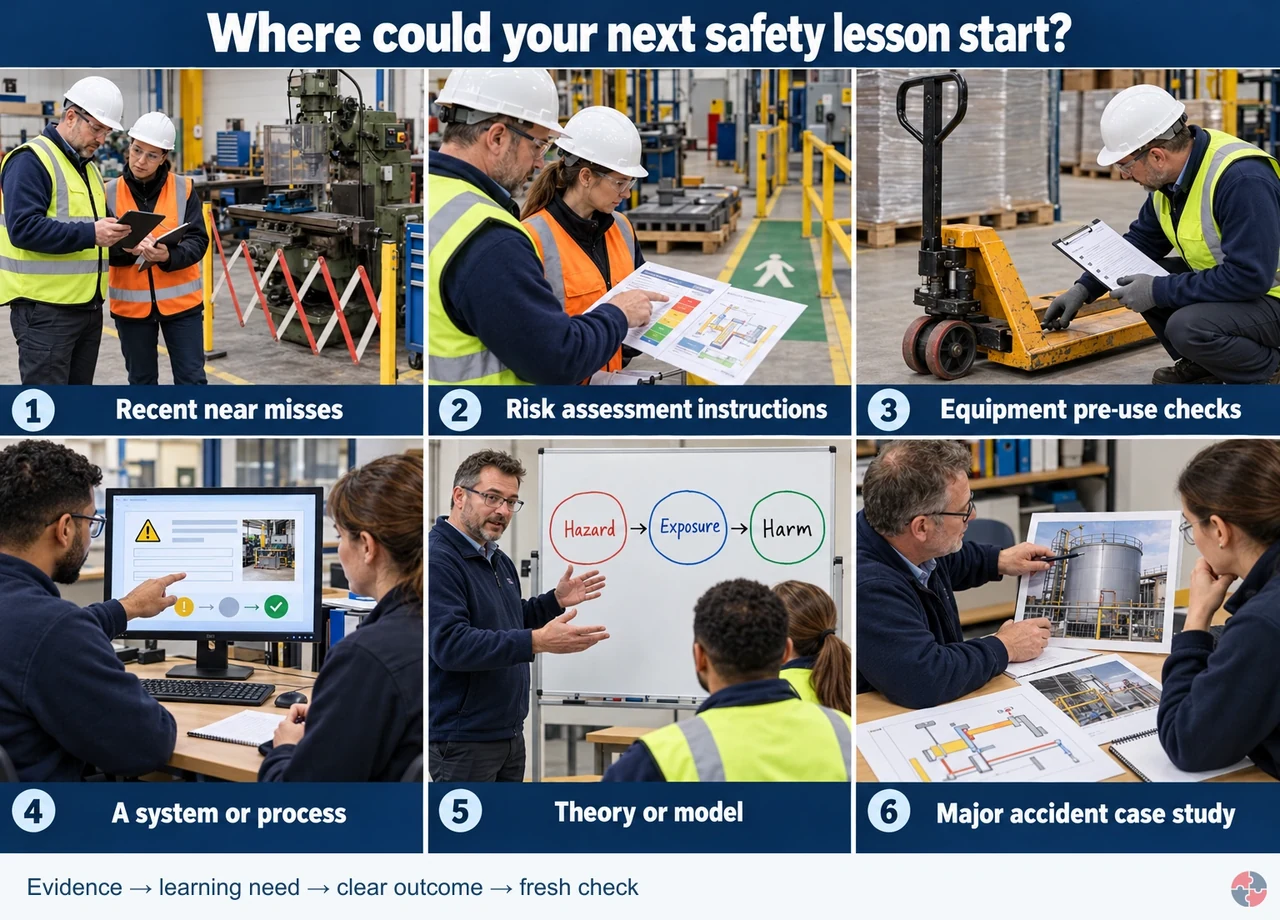

Approximate self-study learning time: 5 hours 40 minutes, including teaching, automatic checks and the final exam. Optional session-development, rehearsal and follow-up practice is additional, around 3 hours or more.
Design, deliver, assess and improve a short workplace safety lesson within your verified subject competence. This independent SHAREhub course does not confer AET, a regulated qualification, accreditation or universal authority to train others.
You will get the most value from this course by undertaking it in good faith: work through the teaching, give the activities an honest attempt and apply the ideas to a real learning need in your workplace.
As you progress, you can work through an optional personal process of developing a training session that will be useful to your team. Start with a training needs analysis, define the intended benefit, plan the session and develop suitable materials and checks. This optional project is self-led and is not assessed or graded.
Use the optional reflective sections to record your thoughts privately about the process: what you are learning, what you find difficult, what you will improve and how your team will benefit. Revisit your notes as your session develops. Your reflections are for your own development and are not assessed.
There is a multiple-choice exam at the end of the course. It is separate from your personal project and reflections. The assigned course provides the exam instructions and records the result.
For workplace subject specialists, supervisors and trainers preparing a short lesson within their verified expertise. Public teaching and practice are available here. Recorded assessment requires a provider-assigned native course; enrolment, fees and membership permissions follow the provider’s actual arrangement.
Open the interactive courseSelf-paced course · SH-TTT-02
Get the recorded course
26 lessons with interactive models, ordering, matching and safety decisions. Includes a training needs analysis, an editable session-plan example, a workbook and a PDF record of your own thoughts and responses.
Approx. 5 hours 40 minutes of core learning. A personal workplace session project and reflection are optional additional practice and are unassessed. The recorded course includes automatically marked final knowledge checks.
Trainer development within your existing subject competence. This course does not award AET or assess observed teaching competence.
£50.00 + VAT per learner, excluding VAT
VAT will be added at checkout.
The purchase is for one named learner. After confirmed payment, recorded access uses their own SHAREhub learning account. Course completion still requires the automatic learning and exam checks.
Learning pathway
- Start here (28 core minutes)
- Training design and safety (156 core minutes)
- Inclusive teaching and improvement (126 core minutes)
- Exam and optional project (30 core minutes + 90 optional minutes)
- Optional rehearsal (0 core minutes + 60 optional minutes)
- Optional later application (0 core minutes + 30 optional minutes)
Outcomes and lessons
- Your task, topic and boundaries: Choose one bounded lesson that you can teach accurately.
- Baseline and private learning needs: Collect proportionate baseline evidence and agree support privately.
- The teaching cycle in action: Connect needs, design, delivery, assessment and evaluation.
- Law, guidance and local arrangements: Distinguish a legal duty from a local method of meeting it.
- Hazards, people and harm: Explain a credible harm pathway without inventing evidence.
- The blocked pedestrian route: Teach a safe recognition and reporting decision.
- Controls that a lesson cannot replace: Recognise when the underlying system needs a different control.
- Adequacy, verification and escalation: Define an observable control standard, owner and failure action.
- Reporting, action and confirmed closure: Teach a complete reporting route and distinguish action from verified closure.
- Outcomes and aligned assessment: Write observable outcomes and select evidence that matches them.
- Stories with evidence and a decision: Build a truthful short story that leads to a learning decision.
- A coherent fifteen-minute lesson plan: Allocate time to participation, checking and a safe close.
- Maslow as a practical conversation prompt: Choose useful participation support without diagnosing learners.
- VARK and varied methods: Select methods for the task and access need rather than fixed labels.
- Useful visual explanations: Choose a visual that makes a relationship clearer.
- Accessible slides and written alternatives: Remove barriers while preserving essential safety meaning.
- Participation and questioning: Gather individual reasoning without pressuring disclosure.
- Safe facilitation and difficult moments: Respond within professional and safeguarding boundaries.
- Demonstration, practice and feedback: Use supported practice followed by a fresh independent check.
- Assessment design and honest conclusions: Create three to five items with valid evidence and rationale.
- Evaluation and documented improvement: Use evidence to revise teaching and plan a later effectiveness check.
- Rehearsal and useful feedback: Use quality prompts to identify strengths, gaps and useful changes.
- Your personal training session project: Develop a useful workplace session through a self-led unassessed process.
- The final multiple-choice exam: Use the assigned exam route and distinguish saved work from a recorded result.
- Rehearse reflect and improve your session: Rehearse your session and use reflection to improve its workplace value.
- Transfer and personal improvement: Record a useful revision and plan a later workplace application check.
Resources and assessment brief
Approximate self-study learning time: 5 hours 40 minutes, including teaching, automatic checks and the final exam. Optional session-development, rehearsal and follow-up practice is additional, around 3 hours or more.
- Learner workbook PDF
- Editable ten-slide lesson example with complete speaker notes
- Download your own saved thoughts and responses as a personal learning record PDF
- Online training needs analysis and session-design form
- Blank training needs analysis form Word
- Blank training needs analysis form PDF
- Editable worked practical session plan
- Printable worked practical session plan
- Personal session planner and development checklist
- Offline practice and learner resources ZIP
Personal development and final exam
Work through the course in good faith. Optional personal practice lets you develop a session of value to your workplace. Your personal project, rehearsal, improvements and reflective notes are self-led and unassessed. Use the ten-slide example as a flexible planning aid and record your thoughts about the process and the intended team benefit.
The separate final multiple-choice exam has 20 questions and open-book access; allow about 30 minutes. The existing pass threshold is 16/20, and all four safety-critical answers correct, checked automatically; review the topic and retry independently. Use the assigned course for the exam, assistance and adjustment instructions, submission confirmation and recorded result.
Quality prompts for your session
Use these for development and reflection. They have no course practical score or assessor approval gate.
- Needs and boundaries: Audience, starting gap, private support and subject limits are evidenced.
- Outcomes and alignment: Observable outcomes connect teaching, practice and individual assessment.
- Technical and legal accuracy: Claims are current for the jurisdiction and local arrangements are verified.
- Hazards and control choices: The lesson explains credible harm and recognises where training cannot fix a control.
- Control verification: Requirement, owner, evidence, failure action and recheck are explicit.
- Story and visual meaning: Truthful, authorised content leads to a decision with accessible descriptions.
- Facilitation and safety: Safe participation, pacing, boundaries and respectful responses support learning.
- Inclusive access: Essential meaning and assessment are usable through agreed equivalent routes.
- Assessment and feedback: Three to five aligned items, rationales, individual evidence and corrective feedback are usable.
- Evaluation and improvement plan: Evidence identifies strengths, gaps and a feasible revision and follow-up.
Sources
- HSE: Health and safety training, INDG345
- GB: Management Regulations 1999, regulation 13
- HSE: Managing risks and reviewing controls
- HSE: Work equipment training and competence
- W3C: Web Content Accessibility Guidelines 2.2
- Pashler and colleagues: Learning Styles, Concepts and Evidence
- Maslow: A Theory of Human Motivation, 1943
- VARK Learn: The VARK modalities