Focused awareness learning based on SHAREhub pages. Apply the actual workplace arrangements and your role; completion is not practical competence or permission for specialist work.
This reader supplies the complete teaching. Use the interactive LMS course for assessed activities, saved progress and completion.
LESSON 1
Connect the three driving decisions
Connect the three driving decisions.
Existing SHAREhub photographic illustration. The written fictional case supplies the condition and decision evidence.
Connect the three driving decisions
Work driving can be part of many roles, not just a professional driver job. It can involve company, hired or worker-owned vehicles used for business. The useful assessment connects the journey, driver and vehicle. A licensed person can still face an unrealistic schedule or unsuitable load, while a roadworthy vehicle cannot prevent fatigue. Ordinary commuting is generally different, but temporary or changing work locations need the actual arrangement considered rather than an automatic assumption.
Identify who may be harmed: driver, passengers, pedestrians and other road users. Ask whether the journey is necessary and whether a remote meeting or alternative transport can achieve the purpose safely. If driving remains, plan the current trip and work demands together. The organisation must not leave the whole risk to a person reacting alone once the journey is underway.
Applied case
A manager says driving risk belongs only to delivery drivers. A surveyor regularly travels between work sites in a personal vehicle, carrying equipment and meeting changing appointment times.
Look beyond the label
Ownership does not remove the journey from the work-risk question. A worker-owned car used for business still needs the relevant suitability, roadworthiness and management arrangements for that work.
Test your decision
What should the organisation assess?
The surveyor actual work journey, driver and vehicle arrangements.
Only vehicles carrying company branding.
Only people whose job title contains driver.
Compare the explanation
The surveyor actual work journey, driver and vehicle arrangements.
Work activity and actual use determine the assessment, not branding or a narrow job title.
Design a realistic journey rather than a pressure target
Design a realistic journey rather than a pressure target.
Photorealistic illustrative UK workplace scene. Review checks: No grey fleet checks: Uninsured or unroadworthy private vehicles are used for business. Unrealistic schedules: Speeding, missed breaks, fatigue and phone use become normalised. Defects not closed: Vehicle failure, breakdown or collision risk increases.
Design a realistic journey rather than a pressure target
Plan route, timing, traffic, weather, breaks, welfare and the work before and after travel. Check whether the visit can be avoided, combined or rearranged without creating another unsafe demand. An appointment schedule must allow safe progress rather than depend on speeding, missed breaks or continuing through fatigue. Delays are foreseeable work conditions to manage, not personal failures that a driver must recover on the road.
Assess changes while there is still time to choose a safe alternative. A late extra visit, distant return or unsuitable route can invalidate the original plan. Managers should provide a usable way to report delay or stop and revise the job without blame. Meeting the customer promise does not authorise unsafe driving, and a navigation app estimate is not the complete journey-risk assessment.
Applied case
A late visit is added after the original route was accepted. The only way to meet the new times appears to be skipping breaks and making up delay while driving home.
Look beyond the label
A changed schedule is a new risk decision. Review the whole working day and return journey rather than assume the original acceptance covers added distance, delay and pressure automatically.
Test your decision
What should management do?
Keep the times and tell the driver to try harder.
Treat the app fastest arrival as complete acceptance.
Reassess and agree a realistic safe journey or alternative arrangement.
Compare the explanation
Reassess and agree a realistic safe journey or alternative arrangement.
Work planning must not create pressure to take unsafe road decisions.
Existing SHAREhub 2D teaching schematic. Use alongside the explanation and fictional case in this lesson.
Treat tiredness as a work-planning concern
Fatigue can arise from shifts, early starts, night work, poor sleep, long travel and driving after a full day of work. Illness, medication and stress can also affect the person. Being within a legal hours rule does not prove someone is fit to drive safely. A licence is only one part of driver suitability, and a manager should not diagnose a health condition from a brief conversation.
Plan suitable rest and breaks and consider alternatives such as postponement, an overnight stay, another suitable travel method or a revised workload through the organisation arrangements. Encourage honest reporting and a safe stopping decision. Do not rely on a promise to push through tiredness or a reward for rapid completion. Relevant health concerns need the proper competent advice while immediate journey risk is controlled.
Applied case
The driver reports difficulty staying alert after a demanding shift. The manager says the legal driving-hours allowance is not exhausted, so the return trip must still be completed tonight.
Look beyond the label
Fatigue is not simply a test of willpower. Workload and scheduling can create it, so the response must include a realistic safe alternative rather than pressure to finish the original plan.
Test your decision
What should govern the decision?
A promise that the driver will open a window.
The current fatigue and a safe revised work or travel arrangement.
The hours allowance as proof of alertness.
Compare the explanation
The current fatigue and a safe revised work or travel arrangement.
Legal compliance alone cannot establish present fitness or make fatigue safe.
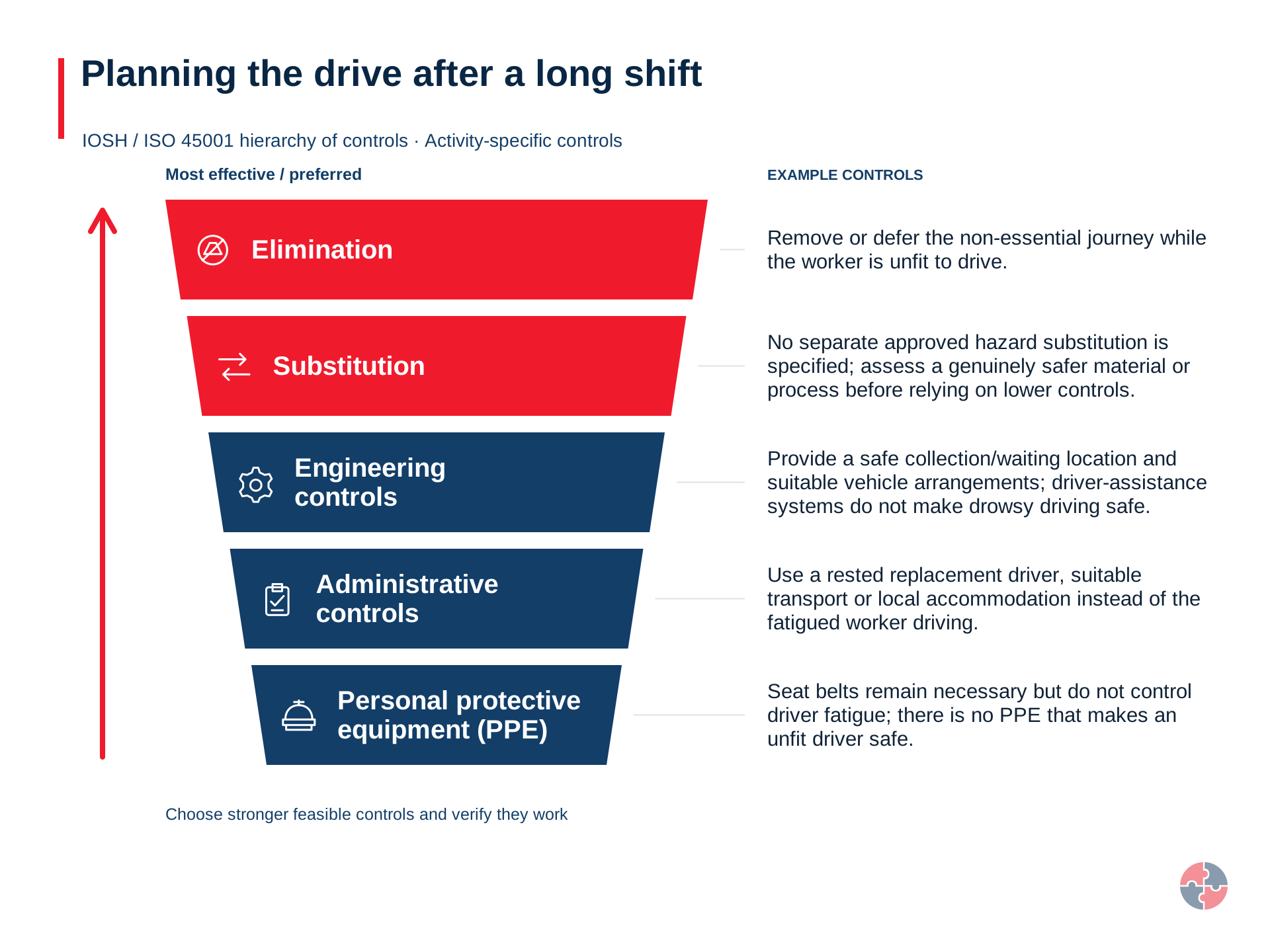
Photorealistic illustrative UK workplace scene. Review checks: Elimination: Remove or defer the non-essential journey while the worker is unfit to drive. Administrative controls: Use a rested replacement driver, suitable transport or local accommodation instead of the fatigued worker driving. Administrative controls: Do not release the vehicle to a driver who is unfit; keep the worker away from driving and other safety-critical duties. Engineering controls: Provide a safe collection/waiting location and suitable vehicle arrangements; driver-assistance systems do not make drowsy driving safe. Administrative controls: The driver and transport owner check alertness, recent duty and sleep opportunity before departure.
Match the vehicle and load to the work
A vehicle needs to suit the people, load, route and work, remain roadworthy and have usable defect arrangements. A car suitable for a meeting may not suit carrying tools or substances. A van may need appropriate load restraint and storage. Check the actual equipment and load rather than assume that a company vehicle or rental is automatically ready. A current inspection or test cannot override a new unsafe defect.
Drivers need to know relevant pre-use checks, reporting and when not to use the vehicle. Management must support prompt repair and keep unsafe vehicles out of service. Worker-owned vehicles used for business also need the appropriate evidence and arrangements; reimbursement is not a suitability check. Do not improvise load securing or diagnose a warning from a generic course instead of following the actual vehicle instructions.
Applied case
A replacement vehicle is available, but the tools cannot be secured in the provided space and a new defect is reported. The manager proposes using it because the scheduled test is current.
Look beyond the label
Roadworthiness, task suitability and load security are connected but distinct. A vehicle can have current paperwork while a new defect or an unsuitable carried load prevents safe use today.
Test your decision
What must be resolved?
Present vehicle condition and suitability for the actual load and journey.
Only the scheduled test date.
The fact that the vehicle was supplied by a reputable firm.
Compare the explanation
Present vehicle condition and suitability for the actual load and journey.
The current task and condition matter; historic paperwork and supplier reputation do not fix them.
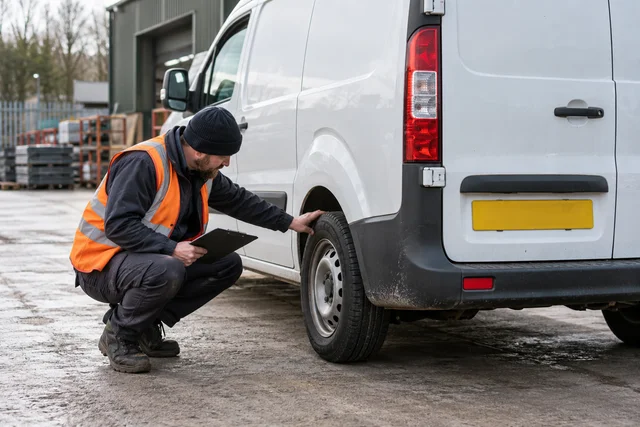
Existing SHAREhub photographic illustration. The written fictional case supplies the condition and decision evidence.
Remove the expectation to respond while driving
Distraction includes more than holding a phone. Calls, messages, complex route changes, screens and work pressure can take attention from driving. Hands-free use can still distract. The exact legal rules depend on jurisdiction, while the employer can set a stricter work rule. A lawful action is not automatically a safe one for every road situation. Managers must not create an expectation that drivers answer immediately.
Plan communication before movement and arrange check-ins or callbacks when safely parked under the organisation method. Configure relevant route information before the journey and review how work apps affect attention. Technology can support a safe arrangement but cannot replace it. If plans change, use the safe stopping and communication route instead of trying to reorganise appointments, enter directions or explain delay while still driving.
Applied case
The workplace bans handheld use but the manager expects lengthy hands-free calls during busy journeys and immediate app responses. The team treats the policy title as complete distraction control.
Look beyond the label
A no-handheld rule is not a complete communication plan. Work should be organised so the driver can give attention to the road and respond through a safe agreed arrangement when parked.
Test your decision
What should the review address?
Only whether the phone is physically held.
A rule that hands-free conversation cannot distract.
The actual attention demands and management communication expectations.
Compare the explanation
The actual attention demands and management communication expectations.
Distraction risk and the minimum legal offence are different questions.
Photorealistic illustrative UK workplace scene. Review checks: Setting: A the site team supervisor asks a van driver to deliver tools to two construction sites and return the same night after a full shift. Act: Remove the avoidable second trip or allocate a local crew, check licence and task authorisation, inspect tyres/lights/restraints and secure the load. Hold / review: Poor alertness, unsafe weather, failed restraint, insecure load, vehicle defect, unplanned overtime or uncontrolled reversing space stops dispatch or work.
Make stopping and review usable
Warning signs include repeated unrealistic schedules, pressure to answer calls, fatigue reports, vehicle defects and insecure loads. A safe system needs a practical route to stop, report and obtain a revised decision. Do not punish honest disclosure in a way that hides risk. Incident and near-miss learning should examine the journey plan, workload and vehicle arrangements as well as individual behaviour. Monitoring technology needs a justified purpose and responsible use.
Restart or a replacement journey follows resolution of the relevant condition, not a promise to take more care. Check the current driver state, suitable vehicle and load, realistic route and communication expectations together. Record the accepted change and tell those affected, including the person waiting for the visit. A rescheduled appointment alone does not repair the vehicle or remove fatigue from the rest of the workday.
Applied case
The late visit is cancelled, but the tired technician still faces the long return in the unsuitable vehicle. Management proposes closing the concern because the diary is now within its original target.
Look beyond the label
Follow a concern to the real journey that remains. A changed diary is useful only when current fatigue, vehicle suitability, timing and communication demands form a safe workable arrangement.
Test your decision
What should the revised decision cover?
A promise that the driver will concentrate harder.
The actual remaining journey, driver condition and suitable vehicle arrangement.
Only the cancelled appointment entry.
Compare the explanation
The actual remaining journey, driver condition and suitable vehicle arrangement.
Removing one schedule pressure does not automatically resolve the remaining driving risks.