Focused awareness learning based on SHAREhub pages. Apply the actual workplace arrangements and your role; completion is not practical competence or permission for specialist work.
This reader supplies the complete teaching. Use the interactive LMS course for assessed activities, saved progress and completion.
LESSON 1
Understand what authorisation can establish
Understand what authorisation can establish.
Existing SHAREhub photographic illustration. The written fictional case supplies the condition and decision evidence.
Understand what authorisation can establish
A permit-to-work is a formal authorisation and communication mechanism for defined hazardous work under stated conditions. It confirms that the required controls have been identified, implemented and verified through the appropriate system. It does not itself isolate plant, remove a flammable atmosphere or provide a rescue capability. If a physical condition is wrong, a complete-looking form cannot make it safe. Paper and electronic permits share that limitation.
Use the permit with the risk assessment, safe method and competent task arrangements. The people issuing and accepting it need to understand the actual job and boundary. Check the workface rather than relying on a desk-issued document. If equipment identity or essential conditions cannot be established, the affected work does not start merely because signatures have been collected.
Applied case
A permit is fully signed, but the team cannot identify which of two similar equipment items is authorised. They propose choosing the nearest one to avoid delaying the contractor.
Look beyond the label
A permit records an accepted arrangement; it cannot manufacture missing identity or physical protection. Ask whether the actual equipment and conditions match what the authorised people have accepted.
Test your decision
What must happen?
Let the contractor choose the likely equipment.
Resolve the actual job identity and boundary before starting.
Use the signatures to approve either item.
Compare the explanation
Resolve the actual job identity and boundary before starting.
A defined authorisation cannot cover an unidentified work point.
Photorealistic illustrative UK workplace scene. Review checks: Mismatch: The permit describes a different location, scope or plant state. Energy: Unproven isolation can release motion, pressure or hazardous material. Interface: Other work or an unplanned restart can expose the permitted team.
Resolve stronger controls before permit issue
Before authorising hazardous work, consider whether the task or exposure can be avoided or redesigned. Where it remains necessary, suitable physical controls and competent verification are central. A permit sits in the administrative layer: it coordinates the job, people and live conditions but cannot replace isolation, containment, effective segregation or another required barrier. Additional signatures do not make a weaker physical arrangement equivalent to a practicable safer method.
Planning should explain why the intrusive or hazardous method remains necessary and what makes it safe. If production pressure prevents the required safe condition, retain the hold rather than issue a permit that assumes it away. PPE supports the accepted arrangement; it does not prove a line empty or an atmosphere suitable. Link the permit to the evidence for the actual safeguards.
Applied case
A planned intrusive repair lacks the required safe isolation. The supervisor proposes more permit signatures and heavier PPE so the job can proceed while the process remains live.
Look beyond the label
A stronger form is not a stronger isolation. Keep the permit connected to verified controls and do not use paperwork or PPE to approve an unsafe physical condition.
Test your decision
Which principle should govern the decision?
The required safe physical condition must be resolved before authorisation.
Extra signatures replace the missing isolation.
PPE proves the process cannot release material.
Compare the explanation
The required safe physical condition must be resolved before authorisation.
Administrative authorisation cannot compensate for an unresolved required physical barrier.
Existing SHAREhub 2D teaching schematic. Use alongside the explanation and fictional case in this lesson.
Make decision rights and understanding explicit
The issuer needs to understand the area and hazards; the person accepting the work needs to understand its scope and controls. Isolation and testing roles need the competence relevant to their functions. Supervision monitors actual conditions rather than merely collecting signatures. Titles alone do not establish who can issue, suspend, revalidate or close a permit. Gaps can arise when operations, maintenance and contractors each assume another team owns the same check.
Before work, confirm who controls the boundary, what each person has accepted and how the work team understands the precautions and stop conditions. Use a briefing that permits questions and checks comprehension. A person signing for a crew does not automatically demonstrate every worker understanding. Refer unclear authority through the site system rather than inventing approval because the usual role is absent.
Applied case
A contractor signs acceptance but the work crew cannot explain the stop condition. Operations assumes the contractor briefed them, while the contractor assumes the issuer will do it later.
Look beyond the label
A signature can confirm one person action. It cannot by itself demonstrate the whole crew understanding or fill an unclear decision right between host, contractor and supervisor.
Test your decision
What needs resolution before the job proceeds?
Only another acceptance signature.
An assumption that the crew will learn the limits during the task.
Clear briefing responsibility and verified crew understanding of the accepted controls.
Compare the explanation
Clear briefing responsibility and verified crew understanding of the accepted controls.
Communication must reach the people doing the work and resolve the responsibility gap.
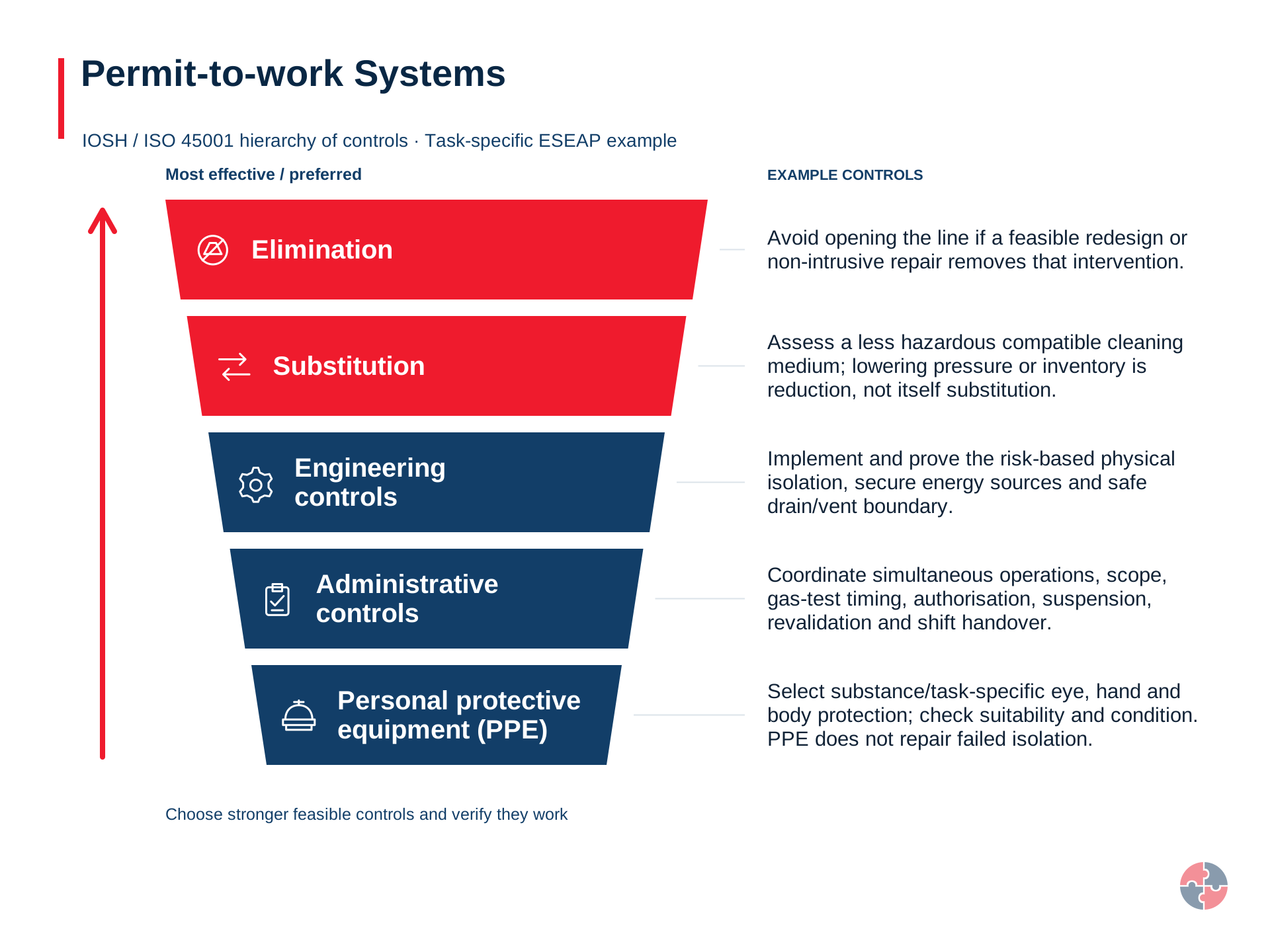
Photorealistic illustrative UK workplace scene. Review checks: Eliminate: Eliminate or redesign: the maintenance planner checks whether the repair can be completed without opening the line, or whether the pump can be taken fully out of service and worked on in a controlled workshop. Reduce: Substitute or reduce: engineering considers a less hazardous cleaning medium or reduced inventory and pressure before opening, only if process compatibility and the approved procedure allow it. Isolate: Isolate and engineer: the isolation authority selects a risk-based physical isolation scheme under HSE HSG253, identifies the exact line, secures energy sources, drains and vents to a safe system, and proves the boundary before work. Control: Control, PPE and Discipline: the area authority coordinates simultaneous operations, gas-test timing, permitted scope, time limit, fire/containment arrangements and shift handover under HSG250. Control: Read the full task example, checks and stop points on this page.
Coordinate jobs that interact
Individually acceptable tasks can become unsafe when combined. Hot work beside flammable transfer, a lift above another crew or nearby cleaning affecting an entry can create a new harm pathway. The area authority needs a current view of live work, plant status and impairments. A permit board or electronic system helps communication only when it reflects the actual workface and is actively reviewed.
Check interactions during planning, issue, shift change and revalidation. Separate work in time or space, suspend a conflicting activity or revise controls through the responsible system before proceeding. Do not assume different permit numbers mean independent risks. Include contractors and operations outside the immediate work team. A changed adjacent task can invalidate the accepted conditions even when the original job has not altered.
Applied case
One team has a hot-work permit and another has permission to transfer flammable material nearby. Each supervisor checks only their own form and sees no need to coordinate.
Look beyond the label
The permit boundary is not a wall around consequences. Follow releases, ignition, movement and shared plant across jobs, then agree a workable combined arrangement before either team relies on it.
Test your decision
What should govern the combined work?
Which team arrived first at the workface.
An active review and resolution of the interacting hazards.
The fact that two different permit numbers exist.
Compare the explanation
An active review and resolution of the interacting hazards.
Individual authorisations do not establish that simultaneous activities are compatible.
Existing SHAREhub photographic illustration. The written fictional case supplies the condition and decision evidence.
Suspend when conditions no longer match
A permit is live for a defined task under stated conditions. Monitoring must identify a changed scope, plant state, test condition, adjacent operation or work-team understanding that invalidates it. A printed expiry time does not authorise continuation after an essential barrier fails. Suspending work protects the people and plant while the responsible roles reassess; it is not a paperwork failure to conceal or avoid.
Use the planned safe stopping and reporting route. Record the actual condition and maintain the necessary restrictions. Revalidation requires the relevant controls and authority to be restored for the present job, not simply a new date written on the same assumptions. Shift handover must make live permits, incomplete work, tests due and invalidating conditions visible to incoming people before they make the next decision.
Applied case
A task remains within the printed permit time, but an adjacent operation changes and a required condition can no longer be confirmed. The crew is told to continue until expiry.
Look beyond the label
Revalidation answers whether the current job is safe under current conditions. It is not a date extension that preserves an invalid assumption or removes the need for field verification.
Test your decision
What is the appropriate response?
Suspend the affected work and obtain reassessment and revalidation.
Treat the expiry time as permission despite changed conditions.
Erase the changed condition from the handover.
Compare the explanation
Suspend the affected work and obtain reassessment and revalidation.
The accepted conditions, not the remaining clock time alone, govern whether the permit remains valid.
Photorealistic illustrative UK workplace scene. Review checks: Setting: Replace a gasket on hydrocarbon pump P-204 at a fuel terminal during a planned shutdown. Act: Identify the exact flange and boundary, plan the isolation, drain and vent to a safe route, and check concurrent work. Hold / review: A passing valve, blocked drain, residual pressure, odour, gas alarm or conflicting operation suspends the job for reassessment.
Hand back the actual plant state
Closing a permit should communicate what work is complete, what remains open, which people and tools are clear and whether the plant and protective arrangements are ready for the next authorised state. The details depend on the actual job. A completed repair may still leave containment, safeguards or test evidence unresolved. Removing the permit from a board does not restore a barrier or prove every team has finished.
Use the accepted handback and release process, with clear responsibility between work team and plant owner. Keep restrictions visible where required checks remain outstanding. Audits should compare permits with field observations, worker understanding and defect follow-through rather than count closed forms alone. A useful action closes when the relevant condition is verified and communicated, not merely when a document reaches its final status.
Applied case
The repair crew has finished, but a protective function is still out of service and another work area remains open. The coordinator proposes closing the permit to clear the board.
Look beyond the label
Follow the job beyond the repair. Handback and release need a clear accepted plant state; a tidy board is not evidence that protection, containment and all affected people are accounted for.
Test your decision
What must the handback establish?
Only that the repair crew has left.
That a closed status restores the protective function.
The real plant state, unresolved restrictions and required acceptance before release.
Compare the explanation
The real plant state, unresolved restrictions and required acceptance before release.
Administrative closure must describe the physical and work condition rather than conceal incomplete restoration.