Focused awareness learning based on SHAREhub pages. Apply the actual workplace arrangements and your role; completion is not practical competence or permission for specialist work.
This reader supplies the complete teaching. Use the interactive LMS course for assessed activities, saved progress and completion.
LESSON 1
Identify the complete fall path
Identify the complete fall path.
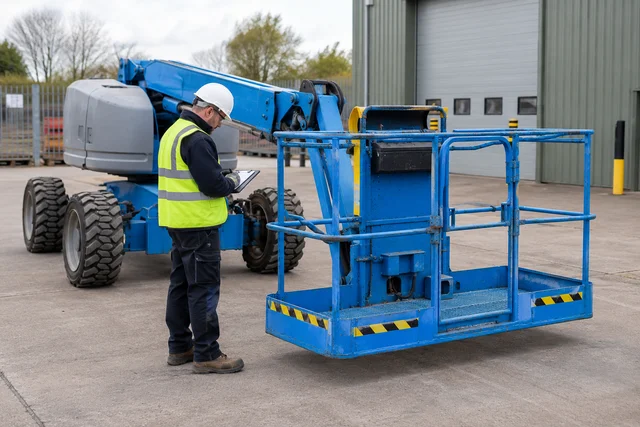
Existing SHAREhub photographic illustration. The written fictional case supplies the condition and decision evidence.
Identify the complete fall path
Work at height can exist wherever a person could fall a distance liable to cause injury without precautions. It can include an opening or a fragile surface above a void, not just a high platform. A short fall can cause serious injury, and materials dropped during the task can harm people below. The relevant assessment follows the person, surface, edge or opening and the potential landing, rather than assuming that a low position is automatically harmless.
Consider access, the working position and leaving the area. Moving tools or materials can change balance and create another falling-object route. Include cleaners, visitors and other trades who may enter below. Unknown strength or an unprotected opening is a reason to hold the affected task, not to step closer and test it with a foot.
Applied case
A worker plans a low-level task beside an uncovered opening. The supervisor dismisses fall precautions because the worker will stand close to ordinary floor level throughout the task.
Look beyond the label
Follow where a person or object could go if protection were absent. Floor-level work near a void can create a fall hazard even without a ladder or elevated platform.
Test your decision
What must be assessed?
The possible fall through the opening and its consequences.
Only the height of the worker feet above the floor.
Only whether the work will take a few minutes.
Compare the explanation
The possible fall through the opening and its consequences.
The fall path can pass below floor level; height above the floor alone does not define the risk.
Photorealistic illustrative UK workplace scene. Review checks: Fragile rooflight or sheet: The surface gives way and a person falls through into the space below. Edge, opening or ladder: A slip or overreach leads to a fall onto a hard or obstructed landing. Dropped tool or material: A person below is struck even though the worker above remains protected.
Choose avoid, prevent, then minimise
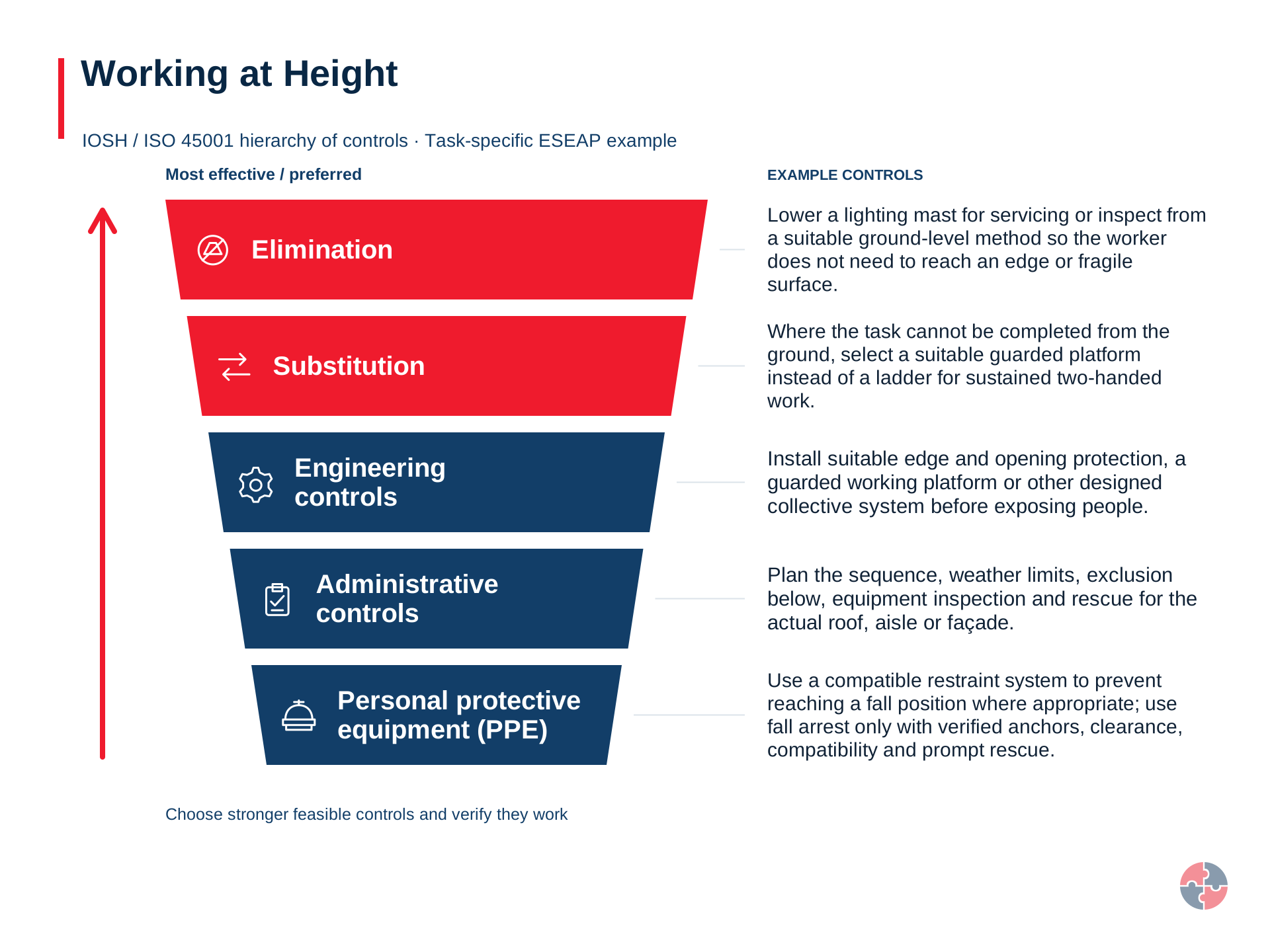
First consider doing the work without exposure to a fall, such as a suitable method from ground level. If height work remains, prevent falls using a safe existing place or suitable equipment. Only then consider measures that minimise the distance and consequences of a remaining fall. Prefer protection that works for everyone over measures depending on each individual. Owning a harness or ladder does not settle the method decision.
Restraint can prevent reaching an edge when correctly specified; fall arrest acts after a fall and needs verified clearance and rescue. Neither makes a fragile roof strong. The competent plan must fit the actual location, task and equipment. Compare practical alternatives before committing people to the height, and record why the selected method is suitable for this job rather than simply available.
Applied case
A repair is planned from a ladder because one is already on site, although a suitable ground-level method may avoid the climb. A harness is proposed as the entire justification.
Look beyond the label
Preventing a fall and arresting one are different functions. A personal system must not be used as a shortcut around feasible avoidance or collective protection for the actual task.
Test your decision
What should planning consider first?
Which harness looks most substantial.
How quickly the nearest ladder can be carried over.
Whether the task can practicably avoid exposure to the fall.
Compare the explanation
Whether the task can practicably avoid exposure to the fall.
The hierarchy begins with avoiding the height exposure, not adding personal equipment to an unexamined method.
Settle task, access and competence before starting
Settle task, access and competence before starting.
Existing SHAREhub 2D teaching schematic. Use alongside the explanation and fictional case in this lesson.
Settle task, access and competence before starting
Planning should identify the exact task and location, access and egress, equipment, loads, ground or surface conditions and the people competent to do the work. Include overhead services, other activities, falling objects and emergency arrangements. Choose equipment for reach, posture, force, duration and materials rather than for what is closest. A guarded platform may fit a lengthy two-handed task better than a ladder, but it also needs suitable ground and operating conditions.
The workface must match the plan. Check current information, equipment condition, required inspections, access routes and who can authorise a change. A task that becomes heavier, longer or more awkward needs reassessment before that extension starts. Familiarity and an earlier authorisation do not establish that the changed job is still within the accepted method.
Applied case
A planned visual inspection reveals a seized component requiring force and two-handed removal. The worker can reach it from the existing position and wants to continue under the inspection method.
Look beyond the label
Reaching the component is one fact. Working safely on it also depends on posture, force, duration, materials, access and protection, so a changed task needs its own accepted method.
Test your decision
What is the appropriate decision?
Use the inspection authorisation for every later repair.
Pause the expanded task and reassess the method and equipment.
Treat reach as proof that forceful removal is safe.
Compare the explanation
Pause the expanded task and reassess the method and equipment.
The changed work can alter stability, protection and handling demands; the original scope does not automatically cover it.
Photorealistic illustrative UK workplace scene. Review checks: Avoid: Avoid work at height where reasonably practicable. Prevent: Where height remains, prevent falls through the assessed method and suitable protection, considering collective protection first. Minimise: If risk remains, minimise fall distance and consequences with suitable equipment and an assessed rescue arrangement.
Do not infer surface strength from appearance
Rooflights, suspect sheeting and deteriorated surfaces can fail under a person even when they appear sound. Treat uncertain surfaces as fragile until competent evidence establishes otherwise. Avoid roof access where a suitable protected method from below or other equipment can do the work. If access is unavoidable, specialist planning must address safe routes, working platforms, edges, fall protection and rescue. A warning sign or loose board is not a substitute for an effective protective arrangement.
Check that information describes the actual location and current condition. Hidden openings, repairs and weathering can make familiar routes different. Workers should not test strength by standing on the surface or follow an unverified shortcut. Hold uncertain access and obtain the competent assessment and installed protection before allowing the affected work to begin.
Applied case
A rooflight is obscured by dirt on a familiar route. No current surface information is available, but a colleague suggests stepping carefully because the roof was used successfully last year.
Look beyond the label
Surface uncertainty is a planning hold, not an invitation to experiment. A competent assessment and effective protection must address the actual route before a person relies on it.
Test your decision
What is the defensible boundary?
Keep off the uncertain surface until competent assessment and protection are established.
Use last year successful crossing as proof.
Test the rooflight gently with body weight.
Compare the explanation
Keep off the uncertain surface until competent assessment and protection are established.
Past use and visual appearance do not establish present load-bearing strength.
Existing SHAREhub photographic illustration. The written fictional case supplies the condition and decision evidence.
Protect others and respond to changed conditions
Height work can expose people who never climb. Tools, materials and debris need suitable securing or containment, with effective separation below. A helmet does not prevent a falling object. Coordinate pedestrians, vehicles and other trades, and check that the boundary remains usable throughout the task. A sign without control of access can leave the harm route open. Materials being removed can create a different drop or handling path from the original work.
Weather, visibility and surface conditions can change stability and safe access. Use the equipment and task limits from the plan rather than inventing a universal wind value. If people enter below or conditions jeopardise safety, stop the affected work and restore the arrangement. Do not continue because a permit was signed before the change or because the worker is nearly finished.
Applied case
During overhead maintenance, a delivery opens the pedestrian exclusion route and rain makes the access surface slippery. The team argues that the last fastening will take only a moment.
Look beyond the label
A work boundary is an operating control, not just a line drawn at the briefing. Check that it still excludes people and that changed surfaces or weather remain within the plan.
Test your decision
What should happen?
Finish because only one fastening remains.
Rely on helmets instead of the exclusion.
Stop the affected work and restore the safe conditions and separation.
Compare the explanation
Stop the affected work and restore the safe conditions and separation.
Near-completion does not remove the current fall or falling-object pathway.
Photorealistic illustrative UK workplace scene. Review checks: Setting: Inspect ageing rooflights without stepping on a suspect roof. Act: Review fragility and whether an internal or MEWP method can reach the task; exclude people below. Hold / review: Hold if roof strength, route or protection is uncertain or wind exceeds the equipment limit.
Plan recovery and verify return
A workable rescue plan is needed before relying on the height-working arrangement. It must fit the location, equipment and credible emergency, including a stranded or incapacitated person. Identify competent responders, communication, equipment and access, and practise the agreed arrangement. Calling emergency services must not be the only planned provision. Ordinary colleagues should not create another casualty by climbing or entering an unsafe area without the planned capability.
Before starting, confirm that the required people and resources are available. Hold work if rescue, communication, protection or inspection cannot be verified. After a defect or change, a competent authorised person needs to confirm the method and restored controls before release. Keep the handover clear about restrictions; a repaired item or renewed tag alone does not establish that the complete work and recovery arrangements are ready.
Applied case
The named rescue person is absent and the emergency equipment location is uncertain. The supervisor proposes starting because a phone is available to call for help if anything happens.
Look beyond the label
A written plan is not available capability. Verify people, access, communication and equipment together, and retain the work restriction when the actual recovery arrangement cannot be delivered.
Test your decision
What should govern release?
A promise that an untrained colleague will climb if needed.
Availability of the task-specific planned rescue and work controls.
The phone alone as complete rescue provision.
Compare the explanation
Availability of the task-specific planned rescue and work controls.
The plan must be usable for the actual task before exposure begins; improvising recovery can create another casualty.