Focused awareness learning based on SHAREhub pages. Apply the actual workplace arrangements and your role; completion is not practical competence or permission for specialist work.
This reader supplies the complete teaching. Use the interactive LMS course for assessed activities, saved progress and completion.
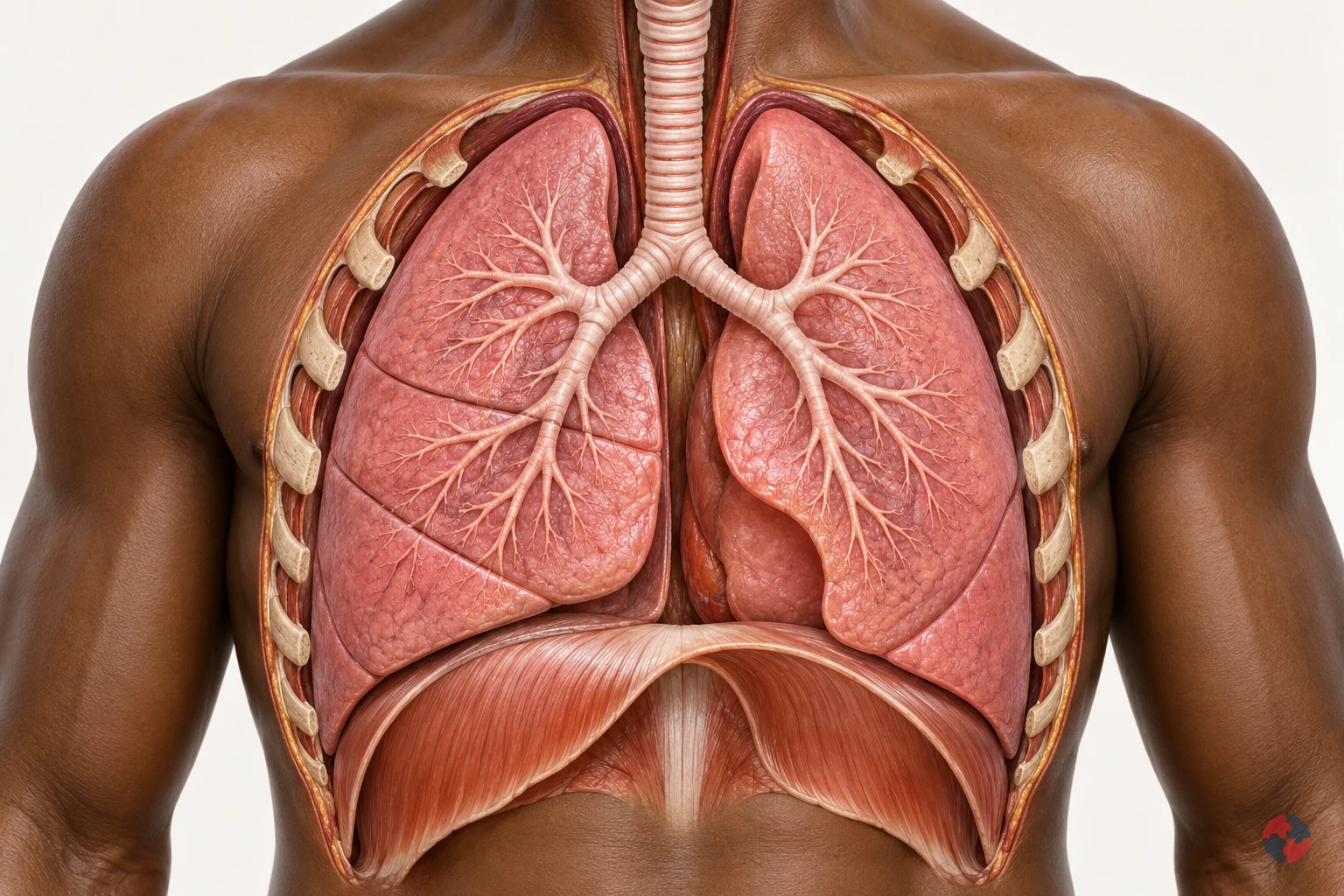
Locate the lungs, branching airways and diaphragm below them. The cutaway reveals structures normally hidden by the chest wall.
Trace the source-to-breathing-zone route in this lesson. Which change would prevent the contaminant reaching the person?
educational illustration · healthy anatomy; enlarged details and teaching colours.
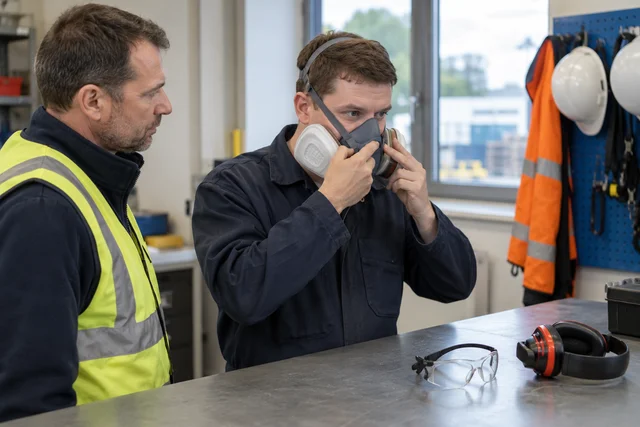
Existing SHAREhub photographic illustration. The written fictional case supplies the condition and decision evidence.
Trace contaminated air to the wearer
Tight-fitting respiratory protective equipment depends on a seal against the individual face. Contaminated air can pass around a poor seal instead of through the intended protection. Movement, speech, stubble or incompatible eye protection can disturb that seal. Harm depends on the substance: irritation may occur quickly, while repeated exposure can contribute to asthma, lung disease or cancer much later. Feeling well during a task does not demonstrate adequate control.
A fit test checks the selected facepiece on a particular wearer. It does not measure workplace exposure or approve the complete task. Start with the actual material and airborne source, people nearby and the assessed controls. Ask what the evidence covers before treating a pass as permission to work.
Applied case
A worker has a fit-test pass but the supervisor cannot identify the material being disturbed or the intended extraction. The team wants to start immediately.
Look beyond the label
A successful seal result answers a wearer-and-facepiece question. It cannot establish the identity of an unknown material, the effectiveness of extraction or the actual exposure during work.
Test your decision
What does the pass establish in this case?
Proof that the workplace exposure has been measured.
The tested seal result, leaving material and task-control questions unresolved.
Approval to disturb any material while wearing that mask.
Compare the explanation
The tested seal result, leaving material and task-control questions unresolved.
The seal is one part of the control chain; it cannot resolve an unidentified hazard or missing task controls.
Photorealistic illustrative UK workplace scene. Review checks: Source / exposure: PPE fails when selection, fit, compatibility, maintenance, behaviour or upstream control decisions are weak. Possible consequence: A filter for particles will not automatically control a solvent vapour, and even the correct respirator fails if the seal is poor. Control failure: Check the hazard route, fit, compatibility and condition before issue; stop the task when the required protection cannot be demonstrated.
Control the source before relying on PPE
PPE protects the person against remaining risk; it does not remove the source. Before selecting a mask, consider avoiding the exposure-producing work, a genuinely safer material or method, and effective enclosure or extraction. Procedures and access arrangements support those controls. RPE may still be needed for residual exposure, but issuing it cannot make a failed engineering control acceptable. Nearby workers and cleaners may remain exposed even when the operator wears a mask.
Judge the whole arrangement during the real task. Check that the assessed source controls are available and being used as intended. If they fail, stop the affected activity safely and obtain review. Counting issued masks is weaker evidence than observing effective capture and correct, compatible equipment use.
Applied case
Extraction has failed during a dusty repair. The store has enough masks for the main operators, so the team proposes continuing while cleaners work nearby.
Look beyond the label
The number of masks issued is an inventory fact. Effective exposure control needs the source, the task, other affected people and the remaining personal protection considered together.
Test your decision
Which response follows the hierarchy?
Stop the affected task and restore or review the required source controls.
Continue because issuing masks restores extraction.
Give only the cleaners a warning and carry on.
Compare the explanation
Stop the affected task and restore or review the required source controls.
PPE does not restore a failed engineering function or establish protection of people around the task.
Existing SHAREhub 2D teaching schematic. Use alongside the explanation and fictional case in this lesson.
Separate suitable protection from a good fit
Selection starts with the substance, its form, exposure conditions and the task. A facepiece must provide the assessed protection and be suitable for the wearer, work and other PPE. A good seal cannot make an unsuitable filter protect against a different contaminant. A particle-filter classification does not establish protection against a gas or vapour. Filtering RPE is unsuitable for oxygen-deficient atmospheres; an awareness learner must not improvise specialist respiratory equipment or entry arrangements.
Use the competent assessment and manufacturer information rather than choosing from a photograph or familiar label. Resolve missing substance or selection information before exposure. The employer should also address whether the person can use the selected equipment safely, with confidential medical advice where needed, without sharing unnecessary health details.
Applied case
A familiar dust task now includes solvent vapour. The team points to a successful face-fit result and assumes the existing particle filter covers the changed exposure.
Look beyond the label
A high fit-test result does not increase a mask protection factor or make a particle filter suitable for vapour. Keep selection evidence distinct from the seal result.
Test your decision
What must the decision address?
Only whether the original test score was high.
Only whether the mask looks clean.
The changed contaminant and complete RPE selection, as well as fit.
Compare the explanation
The changed contaminant and complete RPE selection, as well as fit.
Fit testing concerns the seal; filter suitability and the exposure assessment remain separate requirements.
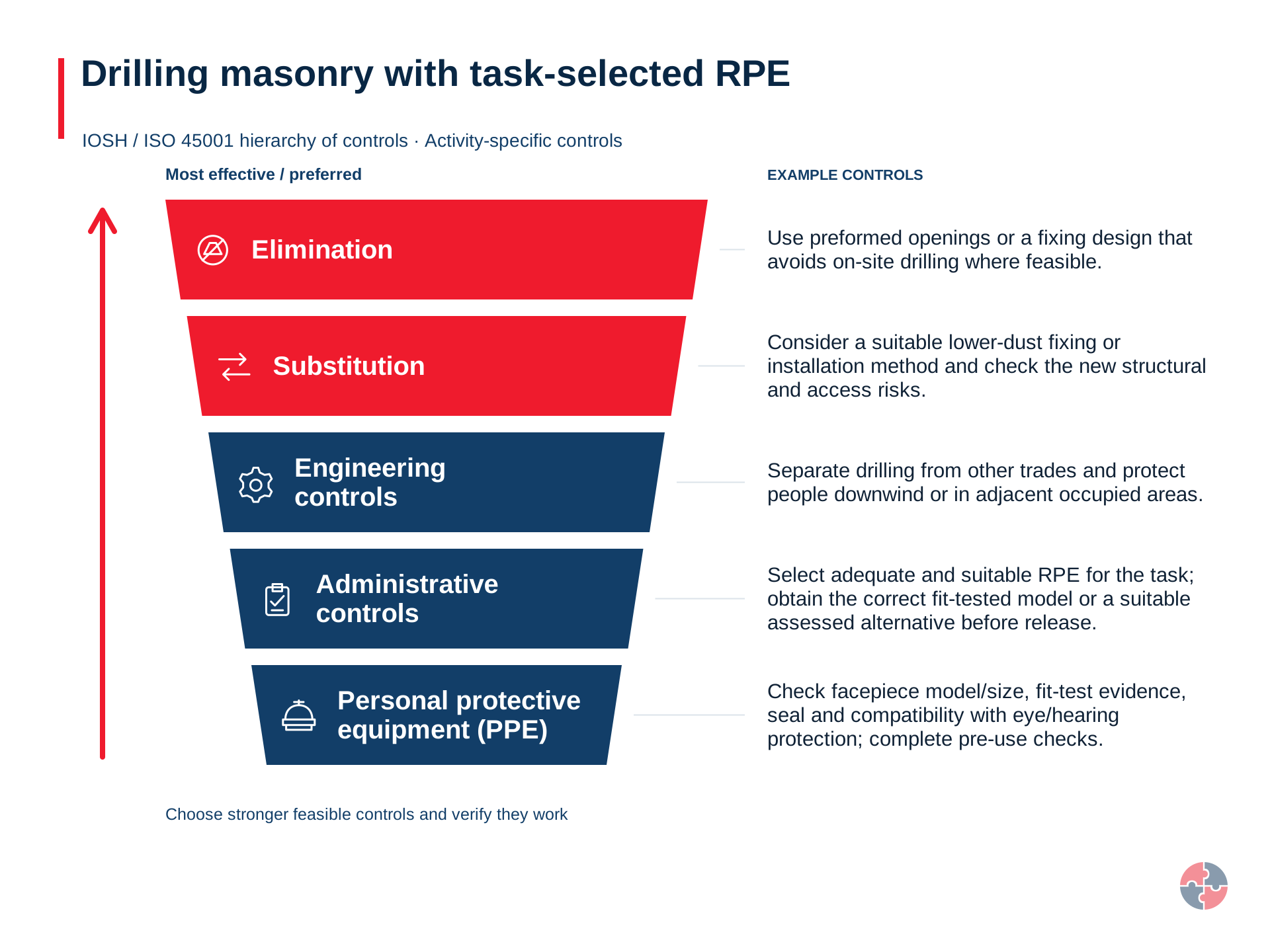
Photorealistic illustrative UK workplace scene. Review checks: Elimination: Use preformed openings or a fixing design that avoids on-site drilling where feasible. Substitution: Consider a suitable lower-dust fixing or installation method and check the new structural and access risks. Engineering controls: Use effective compatible on-tool extraction or an assessed wet method; verify dust control at the drill point and protect adjacent people. Administrative controls: Select adequate and suitable RPE for the task; obtain the correct fit-tested model or a suitable assessed alternative before release. PPE: Check facepiece model/size, fit-test evidence, seal and compatibility with eye/hearing protection; complete pre-use checks.
Match the issued facepiece to its evidence
A usable fit-test record identifies the wearer and the facepiece tested, including its type, make, model and size. Relevant equipment and other PPE information help the supervisor confirm what can actually be issued. A certificate stating only a broad filter class does not establish that another brand or size fits the individual. The controlled record must be available to the people who need to check it without exposing unrelated clinical information.
Compare the physical item with the record before use. Procurement substitutions and new head-worn PPE can change the arrangement. Obtain the tested equipment or a competent selection and fit review for an alternative. Do not turn stock pressure or a generic certificate into evidence that a replacement is suitable.
Applied case
The store issues the same filter class in a different mask size. The record names the original size, and the worker has not been tested in the replacement.
Look beyond the label
Product classification describes part of the equipment. The individual record links the wearer to the facepiece actually tested, which is why seemingly similar stock is not automatically interchangeable.
Test your decision
What should the supervisor do?
Alter the record to match the box.
Hold the substitution pending matching equipment or competent review and fit testing.
Accept any size with the same filter class.
Compare the explanation
Hold the substitution pending matching equipment or competent review and fit testing.
The actual facepiece must match the wearer-specific evidence; changing a record cannot create a seal result.
Existing SHAREhub photographic illustration. The written fictional case supplies the condition and decision evidence.
Use the wearer check every time
Fit testing and a wearer seal check serve different purposes. The fit test assesses the selected tight-fitting facepiece; the seal check helps identify immediate problems each time it is put on. Follow the manufacturer instructions in a safe area, inspect the equipment, check seal-area hair and add compatible PPE. A generic pressure manoeuvre may not suit every design. Neither a quick check nor a colleague saying it looks right replaces the fit test.
During exposure, keep the protection in position. If it slips, leaks, becomes damaged, breathing becomes difficult or the wearer feels unwell, leave by the planned safe route and report the problem. Do not lift the facepiece to speak or attempt a repair inside the contaminated area.
Applied case
A worker completed fit testing earlier, but new goggles disturb the mask during the pre-use check. A colleague suggests tightening it repeatedly and entering the work area.
Look beyond the label
A daily wearer check tests present readiness; a fit test establishes a different evidence point. Both matter, and neither justifies entering with an unresolved leak or incompatible PPE.
Test your decision
What is the appropriate decision?
Resolve the fit and compatibility problem before exposure.
Rely on the earlier pass despite the present leak.
Check it for the first time inside the contaminated area.
Compare the explanation
Resolve the fit and compatibility problem before exposure.
A previous result does not override a current seal or compatibility problem.
Photorealistic illustrative UK workplace scene. Review checks: Setting: the site team needs to drill identified masonry for fixings in an enclosed refurbishment room. Act: Avoid on-site drilling where practicable, then choose the assessed source control and restrict access. Hold / review: Hold for unknown material, missing selection information, unverified fit, incompatible PPE or a failed seal check.
Report changes and verify safe return
Fit evidence needs review when the facepiece changes, the wearer changes physically or there is reason to doubt fit. Relevant changes can include facial injury, dental changes, weight change or new head-worn PPE. There is no universal expiry interval that settles every case. The RPE programme should set a risk-based review arrangement and respond to changes before a diary date where necessary. Users should know how to report discomfort, defects and unavailable stock.
After use, follow contamination-control arrangements, clean and store reusable equipment as instructed, dispose of single-use items correctly and keep defects out of circulation. Restart follows confirmation that task controls, selection, fit and equipment condition are restored. A new appointment booking alone does not make an unresolved exposure task ready.
Applied case
A wearer reports changed fit after dental work while the recorded review date is months away. The supervisor must decide whether the unchanged diary entry is sufficient.
Look beyond the label
Review is driven by conditions as well as dates. A booked test is an action in progress, while restored and verified protection is the evidence needed for the affected task.
Test your decision
What should trigger action?
Only arrival of the planned review date.
A decision by the wearer to accept the leak.
The reported change and doubt about fit, regardless of the future diary date.
Compare the explanation
The reported change and doubt about fit, regardless of the future diary date.
Changed circumstances can require review before a scheduled date; unresolved fit must not be accepted as protection.

 View full detail ↗