Focused awareness learning based on SHAREhub pages. Apply the actual workplace arrangements and your role; completion is not practical competence or permission for specialist work.
This reader supplies the complete teaching. Use the interactive LMS course for assessed activities, saved progress and completion.
LESSON 1
Understand the harm and the exposure
Recognise cumulative exposure and separate peak concerns.
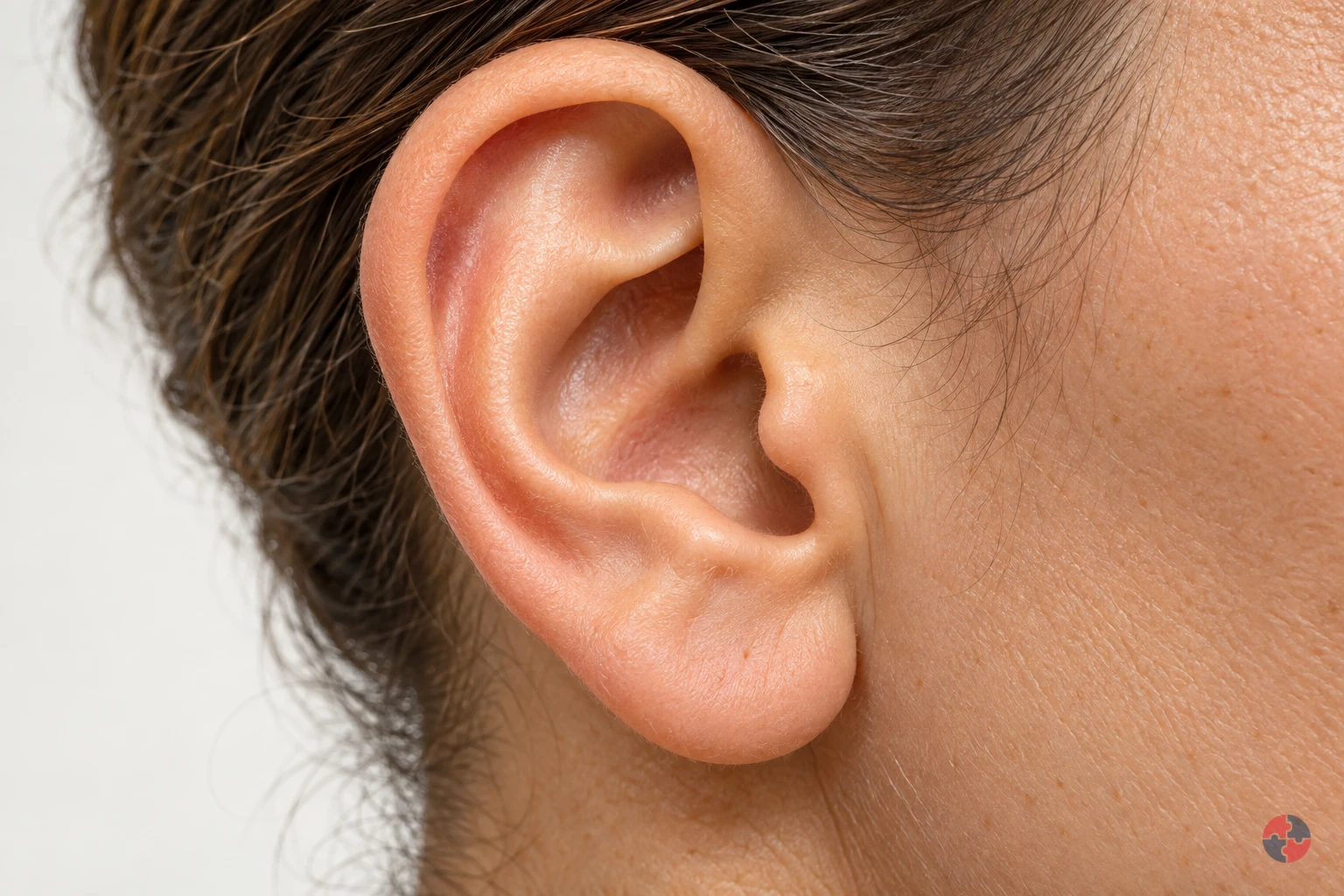
Locate the visible outer ear before considering the hearing pathway and the lesson’s noise-control decisions.
Locate the outer ear, then connect the lesson to the hearing pathway. What would reduce noise exposure at source?
educational illustration · healthy anatomy; enlarged details and teaching colours.
Existing SHAREhub photographic illustration. The written fictional case supplies the condition and decision evidence.
Understand the harm and the exposure
Noise exposure can damage hearing and cause tinnitus; harm may develop gradually and may be irreversible. Loud noise can also interfere with speech and warning signals. The relevant question is what reaches people during their actual work, including the surrounding tasks and operating conditions.
A sound level at one instant is not the same as a person’s daily exposure. Duration and contributions from different tasks matter, while a high peak needs separate consideration. Decibels are not combined by a simple arithmetic average. This awareness course supplies no exposure calculation or safe listening prescription. It explains why a competent assessment must use the correct quantities and representative information rather than declare safety from a quiet moment or a worker’s familiarity with the sound.
Applied case
The press is quiet during a short inspection pause. The manager treats that reading as proof that full production, impact work and overtime create no hearing risk.
Familiar is not harmless
People can become accustomed to a workplace sound without its exposure becoming safe. Subjective tolerance is not a substitute for representative assessment and appropriate controls.
Test your decision
What does the reading fail to represent?
The person’s actual task exposure and separate peak concerns during operation.
Only the inspector’s hearing preference.
Nothing because one quiet reading describes every shift.
Compare the explanation
The person’s actual task exposure and separate peak concerns during operation.
Representative operating conditions and correct exposure quantities are necessary.
Identify representative data, durations and uncertainty.
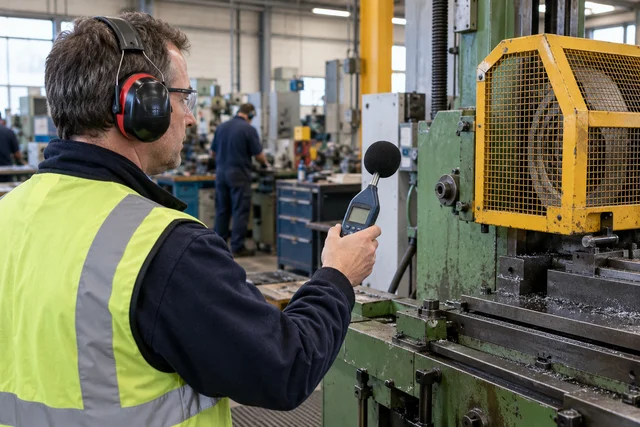
Photorealistic illustrative UK workplace scene. Review checks: Source / exposure: A-weighting is used for daily or weekly exposure, C-weighting for peak sound pressure, and L_EX,8h is an energy-equivalent daily exposure. Possible consequence: For equal-duration tasks, an 88 dB(A) task contributes twice the sound energy of an 85 dB(A) task. Control failure: An illustrative eight-hour day with four hours at 88 dB(A) and four at 82 dB(A) is about 86.0 dB(A); this is a teaching estimate, not a site measurement.
Map the real working day
A noise assessment maps the tasks, people, operating modes and time exposed. Include overtime, intermittent impact tasks, nearby machinery and foreseeable variation. Measurements and other reliable information should represent the actual installed work, not only the quietest shift or a manufacturer’s emission figure.
Record relevant conditions and uncertainty so the responsible person can understand what the result supports. A changed production rate, material, tool or enclosure position can make old data unrepresentative. Where uncertainty could change the required control decision, improve the evidence and use suitable protective arrangements while it is resolved. Competent assessors interpret daily exposure and peaks. Workers contribute accurate task information; they should not be asked to convert a phone reading or average of decibels into an approval.
Applied case
The old survey covered occasional press use with the enclosure closed. Production now doubles the cycles and operators leave an access panel open during normal work.
Emission is not personal exposure
Supplier information can help compare equipment. It is not automatically the exposure of a worker using installed machinery alongside other tasks, durations and sources.
Test your decision
What should the assessment review?
Only whether the old report has a signature.
A simple average of unrelated sound readings.
Current duty, operating mode, enclosure use, durations and exposure evidence.
Compare the explanation
Current duty, operating mode, enclosure use, durations and exposure evidence.
Changed work can invalidate the assumptions behind previous measurements.
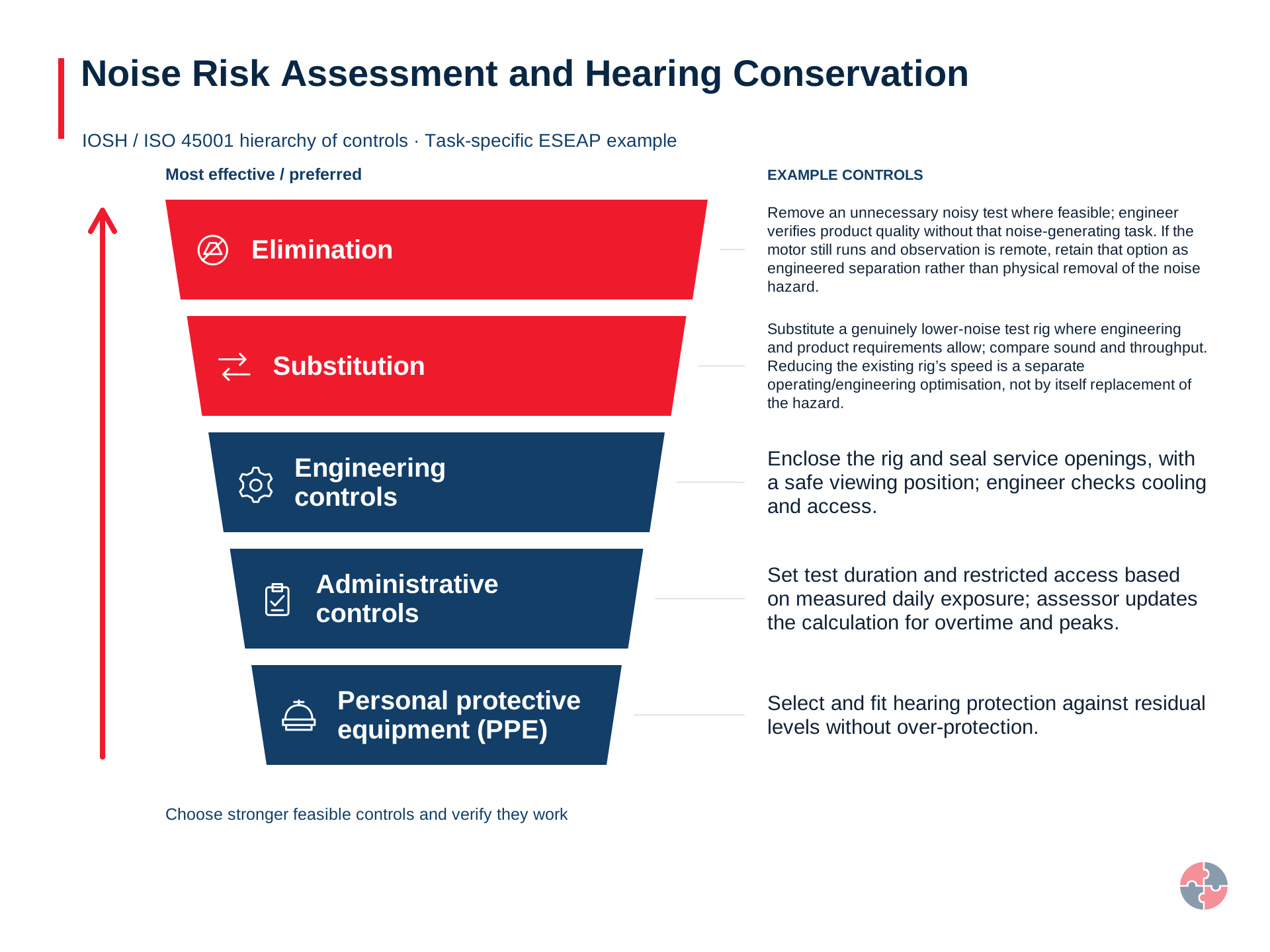
Choose quieter methods and engineering before PPE reliance.
Existing SHAREhub 2D teaching schematic. Use alongside the explanation and fictional case in this lesson.
Reduce noise at its source
First consider avoiding the noisy operation or choosing a quieter effective method or machine. Engineering measures may reduce vibration and transmission, enclose a source or separate people from it. Maintenance can prevent deterioration that increases noise. The best option depends on the actual machine, task and other safety requirements.
Administrative limits and hearing protection address remaining exposure but should not become a reason to leave practicable source reduction undone. An enclosure must work during the operating state people actually use, without defeating guarding or introducing another hazard. Give improvements a responsible owner and a meaningful acceptance check. Workers should report missing panels, damaged seals or unusual noise rather than assume the original purchase specification remains valid throughout the equipment’s life.
Applied case
The press enclosure is effective only while fully closed, but the production method routinely leaves a panel open. Management proposes larger hearing-protection signs instead of reviewing that interface.
Installed does not mean effective
An enclosure’s presence is one fact. Its condition, access configuration and use under representative load determine whether it delivers the intended reduction for people.
Test your decision
What needs priority?
A rule that PPE removes the need for engineering review.
A workable source-control and operating arrangement verified during actual production.
Only a larger sign beside the open panel.
Compare the explanation
A workable source-control and operating arrangement verified during actual production.
Controls must function during real work and remain compatible with other safety requirements.
Recognise fit, compatibility and overprotection concerns.
Photorealistic illustrative UK workplace scene. Review checks: Eliminate: Design the test so a worker no longer attends beside a running motor; engineer verifies remote observation covers the quality task. Substitution: Choose a lower-noise test rig or process speed if engineering and product requirements allow; compare both sound and throughput. Engineering: Enclose the rig and seal service openings, with a safe viewing position; engineer checks cooling and access. Administrative: Set test duration and restricted access based on measured daily exposure; assessor updates the calculation for overtime and peaks. PPE plus upkeep: Select and fit hearing protection against residual levels without over-protection.
Select and wear protection properly
Hearing protection needs to suit the assessed noise and task, fit the wearer and work with other equipment. A rating on a box is not the reduction necessarily achieved in use. Glasses, hair, poor insertion, damaged seals or incompatible head protection can undermine the fit.
More attenuation is not automatically better. Excessive protection may interfere with speech or warning detection, so selection must consider communication and the actual spectrum and task. Use the organisation’s suitable selection, fitting, training and replacement arrangements rather than improvise from this course. Keep required protection and zones while source changes are verified. Report discomfort or interference early so a workable alternative can be assessed; removing protection in a noisy area to solve a communication problem is not an acceptable unassessed workaround.
Applied case
The new earmuffs press against thick safety-glasses arms and do not seal consistently. The purchaser dismisses this because the advertised rating is higher than the previous model.
Protection needs a complete combination
Check the equipment as worn together during the task. Improving one item can undermine another, so selection and fitting should assess the whole relevant PPE arrangement.
Test your decision
What needs assessment?
Actual fit and compatibility with the wearer’s other PPE and communication needs.
Only the largest rating on the box.
An instruction to remove eye protection without review.
Compare the explanation
Actual fit and compatibility with the wearer’s other PPE and communication needs.
Nominal attenuation does not establish protection in the actual combination.
Separate clinical assessment from source-control verification.
Existing SHAREhub photographic illustration. The written fictional case supplies the condition and decision evidence.
Use hearing surveillance as a complement
Hearing surveillance may be indicated by the actual exposure and risk. A competent occupational-health programme determines appropriate checks and follow-up. Workers should report hearing concerns and receive appropriate advice; managers should not diagnose the cause from a conversation or survey.
A change in hearing findings should prompt exposure and control review alongside the health route, not automatic blame of the worker. Keep clinical records confidential and use the appropriate work-focused advice. A favourable hearing check does not approve continuing uncontrolled noise, just as an engineering repair does not decide a person’s clinical condition. The programme supports prevention by identifying possible harm and the need for action; it does not restore hearing or replace source reduction, suitable protection and reliable exposure evidence.
Applied case
A worker reports new ringing after work. The supervisor says the last hearing check was satisfactory, so neither occupational-health advice nor review of the changed press duty is needed.
A health result is not approval
Surveillance provides information within a clinical programme. It cannot establish that a new production method is controlled or substitute for checking source improvements and exposure.
Test your decision
What is appropriate?
Treat the old check as a permanent guarantee.
Blame the worker before reviewing the arrangement.
Use the health-support route and review current exposure and controls without diagnosing or dismissing the concern.
Compare the explanation
Use the health-support route and review current exposure and controls without diagnosing or dismissing the concern.
New concerns need appropriate attention; surveillance complements rather than replaces prevention.
Keep ownership and evidence aligned before relaxing controls.
Photorealistic illustrative UK workplace scene. Review checks: Situation: A fictional press shop measures the installed line at load, calculates day and peak exposure, then verifies an enclosure and hearing programme. Decision: Before: old measurements cover one press but the new schedule doubles stroke frequency. Follow through: During: the assessor samples press cycles and positions; the engineer tests enclosure seals, and the supervisor logs time near the machine.
Verify change under representative conditions
Before and after a noise improvement, define the relevant load, equipment state, people and task duration. A lower reading taken while production is stopped is not comparable evidence for an enclosure tested under load. Installation acceptance and personal exposure assessment are different technical questions, each requiring suitable competence.
Keep interim protection and access arrangements until the responsible decision is supported. Record remaining uncertainty and review triggers such as changed dies, cycles, panels, maintenance or health concerns. The optional exercise compares a fictional press-shop proposal with the actual operating day and identifies verification needs. It does not measure real exposure, select a universal protector or authorise unrestricted work. The goal is to know what evidence to ask for and when a favourable claim exceeds its scope.
Applied case
The supplier demonstrates the enclosure with the press idle and requests immediate removal of the hearing-protection zone. Normal load, open access and overtime have not been reassessed.
Keep comparisons comparable
A before-and-after difference can reflect load, position or task changes. Establish comparable relevant conditions before attributing the result to an engineering improvement.
Test your decision
What should govern the decision?
The installer’s invoice as personal exposure evidence.
Representative verified exposure and the responsible assessment, with interim controls retained while unresolved.
The quiet idle demonstration alone.
Compare the explanation
Representative verified exposure and the responsible assessment, with interim controls retained while unresolved.
Verify the purpose of the improvement under the conditions it must control.

 View full detail ↗