Focused awareness learning based on SHAREhub pages. Apply the actual workplace arrangements and your role; completion is not practical competence or permission for specialist work.
This reader supplies the complete teaching. Use the interactive LMS course for assessed activities, saved progress and completion.
LESSON 1
Know what the task releases
Distinguish silica from other construction dust and legacy hazards.
Existing SHAREhub photographic illustration. The written fictional case supplies the condition and decision evidence.
Know what the task releases
Construction work can release different dusts from concrete, stone, timber, plasterboard and other materials. Fine particles may reach deep into the lungs even when the air looks clear. Material, particle size, task energy, duration and enclosure influence exposure and harm; the word “dust” alone is not an adequate hazard description.
Concrete and some stone work can release respirable crystalline silica. Timber creates wood dust, while older refurbishment can disturb asbestos, lead coatings or other contaminants requiring separate assessment. Do not assume the same mask and vacuum suit every material. Identify what will be disturbed before cutting or sanding. Unknown material is a reason to hold and seek suitable information, rather than start work and decide the hazard from the cloud that appears.
Applied case
The crew describes every airborne contaminant as ordinary building dust. It proposes one control sheet for concrete cutting, timber sanding and an unidentified old ceiling coating.
A clear view can mislead
Fine harmful dust can remain airborne without an obvious cloud. Visibility is a useful warning when dust escapes, but absence of haze does not demonstrate adequate exposure control.
Test your decision
What should be resolved first?
A universal mask and vacuum for every material.
The actual materials and tasks, including any separate legacy-hazard assessment.
Only whether a cloud is visible.
Compare the explanation
The actual materials and tasks, including any separate legacy-hazard assessment.
Dust type and generation mechanism determine the appropriate assessment and control.
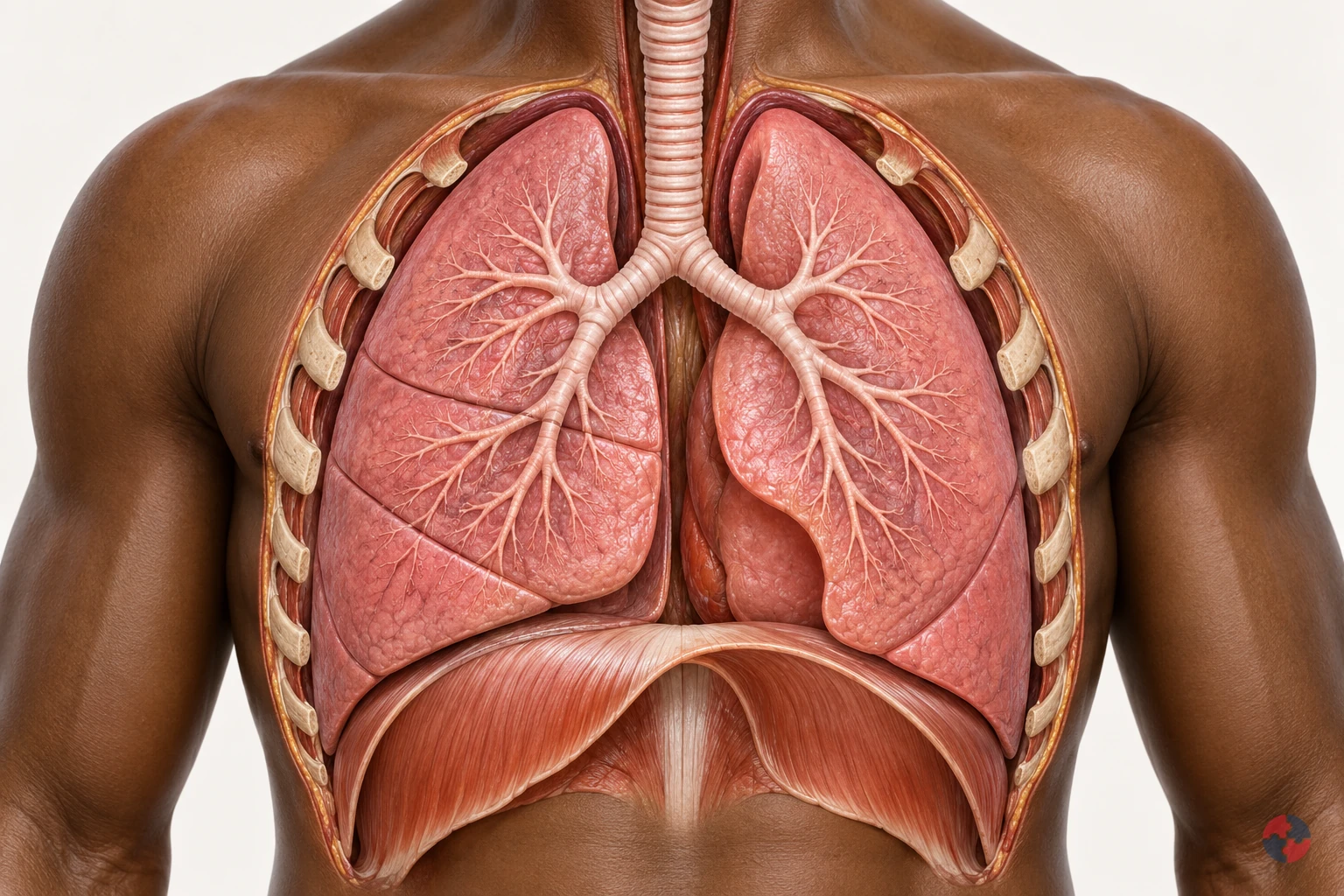
Locate the lungs, branching airways and diaphragm below them. The cutaway reveals structures normally hidden by the chest wall.
Trace the source-to-breathing-zone route in this lesson. Which change would prevent the contaminant reaching the person?
educational illustration · healthy anatomy; enlarged details and teaching colours.
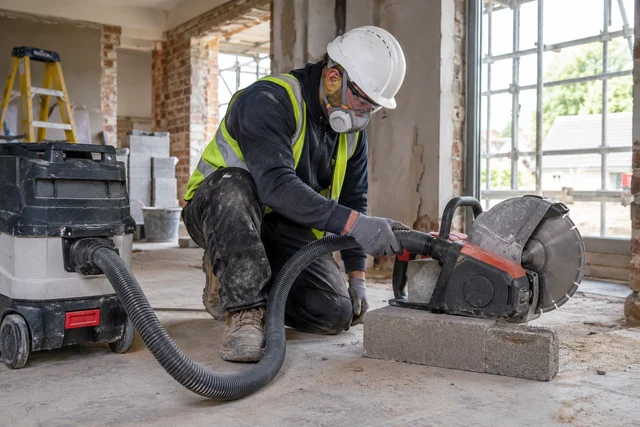
Photorealistic illustrative UK workplace scene. Review checks: Source / exposure: Silica control usually fails through poor planning, unsuitable tools, weak RPE control, dry cleaning or failure to protect nearby people.
Understand the silica harm route
Respirable crystalline silica is the fine airborne fraction that can be generated when silica-containing materials are cut, drilled, ground, polished or broken. Materials include concrete, mortar, brick and stone. Inhalation can cause serious disease including irreversible silicosis, chronic obstructive pulmonary disease and lung cancer.
Risk depends on the material and the actual operation, not only a percentage or task name. A brief high-energy indoor task can create significant exposure, and outdoor work is not automatically safe. People nearby may inhale dust without operating the tool. Prevent release where possible and control what remains at source. This awareness course does not calculate an individual dose, diagnose disease or identify a harmless amount of visible dust; it explains why planning and verified controls matter before symptoms occur.
Applied case
The crew calls the remaining indoor cuts too brief to need the planned controls. Another trade stands nearby and assumes only the tool operator can inhale silica dust.
The material name is not enough
A lower-silica product can still create harmful dust under energetic, prolonged or enclosed work. Assess the actual operation and all relevant contaminants rather than infer safety from a name.
Test your decision
What is the correction?
Short tasks and bystanders can still face harmful exposure; control the actual release and people affected.
Only full-shift operators can be exposed.
Outdoor or brief work is automatically safe.
Compare the explanation
Short tasks and bystanders can still face harmful exposure; control the actual release and people affected.
Task energy, setting and spread matter alongside duration.
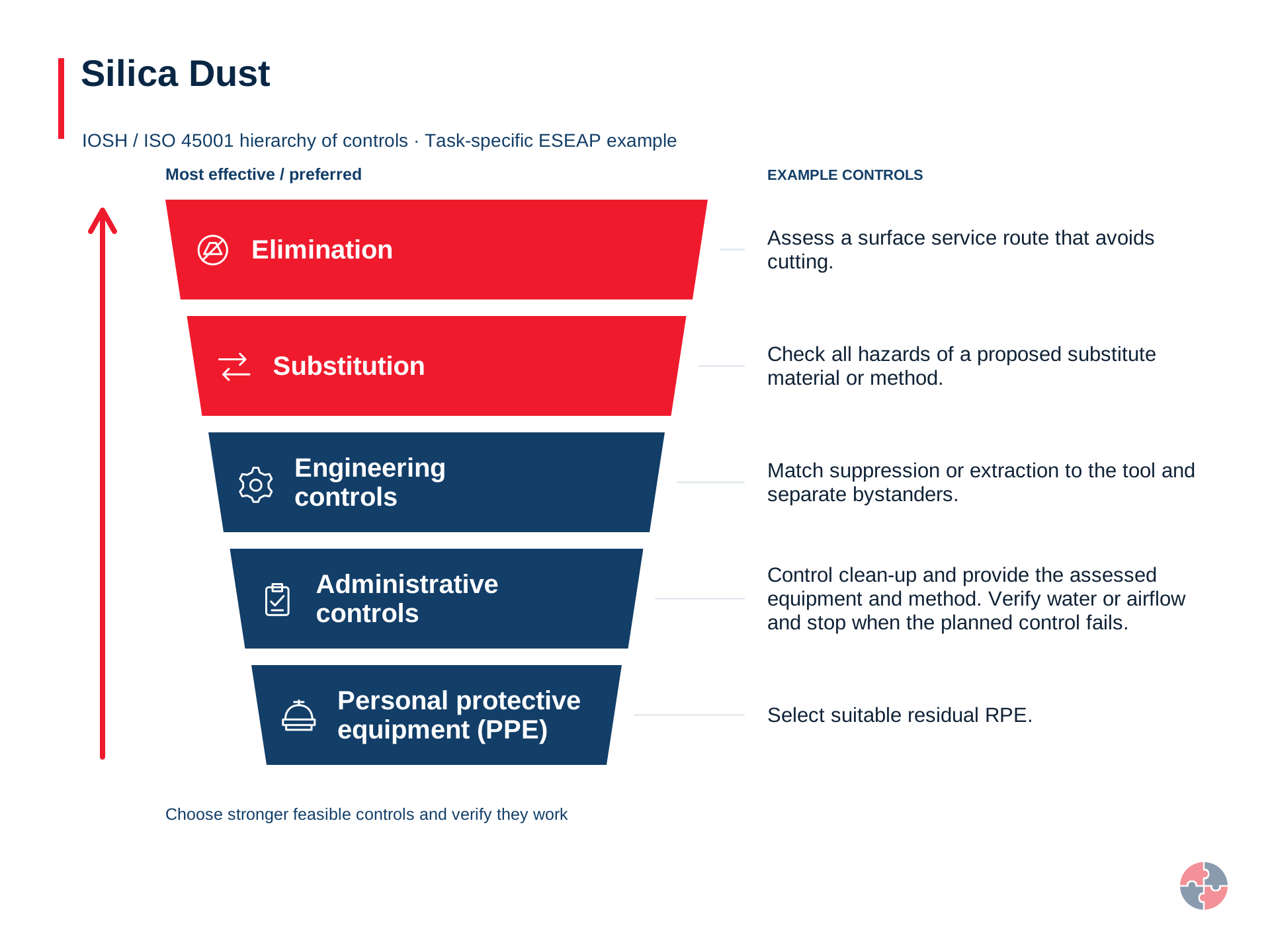
Existing SHAREhub 2D teaching schematic. Use alongside the explanation and fictional case in this lesson.
Avoid or reduce generation first
Before arranging a cut, ask whether it is necessary. A different service route, pre-sized component or off-site preparation may avoid or reduce dust generation. Evaluate a substitute method for all its hazards rather than assume a lower-silica choice creates harmless dust. Source prevention is stronger than asking people to breathe through protection around an uncontrolled release.
Where dusty work remains necessary, plan effective capture or suppression matched to the tool, material and environment. Keep other people away through suitable sequencing and segregation. Select residual respiratory protection from the assessment and wearer needs; it does not replace source controls. Provide the equipment and practical arrangements before work begins. A plan that requires an unavailable vacuum or impossible water supply is not ready merely because the method statement mentions it.
Applied case
The designer can route the service through an existing void, avoiding most concrete cuts. The supervisor dismisses this because disposable masks are already in the stores cupboard.
A method needs equipment
A written extraction requirement is not a functioning control. Check suitable tool connections, supply, upkeep and how the arrangement will be used in the actual work area.
Test your decision
Which option deserves priority?
Choose masks first and ignore feasible design changes.
Assume every alternative material has no dust hazard.
Evaluate the avoidance route before accepting unnecessary dust generation and PPE reliance.
Compare the explanation
Evaluate the avoidance route before accepting unnecessary dust generation and PPE reliance.
Reduce generation at source and check the actual consequences of any alternative.
Recognise incompatible or failed controls as hold points.
Photorealistic illustrative UK workplace scene. Review checks: Eliminate: Assess a surface service route that avoids cutting. Reduce: Check all hazards of a proposed substitute material or method. Isolate: Match suppression or extraction to the tool and separate bystanders. Control: Control clean-up and provide the assessed equipment and method. PPE: Select suitable residual RPE.
Check capture, suppression and wearer fit
The task assessment needs the material, tool, duration, enclosure, people exposed and proposed control. Extraction must work with the tool and capture arrangement; water suppression must be suitable and available. Filters, shrouds, airflow and the changing work position can affect performance. A nearby running vacuum is not proof of capture.
Where respiratory protective equipment is required, it needs suitable protection, compatibility and correct use. Tight-fitting equipment needs face-fit testing for the wearer and an effective seal; facial hair in the sealing area can defeat that seal. Do not improvise a different respirator or filter to compensate for failed source control. Stop the affected method for failed extraction, lost suppression or uncontrolled dust and obtain restoration or a competently assessed alternative.
Applied case
The crew’s vacuum runs but cannot connect to the cutting shroud. When water fails, the supervisor proposes finishing dry because only a few cuts remain and masks are available.
Fit testing is not the whole control
A successful fit test concerns a particular tight-fitting respirator and wearer. It does not prove source capture, filter suitability, daily seal or protection of nearby people.
Test your decision
What is the appropriate decision?
Treat the remaining number of cuts as proof of safety.
Hold the affected cutting until effective source control or a competently assessed alternative is ready.
Continue because a running vacuum is somewhere nearby.
Compare the explanation
Hold the affected cutting until effective source control or a competently assessed alternative is ready.
Required capture or suppression must work; PPE and short duration do not repair its failure.
Include spread, waste and hand-back in the original method.
Existing SHAREhub photographic illustration. The written fictional case supplies the condition and decision evidence.
Prevent secondary exposure at cleanup
Dust can be released again during cleaning and spread through clothing, equipment, routes and adjacent work. Plan cleanup before starting so a controlled cut is not followed by an uncontrolled sweep. Use a suitable vacuum or wet method for the assessed material rather than dry sweeping fine hazardous dust.
Protect nearby workers and public areas, maintain segregation and control slurry or waste through the planned route. Avoid moving dusty contamination into vehicles or welfare spaces. Check the area and resolve remaining defects before releasing access through the responsible arrangement. Do not equate a tidy floor with verified airborne exposure control. Unknown old material needs its own assessment and response; a general construction dust method does not authorise cleaning suspected asbestos or other specialist contamination.
Applied case
The crew plans to dry sweep settled concrete dust while the adjoining trade returns. The cutting had been controlled earlier, so cleanup is treated as an ordinary housekeeping task.
Cleanup is part of the exposure
Settled dust can become airborne again. Assess the entire task through waste and access hand-back instead of ending the control plan when the cutting tool stops.
Test your decision
What needs changing?
A suitable assessed cleanup method and protection of others through hand-back.
Only the appearance of the finished floor.
Nothing because the cutting itself used controls.
Compare the explanation
A suitable assessed cleanup method and protection of others through hand-back.
Secondary release can undo earlier control and expose people who never used the tool.
Separate equipment checks, monitoring and health support.
Photorealistic illustrative UK workplace scene. Review checks: Setting: A contractor cuts a service chase into a concrete wall in an occupied refurbishment site; cutting can release invisible RCS into the room. Act: Consider a surface route or off-site prefabrication. Hold / review: Stop for failed extraction, dry sweeping, visible escape, unknown material, unprotected bystanders or RPE not fit for the wearer.
Verify exposure control and respond to concerns
Workface checks help confirm that the planned equipment and segregation operate as intended. Exposure assessment or monitoring may be needed where control effectiveness is uncertain; a competent person selects and interprets the evidence. An exposure limit is not a target for deliberately dusty work or a guarantee of no harm.
Health surveillance, where indicated by the actual risk, complements prevention rather than permits exposure. Workers should report relevant symptoms or failed controls through the established routes without self-diagnosis. Protect personal clinical information and use suitable occupational-health advice. The optional exercise follows a fictional concrete channel from design to cleanup. It identifies control readiness, stop triggers and verification questions without approving a real dust plan, selecting a universal respirator or claiming specialist competence.
Applied case
The crew records that the vacuum was switched on and declares exposure compliant without representative evidence. A worker’s breathing concern is dismissed because the floor looks clean.
Different evidence answers different questions
A shroud check, exposure sample and health review have different purposes. Use them together where needed without treating any one as blanket approval for uncontrolled dust.
Test your decision
What is the sound response?
Treat a power light as a personal exposure measurement.
Use visible cleanliness as a clinical diagnosis.
Review actual controls and suitable exposure evidence, and route the health concern for appropriate support.
Compare the explanation
Review actual controls and suitable exposure evidence, and route the health concern for appropriate support.
Equipment state, exposure and health questions need relevant evidence and competent roles.