Focused awareness learning based on SHAREhub pages. Apply the actual workplace arrangements and your role; completion is not practical competence or permission for specialist work.
This reader supplies the complete teaching. Use the interactive LMS course for assessed activities, saved progress and completion.
LESSON 1
Look at the work design
Distinguish organisational prevention from wellbeing promotion.
Existing SHAREhub photographic illustration. The written fictional case supplies the condition and decision evidence.
Look at the work design
Mental wellbeing is affected by how work supports manageable demands, control, connection, dignity and useful support. A newsletter, exercise session or assistance programme may help, but it cannot compensate for harmful workload, hostile relationships or unclear change. Start by asking what the work makes difficult.
Use worker feedback and the actual job to identify barriers rather than expect positivity. HSE’s work-design factors include demands, control, support, relationships, role and change. They organise risk questions, not a clinical test of a person. Repeated concerns across a team need assessment and action on their causes. An individual conversation is useful evidence but does not discharge the organisation’s responsibility to assess and control work-related risk. Keep prevention and access to appropriate individual support connected.
Applied case
The administration team receives wellbeing emails while new work arrives without priorities or manager availability. Staff say the campaign gives them no practical way to manage conflicting requests.
Support is more than a perk
A helpful programme can complement prevention. Its presence does not establish that workload, relationships or role conflicts have been assessed or made manageable.
Test your decision
What should be addressed?
A diagnosis assigned to the whole team.
The workload, priorities and support arrangement as well as offering appropriate individual support.
Only whether people express enough gratitude for the newsletter.
Compare the explanation
The workload, priorities and support arrangement as well as offering appropriate individual support.
Promotion cannot replace changing harmful or unmanageable work conditions.
Recognise a reason to check in while respecting uncertainty.
Photorealistic illustrative UK workplace scene. Review checks: Exposure route 1: Unmanageable workload, low control or repeated missed breaks Sustained work pressure can disturb sleep and concentration and contribute to work-related stress or worsening mental health. Bullying, threats or hostile public contact: Repeated unwanted behaviour or violence can cause distress, anxiety or trauma; an acute threat can cause immediate physical injury. Lone or night work with no reliable response route: A crisis or impaired safe function may go unrecognised when contact, location or handover is unclear.
Use observations without diagnosis
Changes such as withdrawal, errors, irritability, absence or fatigue can prompt a respectful check-in. They are not proof of a mental-health condition, misconduct or a private cause. Describe the observation and work effect without guessing about a diagnosis, medication or home life.
Offer a conversation and another appropriate contact if the worker does not want to speak with that manager. Focus on what the person wants to discuss and what work support could help. Do not require intimate disclosure before considering a practical change. A worker can need support without a diagnostic label, while a person with a known condition should not be assumed unable to work safely. Questions about clinical fitness or treatment belong with suitable professionals rather than an informal manager judgement.
Applied case
The worker has stopped contributing in meetings after priorities became unclear. A colleague tells the manager this proves depression and recommends asking for medical details in the team call.
A signal has several explanations
Quietness or errors may reflect many circumstances. Keep the observation factual, ask about work barriers and route clinical questions to appropriate professionals instead of filling uncertainty with labels.
Test your decision
What is a better starting point?
Offer a private check-in about the observed work change and support, without diagnosing or demanding disclosure.
Announce the guessed diagnosis to explain the silence.
Treat the observation as proof of misconduct.
Compare the explanation
Offer a private check-in about the observed work change and support, without diagnosing or demanding disclosure.
An observation is a prompt for respectful inquiry and work review, not a clinical conclusion.
Explain purpose, choices and information limits before listening.
Existing SHAREhub 2D teaching schematic. Use alongside the explanation and fictional case in this lesson.
Prepare a clear private conversation
Choose a private time and explain why the discussion is being offered. Ask open questions about work demands, support, priorities and possible changes. Listen without treating the conversation as counselling or requiring a detailed personal history. The worker may prefer another suitable contact or support route.
Be transparent about what will be recorded, who needs access and when a safety concern may require escalation. Do not promise absolute secrecy or invent a legal basis for disclosure. If a formal performance, grievance or safeguarding process is needed, explain that distinct route rather than disguise it as a supportive check-in. A clear purpose gives the worker a fair understanding of the discussion and helps the manager stay within authority while still addressing practical work concerns.
Applied case
The manager invites a private wellbeing discussion but plans to issue a formal performance warning without telling the worker. They also promise that nothing said can ever be shared.
Privacy is not an absolute promise
Explain the minimum action record and appropriate access. Immediate safety may require a suitable handover, while personal health information needs the organisation’s competent privacy and support processes.
Test your decision
What should change?
Use the wellbeing label to collect undisclosed disciplinary evidence.
Promise unlimited secrecy regardless of immediate safety.
Be honest about purpose, separate formal processes and explain proportionate confidentiality limits.
Compare the explanation
Be honest about purpose, separate formal processes and explain proportionate confidentiality limits.
Supportive conversations need transparent boundaries and fair handling of information.
Turn listening into an owned and reviewed improvement.
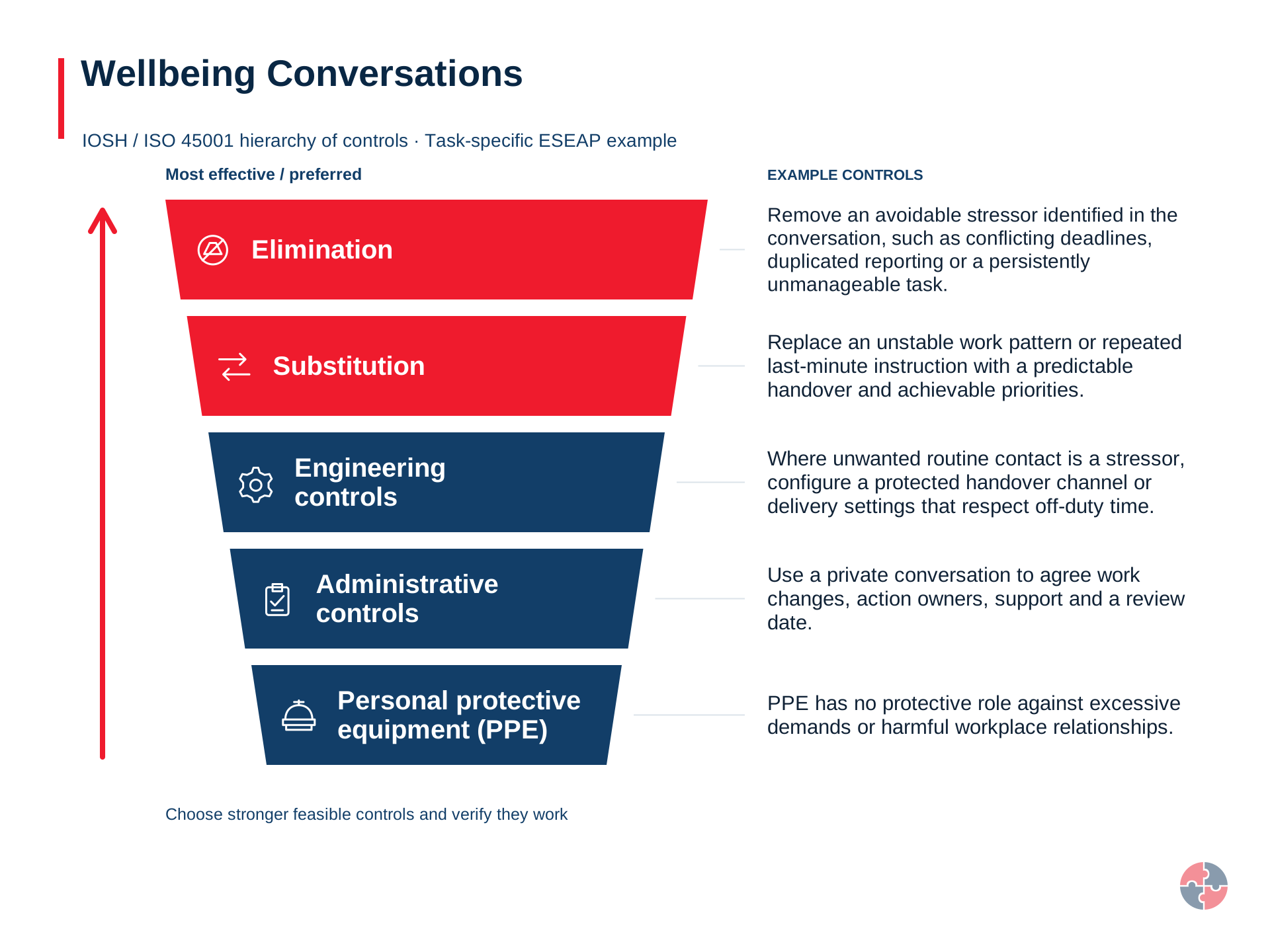
Photorealistic illustrative UK workplace scene. Review checks: Elimination: Remove an avoidable stressor identified in the conversation, such as conflicting deadlines, duplicated reporting or a persistently unmanageable task. Substitution: Replace an unstable work pattern or repeated last-minute instruction with a predictable handover and achievable priorities. Engineering controls: Where unwanted routine contact is a stressor, configure a protected handover channel or delivery settings that respect off-duty time. Administrative controls: Use a private conversation to agree work changes, action owners, support and a review date. PPE: PPE has no protective role against excessive demands or harmful workplace relationships.
Agree practical work changes
Ask which work barriers and support options matter to the person. A clearer priority rule, changed workload, regular contact, suitable equipment or a different support arrangement may help. Consider effects on safety and colleagues, and obtain competent advice where the decision exceeds the manager’s role.
Agree proportionate actions, an owner and a review point. Record the work change rather than unnecessary clinical detail. Needs may fluctuate, so check the result after normal work resumes and adapt where appropriate. Do not promise an outcome the manager cannot deliver or assume one adjustment resolves every concern. Where legal disability or complex employment questions arise, use the applicable competent route; this awareness course does not determine that status. Practical support and assessment of team-level work risks may both be necessary.
Applied case
The worker asks for clearer priorities and a regular manager check-in. The manager offers only a counselling leaflet and closes the issue without discussing any change to conflicting work demands.
An action needs a result
Record what will change, who will make it happen and when its usefulness will be reviewed. A referral or promise does not establish that the work barrier has changed.
Test your decision
What would improve the response?
Require a diagnosis before clarifying priorities.
Agree feasible work actions with ownership and review alongside suitable support options.
Treat a referral leaflet as proof the work problem is resolved.
Compare the explanation
Agree feasible work actions with ownership and review alongside suitable support options.
Listening should lead to practical work decisions within authority, not only signposting.
Distinguish support, work-risk, formal and immediate-safety decisions.
Existing SHAREhub photographic illustration. The written fictional case supplies the condition and decision evidence.
Use the right escalation route
Some concerns need specialist or formal help as well as a work-focused conversation. Repeated pressure may need a stress risk assessment; bullying allegations need the proper impartial route; clinical questions may need occupational-health or other professional support. Do not make the manager the sole expert for every issue.
If immediate safety cannot be maintained, use the local emergency response and suitable urgent help rather than continue a routine meeting. Address an observable unsafe task without diagnosing its cause. Offer an alternative contact where the normal reporting line is implicated. Explain handovers and share only what the authorised role needs through proper privacy arrangements. Support and a fair formal process can operate together when their purposes are clear. Do not promise an investigation outcome or pressure the worker to disclose more than necessary.
Applied case
The worker says their usual supervisor is the source of repeated hostility. Another manager proposes sending them back to that same supervisor as the only route for support or reporting.
Different questions need different owners
Workload, clinical care, privacy and a formal allegation are related but distinct decisions. A transparent handover preserves support while bringing in the authority needed for each question.
Test your decision
What should be available?
An appropriate alternative support and formal reporting route, with immediate work safety considered.
Only the implicated reporting line.
An informal diagnosis instead of dealing with the work allegation.
Compare the explanation
An appropriate alternative support and formal reporting route, with immediate work safety considered.
Use a suitable independent route without deciding the allegation in the supportive conversation.
Use proportionate evidence and include dispersed workers.
Photorealistic illustrative UK workplace scene. Review checks: New starters quiet: Onboarding and social connection weak. One person absorbs complex cases: Workload visibility and prioritisation weak. Remote workers isolated: No informal contact or feedback loop.
Review without surveillance
Check whether agreed changes occurred and helped during real work. Review outstanding barriers and recurring team themes without exposing an individual’s health information. Aggregate feedback may reveal a workload or support problem; do not turn a wellbeing survey into intrusive surveillance or a clinical score.
Remote, lone and night workers need practical contact and escalation that works outside daytime offices. A calendar invitation is not access if the manager never attends or the worker cannot speak privately. Keep an owner for follow-up and tell workers what changed. The optional fictional exercise creates a work-focused conversation and action record with invented circumstances only. It does not collect personal health details, diagnose anyone, submit a formal complaint or replace the organisation’s risk assessment and urgent-help arrangements.
Applied case
The manager schedules check-ins but cancels them whenever workload peaks. A dashboard still marks the support action complete because recurring invitations exist and a survey link was sent.
Review the work effect
A supportive discussion succeeds through listening, suitable action and follow-up, not the depth of disclosure. Check the agreed barrier and outcome while keeping sensitive information proportionate.
Test your decision
What evidence would be more meaningful?
Only the recurring invitation count.
A demand for more private health data to improve the dashboard.
Usable contact, implemented work changes and the worker’s feedback under the relevant conditions.
Compare the explanation
Usable contact, implemented work changes and the worker’s feedback under the relevant conditions.
Check the practical support and exposure rather than its administrative appearance.