Focused awareness learning based on SHAREhub pages. Apply the actual workplace arrangements and your role; completion is not practical competence or permission for specialist work.
This reader supplies the complete teaching. Use the interactive LMS course for assessed activities, saved progress and completion.
LESSON 1
Recognise isolation in ordinary work
Explain why help can be delayed even on a familiar site.
Existing SHAREhub photographic illustration. The written fictional case supplies the condition and decision evidence.
Recognise isolation in ordinary work
Lone work is not limited to someone miles from another person. A cleaner after closing, a worker in a remote plant room or a person opening premises may be without close supervision and immediate help. The same task can have different consequences when nobody notices an injury or missed return.
Lone working is not automatically prohibited, but its risks must be controlled before it begins. Some tasks need direct assistance, supervision or specialist arrangements that a check-in cannot replace. Identify the actual activity, location, person and foreseeable incident, then ask how help will be summoned if the worker cannot call. A broad job title or general permission to work alone cannot decide every later task. Health-related concerns require appropriate support rather than a manager’s diagnosis.
Applied case
The remote-store worker normally operates in a staffed depot. The employer assumes the same general permission covers a short after-hours visit because the worker is experienced.
Short duration still needs a plan
A brief isolated task can produce a serious incident. Assess the credible harm and response rather than assume a small time window removes the need for controls.
Test your decision
What should be assessed?
Nothing because a short visit cannot become lone work.
The actual lone task, location, foreseeable incident and access to help.
Only the worker’s general job title.
Compare the explanation
The actual lone task, location, foreseeable incident and access to help.
Lone conditions and delayed help can change the risk of a familiar activity.
Prioritise removing or redesigning unsuitable lone work.
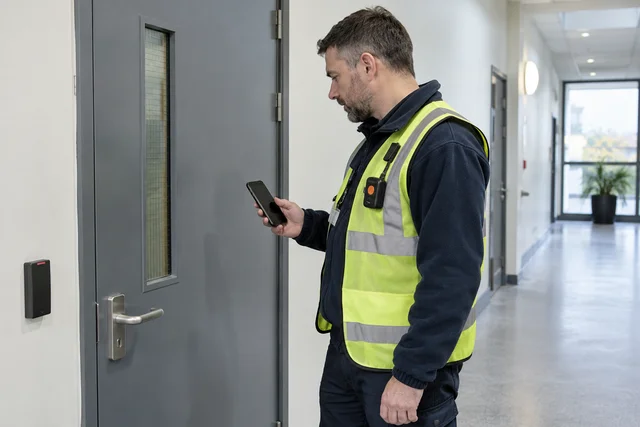
Photorealistic illustrative UK workplace scene. Review checks: Incident: A fall, illness, violence or task failure can leave a person unable to call. Delay: A missed contact may pass unnoticed without a named responder. Consequence: Help can arrive too late when location, access and escalation are unresolved.
Decide the task boundary first
First ask whether the work needs to happen alone at all. A paired visit, remote observation or rescheduled task may remove the isolated exposure. A low-risk visual check is different from electrical fault-finding, entering a confined space or another high-consequence intervention. Avoid extending permission from one to the other.
Where lone work is acceptable, define the permitted actions, exclusions and authority to stop. Match competence, access, lighting, environment and emergency arrangements to that scope. A second person also needs suitable capability and a safe role; merely adding a name does not design rescue. Workers and planners should understand the boundary before departure. If the request changes, reopen the decision rather than rely on experience, an app or pressure to finish while already at the location.
Applied case
The approved visit is a visual inspection from a safe position. On arrival, the worker is asked to open the machinery and investigate an unexplained electrical fault.
Two people is not a rescue design
Additional staffing can help when suitably planned. It does not authorise either person to enter an uncontrolled danger or provide specialist rescue beyond their training and arrangement.
Test your decision
What is the correct task decision?
Keep to the permitted scope and obtain a new competent plan for the changed intervention.
Treat arrival on site as authority for any requested repair.
Use a check-in app as permission to open the machine.
Compare the explanation
Keep to the permitted scope and obtain a new competent plan for the changed intervention.
Task controls and competence must match the actual intervention, not the journey’s original label.
Connect host information with a workable communication route.
Existing SHAREhub 2D teaching schematic. Use alongside the explanation and fictional case in this lesson.
Plan the location and contact chain
Before a lone visit, confirm the task, current site hazards, safe access, expected location and return. Host and sending organisations need clear contact and responsibility where both are involved. A changed locked gate, flooded route or unavailable host contact can undermine the assessment before work starts.
Check communication in the actual location and conditions. A phone that works in the car park may fail in the store or basement. Agree how contact is made, who monitors it and what happens if it is lost. Provide location and access information needed for a safe response, with proportionate handling of personal data. Do not treat an unreachable person on a contact sheet as an active controller. Confirm the arrangement before exposure rather than discover its gaps during an incident.
Applied case
The host’s listed contact no longer works evenings and a new gate restricts access. The worker can send a message outside but loses signal inside the store.
Coverage is location-specific
A successful call outside does not establish communication in a basement or remote room. Test the route needed by the task and provide a suitable alternative or restrict the work.
Test your decision
What must be resolved before proceeding?
Only whether the old checklist is signed.
An assumption that messages will send eventually.
Actual access, a reachable responsible contact and a communication arrangement that works for the task.
Compare the explanation
Actual access, a reachable responsible contact and a communication arrangement that works for the task.
The plan relies on real access and communication, not stale contact information.
Distinguish an alarm from a complete response system.
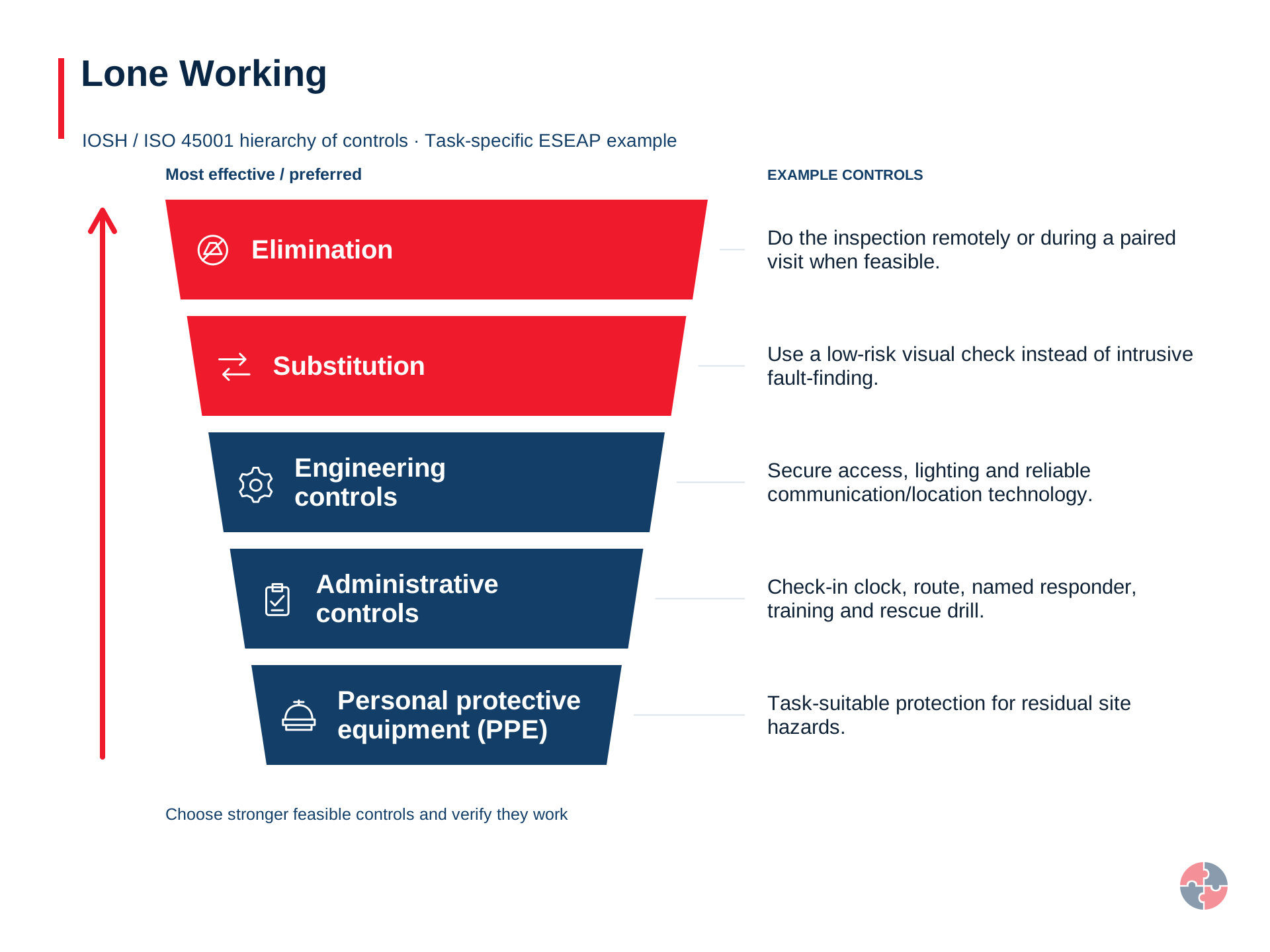
Photorealistic illustrative UK workplace scene. Review checks: Eliminate: Do the inspection remotely or during a paired visit when feasible. Reduce: Use a low-risk visual check instead of intrusive fault-finding. Isolate: Secure access, lighting and reliable communication/location technology. Control: Check-in clock, route, named responder, training and rescue drill. PPE: Task-suitable protection for residual site hazards.
Make a missed contact trigger action
An app, alarm or check-in is useful only when a human response follows. Define the monitored contact pattern, missed-contact escalation, named cover, last-known-location information and access for suitable responders. Set timings from the assessed emergency and achievable response, rather than copy a universal interval.
Test the chain safely: does the controller notice, know what to do and have an appropriate response available outside office hours? A distress alarm or known incident needs immediate emergency action under the plan; it should not wait for the next routine check. Responders must not enter uncontrolled danger for an improvised rescue. If help cannot arrive within the planned needs, redesign or remove the lone arrangement. A device test alone verifies only one part of this chain.
Applied case
The worker’s app generates a missed check-in, but alerts go to an unmonitored daytime inbox. No evening responder knows the location or has a gate-access plan.
The clock needs an owner
A contact interval has value only with named monitoring, clear escalation and suitable cover. Its length must fit the assessed harm and response rather than an arbitrary course rule.
Test your decision
What is missing?
Nothing because the app transmitted an alert.
A monitored, owned escalation and safe achievable response.
Only a newer phone model.
Compare the explanation
A monitored, owned escalation and safe achievable response.
Sending an alarm is not the same as detecting it and safely providing help.
Recognise changed task, contact and access as decision triggers.
Existing SHAREhub photographic illustration. The written fictional case supplies the condition and decision evidence.
Stop when assumptions fail
Lost communication, unexpected people, flooding, an unsafe route or a task beyond the agreed scope can require withdrawal or restriction. Use the defined safe location and reporting route. Do not continue deeper into a location to regain a signal or attempt a prohibited intervention because a return call is due.
The worker needs clear authority to stop; supervisors must support that decision and arrange a safe alternative rather than blame the report. A known emergency requires the site emergency response, while a planned work change needs competent reassessment before restart. Keep the distinction clear. A successful earlier visit does not overrule current conditions. After a failure, record what changed and check the correction before relying on the same lone arrangement again for the next person.
Applied case
The worker cannot maintain contact and finds water across the assessed access route. The supervisor asks them to continue because the inspection has been successful on previous visits.
A stop is useful feedback
A reported loss of control reveals where planning needs improvement. Support the safe decision and correct the arrangement instead of teaching workers to conceal a gap to finish.
Test your decision
What should guide the decision?
The current failed contact and access assumptions, requiring a safe hold or withdrawal and review.
Only the earlier successful visits.
The appointment time, regardless of changed conditions.
Compare the explanation
The current failed contact and access assumptions, requiring a safe hold or withdrawal and review.
Past success cannot establish current control after material conditions change.
Check the complete chain without collecting unnecessary tracking data.
Photorealistic illustrative UK workplace scene. Review checks: Assess: Check the task, location, contact arrangements and foreseeable emergency. Decide: Do not allocate work alone when the assessment requires assistance. Verify: Test contact, missed-check response and the route for summoning help.
Verify the arrangement and respect privacy
Use monitoring proportionately for the safety purpose. Explain the location or alarm information collected, who sees it and the retention and response arrangements. Continuous tracking should not be silently repurposed as performance surveillance; use the organisation’s competent privacy process for such decisions.
Assurance should sample task understanding, working contact, controller cover and a safe missed-contact exercise. Record defects and verify the response rather than count device issues. Review after a task, site, staffing or technology change. The optional fictional exercise maps a remote visit from permission to return and identifies the point where one failed assumption stops the task. It develops planning questions without approving real lone work, collecting an actual worker’s route or authorising rescue.
Applied case
The employer considers the device rollout complete once tracking is enabled. Workers have not been told who monitors alerts or that location data is also being used for attendance scoring.
An end-to-end check matters
Test the real controller and response route, not only the device button. Keep the result scoped to the task, shift and conditions actually tested.
Test your decision
What needs review?
Only how often location points are collected.
An assumption that buying devices authorises any use of the data.
The complete safety response and transparent proportionate data use through the competent organisational route.
Compare the explanation
The complete safety response and transparent proportionate data use through the competent organisational route.
Technology needs a working safety purpose and suitable privacy arrangements.