Focused awareness learning based on SHAREhub pages. Apply the actual workplace arrangements and your role; completion is not practical competence or permission for specialist work.
This reader supplies the complete teaching. Use the interactive LMS course for assessed activities, saved progress and completion.
LESSON 1
Explain the event without blaming the person
Identify the different mechanisms behind slips and trips.
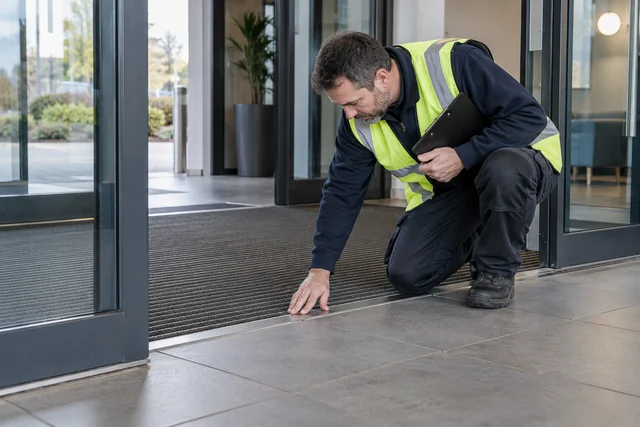
Existing SHAREhub photographic illustration. The written fictional case supplies the condition and decision evidence.
Explain the event without blaming the person
A slip usually involves insufficient grip between footwear and the walking surface for the movement being made. Contamination, floor condition, cleaning and footwear can combine. A trip involves a foot meeting an obstruction or unexpected level change, such as a cable, damaged edge or raised mat. One event can involve both mechanisms.
Avoid closing an investigation with “clumsy” or “not looking”. Ask about the route, lighting, task demands and conditions at the time. Carrying a load may limit the view; rushing can reflect work pressure rather than an isolated choice. This does not remove personal responsibility, but it directs prevention towards causes that can be changed. Record observations and uncertainty without assuming the whole event is explained by the injured person’s action.
Applied case
A worker trips on a lifted mat edge while carrying parcels, then slides on rainwater. The first report records only that the worker should watch their feet.
Two mechanisms can combine
A raised edge can start a trip and contamination can worsen recovery. Naming one cause does not rule out other relevant route and task factors.
Test your decision
What should the review examine?
Only whether the worker admits being careless.
Only whether the entrance was swept earlier.
The mat, contamination, carrying task and route conditions as connected causes.
Compare the explanation
The mat, contamination, carrying task and route conditions as connected causes.
The event can contain both a trip obstruction and loss of grip; examine the actual arrangement.
Recognise why repeated cleaning needs a wider correction.
Photorealistic illustrative UK workplace scene. Review checks: Failed condition: Water spreads beyond a saturated mat, a mat edge is displaced or recurrent ingress remains unresolved. Possible harm: A person may slip or trip and sustain injury; the actual consequence depends on the fall and surrounding hazards. Correct and verify: Protect the route, correct source and surface conditions, then verify the safe arrangement before reopening.
Look for contamination at source
Water, oil, food and other contamination can reduce grip, depending on the floor and footwear. Identify where it comes from and how people carry it along the route. A leaking process, rain entering a doorway and cleaning water need different source controls.
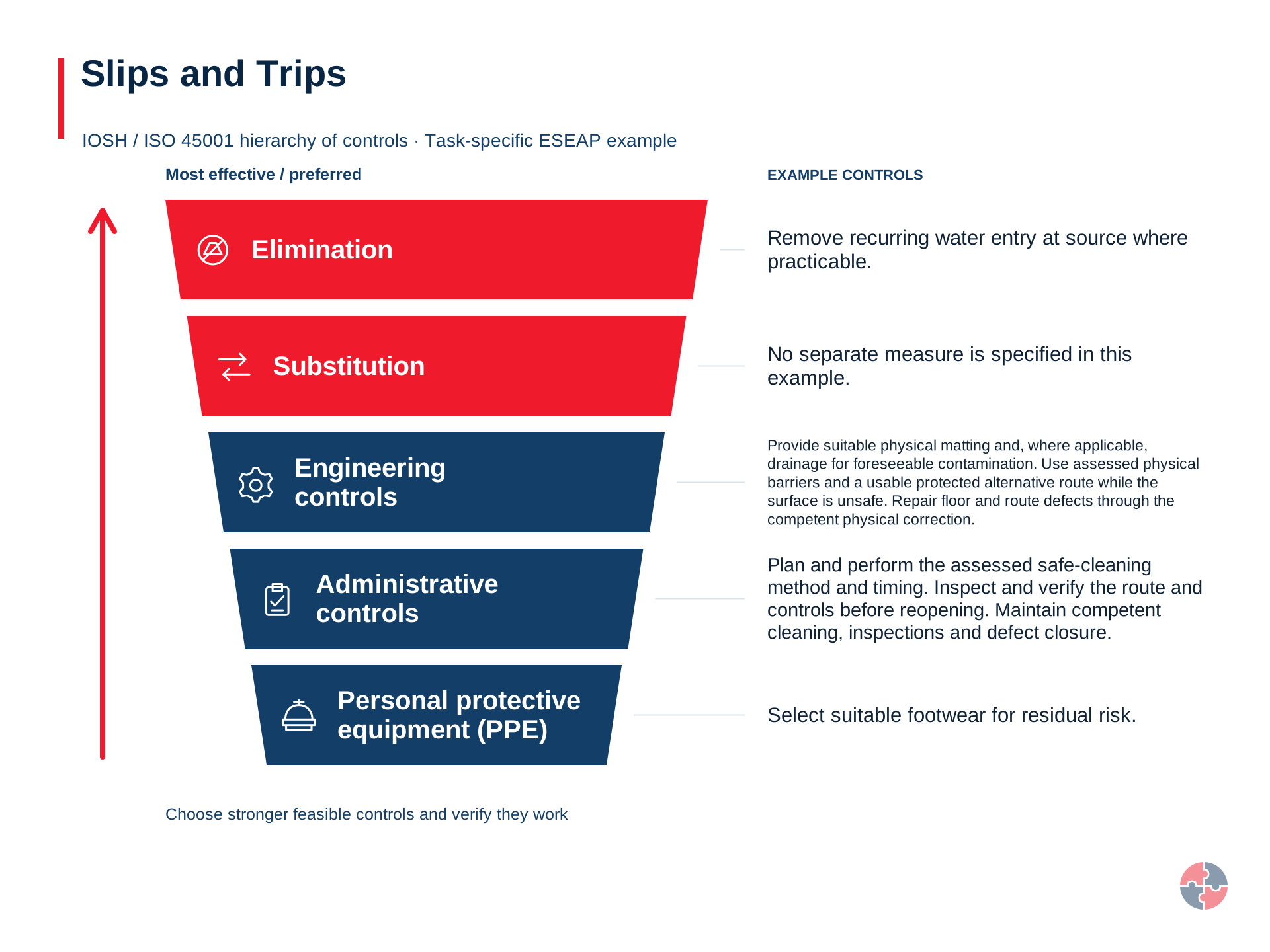
Consider preventing or reducing contamination through the work arrangement, drainage, suitable entrance matting or repair, as appropriate. Then plan detection, response and upkeep. A repeated spill should not become a permanent cleaning job without review of its source. Check nearby routes and people, not just the visible patch. A change that keeps one spot dry can transfer contamination elsewhere. The page’s prevention model therefore joins suitable flooring and route design with cleaning, footwear, ownership and checks of effectiveness.
Applied case
The entrance is mopped several times each morning, but short saturated mats allow rainwater to spread farther into the building. Complaints recur at the same time.
A recurring pattern is evidence
Repeated wetness at one time or place can reveal a design, maintenance or work-sequencing problem. Use it to review the source rather than normalise the cone.
Test your decision
What improvement should be considered?
Assume a floor is suitable for all contaminants because it looks textured.
Review water entry, matting, drainage and cleaning as one route problem.
Add another inspection signature while keeping the same source unchanged.
Compare the explanation
Review water entry, matting, drainage and cleaning as one route problem.
Repeated local cleanup does not establish control of the source or the wider route.
Connect safe routes with storage, leads, lighting and maintenance.
Existing SHAREhub 2D teaching schematic. Use alongside the explanation and fictional case in this lesson.
Remove obstructions and repair defects
Trips can come from trailing leads, temporary hoses, stored materials, uneven surfaces and poorly visible level changes. Remove or reroute the obstruction where possible and provide suitable storage or service access so it does not return. A busy route needs enough space for the people and activity using it.
Report defects with their location and effect on access, then use the assessed interim restriction or alternative route while correction is arranged. A maintenance ticket is not a physical barrier. Check the alternative is usable, including for visitors and people with different mobility needs, and that it does not compromise escape. Lighting and route condition belong in the review because people need to recognise unavoidable features. Do not ask someone to walk through an uncontrolled hazard to prove a defect exists.
Applied case
A delivery pallet narrows the alternative entrance route while a cable crosses its remaining width. The damaged main mat has been reported but remains in use.
Follow the whole route
A diversion is a control only if people can actually use it safely. Check its obstructions, surface, access needs and escape implications before directing traffic there.
Test your decision
What does the current report fail to establish?
That access is controlled and a usable safe route exists now.
That someone noticed a defect.
That a future repair might be planned.
Compare the explanation
That access is controlled and a usable safe route exists now.
Reporting is useful information but does not prevent the next person meeting the unresolved obstruction.
Distinguish a warning from physical prevention of access.
Photorealistic illustrative UK workplace scene. Review checks: Design: Specify suitable floor, drainage, stairs, lighting and route width. Prevent contamination: Stop leaks, fit drip trays, improve entrance matting and cover outdoor transitions. Remove hazards: Clear cables, waste, stock, hoses and uneven temporary materials. Control cleaning: Use correct method, timing, products, drying and barriers. Maintain: Repair defects, curled mats, loose tiles, potholes and stair nosings.
Plan cleaning and access together
Cleaning can introduce a temporary slip hazard as well as remove contamination. Choose a suitable method and time for the actual floor and activity. Where a route remains unsafe, prevent access through the assessed physical arrangement and provide a usable alternative or clean in suitable sections.
Cones and signs communicate a warning; they do not dry a floor, repair a mat or stop people crossing it. A warning placed beside the only route leaves the exposure unresolved. Coordinate cleaners, reception, deliveries and other users so the control remains effective during busy periods. Hand the route back after the required condition has been checked. Do not treat every wet-process area as requiring the same dry-floor rule: the surface and method must suit the actual foreseeable contamination and task.
Applied case
A cleaner puts a cone beside a wet smooth floor, but customers still need to cross it to reach reception. No alternative or physical separation has been arranged.
Warning and separation differ
A sign tells people a hazard exists. A suitable barrier or controlled route prevents exposure while the hazard remains; neither should be confused with removing its source.
Test your decision
What is the key control gap?
The cone must be a different colour to dry the floor.
A signed cleaning record removes the need to control access.
People can still enter the unsafe surface despite the warning.
Compare the explanation
People can still enter the unsafe surface despite the warning.
Warnings do not replace the assessed access and cleaning arrangement.
Existing SHAREhub photographic illustration. The written fictional case supplies the condition and decision evidence.
Match floor and footwear to the task
Flooring and footwear need to suit the activity and foreseeable contamination. A sole that performs well with water on one floor may behave differently with oil on another. The label “non-slip” is not evidence for every surface, contaminant or wear condition.
Use the responsible assessment and suitable procurement information. Where a representative trial is needed, it must be controlled; do not deliberately expose people to an uncontrolled hazard to test shoes. Inspect wear, damage and cleaning needs, and listen to user reports. Footwear is part of the system after stronger source and route controls, not permission to ignore a leak or failed cleaning arrangement. Public-facing premises need particular attention because customers and visitors may not have the same footwear or familiarity as trained workers.
Applied case
A workshop copies footwear selected for a wet reception area, although its main contaminant is oil. The supervisor offers the shoes instead of repairing a recurring leak.
Context changes performance
Water, oil, surface texture and wear can change grip. An earlier successful selection supplies useful information within its scope rather than universal approval for another workplace.
Test your decision
What needs review?
Whether staff can be told to accept the leak because new shoes were issued.
Suitability for the actual floor and contaminant, alongside source and route controls.
Only whether the same brand was successful elsewhere.
Compare the explanation
Suitability for the actual floor and contaminant, alongside source and route controls.
Footwear selection cannot be transferred blindly or replace stronger practicable controls.
Distinguish a controlled route from an administratively closed action.
Photorealistic illustrative UK workplace scene. Review checks: Setting: Heavy rain carries water and leaves through a public leisure-centre entrance. Act: Close or physically separate the wet route, provide a safe accessible alternative, remove contamination and correct matting/drainage defects. Hold / review: Do not reopen while the hazardous condition remains or the alternative creates another hazard.
Verify correction and prevent recurrence
A useful check looks at the real route during the relevant conditions: peak arrivals, cleaning, deliveries or bad weather. Confirm the source correction, surface, obstructions, access restriction and alternative arrangement as appropriate. Keep an owner and follow-up for unresolved defects.
A photograph or completed checklist can support a scoped finding but cannot establish every later condition. Review recurring locations, complaints and near misses to see whether the correction actually worked. If a new hazard appears, protect people through the site’s immediate response and report it; do not wait for the next routine inspection. The optional fictional exercise maps a route from source to users and hand-back. It helps apply the reasoning without authorising real maintenance or recording a workplace approval.
Applied case
The mat is replaced and delivery storage changes. The route is clear on a quiet afternoon, but no one checks the next wet arrival period when problems usually recur.
Test the purpose of the change
If the problem occurred during wet peak arrivals, an empty dry corridor is limited evidence. Check the relevant conditions without deliberately creating unsafe exposure.
Test your decision
What would strengthen the close-out evidence?
A check under the relevant busy/wet conditions and follow-up of any recurring source or access issue.
The age of the repair invoice alone.
A declaration that one clear route photograph proves permanent safety.
Compare the explanation
A check under the relevant busy/wet conditions and follow-up of any recurring source or access issue.
Verify the result in conditions that test the reason for the improvement.