Focused awareness learning based on SHAREhub pages. Apply the actual workplace arrangements and your role; completion is not practical competence or permission for specialist work.
This reader supplies the complete teaching. Use the interactive LMS course for assessed activities, saved progress and completion.
LESSON 1
Recognise change in the work system
Explain how changing roles can affect controls.
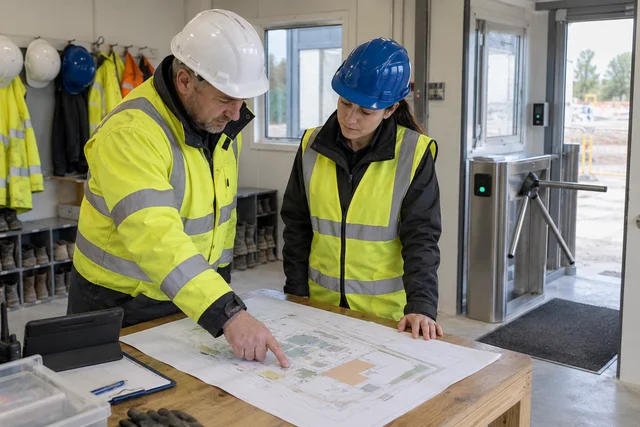
Existing SHAREhub photographic illustration. The written fictional case supplies the condition and decision evidence.
Recognise change in the work system
Organisational change affects health and safety because it changes the system that controls hazards. The safest-looking procedure can fail if the role that owned it disappears, the experienced supervisor moves, the contractor interface changes or the people doing the work are not trained for the new arrangement. HSE warns that organisational changes such as staffing reductions, contractorisation, outsourcing, combining departments and changes to roles are often not analysed as thoroughly as plant or process changes, even though they can damage hazard control. Organisational change and major accident hazards, CHIS7 Human factors toolkit HSE organisational change A strong professional answer separates the destination risk from the transition risk. Destination risk asks whether the proposed future organisation can control hazards.
Applied case
Fictional case: A restructure leaves equipment unchanged but moves supervision and contractor coordination between teams. The project calls it administrative and does not examine the protective tasks those roles previously performed.
Unchanged equipment, changed dependence
A control may depend on a person, information route or response being available. Moving those responsibilities can change risk even when the physical installation stays the same.
Test your decision
What should be reviewed?
The new chart as proof controls are unchanged.
The safety functions and interfaces affected by the role changes.
Only whether hardware moved.
Compare the explanation
The safety functions and interfaces affected by the role changes.
Organisational changes can alter how precautions are delivered.
Consider the move as well as the future arrangement.
Existing SHAREhub 2D teaching schematic. Use alongside the explanation and fictional case in this lesson.
Review transition and destination
A mature change assessment separates what the future organisation must control from what could fail during the journey. Direct effects are the visible changes: headcount, structure, shift pattern, contractor scope, software, role description, asset ownership or location. Indirect effects are the consequences that follow: less mentoring, changed informal communication, weaker handover, diluted technical authority, fatigue, stress, reduced maintenance quality or poorer emergency response. Organisational change and major accident hazards, CHIS7 HSE risk assessment HSE organisational change Destination risk and transition risk should both be assessed, recorded and prioritised; score them only where the chosen method helps the decision, owned and reviewed. Destination risk asks whether the proposed end-state is robust enough. Transition risk asks whether the organisation can survive the handover period without losing key controls.
Applied case
Fictional case: The future team structure has named roles. During the transfer, however, neither old nor new team knows who receives defects or authorises affected contractor work this week.
Two time horizons
Ask whether the final arrangement is suitable and whether the move itself preserves critical controls. A future improvement does not automatically protect today’s changeover period.
Test your decision
What is missing?
Interim ownership and control during the transition.
A future chart as proof of present cover.
An assumption that old and new teams will privately agree.
Compare the explanation
Interim ownership and control during the transition.
The transition can create risks separate from the intended destination.
Use evidence and hold points rather than the timetable alone.
Existing SHAREhub 2D teaching schematic. Use alongside the explanation and fictional case in this lesson.
Screen before committing the change
A stage-gate process prevents change from moving forward until safety-critical evidence is ready. These gates are an adapted management method, not a statutory form for every sector. HSE CHIS7 is written for major-accident hazards; the broader HSE organisational-change guidance supports assessing the proposed organisation and the transition. HSE organisational change For high-risk operations, change should not be managed as a single approval signature. A stage-gate approach creates deliberate decision points. Each gate asks whether the evidence is strong enough to proceed. That is especially important in process safety, construction, healthcare, transport, utilities and other settings where loss of competence or unclear authority can have severe consequences. Organisational change and major accident hazards, CHIS7 Managing for health and safety, HSG65 HSE organisational change
Applied case
Fictional case: A role transfer is scheduled before the team examines competence, workload or emergency interfaces. The deadline is treated as permission to proceed while those questions remain unanswered.
A stage has a purpose
Define what must be understood or demonstrated before progressing. A ticked milestone without its evidence cannot resolve the safety conditions that the milestone was meant to protect.
Test your decision
What should govern progression?
The calendar alone.
A statement that questions can always be answered after transfer.
The required review and readiness evidence through responsible change decisions.
Compare the explanation
The required review and readiness evidence through responsible change decisions.
Use practical knowledge before responsibilities move.
Existing SHAREhub 2D teaching schematic. Use alongside the explanation and fictional case in this lesson.
Involve affected people and interfaces
Organisational change should be managed through screening, risk assessment, consultation, implementation control and post-change verification. A practical change process should start before the decision is final. Too often health and safety is asked to write a risk assessment after the business has already decided the new structure, budget and timescale. At that point, the safety professional is left trying to patch risk into a fixed model. The stronger approach is to screen proposed change early, identify safety-critical roles and tasks, map affected controls and challenge whether the proposal leaves enough competence and capacity. Organisational change and major accident hazards, CHIS7 Human factors toolkit HSE organisational change Consultation matters because workers and contractors often see failure routes hidden from project teams.
Applied case
Fictional case: The restructure affects night work and contracted maintenance, but the planning group includes only day-office managers. It assumes the same informal support will remain available after transfer.
Work as it is done
Affected workers can describe overlapping demands, informal dependencies and recurring difficulties. Their input supports the review without replacing the responsible competence or authority decisions.
Test your decision
What should improve?
Copy the day arrangement to every group without review.
Consult affected people and examine actual tasks, support and handover interfaces.
Treat absence from planning as agreement.
Compare the explanation
Consult affected people and examine actual tasks, support and handover interfaces.
Distinguish named roles from workable arrangements.
Existing SHAREhub photographic illustration. The written fictional case supplies the condition and decision evidence.
Check capability and information before transfer
Evidence should prove that risk, competence, consultation and assurance were considered before, during and after change. Sample a safety-critical decision before and after go-live: who owned it, who covered absence, how a contractor raised doubt and what happened on a night shift. Compare those observations with the change screen, consultation record and open-action list. Closure requires evidence that the replacement arrangement works, not just that roles were renamed. Organisational change and major accident hazards, CHIS7 Training should help people recognise change risk, challenge assumptions and manage transition controls. Affected workers should be able to find the real decision owner during transition and raise a missing-control concern. Change leads should map the safety-critical roles, temporary cover and contractor handovers before go-live.
Applied case
Fictional case: The new owner is named and has document access. No one has established relevant competence, time or an escalation route for decisions previously supported by another team.
Allocated and achievable
A name in the chart establishes allocation. Evidence should show that the person can perform the required function under the actual task demands and decision boundaries.
Test your decision
What remains?
A workable capability, information and authority arrangement for the assigned task.
Document access as complete evidence of readiness.
The role title as proof of every required capability.
Compare the explanation
A workable capability, information and authority arrangement for the assigned task.
Responsibility needs practical support and defined limits.
Existing SHAREhub 2D teaching schematic. Use alongside the explanation and fictional case in this lesson.
Verify after go-live
A before, during and after checklist keeps staffing, competence, supervision, emergency cover and interfaces visible through the whole change. Many change controls fail because the pre-change assessment is reasonable, but the transition is not actively managed. The checklist below keeps attention on the controls that are easy to lose during restructure, outsourcing, shift changes, centralisation, role transfer or temporary resource gaps. Organisational change and major accident hazards, CHIS7 Management Standards for work-related stress HSE organisational change The review should include workers, supervisors, contractors and technical specialists where they control important knowledge. For high-risk operations, any gap in permit ownership, supervision, emergency cover or maintenance backlog should be treated as a readiness hold point rather than an administrative action.
Applied case
Fictional case: The transfer takes place and all project emails are sent. Defect reports now have no clear recipient, but the project closes because the planned organisation chart was issued.
The finish is not the test
Go-live is a milestone. Follow-up asks whether roles, information and critical controls work as intended, with unresolved conditions retained and assigned for responsible correction.
Test your decision
What should the review do?
Treat email distribution as proof of effectiveness.
Wait for an injury to test the new structure.
Examine control performance and resolve the observed interface gap.
Compare the explanation
Examine control performance and resolve the observed interface gap.
Post-change review should compare the intended and actual arrangement.