Focused awareness learning based on SHAREhub pages. Apply the actual workplace arrangements and your role; completion is not practical competence or permission for specialist work.
This reader supplies the complete teaching. Use the interactive LMS course for assessed activities, saved progress and completion.
LESSON 1
Turn duties into safe work
Connect responsibility with practical prevention.
Existing SHAREhub photographic illustration. The written fictional case supplies the condition and decision evidence.
Turn duties into safe work
Employers must identify and control risks created by work, provide safe plant and systems, and protect workers and others so far as reasonably practicable. Workers must take reasonable care, cooperate with the arrangements and raise dangerous shortcomings. The legal starting point depends on place: the Health and Safety at Work etc. Act 1974 and Management Regulations 1999 apply in Great Britain (GB), while the Health and Safety at Work (Northern Ireland) Order 1978 and Management Regulations (Northern Ireland) 2000 are separate Northern Ireland (NI) routes. The same practical question runs through both: can people do the real task without avoidable harm? HSE health and safety law basics and HSENI making health and safety work for your business .
Applied case
Fictional case: A workplace has a policy and signed instructions, but the actual task exposes people to a missing control. The manager treats the documents as the complete demonstration of duty.
From statement to arrangement
Identify the task, people and harm pathway. The duty becomes useful when a responsible role provides a control and checks that it works in the workplace.
Test your decision
What matters?
The practical arrangements and evidence that the work risk is controlled.
The documents alone as proof.
The absence of injury as the only test.
Compare the explanation
The practical arrangements and evidence that the work risk is controlled.
Photorealistic illustrative UK workplace scene. Review checks: Great Britain: Health and Safety at Work etc. Act 1974 and applicable GB regulations. Northern Ireland: Health and Safety at Work (Northern Ireland) Order 1978 and separate regulations. Similar titles do not prove identical provisions.
Establish the applicable route
For England, Scotland and Wales, begin with the Health and Safety at Work etc. Act 1974 and applicable GB regulations. Northern Ireland has the Health and Safety at Work (Northern Ireland) Order 1978 and separate regulations; similar names do not guarantee identical requirements. Sources: Health and Safety at Work etc. Act 1974 , Health and Safety at Work (Northern Ireland) Order 1978 . Identify where the work takes place, who controls it and which activity is involved. HSE and local authorities divide much workplace enforcement in GB; HSENI and district councils have NI roles. Specialist activities may have a different enforcing authority. Scotland shares the general GB workplace framework but has a distinct prosecution system.
Applied case
Fictional case: An organisation copies a legal reference from a GB example into its NI work pack without checking the applicable instrument, activity or responsible dutyholder for that workplace.
Use the right source
A course example is not a legal classification for every workplace. Check the applicable official route and current scope before turning a reference into a task decision.
Test your decision
What should happen?
Apply every reference unchanged.
Assume the company’s home address alone decides every task.
Establish the actual jurisdiction and applicable requirements through appropriate advice.
Compare the explanation
Establish the actual jurisdiction and applicable requirements through appropriate advice.
Location, activity and dutyholder determine applicability.
Recognise worker care, reporting and role boundaries.
Existing SHAREhub 2D teaching schematic. Use alongside the explanation and fictional case in this lesson.
Cooperate without taking over employer duties
Workers must take reasonable care for themselves and others, cooperate with the employer’s lawful arrangements and avoid interfering with protective measures. Employers must supply the safe system and act on reported defects. An operator should use the specified route and controls, stop when a tail-lift behaves abnormally, keep others clear and tell the supervisor. They should not improvise repair or accept pressure to work around a failed device. The supervisor must protect the report, arrange a competent assessment and provide a safe alternative or hold work. HSE employee health and safety duties and HSENI employees . In GB, section 7 concerns employees’ reasonable care and cooperation; section 8’s prohibition on intentional or reckless interference/misuse applies to any person.
Applied case
Fictional case: A worker reports a damaged precaution and follows the task restriction. The manager says the report transfers all responsibility to that worker because safety is everyone’s job.
Different roles, connected action
Workers should use arrangements and raise concerns within their role. Employers still need suitable systems, resources and a response to the reported condition.
Test your decision
What is accurate?
Workers have no responsibilities when a manager is present.
Worker cooperation does not remove the employer’s own duties to manage risks.
Reporting transfers the entire employer duty.
Compare the explanation
Worker cooperation does not remove the employer’s own duties to manage risks.
Responsibilities coexist rather than cancel each other.
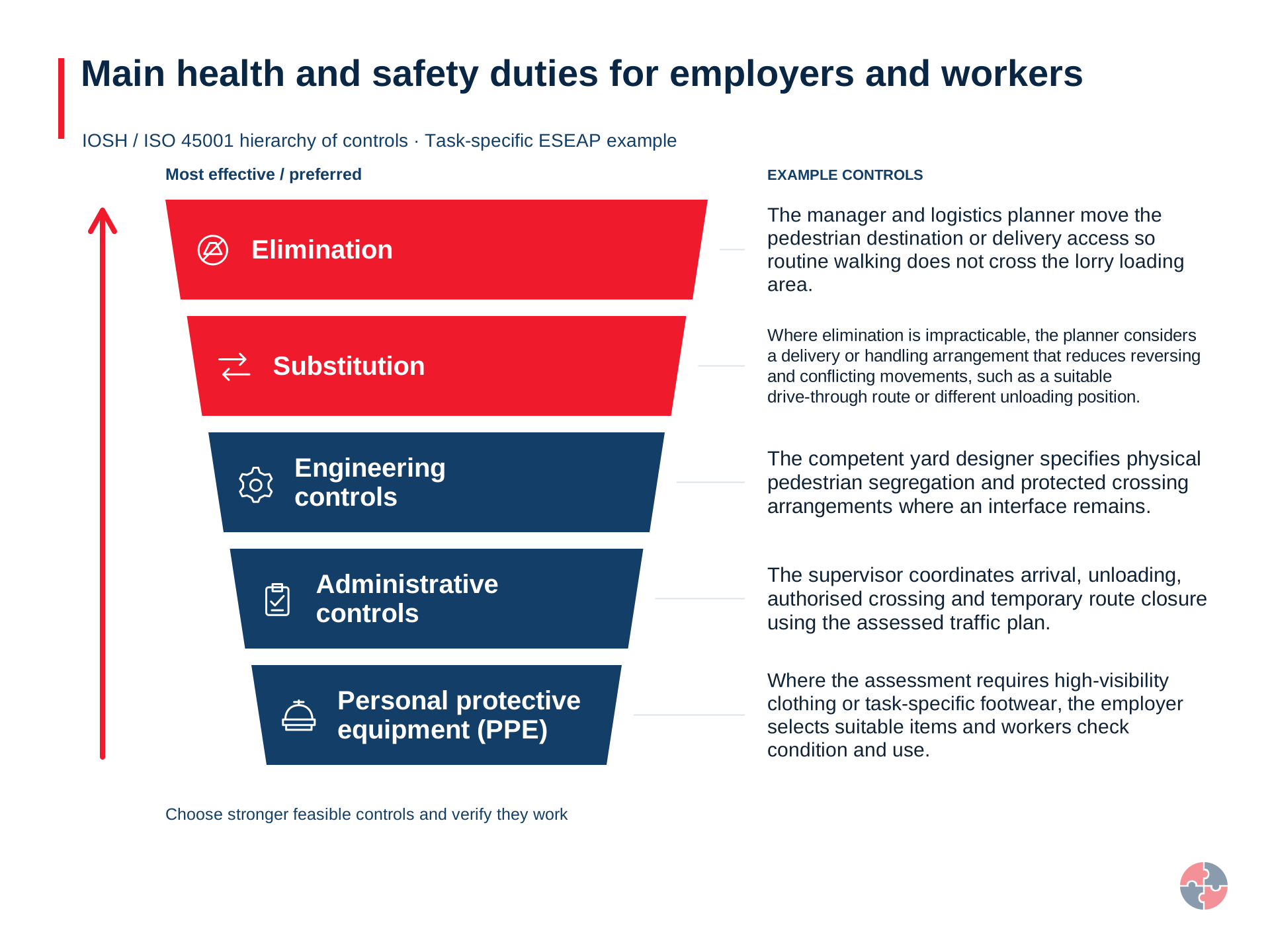
Photorealistic illustrative UK workplace scene. Review checks: Eliminate: The manager and logistics planner move the pedestrian destination or delivery access so routine walking does not cross the lorry loading area. Reduce: Where elimination is impracticable, the planner considers a delivery or handling arrangement that reduces reversing and conflicting movements, such as a suitable drive-through route or different unloading position. Isolate: The competent yard designer specifies physical pedestrian segregation and protected crossing arrangements where an interface remains. Control: The supervisor coordinates arrival, unloading, authorised crossing and temporary route closure using the assessed traffic plan. PPE: Where the assessment requires high-visibility clothing or task-specific footwear, the employer selects suitable items and workers check condition and use.
Choose effective precautions
Choose controls that prevent the harm the duty is intended to avoid. In a loading yard, redesign pedestrian and vehicle movement before depending on hi-vis clothing, warnings or a worker noticing a reversing lorry. Illustrative decision: BuildOut has deliveries crossing the route between its stores and office. The manager, yard supervisor, drivers and workers assess the actual traffic and loading tasks together. A safe solution must work for normal arrivals, a delayed vehicle, contractors and a failed loading bay. ERICPD means Eliminate, Reduce (including substitution), Isolate, Control, PPE and Discipline. The five-level hierarchy groups measures as elimination, substitution, engineering controls, administrative controls and PPE. They overlap: isolation is usually an engineering measure; control can include engineered and administrative measures.
Applied case
Fictional case: A vehicle and pedestrian conflict is known. The proposed response requires high-visibility clothing but does not examine removing or separating the encounter through the actual layout.
A practical duty question
Ask what prevents the event, who provides it and how its condition is established. Administrative arrangements and PPE can support control without replacing every stronger measure.
Test your decision
What should the responsible review examine?
Stronger feasible controls addressing the encounter before reliance on visibility and behaviour.
PPE as automatic crush prevention.
A signed statement as physical separation.
Compare the explanation
Stronger feasible controls addressing the encounter before reliance on visibility and behaviour.
Existing SHAREhub photographic illustration. The written fictional case supplies the condition and decision evidence.
Obtain help for the actual question
An employer needs suitable competent help to manage duties and must give that person enough information, access and authority to advise effectively. The level of competence depends on the decision. A supervisor may assess a familiar loading task, while a tail-lift defect, machine alteration or complex exposure needs a suitably skilled specialist. A certificate alone is not proof of competence for the actual equipment and scope. The employer should test advice against site evidence and retain the decision owner. HSE consultation and competent help and HSENI making health and safety work for your business . Teach the decision each role actually makes, assess it in the real work and review authority after change or poor performance.
Applied case
Fictional case: A manager has an unfamiliar technical control decision. A consultant provides advice, but the organisation has not identified who implements it or accepts the resulting work arrangement.
Advice must reach action
Define the question, obtain appropriate expertise and use the resulting advice through the responsible arrangements. A report on a shelf does not establish that its recommendations are implemented.
Test your decision
What remains?
A claim that hiring advice transfers every duty.
Approval by anyone who read the advice.
A responsible implementation and decision route with relevant competence.
Compare the explanation
A responsible implementation and decision route with relevant competence.
Competent help supports duties without removing organisational responsibility.
Use evidence and respond when controls are missing.
Photorealistic illustrative UK workplace scene. Review checks: Setting: At the site team, a warehouse team loads heavy cages into a delivery vehicle. Act: The operator stops, keeps people clear and reports the fault. Hold / review: Hold for uncertain lift condition, missing separation, untrained personnel or an unsafe substitute method.
Check the duty in practice
A good record points to a real control that workers can see and use; it also shows who acted when the control failed. Sample task assessments, worker consultation, competence demonstrations, defect and near-miss reports, maintenance closure, supervision, emergency practice and action follow-up. Compare records with a field walk. A policy signed by a director is useful only if it drives resources and decisions. HSE legislation on leading health and safety and HSE risk assessment steps . Stop when a control is missing, equipment is unsafe, the route is blocked, an exposure is uncontrolled or the task has changed beyond the assessment. Keep clear, report through the site route, protect others and seek a safe alternative.
Applied case
Fictional case: A manager’s review finds a current assessment and training records, but a task observation shows the specified protection is absent. The report proposes closing the issue on document completeness.
Evidence needs a connection
Policies, assessment, instruction and observation should support the same task. Keep the useful records, but do not use them to conceal an unresolved condition in practice.
Test your decision
What is sound?
Wait for harm before acting on the missing protection.
Address the actual control gap and verify the responsible response.
Let paperwork override the observation.
Compare the explanation
Address the actual control gap and verify the responsible response.
Actual risk control is central to a defensible assurance conclusion.