Focused awareness learning based on SHAREhub pages. Apply the actual workplace arrangements and your role; completion is not practical competence or permission for specialist work.
This reader supplies the complete teaching. Use the interactive LMS course for assessed activities, saved progress and completion.
LESSON 1
Find what could cause harm
Use more than a familiar checklist.
Existing SHAREhub photographic illustration. The written fictional case supplies the condition and decision evidence.
Find what could cause harm
The key points are to use more than one input, involve the people who know the work and challenge what can go wrong. Observation finds task reality, incident data finds weak signals, and structured studies find hidden failure paths. A simple task may need a walkthrough and checklist; a process system may need HAZOP, LOPA or specialist review. People doing the work can identify shortcuts, awkward steps, tool defects and controls that look good only on paper. Maintenance, cleaning, start-up, shutdown, fault-finding and contractor work often contain the highest hazards. Hazard identification is not complete until significant findings become controls, owners, records and review triggers. Different techniques reveal different hazards, so combining them gives a more reliable picture of risk.
Applied case
Fictional case: An assessor checks the usual visible items but does not observe cleaning or maintenance. Workers describe a different exposure during those tasks that the checklist never asks about.
The unseen part of work
A convenient visit may miss unusual tasks, different shifts and changed conditions. Use other evidence and people’s knowledge to identify what the first view does not establish.
Test your decision
What would strengthen identification?
Use only the assessor’s memory of the normal shift.
Combine relevant observation, task knowledge and records across the actual work.
Treat the completed checklist as exhaustive.
Compare the explanation
Combine relevant observation, task knowledge and records across the actual work.
Photorealistic illustrative UK workplace scene. Review checks: Unobserved cleaning isolation: Daytime checklist sees normal production only. Blocked process vent: Routine inspection ignores abnormal flow deviation. Repeated minor dust complaints: Injury-only data review omits chronic exposure.
Follow the work step by step
Do not recreate a jam, remove a guard or expose someone to danger to observe real work. Use safe simulation, historical evidence, stopped/isolated equipment or a competently planned trial with prerequisites and stop conditions. Unknown or bulging containers remain on hold for competent assessment. An interlock or emergency stop is not automatically an energy isolation. Task analysis breaks work into steps so hazards and controls can be identified where decisions are actually made. A task may look simple when described in one sentence, but risk often sits inside the detail. Opening a drum includes selecting the drum, moving it, checking identity, contents, container condition and any pressure hazard, using the competent product/container-specific opening method, then decanting, cleaning spills, disposing of waste and storing residues.
Applied case
Fictional case: A review lists machinery but does not examine loading, clearing, cleaning or hand-back. The team cannot identify at which step people approach the dangerous part of the task.
From equipment to encounter
An equipment name identifies a source. The task sequence shows when people meet it, which conditions differ and where the control must interrupt the harm pathway.
Test your decision
What is useful?
Break the actual task into steps and examine exposure at each relevant stage.
Add more machine names only.
Assume normal production describes every intervention.
Compare the explanation
Break the actual task into steps and examine exposure at each relevant stage.
Task analysis connects the hazard with an encounter.
Capture work-as-done without accepting every assumption.
Existing SHAREhub 2D teaching schematic. Use alongside the explanation and fictional case in this lesson.
Use the people who know the variation
Worker knowledge should be gathered deliberately because people doing the work know the awkward steps, weak controls and normal drift. Consultation should be more than asking people to sign an assessment. Useful questions include: which part of the job feels most difficult, what fails most often, what do new starters get wrong, when do you improvise, what makes the control hard to use and when would you stop the job? Worker input should be recorded, answered and fed back. If people raise issues and nothing changes, future hazard identification will become quieter and less honest. HSE asks employers to involve workers in identifying hazards. HSE risk assessment steps . Incident, near-miss, ill-health and monitoring data reveal hazards that inspections and checklists may not see.
Applied case
Fictional case: The day visit shows a clear route. Night workers explain that deliveries temporarily change it, but their experience is excluded because the inspection photograph looks satisfactory.
A valuable lead
An account can identify where to look without proving the final cause or condition. Preserve its detail and compare it with relevant observation and records.
Test your decision
What should the review do?
Treat the photograph as proof for every shift.
Accept the account as proof of every possible defect without checking.
Examine the reported variation and relevant route conditions.
Compare the explanation
Examine the reported variation and relevant route conditions.
Worker knowledge directs examination while evidence tests conclusions.
Use structured questions without creating the hazard.
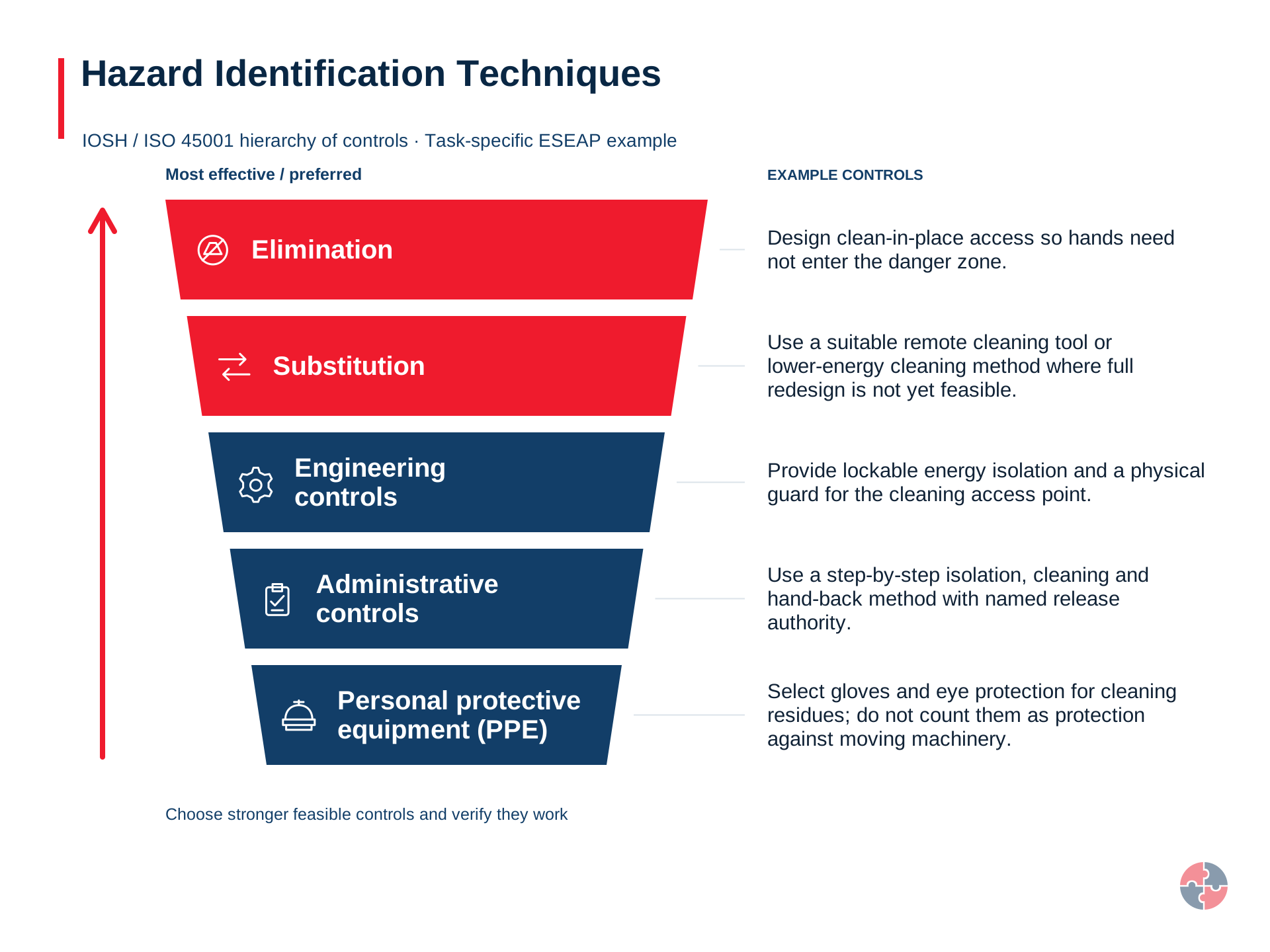
Photorealistic illustrative UK workplace scene. Review checks: Eliminate HSE hierarchy of control: Design clean-in-place access so hands need not enter the danger zone. Reduce: Use a suitable remote cleaning tool or lower-energy cleaning method where full redesign is not yet feasible. Isolate HSE hierarchy of control: Provide lockable energy isolation and a physical guard for the cleaning access point. Control: Add interlocked access where justified by machinery design and verify fail-safe behaviour. Control: Use a step-by-step isolation, cleaning and hand-back method with named release authority.
Ask a specific deviation question
What-if analysis asks credible challenge questions about deviations, failures and changes. What-if thinking is simple but powerful when the right people are in the room. It asks questions such as: what if the valve is opened in the wrong order, the delivery arrives at night, the extraction is off, the contractor brings a different chemical, the drain is blocked or the alarm is ignored? A good what-if review captures cause, consequence, existing safeguards, recommended action and owner. It should avoid vague questions that produce vague answers. The main techniques differ in what they reveal, the evidence they need and the ways they can fail. A good assessor moves from simple to advanced methods in a deliberate way.
Applied case
Fictional case: A workshop asks what happens if a shared service becomes unavailable during the task. It has not established which equipment depends on that service or what controls remain.
Specific enough to examine
Name the deviation and operating context. Then examine credible causes, consequences and controls, keeping missing information visible rather than replacing it with reassurance.
Test your decision
What is appropriate?
Assume separate equipment names prove independence.
Record the dependency question and obtain relevant information for review.
Test the loss live without an authorised plan.
Compare the explanation
Record the dependency question and obtain relevant information for review.
What-if discussion identifies questions; it is not test authority.
Link each identified pathway to stronger controls.
Existing SHAREhub photographic illustration. The written fictional case supplies the condition and decision evidence.
Turn findings into effective precautions
ERICPD is used here as a planning mnemonic. The linked HSE five-level hierarchy is the official source for the order and relative reliability of controls; the two labels are not identical. Start with task redesign and substitution, then engineered separation before procedures and personal protection; verify each control under real conditions. A machine clean-down can expose a cleaner to unexpected energisation when the study only covers production. The hazard-identification method must reveal that work state; the resulting control decision must still use the hierarchy. A checklist or training entry cannot substitute for physical isolation. The facilitator records the scope, missed states and action owner. HSE hierarchy of control ; HSE hierarchy of control . ERICPD is a six-stage planning aid; the HSE five-level order separates substitution, engineering and administration.
Applied case
Fictional case: The team identifies repeated vehicle and pedestrian conflict. It proposes a generic warning before examining whether the crossing can be removed or physically separated.
A list is a beginning
The value of finding a hazard lies in the action it informs. Connect the event, control function, owner and verification so the exposure does not remain unchanged.
Test your decision
What should follow identification?
Review controls that remove or interrupt the actual encounter before relying on warnings.
Treat identifying the hazard as completion of control.
Use only the number of hazards as success.
Compare the explanation
Review controls that remove or interrupt the actual encounter before relying on warnings.
Photorealistic illustrative UK workplace scene. Review checks: Assessing: Use pre-construction information, design risk review, site walkdowns and task analysis for high-risk packages. Analysing: Hold what-if reviews for crane lifts, excavations, temporary works, hot works and service strikes. Implementing: Translate findings into permits, exclusion zones, temporary works checks, plant routes, welfare and supervision plans.
Recognise when a deeper method is needed
Technique selection should reflect the complexity, severity, novelty and uncertainty of the work. A low-risk office change may need a simple walkthrough and staff consultation. A new chemical process may need HAZID, HAZOP, LOPA, DSEAR assessment, occupational hygiene input and emergency planning. The method should be proportionate but not casual. The key is to avoid under-analysis of high-consequence work and over-analysis of low-risk work. Both waste value: one misses harm, the other creates bureaucracy. HSENI supplies the NI baseline for proportionate risk assessment. HSENI five steps to risk assessment . An effective workshop has the right people, clear scope, good information, skilled facilitation and action discipline. Many workshops fail because they become opinion exchanges without evidence.
Applied case
Fictional case: A simple walkthrough raises questions about a complex process dependency. The reviewer wants to declare the issue fully assessed even though the method cannot answer those questions.
Awareness and specialist work
You can recognise the need for more information and ask a better question. This course does not qualify a specialist study leader or authorise engineering acceptance.
Test your decision
What should happen?
Use a familiar method name as proof of adequacy.
Discard the concern until a specialist happens to visit.
Retain the finding and obtain suitable competent analysis for the unresolved question.
Compare the explanation
Retain the finding and obtain suitable competent analysis for the unresolved question.