Focused awareness learning based on SHAREhub pages. Apply the actual workplace arrangements and your role; completion is not practical competence or permission for specialist work.
This reader supplies the complete teaching. Use the interactive LMS course for assessed activities, saved progress and completion.
LESSON 1
Understand the work system
Explain why a method is more than a document.
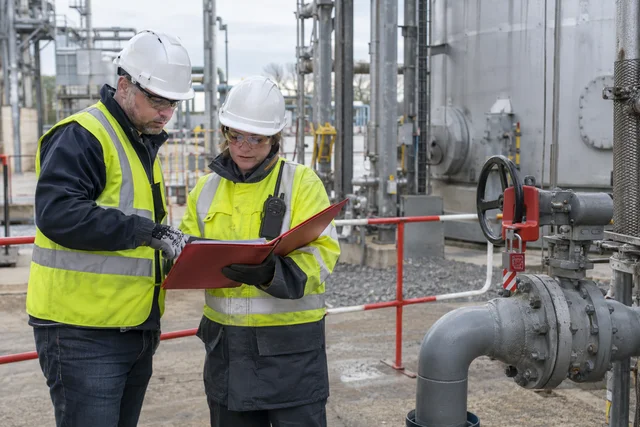
Existing SHAREhub photographic illustration. The written fictional case supplies the condition and decision evidence.
Understand the work system
A safe system of work is the planned way to complete a task after its hazards, people, equipment and changing conditions have been assessed. It combines suitable physical safeguards with a usable sequence, competent people, clear interfaces and stop decisions. A written method alone does not prevent contact with moving machinery, release of stored energy or exposure to harmful material when the control it describes is absent. A safe system of work is the bridge between a risk assessment and a task being done safely. It should explain the task, hazards, people affected, controls, sequence, competence, equipment, supervision, emergency action and stop points. The quality test is whether a competent worker can use it to do the work safely in real conditions.
Applied case
Fictional case: A task has a written method, but the physical safeguard it describes is absent. The team proposes proceeding because every worker signed the latest briefing sheet.
Paper and practice
A written sequence supports work only when the equipment, safeguards, people and conditions it relies on are present and usable at the actual task.
Test your decision
What is missing?
The actual protective arrangement and a responsible task decision.
Only another signature.
A claim that written methods never help.
Compare the explanation
The actual protective arrangement and a responsible task decision.
The method cannot substitute for the control it describes.
Identify people, equipment and interfaces before work.
Photorealistic illustrative UK workplace scene. Review checks: Moving rollers during cleaning: A hand reaches a nip point and is drawn in, causing crush injury or amputation before a worker can react. Stored electrical, hydraulic or pneumatic energy: Unexpected movement or release strikes a maintainer or another worker after the switch is turned off. Chemical cleaner or process residue: Splash, vapour or residue reaches eyes, skin or lungs, causing acute injury and potentially longer-term disease.
Plan the actual sequence
A good SSOW is built from real task analysis and hierarchy-led control, not copied text. The best safe systems are written after watching the job and talking to the people who do it. That is how hidden hazards, awkward steps, time pressure and informal adaptations are found. HSE machinery safety . A safe system should then be tested before issue. If workers cannot follow it in real conditions, the system should change before work continues. Observe the actual job and identify each task step, person and harm route. Choose physical safeguards before preparing the method, then test whether workers can follow the sequence, recognise changed conditions and stop safely. A safe system should include normal work, non-routine work, cleaning, maintenance, breakdowns, emergencies, contractor interfaces, new starters, vulnerable workers and environmental changes.
Applied case
Fictional case: A planner copies a routine method for an unusual maintenance task. The new task exposes stored energy and involves another team, neither considered in the copied sequence.
The boundary matters
Define where the task starts and ends, what remains live and who controls interfaces. Familiar steps do not establish an unfamiliar work boundary.
Test your decision
What should planning do?
Keep the routine method because it is familiar.
Let the crew discover conditions during work.
Assess the actual task and dependencies before agreeing its method and responsibilities.
Compare the explanation
Assess the actual task and dependencies before agreeing its method and responsibilities.
Compare design changes and arrangements dependent on action.
Existing SHAREhub 2D teaching schematic. Use alongside the explanation and fictional case in this lesson.
Build stronger precautions into the method
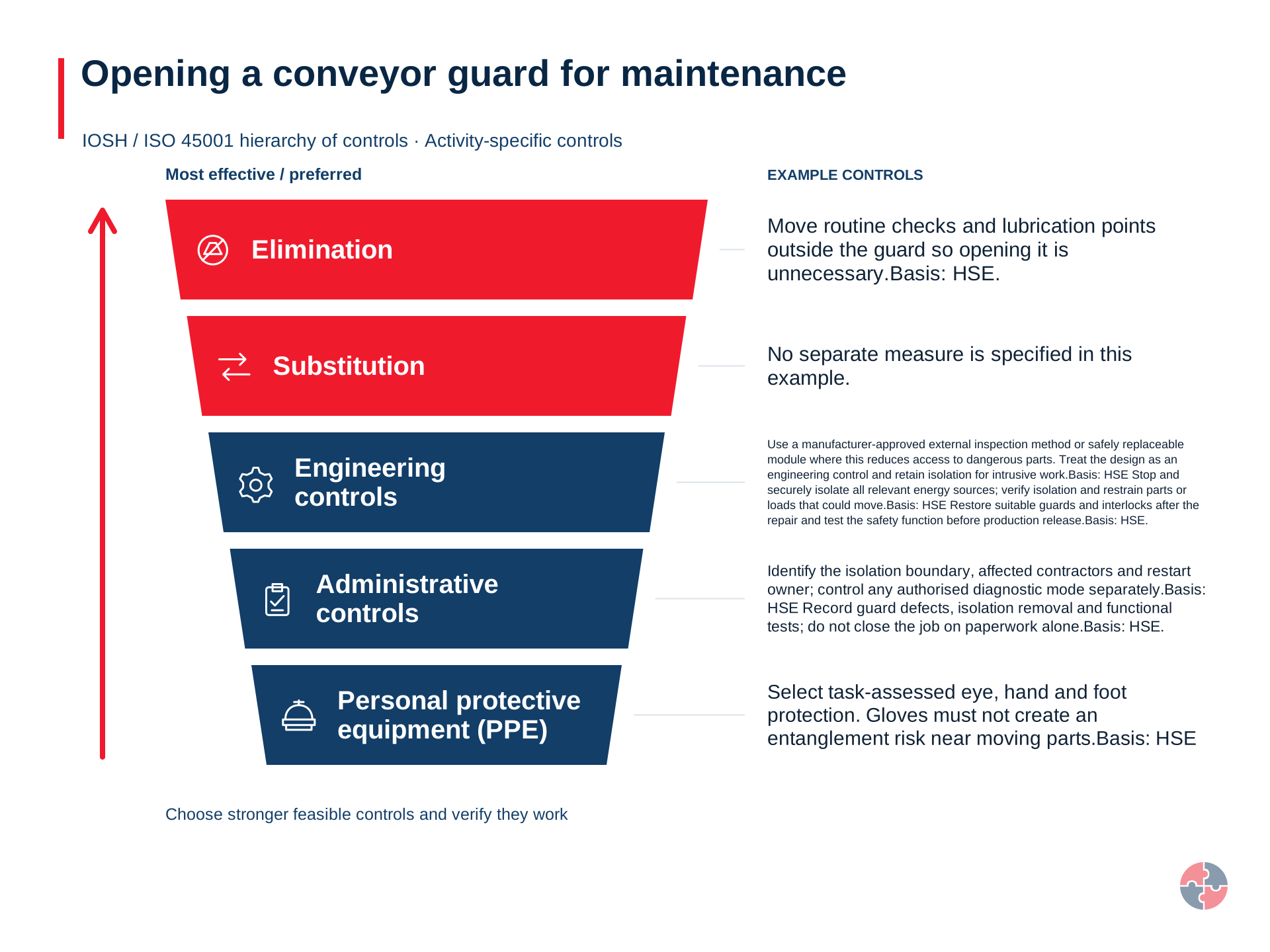
Remove or reduce the hazard before relying on procedures or personal protection. For safe systems of work, assess the actual task and first look for a way to remove the hazard. Where that is not possible, consider a safer substitute, engineered separation and then clear work procedures. PPE protects against remaining exposure; it does not make an uncontrolled task safe. HSE hierarchy of controls The selected measures need a named owner, a usable stop point and a check that they still work when the task or conditions change. In Northern Ireland, verify the separate legal route and site instructions. A maintainer needs access behind a conveyor guard; prevent unexpected motion and released stored energy. ERICPD is a planning crossmap.
Applied case
Fictional case: A cleaning task repeatedly reaches a dangerous area. The method simply warns users to be careful and does not examine whether access or exposure can be avoided.
The instruction is not the barrier
Ask which measure interrupts the harm pathway. The procedure explains use and limits; it cannot make an absent physical safeguard perform its function.
Test your decision
Which approach is stronger?
Assume experienced workers cannot be harmed.
Review removal or reduction of the exposure and suitable protective arrangements.
Add only a larger warning.
Compare the explanation
Review removal or reduction of the exposure and suitable protective arrangements.
A method should incorporate effective controls, not describe exposure politely.
Photorealistic illustrative UK workplace scene. Review checks: Eliminate: Move routine checks and lubrication points outside the guard so opening it is unnecessary. Reduce, including substitution: Use a manufacturer-approved external inspection method or safely replaceable module where this reduces access to dangerous parts. Isolate: Stop and securely isolate all relevant energy sources; verify isolation and restrain parts or loads that could move. Control: Restore suitable guards and interlocks after the repair and test the safety function before production release. Control: Identify the isolation boundary, affected contractors and restart owner; control any authorised diagnostic mode separately.
Make the method usable
A procedure should support decision-making at the point of work, not bury critical information. HSE operating-procedure guidance is especially useful here: procedures should reflect plant practice, use simple familiar language, identify prerequisites, place warnings before relevant steps and be validated before issue. HSE procedures . For ordinary workplaces, the same principles apply. A good procedure is clear, current, task-specific, usable and supported by training and supervision. A safe system should not be used to justify weak engineering where stronger controls are reasonably practicable. A key professional lesson is that procedural controls are often weaker than design or engineering controls. If a guard, barrier, isolation, LEV, mechanical aid or separation control is available and proportionate, the safe system should include it rather than replace it.
Applied case
Fictional case: The instruction says check everything and continue normally. It does not identify the required state, accepting role or response if an indication conflicts with the task plan.
Clear at the point of work
State what must be checked and what happens if it is not established. A vague instruction can hide the most important decision in the task.
Test your decision
What should improve?
Specific checks, decision boundaries and clear stop or escalation conditions.
More general reassurance.
A rule to choose the most convenient indication.
Compare the explanation
Specific checks, decision boundaries and clear stop or escalation conditions.
Users need a method that supports the actual decision.
Existing SHAREhub photographic illustration. The written fictional case supplies the condition and decision evidence.
Confirm readiness and understanding
Keep the current assessment and method alongside proof that the physical controls work, people are competent, defects were resolved and a named person released the task. Records should allow a supervisor to reconstruct a hold and restart decision. Evidence is as important as explanation. A competent manager should be able to retrieve records that show who owns the control, what standard applies, what was checked and what changed after findings. Evidence should combine documents, field observation and conversations. A form may show intent, but observation and worker understanding show whether the safe system is alive. For roller cleaning, compare the task assessment and product information with the physical guard, isolation point, lock-off and zero-energy test.
Applied case
Fictional case: The right equipment is present and the briefing is complete, but the receiving team cannot explain the task restriction or who releases the next hold point.
A useful cross-check
Ask the team to explain the relevant condition and next decision in their own words. Clarify the gap without turning a briefing into authority for specialist work.
Test your decision
What remains?
Nothing because attendance is recorded.
A promise that confidence is competence.
Task-relevant understanding and a clear authorised decision arrangement.
Compare the explanation
Task-relevant understanding and a clear authorised decision arrangement.
Information receipt does not establish usable understanding.
Recognise a changed task and controlled hand-back.
Photorealistic illustrative UK workplace scene. Review checks: Task design: Analyse cleaning separately from normal operation. (HSE source) Engineering control: Stop access until guarding is restored or a competent engineer establishes and verifies a safe engineered or isolated method that meets applicable work-equipment duties. (HSE source) Isolation: Lock off, prove zero energy and control stored energy. (HSE source)
Stop when the basis changes
Pause the affected work when the live task differs from the assessment, a critical control is missing, or the person authorised to release it cannot resolve the mismatch. Make the area or plant safe, identify the owner and record the evidence needed before a competent restart decision. Escalation must be practical. Supervisors and workers need to know which conditions mean stop, pause, seek authorisation, redesign the work or involve a competent specialist. The decision guide should be used during planning, pre-start briefings, live supervision, audit sampling and incident learning. If the work no longer matches the assessment or procedure, the safe answer is to stop and re-establish control. A missing guard, unclear isolation, unexpected motion or cleaner with unknown hazards is a no-go.
Applied case
Fictional case: An extra connection is discovered during work. The agreed method does not cover it, and the outgoing team wants to hand back the task as complete before clarification.
Complete means a defined state
Task completion, physical restoration and operational acceptance can be different conditions. State what is established and what remains restricted before responsibility changes hands.
Test your decision
What is sound?
Describe the task as complete to match the schedule.
Restrict the affected work and resolve scope, condition and hand-back through the responsible route.
Test the connection by opening it.
Compare the explanation
Restrict the affected work and resolve scope, condition and hand-back through the responsible route.
Changed conditions need a controlled decision, not improvisation.