Focused awareness learning based on SHAREhub pages. Apply the actual workplace arrangements and your role; completion is not practical competence or permission for specialist work.
This reader supplies the complete teaching. Use the interactive LMS course for assessed activities, saved progress and completion.
LESSON 1
Make leadership practical
Connect leadership behaviour to risk control.
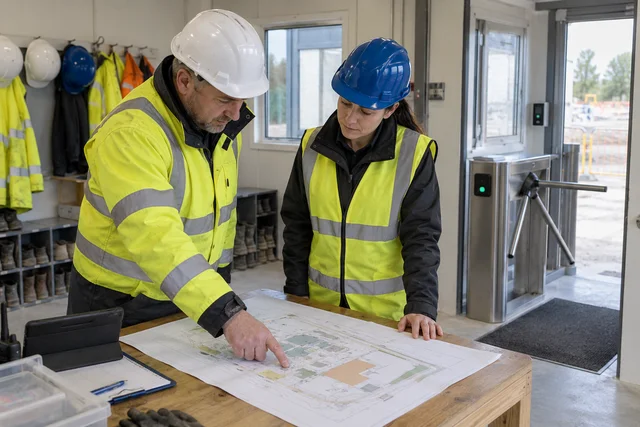
Existing SHAREhub photographic illustration. The written fictional case supplies the condition and decision evidence.
Make leadership practical
It means using authority, credibility and professional influence to make risk control real in daily decisions. Leadership is not only about giving speeches or approving a policy. It is the set of repeated behaviours that tell people what matters. If leaders ask only about output, people learn output matters most. If leaders ask about barrier health, worker concerns, overdue actions and health risks, people learn risk control matters too. Influence matters because many people who affect health and safety do not sit at the top of the hierarchy. A supervisor can influence how a team handles shortcuts. A safety adviser can influence investment by presenting evidence clearly. A worker representative can influence control design by explaining how the work is actually done.
Applied case
Fictional case: A supervisor regularly praises safe work, but workers cannot obtain a decision on a damaged protective arrangement and continue using the same exposed route.
Intent reaches the work
A statement can explain intent. The task decision, resources and response to concerns show whether people can put that intention into practice under real pressures.
Test your decision
What would make the commitment practical?
Add another slogan only.
Ask workers to stop mentioning the defect.
Resolve the control decision, support the necessary restriction and resource the response.
Compare the explanation
Resolve the control decision, support the necessary restriction and resource the response.
Leadership is demonstrated in priorities and follow-through.
Photorealistic illustrative UK workplace scene. Review checks: Actions stay overdue: Known risks become normalised. Only injury rates are reviewed: Health risks and major hazards are missed. Workers do not report concerns: Weak signals disappear.
Respond when time pressure conflicts
Leaders should make risk visible, pause unsafe work and decide with evidence when cost, time or production pressure increases. The situations below are common points where leadership intent is tested. Each example shows how a weak decision can normalise drift, and how a stronger decision keeps the risk visible, owned and controlled. Hold the affected transfer when a relied-on overfill alarm, trip or required inspection is bypassed or overdue; seek competent restoration and verified release. HSE large-tank high-level-switch safety alert HSE Buncefield learning Resource decisions should be based on risk profile, legal duty, control criticality and evidence of drift. A leadership team that approves a risk register but does not resource the actions has not controlled the risk.
Applied case
Fictional case: A delivery deadline approaches while a required safeguard is unavailable. The pack supplies no accepted alternative, but the supervisor is asked to make the delay disappear.
A visible conflict
Explain both the work pressure and the unresolved control. Hiding either prevents the responsible person from making an informed decision and arranging appropriate support.
Test your decision
What is sound?
Ask an unbriefed worker to carry the decision alone.
Keep the applicable restriction and use the responsible decision route.
Treat the deadline as approval.
Compare the explanation
Keep the applicable restriction and use the responsible decision route.
Pressure does not establish a safe operating basis.
Existing SHAREhub 2D teaching schematic. Use alongside the explanation and fictional case in this lesson.
Use concerns as information
Worker voice should be used to improve decisions, control design and trust, not simply to tick a consultation box. Worker voice only adds value when it reaches people who can act. The routes below show different ways leaders can capture practical knowledge from the workforce and convert concerns into visible decisions and feedback. Operators and maintainers can identify a bypass or weak test procedure before leaders see a dashboard. HSE consulting and involving workers HSENI trade-union representatives and consultation Communication builds trust when leaders are honest, specific, timely and willing to act on what they hear. Good communication is not broadcasting instructions. It is a loop: leaders explain intent, workers explain reality, concerns are recorded, decisions are made and feedback returns to the people affected.
Applied case
Fictional case: A worker raises a recurring access problem. Earlier reports received no outcome, so the team has started treating the issue as something management does not want discussed.
Listen and respond
Workers can reveal how the task differs from the plan. Explain the decision and what remains open, including reasons when a proposed option is not selected.
Test your decision
What should the supervisor improve?
A fair hearing, responsible assessment and feedback about the resulting arrangement.
Discourage reports until someone is injured.
Promise every suggestion will automatically be adopted.
Compare the explanation
A fair hearing, responsible assessment and feedback about the resulting arrangement.
Reporting needs a usable response, not silence or blanket promises.
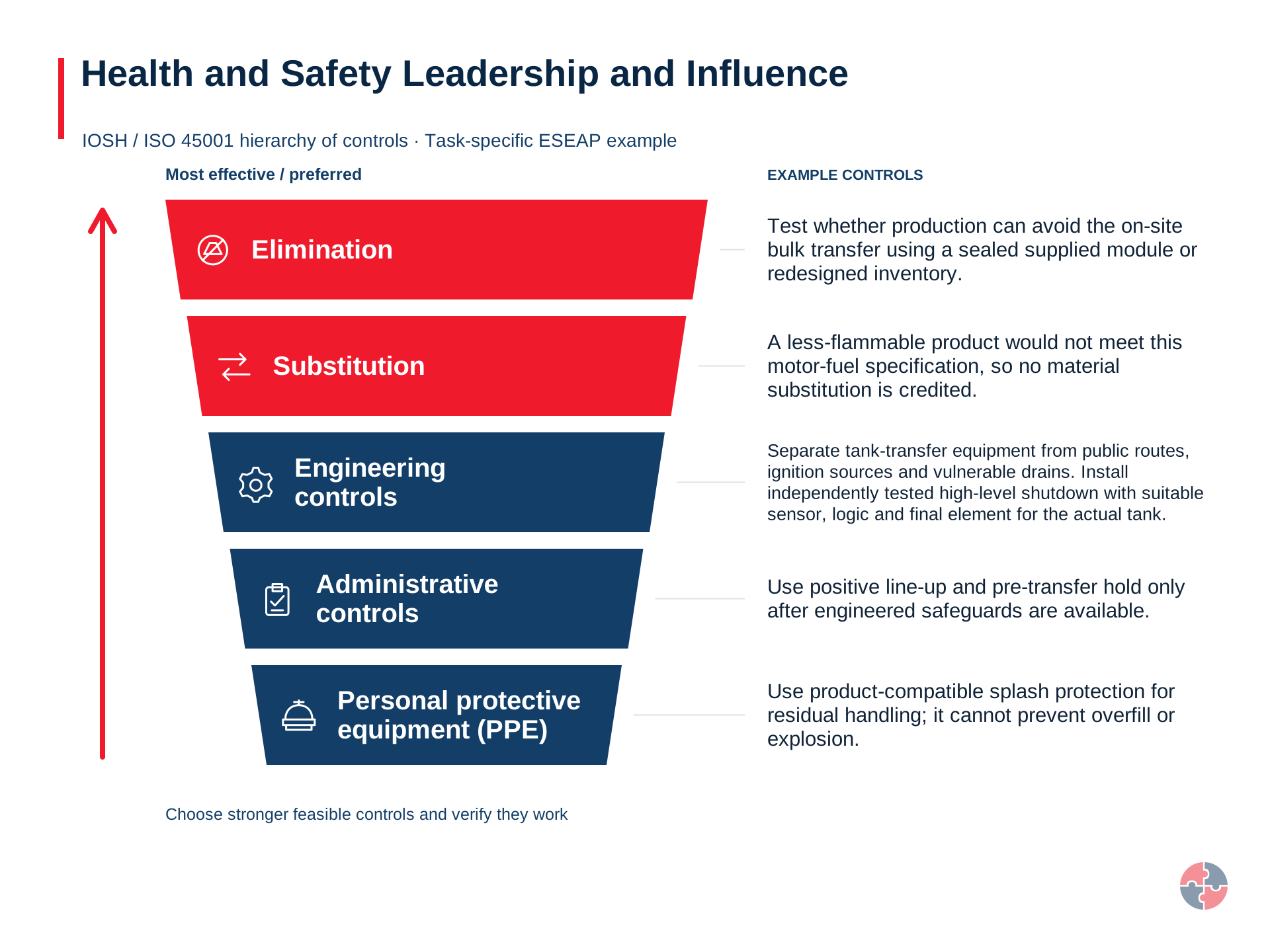
Photorealistic illustrative UK workplace scene. Review checks: Eliminate HSE five-level hierarchy: Test whether production can avoid the on-site bulk transfer using a sealed supplied module or redesigned inventory. Reduce: A less-flammable product would not meet this motor-fuel specification, so no material substitution is credited. Isolate HSE five-level hierarchy: Separate tank-transfer equipment from public routes, ignition sources and vulnerable drains. Control: Install independently tested high-level shutdown with suitable sensor, logic and final element for the actual tank. Control: Use positive line-up and pre-transfer hold only after engineered safeguards are available.
Fund controls that change exposure
ERICPD is used here as a planning mnemonic. The linked HSE five-level hierarchy is the official source for the order and relative reliability of controls; the two labels are not identical. A manager or observer can enable and verify a control, but the hierarchy applies to the real vehicle, dust or overfill hazard. At a bulk-fuel terminal, a tank high-level switch is bypassed before unloading. Overfill can release fuel and form a flammable vapour cloud; ignition can cause fire or explosion with serious injury or death. Leadership is shown by holding the transfer, funding a reliable design and requiring a verified restart; a signed acceptance form does not protect the tank. HSE Buncefield learning HSE large-tank high-level-switch safety alert
Applied case
Fictional case: Repeated checks show people sharing a vehicle route. A manager offers another awareness poster but will not examine whether the layout can remove or separate the conflict.
A useful resource question
Ask what the proposed expenditure changes in the task. A reminder and a physical separation can have different effects, dependencies and verification needs.
Test your decision
What should leadership examine?
Only whether workers can repeat the current route rule, without considering separation.
Whether familiarity makes the route safe.
Stronger feasible changes to the route and the resources needed to implement them.
Compare the explanation
Stronger feasible changes to the route and the resources needed to implement them.
Existing SHAREhub photographic illustration. The written fictional case supplies the condition and decision evidence.
Challenge a reassuring dashboard
Leadership evidence should show decisions, resources, worker involvement, action closure and control improvement. Evidence should be read as a chain rather than a filing exercise. A single record rarely proves good management on its own; stronger assurance comes from matching records, observations, interviews, trends and verified action closure. Compare board decisions with field-tested barrier health and the closure of overdue safety-critical actions. HSG65 Managing for health and safety HSG254 Developing process safety indicators Visible felt leadership means workers see leaders engaging with real work and believe that concerns will lead to action. A leadership tour is valuable only if it reaches beyond a staged walkaround. Leaders should ask people what can hurt them, what makes safe work difficult, which controls are unreliable and what has not been fixed.
Applied case
Fictional case: The monthly report shows high briefing attendance. It does not show whether open critical defects were corrected or whether workers understand the current restrictions in practice.
Evidence with a purpose
Use observations, worker accounts and records to test the specific control claim. Do not let a favourable average hide an important unresolved condition.
Test your decision
What should the review add?
A combined activity total that leaves unresolved critical conditions unexamined.
Relevant evidence of control condition, decisions and implementation.
A claim that attendance proves all controls effective.
Compare the explanation
Relevant evidence of control condition, decisions and implementation.
Activity counts have value only within their actual scope.
Photorealistic illustrative UK workplace scene. Review checks: Assessing: Review major accident scenarios, maintenance backlog, barrier health, worker concerns, contractor performance and audit findings. Analysing: Separate urgent control failures from strategic weaknesses such as ageing assets, weak supervision or competence gaps. Implementing: Fund safety-critical maintenance, strengthen permit leadership, improve contractor mobilisation and set stop-work expectations.
Follow through on the decision
For fuel tank overfill protection during bulk transfer, the management check should start with a real control decision: Test whether production can avoid the on-site bulk transfer using a sealed supplied module or redesigned inventory. Name the person who will test it, keep evidence from the actual work, and reopen the assessment when the failure condition in the hierarchy table occurs. HSE management-system guidance . A review should compare the planned control with what workers and supervisors can use in practice. Record the defect, owner, interim protection, verification and next review trigger so that a policy statement or certificate does not stand in for a working control. Awareness and attendance are starting points; practical decisions, assessor, record and reassessment trigger depend on the role.
Applied case
Fictional case: The supervisor arranges a reviewed repair and communicates restrictions. The next shift receives only a note saying management is aware, with no current acceptance status.
Influence has boundaries
A supervisor can raise, coordinate and explain a concern. Specialist approval still needs the appropriate competence and authority; the course does not create either.
Test your decision
What should the handover establish?
The actual restriction, responsible decision and evidence needed before release.
The planned repair date presented as though operational acceptance had occurred.
That awareness automatically means resolution.
Compare the explanation
The actual restriction, responsible decision and evidence needed before release.
Leadership follow-through reaches the people controlling the task.