Focused awareness learning based on SHAREhub pages. Apply the actual workplace arrangements and your role; completion is not practical competence or permission for specialist work.
This reader supplies the complete teaching. Use the interactive LMS course for assessed activities, saved progress and completion.
LESSON 1
Protect people before examining the event
Recognise the safe-response boundary.
Existing SHAREhub photographic illustration. The written fictional case supplies the condition and decision evidence.
Protect people before examining the event
An investigation starts after people are protected and the scene is made safe. It should establish the event, the failed controls and changes that prevent recurrence; any regulator report must follow the correct Great Britain or Northern Ireland route. Use a proportionate, fair process: preserve evidence without exposing others, involve people who know the task, address immediate danger and verify corrective actions in real work. HSG245 supports the investigation method, but its 2004 RIDDOR references are superseded. Current HSE or HSENI guidance controls reporting decisions; local emergency, privacy and employment arrangements still apply. A good investigation follows a clear sequence from making the situation safe through to verified learning. The steps below are deliberately practical.
Applied case
Fictional case: A dropped load has missed workers. The area remains restricted, and someone wants to move beneath the lifting equipment to photograph the original position.
Two related decisions
Protecting people and preserving evidence both matter. Safe response comes first; an investigation plan must respect the scene restrictions and responsible authority.
Test your decision
What takes priority?
Restart lifting to reproduce the event.
Maintain scene protection and arrange safe evidence collection.
Enter briefly because the photograph is useful.
Compare the explanation
Maintain scene protection and arrange safe evidence collection.
Evidence gathering must not create another exposure.
Choose investigation depth from more than the injury count.
Photorealistic illustrative UK workplace scene. Review checks: Yard delivery: moving or reversing vehicle: A pedestrian enters the vehicle path or is trapped against a fixed object; kinetic energy reaches the whole body. Construction lift: suspended or unstable load: A load or component falls or swings into people below or beside the lift. Manufacturing maintenance: moving machinery: A hand, clothing or body reaches a nip or moving part during a fault or cleaning intervention.
Consider realistic potential
The investigation level should be proportionate to the actual outcome, realistic worst-case outcome, complexity and learning value. A proportionate system avoids two opposite failures: over-investigating every small matter until people stop reporting, and under-investigating high-potential events because nobody was hurt. Potential severity is often the deciding factor. A near miss involving a moving vehicle, live electricity, a dropped load, a confined space, a release of hazardous substance or a failed isolation may justify a formal investigation even if nobody was injured. The level should also reflect recurrence. Several small events in the same area may reveal a management-system weakness that one isolated event would not show. Investigation level should therefore be reviewed if patterns emerge through first aid records, near-miss reports, maintenance defects or audit findings.
Applied case
Fictional case: A reversing vehicle narrowly misses a visitor. No injury occurs, but the event reveals a failed crossing arrangement during the busiest part of the shift.
Outcome and potential
A fortunate result does not prove the controls worked. State actual harm separately from the credible potential and the evidence needed to understand the failure.
Test your decision
Why investigate the near miss?
Its credible potential and failed control can be significant despite the fortunate outcome.
No injury means no useful learning.
Every near miss must be described as a fatal accident.
Compare the explanation
Its credible potential and failed control can be significant despite the fortunate outcome.
Potential helps determine proportionate investigation without inventing an actual outcome.
Existing SHAREhub 2D teaching schematic. Use alongside the explanation and fictional case in this lesson.
Build a traceable timeline
Evidence should show what happened, what conditions existed and how the work system allowed the event to occur. Investigators should collect only what is necessary for a defined investigation purpose, record who has access and preserve original files securely. Keep the statutory incident record distinct from restricted health details, witness accounts and identifiable CCTV or photographs. The organisation must document a lawful basis and, for worker health information, an applicable special-category condition and safeguards; set retention for each record class rather than using the RIDDOR minimum as a blanket period. Before any identifiable incident material is used with SHARE Intelligence or another AI service, the authorised data owner must check the organisation's approved system, purpose, access permissions, minimisation and redaction rules.
Applied case
Fictional case: The access log has an exact time. A witness remembers an interruption around the same period but cannot say whether it came before the event.
Do not tidy away uncertainty
A timeline can contain uncertain entries. Recording their source and limits is stronger than creating an apparently precise sequence that the evidence cannot support.
Test your decision
How should the interruption appear?
At the time assumed in the first account, without recording its uncertainty.
Nowhere because recollection has no value.
As a reported event with its timing uncertain.
Compare the explanation
As a reported event with its timing uncertain.
Retain useful evidence with its source and limitations.
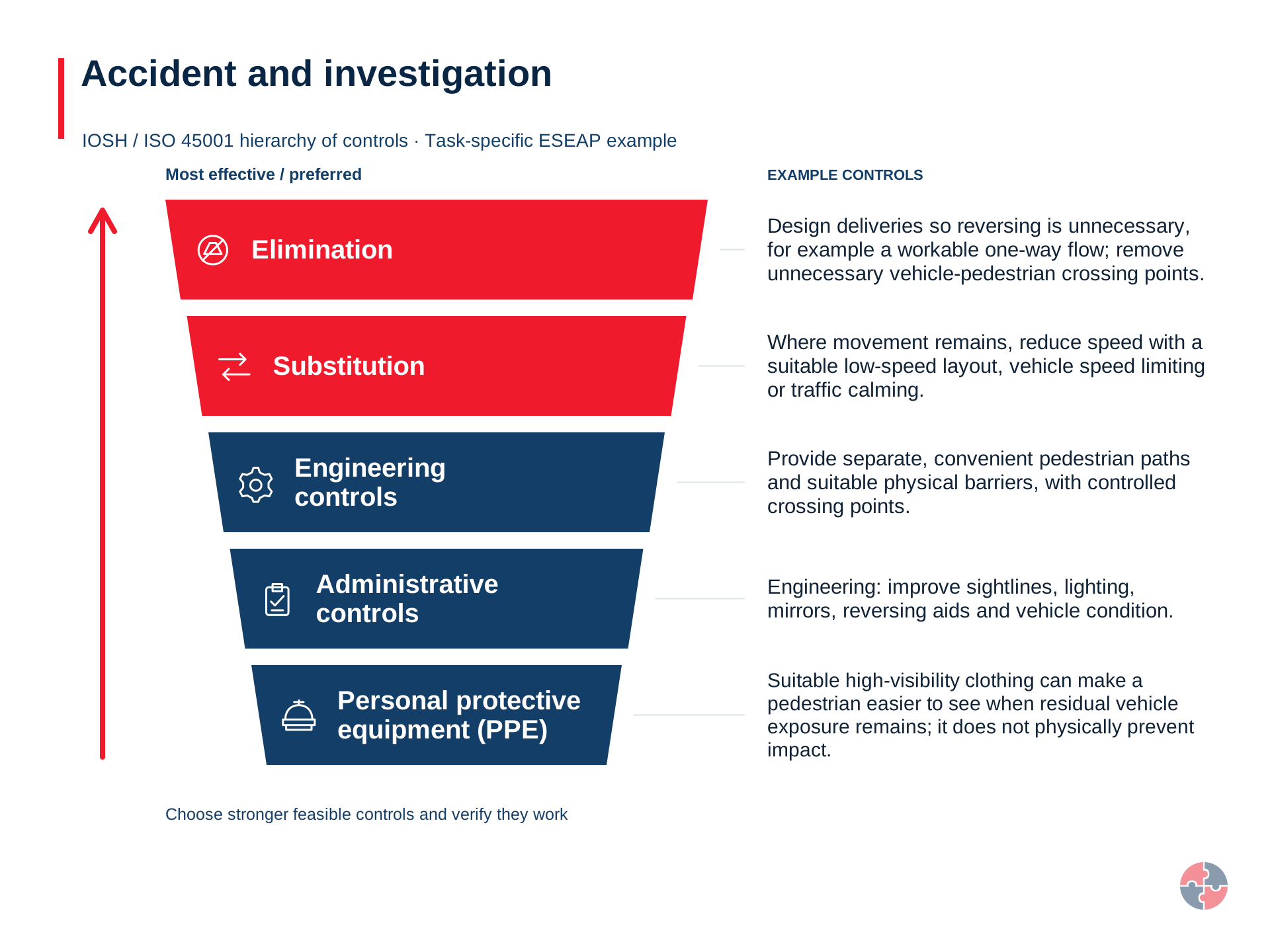
Photorealistic illustrative UK workplace scene. Review checks: Elimination: Replan loading and cleaning so pedestrians never need to enter the reversing bay; feasible if delivery route and service access permit. Substitution: Replace reversing with a one-way drive-through layout where site geometry permits; if not, record swept-path constraint. Engineering controls: Install impact-rated segregation and a gated crossing away from reversing; do not treat painted lines as a physical barrier. Administrative controls: Schedule cleaning outside deliveries and use a controlled crossing procedure for residual access. PPE: High-visibility clothing may aid detection but cannot prevent a forklift strike; select fit/condition for site rules only.
Look beyond the final action
Start by making the scene safe and preserving evidence. Gather accounts and records, build a time sequence, distinguish facts from assumptions, analyse failed barriers and underlying conditions, then choose higher-order corrective actions with owners and verify them in real work. The investigation sequence follows HSE HSG245 . For a forklift/pedestrian corrective action, HSE workplace transport guidance and HSENI separation guidance support route separation; apply the right GB or NI legal route and verify the actual site layout. HSE HSG245 sets out a simple investigation logic: gather information, analyse information, identify risk control measures, and produce an action plan. RCA adds depth by testing why the controls were not present, used, effective or sustained. The investigator should distinguish fact, inference and opinion.
Applied case
Fictional case: An initial note says worker error. Accounts also mention unclear labels and an interrupted handover, but neither factor has yet been checked against records.
A question rather than an answer
An action can be part of the sequence without explaining why it occurred. Examine task conditions and barriers before deciding which causes the evidence supports.
Test your decision
What should analysis do?
Treat the first reported contributor as the only cause without testing alternatives.
Test the proposed factors and barriers against evidence.
Accept worker error as the complete explanation.
Compare the explanation
Test the proposed factors and barriers against evidence.
Causal claims need supported connections, not a blame label.
A fishbone, also called a cause-and-effect or Ishikawa diagram, places the event at its head. The main bones group possible contributors; smaller branches explore what led to each one. Categories are prompts to investigate, not findings.
Fishbone: explore the wider picture
Use it when several things may have contributed. Start with categories such as people, equipment, methods, materials, environment and management; rename them to suit the work. Add causes and subcauses without forcing a single chain.
Ask what led to a specific explanation. Branch when there is another reason, and stop where the evidence runs out. Five is a guide, not a target. Use the two methods together to examine a broad picture and its individual paths.
Define what happened, including the task, place and sequence. Keep the event separate from assumptions about why.
Gather accounts from people involved and add several possible explanations. Explore work conditions, equipment and management arrangements as well as individual actions.
Record supporting and contradictory evidence for each explanation. Keep untested ideas separate from accepted findings; add an open question where evidence is missing.
Review immediate, underlying and root causes from the evidence. A category, the final card or the depth of a branch does not decide the cause level.
Link actions to the supported causes, assign an owner and date, then check implementation and whether the action prevents recurrence.
Compare the worked examples
The two BuildOut reports examine the same invented excavator-arm/scaffold incident: 18 explanations and six actions. Their evidence references are fictional teaching records.
BuildOut fishbone
Six cause categories with subcauses, evidence checks and actions · 24 pages.
Existing SHAREhub photographic illustration. The written fictional case supplies the condition and decision evidence.
Choose actions that change the pathway
A strong action changes the conditions that allowed the event, not just the behaviour after the event. Use ERICPD (Eliminate, Reduce including substitution, Isolate, Control, Personal Protective Equipment, Discipline) to compare proposed corrective actions against the underlying harm path. It is a teaching prompt alongside the HSE five-level hierarchy, not a statutory ladder; a feasible physical route change outranks a new warning or refresher briefing. ERICPD is a planning crossmap. Its prompts do not add a sixth rung or rank Isolate above engineering. Discipline verifies and sustains every control level. The hierarchy of controls in ISO 45001:2018 comes under Clause 8.1.2 (Eliminating hazards and reducing OH&S risks), which is located within Clause 8 ("Operation") .
Applied case
Fictional case: The review establishes that overlapping routes caused repeated encounters. A proposed action is another generic reminder, with no examination of the route arrangement itself.
Completion is not prevention
A briefing may support a changed arrangement. It does not by itself remove the physical pathway that the investigation identified as contributing to the event.
Test your decision
What is the stronger action basis?
Review how to remove or physically control the overlap and verify the chosen arrangement.
Send the reminder and assume the route problem is solved.
Change the layout informally without review.
Compare the explanation
Review how to remove or physically control the overlap and verify the chosen arrangement.
Actions should address the supported mechanism using the appropriate controlled process.
Photorealistic illustrative UK workplace scene. Review checks: Setting: A contractor's lift drops a load into a segregated construction bay; nobody is struck, but workers and a visiting delivery driver were close enough for a credible fatal outcome. Act: Stop the lift and nearby work, account for people, and make the suspended or unstable load safe through the competent lifting team. Hold / review: The local lifting and site leads hold any restart until the equipment and method are checked, interim controls are in place and the investigation owner has recorded the reporting decision.
Verify learning before closure
Actions should match the causes, reduce the risk and be checked after completion to prove they work. An action is not strong simply because it is quick. Re-training everyone after every event may look decisive, but it often avoids the harder questions about equipment, design, workload, maintenance, supervision and planning. A good investigator asks what action would have prevented the event even if a person made a foreseeable mistake. Corrective actions should be written in a way that can be closed properly: what will change, who owns it, when it is due, what evidence proves completion, and how effectiveness will be checked. For serious events, actions should also be reviewed across similar areas so the organisation does not fix one location while leaving the same weakness elsewhere.
Applied case
Fictional case: New crossing controls are installed, but nobody has checked their use during peak deliveries. The report is ready to close because the installation invoice arrived.
Close the learning loop
Record what changed, who checked it and what the sample establishes. Return the outcome to affected people, retaining any unresolved limitation or restriction.
Test your decision
What remains?
Only payment approval.
Proof that no future event is possible.
Verification that the changed arrangement addresses the original encounter in relevant work.
Compare the explanation
Verification that the changed arrangement addresses the original encounter in relevant work.
Closure should connect the action to its intended effect.