Focused awareness learning based on SHAREhub pages. Apply the actual workplace arrangements and your role; completion is not practical competence or permission for specialist work.
This reader supplies the complete teaching. Use the interactive LMS course for assessed activities, saved progress and completion.
LESSON 1
Describe the task and the event
Separate a hazard name from a usable risk scenario.
Existing SHAREhub photographic illustration. The written fictional case supplies the condition and decision evidence.
Describe the task and the event
Risk assessment identifies how work could cause harm and decides what will prevent it. Begin with the actual task, location and people, rather than copying a hazard list. A vehicle is a hazard; a reversing vehicle meeting a pedestrian at a busy doorway describes an event that controls can address. Consider how people reach that point and what changes during the shift.
Use worker knowledge and observation to check the description. Include cleaners, visitors and contractors where their routes interact with work. Record significant findings clearly enough for the person organising the task to act. A completed form is useful only when its account matches the work and makes the required precautions understandable.
Applied case
Fictional case: A depot assessment lists forklifts but omits cleaners crossing its delivery doorway. The supervisor wants to understand the event before choosing precautions.
From name to pathway
A hazard name starts the discussion. The task, exposure route and credible harm explain where a preventive measure must actually interrupt the event.
Test your decision
What should the assessment describe?
A vehicle-maintenance list without examining pedestrian movement.
The previous form’s completion status without observing this task.
The crossing activity, affected people and credible vehicle-contact pathway.
Compare the explanation
The crossing activity, affected people and credible vehicle-contact pathway.
A specific event connects people, exposure and the controls needed.
Recognise a present gap without inventing another defect.
Existing SHAREhub 2D teaching schematic. Use alongside the explanation and fictional case in this lesson.
Identify exposure and uncertainty
Exposure depends on when and where people meet the hazard. Map actual movements, routine and unusual tasks, and the conditions that increase conflict. The source example includes overlapping pedestrian and vehicle routes, poor visibility and delivery pressure. These details explain why a generic instruction may not control the encounter.
Keep facts separate from assumptions. A damaged gate is an observed condition if the case supplies it; a planned barrier is still a future action. Do not credit an uninstalled measure in today’s assessment. If necessary information is missing, identify who must establish it and what restriction is needed meanwhile. An unknown condition is neither proof of safety nor proof that every part of the workplace has failed.
Applied case
Fictional case: The delivery gate is damaged and a new barrier is ordered. No installation has occurred, but the document assessment counts the barrier as present.
Planned and present
Credit the arrangement that exists and is verified now. Record future improvement separately so the current decision does not depend on an imaginary barrier.
Test your decision
Which status is accurate?
The gate finding as a substitute for checking the other relevant route controls.
The barrier is planned; current conflicting movement still needs control.
The purchase order establishes physical protection.
Compare the explanation
The barrier is planned; current conflicting movement still needs control.
Planning a control does not demonstrate that it protects today’s task.
Compare measures by how they change the harm pathway.
Existing SHAREhub 2D teaching schematic. Use alongside the explanation and fictional case in this lesson.
Start with stronger controls
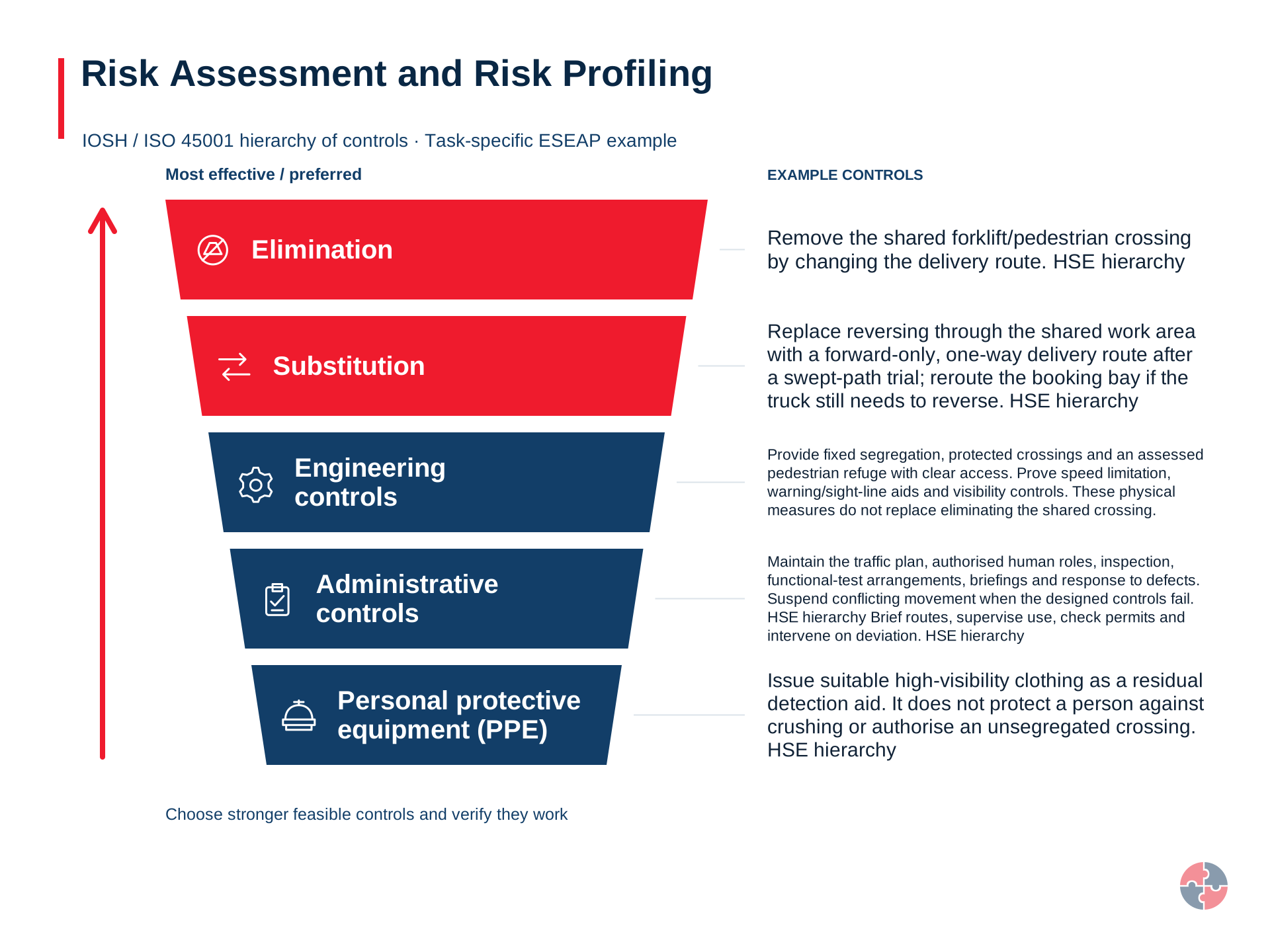
Use the hierarchy to challenge the first convenient solution. Removing a crossing avoids that particular conflict. A physically segregated route changes how vehicles and people can meet. Rules, delivery bookings, instruction and supervision depend on arrangements being followed; high-visibility clothing helps detection but cannot protect a person from crushing.
The appropriate combination needs assessment of the actual layout and task. Do not claim that one measure solves every exposure. Consider whether a proposed substitution or redesign introduces another problem, and identify competent review where needed. The source’s ERICPD teaching prompt helps compare options; it is not an additional statutory checklist. The practical question is which feasible measures reduce the hazard or separate people before reliance on behaviour and PPE.
Applied case
Fictional case: A team proposes only brighter clothing for a doorway where pedestrians and reversing vehicles still share the same space during deliveries and cleaning.
Function before label
Ask what each measure does to this event. A booking rule, physical barrier and garment have different functions and need different evidence of effectiveness.
Test your decision
Which option addresses the encounter more directly?
Review removal or physical separation of the conflicting route.
Treat brighter clothing as crush protection.
Add a signature without changing the route.
Compare the explanation
Review removal or physical separation of the conflicting route.
Stronger controls change the exposure pathway rather than only asking people to notice it.
Specify implementation and verification rather than a vague promise.
Existing SHAREhub 2D teaching schematic. Use alongside the explanation and fictional case in this lesson.
Turn findings into owned action
A useful assessment records the hazard, people, exposure, current controls and further action. Each important improvement needs a responsible role and evidence of completion. The person controlling the task should understand the interim restriction and the conditions for accepting the changed arrangement.
Verification looks beyond a purchase order or a completed briefing. For a protected crossing, the source example examines its actual location, gate, vehicle movement and pedestrian access under representative conditions. A signed record may support that examination but cannot replace it. State residual uncertainty honestly, such as late deliveries or visitor access. The assessment should connect the evidence to the actual task, rather than assume that several unrelated documents create a complete safety argument.
Applied case
Fictional case: A new protected route is installed. Its action is marked complete before anyone checks whether cleaners and visitors can actually use it during busy deliveries.
Installed and effective
Installation is one milestone. Effectiveness asks whether the intended people can use the arrangement and whether the original harm pathway is controlled in practice.
Test your decision
What is the missing close-out question?
Whether procurement records are complete, without checking the installed route in use.
Whether the owner marked the action complete, without field verification.
Whether the installed arrangement controls the actual crossing under relevant conditions.
Compare the explanation
Whether the installed arrangement controls the actual crossing under relevant conditions.
Verify the effect in work, not only administrative completion.
Connect task findings with organisational priorities.
Existing SHAREhub photographic illustration. The written fictional case supplies the condition and decision evidence.
Escalate the wider pattern
Risk profiling looks across tasks and locations to identify the organisation’s important exposures and weak controls. It considers harm potential, confidence in controls, uncertainty and change. A local assessment may identify one blind doorway; the profile asks whether the same problem exists at other depots or on other shifts.
Leaders use that picture to direct resources, assurance and improvement. Do not rank priorities only by the number of minor reports or a convenient average. A serious foreseeable event with an unverified control can require attention despite a low matrix score. Keep the local action and the wider resource decision connected but distinct, with clear owners and a way to check whether the common weakness has actually been addressed.
Applied case
Fictional case: Three depots report the same pedestrian crossing weakness. Each local action waits for funding while the board dashboard averages it with minor office defects.
One site and many
A local finding controls that task. A repeated pattern can also require a leadership decision about design, resources and assurance across affected operations.
Test your decision
What should profiling make visible?
A claim that every depot is identical.
The common high-consequence exposure, control confidence and leadership resource decision.
Only the average number of defects.
Compare the explanation
The common high-consequence exposure, control confidence and leadership resource decision.
A profile supports priorities while preserving the actual scope of the evidence.
Recognise limits and obtain appropriate further assessment.
Existing SHAREhub 2D teaching schematic. Use alongside the explanation and fictional case in this lesson.
Review when the basis changes
An assessment remains useful only while its assumptions fit the work. Changed routes, equipment, materials, people or working patterns can require review. Incidents and worker reports may also show that a control does not perform as expected. Review should ask what changed in the harm pathway, not merely replace the document date.
Some hazards need specialist assessment or advice. A generic form cannot establish an unknown exposure level, structural capacity or machine-safety requirement. Keep one coherent risk picture and identify the specific question needing expertise. The source distinguishes GB and NI requirements and cautions against automatically creating separate forms for every circumstance. Use the actual workplace arrangements, retain necessary restrictions and record what evidence will allow the responsible person to resolve the uncertainty.
Applied case
Fictional case: A depot changes delivery times and visitor access. The old assessment assumes an empty doorway, and nobody has checked how the new pattern affects crossing conflicts.
A decision aid
A score organises discussion; it cannot supply missing technical information or cancel a serious control question. Escalate the uncertainty to the appropriate competent role.
Test your decision
What should trigger review?
The changed exposure pattern and whether the existing controls still work.
Only the assessment’s anniversary.
Only a serious injury.
Compare the explanation
The changed exposure pattern and whether the existing controls still work.
Review follows changed conditions and evidence, rather than waiting for harm.