Optional presentation practice. Choices and model launches do not write LMS grades, completion or certificates. This extension takes additional learning time.
1. Workplace transport and pedestrian safety Remove vehicle encounters where possible and keep the live routes separated.
2. Choose a learning route 3. Follow the vehicle and pedestrian encounter Follow the vehicle and pedestrian encounter.
A slow vehicle can still crush, trap or run over a person. A turning vehicle can sweep beyond its wheel tracks, and a load or trailer can hide someone from the driver. Walls, parked equipment and loading areas can leave pedestrians no safe space.
A slow vehicle can still crush, trap or run over a person. A turning vehicle can sweep beyond its wheel tracks, and a load or trailer can hide someone from the driver. Walls, parked equipment and loading areas can leave pedestrians no safe space. Loads can shift or fall, vehicles can overturn and people can fall while getting on or off. These harm pathways exist in familiar yards as well as unusual work sites.
Start with the actual journeys and activities rather than the speed sign alone. Include staff, visitors, cleaners, contractors and the public where they can be exposed. Identify doors, crossings, blind corners, parking, reversing and loading. A driver acting carefully cannot compensate for every unsuitable route or person placed in the vehicle danger area.
4. The fictional case and decision boundary Follow the vehicle and pedestrian encounter.
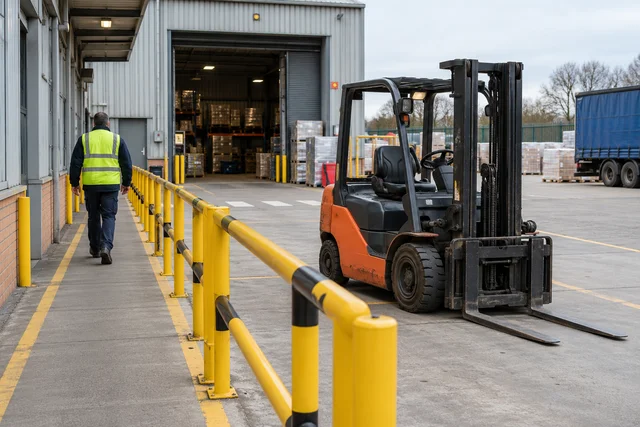
Task and setting A delivery enters a busy yard while staff use a welfare route. Stored materials narrow the walkway, a different vehicle arrives and the unloading team must resolve the live movement plan. Decision to practise Pallet storage blocks the protected walkway, so workers step into the delivery route. The proposed fix is brighter clothing and another sign while leaving the storage in place. Evidence to consider Remove and separate journeys before adding warnings.
5. Decision 1: interpret the evidence Pallet storage blocks the protected walkway, so workers step into the delivery route. The proposed fix is brighter clothing and another sign while leaving the storage in place.
Which improvement addresses the stronger control?
Restore or redesign effective pedestrian separation and the usable route. (supported response) Use clothing as a complete replacement for the walkway. Tell pedestrians to walk faster past vehicles. The layout must provide a practical safe route rather than rely on visibility and individual reaction alone.
6. Reconsider the evidence Which improvement addresses the stronger control?
Restore or redesign effective pedestrian separation and the usable route. (supported response) Use clothing as a complete replacement for the walkway. Tell pedestrians to walk faster past vehicles. The layout must provide a practical safe route rather than rely on visibility and individual reaction alone.
7. Decision 1 explained The layout must provide a practical safe route rather than rely on visibility and individual reaction alone.
Remove and separate journeys before adding warnings.
8. Remove and separate journeys before adding warnings Remove and separate journeys before adding warnings.
First remove unnecessary vehicle movements and reversing where practicable. Design routes and schedules to separate people from vehicles, with suitable physical protection where risk warrants. Safe crossings, sightlines, entrances and waiting areas must fit the actual activities.
First remove unnecessary vehicle movements and reversing where practicable. Design routes and schedules to separate people from vehicles, with suitable physical protection where risk warrants. Safe crossings, sightlines, entrances and waiting areas must fit the actual activities. Marked lines, alarms, high-visibility clothing and a marshal support a suitable layout; they do not replace it. A blocked walkway can force people into a vehicle route despite a good plan on paper.
Check how workers actually reach welfare, exits and their work areas. Include accessible routes and visiting drivers rather than assuming everyone knows a shortcut. Temporary storage and construction phases can alter the encounter points. If the work reaches a public road or footway, use the separate competent design and approval route; a private yard sketch cannot authorise a road closure or diversion.
9. Match the transport question Match each card to its meaning. Drag, or use the labelled category selector.
Match each card to its meaning. Drag, or use the labelled category selector.
Are the route, barriers and sightlines suitable? — Safe site. Layout and operating areas matter. Does the actual vehicle suit the load and space? — Safe vehicle. Do not assume the booked type arrived. Is the operator competent and briefed for this site? — Safe driver. A general certificate does not explain the yard. 10. Compare the reasoning: Match the transport question Are the route, barriers and sightlines suitable? Safe site Does the actual vehicle suit the load and space? Safe vehicle Is the operator competent and briefed for this site? Safe driver
Match each card to its meaning. Drag, or use the labelled category selector.
Are the route, barriers and sightlines suitable? — Safe site. Layout and operating areas matter. Does the actual vehicle suit the load and space? — Safe vehicle. Do not assume the booked type arrived. Is the operator competent and briefed for this site? — Safe driver. A general certificate does not explain the yard. 11. Match site, vehicle and driver Match site, vehicle and driver.
The safe-site, safe-vehicle and safe-driver model connects three requirements. The route needs suitable space, ground, lighting, visibility and overhead clearance. The vehicle needs to suit the load and task and remain in safe condition. The driver needs competence, authorisation and current site instructions.
The safe-site, safe-vehicle and safe-driver model connects three requirements. The route needs suitable space, ground, lighting, visibility and overhead clearance. The vehicle needs to suit the load and task and remain in safe condition. The driver needs competence, authorisation and current site instructions. Strength in one area cannot automatically correct failure in another. A skilled driver cannot make an unsuitable turning space or unstable load safe simply by taking care.
Agree delivery details before arrival with the host, carrier and supplier. Confirm the actual vehicle, load information, unloading method, waiting location and communication. A larger or unfamiliar vehicle can invalidate the booked route. Hold the affected movement at the agreed safe point while responsible people resolve the mismatch instead of asking the visiting driver to invent a plan at the gate.
Open the related fictional model case
12. Decision 2: choose the response A guide stands in the narrowing space behind a reversing vehicle. The driver loses the agreed view, but another worker waves from a different position to keep the delivery moving.
What is the appropriate decision?
Ask the guide to remain in the trapping space. Stop using the agreed safe rule and restore a workable coordinated method. (supported response) Choose whichever signal is easiest to see and continue. Guidance must not expose the guide or replace the required clear communication and safe route.
13. Compare the consequences What is the appropriate decision?
Ask the guide to remain in the trapping space. Stop using the agreed safe rule and restore a workable coordinated method. (supported response) Choose whichever signal is easiest to see and continue. Guidance must not expose the guide or replace the required clear communication and safe route.
14. Decision 2 explained Guidance must not expose the guide or replace the required clear communication and safe route.
Control reversing and communication without exposing a guide.
15. Control reversing and communication without exposing a guide Control reversing and communication without exposing a guide.
Avoid or reduce reversing by suitable layout and planning where practicable. Where residual movement needs guidance, the method must provide competent people, agreed communication, visibility and a safe position.
Avoid or reduce reversing by suitable layout and planning where practicable. Where residual movement needs guidance, the method must provide competent people, agreed communication, visibility and a safe position. A guide should not stand in a crushing area or walk backwards into danger to make a poor route work. A warning alarm or camera has limitations and does not establish that every blind area is clear.
Use the agreed stop rule if communication or sight is lost or someone enters the danger area. Do not replace the planned signal with competing instructions from passers-by. Review why reversing is needed and whether the route can be changed. A marshal is a supporting control, not automatic permission to use an unsuitable layout or mix pedestrians with the vehicle.
16. Judge reversing controls Sort the cards. Drag each card, or use its labelled category selector.
Sort the cards. Drag each card, or use its labelled category selector.
The agreed communication and safe guide position are maintained. — Useful current control. The guide must remain protected. A camera makes every blind spot impossible. — Does not replace a suitable method. Equipment has limitations. Loss of the agreed view triggers the safe stop. — Useful current control. Act on a failed condition. A marshal compensates for any unsuitable layout. — Does not replace a suitable method. Guidance cannot repair every route failure. 17. Compare the reasoning: Judge reversing controls The agreed communication and safe guide position are maintained. Useful current control A camera makes every blind spot impossible. Does not replace a suitable method Loss of the agreed view triggers the safe stop. Useful current control A marshal compensates for any unsuitable layout. Does not replace a suitable method
Sort the cards. Drag each card, or use its labelled category selector.
The agreed communication and safe guide position are maintained. — Useful current control. The guide must remain protected. A camera makes every blind spot impossible. — Does not replace a suitable method. Equipment has limitations. Loss of the agreed view triggers the safe stop. — Useful current control. Act on a failed condition. A marshal compensates for any unsuitable layout. — Does not replace a suitable method. Guidance cannot repair every route failure. 18. Keep loading and waiting arrangements live Keep loading and waiting arrangements live.
Agree the loading or unloading method before the vehicle arrives. Check the load, equipment, surface, lighting, people and driver waiting or observation position. Keep pedestrians out of the vehicle and load operating area and prevent unplanned vehicle movement through the agreed system.
Agree the loading or unloading method before the vehicle arrives. Check the load, equipment, surface, lighting, people and driver waiting or observation position. Keep pedestrians out of the vehicle and load operating area and prevent unplanned vehicle movement through the agreed system. The host, carrier and supplier have responsibilities to coordinate; the driver should not be left to discover the safe method while standing in a live bay.
During work, control other arrivals and preserve communication. If a load has shifted, do not release restraints or open it by guesswork where material could fall. Obtain a suitable method from the responsible competent loading team. Anyone who needs to approach should first request and confirm the planned stop. Completion must be clear before the vehicle or pedestrians are released back through the area.
Open the related fictional model case
19. Decision 3: apply and review The blocked route is redrawn on a plan, but pallets still prevent access and the new pedestrian arrangement has not been briefed. The next vehicle waits to be admitted.
What supports restarting the affected movement?
The revised drawing alone. The fact that the next driver is waiting. Implemented and verified route controls with communication to affected people. (supported response) Close-out needs the real route and people arrangements restored, not merely edited paperwork.
20. Revisit the control or support boundary What supports restarting the affected movement?
The revised drawing alone. The fact that the next driver is waiting. Implemented and verified route controls with communication to affected people. (supported response) Close-out needs the real route and people arrangements restored, not merely edited paperwork.
21. Decision 3 explained Close-out needs the real route and people arrangements restored, not merely edited paperwork.
Restore the route before restarting movement.
22. Restore the route before restarting movement Restore the route before restarting movement.
Stop affected movement when a barrier, route, load, vehicle condition, visibility or driver briefing fails. The safe waiting and stopping arrangements must be part of the plan, not improvised inside a conflict. Rain, storage, contractor activity and changing delivery peaks can invalidate an earlier check.
Stop affected movement when a barrier, route, load, vehicle condition, visibility or driver briefing fails. The safe waiting and stopping arrangements must be part of the plan, not improvised inside a conflict. Rain, storage, contractor activity and changing delivery peaks can invalidate an earlier check. A signed route sheet is not permission to continue when pedestrians are forced into the vehicle path or the unloading area is unavailable.
Resolve the cause through the responsible site roles. Clear or redesign the route, coordinate affected people and verify separation before restart. After the operation, restore access and barriers, check the area and communicate remaining restrictions. Near misses and recurring workarounds are evidence for improvement. An updated drawing alone does not prove that the changed arrangement works where the vehicle actually moves.
23. Resolve the blocked route Arrange the steps for this case. Drag, or use Move up and Move down.
Arrange the steps for this case. Drag, or use Move up and Move down.
Hold the affected movement at the planned safe point. Resolve the route, load and people conflict through responsible coordination. Implement and verify the suitable separation and instructions. Release the movement and preserve the restored arrangement. This is the planning and release route, not an instruction to manoeuvre a vehicle.
24. Compare the reasoning: Resolve the blocked route 1 Hold the affected movement at the planned safe point. 2 Resolve the route, load and people conflict through responsible coordination. 3 Implement and verify the suitable separation and instructions. 4 Release the movement and preserve the restored arrangement.
Arrange the steps for this case. Drag, or use Move up and Move down.
Hold the affected movement at the planned safe point. Resolve the route, load and people conflict through responsible coordination. Implement and verify the suitable separation and instructions. Release the movement and preserve the restored arrangement. This is the planning and release route, not an instruction to manoeuvre a vehicle.
25. Apply the lesson in a fictional workplace A vehicle reverses around the building where a pedestrian route emerges from a doorway.
Restore the route before restarting movement.
Open the related fictional model case
26. Take the learning into a fictional task Restore the route before restarting movement.
Task and people A delivery enters a busy yard while staff use a welfare route. Stored materials narrow the walkway, a different vehicle arrives and the unloading team must resolve the live movement plan. Control or support Control reversing and communication without exposing a guide. Check and review Restore the route before restarting movement.
27. Explain your reasoning without the answer sheet Use the supplied case facts. Explain why a choice fits the task and what remains uncertain. A points total or completed form cannot replace the required control or support arrangement.
28. Continue with the full course and Knowledge Hub Use the original course for its six lessons, required activities, final assessment and saved record. This optional companion does not change course grades, completion or certificates.
Enable JavaScript for interactive practice, or use the PowerPoint and its notes.


 All 50 presentations