Optional presentation practice. Choices and model launches do not write LMS grades, completion or certificates. This extension takes additional learning time.
1. Confined-space awareness Recognise the risk, avoid entry and never improvise rescue.
2. Choose a learning route 3. Recognise the space and the serious risk Recognise the space and the serious risk.
A confined space is substantially enclosed and has one or more specified serious risks arising from the place, contents, atmosphere or work. It need not be tiny, fully sealed or difficult to enter.
A confined space is substantially enclosed and has one or more specified serious risks arising from the place, contents, atmosphere or work. It need not be tiny, fully sealed or difficult to enter. Serious risks can include fire or explosion, dangerous heat, harmful atmosphere or oxygen deficiency, rising liquid and engulfment by free-flowing solids. Difficult access is an important planning issue but is not, alone, the definition.
Tanks, chambers, pits, ducts and other familiar work locations may need assessment. A large entrance or previous safe visit cannot settle present conditions. Ask what could change through the contents, connected plant or intended task. Do not enter to decide whether the space is hazardous. Keep people out while the responsible competent assessment resolves the actual risk and applicable arrangements.
4. The fictional case and decision boundary Recognise the space and the serious risk.
Task and setting A team wants to inspect a drainage chamber used previously without incident. The current contents and connections are uncertain, and the proposed rescue plan is only to call for help. Decision to practise A team has an earlier gas result but no assessment of a connected liquid feed or moving equipment. They describe the reading as a complete safety certificate for the chamber. Evidence to consider Consider more than a single gas reading.
5. Decision 1: interpret the evidence A team has an earlier gas result but no assessment of a connected liquid feed or moving equipment. They describe the reading as a complete safety certificate for the chamber.
What remains unresolved?
Nothing because one reading controls every hazard. Only a repeat of the earlier atmosphere result without addressing feeds. The other serious risks and whether current conditions and controls are established. (supported response) Atmospheric evidence has a scope and does not control physical or incoming-material hazards.
6. Reconsider the evidence What remains unresolved?
Nothing because one reading controls every hazard. Only a repeat of the earlier atmosphere result without addressing feeds. The other serious risks and whether current conditions and controls are established. (supported response) Atmospheric evidence has a scope and does not control physical or incoming-material hazards.
7. Decision 1 explained Atmospheric evidence has a scope and does not control physical or incoming-material hazards.
Consider more than a single gas reading.
8. Consider more than a single gas reading Consider more than a single gas reading.
Atmospheric hazards may be invisible. Oxygen can be depleted or displaced; toxic gases or vapours can accumulate; flammable material can create fire or explosion conditions. The task itself may introduce a hazard.
Atmospheric hazards may be invisible. Oxygen can be depleted or displaced; toxic gases or vapours can accumulate; flammable material can create fire or explosion conditions. The task itself may introduce a hazard. Physical dangers also include machinery, incoming liquid, moving solids, heat, poor communication and difficult movement. A gas detector does not prevent flooding, stop an agitator or provide a usable rescue route.
The competent assessment must cover the complete task and changing conditions. No smell, no visible mist and a familiar appearance are not proof of safety. A result from unsuitable equipment, a wrong location or an irrelevant time can create false reassurance. An awareness learner must not select alarm limits, sampling positions or breathing equipment from memory; the authorised system defines the proper competent method.
9. Recognise the evidence limit Sort the cards. Drag each card, or use its labelled category selector.
Sort the cards. Drag each card, or use its labelled category selector.
A connected feed could introduce liquid. — Relevant concern or control. Physical risks remain part of the assessment. The entrance is wide, so no assessment is needed. — Insufficient all-clear. Size alone does not settle specified risks. A suitable outside method avoids entry. — Relevant concern or control. First consider genuine avoidance. No smell proves the atmosphere is safe. — Insufficient all-clear. Atmospheric dangers may not be detectable by senses. 10. Compare the reasoning: Recognise the evidence limit A connected feed could introduce liquid. Relevant concern or control The entrance is wide, so no assessment is needed. Insufficient all-clear A suitable outside method avoids entry. Relevant concern or control No smell proves the atmosphere is safe. Insufficient all-clear
Sort the cards. Drag each card, or use its labelled category selector.
A connected feed could introduce liquid. — Relevant concern or control. Physical risks remain part of the assessment. The entrance is wide, so no assessment is needed. — Insufficient all-clear. Size alone does not settle specified risks. A suitable outside method avoids entry. — Relevant concern or control. First consider genuine avoidance. No smell proves the atmosphere is safe. — Insufficient all-clear. Atmospheric dangers may not be detectable by senses. 11. Test a suitable no-entry option first Test a suitable no-entry option first.
First ask whether the objective can be achieved without putting a person into the space. Remote inspection, external sampling or suitable cleaning access may remove the entry exposure.
First ask whether the objective can be achieved without putting a person into the space. Remote inspection, external sampling or suitable cleaning access may remove the entry exposure. The alternative must itself be assessed: equipment used from outside can create pressure, chemical release or public-exposure hazards. Avoidance is not achieved simply by moving the operator a short distance while leaving another person exposed to the same entry risk.
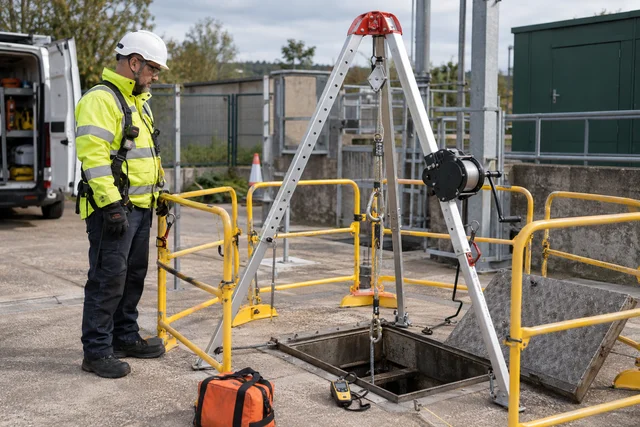
For the drainage case, a competent review can consider inspection and clearance from outside. If entry remains necessary, establish why a practicable no-entry method cannot achieve the task safely, then use a space-specific safe system. Owning entry equipment or being experienced in the chamber does not remove the need to examine the stronger option before committing people.
Open the related fictional model case
12. Decision 2: choose the response A permit is prepared for entry, but the connected feed, responsible standby role and required communication method remain unconfirmed. The team suggests completing those details once someone is inside.
What is the appropriate decision?
Do not start entry until the required safe system and conditions are established. (supported response) Use the permit number as complete authorisation. Enter briefly to help finish planning. Planning and implemented controls must precede exposure; the entry itself cannot be the information-gathering shortcut.
13. Compare the consequences What is the appropriate decision?
Do not start entry until the required safe system and conditions are established. (supported response) Use the permit number as complete authorisation. Enter briefly to help finish planning. Planning and implemented controls must precede exposure; the entry itself cannot be the information-gathering shortcut.
14. Decision 2 explained Planning and implemented controls must precede exposure; the entry itself cannot be the information-gathering shortcut.
Require a complete competent safe system.
15. Require a complete competent safe system Require a complete competent safe system.
If entry cannot be avoided, the safe system must fit the exact space and work. It brings together authorisation, competent people, isolation, cleaning, atmosphere assessment, suitable equipment, ventilation, supervision, communication and rescue.
If entry cannot be avoided, the safe system must fit the exact space and work. It brings together authorisation, competent people, isolation, cleaning, atmosphere assessment, suitable equipment, ventilation, supervision, communication and rescue. A permit may support the arrangement, but the document is not the control itself. Roles must be clear before work: who authorises, who enters, who remains outside and who can stop the job.
Use current information and verify required conditions through the competent system. Isolation must address relevant feeds, machinery and stored hazards, not just the main electrical switch. The atmosphere can change with the task, connected operations or ventilation. If essential information, control or communication is missing, retain the entry hold. Do not invent an entry procedure from this short awareness course.
16. Match the planning question Match each card to its meaning. Drag, or use the labelled category selector.
Match each card to its meaning. Drag, or use the labelled category selector.
Can the task be achieved safely from outside? — Avoidance. Test the stronger option first. Are the exact roles, feeds and conditions controlled? — Entry safe system. A form cannot create them. Can the planned team recover an incapacitated person here? — Rescue capability. The method must fit the real space. 17. Compare the reasoning: Match the planning question Can the task be achieved safely from outside? Avoidance Are the exact roles, feeds and conditions controlled? Entry safe system Can the planned team recover an incapacitated person here? Rescue capability
Match each card to its meaning. Drag, or use the labelled category selector.
Can the task be achieved safely from outside? — Avoidance. Test the stronger option first. Are the exact roles, feeds and conditions controlled? — Entry safe system. A form cannot create them. Can the planned team recover an incapacitated person here? — Rescue capability. The method must fit the real space. 18. Make rescue real before entry Make rescue real before entry.
Rescue must be planned, equipped, staffed and practised for the exact space and foreseeable casualty condition before entry. The route for an incapacitated person can differ from normal access. Communication, competent responders, suitable equipment and emergency-service access all matter.
Rescue must be planned, equipped, staffed and practised for the exact space and foreseeable casualty condition before entry. The route for an incapacitated person can differ from normal access. Communication, competent responders, suitable equipment and emergency-service access all matter. A harness alone does not establish a retrieval system. Calling emergency services is important in an emergency but cannot be the only planned provision for the work.
The standby person must not enter spontaneously. Ordinary colleagues can become additional casualties in an unassessed atmosphere or other danger. If a required rescuer, equipment item or communication link is unavailable, entry does not start. If an essential arrangement fails during the task, use the planned withdrawal and response from safety. Awareness completion does not create specialist rescue competence or authority.
Open the related fictional model case
19. Decision 3: apply and review Communication fails during planned entry and the task is paused. Later the device reconnects, but the team has not checked the current space conditions or revalidated the interrupted work.
What supports restarting?
The old permit as proof nothing else changed. Competent review and accepted restoration of the complete current arrangement. (supported response) The device reconnecting alone. One restored component does not establish the full safe system after an interruption.
20. Revisit the control or support boundary What supports restarting?
The old permit as proof nothing else changed. Competent review and accepted restoration of the complete current arrangement. (supported response) The device reconnecting alone. One restored component does not establish the full safe system after an interruption.
21. Decision 3 explained One restored component does not establish the full safe system after an interruption.
Act on change and retain the entry hold.
22. Act on change and retain the entry hold Act on change and retain the entry hold.
Conditions can change after assessment or testing. New work, a failed ventilation arrangement, unexpected contents, a feed change or lost communication can invalidate the accepted safe state. Use the specified stopping, withdrawal and emergency route rather than remaining inside to diagnose the failure.
Conditions can change after assessment or testing. New work, a failed ventilation arrangement, unexpected contents, a feed change or lost communication can invalidate the accepted safe state. Use the specified stopping, withdrawal and emergency route rather than remaining inside to diagnose the failure. Keep others out and tell the responsible people what is known and uncertain. Do not make an unplanned rescue attempt or re-enter because an obvious symptom disappears.
Restart needs competent reassessment, restored controls and the required authorisation for current conditions. Evidence should connect the task, people, isolation, atmosphere arrangements, equipment and rescue readiness. A previous permit or successful visit does not carry forward indefinitely. Handover must communicate unfinished work and restrictions so the incoming team does not interpret a paused task as an available space.
23. Keep the safe boundary Make a decision at each point and use the feedback before continuing.
Make a decision at each point and use the feedback before continuing.
Stage 1: What does an ordinary worker do? A colleague collapses inside an unassessed space.
Enter quickly because rescue is urgent. — Reconsider. This can create another casualty. Keep out and activate the planned emergency response. — Supported choice. Use the competent response from safety. Enter wearing any available filter mask. — Reconsider. Unknown atmosphere cannot be solved that way. Stage 2: What authorises further entry? The incident is over and the space looks normal.
Current competent assessment and the required restored safe system. — Supported choice. Appearance is not an all-clear. The absence of visible vapour only. — Reconsider. The hazard may be invisible. The previous entry success. — Reconsider. Past outcome does not establish present conditions. 24. Compare the reasoning: Keep the safe boundary What does an ordinary worker do? Keep out and activate the planned emergency response. What authorises further entry? Current competent assessment and the required restored safe system.
Make a decision at each point and use the feedback before continuing.
Stage 1: What does an ordinary worker do? A colleague collapses inside an unassessed space.
Enter quickly because rescue is urgent. — Reconsider. This can create another casualty. Keep out and activate the planned emergency response. — Supported choice. Use the competent response from safety. Enter wearing any available filter mask. — Reconsider. Unknown atmosphere cannot be solved that way. Stage 2: What authorises further entry? The incident is over and the space looks normal.
Current competent assessment and the required restored safe system. — Supported choice. Appearance is not an all-clear. The absence of visible vapour only. — Reconsider. The hazard may be invisible. The previous entry success. — Reconsider. Past outcome does not establish present conditions. 25. Apply the lesson in a fictional workplace Someone is about to descend a drainage chamber with restricted access and a foreseeable dangerous atmosphere.
Act on change and retain the entry hold.
Open the related fictional model case
26. Take the learning into a fictional task Act on change and retain the entry hold.
Task and people A team wants to inspect a drainage chamber used previously without incident. The current contents and connections are uncertain, and the proposed rescue plan is only to call for help. Control or support Require a complete competent safe system. Check and review Act on change and retain the entry hold.
27. Explain your reasoning without the answer sheet Use the supplied case facts. Explain why a choice fits the task and what remains uncertain. A points total or completed form cannot replace the required control or support arrangement.
28. Continue with the full course and Knowledge Hub Use the original course for its six lessons, required activities, final assessment and saved record. This optional companion does not change course grades, completion or certificates.
Enable JavaScript for interactive practice, or use the PowerPoint and its notes.


 All 50 presentations