Optional presentation practice. Choices and model launches do not write LMS grades, completion or certificates. This extension takes additional learning time.
1. LEV awareness and user checks Follow the extraction path and judge capture during the actual work.
2. Choose a learning route 3. Intercept the contaminant before inhalation Intercept the contaminant before inhalation.
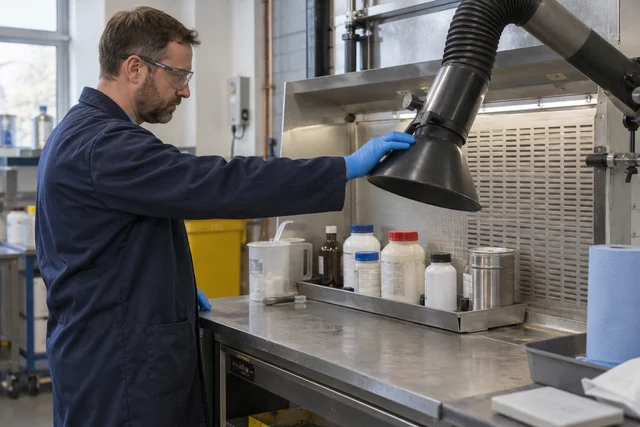
Local exhaust ventilation removes contaminated air close to where dust, fume, mist or vapour is produced. The purpose is to intercept the release before it passes through a person breathing zone or spreads to others. A clean-looking room can still contain hazardous airborne material.
Local exhaust ventilation removes contaminated air close to where dust, fume, mist or vapour is produced. The purpose is to intercept the release before it passes through a person breathing zone or spreads to others. A clean-looking room can still contain hazardous airborne material. Some exposures irritate immediately; others contribute to asthma, cancer or long-term lung disease. Seeing little dust and feeling well are therefore weak assurances of control.
Follow the source, the work position and the intended path into the hood. An extraction system must suit the task and substance, with stronger opportunities to avoid or reduce the release considered first. It is not a general room fan that can be placed anywhere and assumed to protect every activity.
4. The fictional case and decision boundary Intercept the contaminant before inhalation.
Task and setting A workshop uses extraction during sanding and bench work. The fan is audible, but the work position has changed and dust appears outside the expected capture area. Decision to practise The fan runs normally, but a flexible duct is crushed behind the machine. The operator suggests checking only the hood because it is the part nearest the work. Evidence to consider Understand the connected airflow chain.
5. Decision 1: interpret the evidence The fan runs normally, but a flexible duct is crushed behind the machine. The operator suggests checking only the hood because it is the part nearest the work.
Which approach is appropriate?
Ignore everything downstream of the hood. Open the collector without a maintenance assessment. Treat the damaged duct as a system defect and follow the reporting arrangement. (supported response) The system works as a chain; a running fan cannot demonstrate the condition or suitability of the whole route.
6. Reconsider the evidence Which approach is appropriate?
Ignore everything downstream of the hood. Open the collector without a maintenance assessment. Treat the damaged duct as a system defect and follow the reporting arrangement. (supported response) The system works as a chain; a running fan cannot demonstrate the condition or suitability of the whole route.
7. Decision 1 explained The system works as a chain; a running fan cannot demonstrate the condition or suitability of the whole route.
Understand the connected airflow chain.
8. Understand the connected airflow chain Understand the connected airflow chain.
The hood is the visible beginning of a connected system. Ducts transport the contaminated air; suitable cleaners or collectors deal with the relevant contaminant; the fan moves air against system resistance; discharge arrangements must not expose others or allow contamination to return.
The hood is the visible beginning of a connected system. Ducts transport the contaminated air; suitable cleaners or collectors deal with the relevant contaminant; the fan moves air against system resistance; discharge arrangements must not expose others or allow contamination to return. Make-up air, dampers, enclosures and monitoring devices can also affect performance. Designs differ, so do not assume every filter removes every gas or that every system has identical components.
A defect anywhere along the path can weaken capture. A crushed hose, blocked filter, moved damper or damaged enclosure matters even when a fan runs. Use the system information to recognise the installed parts and designated checks. Cleaning or opening contaminated components can expose maintainers and needs its own assessed, competent arrangements.
9. Match the LEV function Match each card to its meaning. Drag, or use the labelled category selector.
Match each card to its meaning. Drag, or use the labelled category selector.
Hood intercepts the release. — Capture. Capture occurs near the source. Duct carries contaminated air. — Transport. The route must remain suitable and intact. Fan moves air through the system. — Air movement. Running alone does not prove capture. Competent examination compares performance with the required basis. — Assurance. This is an assurance activity. 10. Compare the reasoning: Match the LEV function Hood intercepts the release. Capture Duct carries contaminated air. Transport Fan moves air through the system. Air movement Competent examination compares performance with the required basis. Assurance
Match each card to its meaning. Drag, or use the labelled category selector.
Hood intercepts the release. — Capture. Capture occurs near the source. Duct carries contaminated air. — Transport. The route must remain suitable and intact. Fan moves air through the system. — Air movement. Running alone does not prove capture. Competent examination compares performance with the required basis. — Assurance. This is an assurance activity. 11. Keep the task inside the assessed capture arrangement Keep the task inside the assessed capture arrangement.
The capture zone is the area in which the hood can draw the contaminant into the system. The working zone is where the job happens; the breathing zone is the air the person inhales.
The capture zone is the area in which the hood can draw the contaminant into the system. The working zone is where the job happens; the breathing zone is the air the person inhales. Good layout connects the source to the hood without taking contamination past the face. A person standing between the source and hood, a moving workpiece or a cross-draught can disturb that path.
Use the commissioned method and designated hood position rather than a universal distance or a guessed airflow. Move an extraction arm with the task only as the assessed method requires. If the task, workpiece or surrounding conditions change, review whether capture still works. A bigger fan is not a substitute for resolving an unsuitable hood or work arrangement.
Open the related fictional model case
12. Decision 2: choose the response A pre-use sheet is signed before the machine starts. During work, dust escapes and a filter alarm appears; a colleague says the signed sheet permits the whole shift.
What should happen now?
Stop the affected task safely and report the changed control condition. (supported response) Continue until the signed shift ends. Silence the alarm and keep the completed sheet. Current evidence of failure overrides the assumption that an earlier check guarantees an entire shift.
13. Compare the consequences What should happen now?
Stop the affected task safely and report the changed control condition. (supported response) Continue until the signed shift ends. Silence the alarm and keep the completed sheet. Current evidence of failure overrides the assumption that an earlier check guarantees an entire shift.
14. Decision 2 explained Current evidence of failure overrides the assumption that an earlier check guarantees an entire shift.
Use specific pre-use and task checks.
15. Use specific pre-use and task checks Use specific pre-use and task checks.
Users need to know what their system should look, sound and indicate when ready. The manual and logbook should support clear checks of hood position, damage, duct condition, the specified indicator range and any alarms.
Users need to know what their system should look, sound and indicate when ready. The manual and logbook should support clear checks of hood position, damage, duct condition, the specified indicator range and any alarms. A current examination label is useful background, but it does not override a split hose, active alarm or escaping dust noticed today. Checks must relate to the installed system and actual task, not a generic tick list.
Observe performance while work occurs as well as before starting. If dust escapes, a hose breaks or the required indication is wrong, stop the affected activity safely and report it. Do not adjust dampers or bypass alarms to obtain an acceptable-looking reading. Record what was observed and which operation was affected.
16. Judge user-check evidence Sort the cards. Drag each card, or use its labelled category selector.
Sort the cards. Drag each card, or use its labelled category selector.
Dust is escaping during the assessed task. — Actionable present condition. Report and act on failed control. The motor can be heard. — Insufficient reassurance. Sound alone cannot prove capture. A hose is visibly split. — Actionable present condition. Damage affects the airflow chain. An old label is used to dismiss a new alarm. — Insufficient reassurance. Earlier evidence cannot erase a current warning. 17. Compare the reasoning: Judge user-check evidence Dust is escaping during the assessed task. Actionable present condition The motor can be heard. Insufficient reassurance A hose is visibly split. Actionable present condition An old label is used to dismiss a new alarm. Insufficient reassurance
Sort the cards. Drag each card, or use its labelled category selector.
Dust is escaping during the assessed task. — Actionable present condition. Report and act on failed control. The motor can be heard. — Insufficient reassurance. Sound alone cannot prove capture. A hose is visibly split. — Actionable present condition. Damage affects the airflow chain. An old label is used to dismiss a new alarm. — Insufficient reassurance. Earlier evidence cannot erase a current warning. 18. Distinguish the assurance questions Distinguish the assurance questions.
Commissioning establishes whether an installed or modified system meets its intended control specification before people rely on it. User checks look for readiness and deterioration during everyday operation. Maintenance preserves condition. Thorough examination and test is a competent periodic assessment of continuing effectiveness.
Commissioning establishes whether an installed or modified system meets its intended control specification before people rely on it. User checks look for readiness and deterioration during everyday operation. Maintenance preserves condition. Thorough examination and test is a competent periodic assessment of continuing effectiveness. They connect, but one does not replace another. A historic test cannot establish the effect of an unreviewed modification or present damage.
The commissioned benchmark, manual, logbook and earlier findings help people judge the current system. Managers need to resolve defects, not simply file reports. If the process or extraction arrangement changes, obtain the appropriate competent review and verification. Users must not invent test intervals, airflow limits or acceptance criteria from a generic course; the actual system and applicable requirements govern them.
Open the related fictional model case
19. Decision 3: apply and review A split duct has been replaced and the motor starts. The planned capture check has not occurred, and the incoming operator is told that maintenance completion means unrestricted use.
What evidence supports return to the task?
The repair booking being marked complete without the required check. Verified restoration of the required capture function and responsible acceptance. (supported response) The motor starting alone. A repair record is not itself proof that the engineering control performs its required duty.
20. Revisit the control or support boundary What evidence supports return to the task?
The repair booking being marked complete without the required check. Verified restoration of the required capture function and responsible acceptance. (supported response) The motor starting alone. A repair record is not itself proof that the engineering control performs its required duty.
21. Decision 3 explained A repair record is not itself proof that the engineering control performs its required duty.
Report defects and require verified restoration.
22. Report defects and require verified restoration Report defects and require verified restoration.
LEV can deteriorate through filter loading, damaged hoses, worn fan components, corrosion, failed seals and changed settings. Maintenance must consider the contaminant retained inside the system as well as the mechanical defect.
LEV can deteriorate through filter loading, damaged hoses, worn fan components, corrosion, failed seals and changed settings. Maintenance must consider the contaminant retained inside the system as well as the mechanical defect. Filter changes, collector cleaning or duct access can expose maintainers; they need suitable methods, isolation and contamination controls through competent arrangements. An operator must not open equipment simply to find out why capture has failed.
After repair, verify the required control function for the actual process, not merely that a motor starts. Keep the task restriction until the responsible person accepts restored performance. Where RPE is also required, maintain it alongside LEV rather than treating either as permission to ignore the other. Communicate remaining defects and restrictions to the incoming team.
23. Plan the defect close-out Arrange the steps for this case. Drag, or use Move up and Move down.
Arrange the steps for this case. Drag, or use Move up and Move down.
Stop the affected exposure-producing task safely and report facts. Arrange the competent defect assessment and controlled repair. Verify the required function for the actual task. Communicate responsible acceptance and remaining restrictions. This is the decision sequence, not an instruction to dismantle or test contaminated equipment.
24. Compare the reasoning: Plan the defect close-out 1 Stop the affected exposure-producing task safely and report facts. 2 Arrange the competent defect assessment and controlled repair. 3 Verify the required function for the actual task. 4 Communicate responsible acceptance and remaining restrictions.
Arrange the steps for this case. Drag, or use Move up and Move down.
Stop the affected exposure-producing task safely and report facts. Arrange the competent defect assessment and controlled repair. Verify the required function for the actual task. Communicate responsible acceptance and remaining restrictions. This is the decision sequence, not an instruction to dismantle or test contaminated equipment.
25. Apply the lesson in a fictional workplace The welder’s hood is too far from the weld and the fume plume crosses the breathing zone.
Report defects and require verified restoration.
Open the related fictional model case
26. Take the learning into a fictional task Report defects and require verified restoration.
Task and people A workshop uses extraction during sanding and bench work. The fan is audible, but the work position has changed and dust appears outside the expected capture area. Control or support Use specific pre-use and task checks. Check and review Report defects and require verified restoration.
27. Explain your reasoning without the answer sheet Use the supplied case facts. Explain why a choice fits the task and what remains uncertain. A points total or completed form cannot replace the required control or support arrangement.
28. Continue with the full course and Knowledge Hub Use the original course for its six lessons, required activities, final assessment and saved record. This optional companion does not change course grades, completion or certificates.
Enable JavaScript for interactive practice, or use the PowerPoint and its notes.


 All 50 presentations