Optional presentation practice. Choices and model launches do not write LMS grades, completion or certificates. This extension takes additional learning time.
1. Vibration risk and HAVS prevention Assess the actual exposure, reduce it at source and report early health concerns without self-diagnosis.
2. Choose a learning route 3. Separate the two exposure routes Recognise HAV, WBV and the limits of symptom interpretation.
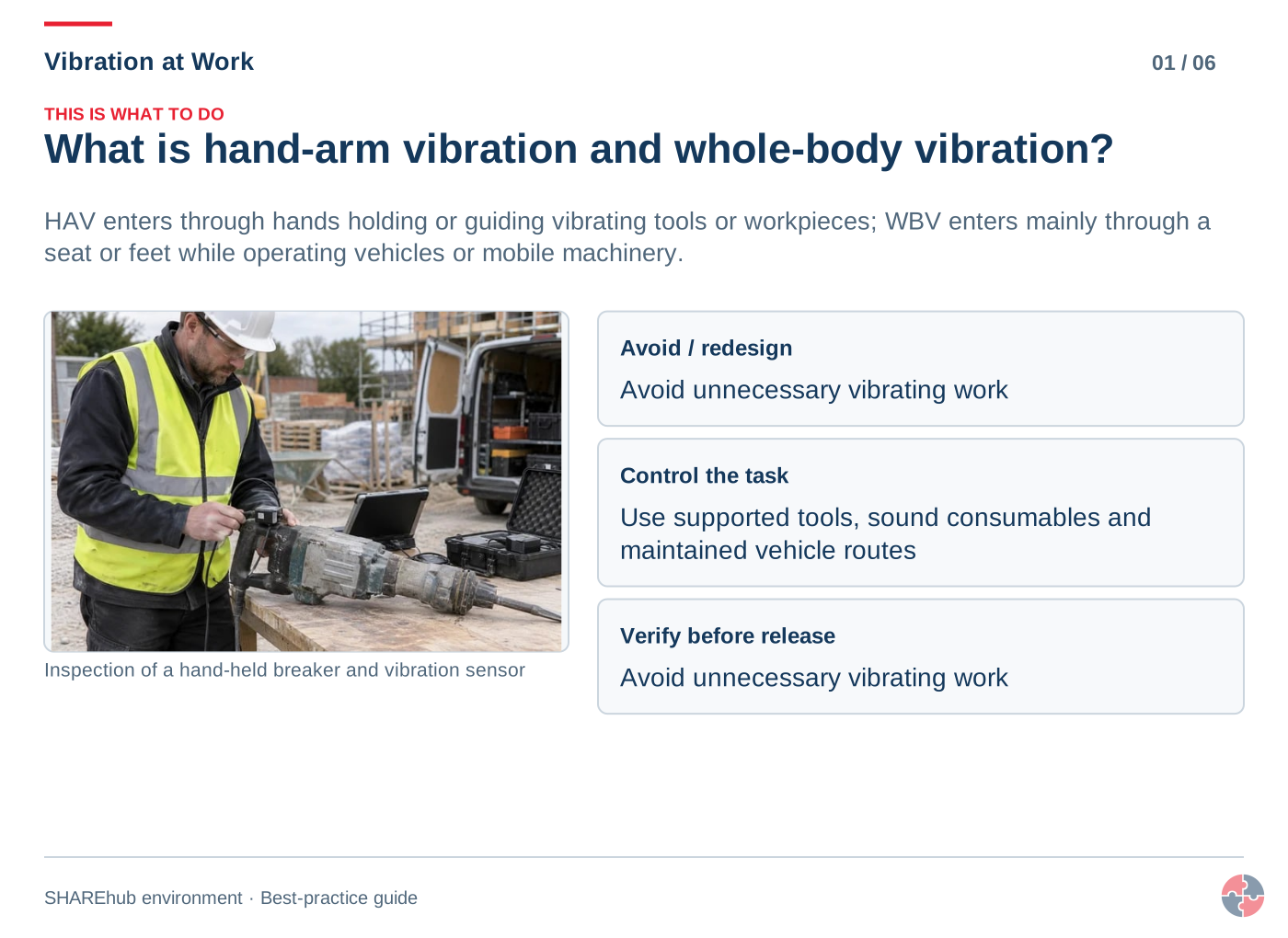
Hand-arm vibration enters through the hands and arms from vibrating tools or processes. It can damage circulation, nerves and hand function. Whole-body vibration enters through a supporting seat or the feet; vehicle vibration and shocks can contribute to back pain alongside posture and manual handling.
Hand-arm vibration enters through the hands and arms from vibrating tools or processes. It can damage circulation, nerves and hand function. Whole-body vibration enters through a supporting seat or the feet; vehicle vibration and shocks can contribute to back pain alongside posture and manual handling. These are different exposures.
Assess them separately using the relevant method. Do not add a hand-tool points total to a vehicle exposure or treat one assessment as covering both. Other risks such as noise, dust, force and cold also need their own controls. Tingling, numbness, reduced dexterity, finger blanching or back symptoms are reasons for appropriate reporting and review, not proof of a diagnosis. This course provides recognition and prevention awareness, not clinical assessment or fitness approval.
4. The fictional case and decision boundary Recognise HAV, WBV and the limits of symptom interpretation.
Task and setting Fictional case: a maintenance worker uses several vibrating tools and drives a vehicle over a rough yard. Decision to practise The breaker assessment uses a supplier figure for a new accessory on a different material. The current bit is worn and operators report noticeably harsher vibration during the real job. Evidence to consider Check equipment, accessory, material and conditions.
5. Decision 1: interpret the evidence The breaker assessment uses a supplier figure for a new accessory on a different material. The current bit is worn and operators report noticeably harsher vibration during the real job.
What should be reviewed?
A lower value selected to keep the task within the old plan. Whether the data represents the current tool, accessory, material and condition, alongside necessary controls. (supported response) Only the brand name shared by both tools. Representative data and current condition matter more than an unexamined nominal figure.
6. Reconsider the evidence What should be reviewed?
A lower value selected to keep the task within the old plan. Whether the data represents the current tool, accessory, material and condition, alongside necessary controls. (supported response) Only the brand name shared by both tools. Representative data and current condition matter more than an unexamined nominal figure.
7. Decision 1 explained Representative data and current condition matter more than an unexamined nominal figure.
Check equipment, accessory, material and conditions.
8. Choose data that represents the job Check equipment, accessory, material and conditions.
Vibration information must represent the work. Tool model, accessory, material, condition, technique and work rate affect hand-arm exposure. For vehicles, route surface, load, speed, tyre and suspension condition, seat setup and shocks matter.
Vibration information must represent the work. Tool model, accessory, material, condition, technique and work rate affect hand-arm exposure. For vehicles, route surface, load, speed, tyre and suspension condition, seat setup and shocks matter. A laboratory emission figure may help comparison but not describe the actual workplace magnitude.
Use reliable representative sources and competent measurement where other evidence is insufficient. Record the source, scope, date and uncertainty. A worn bit or damaged route may change conditions after the original assessment. Do not invent a reassuring low value to fill an empty form. Where uncertainty could change a high-risk decision, obtain better evidence or use a conservative control through the responsible assessment. Ordinary users contribute observations; technical interpretation remains with the appropriate competent role.
9. Separate the assessment evidence Sort the cards. Drag each card, or use its labelled category selector.
Sort the cards. Drag each card, or use its labelled category selector.
Actual trigger time for every vibrating hand tool — Hand-arm vibration. Combine relevant HAV sources using the appropriate assessment method. Route shocks and actual vehicle operating periods — Whole-body vibration. Assess WBV separately with its relevant method. A tool booking receipt without use observations — Neither proves exposure alone. Booking does not establish actual vibration duration or magnitude. 10. Compare the reasoning: Separate the assessment evidence Actual trigger time for every vibrating hand tool Hand-arm vibration Route shocks and actual vehicle operating periods Whole-body vibration A tool booking receipt without use observations Neither proves exposure alone
Sort the cards. Drag each card, or use its labelled category selector.
Actual trigger time for every vibrating hand tool — Hand-arm vibration. Combine relevant HAV sources using the appropriate assessment method. Route shocks and actual vehicle operating periods — Whole-body vibration. Assess WBV separately with its relevant method. A tool booking receipt without use observations — Neither proves exposure alone. Booking does not establish actual vibration duration or magnitude. 11. Record actual vibration exposure time Distinguish trigger time from booking and shift length.
For hand-arm vibration, exposure time is when the hands actually receive vibration from the operating tool or process. A tool booked out for a shift may be used intermittently.
For hand-arm vibration, exposure time is when the hands actually receive vibration from the operating tool or process. A tool booked out for a shift may be used intermittently. Repeated short operations can still add up, and every relevant HAV source in the person’s day needs consideration.
Use representative observation and workload rather than assume booking time is exposure or ignore tools borrowed from another team. For whole-body vibration, consider actual driving or operating periods and significant shocks rather than engine hours alone. A timer can help estimate time but does not automatically measure the magnitude entering the hand or prove compliance. Check the values and assumptions loaded into any monitoring system. The course does not assign universal safe trigger times or convert a device colour into permission to continue.
Open the related fictional model case
12. Decision 2: choose the response The supervisor offers gloves and rotates workers through the same worn breaker while postponing an available lower-vibration method and accessory maintenance. No individual daily totals are reviewed.
What is the stronger response?
Count gloves as a reliable vibration-reduction factor. Assume rotation removes exposure instead of redistributing it. Review avoidance, effective equipment and maintenance, then assess any remaining individual exposure. (supported response) Source reduction precedes reliance on work sharing or personal protection.
13. Compare the consequences What is the stronger response?
Count gloves as a reliable vibration-reduction factor. Assume rotation removes exposure instead of redistributing it. Review avoidance, effective equipment and maintenance, then assess any remaining individual exposure. (supported response) Source reduction precedes reliance on work sharing or personal protection.
14. Decision 2 explained Source reduction precedes reliance on work sharing or personal protection.
Choose method, equipment and maintenance before reliance on rotation.
15. Reduce the task and magnitude at source Choose method, equipment and maintenance before reliance on rotation.
First consider avoiding the vibrating operation through design, mechanisation or another effective process. Where it remains, select suitable lower-vibration equipment that also performs the real job efficiently.
First consider avoiding the vibrating operation through design, mechanisation or another effective process. Where it remains, select suitable lower-vibration equipment that also performs the real job efficiently. A nominally quieter tool taking much longer can need a full exposure comparison rather than a purchase based on one figure.
Maintain tools, consumables, vehicles, routes and seats. Improve support, access and work technique through suitable task training. For vehicles, repair severe route defects and control unnecessary shocks rather than rely only on a seat. Limit necessary duration after stronger measures are considered. Rotation redistributes exposure and can expose more people; assess each individual’s day. Gloves may support warmth and comfort but generally do not provide a reliable HAV exposure reduction or replace source control.
16. Match the prevention question Match each card to its meaning. Drag, or use the labelled category selector.
Match each card to its meaning. Drag, or use the labelled category selector.
Can a different process remove breaker use? — Avoid the operation. Start with task design. Is a worn bit or rough route increasing vibration? — Maintain source conditions. Correct deterioration at source. Has new tingling been routed for suitable advice? — Respond to health information. Report early without self-diagnosis. 17. Compare the reasoning: Match the prevention question Can a different process remove breaker use? Avoid the operation Is a worn bit or rough route increasing vibration? Maintain source conditions Has new tingling been routed for suitable advice? Respond to health information
Match each card to its meaning. Drag, or use the labelled category selector.
Can a different process remove breaker use? — Avoid the operation. Start with task design. Is a worn bit or rough route increasing vibration? — Maintain source conditions. Correct deterioration at source. Has new tingling been routed for suitable advice? — Respond to health information. Report early without self-diagnosis. 18. Act on changed control or health concerns Identify hold points without diagnosing HAVS or back conditions.
A defect that increases vibration, persistent severe jolts, an unrepresentative assessment or unresolved health advice can require a hold or changed task. Where credible exposure could exceed a limit, high-risk work must not proceed on invented low data.
A defect that increases vibration, persistent severe jolts, an unrepresentative assessment or unresolved health advice can require a hold or changed task. Where credible exposure could exceed a limit, high-risk work must not proceed on invented low data. Stop equipment safely and protect people from the wider task hazards.
Early symptoms need a work and health response rather than waiting for the next routine questionnaire. Use the supervisor and occupational-health route; managers should not diagnose HAVS, carpal tunnel syndrome or a back condition. Health surveillance supports prevention where indicated but never permits ongoing uncontrolled exposure. Restart requires a defensible task and exposure plan, corrected conditions and any appropriate health restrictions applied through the authorised route. This course does not decide those technical or clinical outcomes.
Open the related fictional model case
19. Decision 3: apply and review The yard is resurfaced and the breaker repaired, but the log still omits other tools. The manager asks for the worker’s full clinical notes instead of checking the remaining exposure and work restrictions.
What should follow-up focus on?
Complete representative exposure and control evidence, with proportionate work advice and protected clinical records. (supported response) Only the two invoices as blanket approval. Copying clinical detail into the shared tool register. Verify the actual control plan and use suitable health information within the right boundary.
20. Revisit the control or support boundary What should follow-up focus on?
Complete representative exposure and control evidence, with proportionate work advice and protected clinical records. (supported response) Only the two invoices as blanket approval. Copying clinical detail into the shared tool register. Verify the actual control plan and use suitable health information within the right boundary.
21. Decision 3 explained Verify the actual control plan and use suitable health information within the right boundary.
Check changes and keep clinical information protected.
22. Verify the full work and health response Check changes and keep clinical information protected.
Verify the actual result of a change: the accessory works, the route defect is corrected, the seat and task suit the vehicle use and representative exposure assumptions remain valid. Keep owners, evidence and review triggers for changes in workload, tools, materials or conditions.
Verify the actual result of a change: the accessory works, the route defect is corrected, the seat and task suit the vehicle use and representative exposure assumptions remain valid. Keep owners, evidence and review triggers for changes in workload, tools, materials or conditions. A repair invoice does not establish the whole exposure decision.
Keep clinical details confidential and use appropriate work-focused advice from the health provider. Managers need relevant restrictions and follow-up, not unnecessary diagnostic records in a tool log. The optional exercise separates a fictional worker’s tool and vehicle exposures and identifies missing data and stronger controls. It calculates no real exposure, approves no safe operating time and gives no medical clearance. Its purpose is to ask better planning and verification questions before relying on a favourable number.
23. Select sound vibration decisions Choose every supported action. Leave the unsuitable actions unselected.
Choose every supported action. Leave the unsuitable actions unselected.
Review actual exposure when tools or materials change — Supported action. Old data may no longer represent the task. Control current exposure and report new symptoms early — Supported action. Do not wait for a routine questionnaire. Subtract an assumed glove reduction from the tool value — Leave unselected. Gloves generally do not provide a reliable HAV exposure reduction. 24. Compare the reasoning: Select sound vibration decisions Review actual exposure when tools or materials change Supported action Control current exposure and report new symptoms early Supported action Subtract an assumed glove reduction from the tool value Leave unselected
Choose every supported action. Leave the unsuitable actions unselected.
Review actual exposure when tools or materials change — Supported action. Old data may no longer represent the task. Control current exposure and report new symptoms early — Supported action. Do not wait for a routine questionnaire. Subtract an assumed glove reduction from the tool value — Leave unselected. Gloves generally do not provide a reliable HAV exposure reduction. 25. Apply the lesson in a fictional workplace A repairer reports tingling after long periods with sanders and an air chisel.
Check changes and keep clinical information protected.
Open the related fictional model case
26. Take the learning into a fictional task Check changes and keep clinical information protected.
Task and people Fictional case: a maintenance worker uses several vibrating tools and drives a vehicle over a rough yard. Control or support Choose method, equipment and maintenance before reliance on rotation. Check and review Check changes and keep clinical information protected.
27. Explain your reasoning without the answer sheet Use the supplied case facts. Explain why a choice fits the task and what remains uncertain. A points total or completed form cannot replace the required control or support arrangement.
28. Continue with the full course and Knowledge Hub Use the original course for its six lessons, required activities, final assessment and saved record. This optional companion does not change course grades, completion or certificates.
Enable JavaScript for interactive practice, or use the PowerPoint and its notes.


 All 50 presentations