Optional presentation practice. Choices and model launches do not write LMS grades, completion or certificates. This extension takes additional learning time.
1. Manual handling risk reduction Reduce handling demands before relying on technique.
2. Choose a learning route 3. Recognise the handling task Include lifting, carrying, pushing, pulling and support.
Manual handling is transporting or supporting a load by hand or bodily force, including lifting, lowering, pushing, pulling, carrying and moving. A load can be an object, person or animal.
Manual handling is transporting or supporting a load by hand or bodily force, including lifting, lowering, pushing, pulling, carrying and moving. A load can be an object, person or animal. Manual handling becomes hazardous when the task, load, person, environment or work organisation creates a risk of injury. The law does not set a single safe weight limit because risk depends on reach, height, frequency, posture, grip, distance, pace, recovery, floor condition, team handling and individual capability. Sources: HSE manual handling at work ; HSENI manual handling The legal hierarchy is simple and powerful: avoid hazardous manual handling so far as reasonably practicable; assess any hazardous handling that cannot be avoided; reduce the risk of injury so far as reasonably practicable.
4. The fictional case and decision boundary Include lifting, carrying, pushing, pulling and support.
Task and setting A fictional team handles repeated deliveries along a changing route. Decision to practise Fictional case: The load mass is known, but the assessment omits its grip, repeated movement, reach and restricted space. The draft calls weight alone a complete handling assessment. Evidence to consider Consider task, individual, load and environment together.
5. Decision 1: interpret the evidence Fictional case: The load mass is known, but the assessment omits its grip, repeated movement, reach and restricted space. The draft calls weight alone a complete handling assessment.
What is missing?
The assumption that one successful lift proves the whole shift manageable. The interacting task, person, load and environmental factors. (supported response) A comparison of weights alone across jobs. The same mass can present different demands in different work.
6. Reconsider the evidence What is missing?
The assumption that one successful lift proves the whole shift manageable. The interacting task, person, load and environmental factors. (supported response) A comparison of weights alone across jobs. The same mass can present different demands in different work.
7. Decision 1 explained The same mass can present different demands in different work.
Consider task, individual, load and environment together.
8. Assess interacting factors Consider task, individual, load and environment together.
TILE, TILEO and TILEE are practical prompts that help assess the whole handling situation rather than focusing only on load weight. TILE is the core prompt: Task, Individual, Load and Environment.
TILE, TILEO and TILEE are practical prompts that help assess the whole handling situation rather than focusing only on load weight. TILE is the core prompt: Task, Individual, Load and Environment. It reflects the main risk factors HSE expects employers to consider when assessing manual handling. TILEO adds Other factors, such as work organisation, time pressure, communication, PPE, fatigue, team handling, handling aids and recovery. TILEE is used by some organisations as a further extension; the final E should be defined in the organisation's standard, most usefully as Equipment, Ergonomics or Existing controls. Sources: HSE L23 Manual handling guidance on regulations ; HSE manual handling at work The important point is not which acronym is used, but whether the assessment identifies the real risk factors and produces better work design.
9. Classify the assessment inputs Sort the cards. Drag each card, or use its labelled category selector.
Sort the cards. Drag each card, or use its labelled category selector.
Repeated movements over the shift. — Task or frequency. Frequency affects exposure. Uncertain grip and centre of gravity. — Load. Load characteristics matter. Restricted space along the route. — Environment. The surroundings affect the task. 10. Compare the reasoning: Classify the assessment inputs Repeated movements over the shift. Task or frequency Uncertain grip and centre of gravity. Load Restricted space along the route. Environment
Sort the cards. Drag each card, or use its labelled category selector.
Repeated movements over the shift. — Task or frequency. Frequency affects exposure. Uncertain grip and centre of gravity. — Load. Load characteristics matter. Restricted space along the route. — Environment. The surroundings affect the task. 11. Avoid hazardous handling where possible Compare task redesign before technique alone.
Avoid hazardous manual handling where reasonably practicable, assess what remains and reduce the injury risk. Training and gloves support the chosen method; they cannot make an unsuitable repetitive lift safe. Illustrative decision: warehouse workers repeatedly lift stock from floor-level pallets to dispatch benches.
Avoid hazardous manual handling where reasonably practicable, assess what remains and reduce the injury risk. Training and gloves support the chosen method; they cannot make an unsuitable repetitive lift safe. Illustrative decision: warehouse workers repeatedly lift stock from floor-level pallets to dispatch benches. The manager and workers examine the whole supply-to-dispatch task, including reaching, twisting, pushing, load stability and differing individual capability. ERICPD means Eliminate, Reduce (including substitution), Isolate, Control, PPE and Discipline. The five-level hierarchy groups measures as elimination, substitution, engineering controls, administrative controls and PPE. They overlap: isolation is usually an engineering measure; control can include engineered and administrative measures. Discipline means maintaining and checking the controls, supervising the method and learning from defects, rather than blaming someone or accepting weaker protection.
Open the related fictional model case
12. Decision 2: choose the response Fictional case: An aid is available, but the route and task interface have not been checked. The action closes because the equipment is listed in the workplace inventory.
What should be verified?
Availability in the inventory as proof of effective use. The previous task’s assessment as automatic acceptance for every route. Whether the aid is suitable and usable for the actual load, route and task. (supported response) An aid needs a task-specific basis and practical application.
13. Compare the consequences What should be verified?
Availability in the inventory as proof of effective use. The previous task’s assessment as automatic acceptance for every route. Whether the aid is suitable and usable for the actual load, route and task. (supported response) An aid needs a task-specific basis and practical application.
14. Decision 2 explained An aid needs a task-specific basis and practical application.
Examine the load, route and use of proposed equipment.
15. Make aids fit the actual job Examine the load, route and use of proposed equipment.
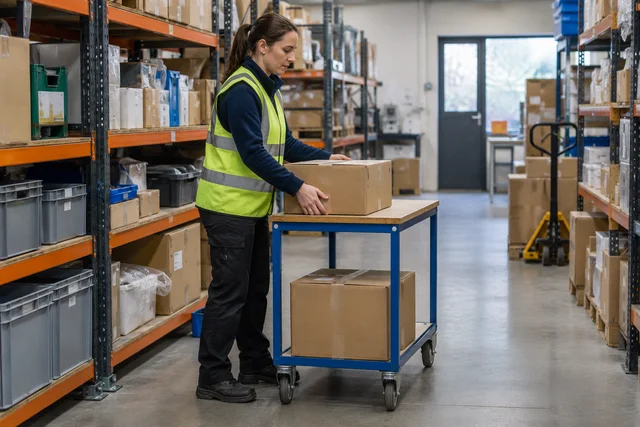
A worked example shows why manual-handling training is not enough where storage height, frequency and route design create risk. Warehouse workers pick heavy boxes from floor-level pallets, twist to place them into roll cages and push loaded cages over a damaged threshold.
A worked example shows why manual-handling training is not enough where storage height, frequency and route design create risk. Warehouse workers pick heavy boxes from floor-level pallets, twist to place them into roll cages and push loaded cages over a damaged threshold. Back and shoulder discomfort is common during seasonal peaks. The weak response is refresher manual-handling training and a poster about bending knees. Sources: HSE Manual Handling Assessment Charts ; HSE making the best use of lifting and handling aids A stronger response observes the task, uses MAC/RAPP-style thinking, raises storage height, reduces box weights, changes slotting so heavy goods are between knee and shoulder height, repairs the threshold, maintains cage wheels, uses lift tables for peak work, rotates tasks and reviews staffing so pace does not destroy recovery.
16. Check the handling aid Choose every supported action. Leave the unsuitable actions unselected.
Choose every supported action. Leave the unsuitable actions unselected.
Match it to the actual load and route. — Supported action. Suitability is task-specific. Treat purchase as proof of use. — Leave unselected. The interface remains untested. Examine remaining handling demands. — Supported action. An aid may not remove every exposure. 17. Compare the reasoning: Check the handling aid Match it to the actual load and route. Supported action Treat purchase as proof of use. Leave unselected Examine remaining handling demands. Supported action
Choose every supported action. Leave the unsuitable actions unselected.
Match it to the actual load and route. — Supported action. Suitability is task-specific. Treat purchase as proof of use. — Leave unselected. The interface remains untested. Examine remaining handling demands. — Supported action. An aid may not remove every exposure. 18. Listen and check work as done Use observations and worker information to test controls.
Evidence should show that hazardous handling has been avoided where possible, assessed where unavoidable and reduced through work design.
Evidence should show that hazardous handling has been avoided where possible, assessed where unavoidable and reduced through work design. Useful evidence includes task observation, manual-handling assessment, MAC/RAPP records where useful, photos of layout, load information, handling-aid inspection, worker consultation, training, early discomfort reports, task redesign actions, occupational health advice where needed and review after change. Sources: HSE L23 Manual handling guidance on regulations ; HSE Manual Handling Assessment Charts The best evidence is visible in the workplace: fewer floor-level lifts, maintained trolleys, shorter carrying distances, clearer routes, better storage and workers who can explain what to do when a load is unsafe. Assurance should test whether task design has improved and whether controls are used in real work.
Open the related fictional model case
19. Decision 3: apply and review Fictional case: A changed load cannot be handled as the assessed method expects. The team is asked to improvise because the old instruction is signed and the delivery is urgent.
What is appropriate?
Use the workplace restriction and seek a reviewed suitable method. (supported response) Repeat the old method to see whether it works. Treat urgency as evidence that the load is manageable. Changed demands need reassessment rather than an unplanned trial.
20. Revisit the control or support boundary What is appropriate?
Use the workplace restriction and seek a reviewed suitable method. (supported response) Repeat the old method to see whether it works. Treat urgency as evidence that the load is manageable. Changed demands need reassessment rather than an unplanned trial.
21. Decision 3 explained Changed demands need reassessment rather than an unplanned trial.
Use the appropriate stop, reporting and reassessment route.
22. Review difficulty before repeating the task Use the appropriate stop, reporting and reassessment route.
Stop or escalate when the load, route, frequency, posture, handling aid, environment or worker capability makes injury likely. Workers and supervisors should not wait for injury.
Stop or escalate when the load, route, frequency, posture, handling aid, environment or worker capability makes injury likely. Workers and supervisors should not wait for injury. Stop points should include unknown weight, unstable load, blocked route, damaged trolley, inadequate staffing for team handling, pain or discomfort, poor lighting, slippery floor, fatigue or a task that cannot be done as assessed. Sources: HSE manual handling at work ; HSENI manual handling Escalation should lead to redesign, equipment, staffing, changed delivery, competent assessment or occupational health support where individual restrictions are involved. They fail when organisations focus on worker technique while leaving poor work design, poor equipment and unrealistic workload unchanged. Sources: HSE L23 Manual handling guidance on regulations ; HSE MSD toolkit frequently asked questions
23. Review the changed load Arrange the steps for this case. Drag, or use Move up and Move down.
Arrange the steps for this case. Drag, or use Move up and Move down.
Recognise the mismatch and use the relevant restriction. Establish the changed task and handling demands. Agree the reviewed control and suitable method. Verify practical use and communicate the updated arrangement. Do not use an improvised handling trial to replace assessment.
24. Compare the reasoning: Review the changed load 1 Recognise the mismatch and use the relevant restriction. 2 Establish the changed task and handling demands. 3 Agree the reviewed control and suitable method. 4 Verify practical use and communicate the updated arrangement.
Arrange the steps for this case. Drag, or use Move up and Move down.
Recognise the mismatch and use the relevant restriction. Establish the changed task and handling demands. Agree the reviewed control and suitable method. Verify practical use and communicate the updated arrangement. Do not use an improvised handling trial to replace assessment.
25. Apply the lesson in a fictional workplace A worker lifts a full cleaning machine while twisted between a car and stored supplies.
Use the appropriate stop, reporting and reassessment route.
Open the related fictional model case
26. Take the learning into a fictional task Use the appropriate stop, reporting and reassessment route.
Task and people A fictional team handles repeated deliveries along a changing route. Control or support Examine the load, route and use of proposed equipment. Check and review Use the appropriate stop, reporting and reassessment route.
27. Explain your reasoning without the answer sheet Use the supplied case facts. Explain why a choice fits the task and what remains uncertain. A points total or completed form cannot replace the required control or support arrangement.
28. Continue with the full course and Knowledge Hub Use the original course for its six lessons, required activities, final assessment and saved record. This optional companion does not change course grades, completion or certificates.
Enable JavaScript for interactive practice, or use the PowerPoint and its notes.


 All 50 presentations