Workplace awareness and prevention. Specialist competence, statutory examinations and work authorisation require separate evidence. Check the relevant UK nation and actual workplace arrangements. Completion does not establish practical competence, authorise hazardous work or award an external qualification.
Read the complete core teaching here. Use the interactive course for required activities, saved assessment and conditional completion.
Plan around the real risks
Plan around the real risks
Connect policy to real responsibilities
Professional teaching illustration. Read the written scenario for the facts; the image is not evidence of a real workplace.
Understand the business activities and people affected, choose priorities and assign authority, resources and responsibilities. A policy should explain how important risks are managed; copying a long document does not establish an operating system.
What does a health and safety management system mean?
It means the repeatable arrangements that make risk control happen before, during and after work. A management system connects policy, risk assessment, people, controls, monitoring and learning. It should make clear who does what, when and how. It should also show how decisions are made when circumstances change, such as a new contractor, new equipment, a near miss, a health surveillance trend or a maintenance backlog. The most useful way to test a system is to follow a risk from identification to control. If a dust hazard is identified, the system should show how exposure is assessed, how controls are selected, how workers are trained, how LEV is maintained, how health surveillance is considered and how performance is reviewed.
A system connects a named owner, the site risk profile, working controls and feedback; a procedure library alone cannot show whether silica extraction works. HSE health and safety management systems
Fictional workplace decision
Fictional case — A signed policy and a favourable audit sit beside repeated extraction defects. Management proposes another reminder without assigning repair resources, a control owner or a verification date.
Compare the reasoning
Translate the recurring extraction defect into a practical corrective decision with a responsible owner, adequate resources and a verification date. Review whether affected work needs a safe hold or changed method meanwhile. The management cycle should check the restored control and learn from recurrence; another reminder alone cannot repair failed protection.
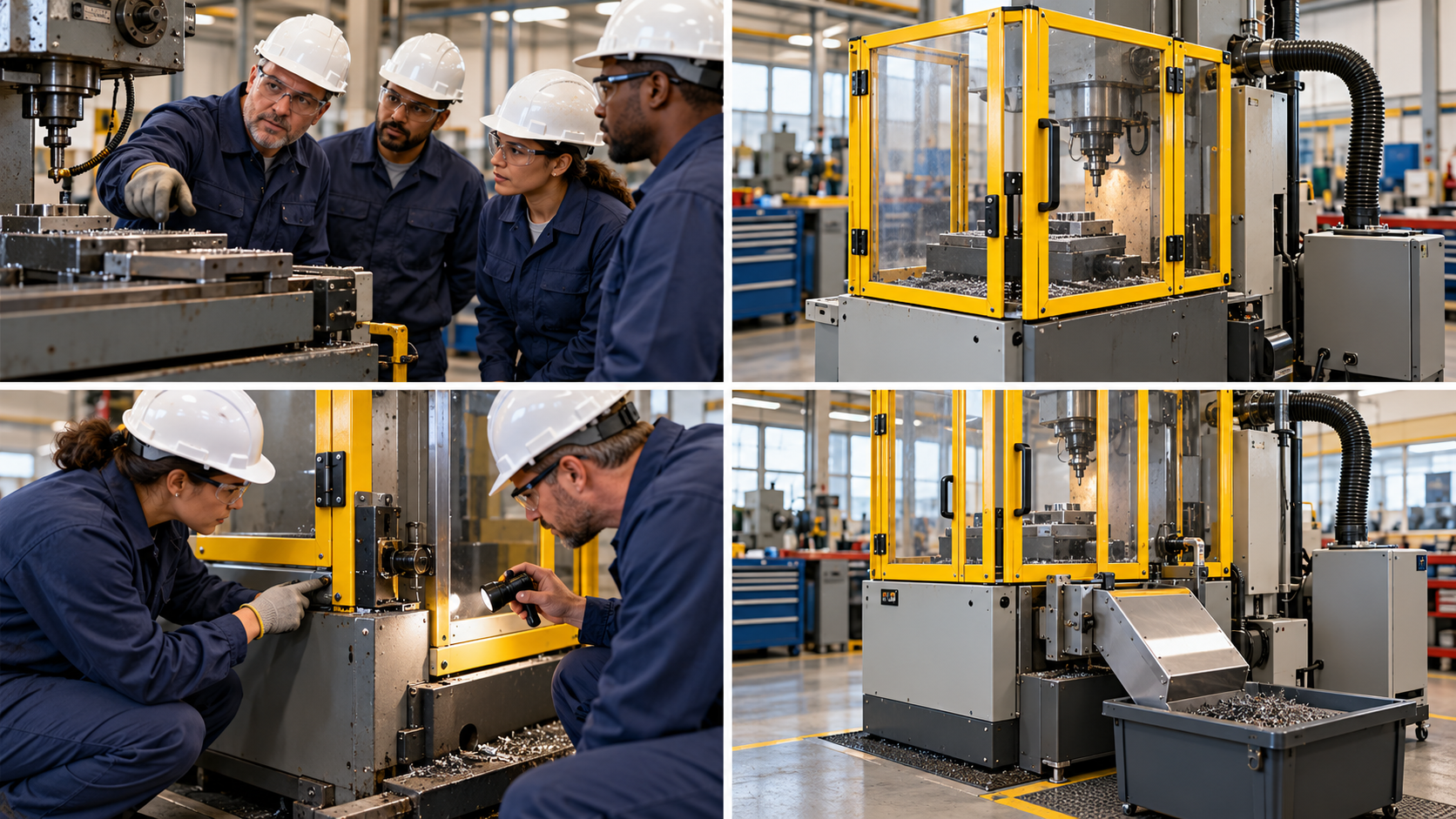
Existing SHAREhub photographic illustration. The fictional case supplies the task and decision evidence.
Understand the business activities and people affected, choose priorities and assign authority, resources and responsibilities. A policy should explain how important risks are managed; copying a long document does not establish an operating system.
What does a health and safety policy mean?
A health and safety policy is the organisation's written or stated approach to managing health and safety in practice. The policy should be simple enough for people to understand and specific enough to guide decisions. It should not try to hold every procedure. Its job is to set direction, define responsibility and point to the practical arrangements that control risk. A good policy links to the wider management system. If it promises safe contractors, the arrangements should explain contractor selection, induction, permits, supervision and review.
If it promises worker involvement, the arrangements should say how consultation happens and how feedback is closed. A policy names the commitment, decision owners and arrangements that keep visitors out of vehicle routes. HSE prepare a health and safety policy
Fictional workplace decision
Fictional case — A signed policy and a favourable audit sit beside repeated extraction defects. Management proposes another reminder without assigning repair resources, a control owner or a verification date.
Compare the reasoning
Translate the recurring extraction defect into a practical corrective decision with a responsible owner, adequate resources and a verification date. Review whether affected work needs a safe hold or changed method meanwhile. The management cycle should check the restored control and learn from recurrence; another reminder alone cannot repair failed protection.
How should a legal register turn health and safety duties into practical action?
Plan around the real risks
Connect policy to real responsibilities
Existing SHAREhub photographic illustration. The fictional case supplies the task and decision evidence.
Understand the business activities and people affected, choose priorities and assign authority, resources and responsibilities. A policy should explain how important risks are managed; copying a long document does not establish an operating system.
How should a legal register turn health and safety duties into practical action?
A useful legal register connects each applicable requirement to the activities it affects, the controls required, a responsible person and evidence of implementation. A list of legislation alone does not show compliance. The legal register and risk register answer different questions. The risk register describes what could cause harm and how it is controlled. The legal register identifies the applicable duties and how the business will meet and check them. Link the two to the same activities and procedures. Worked connection — refurbishment dust: the activity review identifies concrete chasing; the assessment identifies silica exposure; the legal review identifies the applicable substance-control duties.
The operating arrangement considers avoiding the chase, then specifies the necessary dust controls, competent users, equipment checks and stop conditions for any remaining cutting. Inspections and maintenance evidence test whether the controls work; defects feed back into the method and management review. This is an illustrative connection, not a complete assessment or legal-register entry. HSE concrete chasing guidance. A legal register is a practical management tool; there is no general requirement for every business to keep a document with that name. The underlying duties are to comply with applicable law and maintain effective arrangements.
Use current requirements for the relevant jurisdiction, including separate Northern Ireland instruments and nation-specific requirements where applicable. HSE management duties; GB and Northern Ireland duties.
Fictional workplace decision
Fictional case — A signed policy and a favourable audit sit beside repeated extraction defects. Management proposes another reminder without assigning repair resources, a control owner or a verification date.
Compare the reasoning
Translate the recurring extraction defect into a practical corrective decision with a responsible owner, adequate resources and a verification date. Review whether affected work needs a safe hold or changed method meanwhile. The management cycle should check the restored control and learn from recurrence; another reminder alone cannot repair failed protection.
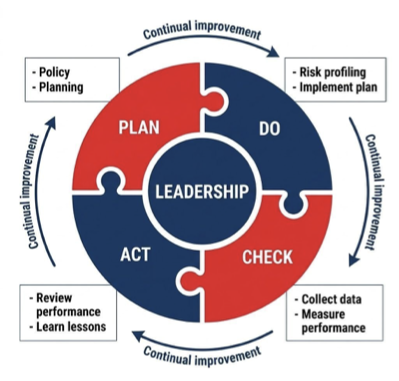
Detailed SHAREhub teaching diagram, used with its source explanation. It cannot establish actual site conditions or diagnose a person.
Put controls into practice through competent people, suitable equipment, consultation and supervision. Check performance at the workface and learn from incidents and health concerns. Reuse the earlier inspection and audit courses for deeper verification skills.
How can the ISO 45001 hierarchy of controls turn health and safety policy into effective risk controls?
ERICPD is used here as a planning mnemonic. The linked HSE five-level hierarchy is the official source for the order and relative reliability of controls; the two labels are not identical. The document, dashboard or audit can assign and test a control; the hierarchy applies to the real hazard and people exposed. Riverside Leisure Ltd receives deliveries beside a public entrance. A reversing vehicle can strike and crush a visitor. The policy must name the owner of the route, require pedestrian separation and empower staff to hold a delivery when the route is occupied; a signed statement alone is not a barrier.
HSE separating pedestrians and vehicles ERICPD is a six-stage planning aid. HSE’s five levels place elimination and substitution before engineering, administration and residual PPE. Isolate normally maps to engineered separation; ERICPD Control may be physical or administrative. Discipline sustains the selected control through maintenance, supervision and learning. HSE five-level hierarchy HSE five-level hierarchy The hierarchy of controls in ISO 45001:2018 comes under Clause 8.1.2 (Eliminating hazards and reducing OH&S risks), which is located within Clause 8 ("Operation"). ESEAP: Elimination, Substitution, Engineering controls, Administrative controls and PPE.
Control order: HSE hierarchy of controls and IOSH hierarchy of control guidance.
Fictional workplace decision
Fictional case — A signed policy and a favourable audit sit beside repeated extraction defects. Management proposes another reminder without assigning repair resources, a control owner or a verification date.
Compare the reasoning
Translate the recurring extraction defect into a practical corrective decision with a responsible owner, adequate resources and a verification date. Review whether affected work needs a safe hold or changed method meanwhile. The management cycle should check the restored control and learn from recurrence; another reminder alone cannot repair failed protection.
How can the hierarchy of controls guide practical risk reduction within a management system?
Deliver and check
Identify evidence of implementation
Professional teaching illustration. Read the written scenario for the facts; the image is not evidence of a real workplace.
Put controls into practice through competent people, suitable equipment, consultation and supervision. Check performance at the workface and learn from incidents and health concerns. Reuse the earlier inspection and audit courses for deeper verification skills.
How can the hierarchy of controls guide practical risk reduction within a management system?
ERICPD is used here as a planning mnemonic. The linked HSE five-level hierarchy is the official source for the order and relative reliability of controls; the two labels are not identical. The document, dashboard or audit can assign and test a control; the hierarchy applies to the real hazard and people exposed. BuildOut Ltd plans concrete chasing during refurbishment. Cutting can release respirable crystalline silica; breathing it can cause silicosis, COPD and lung cancer. The management system must let a designer remove the cut, a supervisor hold failed extraction and leaders verify the repair.
HSE concrete chasing and mortar raking HSE silica cancer and lung-disease risk ERICPD is a six-stage planning aid. HSE’s five levels place elimination and substitution before engineering, administration and residual PPE. Isolate normally maps to engineered separation; ERICPD Control may be physical or administrative. Discipline sustains the selected control through maintenance, supervision and learning. HSE five-level hierarchy HSE five-level hierarchy ERICPD is a planning crossmap. Its prompts do not add a sixth rung or rank Isolate above engineering. Discipline verifies and sustains every control level.
The hierarchy of controls in ISO 45001:2018 comes under Clause 8.1.2 (Eliminating hazards and reducing OH&S risks), which is located within Clause 8 ("Operation"). ESEAP: Elimination, Substitution, Engineering controls, Administrative controls and PPE. Control order: HSE hierarchy of controls and IOSH hierarchy of control guidance.
Fictional workplace decision
Fictional case — A signed policy and a favourable audit sit beside repeated extraction defects. Management proposes another reminder without assigning repair resources, a control owner or a verification date.
Compare the reasoning
Translate the recurring extraction defect into a practical corrective decision with a responsible owner, adequate resources and a verification date. Review whether affected work needs a safe hold or changed method meanwhile. The management cycle should check the restored control and learn from recurrence; another reminder alone cannot repair failed protection.
What could a simple health and safety policy look like?
Deliver and check
Identify evidence of implementation
Existing SHAREhub photographic illustration. The fictional case supplies the task and decision evidence.
Put controls into practice through competent people, suitable equipment, consultation and supervision. Check performance at the workface and learn from incidents and health concerns. Reuse the earlier inspection and audit courses for deeper verification skills.
What could a simple health and safety policy look like?
Illustrative chain: the site director commits resources for separated pedestrian access; the operations manager (deputy: duty manager) owns local traffic arrangement TRA-01. Before opening, the duty manager checks the barrier and crossing against that arrangement. A damaged barrier closes the affected route. The authorised operations manager receives repair and observed-function evidence before reopening, records the decision and sets the review date. This is an original teaching example, not an approved traffic layout. A simple policy should be specific enough to guide responsibility and arrangements without becoming a full procedure manual.
The example below is deliberately short. A real business would tailor it to its activities, risks, size, locations, workforce and consultation arrangements. The value is in the structure: clear intent, named responsibility and practical arrangements that point to the controls used in the management system. For learners, this is a useful way to remember that a policy is not only a signed statement. It should show who owns the system and how the organisation will plan, organise, control, monitor and review health and safety. A short example should identify who stops a delivery when the entrance route is occupied.
HSE prepare a health and safety policy
Fictional workplace decision
Fictional case — A signed policy and a favourable audit sit beside repeated extraction defects. Management proposes another reminder without assigning repair resources, a control owner or a verification date.
Compare the reasoning
Translate the recurring extraction defect into a practical corrective decision with a responsible owner, adequate resources and a verification date. Review whether affected work needs a safe hold or changed method meanwhile. The management cycle should check the restored control and learn from recurrence; another reminder alone cannot repair failed protection.
Existing SHAREhub photographic illustration. The fictional case supplies the task and decision evidence.
Management review should decide what changes, who owns it and whether it is effective. A management-system standard can provide structure, but certification does not guarantee every task is safe. Keep the process proportionate to the organisation.
Which health and safety management duties apply in Great Britain and Northern Ireland?
Effective management duties apply in each jurisdiction; an ISO certificate or policy document does not replace control of the work. Use the instrument for the site and workforce. Reporting a specified dangerous occurrence is distinct from recording an ordinary near miss; neither replaces checking the actual control. Management of Health and Safety at Work Regulations 1999 Management of Health and Safety at Work Regulations (NI) 2000 Reporting of Injuries, Diseases and Dangerous Occurrences Regulations 2013 Reporting of Injuries, Diseases and Dangerous Occurrences Regulations (NI) 1997
Fictional workplace decision
Fictional case — A signed policy and a favourable audit sit beside repeated extraction defects. Management proposes another reminder without assigning repair resources, a control owner or a verification date.
Compare the reasoning
Translate the recurring extraction defect into a practical corrective decision with a responsible owner, adequate resources and a verification date. Review whether affected work needs a safe hold or changed method meanwhile. The management cycle should check the restored control and learn from recurrence; another reminder alone cannot repair failed protection.
Which duties apply in Great Britain and Northern Ireland?
Act on what is learned
Use review to change decisions
Existing SHAREhub photographic illustration. The fictional case supplies the task and decision evidence.
Management review should decide what changes, who owns it and whether it is effective. A management-system standard can provide structure, but certification does not guarantee every task is safe. Keep the process proportionate to the organisation.
Which duties apply in Great Britain and Northern Ireland?
Effective management duties apply in each jurisdiction; an ISO certificate or policy document does not replace control of the work. Use the instrument for the site and workforce. Reporting a specified dangerous occurrence is distinct from recording an ordinary near miss; neither replaces checking the actual control. Management of Health and Safety at Work Regulations 1999 Management of Health and Safety at Work Regulations (NI) 2000 Reporting of Injuries, Diseases and Dangerous Occurrences Regulations 2013 Reporting of Injuries, Diseases and Dangerous Occurrences Regulations (NI) 1997 Both HSE and HSENI say a written health and safety policy is required when an employer has five or more employees; below that threshold a written policy can still help.
The policy must be communicated and kept useful in the work. HSE prepare a health and safety policy HSENI health and safety policy
Fictional workplace decision
Fictional case — A signed policy and a favourable audit sit beside repeated extraction defects. Management proposes another reminder without assigning repair resources, a control owner or a verification date.
Compare the reasoning
Translate the recurring extraction defect into a practical corrective decision with a responsible owner, adequate resources and a verification date. Review whether affected work needs a safe hold or changed method meanwhile. The management cycle should check the restored control and learn from recurrence; another reminder alone cannot repair failed protection.
How should monitoring and review keep a health and safety management system effective?
Act on what is learned
Use review to change decisions
Professional teaching illustration. Read the written scenario for the facts; the image is not evidence of a real workplace.
Management review should decide what changes, who owns it and whether it is effective. A management-system standard can provide structure, but certification does not guarantee every task is safe. Keep the process proportionate to the organisation.
How should monitoring and review keep a health and safety management system effective?
Monitoring and review should show whether controls are working, drifting or needing stronger action. Monitoring and review keep the system alive after arrangements have been written. The examples below show how inspection, audit, incident learning, health data and management review should lead to action. A management review should challenge repeat extraction failures and fund a design or supplier change. HSG65 Managing for health and safety
Fictional workplace decision
Fictional case — A signed policy and a favourable audit sit beside repeated extraction defects. Management proposes another reminder without assigning repair resources, a control owner or a verification date.
Compare the reasoning
Translate the recurring extraction defect into a practical corrective decision with a responsible owner, adequate resources and a verification date. Review whether affected work needs a safe hold or changed method meanwhile. The management cycle should check the restored control and learn from recurrence; another reminder alone cannot repair failed protection.