Workplace awareness and prevention. Specialist competence, statutory examinations and work authorisation require separate evidence. Check the relevant UK nation and actual workplace arrangements. Completion does not establish practical competence, authorise hazardous work or award an external qualification.
Read the complete core teaching here. Use the interactive course for required activities, saved assessment and conditional completion.
Plan the intervention
Plan the intervention
Plan the maintenance task and interfaces
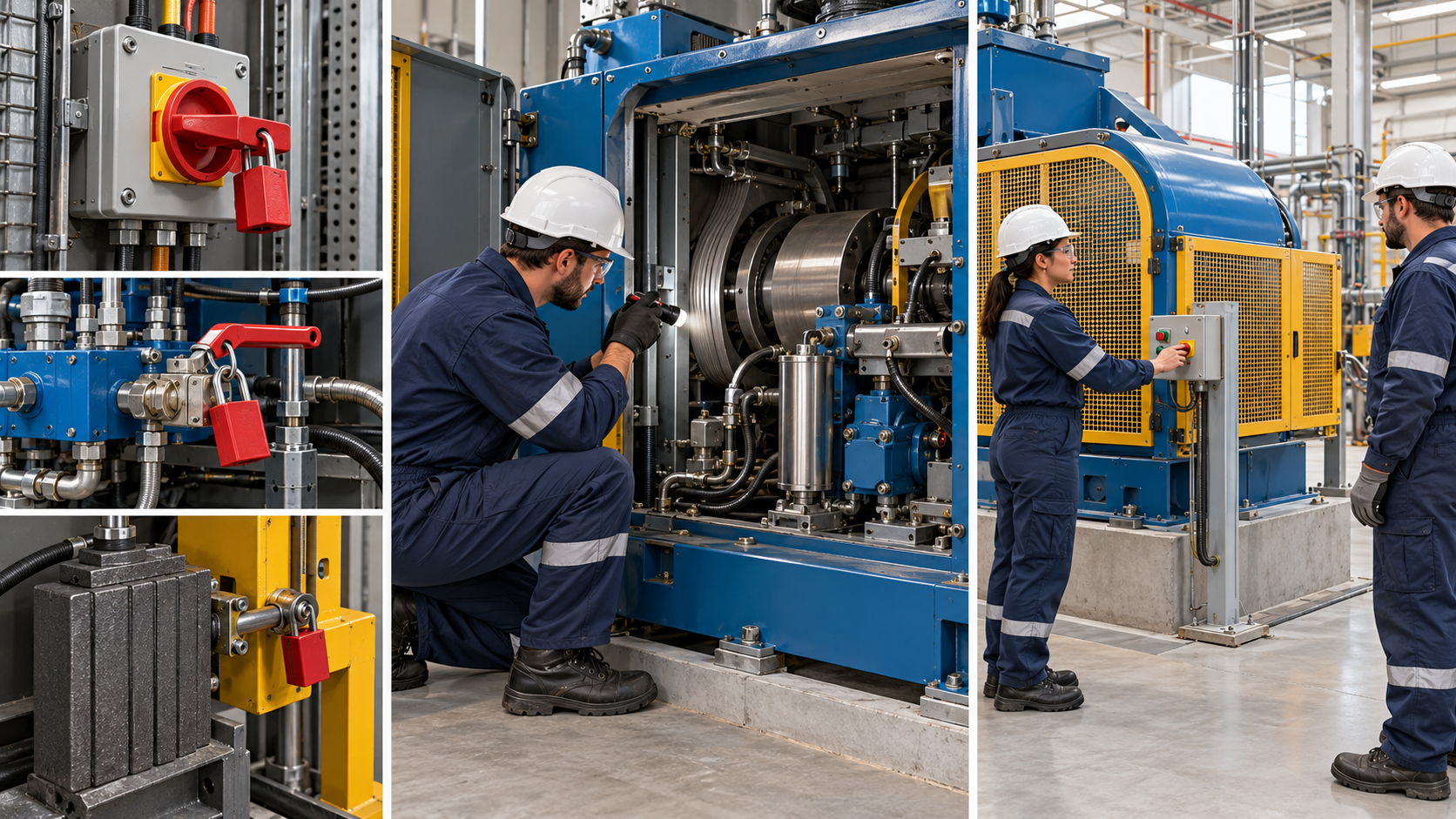
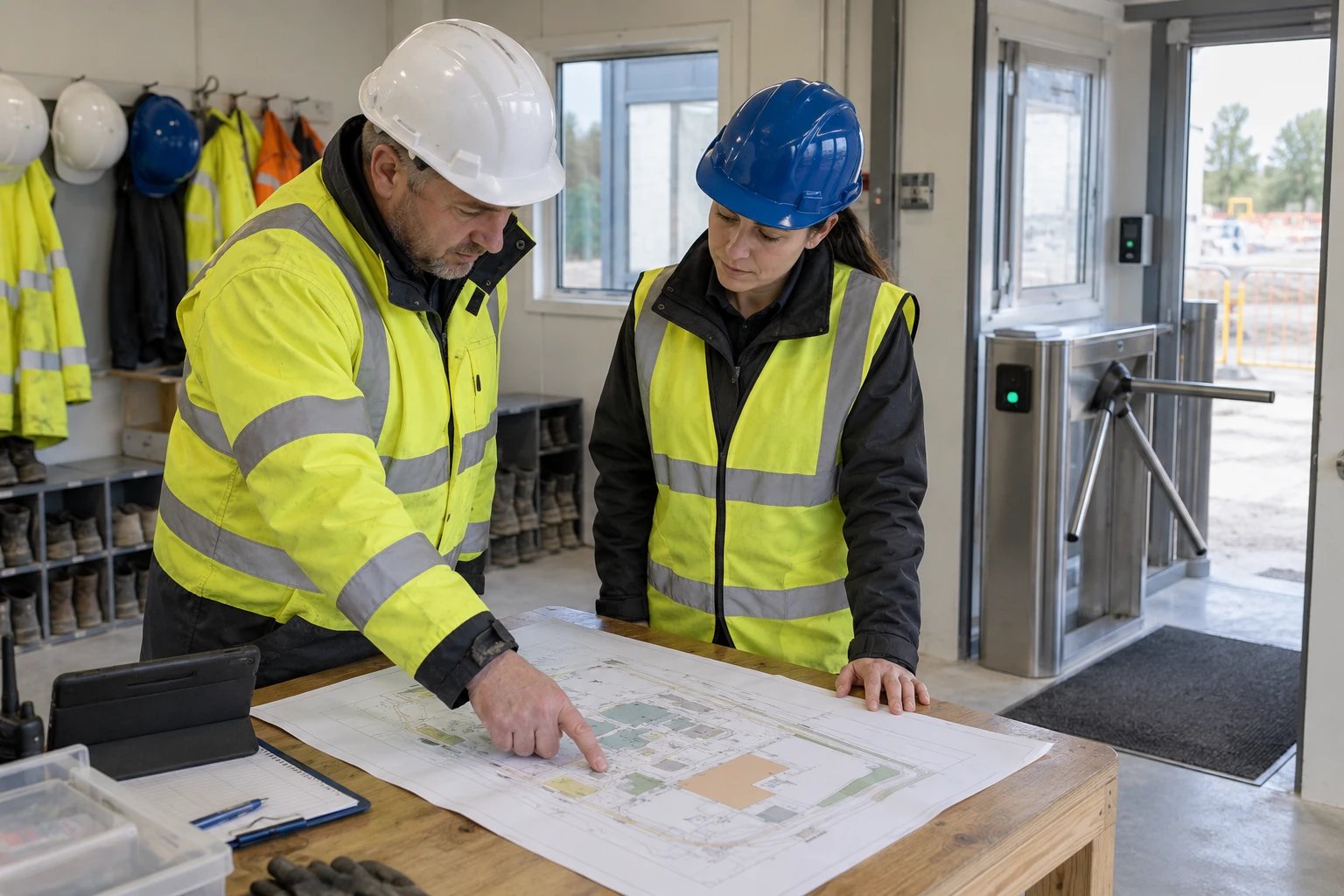
Professional teaching illustration. Read the written scenario for the facts; the image is not evidence of a real workplace.
Maintenance changes the normal state of equipment and may expose stored energy, hazardous material or unguarded parts. Define the task, competent roles, isolations, access and simultaneous work. Include testing and reinstatement in the plan rather than treating them as an afterthought.
What should fuel-equipment inspection and testing evidence identify?
Use the component view to identify the actual equipment and intended protection function. The planned record link describes expected evidence, not a completed check. A hose, tank or protective device has a safety purpose which depends on its condition and supporting checks. Activity focus: Connect each identified defect to the responsible owner and appropriate operational decision. Contextual workplace scene. Use the task, control and evidence checks in this section; appearance alone does not establish safe conditions, individual health or approval. Compare the fixed dispenser island and cabinet with an inserted nozzle at the vehicle filler.
The near and extended-hose positions show why the refuelling interface needs its own assessment location. Activity focus: Use the cutaway for the dispenser internals, then follow the hose to the nozzle tip. Move the filler outward without stretching the hose and compare the stated Stage II recovery conditions. Contextual workplace scene. Use the task, control and evidence checks in this section; appearance alone does not establish safe conditions, individual health or approval. Educational illustration, not to scale. Coloured zones are teaching examples, not a site-specific hazardous-area classification.
Basis and limits: Inspection / non-destructive testing · Electricity in potentially explosive atmospheres · ATEX equipment and explosive atmospheres · Petrol dispensing premises: DSEAR risk assessments, GN75 · Payment at the pump: hazardous areas and vehicle refuelling · Dispensing petrol as a fuel: physical hazards
Fictional workplace decision
Fictional case — A conveyor repair is invoiced as complete, but an interlock remains bypassed from diagnostics. Operations wants normal production before any authorised safeguard test or hand-back is recorded.
Compare the reasoning
The invoice records completed repair work; it does not establish that the conveyor is ready for normal operation. The diagnostic bypass remains an unresolved protective-function defect. Keep production release on hold while competent people restore and safely test the affected safeguard, reconcile the work area and records, and obtain the named authorised hand-back.
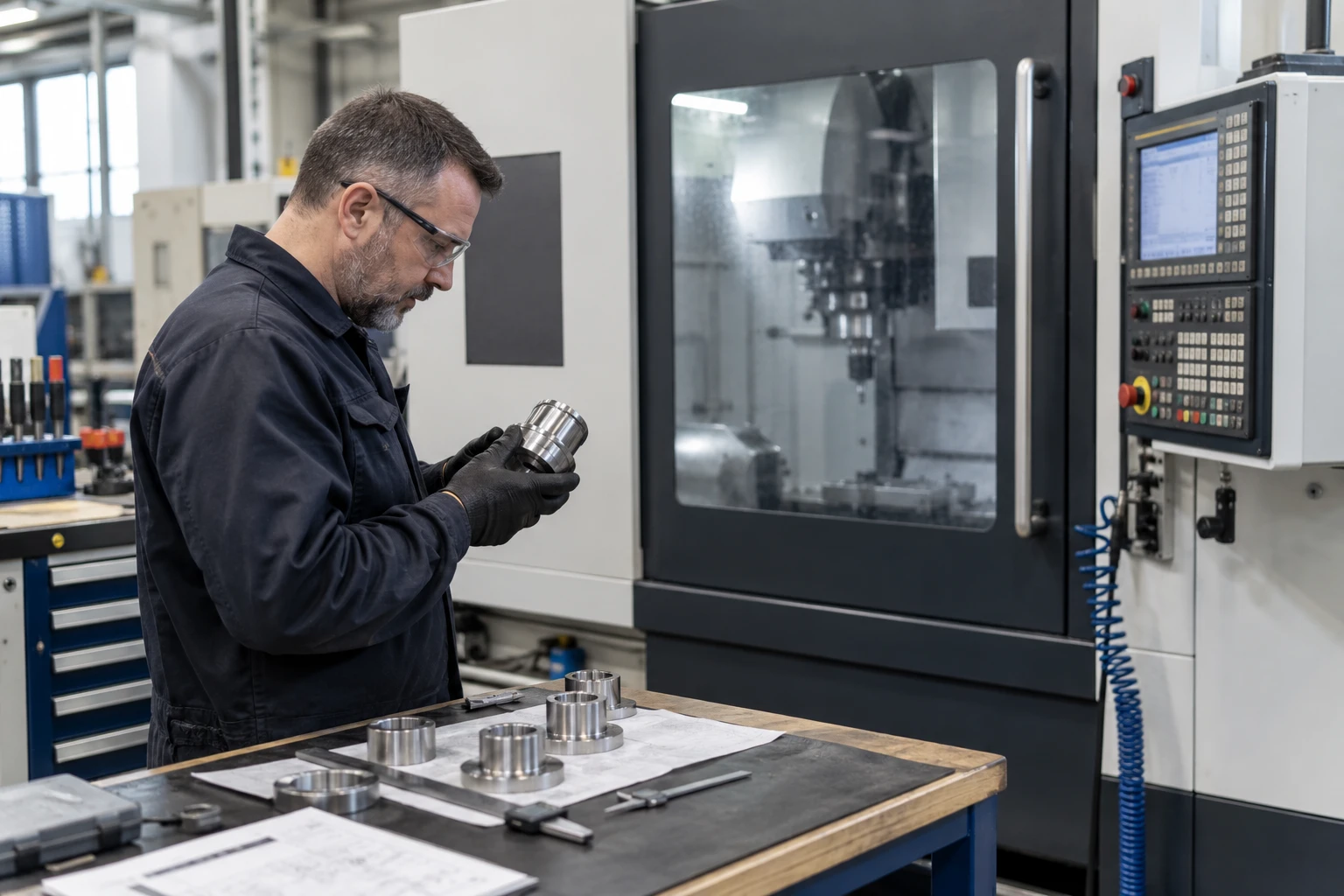
Existing SHAREhub photographic illustration. The fictional case supplies the task and decision evidence.
Maintenance changes the normal state of equipment and may expose stored energy, hazardous material or unguarded parts. Define the task, competent roles, isolations, access and simultaneous work. Include testing and reinstatement in the plan rather than treating them as an afterthought.
BuildOut service and failed interlock
Task Material And Setting: BuildOut Ltd’s warehouse conveyor moves bagged building material. A contractor services bearings, then an operator reports that the interlocked access guard no longer stops the belt. People And Prerequisites: Operator, cleaner, contractor and supervisor may enter the zone. The machine identity, linked drives, pneumatic feed, instructions and previous test result are needed. Before: The operator stops and reports the failure; the supervisor holds the whole affected line. The maintainer identifies and verifies every energy boundary before opening the guard. During: Competent repair investigates the interlock and service change.
No production running or improvised powered test occurs while a person is exposed. Hold Or Stop: Hold if guard function, isolation, run-down, linked restart or personnel accounting is uncertain. The completed service sheet is not a release. Completion And Hand Back: Restore guards, clear tools and people, perform the specified protected stop/restart test, record the result and obtain named release. Evidence: Keep defect and hold record, isolation method, repair, functional test, affected inspection decision, contractor handback and recurring-failure review. Sources: HSE maintenance of work equipment; HSE inspection of work equipment; HSE L22 Safe use of work equipment.
Fictional workplace decision
Fictional case — A conveyor repair is invoiced as complete, but an interlock remains bypassed from diagnostics. Operations wants normal production before any authorised safeguard test or hand-back is recorded.
Compare the reasoning
The invoice records completed repair work; it does not establish that the conveyor is ready for normal operation. The diagnostic bypass remains an unresolved protective-function defect. Keep production release on hold while competent people restore and safely test the affected safeguard, reconcile the work area and records, and obtain the named authorised hand-back.
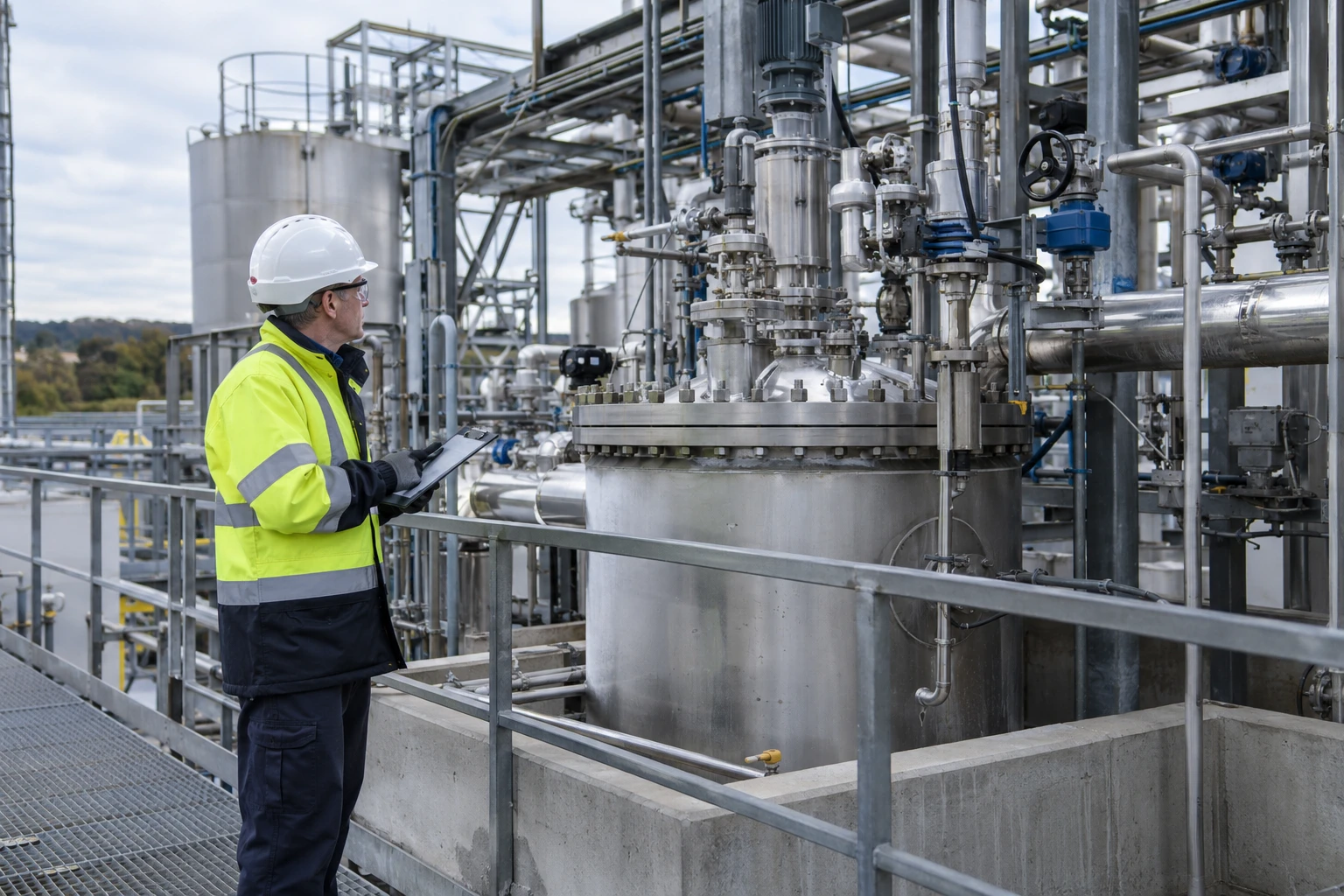
Existing SHAREhub photographic illustration. The fictional case supplies the task and decision evidence.
Maintenance changes the normal state of equipment and may expose stored energy, hazardous material or unguarded parts. Define the task, competent roles, isolations, access and simultaneous work. Include testing and reinstatement in the plan rather than treating them as an afterthought.
How should defects be controlled?
Report and classify the defect, keep dangerous equipment out of use, repair competently and prove the affected function before release. A missing guard, failed brake, cracked lifting part or uncertain pressure protection needs a clear stop-use decision. Tagging helps communicate a hold but does not physically prevent reuse on its own; choose isolation or access control as needed. Record who may remove the hold and what evidence they require. Repeated defects call for cause investigation and a changed plan. HSE maintenance of work equipment and HSE thorough examination of lifting equipment.
An ordinary service defect is recorded, quarantined and resolved through the equipment system. A statutory examiner’s finding follows its own report route as well as the work restriction. For GB LOLER, the examiner immediately informs the dutyholder of dangerous defects; serious existing or potential dangerous defects require the prescribed written report and a copy to the enforcing authority as soon as practicable. Respect any specified remedy deadline and prohibition on continued use. HSE: lifting examinations and dangerous-defect reports. For GB PSSR, the competent person’s imminent-danger process includes immediate notification, a written report to the user/owner and a copy to the enforcing authority within 14 days; prevent operation until the required remedy is made.
HSE: pressure systems. NI has separate LOLER/PSSR instruments and enforcing routes: apply the corresponding current provisions and competent advice. A manager cannot waive an examiner’s restriction; not every minor maintenance defect is externally reportable.
Fictional workplace decision
Fictional case — A conveyor repair is invoiced as complete, but an interlock remains bypassed from diagnostics. Operations wants normal production before any authorised safeguard test or hand-back is recorded.
Compare the reasoning
The invoice records completed repair work; it does not establish that the conveyor is ready for normal operation. The diagnostic bypass remains an unresolved protective-function defect. Keep production release on hold while competent people restore and safely test the affected safeguard, reconcile the work area and records, and obtain the named authorised hand-back.
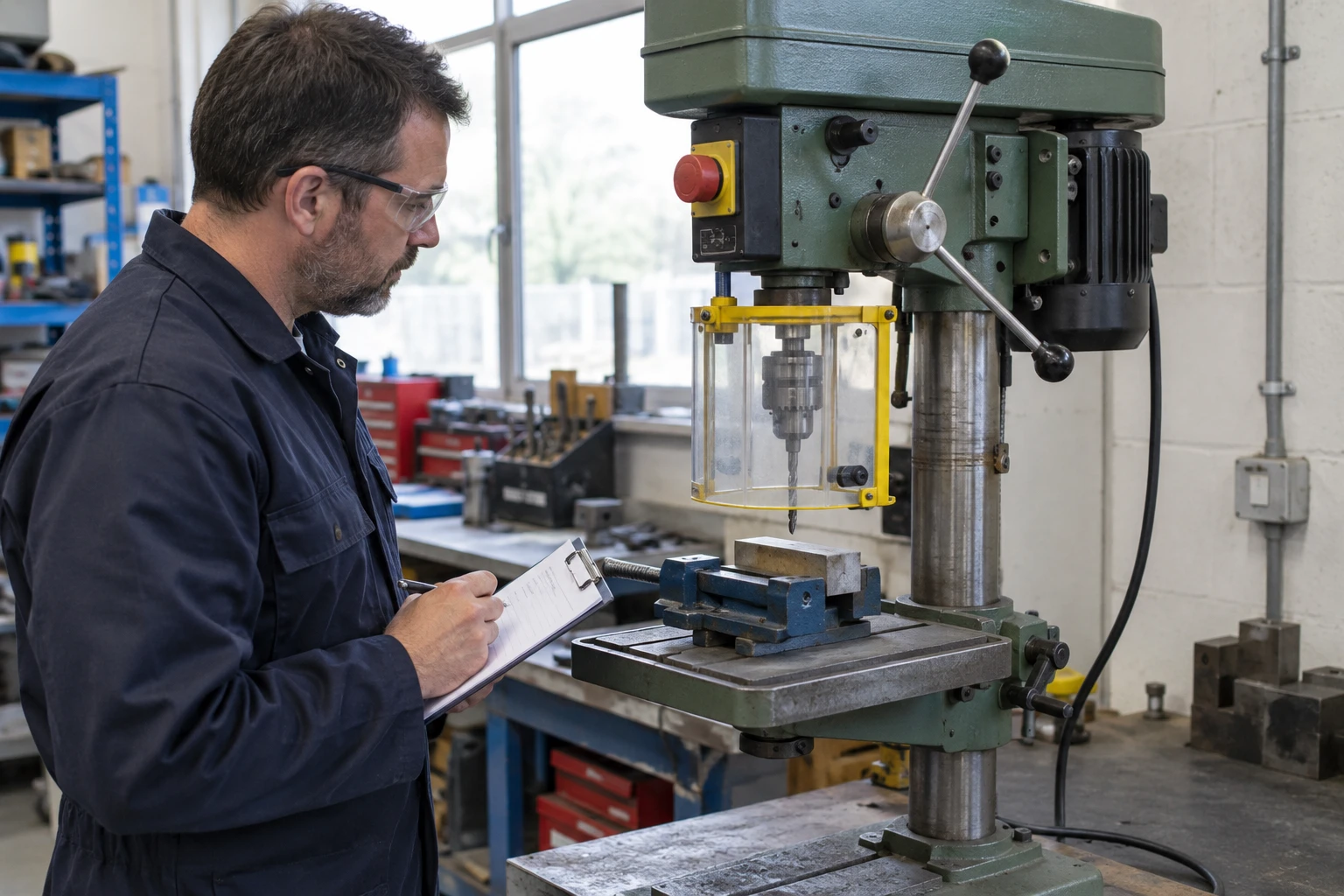
Existing SHAREhub photographic illustration. The fictional case supplies the task and decision evidence.
Track removed guards, bypasses, temporary repairs and incomplete work. Use clear communication between operations and maintainers. A machine being able to run is not the same as being ready for normal service.
Who owns each check and release?
Users perform defined pre-use checks; competent people inspect, maintain and test within scope; competent, sufficiently impartial people handle specialist statutory examinations; managers control defects and release. Source basis: HSE PUWER overview · HSE inspection of work equipment · HSE LOLER overview · HSE thorough examination of lifting equipment · GB PUWER 1998 legislation · NI PUWER 1999 legislation · GB LOLER 1998 legislation · NI LOLER 1999 legislation · GB Pressure Systems Safety Regulations 2000 · NI Pressure Systems Safety Regulations 2004 · HSE pressure systems regulations overview · HSENI work equipment and machinery guidance · HSE maintenance of work equipment.
A supervisor should not sign a specialist examination they cannot judge. A competent examiner may be in-house if sufficiently independent and impartial; the person who routinely maintains the equipment should not examine their own work. The examiner must identify dangerous defects and act without pressure from the maintenance team. A manager needs one asset record that connects tasks, findings, holds, tests, statutory reports and authorisation. HSE thorough examination of lifting equipment and HSE inspection of work equipment.
Fictional workplace decision
Fictional case — A conveyor repair is invoiced as complete, but an interlock remains bypassed from diagnostics. Operations wants normal production before any authorised safeguard test or hand-back is recorded.
Compare the reasoning
The invoice records completed repair work; it does not establish that the conveyor is ready for normal operation. The diagnostic bypass remains an unresolved protective-function defect. Keep production release on hold while competent people restore and safely test the affected safeguard, reconcile the work area and records, and obtain the named authorised hand-back.
Professional teaching illustration. Read the written scenario for the facts; the image is not evidence of a real workplace.
Track removed guards, bypasses, temporary repairs and incomplete work. Use clear communication between operations and maintainers. A machine being able to run is not the same as being ready for normal service.
Which assets and functions need a plan?
List work equipment, its tasks, safety-critical parts, degradation mechanisms and required checks. Assign an owner for each inspection, maintenance task, test and defect. For a conveyor, include guards, interlocks, emergency stops, drives, nip points and stored energy. For mobile plant, include brakes, tyres, steering, lift functions and attachments. For a pressure system, identify whether the system qualifies for a written scheme and its protected parts. Use the manufacturer’s information and the risk assessment to define what can deteriorate and who is competent to inspect it.
HSE PUWER overview and HSE inspection of work equipment.
Fictional workplace decision
Fictional case — A conveyor repair is invoiced as complete, but an interlock remains bypassed from diagnostics. Operations wants normal production before any authorised safeguard test or hand-back is recorded.
Compare the reasoning
The invoice records completed repair work; it does not establish that the conveyor is ready for normal operation. The diagnostic bypass remains an unresolved protective-function defect. Keep production release on hold while competent people restore and safely test the affected safeguard, reconcile the work area and records, and obtain the named authorised hand-back.
Existing SHAREhub photographic illustration. The fictional case supplies the task and decision evidence.
Track removed guards, bypasses, temporary repairs and incomplete work. Use clear communication between operations and maintainers. A machine being able to run is not the same as being ready for normal service.
Which GB and NI legal routes apply?
Great Britain uses PUWER 1998, LOLER 1998 and PSSR 2000 where each applies; Northern Ireland has separate 1999 PUWER and LOLER instruments and PSSR 2004. Source basis: HSE inspection of work equipment · HSE maintenance of work equipment · HSE LOLER overview · HSE pressure systems regulations overview · NI LOLER 1999 legislation · HSENI work equipment and machinery guidance · NI PUWER 1999 legislation · HSENI PUWER 1999 · GB PUWER 1998 legislation · GB LOLER 1998 legislation · GB Pressure Systems Safety Regulations 2000 · NI Pressure Systems Safety Regulations 2004 · HSE thorough examination of lifting equipment.
Identify the workplace, equipment, intended function and whether lifting or a relevant pressure system is involved. Do not apply an examination interval from one regime to every machine. PUWER inspection, LOLER thorough examination and PSSR written-scheme examination are different duties with different evidence. HSE inspection of work equipment, HSE thorough examination of lifting equipment, HSE pressure systems regulations overview and HSENI work equipment and machinery guidance.
Fictional workplace decision
Fictional case — A conveyor repair is invoiced as complete, but an interlock remains bypassed from diagnostics. Operations wants normal production before any authorised safeguard test or hand-back is recorded.
Compare the reasoning
The invoice records completed repair work; it does not establish that the conveyor is ready for normal operation. The diagnostic bypass remains an unresolved protective-function defect. Keep production release on hold while competent people restore and safely test the affected safeguard, reconcile the work area and records, and obtain the named authorised hand-back.
Existing SHAREhub photographic illustration. The fictional case supplies the task and decision evidence.
Confirm people and tools are clear, required safeguards are restored, tests are acceptable and limitations are communicated. The authorised restart decision must be explicit. Follow task-specific procedures; the session does not teach live testing or hazardous fault-finding.
How should managers assure equipment remains safe?
Trace each important failure to the check that detects it, then sample the evidence and the actual plant condition. Review overdue checks by risk, failed functional tests, statutory reports, repeated defects, contractor quality and unauthorised returns. Walk the equipment with operators to find access and intervention realities. A dashboard showing 100% completed services is weak if it omits guards, emergency stops or pressure protection. HSE inspection of work equipment and HSE maintenance of work equipment. Illustrative asset record: conveyor interlock; protected functional check under the machine-specific plan; competent engineer; last result failed; equipment held; next trigger after repair; release requires specified passing results, guards restored and named handback.
A service closure is not proof of a required inspection or examination.
Fictional workplace decision
Fictional case — A conveyor repair is invoiced as complete, but an interlock remains bypassed from diagnostics. Operations wants normal production before any authorised safeguard test or hand-back is recorded.
Compare the reasoning
The invoice records completed repair work; it does not establish that the conveyor is ready for normal operation. The diagnostic bypass remains an unresolved protective-function defect. Keep production release on hold while competent people restore and safely test the affected safeguard, reconcile the work area and records, and obtain the named authorised hand-back.
When must equipment be held or an emergency start?
Verify the hand-back
Verify safeguards before restart
Existing SHAREhub photographic illustration. The fictional case supplies the task and decision evidence.
Confirm people and tools are clear, required safeguards are restored, tests are acceptable and limitations are communicated. The authorised restart decision must be explicit. Follow task-specific procedures; the session does not teach live testing or hazardous fault-finding.
When must equipment be held or an emergency start?
Hold use for a failed safeguard, dangerous defect, overdue required examination, uncertain pressure condition or unverified isolation. Protect people before investigating records. 2 linked parts. Follow the question numbers and complete the applicable route. Part 1 of 2 · Questions 1–3 Source basis: HSE maintenance of work equipment · HSE thorough examination of lifting equipment · HSE pressure systems regulations overview · HSE inspection of work equipment · HSE managing risk using PPE · HSENI PUWER 1999 · HSE L22 Safe use of work equipment · HSE LOLER overview.
Stop from a safe place, prevent reuse, report and ask the competent owner for assessment. For injury, entrapment or release, raise the alarm and follow the site rescue or emergency plan; improvised movement can worsen harm. Resume only after correction, required examination or test, restored protection and named handback. HSE maintenance of work equipment and HSE thorough examination of lifting equipment.
Fictional workplace decision
Fictional case — A conveyor repair is invoiced as complete, but an interlock remains bypassed from diagnostics. Operations wants normal production before any authorised safeguard test or hand-back is recorded.
Compare the reasoning
The invoice records completed repair work; it does not establish that the conveyor is ready for normal operation. The diagnostic bypass remains an unresolved protective-function defect. Keep production release on hold while competent people restore and safely test the affected safeguard, reconcile the work area and records, and obtain the named authorised hand-back.
How can the ISO 45001 hierarchy of controls reduce machinery risks during maintenance, inspection and testing?
Verify the hand-back
Verify safeguards before restart
Professional teaching illustration. Read the written scenario for the facts; the image is not evidence of a real workplace.
Confirm people and tools are clear, required safeguards are restored, tests are acceptable and limitations are communicated. The authorised restart decision must be explicit. Follow task-specific procedures; the session does not teach live testing or hazardous fault-finding.
How can the ISO 45001 hierarchy of controls reduce machinery risks during maintenance, inspection and testing?
Choose the safe intervention and test method before a maintainer approaches danger. Design out unnecessary access, use engineered separation and secure isolation for the planned work, then support those measures with competent instruction, controlled tests and residual PPE. Illustrative decision: BuildOut replaces a conveyor bearing and checks the protective interlock. Mechanical repair and demonstration of the safety function are separate tasks. The engineer specifies the isolation and the protected test; the supervisor coordinates operators, cleaners and linked equipment. ERICPD means Eliminate, Reduce (including substitution), Isolate, Control, PPE and Discipline.
The five-level hierarchy groups measures as elimination, substitution, engineering controls, administrative controls and PPE. They overlap: isolation is usually an engineering measure; control can include engineered and administrative measures. Discipline means maintaining and checking the controls, supervising the method and learning from defects, rather than blaming someone or accepting weaker protection. ERICPD is a planning crossmap. Its prompts do not add a sixth rung or rank Isolate above engineering. Discipline verifies and sustains every control level. The hierarchy of controls in ISO 45001:2018 comes under Clause 8.1.2 (Eliminating hazards and reducing OH&S risks), which is located within Clause 8 ("Operation").
ESEAP: Elimination, Substitution, Engineering controls, Administrative controls and PPE. Control order: HSE hierarchy of controls and IOSH hierarchy of control guidance. The comparison is an original illustrative application of the general HSE hierarchy, not a machine-specific method, permit or design approval. The employer must choose measures for the actual work and jurisdiction. Apply the separate Northern Ireland legal route where relevant; the local assessment and competent technical decision govern release. Sources: HSE hierarchy of controls; HSE maintenance of work equipment; HSE inspection of work equipment; HSENI PUWER 1999.
Fictional workplace decision
Fictional case — A conveyor repair is invoiced as complete, but an interlock remains bypassed from diagnostics. Operations wants normal production before any authorised safeguard test or hand-back is recorded.
Compare the reasoning
The invoice records completed repair work; it does not establish that the conveyor is ready for normal operation. The diagnostic bypass remains an unresolved protective-function defect. Keep production release on hold while competent people restore and safely test the affected safeguard, reconcile the work area and records, and obtain the named authorised hand-back.