Workplace awareness and prevention. Specialist competence, statutory examinations and work authorisation require separate evidence. Check the relevant UK nation and actual workplace arrangements. Completion does not establish practical competence, authorise hazardous work or award an external qualification.
Read the complete core teaching here. Use the interactive course for required activities, saved assessment and conditional completion.
Know the equipment
Know the equipment
Identify equipment and responsible roles
Professional teaching illustration. Read the written scenario for the facts; the image is not evidence of a real workplace.
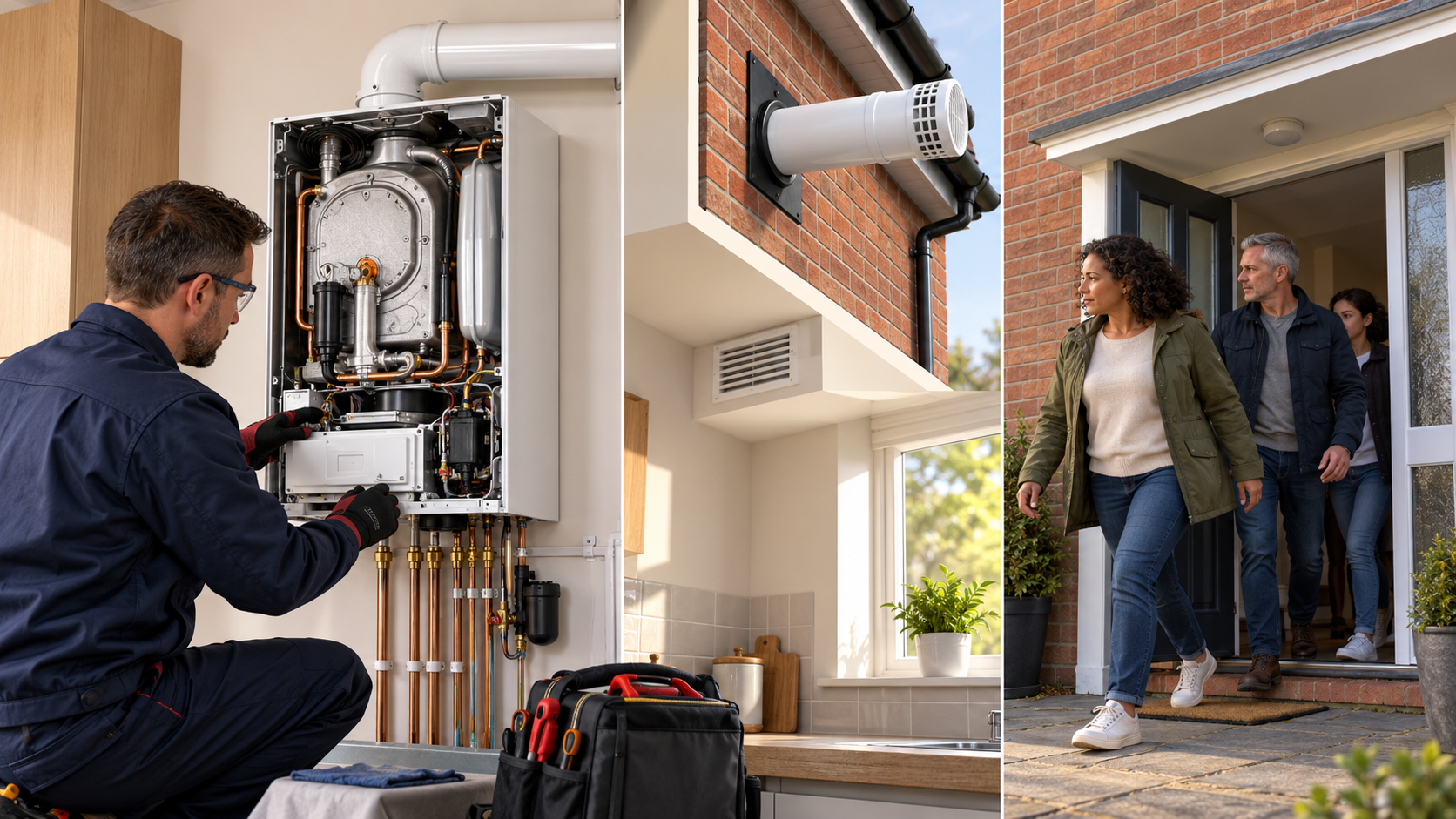
Map gas appliances, pipework, ventilation and flues relevant to the premises. Combustion equipment can produce carbon monoxide, which cannot be identified reliably by smell. Portable or outdoor equipment can create serious hazards if used in an unsuitable enclosed location.
What does gas safety mean at work?
Gas safety means keeping fuel and other gases contained, using equipment suited to the gas and task, controlling combustion and preventing people being exposed to leaks, fire, explosion, pressure release or oxygen-deficient air. A gas system includes the supply, pipework, valves, appliance, combustion air and flue or exhaust. These parts work together: a well-serviced boiler can become dangerous if a refurbishment blocks its air supply or damages its flue. Gas safety therefore continues between engineer visits. This page covers workplace boilers, kitchens, LPG events and portable gas welding equipment.
Facilities staff, operators, contractors and purchasers each control a different part of the risk. Bulk LNG, gas networks, process furnaces, specialist toxic gases and confined-space work need specialist assessment; this page does not provide commissioning, purging, leak-testing or rescue methods. The practical principles apply across Great Britain and Northern Ireland; legal instruments and emergency routes differ. HSE L56 supplies the GB gas-use framework, while the NI 2004 Regulations and HSENI guidance provide the NI route. HSE L56 Gas Safety Installation and Use ACOP; HSENI Gas safety in commercial catering.
Fictional workplace decision
Fictional case — A fuel-fired heater is moved into a less ventilated work area. A carbon monoxide alarm is installed, and the supervisor assumes that the alarm settles equipment suitability.
Compare the reasoning
Stop use in the changed location while competent assessment resolves equipment suitability, combustion and ventilation. The carbon monoxide alarm provides a warning function; it does not make an unsuitable installation acceptable. Review the whole supply and appliance arrangement and obtain the relevant verified acceptance before any return to use.
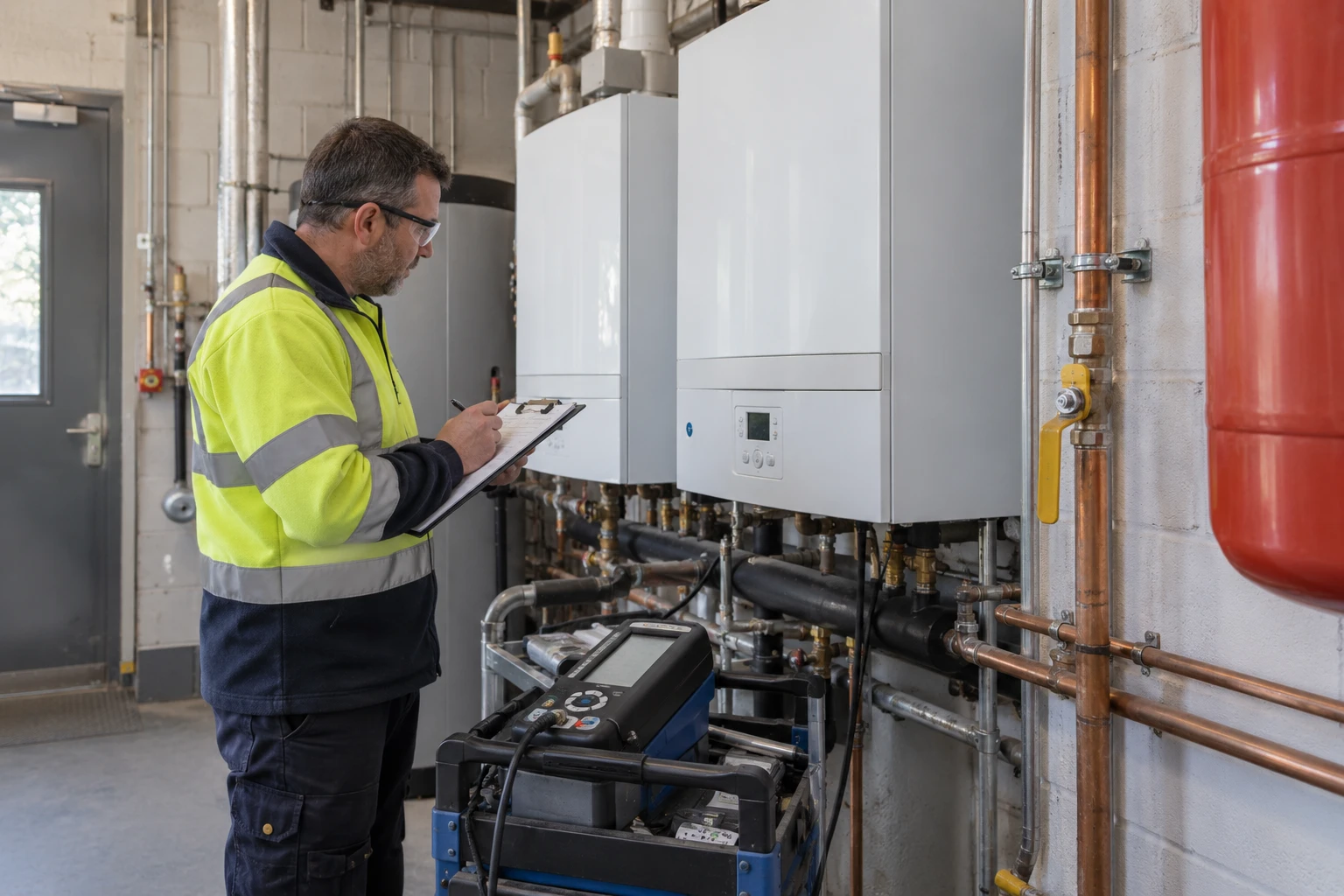
Existing SHAREhub photographic illustration. The fictional case supplies the task and decision evidence.
Map gas appliances, pipework, ventilation and flues relevant to the premises. Combustion equipment can produce carbon monoxide, which cannot be identified reliably by smell. Portable or outdoor equipment can create serious hazards if used in an unsuitable enclosed location.
How should gas risks be reduced?
First ask whether the gas or hot-work task can be removed. Where it remains, reduce the potential release, contain and isolate the supply, control ignition and combustion, and plan for failure before relying on instructions or PPE. For a temporary event, a suitable electric cooking option may remove the need for LPG cylinders and hoses, although electrical capacity and other hazards still need checking. For fabrication, a cold-cutting method may avoid oxy-fuel hot work. If gas is necessary, competent design and installation should provide appropriate containment, ventilation, flues, isolation and protective devices.
Keep quantities proportionate to the work, protect pipework and cylinders from vehicles and heat, and control ignition sources where a release could create an explosive atmosphere. Establish who owns ventilation and safety interlocks, and how faults are reported and repaired. Never defeat an interlock to keep production running. DSEAR assessment determines prevention and mitigation measures; a generic separation distance or gas alarm setpoint is not a substitute. HSE Dangerous Substances and Explosive Atmospheres Regulations. Administrative controls then support the engineered precautions: authorise work, coordinate contractors, check changes, maintain the system and practise evacuation.
Use suitable eye, hand, body and other protection for identified residual hazards such as hot work or cylinder handling. Ordinary masks and gloves cannot make an unsafe gas atmosphere acceptable. Escape, emergency intervention and confined-space rescue need separately planned competent arrangements.
Fictional workplace decision
Fictional case — A fuel-fired heater is moved into a less ventilated work area. A carbon monoxide alarm is installed, and the supervisor assumes that the alarm settles equipment suitability.
Compare the reasoning
Stop use in the changed location while competent assessment resolves equipment suitability, combustion and ventilation. The carbon monoxide alarm provides a warning function; it does not make an unsuitable installation acceptable. Review the whole supply and appliance arrangement and obtain the relevant verified acceptance before any return to use.
Existing SHAREhub photographic illustration. The fictional case supplies the task and decision evidence.
Map gas appliances, pipework, ventilation and flues relevant to the premises. Combustion equipment can produce carbon monoxide, which cannot be identified reliably by smell. Portable or outdoor equipment can create serious hazards if used in an unsuitable enclosed location.
How can gas exposure injure people?
A fuel-gas release can reach a person as an ignitable cloud, while faulty combustion can send colourless carbon monoxide into breathing air. Fire and blast cause immediate burns and trauma; inhaled carbon monoxide deprives organs of oxygen and can cause serious illness, death or lasting neurological harm. A non-flammable gas can also displace oxygen in an enclosed space. Follow the whole route from source to person. A damaged hose or fitting may release natural gas or LPG; LPG vapour can collect in a pit or low area before an ignition source starts a fire or explosion.
Blocked combustion air or a damaged flue can let carbon monoxide enter an occupied room without a smell. High-pressure releases and falling cylinders create impact and cold-injury risks. Quantity, enclosure, ventilation, ignition, pressure, exposure time and the people present alter severity. Do not use the absence of smell as evidence of a safe atmosphere. The first decision is to leave, protect others and use the relevant emergency route; diagnosis, atmospheric testing and repair belong to competent specialists. HSE carbon monoxide advice and HSE employer guidance describe these mechanisms and the workplace response.
Fictional workplace decision
Fictional case — A fuel-fired heater is moved into a less ventilated work area. A carbon monoxide alarm is installed, and the supervisor assumes that the alarm settles equipment suitability.
Compare the reasoning
Stop use in the changed location while competent assessment resolves equipment suitability, combustion and ventilation. The carbon monoxide alarm provides a warning function; it does not make an unsuitable installation acceptable. Review the whole supply and appliance arrangement and obtain the relevant verified acceptance before any return to use.
Existing SHAREhub photographic illustration. The fictional case supplies the task and decision evidence.
Plan suitable inspection and maintenance with appropriately qualified people. Use Gas Safe registration where the work falls within that regime and check the engineer’s relevant scope. Do not let unqualified staff modify appliances, flues or gas fittings.
Who needs which competence?
Everyone needs instructions suited to their role, while technical gas work needs task-specific competence and the registration required by the applicable regime. Attendance at an awareness course does not authorise gas engineering. For GB shops, restaurants, schools, hospitals and domestic or sleeping accommodation, gas fitting work must be carried out by an appropriately qualified Gas Safe registered engineer, as HSE states. Certain industrial and other premises fall outside much of GSIUR: a competent person is still required, and residential parts may remain in scope. Do not decide this boundary from the business name alone.
For NI, apply the NI Regulations and seek HSENI advice on unusual scope questions. HSE Gas safety for employers; HSENI Gas safety in commercial catering. Refresh training when tasks, equipment, conditions or observed performance change. Set any local refresher interval through assessment; do not invent a universal gas-awareness certificate expiry. Separate trained observation and operation, an expressly authorised supplier-specific cylinder change, and technical gas-fitting work. Awareness training does not authorise appliance modification, opening gasways, combustion adjustment or bypassing protection.
Fictional workplace decision
Fictional case — A fuel-fired heater is moved into a less ventilated work area. A carbon monoxide alarm is installed, and the supervisor assumes that the alarm settles equipment suitability.
Compare the reasoning
Stop use in the changed location while competent assessment resolves equipment suitability, combustion and ventilation. The carbon monoxide alarm provides a warning function; it does not make an unsuitable installation acceptable. Review the whole supply and appliance arrangement and obtain the relevant verified acceptance before any return to use.
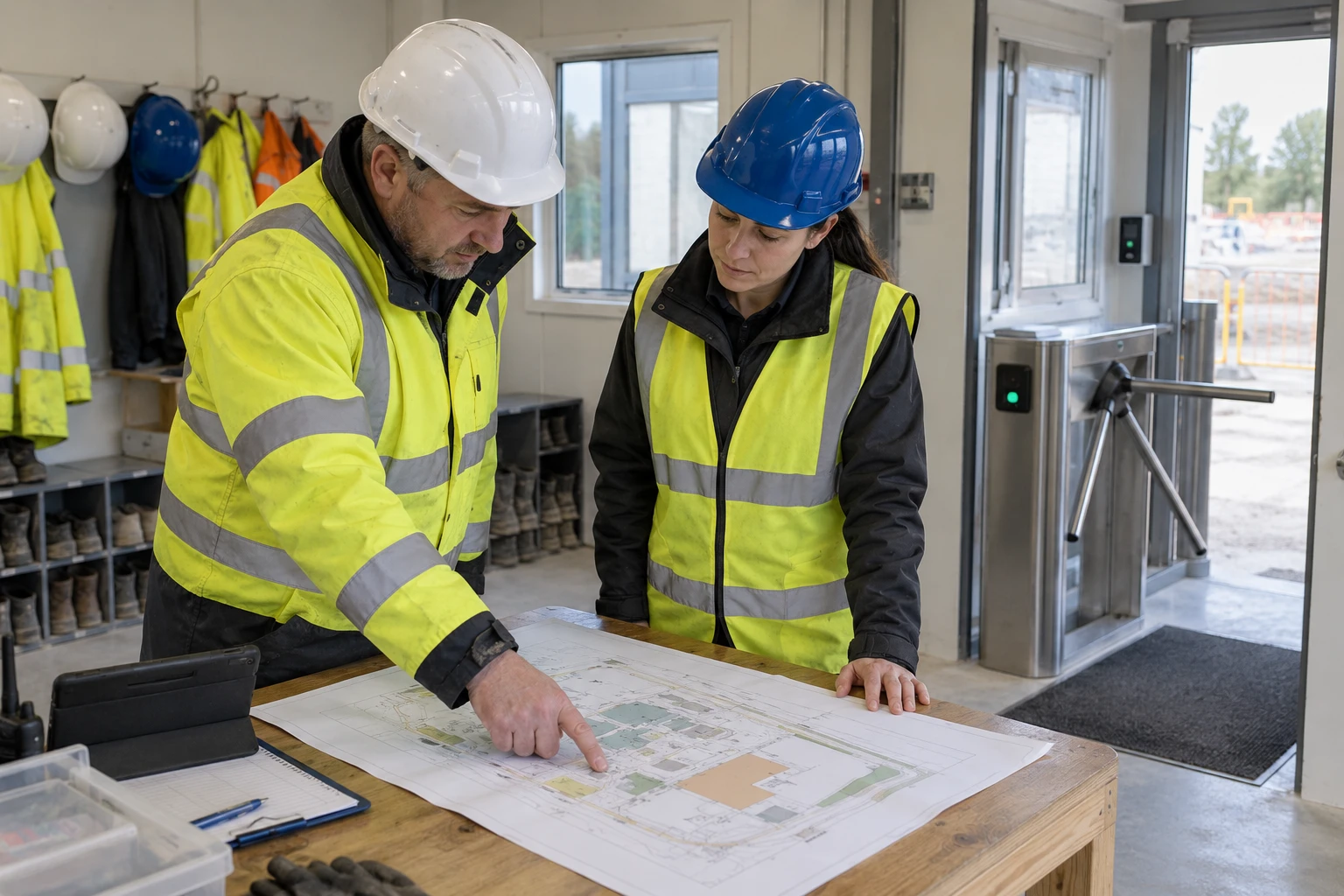
Professional teaching illustration. Read the written scenario for the facts; the image is not evidence of a real workplace.
Plan suitable inspection and maintenance with appropriately qualified people. Use Gas Safe registration where the work falls within that regime and check the engineer’s relevant scope. Do not let unqualified staff modify appliances, flues or gas fittings.
What should managers record and review?
Keep evidence that connects each gas risk to an owner, a control and a verified action. A folder of service certificates is insufficient if equipment is missing from the register or unsafe defects remain open. A practical asset record identifies the appliance or supply, location, gas type, flue and ventilation dependencies, isolation points, relevant instructions, service or check basis, contractor and due actions. Preserve installation and commissioning evidence, engineer-category verification, landlord records where applicable, risk and change assessments, defects and formal hand-back. In the risk register, describe a credible event such as “kitchen extraction fails while cooking continues”, the people exposed, preventive and warning barriers, barrier owners and stop/restart conditions.
Record the remaining risk and actions with their owners and deadlines. This is a SHARE assurance approach, not a prescribed statutory form. Sample the workplace as well as the records: can staff identify their emergency contact; is an isolation valve accessible; has an unsafe label been respected; are flues or vents obstructed; do recurring pilot failures or alarm reports receive investigation? Escalate repeated resets, unexplained gas use, missing assets, defective hoses and overdue safety actions. Learn from incidents after making the situation safe. Use the applicable gas law, HSE or HSENI guidance, and manufacturer instructions for the actual appliance.
Where a technical standard may be relevant, a competent engineer must consult an authorised current copy. The competent engineer should use current authorised technical standards where relevant, alongside legal duties and the actual manufacturer instructions. HSE gas safety for employers.
Fictional workplace decision
Fictional case — A fuel-fired heater is moved into a less ventilated work area. A carbon monoxide alarm is installed, and the supervisor assumes that the alarm settles equipment suitability.
Compare the reasoning
Stop use in the changed location while competent assessment resolves equipment suitability, combustion and ventilation. The carbon monoxide alarm provides a warning function; it does not make an unsuitable installation acceptable. Review the whole supply and appliance arrangement and obtain the relevant verified acceptance before any return to use.
What should I do if I suspect a leak or carbon monoxide?
Use the right competence
Recognise signs requiring withdrawal
Existing SHAREhub photographic illustration. The fictional case supplies the task and decision evidence.
Plan suitable inspection and maintenance with appropriately qualified people. Use Gas Safe registration where the work falls within that regime and check the engineer’s relevant scope. Do not let unqualified staff modify appliances, flues or gas fittings.
What should I do if I suspect a leak or carbon monoxide?
Leave the affected area, avoid ignition and call from safety: Great Britain natural gas 0800 111 999; Northern Ireland natural gas 0800 002 001; LPG or cylinder gas the supplier’s emergency route. For suspected gas-appliance CO, call the applicable gas emergency route even without symptoms. Obtain urgent medical advice for possible poisoning; call 999 for fire, immediate danger, breathing difficulty, sudden confusion, collapse, weakness, chest or muscle pain after suspected exposure. Do not re-enter or restart until competent advice confirms safety. Avoid smoking, flames and electrical switching in a suspected gas atmosphere, including switching lights or fans off.
Close an accessible emergency gas valve and open doors or windows only if you can do so safely without delaying escape or entering danger. Do not approach or move a heated, fire-affected or leaking cylinder as an untrained responder. Keep others away and follow the site evacuation arrangements. Do not re-enter or restore the supply until the emergency responder and competent gas specialist have made the situation safe and given the appropriate advice. The duty manager records affected equipment, symptoms, isolation and the hand-back decision.
Investigate after people are safe; do not postpone emergency action to collect evidence. Medical help is separate from the gas-emergency response. For possible CO symptoms below the emergency threshold, obtain urgent medical advice using NHS 111 in England, NHS 24 on 111 in Scotland or NHS 111 Wales; in NI use the local GP/out-of-hours or emergency-department route. Use 999 for the emergency signs above. NHS CO medical action; HSENI CO and NI medical help.
Fictional workplace decision
Fictional case — A fuel-fired heater is moved into a less ventilated work area. A carbon monoxide alarm is installed, and the supervisor assumes that the alarm settles equipment suitability.
Compare the reasoning
Stop use in the changed location while competent assessment resolves equipment suitability, combustion and ventilation. The carbon monoxide alarm provides a warning function; it does not make an unsuitable installation acceptable. Review the whole supply and appliance arrangement and obtain the relevant verified acceptance before any return to use.
Existing SHAREhub photographic illustration. The fictional case supplies the task and decision evidence.
A gas smell, suspected carbon monoxide or alarm needs the site’s withdrawal and emergency arrangements, not improvised fault-finding. Alarms support prevention but do not replace safe installation and maintenance. Restart requires competent investigation and verified safety.
How do LPG and welding cylinders change the controls?
Use a planned storage and handling arrangement for the actual gas, cylinder and site. Keep cylinders secure and protected, use compatible regulators and hoses, and agree the supplier’s emergency route. LPG cylinder and bulk-tank locations need competent siting assessment, including ignition, traffic impact, access, ventilation and low points where vapour could collect. Keep cylinders in their prescribed orientation and move them with suitable equipment. Full and nominally empty cylinders both need control; an empty cylinder can retain hazardous contents. Do not improvise adapters, repair valves or use a flame to find a leak.
Portable oxy-fuel equipment needs the right gas, regulators, hose assemblies, non-return valves and flashback arresters. A non-return valve limits reverse flow; it does not stop a flame front. HSE INDG297 calls for arresters on both oxygen and fuel-gas lines near the regulators, with additional protection for long hose arrangements. Select and maintain the complete assembly with the supplier, and keep oil and grease away from oxygen equipment. HSE INDG297 Gas welding cutting and similar processes. Hot work also needs control of nearby combustibles, hidden voids, fumes, other workers and post-work fire risk.
The permit and risk assessment set the task-specific monitoring and fire-watch arrangements; this page does not prescribe an arbitrary duration. Stop for unknown coatings, residues, containers or gas identity and obtain competent assessment. A cylinder involved in fire, or an acetylene cylinder becoming hot or vibrating, requires withdrawal and emergency fire-service help, not an improvised cooling or moving operation. For welding-fume control, use HSE welding fume: protect workers alongside the actual task assessment; older hot-work publications do not replace current fume advice.
Fictional workplace decision
Fictional case — A fuel-fired heater is moved into a less ventilated work area. A carbon monoxide alarm is installed, and the supervisor assumes that the alarm settles equipment suitability.
Compare the reasoning
Stop use in the changed location while competent assessment resolves equipment suitability, combustion and ventilation. The carbon monoxide alarm provides a warning function; it does not make an unsuitable installation acceptable. Review the whole supply and appliance arrangement and obtain the relevant verified acceptance before any return to use.
A changed kitchen needs coordinated competent hand-back
Make the emergency route clear
Distinguish maintenance from alarms
Existing SHAREhub photographic illustration. The fictional case supplies the task and decision evidence.
A gas smell, suspected carbon monoxide or alarm needs the site’s withdrawal and emergency arrangements, not improvised fault-finding. Alarms support prevention but do not replace safe installation and maintenance. Restart requires competent investigation and verified safety.
A changed kitchen needs coordinated competent hand-back
An appliance, ventilation, flue and protective interfaces can depend on one another. A change by one trade must not leave the gas installation assumed safe by another. Record the actual appliance and work on extraction, ventilation or connected systems, and who controls each part. For a suspected escape, move away safely and use the appropriate emergency route for the location and fuel; do not investigate or relight equipment. The relevant gas and ventilation specialists verify their functions and interfaces against the actual installation. The operating owner receives identified evidence and restrictions.
Keep affected use held if required information or verification is missing. ERICPD is a planning cross-map: Discipline verifies and sustains every control. ESEAP compares effectiveness. A label does not authorise the task; retain the owner, evidence and stop or change decision.
Fictional workplace decision
Fictional case — A fuel-fired heater is moved into a less ventilated work area. A carbon monoxide alarm is installed, and the supervisor assumes that the alarm settles equipment suitability.
Compare the reasoning
Stop use in the changed location while competent assessment resolves equipment suitability, combustion and ventilation. The carbon monoxide alarm provides a warning function; it does not make an unsuitable installation acceptable. Review the whole supply and appliance arrangement and obtain the relevant verified acceptance before any return to use.
Professional teaching illustration. Read the written scenario for the facts; the image is not evidence of a real workplace.
A gas smell, suspected carbon monoxide or alarm needs the site’s withdrawal and emergency arrangements, not improvised fault-finding. Alarms support prevention but do not replace safe installation and maintenance. Restart requires competent investigation and verified safety.
Why does carbon monoxide need a separate warning?
Carbon monoxide, or CO, is a poisonous gas from incomplete combustion; it has no colour or smell. For a CO alarm or suspected exposure, go outside and call the relevant gas emergency route from safety even without symptoms: GB natural gas 0800 111 999, NI natural gas 0800 002 001, or the LPG supplier. Seek urgent medical advice for suspected poisoning and call 999 for breathing difficulty, sudden confusion, collapse, weakness, chest or muscle pain. Do not re-enter or restart until competent advice confirms safety.
Poor combustion, restricted combustion air or defective exhaust arrangements can allow CO to build up. Headache, dizziness, nausea and unusual tiredness are easily mistaken for ordinary illness. Several people becoming unwell in one area, or symptoms easing outside, are reasons to act, not a diagnosis. Do not wait for a detector reading before seeking help. CO interferes with the body’s oxygen supply and can cause fatal poisoning or lasting harm. Sooting, repeated pilot failure and unexpected flame changes need competent investigation, but the absence of these signs does not establish safety.
Some decorative appliances normally show yellow flames; compare with the manufacturer’s intended operation. CO alarms add warning and must be suitable, installed, tested and replaced to their instructions. They do not replace safe installation, maintenance, ventilation or required landlord checks. Alarm positioning and replacement periods are product-specific. HSE carbon monoxide advice. Medical help is separate from the gas-emergency response. For possible CO symptoms below the emergency threshold, obtain urgent medical advice using NHS 111 in England, NHS 24 on 111 in Scotland or NHS 111 Wales; in NI use the local GP/out-of-hours or emergency-department route.
Use 999 for the emergency signs above. NHS CO medical action; HSENI CO and NI medical help.
Fictional workplace decision
Fictional case — A fuel-fired heater is moved into a less ventilated work area. A carbon monoxide alarm is installed, and the supervisor assumes that the alarm settles equipment suitability.
Compare the reasoning
Stop use in the changed location while competent assessment resolves equipment suitability, combustion and ventilation. The carbon monoxide alarm provides a warning function; it does not make an unsuitable installation acceptable. Review the whole supply and appliance arrangement and obtain the relevant verified acceptance before any return to use.