Wellbeing strategy: choosing actions that change work
Approximately 52–80 minutes
Workplace awareness and prevention. Individual clinical diagnosis and treatment belong with qualified clinicians; protect personal information and use appropriate advice. Check the relevant UK nation and actual workplace arrangements. Completion does not establish practical competence, authorise hazardous work or award an external qualification.
Read the complete core teaching here. Use the interactive course for required activities, saved assessment and conditional completion.
Start with an evidence question
Start with an evidence question
Identify workforce needs without intrusive data
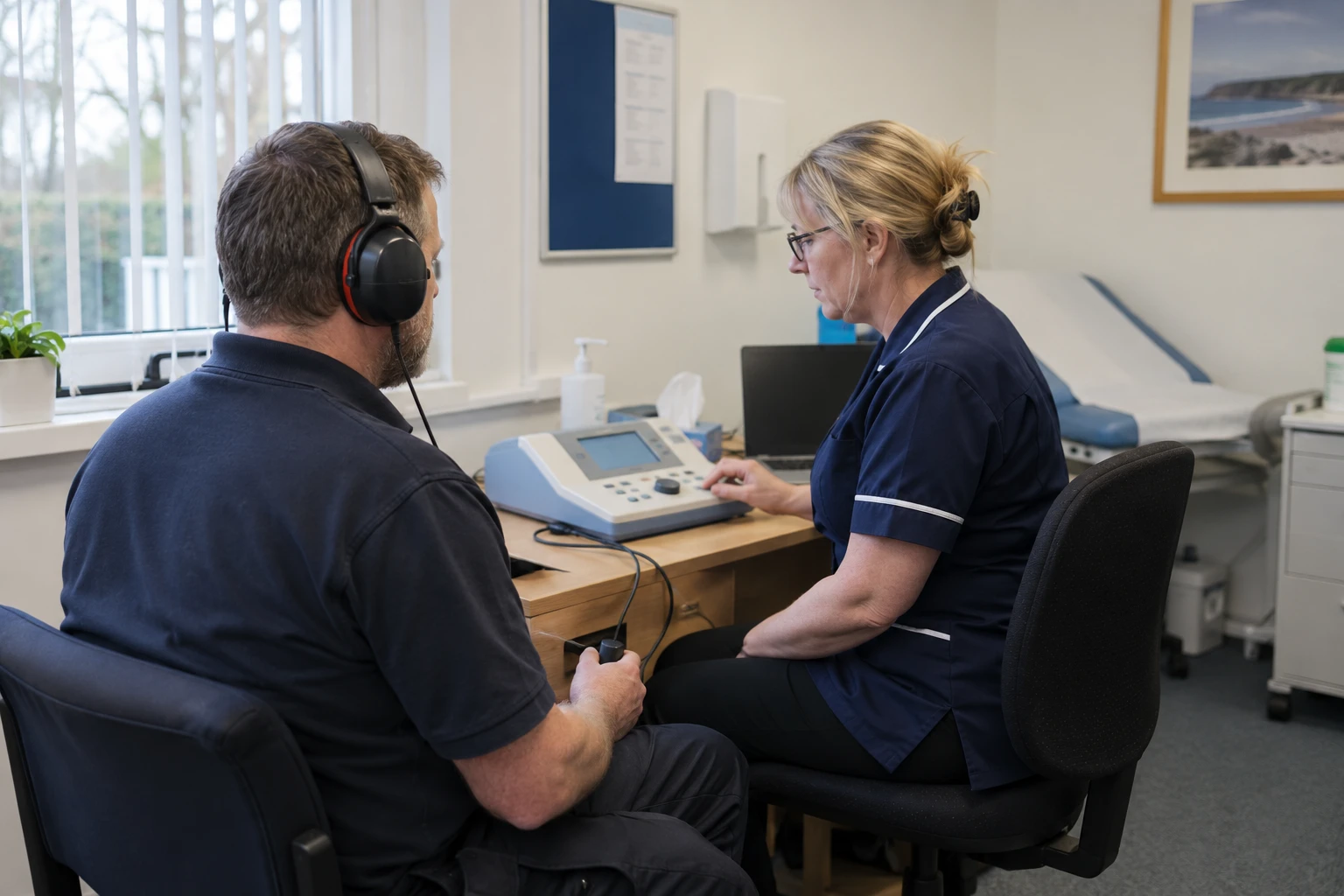
Professional teaching illustration. Read the written scenario for the facts; the image is not evidence of a real workplace.
Combine worker consultation with appropriate absence, turnover and work-risk information. Look for underserved shifts, locations and roles. Use sufficiently grouped data so individuals cannot be identified; a small-team dashboard can reveal more than intended.
How can a weak strategy allow harm to develop?
A strategy fails when it counts activities while leaving excessive demand, hostile contact or unsafe work unchanged. Repeated pressure can disturb sleep and concentration and contribute to work-related stress; in a safety-critical task, fatigue or poor communication can also contribute to physical injury. Identify the exposure and change the work, rather than labelling a person as the hazard. Use worker accounts, incidents and work observations to trace source, route, frequency and affected group. A private offer may help one person, but it does not remove an overloaded rota or an abusive public interaction.
Acute threats need an immediate task and emergency response; persistent pressure needs assessed and resourced work redesign.HSE Management StandardsHSENI Management Standards Sources: HSE Management Standards; HSENI Management Standards for work-related stress; HSE HSG48 Reducing error and influencing behaviour
Fictional workplace decision
Fictional organisation-wide programme: wellbeing-event attendance is high, but workers report repeated missed breaks and unpredictable workload. The programme proposes more events without defining which work problem should change.
Compare the reasoning
The programme lead defines the actual work problem and examines missed breaks, workload variation, worker feedback and the existing control arrangements. Assign practical work actions and review what changes. High event attendance measures participation; it does not demonstrate that harmful demands have been removed or justify substituting more events for an unresolved operational issue.
How should a wellbeing programme portfolio be balanced?
Start with an evidence question
Identify workforce needs without intrusive data
Existing SHAREhub photographic illustration. The fictional case supplies the task and decision evidence.
Combine worker consultation with appropriate absence, turnover and work-risk information. Look for underserved shifts, locations and roles. Use sufficiently grouped data so individuals cannot be identified; a small-team dashboard can reveal more than intended.
How should a wellbeing programme portfolio be balanced?
Map each initiative to a documented need and tier: organisation-wide prevention is the foundation, followed by optional individual support and targeted support where justified. Show dependencies and gaps. Several individual apps do not become an organisational strategy, and one targeted service should not be expected to repair unsafe work design. Start with the defined need and objective, compare no-purchase and work-design options, assess evidence and fit, consult users, review risks and approve only with an evaluation and exit plan. Free or discounted products still require due diligence.
A prestigious logo, testimonial, award or supplier case study is not evidence that the programme will work for this workforce. Basis: Magenta Book central government guidance on evaluation; HSE HSG65 Managing for health and safety Check intervention, comparison, population, setting, outcomes, duration, effect size, harms, independence and uncertainty, then state only claims the evidence supports. Do not promise reduced absence, productivity, health improvement or return on investment from weak association, testimonials or a vendor calculator. Record conflicts and whether evidence is peer reviewed, independent and transferable.
Basis: Magenta Book central government guidance on evaluation
Fictional workplace decision
Fictional organisation-wide programme: wellbeing-event attendance is high, but workers report repeated missed breaks and unpredictable workload. The programme proposes more events without defining which work problem should change.
Compare the reasoning
The programme lead defines the actual work problem and examines missed breaks, workload variation, worker feedback and the existing control arrangements. Assign practical work actions and review what changes. High event attendance measures participation; it does not demonstrate that harmful demands have been removed or justify substituting more events for an unresolved operational issue.
Existing SHAREhub photographic illustration. The fictional case supplies the task and decision evidence.
Combine worker consultation with appropriate absence, turnover and work-risk information. Look for underserved shifts, locations and roles. Use sufficiently grouped data so individuals cannot be identified; a small-team dashboard can reveal more than intended.
Acronyms and terms
Use terms that separate wellbeing, psychosocial risk, work-related stress, intervention, monitoring, evaluation, health data, adjustment and clinical care. Wellbeing strategy. Meaning: Governed plan for prevention, healthy work and support.; Boundary: Not a calendar of benefits. Programme or intervention. Meaning: Activity intended to create defined change.; Boundary: Needs evidence, controls and evaluation. Psychosocial hazard. Meaning: Work factor with potential for psychological or physical harm.; Boundary: Not a label for a person. Theory of change. Meaning: How inputs and activities are expected to produce outcomes.; Boundary: Assumptions must be tested.
Monitoring. Meaning: Routine evidence about delivery and signals.; Boundary: Does not establish causation alone. Evaluation. Meaning: Systematic assessment of design, delivery and outcomes.; Boundary: Must state uncertainty and alternatives. Special-category data. Meaning: Personal data concerning physical or mental health.; Boundary: Needs a lawful basis, condition and safeguards. Reasonable adjustment. Meaning: Change intended to remove or reduce disability disadvantage.; Boundary: Legal framework differs in GB and NI. Basis: Magenta Book central government guidance on evaluation; HSE Work-related stress and how to manage it
Fictional workplace decision
Fictional organisation-wide programme: wellbeing-event attendance is high, but workers report repeated missed breaks and unpredictable workload. The programme proposes more events without defining which work problem should change.
Compare the reasoning
The programme lead defines the actual work problem and examines missed breaks, workload variation, worker feedback and the existing control arrangements. Assign practical work actions and review what changes. High event attendance measures participation; it does not demonstrate that harmful demands have been removed or justify substituting more events for an unresolved operational issue.
Existing SHAREhub photographic illustration. The fictional case supplies the task and decision evidence.
Prioritise employer-controlled causes such as excessive demand, poor welfare, late pay or barriers to support. Optional health promotion can complement these actions. Assign ownership and resources rather than counting events, posters or app registrations as proof of improvement.
How can the ISO 45001 hierarchy of controls prioritise changes to harmful working conditions in a wellbeing programme?
Assess the work demands and remove or redesign avoidable sources of work-related stress before relying on individual support. HSE’s risk-assessment route considers demands, control, support, relationships, role and change. Assign a responsible owner and review whether the work change helps. ERICPD (Eliminate, Reduce including substitution, Isolate, Control, personal protective equipment (PPE), Discipline) is a SHARE decision prompt cross-mapped to HSE’s five-level hierarchy. Choose stronger feasible controls first, verify them in the actual task and record why a stronger option cannot be used. Discipline means sustaining controls through maintenance, supervision and learning.
Apply this proportionately to the actual work risk; body size, distress or a health result is not itself a control hierarchy. Organisational rules are administrative controls, and support services do not replace prevention. ERICPD is a planning crossmap. Its prompts do not add a sixth rung or rank Isolate above engineering. Discipline verifies and sustains every control level. The hierarchy of controls in ISO 45001:2018 comes under Clause 8.1.2 (Eliminating hazards and reducing OH&S risks), which is located within Clause 8 ("Operation"). ESEAP: Elimination, Substitution, Engineering controls, Administrative controls and PPE.
Control order: HSE hierarchy of controls and IOSH hierarchy of control guidance. Sources: HSE Work-related stress risk assessment Replacing one support service with another does not itself substitute the source of risk. For example, replacing an on-call rota that repeatedly interrupts recovery with an assessed staffed cover arrangement changes the harmful demand; verify that workload and risk have not simply transferred to another group. Keep optional support separate from this work-control decision.
Fictional workplace decision
Fictional organisation-wide programme: wellbeing-event attendance is high, but workers report repeated missed breaks and unpredictable workload. The programme proposes more events without defining which work problem should change.
Compare the reasoning
The programme lead defines the actual work problem and examines missed breaks, workload variation, worker feedback and the existing control arrangements. Assign practical work actions and review what changes. High event attendance measures participation; it does not demonstrate that harmful demands have been removed or justify substituting more events for an unresolved operational issue.
How is a defensible wellbeing needs assessment made?
Choose work changes first
Choose a proportionate intervention
Professional teaching illustration. Read the written scenario for the facts; the image is not evidence of a real workplace.
Prioritise employer-controlled causes such as excessive demand, poor welfare, late pay or barriers to support. Optional health promotion can complement these actions. Assign ownership and resources rather than counting events, posters or app registrations as proof of improvement.
How is a defensible wellbeing needs assessment made?
Triangulate work-risk assessments, protected worker feedback, absence and turnover patterns, incidents, complaints, change plans, equality evidence and service data without treating any one source as the answer.
Survey scores are indicators, not diagnoses or proof of cause. Check who is missing, subgroup re-identification risk, data quality, seasonal effects, selection bias and whether trends reflect work or external change.
Case
Useful for
Limitation
Risk assessment and observation
Work factors and exposed roles.
May miss unreported experience.
Survey or focus group
Perception and possible hot spots.
Selection, wording and anonymity limits.
Administrative trend
Where to investigate.
Does not prove cause or programme impact.
Complaints and incidents
Serious barriers and control failure.
Access and under-reporting vary.
Assess tasks, staffing, pace, hours, shifts, remote and lone work, public contact, travel, role clarity, change, support, equipment and environment, then control foreseeable harm through ordinary management.
Work can cause, contribute to, trigger or reveal poor wellbeing. The response should examine job and organisational factors as well as individual needs and should not default to blame.
Case
Possible control
Evidence of effect
Demand and staffing
Priorities, capacity, breaks and recovery.
Actual workload and missed-break trend.
Control and autonomy
Decision latitude and escalation.
Worker-reported control and exceptions.
Support and relationships
Supervision, resources and behaviour control.
Access, action and complaint themes.
Change and role
Consultation, clarity and transition support.
Questions resolved and controls reviewed.
Use demands, control, support, relationships, role and change as a structure for work-stress assessment, worker discussion, action planning and review in the correct GB or Northern Ireland route.
The six areas are not a wellbeing score or clinical diagnostic tool. Use mixed evidence and consultation to identify underlying causes and test controls.
Prioritise material work risks, serious inequality, repeated concerns, exposed groups, feasible controls and strategic changes using transparent criteria agreed with workers.
Popularity is not the same as need. A visible low-risk campaign must not displace action on harmful demand, violence, bullying, job insecurity or inaccessible work.
Fictional organisation-wide programme: wellbeing-event attendance is high, but workers report repeated missed breaks and unpredictable workload. The programme proposes more events without defining which work problem should change.
Compare the reasoning
The programme lead defines the actual work problem and examines missed breaks, workload variation, worker feedback and the existing control arrangements. Assign practical work actions and review what changes. High event attendance measures participation; it does not demonstrate that harmful demands have been removed or justify substituting more events for an unresolved operational issue.
Existing SHAREhub photographic illustration. The fictional case supplies the task and decision evidence.
Prioritise employer-controlled causes such as excessive demand, poor welfare, late pay or barriers to support. Optional health promotion can complement these actions. Assign ownership and resources rather than counting events, posters or app registrations as proof of improvement.
Example handy documents
These are examples of documents an organisation can create and adapt to its actual work. They are not downloadable files on this page and do not replace local risk assessment or clinical and legal advice. Strategy from Work Risk to Reviewed Action. Decision supported: Build and govern the complete lifecycle.; Hard stop: No perks-first or activity-only strategy. Programme Selection and Due Diligence. Decision supported: Approve, pilot, redesign or reject.; Hard stop: No unknown data or unsupported claim. Measures That Inform Decisions Not Judge People. Decision supported: Interpret evidence without scoring workers.; Hard stop: No individual fitness or commitment inference.
Need or Proposal decision tree. Decision supported: Route a need through prevention and approval gates.; Hard stop: No launch without readiness and stop rules. Monitoring Signal decision tree. Decision supported: Move findings to corrective action and review.; Hard stop: No release without verified control. Basis: Magenta Book central government guidance on evaluation; HSE HSG65 Managing for health and safety
Fictional workplace decision
Fictional organisation-wide programme: wellbeing-event attendance is high, but workers report repeated missed breaks and unpredictable workload. The programme proposes more events without defining which work problem should change.
Compare the reasoning
The programme lead defines the actual work problem and examines missed breaks, workload variation, worker feedback and the existing control arrangements. Assign practical work actions and review what changes. High event attendance measures participation; it does not demonstrate that harmful demands have been removed or justify substituting more events for an unresolved operational issue.
Existing SHAREhub photographic illustration. The fictional case supplies the task and decision evidence.
Define what success would look like before launch and check implementation, access and worker experience. Compare over time while acknowledging other changes and small samples. Do not claim a programme caused lower absence solely because both happened together.
What should routine monitoring cover?
Monitor resources, delivery fidelity, reach and equitable access, work-control completion, support and complaint performance, data quality, outcomes and adverse effects against defined thresholds.
Use the least intrusive data that can answer the question. Monitoring tells you what is happening; it does not by itself establish why or prove programme impact. Magenta Book evaluation guidance
Case
Example
Decision use
Inputs
Budget, trained capacity and manager time.
Can delivery be sustained?
Process
Access, wait, drop-out and control closure.
Is implementation working fairly?
Leading control
Workload or change actions verified.
Are causes being addressed?
Outcome and harm
Relevant change and unintended effect.
Continue, investigate or stop.
Plan evaluation before launch using a theory of change, baseline, questions, process and outcome measures, qualitative evidence, comparison or alternative explanations where feasible, and decision dates.
Ask what worked, for whom, in which context, why, at what cost and with what unintended effects. Use proportionate expertise and distinguish contribution from causation.
Treat participation, survey scores, absence, turnover, productivity and service use as partial signals with definitions, denominators, uncertainty and context, never as individual diagnosis or fitness thresholds.
High uptake can reflect pressure or incentives; low uptake can reflect good health, poor access, distrust or irrelevance. Falling absence may reflect presenteeism or policy change. Triangulate before acting.
A 60-person service compares eight baseline weeks with eight pilot weeks. Recorded missed-break shifts fall from 24 of 240 staffed shifts to 12 of 240 after extra relief cover, while a demand reduction could also explain part of the change. Only 48 day workers received the new cover; 12 night workers were excluded and report continued missed breaks. The evaluation owner records the denominator, coverage and alternative explanation, redesigns night cover and repeats the review before considering expansion. Attendance or the overall average alone cannot justify a causal wellbeing claim.
Fictional organisation-wide programme: wellbeing-event attendance is high, but workers report repeated missed breaks and unpredictable workload. The programme proposes more events without defining which work problem should change.
Compare the reasoning
The programme lead defines the actual work problem and examines missed breaks, workload variation, worker feedback and the existing control arrangements. Assign practical work actions and review what changes. High event attendance measures participation; it does not demonstrate that harmful demands have been removed or justify substituting more events for an unresolved operational issue.
Existing SHAREhub photographic illustration. The fictional case supplies the task and decision evidence.
Define what success would look like before launch and check implementation, access and worker experience. Compare over time while acknowledging other changes and small samples. Do not claim a programme caused lower absence solely because both happened together.
What should leaders review?
Review context, risk, objectives, resources, worker voice, control completion, portfolio fit, access, privacy, outcomes, harms, complaints, vendor performance and assurance, then make explicit decisions.
Do not accept activity counts as assurance. Challenge whether the organisation changed harmful work, whether evidence supports claims and whether unresolved issues need resources or stop action.
Case
Evidence
Decision
Are causes controlled?
Risk actions and worker verification.
Fund, escalate or redesign.
Is delivery fair and safe?
Access, adverse and complaint evidence.
Correct, hold or stop.
Are outcomes credible?
Evaluation and limitations.
Continue, test or withdraw claim.
Is governance effective?
Overdue actions, conflicts and assurance.
Change ownership or capacity.
Repeat needs evidence, consult, review policies and controls, test changes, learn from adverse effects and update objectives, routes and the portfolio through a documented Plan, Do, Check, Act cycle.
Close the loop to workers and preserve what did not work as organisational learning. A yearly relaunch with the same unresolved work risks is not continual improvement.
Case
Action
Evidence
Plan
Refresh context, risk and priorities.
Updated need and objectives.
Do
Implement controls and approved programmes.
Resources and delivery record.
Check
Monitor, evaluate and seek worker feedback.
Findings and uncertainty.
Act
Correct, scale, redesign or stop.
Leadership decision and verified action.
Keep proportionate evidence of decisions, consultation, risk and equality review, data governance, procurement, competence, implementation, monitoring, evaluation, corrective action and approval.
Assurance should show how conclusions were reached and limitations handled, without retaining unnecessary personal health narratives. Independent review should be strongest where risk, novelty or claim size is greatest.
Fictional organisation-wide programme: wellbeing-event attendance is high, but workers report repeated missed breaks and unpredictable workload. The programme proposes more events without defining which work problem should change.
Compare the reasoning
The programme lead defines the actual work problem and examines missed breaks, workload variation, worker feedback and the existing control arrangements. Assign practical work actions and review what changes. High event attendance measures participation; it does not demonstrate that harmful demands have been removed or justify substituting more events for an unresolved operational issue.
Professional teaching illustration. Read the written scenario for the facts; the image is not evidence of a real workplace.
Define what success would look like before launch and check implementation, access and worker experience. Compare over time while acknowledging other changes and small samples. Do not claim a programme caused lower absence solely because both happened together.
A programme decision needs an evidence trail
A programme should start with a work need, not a purchase. Delivery, benefits, harms and uncertainty inform a continuing owned decision. Use consultation and work evidence, such as an identified reception rota gap, without treating individuals as the source of the hazard. Resource a relief plan and check that it reaches the intended shifts and workers; participation is delivery evidence, not proof of benefit. Consider mixed results, privacy, exclusion, unintended burden and uncertainty without attributing causation to absence or productivity alone. The programme owner continues, redesigns, stops or considers scaling with a fresh context check.
Return the decision and evidence to needs and priorities. ERICPD is a planning cross-map: Discipline verifies and sustains every control. ESEAP compares effectiveness. A label does not authorise the task; retain the owner, evidence and stop or change decision.
Fictional workplace decision
Fictional organisation-wide programme: wellbeing-event attendance is high, but workers report repeated missed breaks and unpredictable workload. The programme proposes more events without defining which work problem should change.
Compare the reasoning
The programme lead defines the actual work problem and examines missed breaks, workload variation, worker feedback and the existing control arrangements. Assign practical work actions and review what changes. High event attendance measures participation; it does not demonstrate that harmful demands have been removed or justify substituting more events for an unresolved operational issue.