Workplace awareness and prevention. Individual clinical diagnosis and treatment belong with qualified clinicians; protect personal information and use appropriate advice. Check the relevant UK nation and actual workplace arrangements. Completion does not establish practical competence, authorise hazardous work or award an external qualification.
Read the complete core teaching here. Use the interactive course for required activities, saved assessment and conditional completion.
Offer support without stigma
Offer support without stigma
Identify a reliable quit-support route
Professional teaching illustration. Read the written scenario for the facts; the image is not evidence of a real workplace.
Stopping smoking benefits health, but change is personal and support should be voluntary. Signpost current NHS or local stop-smoking services rather than prescribing treatment. Avoid turning a wellbeing initiative into public monitoring of individual behaviour.
How should a workplace smoking and vaping policy be structured?
A good policy explains the law, local rules, fire controls, designated areas, vehicles, visitors, contractors, breaks and support. The policy should be easy to enforce because ambiguity creates conflict. If workers do not know whether vaping is allowed at entrances, in vans, in welfare areas, at outdoor events or on client sites, supervisors end up making inconsistent decisions. A strong policy also links to fire risk assessment. Smoking shelters, cigarette waste, discarded matches, oxygen cylinders, flammable stores, aerosols, fuel areas, LPG cages, battery charging and process areas all need specific consideration.
A smoking rule that works in an office car park may be completely unsuitable near a fuel store or gas cylinder compound. The table illustrates policy design. GOV.UK smoke-free workplace overview supplies the smoking/vaping distinction, while HSE DSEAR ignition controls supplies the GB dangerous-substance boundary. Breaks and privacy have separate rules.
Fictional workplace decision
Fictional workshop: a worker asks for help to stop smoking, and the supervisor proposes a public progress chart. A separate workplace entrance rule is being applied inconsistently across shifts.
Compare the reasoning
The manager offers appropriate support privately without stigma while addressing the workplace rule separately. Personal support should not depend on public disclosure or become a substitute for clear work arrangements. A smoking rule that works in an office car park may be completely unsuitable near a fuel store or gas cylinder compound.
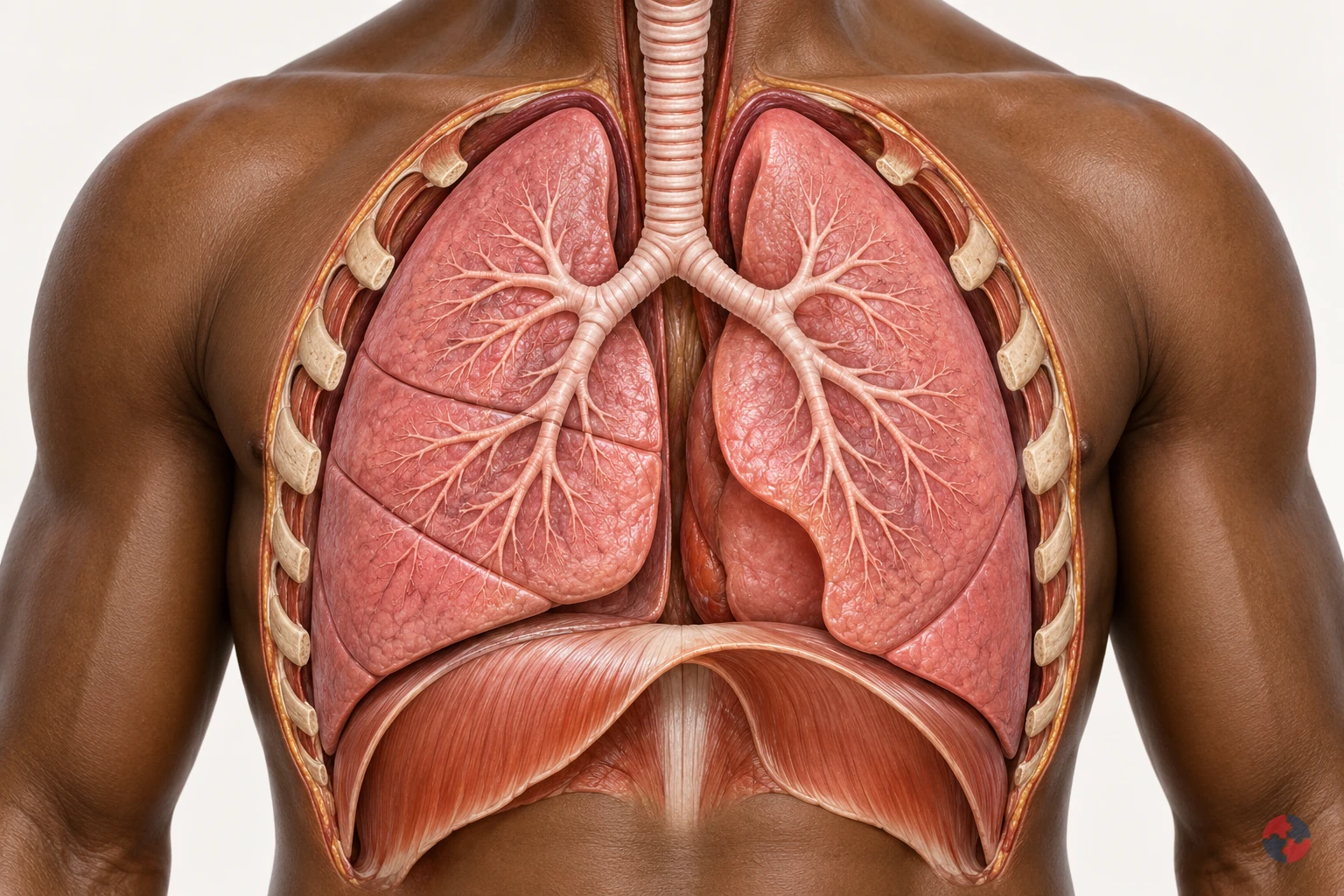
Locate the lungs, branching airways and diaphragm below them. The cutaway reveals structures normally hidden by the chest wall.
Trace the source-to-breathing-zone route in this lesson. Which change would prevent the contaminant reaching the person?
educational illustration · healthy anatomy; enlarged details and teaching colours.
Existing SHAREhub photographic illustration. The fictional case supplies the task and decision evidence.
Stopping smoking benefits health, but change is personal and support should be voluntary. Signpost current NHS or local stop-smoking services rather than prescribing treatment. Avoid turning a wellbeing initiative into public monitoring of individual behaviour.
How should smoking and vaping be understood at work?
Existing smoke-free law prohibits smoking in enclosed workplaces and shared work vehicles, while current GOV.UK guidance treats e-cigarettes separately and leaves ordinary workplace vaping rules to the employer. A policy should set clear site and vehicle boundaries, prevent second-hand smoke and ignition hazards, and offer balanced government stop-smoking information and local support. The Tobacco and Vapes Act 2026 contains country-specific vape-free-place powers whose effect depends on commencement and designation regulations; do not present them as a blanket ban already in force. Direct primary guidance provides the source boundary for the main claim.
Smoke-free workplace duties apply through separate laws in England, Scotland, Wales and Northern Ireland; enclosed workplaces and relevant work vehicles are covered, subject to each jurisdiction’s detail. Businesses must prevent smoking in relevant premises and vehicles, display required no-smoking signs and avoid creating staff smoking rooms. This is a legal baseline, not a wellbeing preference. E-cigarettes are different. GOV.UK guidance makes clear that smoke-free law does not apply to vaping in the same way; employers decide whether vaping is allowed. That decision still needs to be controlled because vaping can create complaints, comfort issues, customer-facing concerns, charging risks, confusion with smoking rules and particular problems in vehicles, care settings, schools, food areas, explosive atmospheres or oxygen-rich environments.
Good policy separates three ideas: legal compliance for smoking, workplace rules for vaping, and supportive health promotion for people who want to stop smoking. The workplace should not shame people who smoke, but it can require safe, fair and legally compliant behaviour. The charging/fire claim uses OPSS vape-battery safety rather than health-effect evidence. Use the supplied charger, do not charge overnight, inspect the device and charge visibly away from combustible material; follow manufacturer instructions. A safe charging arrangement does not permit device use inside an ignition-sensitive zone.
Select the applicable rule, risk or voluntary-support route. Workplace rules · Vehicles and ignition-sensitive tasks · Fuel, oxygen and charging risks · Voluntary quitting support ·
Fictional workplace decision
Fictional workshop: a worker asks for help to stop smoking, and the supervisor proposes a public progress chart. A separate workplace entrance rule is being applied inconsistently across shifts.
Compare the reasoning
The manager offers appropriate support privately without stigma while addressing the workplace rule separately. Personal support should not depend on public disclosure or become a substitute for clear work arrangements. A smoking rule that works in an office car park may be completely unsuitable near a fuel store or gas cylinder compound.
Separate quitting support from site ignition controls
Offer support without stigma
Identify a reliable quit-support route
Existing SHAREhub photographic illustration. The fictional case supplies the task and decision evidence.
Stopping smoking benefits health, but change is personal and support should be voluntary. Signpost current NHS or local stop-smoking services rather than prescribing treatment. Avoid turning a wellbeing initiative into public monitoring of individual behaviour.
Separate quitting support from site ignition controls
Confidential cessation support and workplace rules answer different questions. Support choices do not remove smoke-free requirements or the assessment of ignition, exposure, charging and disposal. Direct people to appropriate current UK cessation advice and support. Avoid product endorsements or unsupported comparative percentages. Clinical/support decisions belong with the person and appropriate service. The workplace can offer support without collecting unnecessary private health information. Apply the relevant requirements for buildings and vehicles and the actual workplace policy. Do not treat vaping and smoking as legally identical in every setting.
Keep ignition away from flammable substances and other fuel through the assessed site arrangements. An outdoor location is not automatically an acceptable smoking area. If an area is provided, assess its location, access, exposure to others, waste and emergency interfaces. A site-plan icon supplies no universal safe distance. Follow suitable device/battery charging and disposal arrangements and respond to defects. Cessation messaging is not a substitute for these physical safety controls. Discipline verifies and sustains all the controls; it is not a separate substitute for them.
Compare stronger feasible controls while preserving the actual task, checks and release requirements. No tobacco/vape product is recommended and no diagram overrides the relevant law or assessed site rules. Further guidance: NHS: quit smoking · HSE: fire and explosion.
Fictional workplace decision
Fictional workshop: a worker asks for help to stop smoking, and the supervisor proposes a public progress chart. A separate workplace entrance rule is being applied inconsistently across shifts.
Compare the reasoning
The manager offers appropriate support privately without stigma while addressing the workplace rule separately. Personal support should not depend on public disclosure or become a substitute for clear work arrangements. A smoking rule that works in an office car park may be completely unsuitable near a fuel store or gas cylinder compound.
Existing SHAREhub photographic illustration. The fictional case supplies the task and decision evidence.
Smoking and vaping are different exposures and are not governed identically in every setting. Check current law, local rules and the organisation’s policy. Communicate where activities are permitted, how complaints are handled and what fair break arrangements apply.
How should nicotine dependency be supported without stigma?
Workplaces should enforce safety rules while offering voluntary support for people who want help to stop smoking. Nicotine dependency can be difficult to manage, particularly for workers on long shifts, mobile routes, safety-critical work or customer-facing duties with limited break flexibility. A respectful workplace recognises that dependency may affect behaviour without allowing unsafe or unlawful smoking. The manager's role is to set fair rules, protect others, manage fire risk and signpost support. It is not to shame people, force disclosure, monitor personal health choices or treat every conversation as misconduct.
Where a worker asks for help, signposting to NHS or local stop-smoking support can sit alongside ordinary break and conduct arrangements. The support options are illustrative. The government vaping evidence informs cessation/harm discussion; work-break entitlements use the GB/NI routes in the source register, and personal health information uses the privacy rules below. Choose the official service for the person’s location. Support remains voluntary and separate from the workplace’s smoke-free, vaping-policy and ignition-control decisions; the service links are not a claim that one nation’s care route applies UK-wide.
England: NHS quit-smoking support · Scotland: NHS Inform stopping smoking · Wales: NHS Help Me Quit · NI: nidirect stopping smoking ·
Fictional workplace decision
Fictional workshop: a worker asks for help to stop smoking, and the supervisor proposes a public progress chart. A separate workplace entrance rule is being applied inconsistently across shifts.
Compare the reasoning
The manager offers appropriate support privately without stigma while addressing the workplace rule separately. Personal support should not depend on public disclosure or become a substitute for clear work arrangements. A smoking rule that works in an office car park may be completely unsuitable near a fuel store or gas cylinder compound.
Professional teaching illustration. Read the written scenario for the facts; the image is not evidence of a real workplace.
Smoking and vaping are different exposures and are not governed identically in every setting. Check current law, local rules and the organisation’s policy. Communicate where activities are permitted, how complaints are handled and what fair break arrangements apply.
What should managers do and avoid?
Managers should apply policy consistently, protect others from exposure and signpost support without shaming workers. Smoking and vaping conversations can become unnecessarily personal. The manager's role is to explain workplace rules, safety reasons, fairness and support routes. They should not lecture workers about lifestyle or assume that every policy breach is a conduct issue before understanding the facts. Consistency matters. If managers overlook smoking near one entrance but challenge it elsewhere, the rule loses credibility and workers can feel singled out. The manager responses are illustrative practices.
GOV.UK smoke-free workplace overview supports the legal/policy distinction; health information has the separate privacy requirements below. If a work decision requires health information, establish a lawful basis, minimise records and restrict access. UK GDPR Article 5 supplies the principles and Article 9 requires an additional applicable health-data condition. A support offer does not itself establish lawful collection.
Fictional workplace decision
Fictional workshop: a worker asks for help to stop smoking, and the supervisor proposes a public progress chart. A separate workplace entrance rule is being applied inconsistently across shifts.
Compare the reasoning
The manager offers appropriate support privately without stigma while addressing the workplace rule separately. Personal support should not depend on public disclosure or become a substitute for clear work arrangements. A smoking rule that works in an office car park may be completely unsuitable near a fuel store or gas cylinder compound.
How can the ISO 45001 hierarchy of controls reduce workplace exposure to tobacco smoke and vaping aerosol?
Make the policy clear
Distinguish smoking law from vaping policy
Existing SHAREhub photographic illustration. The fictional case supplies the task and decision evidence.
Smoking and vaping are different exposures and are not governed identically in every setting. Check current law, local rules and the organisation’s policy. Communicate where activities are permitted, how complaints are handled and what fair break arrangements apply.
How can the ISO 45001 hierarchy of controls reduce workplace exposure to tobacco smoke and vaping aerosol?
Control classification: Classify the mechanism separately from its upkeep: physical floor repair, drainage, barriers, protected routes, compartmentation, fire doors and suitable disposal facilities are physical measures where specified. Cleaning schedules, inspections, policies, funding, supervision and verification are administrative arrangements maintaining them. A verbal instruction is not a physical barrier. Read this correction with the source table. Retained overview and stage artwork requires the matching classification update. Address work-created hazards at source, then agree proportionate task controls and personal support. For smoking and vaping, assess the work itself: staffing, scheduling, exposure, equipment or interpersonal conditions as applicable.
Remove or reduce hazards where possible, then agree practical procedures and review whether they work. A personal health condition calls for clinical advice and suitable work adjustments, not a generic control or diagnosis by a manager. HSE hierarchy of controls Document who will act, what triggers a pause or referral, and when the arrangement will be reviewed. Apply the correct GB or NI duties and site instructions. For the van/fuel delivery, eliminate smoking from smoke-free vehicles and ignition sources from the assessed fuel zone. Separate permitted outdoor breaks from flammables, waste, entrances and routes; provide safe disposal and enforce a clear vaping/charging policy.
Do not rely on PPE to make smoking near fuel safe. ERICPD (Eliminate, Reduce, Isolate, Control, PPE, Discipline) is a teaching prompt; Discipline means consistent briefing, supervision and review. GOV.UK smoke-free workplace overview; HSE DSEAR ignition controls. ERICPD is a planning crossmap. Its prompts do not add a sixth rung or rank Isolate above engineering. Discipline verifies and sustains every control level. The hierarchy of controls in ISO 45001:2018 comes under Clause 8.1.2 (Eliminating hazards and reducing OH&S risks), which is located within Clause 8 ("Operation").
ESEAP: Elimination, Substitution, Engineering controls, Administrative controls and PPE. Control order: HSE hierarchy of controls and IOSH hierarchy of control guidance.
Fictional workplace decision
Fictional workshop: a worker asks for help to stop smoking, and the supervisor proposes a public progress chart. A separate workplace entrance rule is being applied inconsistently across shifts.
Compare the reasoning
The manager offers appropriate support privately without stigma while addressing the workplace rule separately. Personal support should not depend on public disclosure or become a substitute for clear work arrangements. A smoking rule that works in an office car park may be completely unsuitable near a fuel store or gas cylinder compound.
Existing SHAREhub photographic illustration. The fictional case supplies the task and decision evidence.
Assess ignition near dangerous substances and safe storage, charging and disposal of vaping batteries. Follow manufacturer instructions and the site’s electrical and fire arrangements. Do not assume a permitted smoking area is suitable for charging devices or storing combustible waste.
Which GB and Northern Ireland duties apply?
Current UK government guidance says smoke-free workplace law does not itself apply to e-cigarettes; employers may set a vaping policy. Northern Ireland has its own Smoking Order. The Tobacco and Vapes Act 2026 creates country-specific vape-free-place powers, but section 176 requires country-specific commencement. Place/vehicle designation regulations are also needed; check both before treating a new vaping prohibition as operative. Check the actual work location, current commencement and responsible authority before acting. The designation powers are country-specific: England designation power (section 145); Scotland designation power (section 150); Wales designation power (section 156); Northern Ireland designation power (section 161).
Section 176 addresses commencement; these separate powers require the applicable regulations before a designated-place restriction can apply. Keep the operative premises/vehicle rules, local vaping policy and future designation powers distinct. The editorial/legal owner should record the provisions checked, jurisdiction and next commencement/designation trigger; enactment alone does not establish a blanket current workplace vaping ban. Fictional completed teaching record for the SHAREhub environment. Values and timings illustrate the decision; they are not site instructions or universal limits.
Fictional workplace decision
Fictional workshop: a worker asks for help to stop smoking, and the supervisor proposes a public progress chart. A separate workplace entrance rule is being applied inconsistently across shifts.
Compare the reasoning
The manager offers appropriate support privately without stigma while addressing the workplace rule separately. Personal support should not depend on public disclosure or become a substitute for clear work arrangements. A smoking rule that works in an office car park may be completely unsuitable near a fuel store or gas cylinder compound.
When should smoking or vaping concerns be escalated?
Include practical safety
Recognise practical fire risks
Existing SHAREhub photographic illustration. The fictional case supplies the task and decision evidence.
Assess ignition near dangerous substances and safe storage, charging and disposal of vaping batteries. Follow manufacturer instructions and the site’s electrical and fire arrangements. Do not assume a permitted smoking area is suitable for charging devices or storing combustible waste.
When should smoking or vaping concerns be escalated?
Escalation is needed where legal compliance, fire risk, vulnerable people, contractors, repeated breaches or fairness concerns are involved. Not every concern needs formal action, but some conditions require immediate intervention: smoking in enclosed premises, smoking in shared work vehicles, smoking near flammable stores, cigarette waste in combustible bins, vaping where local policy prohibits it, damaged chargers or repeated conflict between teams. The best escalation is usually calm and factual. Explain the rule, the reason and the next step. If the concern involves addiction or wellbeing, offer signposting without making support compulsory.
The triggers illustrate prompt site action. GOV.UK smoke-free workplace overview supplies smoke-free law; HSE DSEAR ignition controls supplies ignition control and OPSS vape-battery safety supplies the device/charging boundary. Assess safe intervention; do not approach an overheating or burning device.
Fictional workplace decision
Fictional workshop: a worker asks for help to stop smoking, and the supervisor proposes a public progress chart. A separate workplace entrance rule is being applied inconsistently across shifts.
Compare the reasoning
The manager offers appropriate support privately without stigma while addressing the workplace rule separately. Personal support should not depend on public disclosure or become a substitute for clear work arrangements. A smoking rule that works in an office car park may be completely unsuitable near a fuel store or gas cylinder compound.
Where do smoking and vaping arrangements commonly fail?
Include practical safety
Recognise practical fire risks
Professional teaching illustration. Read the written scenario for the facts; the image is not evidence of a real workplace.
Assess ignition near dangerous substances and safe storage, charging and disposal of vaping batteries. Follow manufacturer instructions and the site’s electrical and fire arrangements. Do not assume a permitted smoking area is suitable for charging devices or storing combustible waste.
Where do smoking and vaping arrangements commonly fail?
Arrangements fail when policy is vague, signs are missing, designated areas are poorly located, contractors are not briefed or fire risks are ignored. The most common weakness is treating the issue as a personal behaviour problem only. That misses the physical controls: signs, routes, shelters, waste, flammable stores, ventilation intakes, vehicles and charging arrangements. The second weakness is inconsistent enforcement. A policy that is clear on paper but ignored for visitors, senior staff or contractors quickly loses authority. These failures illustrate policy and physical-control weaknesses.
Use GOV.UK smoke-free workplace overview for law/policy, HSE DSEAR ignition controls for dangerous substances and OPSS vape-battery safety for device safety.
Fictional workplace decision
Fictional workshop: a worker asks for help to stop smoking, and the supervisor proposes a public progress chart. A separate workplace entrance rule is being applied inconsistently across shifts.
Compare the reasoning
The manager offers appropriate support privately without stigma while addressing the workplace rule separately. Personal support should not depend on public disclosure or become a substitute for clear work arrangements. A smoking rule that works in an office car park may be completely unsuitable near a fuel store or gas cylinder compound.