Workplace awareness and prevention. Individual clinical diagnosis and treatment belong with qualified clinicians; protect personal information and use appropriate advice. Check the relevant UK nation and actual workplace arrangements. Completion does not establish practical competence, authorise hazardous work or award an external qualification.
Read the complete core teaching here. Use the interactive course for required activities, saved assessment and conditional completion.
Recognise different experiences
Recognise different experiences
Discuss work impacts respectfully
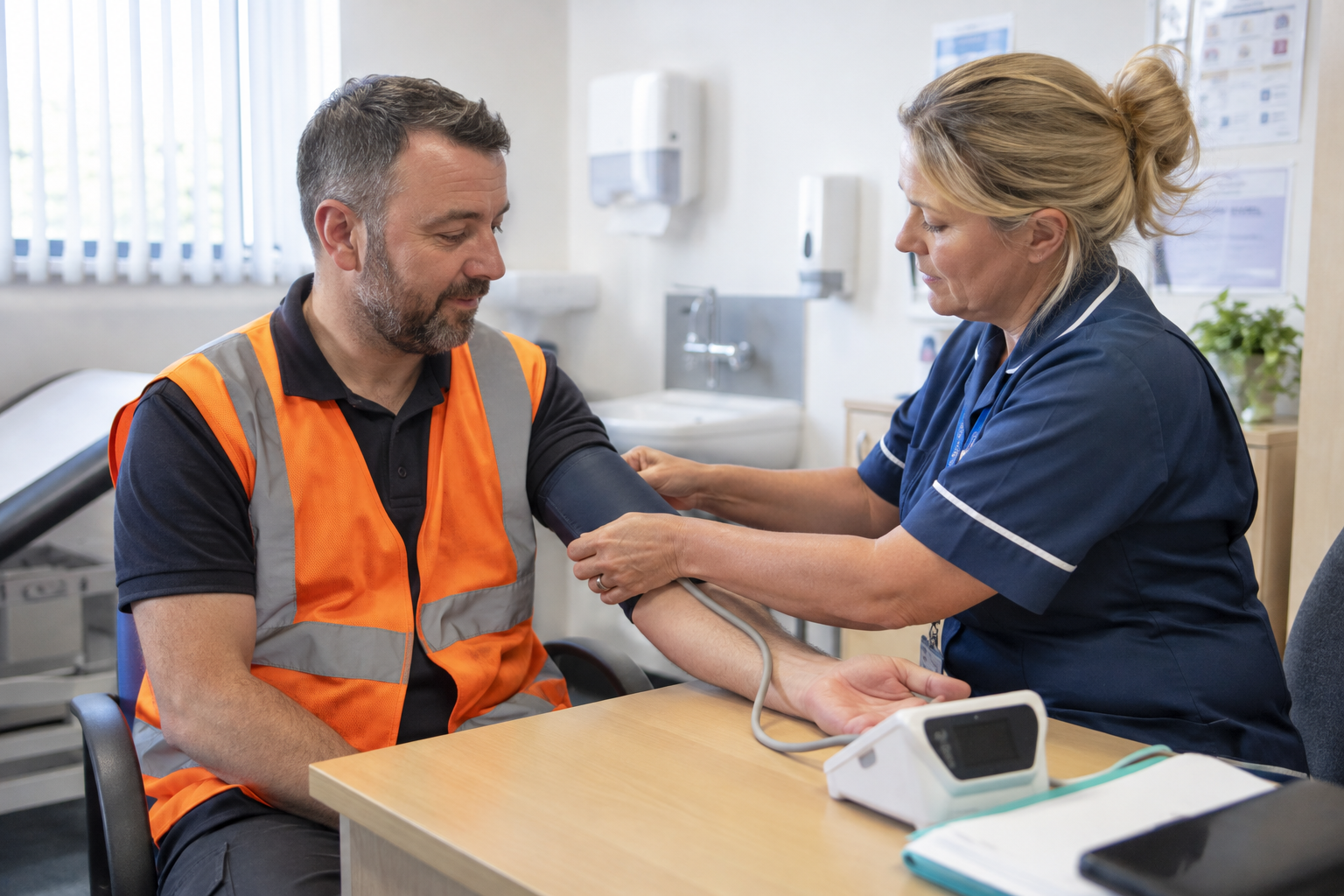
Professional teaching illustration. Read the written scenario for the facts; the image is not evidence of a real workplace.
Pain, fatigue or heavy bleeding can affect a working day, but symptoms and needs vary. Avoid jokes, assumptions or demands for intimate detail. A manager should ask what work support is useful and leave diagnosis and treatment to clinicians.
What is endometriosis?
Endometriosis is a condition where tissue similar to womb lining grows in other places and can cause long-term pain and other symptoms. NHS guidance explains that endometriosis is often found around the womb, ovaries, fallopian tubes and pelvis, and can sometimes affect organs such as the bowel or bladder. Symptoms can happen around periods or at other times. Workplaces do not need to understand every clinical detail to support someone well. They do need to understand that endometriosis can be painful, unpredictable, tiring, sensitive to discuss and capable of affecting work in practical ways.
See NHS endometriosis. The NHS describes cells similar to womb-lining cells growing elsewhere; symptoms and work impact vary. The manager should not infer a diagnosis, treatment, fertility status or disability decision from symptoms. See NHS endometriosis.
Fictional workplace decision
Fictional production team: a worker requests more reliable welfare access during some shifts. The supervisor assumes a colleague’s experience predicts what this worker will need and proposes a standard response.
Compare the reasoning
The supervisor asks privately about the worker’s actual barriers and practical needs during the relevant shifts. Agree a usable arrangement and review how it works with the person. A colleague’s experience or a shared condition label does not establish identical needs, and the conversation should not require a manager to diagnose the cause of symptoms.
How should managers support menstrual health without intruding?
Recognise different experiences
Discuss work impacts respectfully
Existing SHAREhub photographic illustration. The fictional case supplies the task and decision evidence.
Pain, fatigue or heavy bleeding can affect a working day, but symptoms and needs vary. Avoid jokes, assumptions or demands for intimate detail. A manager should ask what work support is useful and leave diagnosis and treatment to clinicians.
How should managers support menstrual health without intruding?
Ask about the task or working condition that needs support and agree what practical change to try. Source basis: Equality Act 2010 · Health and Safety at Work etc. Act 1974 · Management of Health and Safety at Work Regulations 1999 · Workplace (Health, Safety and Welfare) Regulations 1992 · HSE workplace welfare facilities · HSENI welfare facilities · Disability Discrimination Act 1995 · Health and Safety at Work (NI) Order 1978 · Management of Health and Safety at Work Regulations (NI) 2000 · Sex Discrimination (Northern Ireland) Order 1976 · Workplace (Health, Safety and Welfare) Regulations (NI) 1993.
Source basis: Equality Act 2010 · Health and Safety at Work etc. Act 1974 · Management of Health and Safety at Work Regulations 1999 · Workplace (Health, Safety and Welfare) Regulations 1992 · HSE access to welfare facilities at work · HSE workplace welfare facilities · HSENI welfare facilities · Disability Discrimination Act 1995 · Health and Safety at Work (NI) Order 1978 · Management of Health and Safety at Work Regulations (NI) 2000 · Sex Discrimination (Northern Ireland) Order 1976 · Workplace (Health, Safety and Welfare) Regulations (NI) 1993.
Hold the discussion privately and let the worker describe their needs without guessing from age or appearance. Identify the affected shift, environment, access and task. The operational decision should state the change, owner and review; obtain competent privacy advice before collecting or sharing detailed health information. A welfare repair can help everyone, while an individual adjustment may need different timing or cover. Check the actual arrangement before calling it complete. For example, a rest area that cannot be reached during the shift is not a usable solution.
Fictional production team: a worker requests more reliable welfare access during some shifts. The supervisor assumes a colleague’s experience predicts what this worker will need and proposes a standard response.
Compare the reasoning
The supervisor asks privately about the worker’s actual barriers and practical needs during the relevant shifts. Agree a usable arrangement and review how it works with the person. A colleague’s experience or a shared condition label does not establish identical needs, and the conversation should not require a manager to diagnose the cause of symptoms.
How can endometriosis affect safe and healthy work?
Recognise different experiences
Discuss work impacts respectfully
Existing SHAREhub photographic illustration. The fictional case supplies the task and decision evidence.
Pain, fatigue or heavy bleeding can affect a working day, but symptoms and needs vary. Avoid jokes, assumptions or demands for intimate detail. A manager should ask what work support is useful and leave diagnosis and treatment to clinicians.
How can endometriosis affect safe and healthy work?
Endometriosis can affect safe work where pain, fatigue, medication or restricted access to facilities creates risk or distress. Most support is about work design rather than removing someone from work. A worker may be entirely capable of their role with modest adjustments such as flexible start times, short breaks, remote work on flare days, seating, welfare access, reduced travel, temporary duty changes or predictable cover for medical appointments. Safety-sensitive work needs extra care. If the role involves driving, machinery, working at height, lone work, public conflict, emergency response or high-consequence decisions, the employer should review whether symptoms or medication could temporarily affect safe performance.
Fictional workplace decision
Fictional production team: a worker requests more reliable welfare access during some shifts. The supervisor assumes a colleague’s experience predicts what this worker will need and proposes a standard response.
Compare the reasoning
The supervisor asks privately about the worker’s actual barriers and practical needs during the relevant shifts. Agree a usable arrangement and review how it works with the person. A colleague’s experience or a shared condition label does not establish identical needs, and the conversation should not require a manager to diagnose the cause of symptoms.
Existing SHAREhub photographic illustration. The fictional case supplies the task and decision evidence.
Assess real access to toilets, washing, disposal facilities and breaks, including mobile jobs and customer-facing shifts. A facility at the depot is insufficient if staff cannot reach it. Plan relief and travel arrangements, not just permission in a policy.
Which legal and welfare routes govern menstrual-health support?
Check the actual GB or NI worker-safety, welfare and equality route; no health label alone settles the legal test. Source basis: HSE workplace welfare facilities · HSENI welfare facilities · HSE hierarchy of controls · Health and Safety at Work etc. Act 1974 · Health and Safety at Work (NI) Order 1978 · Management of Health and Safety at Work Regulations 1999 · Management of Health and Safety at Work Regulations (NI) 2000 · Workplace (Health, Safety and Welfare) Regulations 1992 · Workplace (Health, Safety and Welfare) Regulations (NI) 1993 · Equality Act 2010 · Sex Discrimination (Northern Ireland) Order 1976 · Disability Discrimination Act 1995.
GB and NI have separate general safety/management and welfare legislation. GB Equality Act and NI sex/disability legislation are different routes. Apply their actual scope and circumstances with competent advice. Workplace welfare duties and individual support decisions both need attention. Sources: Health and Safety at Work etc. Act 1974; Health and Safety at Work (NI) Order 1978; Management of Health and Safety at Work Regulations 1999; Management of Health and Safety at Work Regulations (NI) 2000; Workplace (Health, Safety and Welfare) Regulations 1992; Workplace (Health, Safety and Welfare) Regulations (NI) 1993; Equality Act 2010; Sex Discrimination (Northern Ireland) Order 1976; Disability Discrimination Act 1995.
Fictional workplace decision
Fictional production team: a worker requests more reliable welfare access during some shifts. The supervisor assumes a colleague’s experience predicts what this worker will need and proposes a standard response.
Compare the reasoning
The supervisor asks privately about the worker’s actual barriers and practical needs during the relevant shifts. Agree a usable arrangement and review how it works with the person. A colleague’s experience or a shared condition label does not establish identical needs, and the conversation should not require a manager to diagnose the cause of symptoms.
How can the ISO 45001 hierarchy of controls improve screen-work conditions through agreed workplace adjustments?
Make facilities usable
Plan usable welfare access
Professional teaching illustration. Read the written scenario for the facts; the image is not evidence of a real workplace.
Assess real access to toilets, washing, disposal facilities and breaks, including mobile jobs and customer-facing shifts. A facility at the depot is insufficient if staff cannot reach it. Plan relief and travel arrangements, not just permission in a policy.
How can the ISO 45001 hierarchy of controls improve screen-work conditions through agreed workplace adjustments?
Use source and work-design controls first; support and procedures cannot replace prevention. Source basis: Official task guidance: www.hse.gov.uk. Adjustments should be discussed with the worker because symptoms are personal and variable. The same person may need different support during a flare-up, after surgery, during treatment changes or while waiting for specialist care. Where endometriosis has a substantial and long-term effect on normal day-to-day activities, the worker may be disabled under equality law. Employers should avoid waiting for perfect medical certainty before considering practical support. A worker requests changes to screen work because symptoms affect comfort and concentration.
Agree the functional work needs and suitable advice privately; the hierarchy addresses work design, not elimination of the condition. ERICPD is a planning crossmap. Its prompts do not add a sixth rung or rank Isolate above engineering. Discipline verifies and sustains every control level. The hierarchy of controls in ISO 45001:2018 comes under Clause 8.1.2 (Eliminating hazards and reducing OH&S risks), which is located within Clause 8 ("Operation"). ESEAP: Elimination, Substitution, Engineering controls, Administrative controls and PPE. Control order: HSE hierarchy of controls and IOSH hierarchy of control guidance.
Illustrative leisure-centre role: long standing, fixed breaks and a distant toilet make pain flares hard to manage. Agree changes with the worker; this is not a medical treatment plan. See Acas reasonable adjustments at work.
Fictional workplace decision
Fictional production team: a worker requests more reliable welfare access during some shifts. The supervisor assumes a colleague’s experience predicts what this worker will need and proposes a standard response.
Compare the reasoning
The supervisor asks privately about the worker’s actual barriers and practical needs during the relevant shifts. Agree a usable arrangement and review how it works with the person. A colleague’s experience or a shared condition label does not establish identical needs, and the conversation should not require a manager to diagnose the cause of symptoms.
How can poor toilet access become a real work problem?
Make facilities usable
Plan usable welfare access
Existing SHAREhub photographic illustration. The fictional case supplies the task and decision evidence.
Assess real access to toilets, washing, disposal facilities and breaks, including mobile jobs and customer-facing shifts. A facility at the depot is insufficient if staff cannot reach it. Plan relief and travel arrangements, not just permission in a policy.
How can poor toilet access become a real work problem?
A mobile-work example shows why menstrual health support is often about route planning, cover and dignity rather than medical detail. Source basis: HSE workplace welfare facilities · HSENI welfare facilities · HSE hierarchy of controls. A mobile maintenance worker covers multiple sites and sometimes drives for two hours without reliable welfare access. During heavy periods they skip fluids, avoid long jobs and worry about leaks. The supervisor only sees reduced availability and assumes motivation is the issue. Sources: HSE workplace welfare facilities; HSENI welfare facilities A better response is a private conversation about work barriers, route planning with known welfare stops, flexibility to swap the longest isolated jobs on severe days, a clear process for urgent cover and a review date.
The manager does not ask for intimate details and does not record unnecessary medical information. Sources: HSE workplace welfare facilities; HSENI welfare facilities Illustrative mobile-worker plan: dispatch confirms stop opening hours and permission, safe parking/access, washing and disposal before departure; the route planner includes sufficient time and a fallback stop. The duty supervisor can authorise a safe route change if a stop is closed. Do not manage a failed stop by avoiding fluids or unsafe delay.
Fictional workplace decision
Fictional production team: a worker requests more reliable welfare access during some shifts. The supervisor assumes a colleague’s experience predicts what this worker will need and proposes a standard response.
Compare the reasoning
The supervisor asks privately about the worker’s actual barriers and practical needs during the relevant shifts. Agree a usable arrangement and review how it works with the person. A colleague’s experience or a shared condition label does not establish identical needs, and the conversation should not require a manager to diagnose the cause of symptoms.
Existing SHAREhub photographic illustration. The fictional case supplies the task and decision evidence.
Consider temporary flexibility, a different task sequence, rest opportunities or appointment arrangements. Record agreed functional needs with limited access. Check that absence and performance processes fairly account for relevant circumstances with current HR advice.
Trial arrangements around the person’s actual work
Before the rota trial, Riverside’s counter worker has unpredictable relief, long standing and delayed toilet access. The manager arranges predictable cover, usable seating and a clear relief call. At review the worker reports that seating helps but the busiest handover still delays breaks; the manager moves cover to that period and checks the next shift with the worker. An office or mobile worker may instead need appointment flexibility, accessible toilets along the route or a change to travel and meeting patterns. Agree the relevant trial rather than copying one package across roles.
Record the arrangement, owner and review trigger; ordinary management records do not need reproductive or treatment details. Content amended 19 October 2026 by the SHARE Knowledge Hub editorial team. This records an editorial content change; the existing technical-review and approval status still applies.
Fictional workplace decision
Fictional production team: a worker requests more reliable welfare access during some shifts. The supervisor assumes a colleague’s experience predicts what this worker will need and proposes a standard response.
Compare the reasoning
The supervisor asks privately about the worker’s actual barriers and practical needs during the relevant shifts. Agree a usable arrangement and review how it works with the person. A colleague’s experience or a shared condition label does not establish identical needs, and the conversation should not require a manager to diagnose the cause of symptoms.
When should menstrual health concerns be escalated?
Agree and revisit changes
Review adjustments without requiring disclosure
Existing SHAREhub photographic illustration. The fictional case supplies the task and decision evidence.
Consider temporary flexibility, a different task sequence, rest opportunities or appointment arrangements. Record agreed functional needs with limited access. Check that absence and performance processes fairly account for relevant circumstances with current HR advice.
When should menstrual health concerns be escalated?
Review the work arrangement when the worker reports a barrier, the agreed measure fails or the task changes. Source basis: HSE workplace welfare facilities · HSENI welfare facilities · HSE access to welfare facilities at work · Health and Safety at Work etc. Act 1974 · Health and Safety at Work (NI) Order 1978 · Management of Health and Safety at Work Regulations 1999 · Management of Health and Safety at Work Regulations (NI) 2000 · Workplace (Health, Safety and Welfare) Regulations 1992 · Workplace (Health, Safety and Welfare) Regulations (NI) 1993 · Equality Act 2010 · Sex Discrimination (Northern Ireland) Order 1976 · Disability Discrimination Act 1995.
Source basis: HSE workplace welfare facilities · HSENI welfare facilities. Act on an immediate safety concern through the normal safe cessation and assistance route, then assess the support needed. Do not require an unsupported clinical label before fixing an obvious lack of welfare access. Record the owner and next review; refer health questions through the appropriate competent route. Sources: HSE welfare guidance; HSENI welfare guidance.
Fictional workplace decision
Fictional production team: a worker requests more reliable welfare access during some shifts. The supervisor assumes a colleague’s experience predicts what this worker will need and proposes a standard response.
Compare the reasoning
The supervisor asks privately about the worker’s actual barriers and practical needs during the relevant shifts. Agree a usable arrangement and review how it works with the person. A colleague’s experience or a shared condition label does not establish identical needs, and the conversation should not require a manager to diagnose the cause of symptoms.
Which legal duties apply to endometriosis and workplace wellbeing?
Agree and revisit changes
Review adjustments without requiring disclosure
Professional teaching illustration. Read the written scenario for the facts; the image is not evidence of a real workplace.
Consider temporary flexibility, a different task sequence, rest opportunities or appointment arrangements. Record agreed functional needs with limited access. Check that absence and performance processes fairly account for relevant circumstances with current HR advice.
Which legal duties apply to endometriosis and workplace wellbeing?
Select the law by site nation, activity and duty. The Great Britain instruments in this table do not automatically apply in Northern Ireland. This page explains work support, not a medical diagnosis or a legal finding about disability. Seek appropriate clinical or occupational-health advice for personal care and specialist legal advice for a disputed adjustment decision. Keep only the worker health information needed for a lawful work purpose, restrict access and review retention. The ICO worker-health guidance is under review after the Data (Use and Access) Act 2025, so use current UK GDPR and Data Protection Act 2018 text for a precise legal decision.
UK GDPR DPA 2018
Fictional workplace decision
Fictional production team: a worker requests more reliable welfare access during some shifts. The supervisor assumes a colleague’s experience predicts what this worker will need and proposes a standard response.
Compare the reasoning
The supervisor asks privately about the worker’s actual barriers and practical needs during the relevant shifts. Agree a usable arrangement and review how it works with the person. A colleague’s experience or a shared condition label does not establish identical needs, and the conversation should not require a manager to diagnose the cause of symptoms.