Employee assistance programmes: access and limitations
Approximately 43–67 minutes
Workplace awareness and prevention. Individual clinical diagnosis and treatment belong with qualified clinicians; protect personal information and use appropriate advice. Check the relevant UK nation and actual workplace arrangements. Completion does not establish practical competence, authorise hazardous work or award an external qualification.
Read the complete core teaching here. Use the interactive course for required activities, saved assessment and conditional completion.
Check what is provided
Check what is provided
Explain the actual service offer
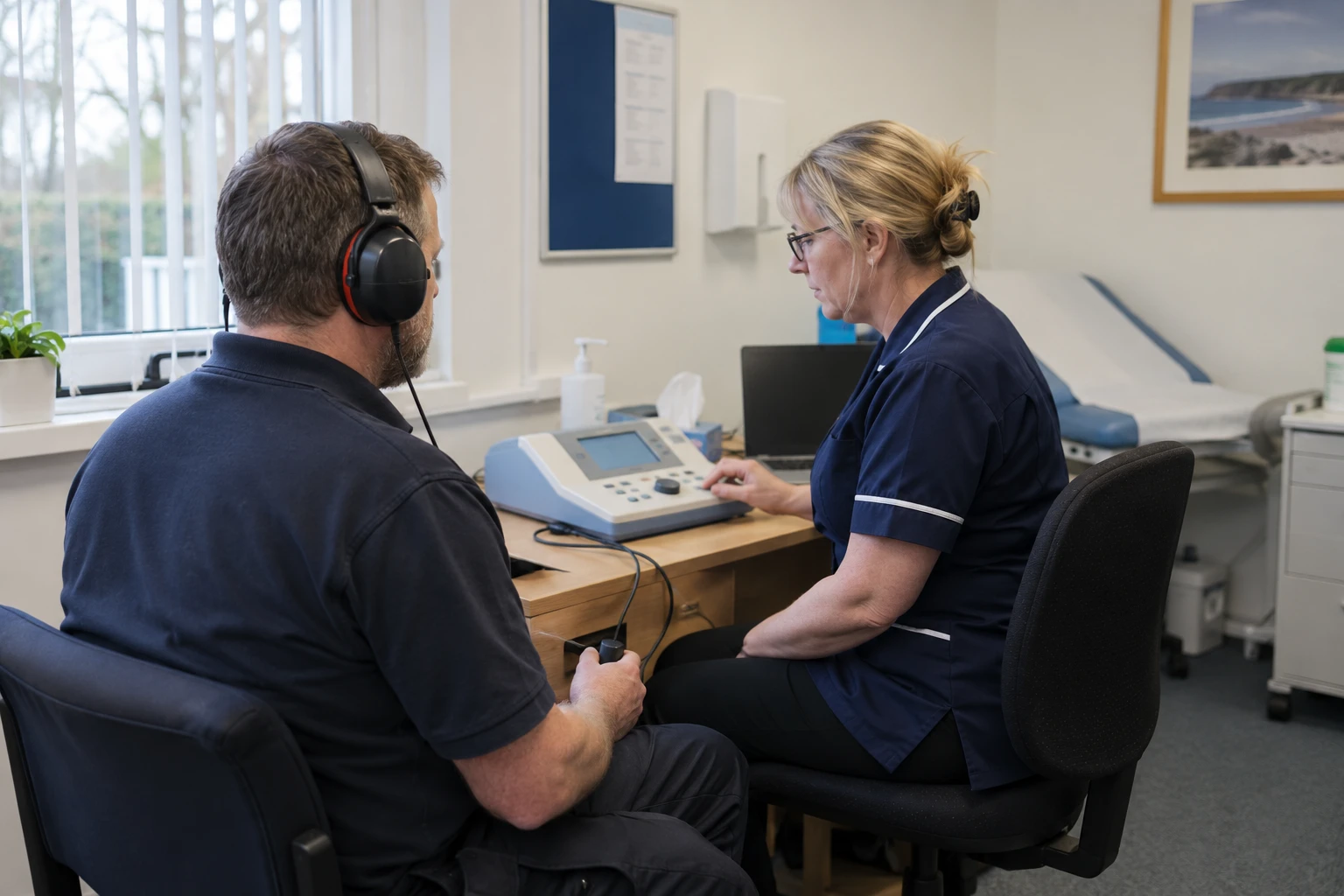
Professional teaching illustration. Read the written scenario for the facts; the image is not evidence of a real workplace.
An EAP may offer counselling, practical information or referral, but the contract determines scope, waiting times and eligibility. Check access for night workers, remote staff and people needing accessible formats. Do not promise a service that has not been confirmed.
What is an employee assistance programme?
An employee assistance programme is a confidential workplace support route for workers who may need advice, early emotional support or signposting. EAPs vary by provider and contract. Some offer telephone counselling triage, short counselling sessions, legal or financial information, wellbeing resources, trauma support, manager advice lines or referral routes. The employer should explain what the specific service does and does not provide. The value of an EAP is early access and low-friction support. It can help people talk to someone before a problem becomes absence, conflict, unsafe performance or a formal HR process.
But it should sit alongside prevention, manager competence, occupational health, reasonable adjustments, safe staffing and respectful work culture. The programme is a service, not a diagnosis or a health condition. Its usefulness depends on trust, access, provider quality and action on the underlying work environment. See Acas creating a supportive environment.
Fictional workplace decision
Fictional contact centre: a worker is offered an employee assistance number that cannot be reached during their shift. The manager assumes an offer is sufficient without checking access or the service scope.
Compare the reasoning
The manager checks the actual provider route, availability and services before explaining the offer. Support should be voluntary and accurate; an inaccessible contact number does not establish a usable arrangement. But it should sit alongside prevention, manager competence, occupational health, reasonable adjustments, safe staffing and respectful work culture.
How should EAP and worker health information be protected?
Check what is provided
Explain the actual service offer
Existing SHAREhub photographic illustration. The fictional case supplies the task and decision evidence.
An EAP may offer counselling, practical information or referral, but the contract determines scope, waiting times and eligibility. Check access for night workers, remote staff and people needing accessible formats. Do not promise a service that has not been confirmed.
How should EAP and worker health information be protected?
Worker health and wellbeing information should be handled lawfully, fairly, transparently and only where necessary. EAP data may include sensitive personal data or information from which health or wellbeing concerns can be inferred. Employers should be clear about who is the controller, what the provider reports, how information is anonymised, how long records are kept, what workers are told and whether a data protection impact assessment is needed. Individual counselling or support details should not be passed to managers as routine management information. If occupational health advice is needed, the worker should understand what information will be requested, who will see the report and what decisions it will support.
Agree contractually which party controls each data flow, what is shared with the employer, when an urgent safety exception applies, and how small-group reporting avoids re-identifying a worker. See ICO data protection and workers health information. The ICO flags its worker-health guidance as under review following the Data (Use and Access) Act 2025. For a specific lawful-basis, special-category or sharing decision, check the current UK GDPR and Data Protection Act 2018 with competent privacy advice; do not infer a blanket right to disclose counselling details.
Fictional workplace decision
Fictional contact centre: a worker is offered an employee assistance number that cannot be reached during their shift. The manager assumes an offer is sufficient without checking access or the service scope.
Compare the reasoning
The manager checks the actual provider route, availability and services before explaining the offer. Support should be voluntary and accurate; an inaccessible contact number does not establish a usable arrangement. But it should sit alongside prevention, manager competence, occupational health, reasonable adjustments, safe staffing and respectful work culture.
How can the ISO 45001 hierarchy of controls reduce work pressures alongside employee assistance support?
Check what is provided
Explain the actual service offer
Existing SHAREhub photographic illustration. The fictional case supplies the task and decision evidence.
An EAP may offer counselling, practical information or referral, but the contract determines scope, waiting times and eligibility. Check access for night workers, remote staff and people needing accessible formats. Do not promise a service that has not been confirmed.
How can the ISO 45001 hierarchy of controls reduce work pressures alongside employee assistance support?
Use the stronger source and work-design controls first; response or individual support does not replace prevention. A workplace can have a high-quality EAP and still fail people if the wider system is poor. Work-related stress still needs risk assessment. Reasonable adjustments still need consideration. Absence and return-to-work processes still need fairness. Safety-critical work still needs immediate risk control if a person cannot work safely. The strongest approach is a joined-up support pathway: line manager conversation, EAP signposting, occupational health where functional advice is needed, HR where policy decisions are involved, first aid or emergency response where there is immediate danger, and leadership review where anonymised themes point to work-design problems.
See HSE work-related stress Management Standards. Illustrative call-centre scenario: a night team faces repeated abusive calls, excessive queues and rising stress. The EAP is one support route while the employer addresses the work design. An EAP can provide confidential support to a reception team under pressure. The manager still has to fix excessive demands, poor cover and exposure to abuse; counselling does not remove those work conditions. ERICPD is a planning crossmap. Its prompts do not add a sixth rung or rank Isolate above engineering.
Discipline verifies and sustains every control level. The hierarchy of controls in ISO 45001:2018 comes under Clause 8.1.2 (Eliminating hazards and reducing OH&S risks), which is located within Clause 8 ("Operation"). ESEAP: Elimination, Substitution, Engineering controls, Administrative controls and PPE. Control order: HSE hierarchy of controls and IOSH hierarchy of control guidance.
Fictional workplace decision
Fictional contact centre: a worker is offered an employee assistance number that cannot be reached during their shift. The manager assumes an offer is sufficient without checking access or the service scope.
Compare the reasoning
The manager checks the actual provider route, availability and services before explaining the offer. Support should be voluntary and accurate; an inaccessible contact number does not establish a usable arrangement. But it should sit alongside prevention, manager competence, occupational health, reasonable adjustments, safe staffing and respectful work culture.
Existing SHAREhub photographic illustration. The fictional case supplies the task and decision evidence.
Give clear information about how to contact the provider and its privacy limits. Do not request counselling notes or assume a referral proves a person has received support. Any employer reporting should protect individuals, particularly in small teams.
What should managers do when signposting an EAP?
Managers should listen, keep the conversation private, avoid diagnosis, explain support routes and agree practical work actions. A manager does not need to know the details of a person's private life to offer support. The useful questions are work-focused: how are you, is anything at work making things harder, what support would help, are there tasks you are worried about, what should stay private and when should we review? EAP signposting should not be used to close down the conversation. If workload, bullying, poor role clarity, unsafe staffing or shift fatigue are part of the issue, the manager must address those work factors as well.
See Acas supporting mental health at work.
Fictional workplace decision
Fictional contact centre: a worker is offered an employee assistance number that cannot be reached during their shift. The manager assumes an offer is sufficient without checking access or the service scope.
Compare the reasoning
The manager checks the actual provider route, availability and services before explaining the offer. Support should be voluntary and accurate; an inaccessible contact number does not establish a usable arrangement. But it should sit alongside prevention, manager competence, occupational health, reasonable adjustments, safe staffing and respectful work culture.
Professional teaching illustration. Read the written scenario for the facts; the image is not evidence of a real workplace.
Give clear information about how to contact the provider and its privacy limits. Do not request counselling notes or assume a referral proves a person has received support. Any employer reporting should protect individuals, particularly in small teams.
Bring this into my business
Offer the employee assistance programme as a confidential optional support route; separately address the work factors, safety concerns and adjustments the worker raises. Source basis: Acas supporting mental health at work · HSE work-related stress Management Standards · ICO data protection and workers health information. A worker reports distress after repeated late shifts. The manager offers EAP details without asking for counselling notes, reviews workload and rota with the worker, and seeks occupational-health advice if fitness or adjustments need professional input. Ask about EAP governance, confidentiality, worker support routes, manager boundaries, occupational health referral, data protection or wellbeing assurance.
Professional learning Practical learning for managers, HR, wellbeing leads, health and safety teams and worker representatives. Link my operations to SHARE knowledge, SHARE AI Intelligence, support pathways, wellbeing data, manager training, policies and assurance checks.
Fictional workplace decision
Fictional contact centre: a worker is offered an employee assistance number that cannot be reached during their shift. The manager assumes an offer is sufficient without checking access or the service scope.
Compare the reasoning
The manager checks the actual provider route, availability and services before explaining the offer. Support should be voluntary and accurate; an inaccessible contact number does not establish a usable arrangement. But it should sit alongside prevention, manager competence, occupational health, reasonable adjustments, safe staffing and respectful work culture.
What is the advice boundary for employee assistance programmes?
Explain choice and confidentiality
Identify privacy and access questions
Existing SHAREhub photographic illustration. The fictional case supplies the task and decision evidence.
Give clear information about how to contact the provider and its privacy limits. Do not request counselling notes or assume a referral proves a person has received support. Any employer reporting should protect individuals, particularly in small teams.
What is the advice boundary for employee assistance programmes?
This page gives general workplace guidance, not medical, legal, counselling or HR advice. Source basis: Acas supporting mental health at work · HSE work-related stress Management Standards · ICO data protection and workers health information. An EAP can be a useful support route, but it should not be treated as clinical diagnosis, medical treatment, legal representation, formal HR case management or a substitute for managing work-related stress and workplace risk. Workers with health concerns should use appropriate healthcare routes, and employers should use competent HR, occupational health, data protection and legal advice where needed.
If there is immediate risk to life, serious harm, violence, safeguarding concern or inability to work safely, ordinary EAP signposting is not enough. The workplace should follow its emergency, safeguarding, first-aid, HR or medical escalation arrangements.
Fictional workplace decision
Fictional contact centre: a worker is offered an employee assistance number that cannot be reached during their shift. The manager assumes an offer is sufficient without checking access or the service scope.
Compare the reasoning
The manager checks the actual provider route, availability and services before explaining the offer. Support should be voluntary and accurate; an inaccessible contact number does not establish a usable arrangement. But it should sit alongside prevention, manager competence, occupational health, reasonable adjustments, safe staffing and respectful work culture.
Existing SHAREhub photographic illustration. The fictional case supplies the task and decision evidence.
An EAP cannot repair unsafe staffing, bullying or unmanageable deadlines. Managers should agree work actions alongside optional support, and review those actions directly. Clinical emergencies require the appropriate urgent route rather than a routine counselling appointment.
Make voluntary support easy to access
The employer’s service-access information should state the named provider, verified telephone or online route, eligible workers or dependants, opening hours, language and accessibility options, and out-of-hours or emergency limits. The contract owner checks those details with the provider and tests access. This guide cannot supply a contact number or promise hours for an unidentified service. In Riverside’s example, a worker declines the EAP. The manager still addresses the reported workload and rota barriers, agrees a review and offers other suitable support without asking for counselling details.
Review service quality and non-identifying feedback alongside work-risk actions; uptake alone is not evidence that wellbeing improved. Content amended 19 October 2026 by the SHARE Knowledge Hub editorial team. This records an editorial content change; the existing technical-review and approval status still applies.
Fictional workplace decision
Fictional contact centre: a worker is offered an employee assistance number that cannot be reached during their shift. The manager assumes an offer is sufficient without checking access or the service scope.
Compare the reasoning
The manager checks the actual provider route, availability and services before explaining the offer. Support should be voluntary and accurate; an inaccessible contact number does not establish a usable arrangement. But it should sit alongside prevention, manager competence, occupational health, reasonable adjustments, safe staffing and respectful work culture.
What training is needed for EAP and wellbeing support?
Keep fixing the work
Keep management actions separate
Existing SHAREhub photographic illustration. The fictional case supplies the task and decision evidence.
An EAP cannot repair unsafe staffing, bullying or unmanageable deadlines. Managers should agree work actions alongside optional support, and review those actions directly. Clinical emergencies require the appropriate urgent route rather than a routine counselling appointment.
What training is needed for EAP and wellbeing support?
Training should be layered so everyone knows the support exists and managers know how to use it appropriately. All workers need simple awareness: what the EAP is, how to access it, what confidentiality means and where to go if they need different support. Managers need deeper training because they are often the first person to notice changes in attendance, behaviour, conflict, distress or performance. HR, health and safety and wellbeing leads need more detailed competence around service governance, privacy, work-related stress, occupational health referral, reasonable adjustments, sensitive case handling and anonymised data review.
Attendance alone does not establish competence; observe the role and reassess after a changed task, failed exercise or incident.
Fictional workplace decision
Fictional contact centre: a worker is offered an employee assistance number that cannot be reached during their shift. The manager assumes an offer is sufficient without checking access or the service scope.
Compare the reasoning
The manager checks the actual provider route, availability and services before explaining the offer. Support should be voluntary and accurate; an inaccessible contact number does not establish a usable arrangement. But it should sit alongside prevention, manager competence, occupational health, reasonable adjustments, safe staffing and respectful work culture.
How does this topic support study and professional development?
Keep fixing the work
Keep management actions separate
Professional teaching illustration. Read the written scenario for the facts; the image is not evidence of a real workplace.
An EAP cannot repair unsafe staffing, bullying or unmanageable deadlines. Managers should agree work actions alongside optional support, and review those actions directly. Clinical emergencies require the appropriate urgent route rather than a routine counselling appointment.
How does this topic support study and professional development?
This topic supports professional development by connecting wellbeing support, legal duties, privacy, manager competence and organisational culture. For IOSH National General Certificate learners, EAPs are relevant to worker welfare, stress, consultation, leadership, competence and health and safety management. The useful exam skill is to avoid saying 'provide an EAP' as a complete answer; the stronger answer explains risk assessment, prevention, confidential reporting, manager training, support routes and review. For Diploma-level learning, the topic sits within organisational culture, psychosocial risk, worker participation, governance, assurance, data use and leadership review.
Professionals should be able to evaluate whether an EAP is a trusted support control or a superficial benefit that masks unresolved work problems.
Fictional workplace decision
Fictional contact centre: a worker is offered an employee assistance number that cannot be reached during their shift. The manager assumes an offer is sufficient without checking access or the service scope.
Compare the reasoning
The manager checks the actual provider route, availability and services before explaining the offer. Support should be voluntary and accurate; an inaccessible contact number does not establish a usable arrangement. But it should sit alongside prevention, manager competence, occupational health, reasonable adjustments, safe staffing and respectful work culture.