Cancer and work: supporting treatment and employment
Approximately 46–70 minutes
Workplace awareness and prevention. Individual clinical diagnosis and treatment belong with qualified clinicians; protect personal information and use appropriate advice. Check the relevant UK nation and actual workplace arrangements. Completion does not establish practical competence, authorise hazardous work or award an external qualification.
Read the complete core teaching here. Use the interactive course for required activities, saved assessment and conditional completion.
Start with the person
Start with the person
Discuss functional work needs
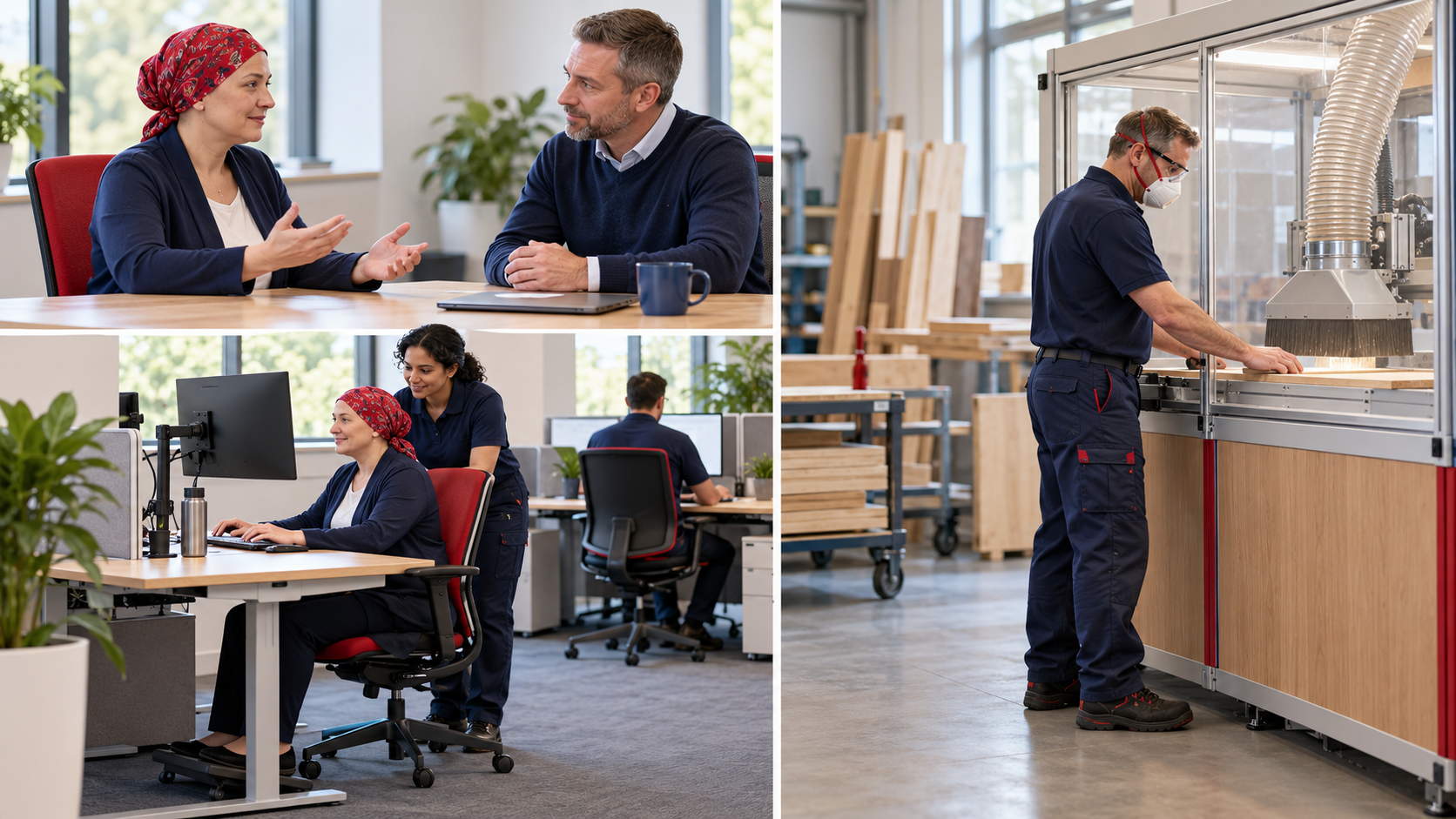
Professional teaching illustration. Read the written scenario for the facts; the image is not evidence of a real workplace.
Cancer and treatment affect people differently. Ask which tasks, hours, travel or workplace exposures are difficult, and what advice the person wants considered. Do not infer capability from the diagnosis or ask for unnecessary treatment details.
What does cancer and work mean?
Cancer and work is the practical relationship between a person’s diagnosis or treatment, the demands of their job and the support needed to work safely. Preventing cancer-causing exposures is a separate employer responsibility. Cancer is a condition in which abnormal cells grow and divide without normal control; they may invade nearby tissue or spread. Cancers and treatments differ. An individual’s cancer rarely has a single identifiable cause, so managers should not blame a worker or infer that their job caused it. Age, inherited factors, infections, lifestyle, UV radiation and some workplace exposures may all influence risk, depending on the cancer.
Work can provide income, routine, connection and identity, while appointments, symptoms or treatment may make ordinary duties difficult for a time. The useful question is how this person’s current health and work fit together: what can they do, what is difficult, what can be changed and when should the plan be reviewed? A diagnosis does not itself determine safe capability for a particular shift or task. Support should focus on function, privacy and reviewable work changes. Use official health advice for medical questions and avoid interpreting symptoms at work.
Official health route: NHS cancer overview.
Fictional workplace decision
Fictional manufacturing office: a technician receiving treatment wants to continue useful work but needs appointment flexibility. The manager offers only full normal shifts or complete absence without discussing current needs.
Compare the reasoning
The manager begins with the technician’s current work needs, actual duties and relevant advice. Discuss appointment flexibility, useful tasks and suitable cover before finalising the allocation. Neither the diagnosis nor a standard shift pattern decides the arrangement alone; agree a practical plan and review it when appointments, work demands or the person’s needs change.
How can cancer and treatment change someone’s working day?
Start with the person
Discuss functional work needs
Existing SHAREhub photographic illustration. The fictional case supplies the task and decision evidence.
Cancer and treatment affect people differently. Ask which tasks, hours, travel or workplace exposures are difficult, and what advice the person wants considered. Do not infer capability from the diagnosis or ask for unnecessary treatment details.
How can cancer and treatment change someone’s working day?
Effects vary by cancer, treatment and person. Fatigue, pain, infection vulnerability, mobility or concentration changes may alter stamina, travel, attendance and safe task performance; effects can continue after active treatment. Some people keep working through treatment; others need reduced duties or time away. Treatment can involve repeated appointments or cycles. Fatigue and recovery may fluctuate within a week and over months. Surgery, chemotherapy, radiotherapy or other treatment can affect different tasks in different ways. For example, tingling in the hands may matter for a precise manual task; fatigue or altered concentration may matter for driving or supervising a hazardous activity.
These are possibilities, not a diagnosis or a standard restriction for everyone. Some chemotherapy can weaken immune defences, cause nausea, numbness, or affect memory and concentration. The treatment team should give individual advice about infection precautions and symptoms. A manager should ask which work conditions matter—crowded public contact, travel, lone work, breaks, manual effort, shift length, access, and task criticality—without demanding treatment details. The worker and clinician can explain functional restrictions where needed. Unusual lumps, bleeding, unexplained weight loss, persistent pain or other symptoms that are new for the person should be discussed with a GP.
They are common to many conditions and are not proof of cancer. A manager’s role is to make a private conversation and time for care possible, not to investigate symptoms. Basis: NHS cancer overview and NHS chemotherapy.
Fictional workplace decision
Fictional manufacturing office: a technician receiving treatment wants to continue useful work but needs appointment flexibility. The manager offers only full normal shifts or complete absence without discussing current needs.
Compare the reasoning
The manager begins with the technician’s current work needs, actual duties and relevant advice. Discuss appointment flexibility, useful tasks and suitable cover before finalising the allocation. Neither the diagnosis nor a standard shift pattern decides the arrangement alone; agree a practical plan and review it when appointments, work demands or the person’s needs change.
How can work exposures or task demands cause harm?
Start with the person
Discuss functional work needs
Existing SHAREhub photographic illustration. The fictional case supplies the task and decision evidence.
Cancer and treatment affect people differently. Ask which tasks, hours, travel or workplace exposures are difficult, and what advice the person wants considered. Do not infer capability from the diagnosis or ask for unnecessary treatment details.
How can work exposures or task demands cause harm?
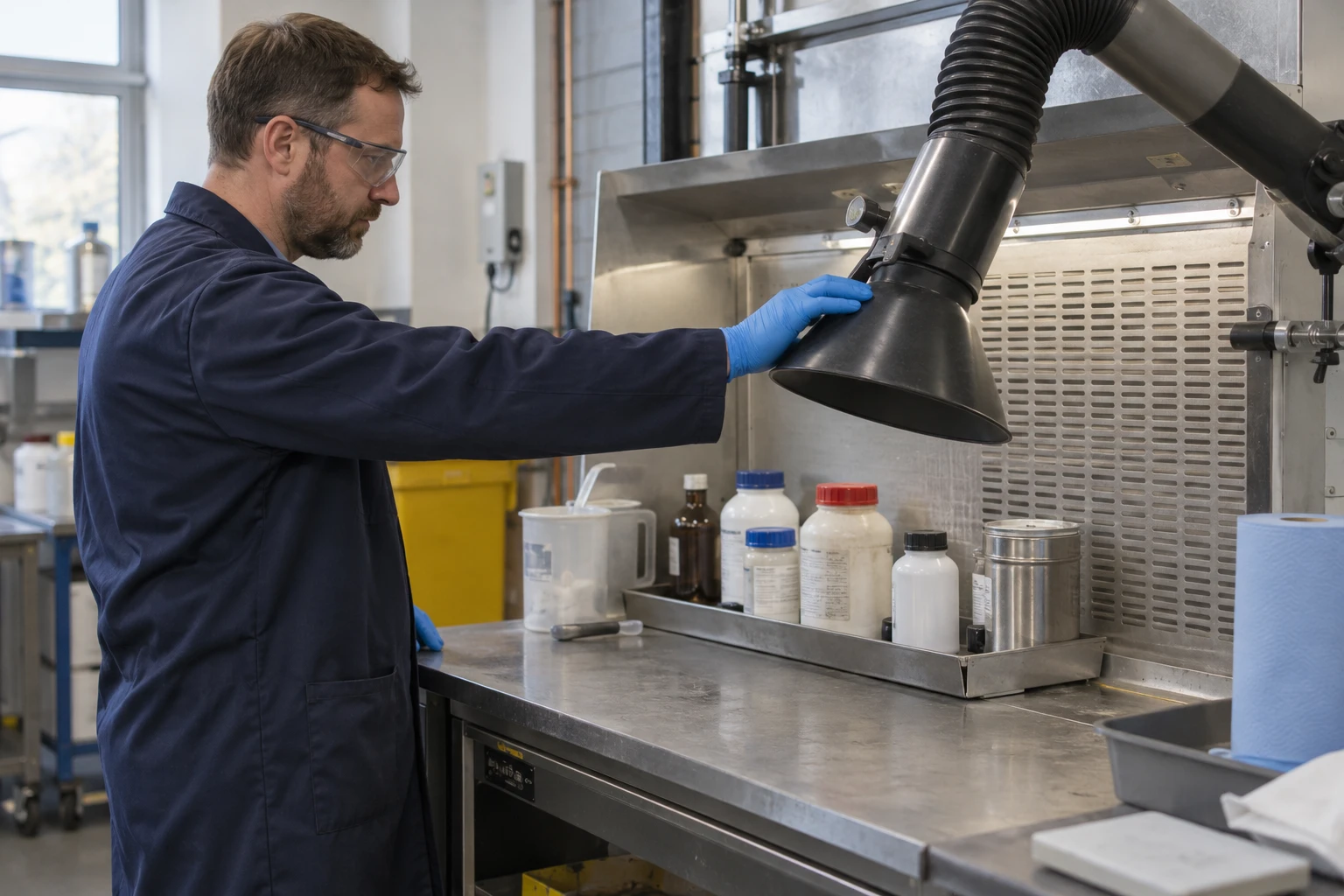
Cancer is not a workplace hazard in a person. The preventable harm chains here are exposure to cancer-causing agents and, separately, unsafe task design when anyone’s current capacity and the duty do not fit.
Identify the source, route into or onto the body, affected tissue and work conditions before choosing a control. A dust cloud or sunburn can warn that a control has failed, but cancer may develop after years without a reliable early warning. Duration, concentration, ventilation, proximity, weather and task design change likelihood. A diagnosis cannot establish that work caused an individual cancer.
Topic-specific evidence: HSE woodworking hazardous substances , HSE cancer and construction: silica , HSE outdoor workers and sun exposure , HSE HSG187 diesel engine exhaust emissions and HSE fatigue . NI workplaces must apply their own HSENI route.
Fictional manufacturing office: a technician receiving treatment wants to continue useful work but needs appointment flexibility. The manager offers only full normal shifts or complete absence without discussing current needs.
Compare the reasoning
The manager begins with the technician’s current work needs, actual duties and relevant advice. Discuss appointment flexibility, useful tasks and suitable cover before finalising the allocation. Neither the diagnosis nor a standard shift pattern decides the arrangement alone; agree a practical plan and review it when appointments, work demands or the person’s needs change.
Existing SHAREhub photographic illustration. The fictional case supplies the task and decision evidence.
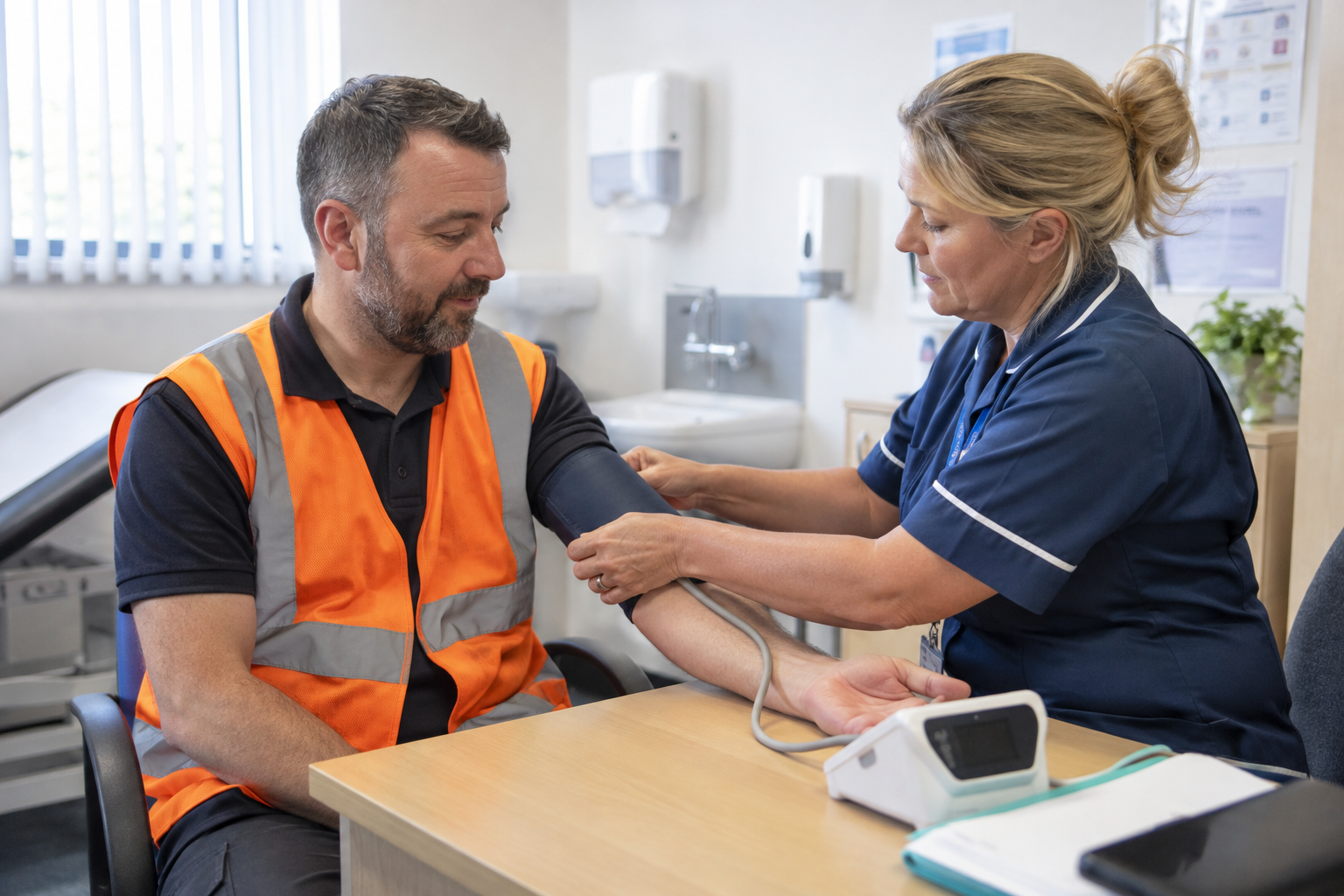
Options may include appointment flexibility, rest, altered duties, infection-exposure review and a phased return. Make cover and review dates explicit. Occupational health can advise on work implications; treatment choices remain with the healthcare team.
How should a return to work be planned?
Plan a return around current capacity, actual job demands, agreed adjustments and review points. Treatment ending does not prove that fatigue, pain or other effects have ended. Before return: ask the worker about their priorities, practical barriers and desired contact. Review the role, shifts, travel, public exposure, manual effort, equipment and emergency duties. Read any fit-note advice as a starting point, discuss feasible changes, and seek occupational-health input where the task-specific answer is uncertain. On return: brief only the people who must implement changed duties or cover.
Test hours, breaks and workload in real shifts. Agree what happens if a treatment cycle, symptom or appointment changes the plan. A phased return may gradually increase hours or duties, but it has no universal timetable. After return: check worker feedback and task outcomes; extend, reduce or end adjustments for a reason, recording the decision. A person may return while still receiving treatment or need another period away. For a critical task, keep the separate hold and release process until the evidence supports it. Basis: GOV.UK fit-note employer guidance, Acas reasonable adjustments and nidirect support while in work.
Fictional workplace decision
Fictional manufacturing office: a technician receiving treatment wants to continue useful work but needs appointment flexibility. The manager offers only full normal shifts or complete absence without discussing current needs.
Compare the reasoning
The manager begins with the technician’s current work needs, actual duties and relevant advice. Discuss appointment flexibility, useful tasks and suitable cover before finalising the allocation. Neither the diagnosis nor a standard shift pattern decides the arrangement alone; agree a practical plan and review it when appointments, work demands or the person’s needs change.
What should a manager do when a worker shares a diagnosis?
Agree a usable plan
Plan flexible support
Professional teaching illustration. Read the written scenario for the facts; the image is not evidence of a real workplace.
Options may include appointment flexibility, rest, altered duties, infection-exposure review and a phased return. Make cover and review dates explicit. Occupational health can advise on work implications; treatment choices remain with the healthcare team.
What should a manager do when a worker shares a diagnosis?
Thank the person, ask what they need at work now, explain how information will be handled and agree an early review. Put immediate work changes in place without pressing for a full medical history. A useful opening is: “Thank you for telling me. What parts of work feel manageable or difficult at present? Are there appointments or changes we should plan for? Who would you like involved in the support discussion?” Give the person time and a choice about what colleagues are told. Do not promise absolute secrecy where a limited operational restriction must be shared to implement support; agree the minimum message and who needs it.
Identify the task, pace, hours, travel, exposures and safety-critical duties. Ask the worker which changes would help and when treatment or recovery might change the pattern. Set an owner for actions and a review date. If the fit between clinical advice and task demands is uncertain, ask occupational health a focused question about function, restrictions and review, explaining the referral to the worker. A carer supporting someone with cancer may also need an individual work conversation, but a relative’s diagnosis does not automatically create the same disability status for the worker.
Explore health-related barriers before treating changed attendance or performance as ordinary misconduct. Keep expected outcomes clear, apply absence rules fairly and obtain HR advice on disability-related absence. Workplace basis: Acas reasonable adjustments, Acas disability-related absence, nidirect support while in work.
Fictional workplace decision
Fictional manufacturing office: a technician receiving treatment wants to continue useful work but needs appointment flexibility. The manager offers only full normal shifts or complete absence without discussing current needs.
Compare the reasoning
The manager begins with the technician’s current work needs, actual duties and relevant advice. Discuss appointment flexibility, useful tasks and suitable cover before finalising the allocation. Neither the diagnosis nor a standard shift pattern decides the arrangement alone; agree a practical plan and review it when appointments, work demands or the person’s needs change.
Which adjustments should be considered and tested?
Agree a usable plan
Plan flexible support
Existing SHAREhub photographic illustration. The fictional case supplies the task and decision evidence.
Options may include appointment flexibility, rest, altered duties, infection-exposure review and a phased return. Make cover and review dates explicit. Occupational health can advise on work implications; treatment choices remain with the healthcare team.
Which adjustments should be considered and tested?
Adjustments should remove a real work disadvantage while preserving safe delivery. Agree the change with the worker, name who will implement it and review whether it works as treatment and recovery change.
Cancer is protected as a disability from diagnosis in GB and NI, under different laws. The legal duty is to consider reasonable changes in the actual circumstances; a diagnosis does not prescribe a fixed adjustment package. Discuss practical options before assuming a person cannot work.
Equipment, hours and duties can be temporary or longer-term. Access to Work may add practical help beyond the employer’s reasonable adjustments: the GB scheme covers England, Scotland and Wales; Northern Ireland has a distinct Access to Work (NI) route. Check current eligibility with the correct service.
Routes: Acas reasonable adjustments , nidirect support while in work , GOV.UK Access to Work eligibility and nidirect Access to Work (NI) .
Fictional manufacturing office: a technician receiving treatment wants to continue useful work but needs appointment flexibility. The manager offers only full normal shifts or complete absence without discussing current needs.
Compare the reasoning
The manager begins with the technician’s current work needs, actual duties and relevant advice. Discuss appointment flexibility, useful tasks and suitable cover before finalising the allocation. Neither the diagnosis nor a standard shift pattern decides the arrangement alone; agree a practical plan and review it when appointments, work demands or the person’s needs change.
Existing SHAREhub photographic illustration. The fictional case supplies the task and decision evidence.
Avoid automatic exclusion from work or opportunities. In Great Britain, cancer has specific disability protection; obtain the correct HR advice for the work location. Share only necessary agreed information and revisit arrangements when treatment or duties change.
Agree support again when treatment or duties change
A support plan is a working agreement, not a prediction about prognosis. Revisit it when treatment, symptoms, appointments or task demands change. Ask what is sustainable now, what is uncertain and which operational decisions need occupational-health input. Keep the person involved in choices rather than excluding them from all work because of a diagnosis. In Riverside’s instructor example, a treatment change may affect an agreed rota that worked last week. The duty manager checks water-supervision competence, relief and emergency responsibilities before allocating the next session.
The worker agrees the limited message colleagues need about assignments; clinical detail stays in the confidential support route. Use the existing GB or NI duties section for the work location. Illustrative example. A fictional outdoor instructor asks to change duties after treatment changes and fatigue becomes less predictable. Decision. The manager pauses the affected water duty, assigns a qualified colleague and agrees booking preparation and adjusted hours with the worker. Evidence to check. The task demands, agreed functional restrictions, qualified cover and the worker’s communication preferences.
Hold or escalation point. Keep the affected activity held if safe cover or task-focused advice is unresolved; do not assume all duties are unsafe. Follow-up. Review after the treatment change and the first adjusted shifts, with an earlier conversation if capacity changes. Read with: NHS cancer overview · NHS chemotherapy · NHS pulmonary embolism.
Fictional workplace decision
Fictional manufacturing office: a technician receiving treatment wants to continue useful work but needs appointment flexibility. The manager offers only full normal shifts or complete absence without discussing current needs.
Compare the reasoning
The manager begins with the technician’s current work needs, actual duties and relevant advice. Discuss appointment flexibility, useful tasks and suitable cover before finalising the allocation. Neither the diagnosis nor a standard shift pattern decides the arrangement alone; agree a practical plan and review it when appointments, work demands or the person’s needs change.
Which legal routes apply in Great Britain and Northern Ireland?
Keep inclusion and safety together
Protect health information
Existing SHAREhub photographic illustration. The fictional case supplies the task and decision evidence.
Avoid automatic exclusion from work or opportunities. In Great Britain, cancer has specific disability protection; obtain the correct HR advice for the work location. Share only necessary agreed information and revisit arrangements when treatment or duties change.
Which legal routes apply in Great Britain and Northern Ireland?
Cancer is protected as a disability from diagnosis under the Equality Act 2010 in GB and the NI Disability Discrimination Act framework. GB workplace risk uses the Health and Safety at Work etc. Act 1974, Management Regulations 1999 and COSHH 2002; NI uses its 1978 Order, Management Regulations (NI) 2000 and COSHH (NI) 2003. GB and NI have separate Access to Work and occupational-disease reporting routes. Apply the rules for the work location.
The same practical support principle applies in both places, while legal duties and public schemes must be checked through the correct GB or NI route.
Fit-note, sickness and pay rules, sector duties, treatment privacy and any disputed adjustment need the correct current advice for the person and jurisdiction. The employer’s reasonable-adjustment duty is not displaced by an external support grant.
Official routes: GOV.UK disability definition , nidirect support while in work , HSE risk assessment , HSENI risk assessment , HSE COSHH basics , HSENI occupational cancers , GOV.UK Access to Work eligibility and nidirect Access to Work (NI) .
Fictional manufacturing office: a technician receiving treatment wants to continue useful work but needs appointment flexibility. The manager offers only full normal shifts or complete absence without discussing current needs.
Compare the reasoning
The manager begins with the technician’s current work needs, actual duties and relevant advice. Discuss appointment flexibility, useful tasks and suitable cover before finalising the allocation. Neither the diagnosis nor a standard shift pattern decides the arrangement alone; agree a practical plan and review it when appointments, work demands or the person’s needs change.
Professional teaching illustration. Read the written scenario for the facts; the image is not evidence of a real workplace.
Avoid automatic exclusion from work or opportunities. In Great Britain, cancer has specific disability protection; obtain the correct HR advice for the work location. Share only necessary agreed information and revisit arrangements when treatment or duties change.
How should cancer information be handled?
Keep clinical information in a restricted health record and share only the functional changes people need to implement. Explain the purpose, access and retention to the worker. Health information is special-category data. The organisation must identify and document a UK GDPR Article 6 lawful basis and Article 9 condition, with any additional Data Protection Act safeguards that apply. Worker consent is not automatically the right legal basis in an employment relationship. Ask for necessary information, separate the diagnosis from routine team schedules, and limit access to those with a work need.
A supervisor may need to know that an instructor is not assigned to lone water duty and when to review the cover; they do not need the cancer type or treatment details. The worker’s choice about what is said socially should be respected. If a safety restriction must be implemented, explain clearly the limited information needed for that purpose. Basis: ICO worker health information.
Fictional workplace decision
Fictional manufacturing office: a technician receiving treatment wants to continue useful work but needs appointment flexibility. The manager offers only full normal shifts or complete absence without discussing current needs.
Compare the reasoning
The manager begins with the technician’s current work needs, actual duties and relevant advice. Discuss appointment flexibility, useful tasks and suitable cover before finalising the allocation. Neither the diagnosis nor a standard shift pattern decides the arrangement alone; agree a practical plan and review it when appointments, work demands or the person’s needs change.