Full public teaching and readers are free without an account. A free learner account is required for saved LMS progress and recorded assessment. Completion and any course-completion certificate depend on the configured LMS conditions. Full course outline and access routes.
Lesson 1
Acceptance is a positive decision, not an empty container
Connect item information, site authorisation and capacity before receiving waste.
Photorealistic illustrative UK workplace scene. Review checks: Setting: At fictional the process operator, a road tanker brings an identified flammable product to a bulk tank after a supplier has changed the additive package. Act: The transport planner confirms classification, documents, vehicle and load details with the carrier. Hold / review: Do not connect if additive compatibility, classification, receiving capacity, hose suitability or a critical protection test is uncertain.
Acceptance is a positive decision, not an empty container
An empty container does not establish that a site may accept a particular battery or electrical item. Reception needs the actual site's authorised waste types, permitted activities and safe capacity. Battery chemistry, size, condition and whether it remains within equipment can affect the route. WEEE is not a single harmless material: relevant components can include batteries, oils, refrigerants, lamps or hazardous substances. Staff must not infer classification from a familiar product name or a tidy casing.
In the fictional yard, a visitor arrives with mixed electrical equipment and an unidentified battery pack. Follow the approved reception procedure, keeping people away from any immediate danger and obtaining the required information or specialist decision. Do not open the pack or dismantle equipment to identify cells. A gatehouse attendant's role is to recognise the information gap and use the designated route, not invent a waste code or expand the site's authority. Rejecting or quarantining a nonconforming item must follow a safe planned process rather than simply sending a dangerous load back onto the road.
Compare positive identification and suitable segregation with placing everything in a general WEEE skip. The general skip may conceal damage or let an item be crushed during loading. Records need to match the actual material, intended treatment and destination. Some WEEE or components may require hazardous-waste and persistent-organic-pollutant assessment; those are competent classification questions, not assumptions that all electrical waste has the same status. The relevant national rules and receiving facility's authority must be checked.
Verification asks whether the reception team can recognise its boundary, find a usable safe route and record the handover accurately. Include busy periods and an unavailable quarantine location. If the safe capacity or suitable route is not available, stop that reception through the site procedure. An order placed for a new container or a plan to obtain paperwork later does not create present capacity or permission. The exercise ends with an evidence question and a bounded acceptance recommendation.
How do carriage checks connect to the receiving-site decision?
Check the consignment requirements and the workplace transfer controls before accepting a movement into a live process.
The GB HSE ADR/CDG guide separates classification, packing and tank provisions, consignment procedures, loading and unloading, and vehicle requirements. A safety data sheet can inform those checks; it is not evidence that every applicable consignment requirement has been met. Confirm the actual load and applicable exemptions with competent dangerous-goods advice rather than treating a familiar product as automatically exempt. Use HSENI’s carriage route for NI duties.
Then make the site decision. For a tanker delivery, the receiver confirms the product, destination, available capacity, compatible connection and working transfer safeguards specified by the site assessment. Correct carriage paperwork does not establish that the receiving tank or line is ready. Equally, a well-controlled store does not prove carriage compliance. If the load information and the physical receiving arrangement disagree, hold connection and resolve the discrepancy. The GB workplace physical-risk basis is HSE’s DSEAR guidance; NI uses its corresponding instrument.
Applied case
An unidentified battery pack arrives when the designated safe reception area is full; a spare general skip is available.
Decision and explanation
Use the nonconforming-waste procedure and obtain the authorised safe decision rather than accepting into the general skip.
Authority, information and suitable capacity are all needed. A spare skip or improvised dismantling does not establish them.
Lesson 2
Stop the battery before the compactor
Recognise destructive-processing risk and use a controlled recovery boundary.
Teaching graphic from the linked SHAREhub source section.
Stop the battery before the compactor
Crushing or damaging a battery can trigger heating, fire and harmful smoke. A battery within electrical equipment may be difficult to see, and a small item can pass through gaps in the reception system. The fictional case shows a battery in material queued for compaction. That observation is enough to question the processing route; it does not establish chemistry, charge or how the item should be physically recovered.
Stop the affected processing through the approved safe method and keep people outside the machine's danger zone. Inform the responsible operator and supervisor, then arrange the authorised separate-battery handling process. Do not reach into a hopper, climb onto a conveyor or enter the compactor because the item is valuable or the belt appears still. A normal stop or emergency-stop button is not by itself a suitable secured isolation for access. Recovery near dangerous machinery belongs within the actual competent work system.
Prevention needs more than a final person's eyesight. Review public instructions, acceptance information, sorting design and the path through loading and transfer. An inspection point must be usable without exposing the inspector to vehicles, falling material, sharp waste or moving parts. Consider how concealed batteries within equipment are routed under the site's approved arrangements. Do not ask ordinary staff to dismantle unknown electrical items during a queue or create a new hand-sorting exposure to solve the battery problem.
Verify that the suspect item has reached the authorised route and that the processing hold is cleared only through the responsible decision. Record where it was found and which earlier control did not intercept it, without inventing blame or a battery type. If similar items recur, review the system rather than praising a sequence of last-minute rescues. For the exercise, map the failure from arrival to compactor and propose one upstream prevention measure and the evidence that would show it works during representative reception.
How can the ISO 45001 hierarchy of controls limit fire spread through layout, separation and passive protection?
First reduce the hazard and the chance of a release or ignition. Then select separation, containment and fire protection for the remaining credible events, including the people and safety systems they could affect.
For dangerous substances, consider removing or substituting the substance or process, reducing inventory, preventing releases, controlling releases at source and avoiding ignition. Keep incompatible substances apart. Mitigation then limits consequences. PPE does not replace a fire-resisting boundary, a protected route or appropriate siting. HSE sets out the GB DSEAR control priorities.
There is no safe separation distance for every tank, store or cabin. The assessor needs substance properties, quantities, operating conditions, release scenarios, topography, drainage, ventilation, neighbouring hazards, occupancy and emergency access. Select the applicable storage or design guidance and check its assumptions; HSG176 is a route for flammable-liquid tanks within its scope.
A hazardous-area zone addresses the likelihood and persistence of an explosive atmosphere and ignition control. Being outside a zone does not prove that an occupied cabin is outside fire, blast or toxic effects. Review the building, its occupants, air intakes and escape routes against the relevant scenarios. A new wall or cabin may also worsen congestion or trap vapour. HSE plant-layout guidance provides the design context.
Start with the strongest feasible change at source, then ask what barrier remains necessary. Eliminate or reduce the hazard where practicable; use engineering, separation and procedural controls for the remaining risk. PPE and work rules support these controls, but do not replace a failed physical fire barrier. GB control hierarchy: HSE hierarchy of risk controls
Here “Discipline” means dependable briefing, supervision and follow-through on a safe system, not blame. PPE and training support the physical and engineered controls; they cannot justify occupation behind a failed barrier. Each row identifies a practical check and a failure that requires a new decision.
How can the ERICPD hierarchy of controls limit fire spread through layout, separation and passive protection?
ERICPD is a planning crossmap. Its prompts do not add a sixth rung or rank Isolate above engineering. Discipline verifies and sustains every control level.
Worked activity: Example one Restoring a warehouse compartment
Activity and exposure
Install a data cable through a warehouse compartment wall beside an occupied office and protected corridor. Workers, visitors, delivery staff and contractors rely on that separation. The wall includes a concealed area above the ceiling; its construction must be confirmed.
Before work
Consider a route that avoids a new breach. Identify and photograph the location; agree isolation and access controls; arrange suitable reinstatement material and inspection before concealment. Confirm continued occupation and escape arrangements during the work, or restrict the affected area. Brief the contractor that a permit does not authorise an unassessed opening.
During the activity
Keep the opening and work area within the assessed scope. Maintain escape routes, control waste and ignition sources, and record the installed system before it becomes hidden. The supervisor checks interfaces with other trades and hands over any unfinished impairment at shift change.
Hold or stop
Stop on unknown wall construction or material, unexpected services, unsupported product substitution, damage to the boundary or loss of the agreed route. The premises lead and competent specialist must reassess before restart. Fire, smoke or an alarm triggers the emergency procedure, not a hurried repair.
Hand-back and release
The competent person checks the installation against the approved specification before concealment. Confirm surrounding junctions and doors remain effective, remove work obstructions and let the premises owner accept restoration. Do not return restricted areas to use while essential evidence or performance is unresolved.
Evidence to retain
Keep the location and penetration ID, design/system evidence, product identification, installer record, before-and-after photographs, inspection and acceptance, updated drawing and closure of the impairment. Record residual defects and restrictions explicitly.
Decision owner
Premises lead with competent fire-stopping specialist
Avoid the new compartment breach or unnecessary occupied cabin; where feasible remove the flammable inventory or ignition-producing task. This removes a route, receptor or initiating source.
Designer and premises or process owner.
Approved alternative route or location and change record. If the hazardous task remains, elimination has not been achieved. Sources: HSE sets out the GB DSEAR control priorities.
Reduce or substitute
Use a less hazardous substance or process, or reduce stored inventory where technically feasible; review compatibility and any new hazard. This reduces fuel or release potential, not the need for a sound barrier.
Process owner, purchaser and competent designer.
Substitution or inventory assessment, updated drawings and operating limits. Do not assume a replacement has lower total risk. Sources: HSE sets out the GB DSEAR control priorities.
Isolate
Separate occupied areas from credible effects and maintain complete compartment walls, doors and protected routes. This interrupts heat, smoke or blast exposure only within the assessed design conditions.
Competent fire/process designer; premises owner checks the installed arrangement.
Scenario-based siting and system evidence, field inspection. A zone boundary or nominal distance alone is insufficient; openings or blocked routes defeat isolation. Sources: HSE plant-layout guidance.
Control — physical and engineered
Specify compatible fire-stopping, protected supports, drainage and, where required, detection or automatic isolation. These limit spread or escalation; drainage may create a new route if its destination is wrong.
Engineering owner, system designer and competent installer.
Coordinate alterations, fire-risk and dangerous-substance assessments, impairment restrictions, inspection and handback. These keep physical barriers within their approved conditions.
Premises/process owner and supervisor.
Current drawings, permits, defect log, shift handover and acceptance. Paperwork cannot replace an absent seal or safe layout. Sources: Premises fire guidance.
Personal protective equipment
Use task-specific PPE for assessed maintenance residual risks and only with the other controls. Ordinary worker PPE cannot make an occupied cabin safe from a credible major fire or blast.
Supervisor selects and checks suitable equipment for the approved task.
Risk assessment, issue, fit and condition checks. PPE protects its wearer only and does not restore a compartment or protect all occupants. Sources: HSE sets out the general control hierarchy.
Discipline — reliable follow-through
Brief roles, supervise critical steps, report defects and stop work when assumptions change. This means dependable training and checks, not blame.
Manager and supervisor; workers report and follow agreed limits.
Briefing, inspection and close-out records; failed checks trigger reassessment. Behaviour alone cannot compensate for a failed physical barrier. GB hierarchy: HSE hierarchy of risk controls
How can the ISO 45001 hierarchy of controls limit fire spread through layout, separation and passive protection?
The hierarchy of controls in ISO 45001:2018 comes under Clause 8.1.2 (Eliminating hazards and reducing OH&S risks), which is located within Clause 8 ("Operation").
Worked activity: Example one Restoring a warehouse compartment
Activity and exposure
Install a data cable through a warehouse compartment wall beside an occupied office and protected corridor. Workers, visitors, delivery staff and contractors rely on that separation. The wall includes a concealed area above the ceiling; its construction must be confirmed.
Before work
Consider a route that avoids a new breach. Identify and photograph the location; agree isolation and access controls; arrange suitable reinstatement material and inspection before concealment. Confirm continued occupation and escape arrangements during the work, or restrict the affected area. Brief the contractor that a permit does not authorise an unassessed opening.
During the activity
Keep the opening and work area within the assessed scope. Maintain escape routes, control waste and ignition sources, and record the installed system before it becomes hidden. The supervisor checks interfaces with other trades and hands over any unfinished impairment at shift change.
Hold or stop
Stop on unknown wall construction or material, unexpected services, unsupported product substitution, damage to the boundary or loss of the agreed route. The premises lead and competent specialist must reassess before restart. Fire, smoke or an alarm triggers the emergency procedure, not a hurried repair.
Hand-back and release
The competent person checks the installation against the approved specification before concealment. Confirm surrounding junctions and doors remain effective, remove work obstructions and let the premises owner accept restoration. Do not return restricted areas to use while essential evidence or performance is unresolved.
Evidence to retain
Keep the location and penetration ID, design/system evidence, product identification, installer record, before-and-after photographs, inspection and acceptance, updated drawing and closure of the impairment. Record residual defects and restrictions explicitly.
Decision owner
Premises lead with competent fire-stopping specialist
Avoid the new compartment breach or unnecessary occupied cabin; where feasible remove the flammable inventory or ignition-producing task. This removes a route, receptor or initiating source.
Designer and premises or process owner.
Approved alternative route or location and change record. If the hazardous task remains, elimination has not been achieved. Sources: HSE sets out the GB DSEAR control priorities.
Substitution — actual replacement
Use a demonstrably less hazardous substance or process where feasible; review compatibility and new hazards. Inventory minimisation remains a separate inherent risk-reduction decision, not the substitution taught in this panel.
Process owner, purchaser and competent designer.
Substitution or inventory assessment, updated drawings and operating limits. Do not assume a replacement has lower total risk. Sources: HSE sets out the GB DSEAR control priorities.
Isolate
Separate occupied areas from credible effects and maintain complete compartment walls, doors and protected routes. This interrupts heat, smoke or blast exposure only within the assessed design conditions.
Competent fire/process designer; premises owner checks the installed arrangement.
Scenario-based siting and system evidence, field inspection. A zone boundary or nominal distance alone is insufficient; openings or blocked routes defeat isolation. Sources: HSE plant-layout guidance.
Control — physical and engineered
Specify compatible fire-stopping, protected supports, drainage and, where required, detection or automatic isolation. These limit spread or escalation; drainage may create a new route if its destination is wrong.
Engineering owner, system designer and competent installer.
Coordinate alterations, fire-risk and dangerous-substance assessments, impairment restrictions, inspection and handback. These keep physical barriers within their approved conditions.
Premises/process owner and supervisor.
Current drawings, permits, defect log, shift handover and acceptance. Paperwork cannot replace an absent seal or safe layout. Sources: Premises fire guidance.
Personal protective equipment
Use task-specific PPE for assessed maintenance residual risks and only with the other controls. Ordinary worker PPE cannot make an occupied cabin safe from a credible major fire or blast.
Supervisor selects and checks suitable equipment for the approved task.
Risk assessment, issue, fit and condition checks. PPE protects its wearer only and does not restore a compartment or protect all occupants. Sources: HSE sets out the general control hierarchy.
Discipline — reliable follow-through
Brief roles, supervise critical steps, report defects and stop work when assumptions change. This means dependable training and checks, not blame.
Manager and supervisor; workers report and follow agreed limits.
Briefing, inspection and close-out records; failed checks trigger reassessment. Behaviour alone cannot compensate for a failed physical barrier. GB hierarchy: HSE hierarchy of risk controls
Distinguish the decisions. Replacing a hazardous substance or process with a demonstrably less hazardous alternative is substitution. Reducing stored quantity is inventory minimisation: it is valuable inherent risk reduction, but is not itself substitution. Keep both decisions in the assessment and record compatibility, remaining release potential and the barrier still required.
Applied case
A battery is visible in the compactor feed and a worker offers to pull it out while another person holds the stop button.
Decision and explanation
Hold affected processing and arrange authorised recovery under the appropriate machine and battery procedures.
A battery concern does not permit dangerous machine access. Stopping, secured isolation where needed and authorised recovery are distinct controls.
Lesson 3
Separate collection still needs short-circuit and storage controls
Check the actual container, contacts, condition and handling route.
Teaching graphic from the linked SHAREhub source section.
Separate collection still needs short-circuit and storage controls
A separate battery collection point can still permit a short circuit if exposed terminals contact metal or other conductive items. Heating may then develop within a container that appears orderly from outside. Batteries differ, and size or apparent age does not establish that energy is absent. Routine storage must therefore follow the actual assessed procedure for the accepted chemistries, conditions and quantities, rather than a generic instruction to put all batteries in a box.
In the fictional reception container, loose terminals touch metal objects. Keep the affected area controlled and obtain the trained handling response. Do not rummage through the container, tape a hot item in place or attempt electrical discharge. Appropriate short-circuit prevention and packaging must suit the item and planned route. Staff need the relevant training, suitable materials and a clear boundary for when routine handling must stop and specialist or emergency advice is required.
The storage arrangement also needs suitable segregation, condition checks, weather protection, capacity and fire controls under the site's plan. Do not copy a universal separation distance, container type or packing material from a different battery category. Selection depends on the actual waste and its risk assessment, with appropriate specialist and fire-service input. Storage should not obstruct escape, emergency access or other protective systems. A quarantine area is a planned capability, not a label placed on whichever corner is empty.
Verification should check actual use: correct stream, no metal contamination, suitable packaging, understood damage criteria and usable access. Confirm that stock and capacity records match the physical area and that staff can escalate an unusual item. An apparently undamaged casing does not guarantee future condition, so monitoring and maintenance remain important. In the exercise, distinguish a routine packaging defect from an actively heating or smoking item; the latter is an emergency decision, not an opportunity to practise hands-on sorting. Record the observed concern without approaching to obtain unnecessary detail.
How can the ISO 45001 hierarchy of controls limit fire spread through layout, separation and passive protection?
First reduce the hazard and the chance of a release or ignition. Then select separation, containment and fire protection for the remaining credible events, including the people and safety systems they could affect.
For dangerous substances, consider removing or substituting the substance or process, reducing inventory, preventing releases, controlling releases at source and avoiding ignition. Keep incompatible substances apart. Mitigation then limits consequences. PPE does not replace a fire-resisting boundary, a protected route or appropriate siting. HSE sets out the GB DSEAR control priorities.
There is no safe separation distance for every tank, store or cabin. The assessor needs substance properties, quantities, operating conditions, release scenarios, topography, drainage, ventilation, neighbouring hazards, occupancy and emergency access. Select the applicable storage or design guidance and check its assumptions; HSG176 is a route for flammable-liquid tanks within its scope.
A hazardous-area zone addresses the likelihood and persistence of an explosive atmosphere and ignition control. Being outside a zone does not prove that an occupied cabin is outside fire, blast or toxic effects. Review the building, its occupants, air intakes and escape routes against the relevant scenarios. A new wall or cabin may also worsen congestion or trap vapour. HSE plant-layout guidance provides the design context.
Start with the strongest feasible change at source, then ask what barrier remains necessary. Eliminate or reduce the hazard where practicable; use engineering, separation and procedural controls for the remaining risk. PPE and work rules support these controls, but do not replace a failed physical fire barrier. GB control hierarchy: HSE hierarchy of risk controls
Here “Discipline” means dependable briefing, supervision and follow-through on a safe system, not blame. PPE and training support the physical and engineered controls; they cannot justify occupation behind a failed barrier. Each row identifies a practical check and a failure that requires a new decision.
How can the ERICPD hierarchy of controls limit fire spread through layout, separation and passive protection?
ERICPD is a planning crossmap. Its prompts do not add a sixth rung or rank Isolate above engineering. Discipline verifies and sustains every control level.
Worked activity: Example one Restoring a warehouse compartment
Activity and exposure
Install a data cable through a warehouse compartment wall beside an occupied office and protected corridor. Workers, visitors, delivery staff and contractors rely on that separation. The wall includes a concealed area above the ceiling; its construction must be confirmed.
Before work
Consider a route that avoids a new breach. Identify and photograph the location; agree isolation and access controls; arrange suitable reinstatement material and inspection before concealment. Confirm continued occupation and escape arrangements during the work, or restrict the affected area. Brief the contractor that a permit does not authorise an unassessed opening.
During the activity
Keep the opening and work area within the assessed scope. Maintain escape routes, control waste and ignition sources, and record the installed system before it becomes hidden. The supervisor checks interfaces with other trades and hands over any unfinished impairment at shift change.
Hold or stop
Stop on unknown wall construction or material, unexpected services, unsupported product substitution, damage to the boundary or loss of the agreed route. The premises lead and competent specialist must reassess before restart. Fire, smoke or an alarm triggers the emergency procedure, not a hurried repair.
Hand-back and release
The competent person checks the installation against the approved specification before concealment. Confirm surrounding junctions and doors remain effective, remove work obstructions and let the premises owner accept restoration. Do not return restricted areas to use while essential evidence or performance is unresolved.
Evidence to retain
Keep the location and penetration ID, design/system evidence, product identification, installer record, before-and-after photographs, inspection and acceptance, updated drawing and closure of the impairment. Record residual defects and restrictions explicitly.
Decision owner
Premises lead with competent fire-stopping specialist
Avoid the new compartment breach or unnecessary occupied cabin; where feasible remove the flammable inventory or ignition-producing task. This removes a route, receptor or initiating source.
Designer and premises or process owner.
Approved alternative route or location and change record. If the hazardous task remains, elimination has not been achieved. Sources: HSE sets out the GB DSEAR control priorities.
Reduce or substitute
Use a less hazardous substance or process, or reduce stored inventory where technically feasible; review compatibility and any new hazard. This reduces fuel or release potential, not the need for a sound barrier.
Process owner, purchaser and competent designer.
Substitution or inventory assessment, updated drawings and operating limits. Do not assume a replacement has lower total risk. Sources: HSE sets out the GB DSEAR control priorities.
Isolate
Separate occupied areas from credible effects and maintain complete compartment walls, doors and protected routes. This interrupts heat, smoke or blast exposure only within the assessed design conditions.
Competent fire/process designer; premises owner checks the installed arrangement.
Scenario-based siting and system evidence, field inspection. A zone boundary or nominal distance alone is insufficient; openings or blocked routes defeat isolation. Sources: HSE plant-layout guidance.
Control — physical and engineered
Specify compatible fire-stopping, protected supports, drainage and, where required, detection or automatic isolation. These limit spread or escalation; drainage may create a new route if its destination is wrong.
Engineering owner, system designer and competent installer.
Coordinate alterations, fire-risk and dangerous-substance assessments, impairment restrictions, inspection and handback. These keep physical barriers within their approved conditions.
Premises/process owner and supervisor.
Current drawings, permits, defect log, shift handover and acceptance. Paperwork cannot replace an absent seal or safe layout. Sources: Premises fire guidance.
Personal protective equipment
Use task-specific PPE for assessed maintenance residual risks and only with the other controls. Ordinary worker PPE cannot make an occupied cabin safe from a credible major fire or blast.
Supervisor selects and checks suitable equipment for the approved task.
Risk assessment, issue, fit and condition checks. PPE protects its wearer only and does not restore a compartment or protect all occupants. Sources: HSE sets out the general control hierarchy.
Discipline — reliable follow-through
Brief roles, supervise critical steps, report defects and stop work when assumptions change. This means dependable training and checks, not blame.
Manager and supervisor; workers report and follow agreed limits.
Briefing, inspection and close-out records; failed checks trigger reassessment. Behaviour alone cannot compensate for a failed physical barrier. GB hierarchy: HSE hierarchy of risk controls
How can the ISO 45001 hierarchy of controls limit fire spread through layout, separation and passive protection?
The hierarchy of controls in ISO 45001:2018 comes under Clause 8.1.2 (Eliminating hazards and reducing OH&S risks), which is located within Clause 8 ("Operation").
Worked activity: Example one Restoring a warehouse compartment
Activity and exposure
Install a data cable through a warehouse compartment wall beside an occupied office and protected corridor. Workers, visitors, delivery staff and contractors rely on that separation. The wall includes a concealed area above the ceiling; its construction must be confirmed.
Before work
Consider a route that avoids a new breach. Identify and photograph the location; agree isolation and access controls; arrange suitable reinstatement material and inspection before concealment. Confirm continued occupation and escape arrangements during the work, or restrict the affected area. Brief the contractor that a permit does not authorise an unassessed opening.
During the activity
Keep the opening and work area within the assessed scope. Maintain escape routes, control waste and ignition sources, and record the installed system before it becomes hidden. The supervisor checks interfaces with other trades and hands over any unfinished impairment at shift change.
Hold or stop
Stop on unknown wall construction or material, unexpected services, unsupported product substitution, damage to the boundary or loss of the agreed route. The premises lead and competent specialist must reassess before restart. Fire, smoke or an alarm triggers the emergency procedure, not a hurried repair.
Hand-back and release
The competent person checks the installation against the approved specification before concealment. Confirm surrounding junctions and doors remain effective, remove work obstructions and let the premises owner accept restoration. Do not return restricted areas to use while essential evidence or performance is unresolved.
Evidence to retain
Keep the location and penetration ID, design/system evidence, product identification, installer record, before-and-after photographs, inspection and acceptance, updated drawing and closure of the impairment. Record residual defects and restrictions explicitly.
Decision owner
Premises lead with competent fire-stopping specialist
Avoid the new compartment breach or unnecessary occupied cabin; where feasible remove the flammable inventory or ignition-producing task. This removes a route, receptor or initiating source.
Designer and premises or process owner.
Approved alternative route or location and change record. If the hazardous task remains, elimination has not been achieved. Sources: HSE sets out the GB DSEAR control priorities.
Substitution — actual replacement
Use a demonstrably less hazardous substance or process where feasible; review compatibility and new hazards. Inventory minimisation remains a separate inherent risk-reduction decision, not the substitution taught in this panel.
Process owner, purchaser and competent designer.
Substitution or inventory assessment, updated drawings and operating limits. Do not assume a replacement has lower total risk. Sources: HSE sets out the GB DSEAR control priorities.
Isolate
Separate occupied areas from credible effects and maintain complete compartment walls, doors and protected routes. This interrupts heat, smoke or blast exposure only within the assessed design conditions.
Competent fire/process designer; premises owner checks the installed arrangement.
Scenario-based siting and system evidence, field inspection. A zone boundary or nominal distance alone is insufficient; openings or blocked routes defeat isolation. Sources: HSE plant-layout guidance.
Control — physical and engineered
Specify compatible fire-stopping, protected supports, drainage and, where required, detection or automatic isolation. These limit spread or escalation; drainage may create a new route if its destination is wrong.
Engineering owner, system designer and competent installer.
Coordinate alterations, fire-risk and dangerous-substance assessments, impairment restrictions, inspection and handback. These keep physical barriers within their approved conditions.
Premises/process owner and supervisor.
Current drawings, permits, defect log, shift handover and acceptance. Paperwork cannot replace an absent seal or safe layout. Sources: Premises fire guidance.
Personal protective equipment
Use task-specific PPE for assessed maintenance residual risks and only with the other controls. Ordinary worker PPE cannot make an occupied cabin safe from a credible major fire or blast.
Supervisor selects and checks suitable equipment for the approved task.
Risk assessment, issue, fit and condition checks. PPE protects its wearer only and does not restore a compartment or protect all occupants. Sources: HSE sets out the general control hierarchy.
Discipline — reliable follow-through
Brief roles, supervise critical steps, report defects and stop work when assumptions change. This means dependable training and checks, not blame.
Manager and supervisor; workers report and follow agreed limits.
Briefing, inspection and close-out records; failed checks trigger reassessment. Behaviour alone cannot compensate for a failed physical barrier. GB hierarchy: HSE hierarchy of risk controls
Distinguish the decisions. Replacing a hazardous substance or process with a demonstrably less hazardous alternative is substitution. Reducing stored quantity is inventory minimisation: it is valuable inherent risk reduction, but is not itself substitution. Keep both decisions in the assessment and record compatibility, remaining release potential and the barrier still required.
Applied case
A battery container includes loose metal parts touching exposed contacts; a separate smoking item is reported nearby.
Decision and explanation
Routine storage defects need the trained controlled route, while smoke or heating activates the damaged-battery emergency arrangement.
Separation labels do not control contacts or damage. Emergency signs change the response boundary and prevent improvised handling.
Lesson 4
A smoking battery is an incident, not routine sorting
Fire classes and fire extinguishersFire classes · agent types · dangerous mismatches
Recognise the fuel. Read the extinguisher. Protect your escape.
People and escape first. Raise the alarm, follow the site’s evacuation plan and arrange the emergency call to 999. Only consider a small fire in its earliest stage if you are trained, authorised, have the correct equipment and a clear escape behind you. Smoke, spreading fire, uncertainty or an unsafe approach mean withdraw. Never delay escape to fetch an extinguisher.
UK awareness reference for common and specialist portable extinguisher families. Actual ratings, exclusions and manufacturer instructions govern each unit. Reading this guide is not practical training or permission to fight a fire. Fixed systems, hose reels and specialist industrial firefighting require their own assessed arrangements.
Battery reception: smoking, hissing or rapidly heating batteries require the planned incident response, not routine picking or carrying.
Fire classes: fuel, examples and the important distinction
Class
Fuel and examples
What matters
AClass A
Solid materials
Wood, paper, textiles and many solid plastics.
Usually forms an ember or char bed. Cooling matters; check the marked A rating.
BClass B
Flammable liquids
Petrol, solvents, diesel when burning, and liquefiable solids such as wax.
Fuel can spread across a surface. An unsuitable jet can spread burning liquid; solvent compatibility matters.
CClass C
Flammable gases
Propane, butane or methane.
Not a routine employee firefighting task. Knocking down flame while gas continues to escape can create an explosive cloud. Fuel isolation requires safe, competent action under the emergency plan.
DClass D
Combustible metals
Magnesium, sodium or metallic lithium.
Needs a metal-specific specialist agent. Ordinary ABC powder is not Class D powder.
FClass F
Cooking oils and fats
Hot oil in a fryer or pan.
Very hot oil can reignite. Water can produce violent steam expansion and eject burning oil.
LClass L
Lithium-ion batteries
A lithium-ion tool, e-bike or vehicle battery in thermal runaway.
Class L is included in BS ISO 3941:2026. Toxic or flammable gas, heat propagation and reignition need specialist planning. This is different from a metallic-lithium Class D fire.
Electrical equipment: Energised electrical equipment is an additional hazard, not a UK fire class called E. Do not import US Class C electrical or Class K cooking labels into this UK guide. Isolation, only where safe and authorised, does not remove the burning fuel or stored battery energy. Use the unit’s explicit electrical suitability and limitations.
Class L is the 2026 addition to the classification standard. Existing extinguisher labels and product test claims vary; a new class name does not certify every battery product.
Compare the classes · including lithium-ion batteries
Typical = usual application for the labelled family. If rated / unit limits = confirm the actual label and manufacturer conditions. No = not a normal selection for that hazard; specialist engineered arrangements are separate. This table cannot authorise firefighting.
* Electrical is an additional hazard, not a fire class. Gas-fire and battery-fire response require the assessed specialist plan. Scroll the table sideways on a narrow screen.
Typical portable-agent applications: always confirm the actual unit
Agent family
A · solids
B · liquids
C · gases
D · metals
Electrical*
F · cooking oil
L · Li-ion
Water
Typical
No
No
No
Unit limits
No
No
Water spray / water with additives
Typical
If rated
No
No
Unit limits
No
No
Foam
Typical
Typical
No
No
Unit limits
No
No
Water mist
Typical
If rated
No
No
Unit limits
If rated
Specialist plan
ABC dry powder
Typical
Typical
Specialist plan
No
Unit limits
No
No
BC dry powder
No
Typical
Specialist plan
No
Unit limits
No
No
Class D specialist powder
No
No
No
Exact metal
No
No
No
Carbon dioxide (CO₂)
No
Typical
No
No
Unit limits
No
No
Wet chemical
If rated
If rated
No
No
Unit limits
Typical
No
Clean agent / vaporising liquid
Unit rating
Unit rating
No
No
Unit limits
No
No
Battery-specific suppression products
If rated
No
No
No
Unit limits
No
Specified battery
Extinguisher types: uses and dangers
These are typical applications, not universal permissions. Check the label on the actual unit. Images are photorealistic teaching illustrations inspired by the referenced equipment; they are not photographs or certified product labels. Use Inspect the parts to explore the hardware. Band, nozzle and label details vary.
Common and specialist portable extinguisher families
Type and recognition
Typical rating and use
Wrong use: what can go wrong?
Parts in text
Cylinder
The pressure vessel holds the agent and propellant as designed. Report corrosion, dents or other damage. Do not open, refill or repair it as an awareness check.
Agent name and colour marking
Read the actual agent name, fire ratings, electrical warnings and instructions. Colour is a recognition aid; it does not prove suitability. The illustration is not an operating label.
Fixed carrying handle
The lower fixed handle supports the unit. It is different from the upper operating lever. The exact grip and operation belong in practical instruction for the model.
Operating / squeeze lever
The upper lever operates the discharge valve when the safety device is released. Do not squeeze or discharge a unit to test it during a routine visual check.
Safety pin and pull ring
The pin mechanically prevents accidental operation. A pin or ring that is missing, distorted or insecure needs reporting; its presence does not prove the unit is serviceable.
Tamper indicator / snap-lock seal
The breakable indicator or snap-lock seal shows possible disturbance. Designs can use a separate pin-retaining strap or a pin-mounted indicator. It is different from the mechanical safety pin and is not a theft lock. Report it if broken or missing.
Pressure gauge
On this stored-pressure example the gauge indicates pressure, not the mass of agent remaining. A pointer in the marked range does not prove the cylinder is full or the unit has passed its service checks.
Hose, nozzle or applicator
The flexible hose ends in the model’s discharge nozzle. The clip is for stowage; a hose being clipped in place is not a service check. Do not block, detach or test-discharge it during a visual inspection.
Base / protective boot
The boot protects the base on this example. Other models have a different foot arrangement or no separate boot. Check the approved mounting and access rather than guessing from the picture.
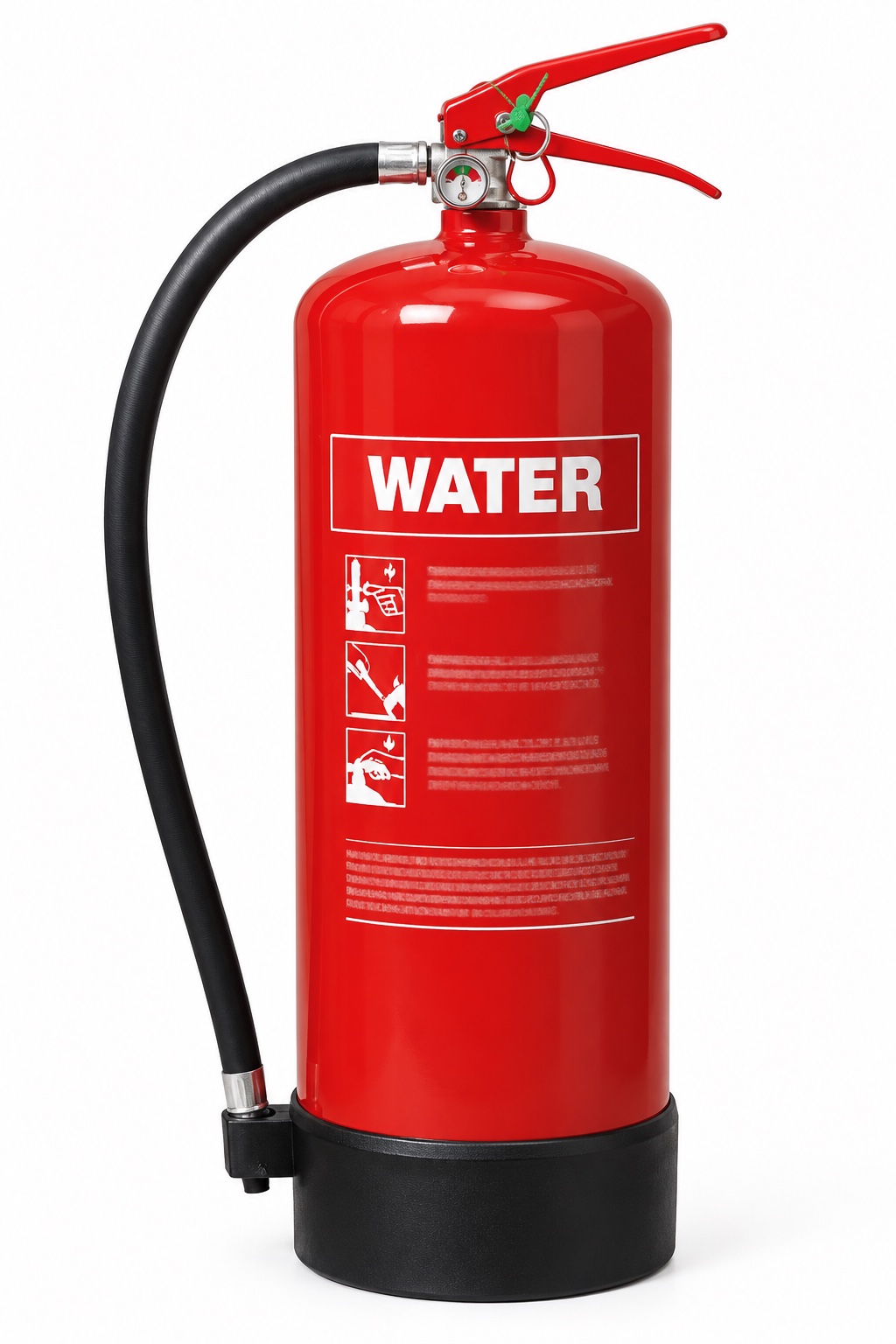
WaterRed / WATER marking
Normally A
Cools burning solid material such as paper, wood or fabric.
Check the limitation
Ordinary water is unsuitable for live electrical equipment, flammable-liquid pools, cooking oil and reactive metals: shock, spreading fuel or violent reaction can result.
Parts in text
Cylinder
The pressure vessel holds the agent and propellant as designed. Report corrosion, dents or other damage. Do not open, refill or repair it as an awareness check.
Agent name and colour marking
Read the actual agent name, fire ratings, electrical warnings and instructions. Colour is a recognition aid; it does not prove suitability. The illustration is not an operating label.
Fixed carrying handle
The lower fixed handle supports the unit. It is different from the upper operating lever. The exact grip and operation belong in practical instruction for the model.
Operating / squeeze lever
The upper lever operates the discharge valve when the safety device is released. Do not squeeze or discharge a unit to test it during a routine visual check.
Safety pin and pull ring
The pin mechanically prevents accidental operation. A pin or ring that is missing, distorted or insecure needs reporting; its presence does not prove the unit is serviceable.
Tamper indicator / snap-lock seal
The breakable indicator or snap-lock seal shows possible disturbance. Designs can use a separate pin-retaining strap or a pin-mounted indicator. It is different from the mechanical safety pin and is not a theft lock. Report it if broken or missing.
Pressure gauge
On this stored-pressure example the gauge indicates pressure, not the mass of agent remaining. A pointer in the marked range does not prove the cylinder is full or the unit has passed its service checks.
Hose, nozzle or applicator
The flexible hose ends in the model’s discharge nozzle. The clip is for stowage; a hose being clipped in place is not a service check. Do not block, detach or test-discharge it during a visual inspection.
Base / protective boot
The boot protects the base on this example. Other models have a different foot arrangement or no separate boot. Check the approved mounting and access rather than guessing from the picture.
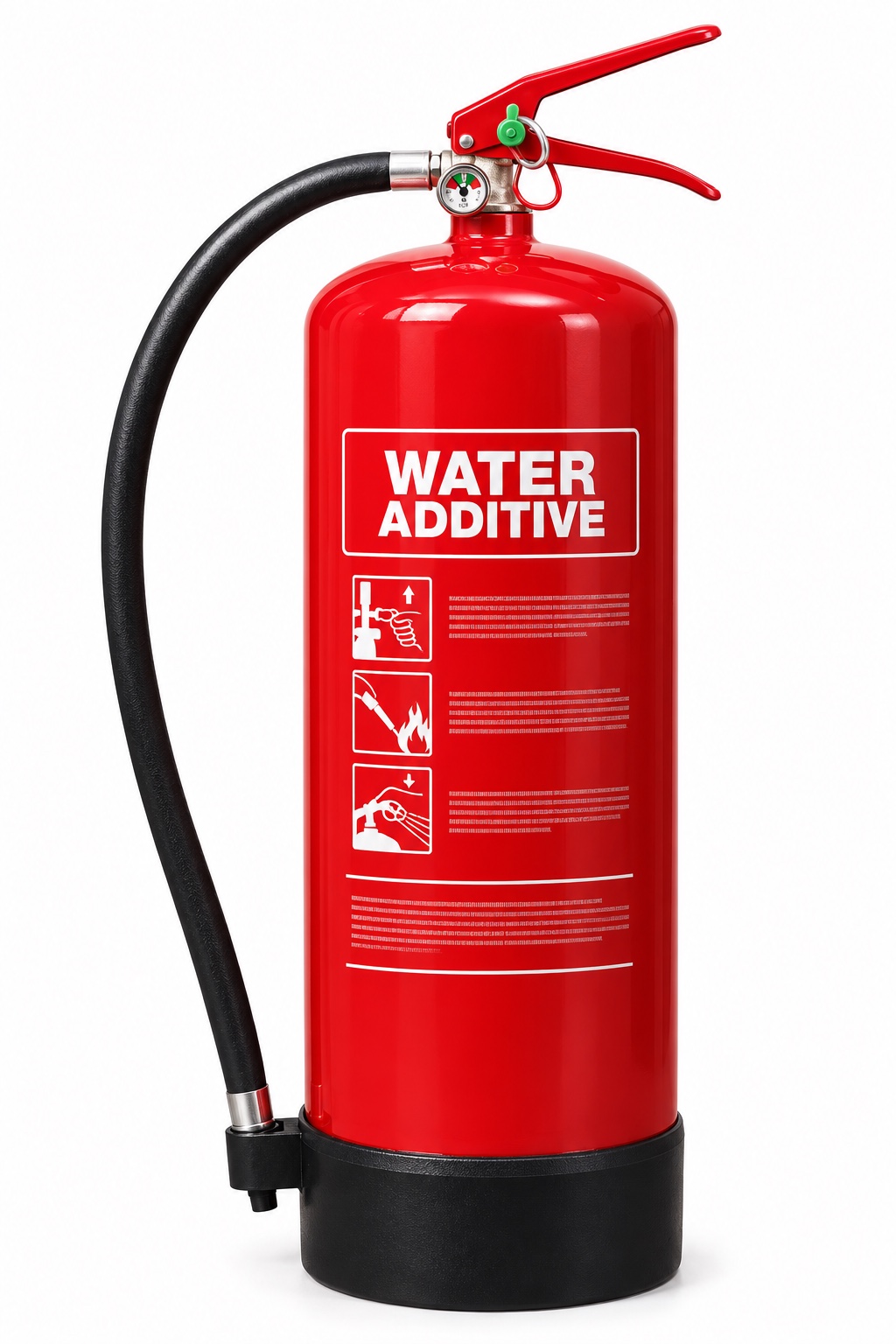
Water spray / water with additivesUsually red; read the agent name
A; B only if explicitly rated
Improved wetting or spray performance can help on the hazards stated on that model’s label.
Check the limitation
An additive does not make every water extinguisher safe for electricity, oils or reactive chemicals. Check the specific exclusions.
Parts in text
Cylinder
The pressure vessel holds the agent and propellant as designed. Report corrosion, dents or other damage. Do not open, refill or repair it as an awareness check.
Agent name and colour marking
Read the actual agent name, fire ratings, electrical warnings and instructions. Colour is a recognition aid; it does not prove suitability. The illustration is not an operating label.
Fixed carrying handle
The lower fixed handle supports the unit. It is different from the upper operating lever. The exact grip and operation belong in practical instruction for the model.
Operating / squeeze lever
The upper lever operates the discharge valve when the safety device is released. Do not squeeze or discharge a unit to test it during a routine visual check.
Safety pin and pull ring
The pin mechanically prevents accidental operation. A pin or ring that is missing, distorted or insecure needs reporting; its presence does not prove the unit is serviceable.
Tamper indicator / snap-lock seal
The breakable indicator or snap-lock seal shows possible disturbance. Designs can use a separate pin-retaining strap or a pin-mounted indicator. It is different from the mechanical safety pin and is not a theft lock. Report it if broken or missing.
Pressure gauge
On this stored-pressure example the gauge indicates pressure, not the mass of agent remaining. A pointer in the marked range does not prove the cylinder is full or the unit has passed its service checks.
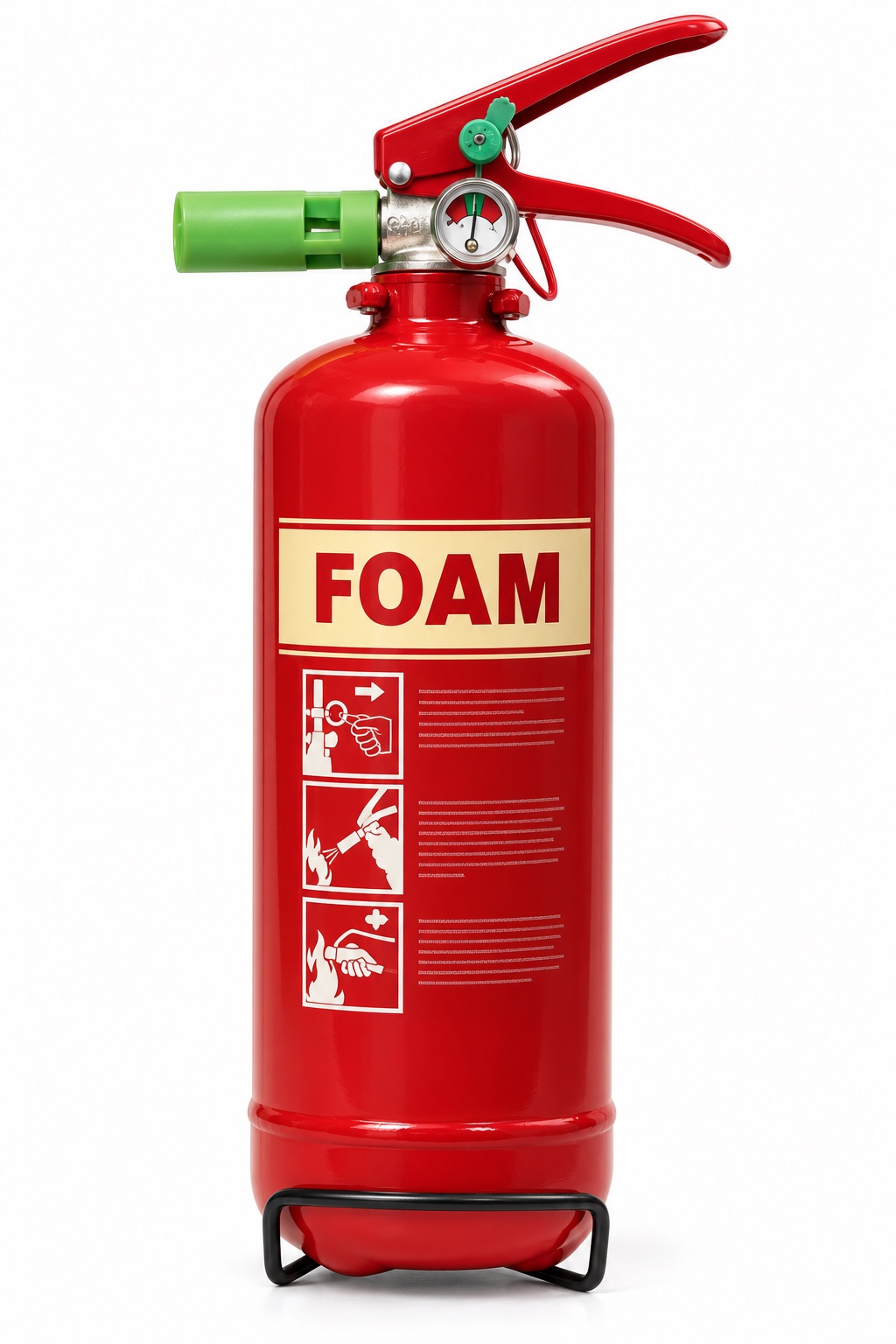
Direct spray nozzle
This compact foam example has a nozzle attached directly to the valve. Larger units may have a hose. Recognise the actual discharge arrangement and use only the approved agent and instructions.
Base / protective boot
The boot protects the base on this example. Other models have a different foot arrangement or no separate boot. Check the approved mounting and access rather than guessing from the picture.
FoamCream panel / FOAM
Commonly A and B
Cools and forms a surface blanket on suitable liquid fires. The agent must suit the actual fuel; some alcohols need alcohol-resistant foam.
Check the limitation
Ordinary foam is not a general answer for live electricity, cooking oil or metal fires. Unsuitable foam may break down on a solvent; a jet can spread fuel. Free-flowing fuel needs specialist response.
Parts in text
Cylinder
The pressure vessel holds the agent and propellant as designed. Report corrosion, dents or other damage. Do not open, refill or repair it as an awareness check.
Agent name and colour marking
Read the actual agent name, fire ratings, electrical warnings and instructions. Colour is a recognition aid; it does not prove suitability. The illustration is not an operating label.
Fixed carrying handle
The lower fixed handle supports the unit. It is different from the upper operating lever. The exact grip and operation belong in practical instruction for the model.
Operating / squeeze lever
The upper lever operates the discharge valve when the safety device is released. Do not squeeze or discharge a unit to test it during a routine visual check.
Safety pin and pull ring
The pin mechanically prevents accidental operation. A pin or ring that is missing, distorted or insecure needs reporting; its presence does not prove the unit is serviceable.
Tamper indicator / snap-lock seal
The breakable indicator or snap-lock seal shows possible disturbance. Designs can use a separate pin-retaining strap or a pin-mounted indicator. It is different from the mechanical safety pin and is not a theft lock. Report it if broken or missing.
Pressure gauge
On this stored-pressure example the gauge indicates pressure, not the mass of agent remaining. A pointer in the marked range does not prove the cylinder is full or the unit has passed its service checks.
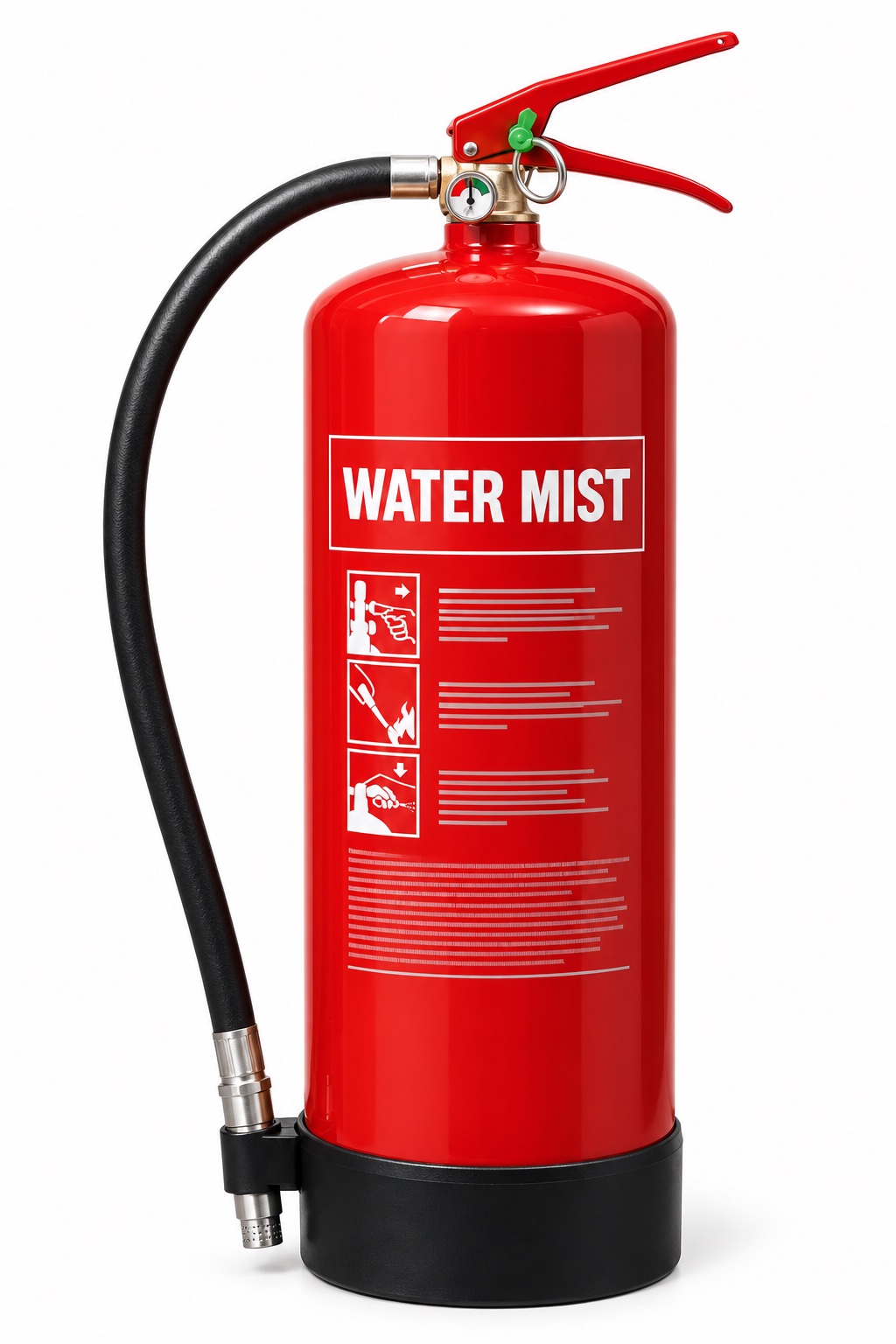
Fine-mist nozzle
The specially designed nozzle creates the intended fine spray. It is not an ordinary water jet. Nozzle appearance alone does not establish any tested electrical suitability.
Base / protective boot
The boot protects the base on this example. Other models have a different foot arrangement or no separate boot. Check the approved mounting and access rather than guessing from the picture.
Water mistManufacturer marking varies
Model-specific; commonly A, some F
Fine droplets absorb heat. Some products have additional ratings or tested electrical suitability, with stated voltage and distance conditions.
Check the limitation
‘Mist’ is not universal approval. Use only the classes and electrical conditions actually declared for that model; do not assume it covers metals, liquids or batteries.
Parts in text
Cylinder
The pressure vessel holds the agent and propellant as designed. Report corrosion, dents or other damage. Do not open, refill or repair it as an awareness check.
Agent name and colour marking
Read the actual agent name, fire ratings, electrical warnings and instructions. Colour is a recognition aid; it does not prove suitability. The illustration is not an operating label.
Fixed carrying handle
The lower fixed handle supports the unit. It is different from the upper operating lever. The exact grip and operation belong in practical instruction for the model.
Operating / squeeze lever
The upper lever operates the discharge valve when the safety device is released. Do not squeeze or discharge a unit to test it during a routine visual check.
Safety pin and pull ring
The pin mechanically prevents accidental operation. A pin or ring that is missing, distorted or insecure needs reporting; its presence does not prove the unit is serviceable.
Tamper indicator / snap-lock seal
The breakable indicator or snap-lock seal shows possible disturbance. Designs can use a separate pin-retaining strap or a pin-mounted indicator. It is different from the mechanical safety pin and is not a theft lock. Report it if broken or missing.
Pressure gauge
On this stored-pressure example the gauge indicates pressure, not the mass of agent remaining. A pointer in the marked range does not prove the cylinder is full or the unit has passed its service checks.
Hose, nozzle or applicator
The flexible hose ends in the model’s discharge nozzle. The clip is for stowage; a hose being clipped in place is not a service check. Do not block, detach or test-discharge it during a visual inspection.
Base / protective boot
The boot protects the base on this example. Other models have a different foot arrangement or no separate boot. Check the approved mounting and access rather than guessing from the picture.
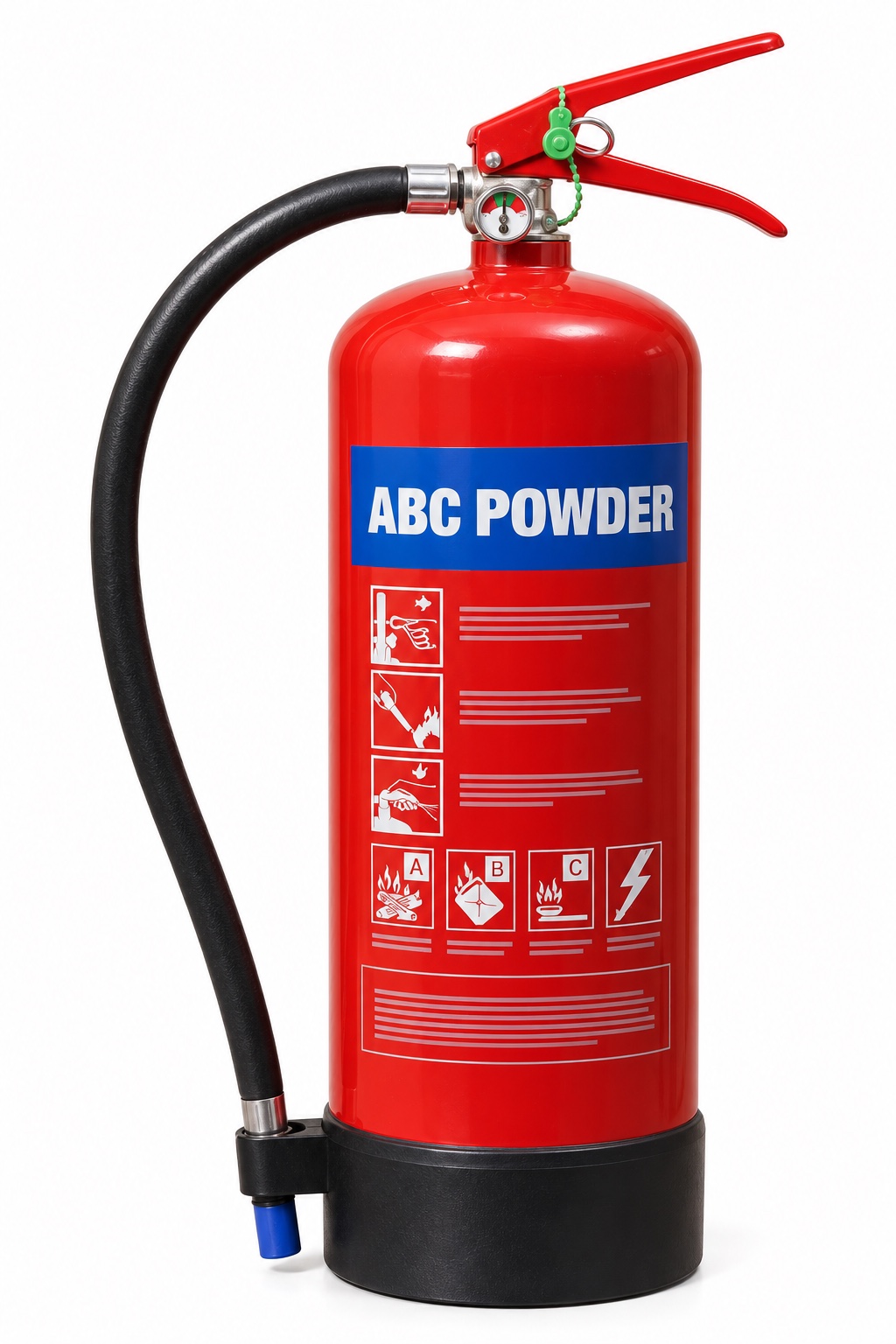
ABC dry powderBlue panel / ABC POWDER
A, B and C if marked
Interrupts flame chemistry; multipurpose powder also acts on Class A material. A C marking does not authorise tackling a gas leak.
Check the limitation
Powder can obscure escape and impair breathing; it is not generally recommended indoors. Limited cooling allows reignition. It is not metal-specific D powder or a substitute for F-rated cooking-oil equipment.
Parts in text
Cylinder
The pressure vessel holds the agent and propellant as designed. Report corrosion, dents or other damage. Do not open, refill or repair it as an awareness check.
Agent name and colour marking
Read the actual agent name, fire ratings, electrical warnings and instructions. Colour is a recognition aid; it does not prove suitability. The illustration is not an operating label.
Fixed carrying handle
The lower fixed handle supports the unit. It is different from the upper operating lever. The exact grip and operation belong in practical instruction for the model.
Operating / squeeze lever
The upper lever operates the discharge valve when the safety device is released. Do not squeeze or discharge a unit to test it during a routine visual check.
Safety pin and pull ring
The pin mechanically prevents accidental operation. A pin or ring that is missing, distorted or insecure needs reporting; its presence does not prove the unit is serviceable.
Tamper indicator / snap-lock seal
The breakable indicator or snap-lock seal shows possible disturbance. Designs can use a separate pin-retaining strap or a pin-mounted indicator. It is different from the mechanical safety pin and is not a theft lock. Report it if broken or missing.
Pressure gauge
On this stored-pressure example the gauge indicates pressure, not the mass of agent remaining. A pointer in the marked range does not prove the cylinder is full or the unit has passed its service checks.
Hose, nozzle or applicator
The flexible hose ends in the model’s discharge nozzle. The clip is for stowage; a hose being clipped in place is not a service check. Do not block, detach or test-discharge it during a visual inspection.
Base / protective boot
The boot protects the base on this example. Other models have a different foot arrangement or no separate boot. Check the approved mounting and access rather than guessing from the picture.
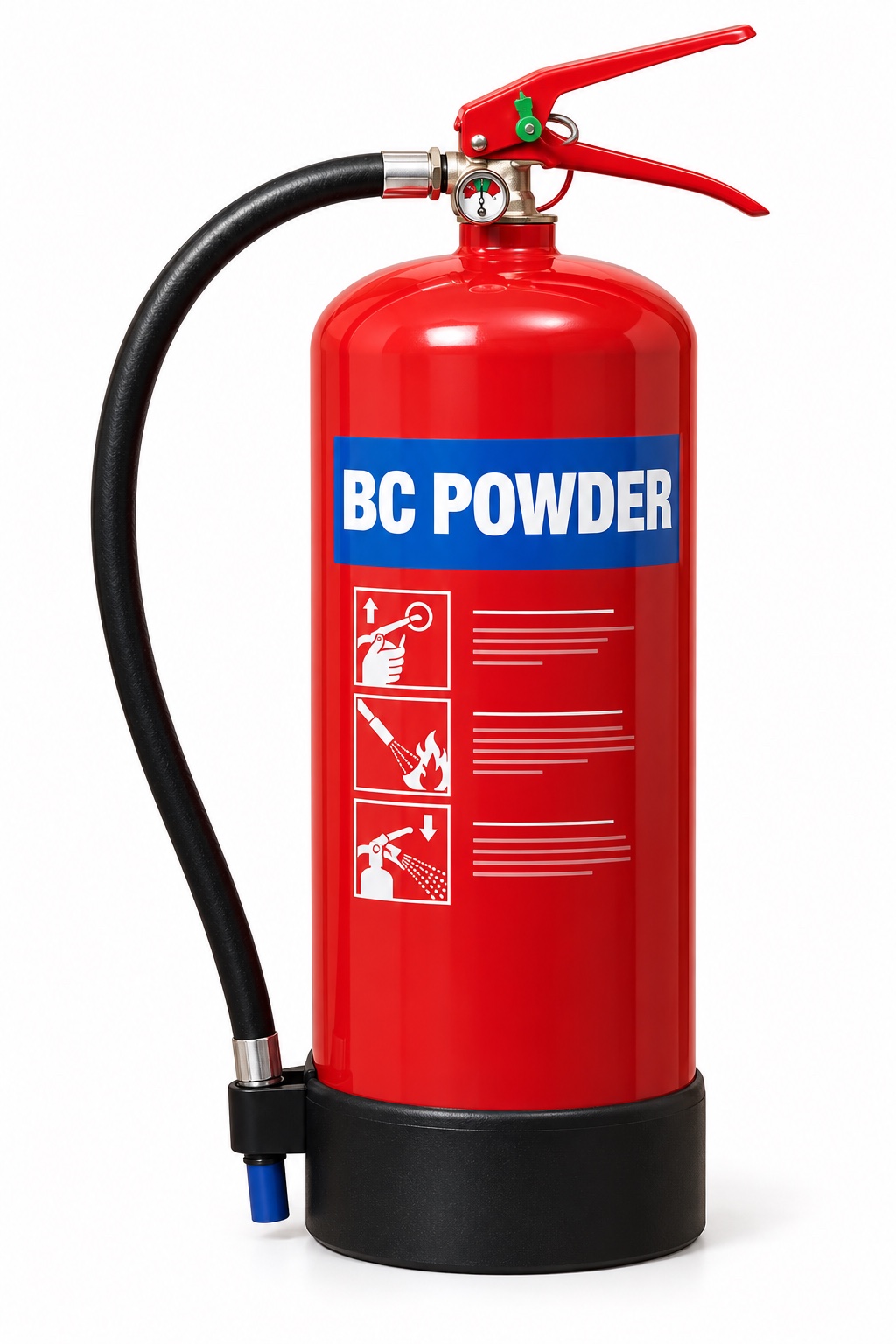
BC dry powderBlue panel / BC POWDER
B and C if marked; not A
Selected for particular liquid or gas hazards under the assessed plan. Electrical use must follow the actual unit’s instructions.
Check the limitation
Do not assume all blue powder extinguishers protect wood or paper. It has the visibility, breathing and reignition limitations of powder; it does not provide Class D or F protection.
Parts in text
Cylinder
The pressure vessel holds the agent and propellant as designed. Report corrosion, dents or other damage. Do not open, refill or repair it as an awareness check.
Agent name and colour marking
Read the actual agent name, fire ratings, electrical warnings and instructions. Colour is a recognition aid; it does not prove suitability. The illustration is not an operating label.
Fixed carrying handle
The lower fixed handle supports the unit. It is different from the upper operating lever. The exact grip and operation belong in practical instruction for the model.
Operating / squeeze lever
The upper lever operates the discharge valve when the safety device is released. Do not squeeze or discharge a unit to test it during a routine visual check.
Safety pin and pull ring
The pin mechanically prevents accidental operation. A pin or ring that is missing, distorted or insecure needs reporting; its presence does not prove the unit is serviceable.
Tamper indicator / snap-lock seal
The breakable indicator or snap-lock seal shows possible disturbance. Designs can use a separate pin-retaining strap or a pin-mounted indicator. It is different from the mechanical safety pin and is not a theft lock. Report it if broken or missing.
Pressure gauge
On this stored-pressure example the gauge indicates pressure, not the mass of agent remaining. A pointer in the marked range does not prove the cylinder is full or the unit has passed its service checks.
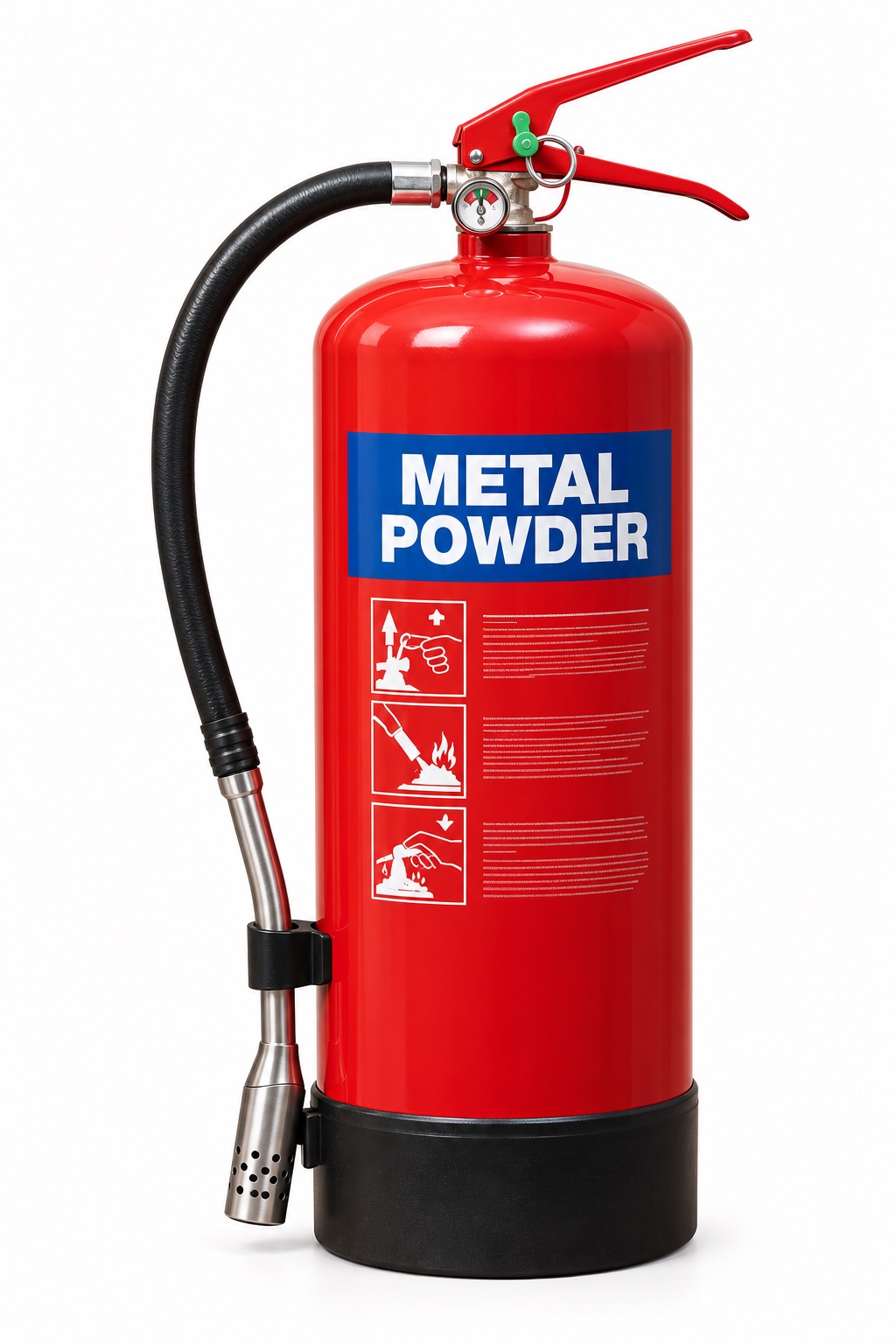
Specialist low-velocity applicator
The specialist applicator places the compatible metal-fire agent without unnecessarily disturbing burning material. Both agent and application method must suit the specific metal; this is not an ABC powder nozzle.
Base / protective boot
The boot protects the base on this example. Other models have a different foot arrangement or no separate boot. Check the approved mounting and access rather than guessing from the picture.
Class D specialist powderSpecific metal and agent named on label
D, for the specified metal
A specialist powder can isolate or absorb heat from a compatible burning metal. Selection requires knowledge of the metal and its form.
Check the limitation
The wrong powder can fail or react. Water, foam and CO₂ can be dangerous on certain burning metals. A powder suitable for magnesium is not automatically suitable for metallic lithium.
Parts in text
Cylinder
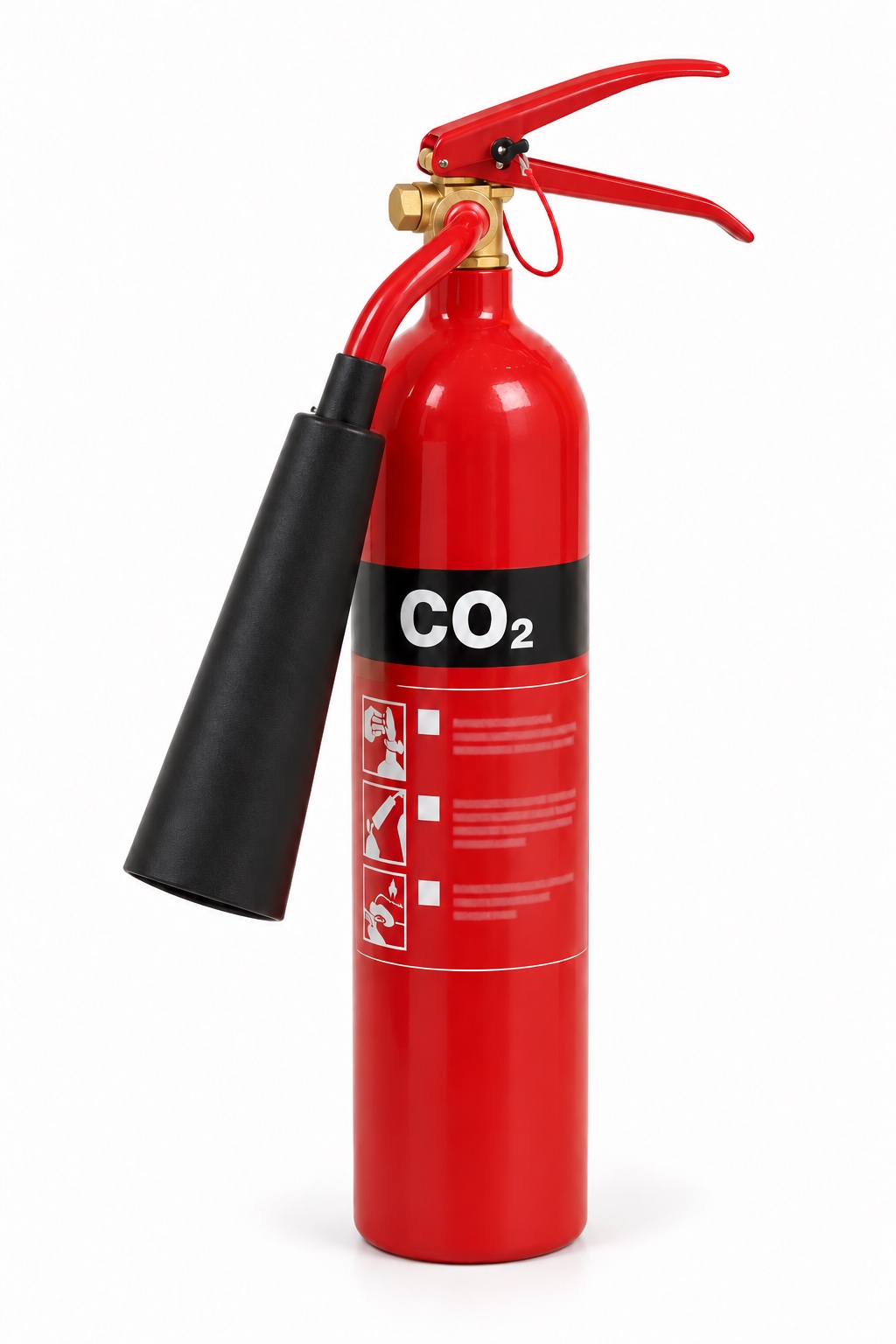
The narrow steel cylinder contains carbon dioxide under pressure. There is normally no pressure gauge on this portable type; service assessment includes the appropriate mass and integrity checks by competent personnel.
Agent name and colour marking
Read the actual agent name, fire ratings, electrical warnings and instructions. Colour is a recognition aid; it does not prove suitability. The illustration is not an operating label.
Fixed carrying handle
The lower fixed handle supports the unit. It is different from the upper operating lever. The exact grip and operation belong in practical instruction for the model.
Operating / squeeze lever
The upper lever operates the discharge valve when the safety device is released. Do not squeeze or discharge a unit to test it during a routine visual check.
Safety pin and pull ring
The pin mechanically prevents accidental operation. A pin or ring that is missing, distorted or insecure needs reporting; its presence does not prove the unit is serviceable.
Tamper indicator / snap-lock seal
The breakable indicator or snap-lock seal shows possible disturbance. Designs can use a separate pin-retaining strap or a pin-mounted indicator. It is different from the mechanical safety pin and is not a theft lock. Report it if broken or missing.
Horn and designated insulated grip
The flared horn directs the CO₂ discharge. Discharge parts can become extremely cold. Only the parts identified by the manufacturer as safe to hold should be gripped; not every horn is frost-free.
Displaces the atmosphere around a small flame and leaves no powder residue. Often selected around electrical equipment.
Check the limitation
Poor cooling means reignition is possible. CO₂ can create a dangerous atmosphere in enclosed spaces; discharge can cause frostbite. Hold only the designated insulated parts. Not a cooking-oil or metal-fire substitute.
Parts in text
Cylinder
The pressure vessel holds the agent and propellant as designed. Report corrosion, dents or other damage. Do not open, refill or repair it as an awareness check.
Agent name and colour marking
Read the actual agent name, fire ratings, electrical warnings and instructions. Colour is a recognition aid; it does not prove suitability. The illustration is not an operating label.
Fixed carrying handle
The lower fixed handle supports the unit. It is different from the upper operating lever. The exact grip and operation belong in practical instruction for the model.
Operating / squeeze lever
The upper lever operates the discharge valve when the safety device is released. Do not squeeze or discharge a unit to test it during a routine visual check.
Safety pin and pull ring
The pin mechanically prevents accidental operation. A pin or ring that is missing, distorted or insecure needs reporting; its presence does not prove the unit is serviceable.
Tamper indicator / snap-lock seal
The breakable indicator or snap-lock seal shows possible disturbance. Designs can use a separate pin-retaining strap or a pin-mounted indicator. It is different from the mechanical safety pin and is not a theft lock. Report it if broken or missing.
Pressure gauge
On this stored-pressure example the gauge indicates pressure, not the mass of agent remaining. A pointer in the marked range does not prove the cylinder is full or the unit has passed its service checks.
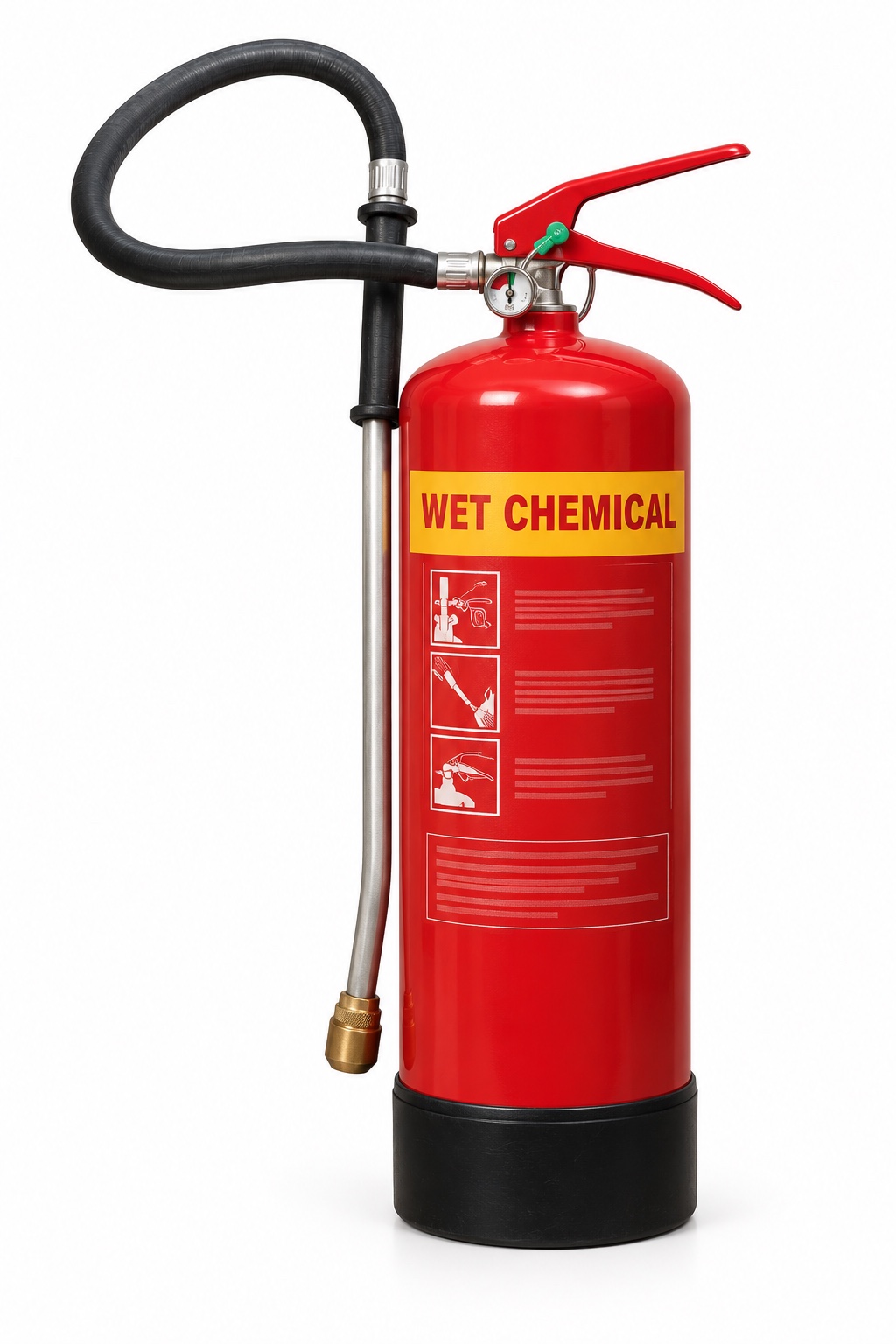
Hose, lance and spray applicator
The hose feeds the long lance and purpose-designed applicator. It helps distinguish this kitchen-fire unit from an ordinary short-nozzle extinguisher. Use requires model-specific practical training.
Base / protective boot
The boot protects the base on this example. Other models have a different foot arrangement or no separate boot. Check the approved mounting and access rather than guessing from the picture.
Wet chemicalYellow panel / WET CHEMICAL
F; often A if marked
Cools cooking oil and creates a protective surface layer through reaction with the fat. Use only within the actual unit’s rating and instructions.
Check the limitation
Do not mistake it for a general liquid-fire or electrical extinguisher. Incorrect application or moving the fryer can splash hot oil; apparent flame-out does not establish safe temperature.
Parts in text
Cylinder
The pressure vessel holds the agent and propellant as designed. Report corrosion, dents or other damage. Do not open, refill or repair it as an awareness check.
Agent name and colour marking
Read the actual agent name, fire ratings, electrical warnings and instructions. Colour is a recognition aid; it does not prove suitability. The illustration is not an operating label.
Fixed carrying handle
The lower fixed handle supports the unit. It is different from the upper operating lever. The exact grip and operation belong in practical instruction for the model.
Operating / squeeze lever
The upper lever operates the discharge valve when the safety device is released. Do not squeeze or discharge a unit to test it during a routine visual check.
Safety pin and pull ring
The pin mechanically prevents accidental operation. A pin or ring that is missing, distorted or insecure needs reporting; its presence does not prove the unit is serviceable.
Tamper indicator / snap-lock seal
The breakable indicator or snap-lock seal shows possible disturbance. Designs can use a separate pin-retaining strap or a pin-mounted indicator. It is different from the mechanical safety pin and is not a theft lock. Report it if broken or missing.
Pressure gauge
On this stored-pressure example the gauge indicates pressure, not the mass of agent remaining. A pointer in the marked range does not prove the cylinder is full or the unit has passed its service checks.
Hose, nozzle or applicator
The flexible hose ends in the model’s discharge nozzle. The clip is for stowage; a hose being clipped in place is not a service check. Do not block, detach or test-discharge it during a visual inspection.
Base / protective boot
The boot protects the base on this example. Other models have a different foot arrangement or no separate boot. Check the approved mounting and access rather than guessing from the picture.
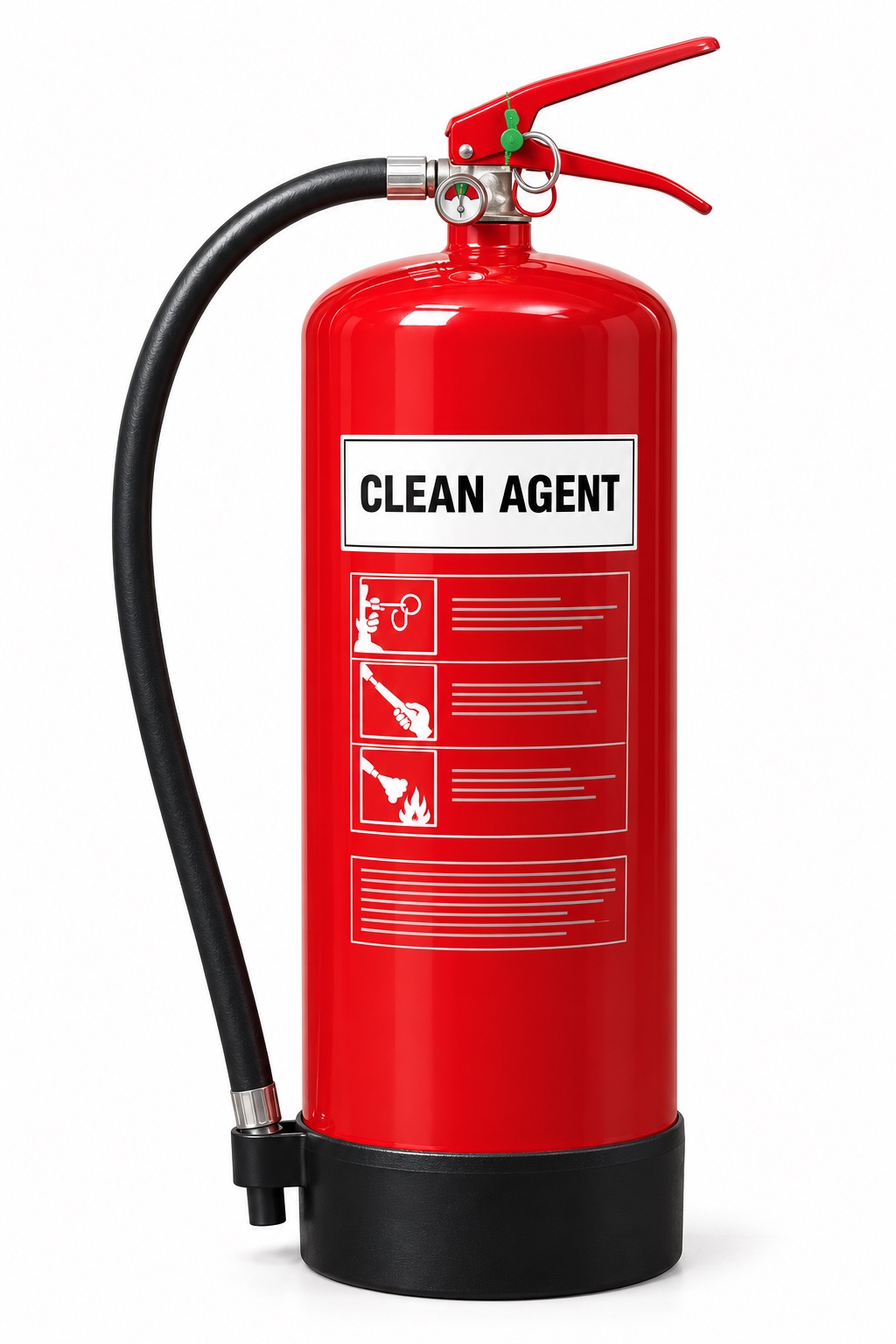
Clean agent / vaporising liquidRead the agent; no universal colour shortcut
Product- and jurisdiction-specific
Specialist low-residue agents may protect sensitive equipment. Confirm the UK-approved application and the manufacturer’s limits.
Check the limitation
Low residue does not mean safe to breathe. Do not copy a US A:B:C rating as UK gas-fire approval. Legacy halon is restricted to permitted critical uses and applicable deadlines.
Parts in text
Cylinder
The pressure vessel holds the agent and propellant as designed. Report corrosion, dents or other damage. Do not open, refill or repair it as an awareness check.
Agent name and colour marking
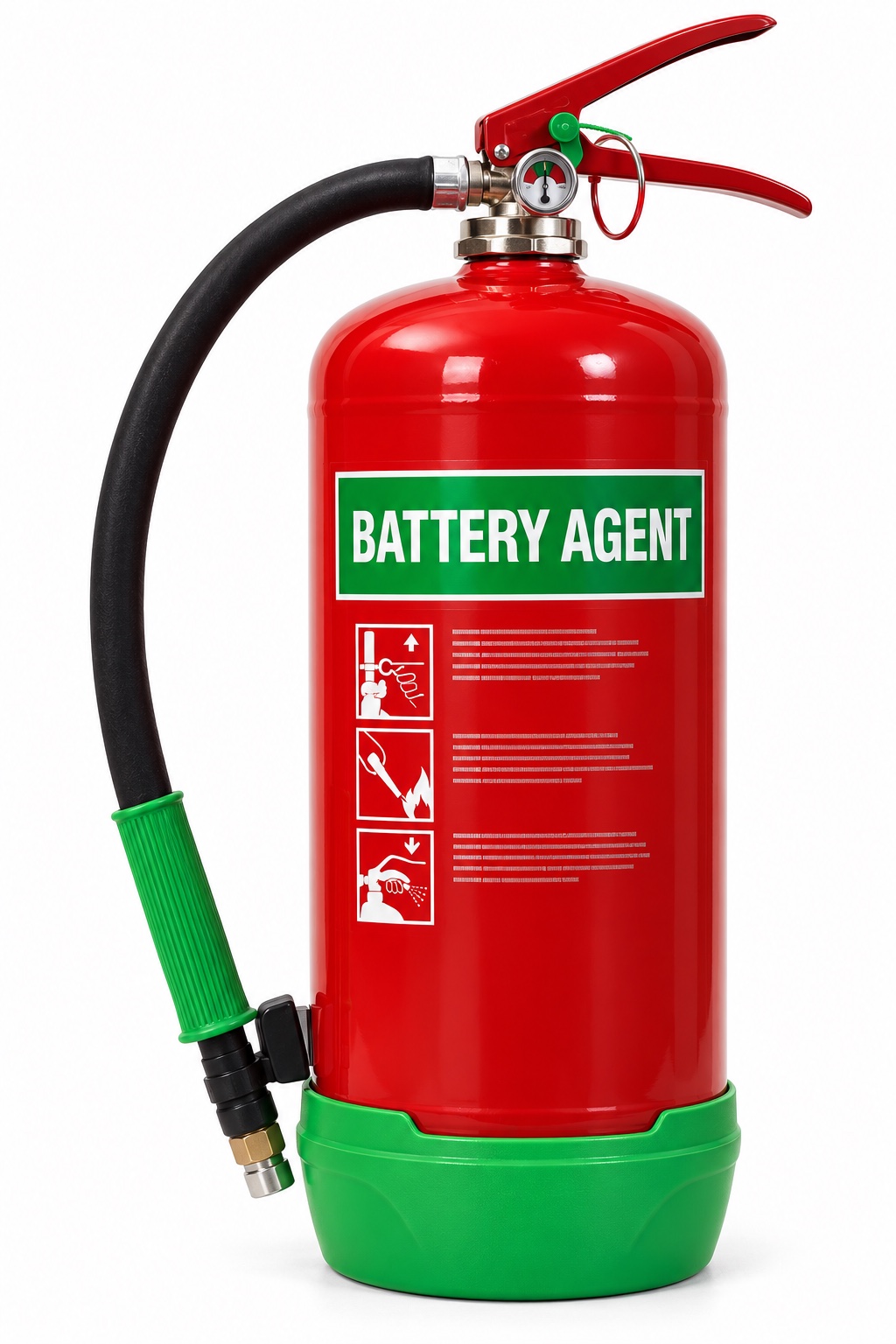
This generic illustration has a green agent area and boot inspired by the supplied product. Green is not a universal Class L identification code. Read the real product name, chemistry, battery limits and instructions.
Fixed carrying handle
The lower fixed handle supports the unit. It is different from the upper operating lever. The exact grip and operation belong in practical instruction for the model.
Operating / squeeze lever
The upper lever operates the discharge valve when the safety device is released. Do not squeeze or discharge a unit to test it during a routine visual check.
Safety pin and pull ring
The pin mechanically prevents accidental operation. A pin or ring that is missing, distorted or insecure needs reporting; its presence does not prove the unit is serviceable.
Tamper indicator / snap-lock seal
The breakable indicator or snap-lock seal shows possible disturbance. Designs can use a separate pin-retaining strap or a pin-mounted indicator. It is different from the mechanical safety pin and is not a theft lock. Report it if broken or missing.
Pressure gauge
On this stored-pressure example the gauge indicates pressure, not the mass of agent remaining. A pointer in the marked range does not prove the cylinder is full or the unit has passed its service checks.
Hose, grip and applicator
The illustrated hose has a coloured ribbed grip and a small application tip. This shows the hardware family, not a tested battery capability. Follow the instructions for the actual agent and generation.
Base / protective boot
The boot protects the base on this example. Other models have a different foot arrangement or no separate boot. Check the approved mounting and access rather than guessing from the picture.
Battery-specific suppression productsNamed formulation and tested application
Check independent scope and instructions
Some products use water-based cooling or specialist media such as aqueous vermiculite for specified battery scenarios. Selection depends on chemistry, capacity and location.
Check the limitation
A ‘lithium’ label is not proof it will stop thermal runaway in a large pack. Flame suppression may not prevent reignition or gas release. Do not approach, carry or submerge a failing battery as a learner exercise.
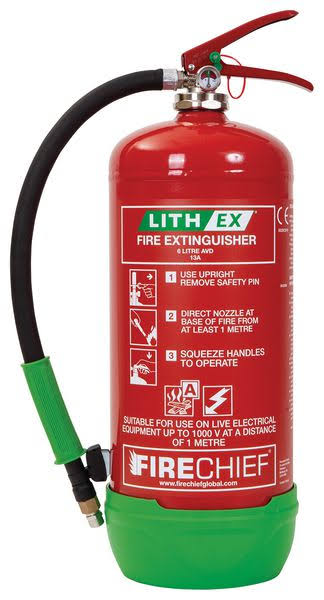
Lithium-ion product example · Firechief 6 L Lith-Ex
A named product example helps connect the generic table to an actual unit. Confirm the exact product before using its claims.
Agent and intended application
The linked Seton example uses aqueous vermiculite dispersion (AVD) for specified lithium-ion battery fire applications. Water content cools; the dispersed mineral helps form a barrier. This is not generic Class D metal-fire powder.
Read the actual rating
Seton lists a 6 L product with a 13A rating. That A rating describes its solid-material test performance; it does not, by itself, certify a universal Class L battery capability.
Match the exact model and generation
The manufacturer’s current 6 L G2 page identifies FLE6X and different discharge details from the retailer’s older listing. Do not mix their time, range or pressure values. Match the delivered label, product sheet and manual.
Check the battery scope
Confirm the allowed battery chemistry, energy capacity, state and scenario with the current manufacturer information and competent fire assessment. A large EV or energy-storage pack cannot be treated as a small-device fire.
Electrical conditions are product-specific
The supplied product label includes a voltage and minimum-distance condition. Do not transfer that condition to another battery extinguisher or infer that it makes an unsafe electrical approach acceptable.
After the flame disappears
Heat, off-gas and reignition can remain. Follow the planned withdrawal, exclusion and fire-service response; do not pick up, submerge or return a failed battery to charging.
Read the agent, fire-class letters, performance rating, electrical warnings, operating instructions and service condition. Numbers such as 13A or 55B describe standardised test performance, not a safe room size or permission to tackle that amount of fire. Colour is a clue; the actual label and assessed plan decide suitability.
What about a fire blanket?
A fire blanket is separate equipment, not an extinguisher type. It may be specified for a small contained cooking fire, but safe approach and the manufacturer’s limits still matter. Never carry a burning pan, improvise a cover or put yourself between fire and your exit.
Spot the dangerous assumption
Pause at each question, then open the explanation. These are unscored learning prompts alongside the course assessment.
A pan of cooking oil is burning. Would ordinary water help?
No. Rapid steam production can throw burning oil across the room. Raise the alarm and follow the kitchen emergency plan; never move the pan. Only a trained, authorised person should consider the specified F-rated equipment with a safe escape.
There is a C on the powder extinguisher. Should I put out the leaking gas flame?
Not as a routine response. Unburnt gas may continue escaping and form an explosive cloud. Withdraw, alarm and report the supply involved. Any safe isolation and specialist firefighting must follow the assessed emergency arrangements.
The flame around a battery has disappeared. Is the incident over?
No. Internal heat, flammable or toxic off-gas and reignition can remain. Keep clear, prevent access and tell the fire and rescue service what battery is involved. Flame-out is not permission to handle it or restart charging.
Both extinguishers have blue panels. Are the powders interchangeable?
No. Read ABC, BC or the exact Class D metal specification. Colour identifies a family; it does not establish the correct agent, rating or safe application.
A CO₂ extinguisher leaves no mess. Is it ideal in a small unventilated room?
No. A dangerous CO₂ concentration can incapacitate a person, while the fire and smoke already threaten escape. Do not enter an unsafe room. The fire plan and competent equipment selection must account for the space.
A water-mist product claims electrical suitability. Can I use any water extinguisher on a live cabinet?
No. Any tested electrical claim belongs to that particular model, with its own voltage and distance limits. It does not apply to ordinary water or another mist product, and it does not make an unsafe approach acceptable.
Source guidance and scope
UK learning context. Consult the applicable national fire guidance and your premises’ assessed plan. Manufacturer examples explain product variation; they are not product recommendations. Guidance checked 24 October 2026.
Protect visitors and workers without giving a universal intervention recipe.
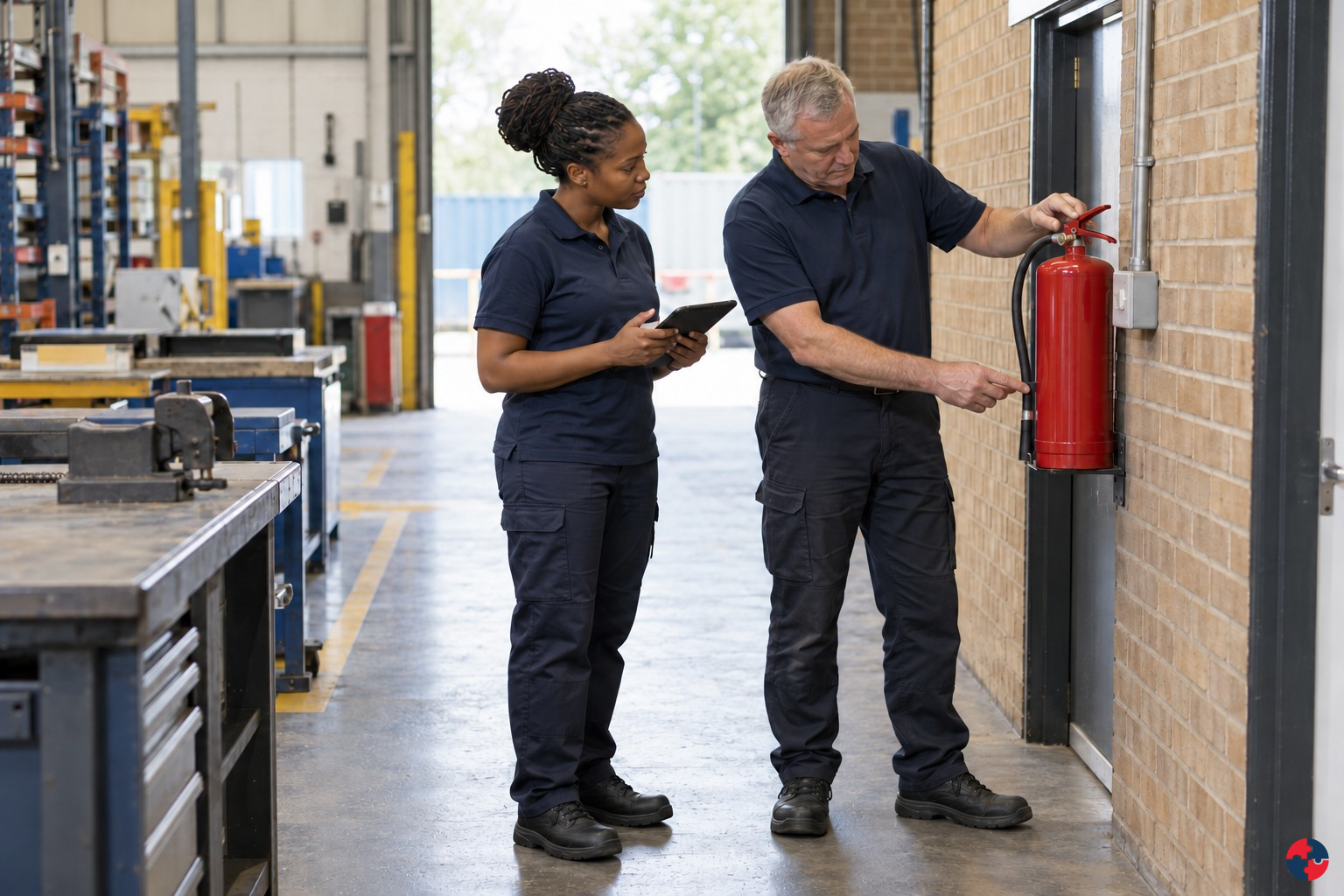
Photorealistic illustrative UK workplace scene. Review checks: Setting: Install a data cable through a warehouse compartment wall beside an occupied office and protected corridor. Act: Consider a route that avoids a new breach. Hold / review: Stop on unknown wall construction or material, unexpected services, unsupported product substitution, damage to the boundary or loss of the agreed route.
A smoking battery is an incident, not routine sorting
Swelling, heating or smoke from a battery can indicate a developing dangerous event. Fire, ejected material and harmful gases may expose visitors and staff, and a damaged item can deteriorate after it first appears controlled. The fictional visitor holds a swollen smoking battery at the public bay. The ordinary attendant's priority is people and emergency communication, not obtaining its voltage, opening its case or carrying it to a distant quarantine container.
Use the actual damaged-battery emergency plan: raise the alarm, clear people by a safe route, restrict access and summon the designated competent response. Pass reliable information from safety, including location, visible condition and nearby people or materials. Do not approach for a close photograph or assume that familiar household size makes the event minor. This course does not teach extinguishing agents, immersion, cooling quantities or battery movement. Those decisions require the site-specific plan, trained capability and responder direction.
Preventing a worse interface is part of readiness. Public staff need understandable instructions and a way to communicate without crossing the affected area. Vehicle movements must not carry others into smoke or block responder access. Quarantine and emergency areas need to remain available as planned; storing ordinary material there defeats their purpose. A plan copied from a site handling a different battery type cannot establish appropriate protection for this yard. Competent assessment and the relevant national authorisation govern the actual arrangements.
After the immediate response, a quiet or cool-looking item is not automatically routine waste again. The designated incident lead and specialists decide monitoring, safe disposition and reopening. Preserve factual records and review why the item reached the public interface in that condition. Test emergency communication through controlled exercises without deliberately heating a battery or exposing participants. The exercise outcome is a clear warning and protective recommendation, not a demonstration that the learner can fight a battery fire or clear an affected atmosphere.
What happens when a barrier is impaired?
An impairment is a loss or uncertainty in the protection being relied on. Stop the work that creates or worsens it, inform the responsible premises or process owner, and establish whether continued occupation or operation can be justified before proceeding.
The decision owner and competent specialist identify what is affected, who may be exposed, other unavailable safeguards and the credible consequences. They define any restrictions, temporary measures, repair route, reassessment triggers and handover requirements. Restrict use or shut down through the approved safe procedure where necessary; do not improvise a shutdown that creates another hazard.
An extra patrol, a permit or a promised repair is not proof that a missing compartment or damaged support remains safe. Temporary measures must be justified for the actual scenario, remain effective and have an owner and expiry or review condition set by the assessment. Tell affected workers, contractors and neighbouring occupiers. A shift change must not erase the restriction.
If there is fire, smoke, a leak or an alarm, follow the site emergency arrangements: raise the alarm, leave by a safe route, summon emergency help and report at the designated place. Do not delay evacuation to repair protection or operate an unfamiliar drain or valve. Give responders the location, substance information and known impairments from safety; re-entry requires the authorised all-clear. Premises fire guidance and DSEAR emergency duties support planning for these events.
Applied case
A visitor presents a smoking swollen battery and asks the attendant to carry it through the queue to the storage cage.
Decision and explanation
Clear and protect people, raise the alarm and follow the designated damaged-battery response from a safe position.
An active incident requires the actual emergency arrangement. A label does not justify moving a dangerous item through occupied space.
Lesson 5
Keep broken lamps on their specialist route
Prevent fragmentation and chemical exposure without improvised recovery.
Photorealistic illustrative UK workplace scene. Review checks: Chemical register: Compatibility class, SDS section 10, storage, owner and approved use. Transfer verification: Right product, tank, hose, valve lineup and ullage confirmed. Storage segregation: Acids, alkalis, oxidisers, flammables and wastes separated.
Keep broken lamps on their specialist route
Not every lamp contains mercury, and staff should not decide contents solely from a broken shape. Fluorescent lamps in the fictional reception area are mixed intact and broken, creating both sharp-fragment and possible mercury exposure concerns. A general glass skip or ordinary broom is not automatically a suitable route. Identification, breakage response and packaging should follow the site's authorised arrangements for the actual lamp type and condition.
Restrict the affected area and arrange trained recovery with suitable containment. Do not crush remaining lamps to reduce volume, hand-pick shards, use a domestic vacuum or send visitors to carry leaking fragments through the site. The course does not provide mercury clean-up or respiratory-protection selection instructions. Where a breakage has affected people, obtain the appropriate support and follow the exposure procedure. Pass factual information without claiming a measured airborne concentration or a clinical diagnosis.
Prevention includes suitable reception and storage containers, weather and damage protection, appropriate separation and a handling method that keeps intact items intact. Check transfer heights, traffic interfaces and how visitors place items so staff are not forced to reach amongst fragments. Equipment that safely handles ordinary glass may not preserve lamp integrity or contain its contents. A storage container must suit the waste and receiving treatment route, not just fit the floor space available.
Verification should establish that the breakage response is complete under the authorised process, the affected material has reached a suitable destination and the remaining storage is ready for use. A clean-looking floor does not by itself establish that the specified recovery or exposure checks were completed. Update the stock and incident records and examine why breakage occurred. For the exercise, write one acceptance question, one handling improvement and one handback condition. Do not turn those questions into a waste classification or a technical recovery procedure beyond the learner's role.
Why are waste streams and drains high-risk mixing routes?
Waste streams and drains are high-risk because chemicals can meet out of sight after leaving the original task area.
A drain, sump, interceptor, IBC, drum or waste tank can become the mixing vessel. Workers may think each individual disposal was small, but incompatible discharges can accumulate or react in a confined space, generating heat, pressure, gas or pollution.
Waste compatibility needs a positive approval process. Unknown waste should not be bulked because it looks similar or because the container is available. Waste labels should include contents, hazards, source, date, incompatible materials and owner.
Drain maps and isolation points are important for process sites, laboratories, workshops and construction sites. If responders do not know where a drain goes, they cannot confidently control a spill or incompatible discharge.
Waste and drain controls
Control
Purpose
Evidence
Waste-stream approval
Prevents incompatible waste from being bulked.
Waste acceptance or approval record.
No unknown bulking rule
Prevents reaction from unidentified material.
Quarantine and characterisation procedure.
Drain map
Shows where spills and discharges may travel.
Current site drainage plan.
Drain protection
Stops incompatible or polluting material entering drainage.
Drain covers, valves and spill drills.
Waste labels
Communicate contents and hazards.
Label inspection and waste register.
Compatibility testing
Confirms bulking is safe where required.
Test record and acceptance criteria.
Applied case
Broken fluorescent lamps are amongst intact lamps, and a worker suggests crushing everything into an ordinary glass bin.
Decision and explanation
Restrict access and use the authorised trained breakage, containment and specialist destination process.
Prevent further release and fragmentation. Ordinary glass handling or domestic equipment does not establish suitable chemical recovery.
Lesson 6
Prove disposition without losing the identity of the waste
Connect records, classification and receiving capability to physical handling.
Photorealistic illustrative UK workplace scene. Review checks: Setting: At fictional the process operator, a road tanker brings an identified flammable product to a bulk tank after a supplier has changed the additive package. Act: The transport planner confirms classification, documents, vehicle and load details with the carrier. Hold / review: Do not connect if additive compatibility, classification, receiving capacity, hose suitability or a critical protection test is uncertain.
Prove disposition without losing the identity of the waste
A waste movement record is useful only if it describes the actual item or stream and a suitable destination. Battery chemistry, damage, lamp condition and components can affect classification, packaging, storage and treatment. Some electrical waste contains hazardous substances or persistent organic pollutants; competent assessment must determine the applicable route. Do not describe every WEEE item as hazardous or POPs waste, but do not mix an uncertain stream into ordinary material to avoid resolving it.
The Environment Agency guidance used in this course concerns permitted facilities in England. It does not automatically establish the requirements in Scotland, Wales or Northern Ireland, nor does it enlarge an individual site's permit. The responsible team must check actual national requirements, the site's authorisation and the receiving operator's capability. A carrier registration or a signed collection note does not by itself prove that a particular destination may treat every material presented.
In the fictional exercise, the collection note calls a container mixed metal even though its reception record lists batteries and broken lamps. Keep the movement controlled while the discrepancy is resolved by the responsible roles. Preserve the original observations and any corrected records rather than overwriting the material's history. Ordinary attendants should not invent waste codes or decide that intact appearance makes the specialist route unnecessary. Appropriate expertise and reliable information are needed.
Verification joins the record to the physical container: correct identity, condition, suitable packaging, compatible storage, authorised destination and the actual handover. Check whether quarantine items remain restricted until their disposition is decided and whether the capacity record is updated after collection. Review recurring discrepancies through acceptance and contractor arrangements, not just a final signature. For learning, create a fictional handover with known facts, uncertainties, responsible decision roles and the evidence required before movement. It is not a real consignment document or permission to transport dangerous goods.
How do carriage checks connect to the receiving-site decision?
Check the consignment requirements and the workplace transfer controls before accepting a movement into a live process.
The GB HSE ADR/CDG guide separates classification, packing and tank provisions, consignment procedures, loading and unloading, and vehicle requirements. A safety data sheet can inform those checks; it is not evidence that every applicable consignment requirement has been met. Confirm the actual load and applicable exemptions with competent dangerous-goods advice rather than treating a familiar product as automatically exempt. Use HSENI’s carriage route for NI duties.
Then make the site decision. For a tanker delivery, the receiver confirms the product, destination, available capacity, compatible connection and working transfer safeguards specified by the site assessment. Correct carriage paperwork does not establish that the receiving tank or line is ready. Equally, a well-controlled store does not prove carriage compliance. If the load information and the physical receiving arrangement disagree, hold connection and resolve the discrepancy. The GB workplace physical-risk basis is HSE’s DSEAR guidance; NI uses its corresponding instrument.
Applied case
A movement note describes mixed metal while the physical container holds recorded batteries and broken lamps.
Decision and explanation
Hold the movement while identity, classification and the suitable authorised route are reconciled.
Records must reflect the waste, not redefine it. Resolve the discrepancy through the competent process while preserving history.
Lesson 7
Hidden battery ignition during compaction
Processing can damage the battery; exposed retrieval also creates a machinery hazard.
Teaching graphic from the linked SHAREhub source section.
Understand the activity and how harm develops
A battery hidden in mixed recyclables can be crushed by a compactor, causing internal damage, heating and ignition. Fire and harmful smoke may then spread through adjacent material or a connected process. A battery that appears small or discharged can still contain enough energy to cause a serious incident.
Prevent batteries entering the wrong stream through clear public information, suitable separate collection and incoming-load checks. If a suspect battery is found at the feed, stop the affected process and obtain the authorised response. Do not reach into machinery or send the item farther through to clear the queue. Active heat or smoke changes the situation into an incident requiring alarm, public protection and the site emergency arrangements.
Recognise the evidence boundary
Question
Case evidence
What is observed?
A discarded battery is visible in material queued for compaction.
How can harm occur?
Crushing could trigger a battery fire and harmful smoke.
What information is needed?
Check incoming-stream controls and the suspect item's safe handling route.
Protect, manage and verify
Purpose
Practical application
Immediate protection
Stop affected processing and arrange authorised separate-battery handling.
Accountable work arrangement
Keep batteries out of mixed compaction through separate collection and acceptance controls. Provide suitable detection, segregation and incident provisions selected for the actual process and stock. Stop the affected feed for authorised handling; activate the emergency plan for heat, smoke or fire.
Release verification
Confirm removal under the procedure and review acceptance controls.
Apply this at work
At the next inspection, look for the same failure pathway beyond battery in feed. Confirm the item’s safe disposition and review how the battery entered the stream before restart. Recheck after changes in waste, staffing, weather, equipment or layout.
How can the ISO 45001 hierarchy of controls limit fire spread through layout, separation and passive protection?
First reduce the hazard and the chance of a release or ignition. Then select separation, containment and fire protection for the remaining credible events, including the people and safety systems they could affect.
For dangerous substances, consider removing or substituting the substance or process, reducing inventory, preventing releases, controlling releases at source and avoiding ignition. Keep incompatible substances apart. Mitigation then limits consequences. PPE does not replace a fire-resisting boundary, a protected route or appropriate siting. HSE sets out the GB DSEAR control priorities.
There is no safe separation distance for every tank, store or cabin. The assessor needs substance properties, quantities, operating conditions, release scenarios, topography, drainage, ventilation, neighbouring hazards, occupancy and emergency access. Select the applicable storage or design guidance and check its assumptions; HSG176 is a route for flammable-liquid tanks within its scope.
A hazardous-area zone addresses the likelihood and persistence of an explosive atmosphere and ignition control. Being outside a zone does not prove that an occupied cabin is outside fire, blast or toxic effects. Review the building, its occupants, air intakes and escape routes against the relevant scenarios. A new wall or cabin may also worsen congestion or trap vapour. HSE plant-layout guidance provides the design context.
Start with the strongest feasible change at source, then ask what barrier remains necessary. Eliminate or reduce the hazard where practicable; use engineering, separation and procedural controls for the remaining risk. PPE and work rules support these controls, but do not replace a failed physical fire barrier. GB control hierarchy: HSE hierarchy of risk controls
Here “Discipline” means dependable briefing, supervision and follow-through on a safe system, not blame. PPE and training support the physical and engineered controls; they cannot justify occupation behind a failed barrier. Each row identifies a practical check and a failure that requires a new decision.
How can the ERICPD hierarchy of controls limit fire spread through layout, separation and passive protection?
ERICPD is a planning crossmap. Its prompts do not add a sixth rung or rank Isolate above engineering. Discipline verifies and sustains every control level.
Worked activity: Example one Restoring a warehouse compartment
Activity and exposure
Install a data cable through a warehouse compartment wall beside an occupied office and protected corridor. Workers, visitors, delivery staff and contractors rely on that separation. The wall includes a concealed area above the ceiling; its construction must be confirmed.
Before work
Consider a route that avoids a new breach. Identify and photograph the location; agree isolation and access controls; arrange suitable reinstatement material and inspection before concealment. Confirm continued occupation and escape arrangements during the work, or restrict the affected area. Brief the contractor that a permit does not authorise an unassessed opening.
During the activity
Keep the opening and work area within the assessed scope. Maintain escape routes, control waste and ignition sources, and record the installed system before it becomes hidden. The supervisor checks interfaces with other trades and hands over any unfinished impairment at shift change.
Hold or stop
Stop on unknown wall construction or material, unexpected services, unsupported product substitution, damage to the boundary or loss of the agreed route. The premises lead and competent specialist must reassess before restart. Fire, smoke or an alarm triggers the emergency procedure, not a hurried repair.
Hand-back and release
The competent person checks the installation against the approved specification before concealment. Confirm surrounding junctions and doors remain effective, remove work obstructions and let the premises owner accept restoration. Do not return restricted areas to use while essential evidence or performance is unresolved.
Evidence to retain
Keep the location and penetration ID, design/system evidence, product identification, installer record, before-and-after photographs, inspection and acceptance, updated drawing and closure of the impairment. Record residual defects and restrictions explicitly.
Decision owner
Premises lead with competent fire-stopping specialist
Avoid the new compartment breach or unnecessary occupied cabin; where feasible remove the flammable inventory or ignition-producing task. This removes a route, receptor or initiating source.
Designer and premises or process owner.
Approved alternative route or location and change record. If the hazardous task remains, elimination has not been achieved. Sources: HSE sets out the GB DSEAR control priorities.
Reduce or substitute
Use a less hazardous substance or process, or reduce stored inventory where technically feasible; review compatibility and any new hazard. This reduces fuel or release potential, not the need for a sound barrier.
Process owner, purchaser and competent designer.
Substitution or inventory assessment, updated drawings and operating limits. Do not assume a replacement has lower total risk. Sources: HSE sets out the GB DSEAR control priorities.
Isolate
Separate occupied areas from credible effects and maintain complete compartment walls, doors and protected routes. This interrupts heat, smoke or blast exposure only within the assessed design conditions.
Competent fire/process designer; premises owner checks the installed arrangement.
Scenario-based siting and system evidence, field inspection. A zone boundary or nominal distance alone is insufficient; openings or blocked routes defeat isolation. Sources: HSE plant-layout guidance.
Control — physical and engineered
Specify compatible fire-stopping, protected supports, drainage and, where required, detection or automatic isolation. These limit spread or escalation; drainage may create a new route if its destination is wrong.
Engineering owner, system designer and competent installer.
Coordinate alterations, fire-risk and dangerous-substance assessments, impairment restrictions, inspection and handback. These keep physical barriers within their approved conditions.
Premises/process owner and supervisor.
Current drawings, permits, defect log, shift handover and acceptance. Paperwork cannot replace an absent seal or safe layout. Sources: Premises fire guidance.
Personal protective equipment
Use task-specific PPE for assessed maintenance residual risks and only with the other controls. Ordinary worker PPE cannot make an occupied cabin safe from a credible major fire or blast.
Supervisor selects and checks suitable equipment for the approved task.
Risk assessment, issue, fit and condition checks. PPE protects its wearer only and does not restore a compartment or protect all occupants. Sources: HSE sets out the general control hierarchy.
Discipline — reliable follow-through
Brief roles, supervise critical steps, report defects and stop work when assumptions change. This means dependable training and checks, not blame.
Manager and supervisor; workers report and follow agreed limits.
Briefing, inspection and close-out records; failed checks trigger reassessment. Behaviour alone cannot compensate for a failed physical barrier. GB hierarchy: HSE hierarchy of risk controls
How can the ISO 45001 hierarchy of controls limit fire spread through layout, separation and passive protection?
The hierarchy of controls in ISO 45001:2018 comes under Clause 8.1.2 (Eliminating hazards and reducing OH&S risks), which is located within Clause 8 ("Operation").
Worked activity: Example one Restoring a warehouse compartment
Activity and exposure
Install a data cable through a warehouse compartment wall beside an occupied office and protected corridor. Workers, visitors, delivery staff and contractors rely on that separation. The wall includes a concealed area above the ceiling; its construction must be confirmed.
Before work
Consider a route that avoids a new breach. Identify and photograph the location; agree isolation and access controls; arrange suitable reinstatement material and inspection before concealment. Confirm continued occupation and escape arrangements during the work, or restrict the affected area. Brief the contractor that a permit does not authorise an unassessed opening.
During the activity
Keep the opening and work area within the assessed scope. Maintain escape routes, control waste and ignition sources, and record the installed system before it becomes hidden. The supervisor checks interfaces with other trades and hands over any unfinished impairment at shift change.
Hold or stop
Stop on unknown wall construction or material, unexpected services, unsupported product substitution, damage to the boundary or loss of the agreed route. The premises lead and competent specialist must reassess before restart. Fire, smoke or an alarm triggers the emergency procedure, not a hurried repair.
Hand-back and release
The competent person checks the installation against the approved specification before concealment. Confirm surrounding junctions and doors remain effective, remove work obstructions and let the premises owner accept restoration. Do not return restricted areas to use while essential evidence or performance is unresolved.
Evidence to retain
Keep the location and penetration ID, design/system evidence, product identification, installer record, before-and-after photographs, inspection and acceptance, updated drawing and closure of the impairment. Record residual defects and restrictions explicitly.
Decision owner
Premises lead with competent fire-stopping specialist
Avoid the new compartment breach or unnecessary occupied cabin; where feasible remove the flammable inventory or ignition-producing task. This removes a route, receptor or initiating source.
Designer and premises or process owner.
Approved alternative route or location and change record. If the hazardous task remains, elimination has not been achieved. Sources: HSE sets out the GB DSEAR control priorities.
Substitution — actual replacement
Use a demonstrably less hazardous substance or process where feasible; review compatibility and new hazards. Inventory minimisation remains a separate inherent risk-reduction decision, not the substitution taught in this panel.
Process owner, purchaser and competent designer.
Substitution or inventory assessment, updated drawings and operating limits. Do not assume a replacement has lower total risk. Sources: HSE sets out the GB DSEAR control priorities.
Isolate
Separate occupied areas from credible effects and maintain complete compartment walls, doors and protected routes. This interrupts heat, smoke or blast exposure only within the assessed design conditions.
Competent fire/process designer; premises owner checks the installed arrangement.
Scenario-based siting and system evidence, field inspection. A zone boundary or nominal distance alone is insufficient; openings or blocked routes defeat isolation. Sources: HSE plant-layout guidance.
Control — physical and engineered
Specify compatible fire-stopping, protected supports, drainage and, where required, detection or automatic isolation. These limit spread or escalation; drainage may create a new route if its destination is wrong.
Engineering owner, system designer and competent installer.
Coordinate alterations, fire-risk and dangerous-substance assessments, impairment restrictions, inspection and handback. These keep physical barriers within their approved conditions.
Premises/process owner and supervisor.
Current drawings, permits, defect log, shift handover and acceptance. Paperwork cannot replace an absent seal or safe layout. Sources: Premises fire guidance.
Personal protective equipment
Use task-specific PPE for assessed maintenance residual risks and only with the other controls. Ordinary worker PPE cannot make an occupied cabin safe from a credible major fire or blast.
Supervisor selects and checks suitable equipment for the approved task.
Risk assessment, issue, fit and condition checks. PPE protects its wearer only and does not restore a compartment or protect all occupants. Sources: HSE sets out the general control hierarchy.
Discipline — reliable follow-through
Brief roles, supervise critical steps, report defects and stop work when assumptions change. This means dependable training and checks, not blame.
Manager and supervisor; workers report and follow agreed limits.
Briefing, inspection and close-out records; failed checks trigger reassessment. Behaviour alone cannot compensate for a failed physical barrier. GB hierarchy: HSE hierarchy of risk controls
Distinguish the decisions. Replacing a hazardous substance or process with a demonstrably less hazardous alternative is substitution. Reducing stored quantity is inventory minimisation: it is valuable inherent risk reduction, but is not itself substitution. Keep both decisions in the assessment and record compatibility, remaining release potential and the barrier still required.
Applied case
A discarded battery is visible in material queued for compaction. The following options are fictional decisions for this inspection point.
Decision and explanation
Stop affected processing and arrange authorised separate handling under the site procedure.
Processing can damage the battery; exposed retrieval also creates a machinery hazard. Verify the arrangement before work resumes. A small battery can retain energy and cause ignition when crushed; size does not clear it for compaction. Reaching into moving plant creates a drawing-in risk before the battery problem is resolved.
Lesson 8
Damaged battery thermal runaway
Unplanned handling can expose people and spread the incident; protect them and use the designated response.
Teaching graphic from the linked SHAREhub source section.
Understand the activity and how harm develops
A swollen battery giving off smoke is an active incident. Internal reactions can generate heat and further failure, and the smoke may harm people even outdoors. A small item can ignite nearby batteries or combustible waste. Its size is not a reliable guide to the required emergency response.
Move people away, raise the alarm and use the site’s damaged-battery emergency arrangements, including emergency-service contact when required. Do not tell a visitor or untrained attendant to carry, open, cool or repack an actively failing battery. The response depends on chemistry, condition, location and available trained capability. This bay represents reception and storage, not battery dismantling or treatment.
Recognise the evidence boundary
Question
Case evidence
What is observed?
A visitor presents a swollen battery giving off smoke at the public bay.
How can harm occur?
Heat, fire and harmful smoke could injure visitors and staff.
What information is needed?
Identify the incident from a safe position and consult the emergency plan.
Protect, manage and verify
Purpose
Practical application
Immediate protection
Clear people, raise the alarm and activate the damaged-battery response.
Accountable work arrangement
Prevent damage through clear reception rules and early identification of unsuitable items. Provide a suitable planned incident or quarantine arrangement and separation from people and other stocks. Clear the public area, summon the designated response and keep emergency access usable.
Release verification
Reopening requires the competent incident lead's clearance and safe storage review.
Apply this at work
At the next inspection, look for the same failure pathway beyond damaged battery. Reopen only after competent incident clearance and review of storage and short-circuit controls. Recheck after changes in waste, staffing, weather, equipment or layout.
How can the ISO 45001 hierarchy of controls limit fire spread through layout, separation and passive protection?
First reduce the hazard and the chance of a release or ignition. Then select separation, containment and fire protection for the remaining credible events, including the people and safety systems they could affect.
For dangerous substances, consider removing or substituting the substance or process, reducing inventory, preventing releases, controlling releases at source and avoiding ignition. Keep incompatible substances apart. Mitigation then limits consequences. PPE does not replace a fire-resisting boundary, a protected route or appropriate siting. HSE sets out the GB DSEAR control priorities.
There is no safe separation distance for every tank, store or cabin. The assessor needs substance properties, quantities, operating conditions, release scenarios, topography, drainage, ventilation, neighbouring hazards, occupancy and emergency access. Select the applicable storage or design guidance and check its assumptions; HSG176 is a route for flammable-liquid tanks within its scope.
A hazardous-area zone addresses the likelihood and persistence of an explosive atmosphere and ignition control. Being outside a zone does not prove that an occupied cabin is outside fire, blast or toxic effects. Review the building, its occupants, air intakes and escape routes against the relevant scenarios. A new wall or cabin may also worsen congestion or trap vapour. HSE plant-layout guidance provides the design context.
Start with the strongest feasible change at source, then ask what barrier remains necessary. Eliminate or reduce the hazard where practicable; use engineering, separation and procedural controls for the remaining risk. PPE and work rules support these controls, but do not replace a failed physical fire barrier. GB control hierarchy: HSE hierarchy of risk controls
Here “Discipline” means dependable briefing, supervision and follow-through on a safe system, not blame. PPE and training support the physical and engineered controls; they cannot justify occupation behind a failed barrier. Each row identifies a practical check and a failure that requires a new decision.
How can the ERICPD hierarchy of controls limit fire spread through layout, separation and passive protection?
ERICPD is a planning crossmap. Its prompts do not add a sixth rung or rank Isolate above engineering. Discipline verifies and sustains every control level.
Worked activity: Example one Restoring a warehouse compartment
Activity and exposure
Install a data cable through a warehouse compartment wall beside an occupied office and protected corridor. Workers, visitors, delivery staff and contractors rely on that separation. The wall includes a concealed area above the ceiling; its construction must be confirmed.
Before work
Consider a route that avoids a new breach. Identify and photograph the location; agree isolation and access controls; arrange suitable reinstatement material and inspection before concealment. Confirm continued occupation and escape arrangements during the work, or restrict the affected area. Brief the contractor that a permit does not authorise an unassessed opening.
During the activity
Keep the opening and work area within the assessed scope. Maintain escape routes, control waste and ignition sources, and record the installed system before it becomes hidden. The supervisor checks interfaces with other trades and hands over any unfinished impairment at shift change.
Hold or stop
Stop on unknown wall construction or material, unexpected services, unsupported product substitution, damage to the boundary or loss of the agreed route. The premises lead and competent specialist must reassess before restart. Fire, smoke or an alarm triggers the emergency procedure, not a hurried repair.
Hand-back and release
The competent person checks the installation against the approved specification before concealment. Confirm surrounding junctions and doors remain effective, remove work obstructions and let the premises owner accept restoration. Do not return restricted areas to use while essential evidence or performance is unresolved.
Evidence to retain
Keep the location and penetration ID, design/system evidence, product identification, installer record, before-and-after photographs, inspection and acceptance, updated drawing and closure of the impairment. Record residual defects and restrictions explicitly.
Decision owner
Premises lead with competent fire-stopping specialist
Avoid the new compartment breach or unnecessary occupied cabin; where feasible remove the flammable inventory or ignition-producing task. This removes a route, receptor or initiating source.
Designer and premises or process owner.
Approved alternative route or location and change record. If the hazardous task remains, elimination has not been achieved. Sources: HSE sets out the GB DSEAR control priorities.
Reduce or substitute
Use a less hazardous substance or process, or reduce stored inventory where technically feasible; review compatibility and any new hazard. This reduces fuel or release potential, not the need for a sound barrier.
Process owner, purchaser and competent designer.
Substitution or inventory assessment, updated drawings and operating limits. Do not assume a replacement has lower total risk. Sources: HSE sets out the GB DSEAR control priorities.
Isolate
Separate occupied areas from credible effects and maintain complete compartment walls, doors and protected routes. This interrupts heat, smoke or blast exposure only within the assessed design conditions.
Competent fire/process designer; premises owner checks the installed arrangement.
Scenario-based siting and system evidence, field inspection. A zone boundary or nominal distance alone is insufficient; openings or blocked routes defeat isolation. Sources: HSE plant-layout guidance.
Control — physical and engineered
Specify compatible fire-stopping, protected supports, drainage and, where required, detection or automatic isolation. These limit spread or escalation; drainage may create a new route if its destination is wrong.
Engineering owner, system designer and competent installer.
Coordinate alterations, fire-risk and dangerous-substance assessments, impairment restrictions, inspection and handback. These keep physical barriers within their approved conditions.
Premises/process owner and supervisor.
Current drawings, permits, defect log, shift handover and acceptance. Paperwork cannot replace an absent seal or safe layout. Sources: Premises fire guidance.
Personal protective equipment
Use task-specific PPE for assessed maintenance residual risks and only with the other controls. Ordinary worker PPE cannot make an occupied cabin safe from a credible major fire or blast.
Supervisor selects and checks suitable equipment for the approved task.
Risk assessment, issue, fit and condition checks. PPE protects its wearer only and does not restore a compartment or protect all occupants. Sources: HSE sets out the general control hierarchy.
Discipline — reliable follow-through
Brief roles, supervise critical steps, report defects and stop work when assumptions change. This means dependable training and checks, not blame.
Manager and supervisor; workers report and follow agreed limits.
Briefing, inspection and close-out records; failed checks trigger reassessment. Behaviour alone cannot compensate for a failed physical barrier. GB hierarchy: HSE hierarchy of risk controls
How can the ISO 45001 hierarchy of controls limit fire spread through layout, separation and passive protection?
The hierarchy of controls in ISO 45001:2018 comes under Clause 8.1.2 (Eliminating hazards and reducing OH&S risks), which is located within Clause 8 ("Operation").
Worked activity: Example one Restoring a warehouse compartment
Activity and exposure
Install a data cable through a warehouse compartment wall beside an occupied office and protected corridor. Workers, visitors, delivery staff and contractors rely on that separation. The wall includes a concealed area above the ceiling; its construction must be confirmed.
Before work
Consider a route that avoids a new breach. Identify and photograph the location; agree isolation and access controls; arrange suitable reinstatement material and inspection before concealment. Confirm continued occupation and escape arrangements during the work, or restrict the affected area. Brief the contractor that a permit does not authorise an unassessed opening.
During the activity
Keep the opening and work area within the assessed scope. Maintain escape routes, control waste and ignition sources, and record the installed system before it becomes hidden. The supervisor checks interfaces with other trades and hands over any unfinished impairment at shift change.
Hold or stop
Stop on unknown wall construction or material, unexpected services, unsupported product substitution, damage to the boundary or loss of the agreed route. The premises lead and competent specialist must reassess before restart. Fire, smoke or an alarm triggers the emergency procedure, not a hurried repair.
Hand-back and release
The competent person checks the installation against the approved specification before concealment. Confirm surrounding junctions and doors remain effective, remove work obstructions and let the premises owner accept restoration. Do not return restricted areas to use while essential evidence or performance is unresolved.
Evidence to retain
Keep the location and penetration ID, design/system evidence, product identification, installer record, before-and-after photographs, inspection and acceptance, updated drawing and closure of the impairment. Record residual defects and restrictions explicitly.
Decision owner
Premises lead with competent fire-stopping specialist
Avoid the new compartment breach or unnecessary occupied cabin; where feasible remove the flammable inventory or ignition-producing task. This removes a route, receptor or initiating source.
Designer and premises or process owner.
Approved alternative route or location and change record. If the hazardous task remains, elimination has not been achieved. Sources: HSE sets out the GB DSEAR control priorities.
Substitution — actual replacement
Use a demonstrably less hazardous substance or process where feasible; review compatibility and new hazards. Inventory minimisation remains a separate inherent risk-reduction decision, not the substitution taught in this panel.
Process owner, purchaser and competent designer.
Substitution or inventory assessment, updated drawings and operating limits. Do not assume a replacement has lower total risk. Sources: HSE sets out the GB DSEAR control priorities.
Isolate
Separate occupied areas from credible effects and maintain complete compartment walls, doors and protected routes. This interrupts heat, smoke or blast exposure only within the assessed design conditions.
Competent fire/process designer; premises owner checks the installed arrangement.
Scenario-based siting and system evidence, field inspection. A zone boundary or nominal distance alone is insufficient; openings or blocked routes defeat isolation. Sources: HSE plant-layout guidance.
Control — physical and engineered
Specify compatible fire-stopping, protected supports, drainage and, where required, detection or automatic isolation. These limit spread or escalation; drainage may create a new route if its destination is wrong.
Engineering owner, system designer and competent installer.
Coordinate alterations, fire-risk and dangerous-substance assessments, impairment restrictions, inspection and handback. These keep physical barriers within their approved conditions.
Premises/process owner and supervisor.
Current drawings, permits, defect log, shift handover and acceptance. Paperwork cannot replace an absent seal or safe layout. Sources: Premises fire guidance.
Personal protective equipment
Use task-specific PPE for assessed maintenance residual risks and only with the other controls. Ordinary worker PPE cannot make an occupied cabin safe from a credible major fire or blast.
Supervisor selects and checks suitable equipment for the approved task.
Risk assessment, issue, fit and condition checks. PPE protects its wearer only and does not restore a compartment or protect all occupants. Sources: HSE sets out the general control hierarchy.
Discipline — reliable follow-through
Brief roles, supervise critical steps, report defects and stop work when assumptions change. This means dependable training and checks, not blame.
Manager and supervisor; workers report and follow agreed limits.
Briefing, inspection and close-out records; failed checks trigger reassessment. Behaviour alone cannot compensate for a failed physical barrier. GB hierarchy: HSE hierarchy of risk controls
Distinguish the decisions. Replacing a hazardous substance or process with a demonstrably less hazardous alternative is substitution. Reducing stored quantity is inventory minimisation: it is valuable inherent risk reduction, but is not itself substitution. Keep both decisions in the assessment and record compatibility, remaining release potential and the barrier still required.
Applied case
A visitor presents a swollen battery giving off smoke at the public bay. The following options are fictional decisions for this inspection point.
Decision and explanation
Clear people, raise the alarm and activate the damaged-battery emergency plan.
Unplanned handling can expose people and spread the incident; protect them and use the designated response. Verify the arrangement before work resumes. Asking a visitor to transport it spreads the incident and exposes them to heat and smoke. Opening the casing can worsen damage and place the person directly at the failing cells.
Lesson 9
Short circuit in separate battery storage
Remaining charge and accidental connections cannot be judged from appearance; use the appropriate storage method.
Teaching graphic from the linked SHAREhub source section.
Understand the activity and how harm develops
Battery terminals can make an unintended electrical connection through loose metal or another battery. The resulting current can generate heat and damage packaging or cells. A mixed reception container may also hide damaged items or incompatible types. A lid and a label do not by themselves prevent a short circuit.
Use the appropriate storage and packaging procedure for the battery types accepted, with suitable terminal protection and segregation carried out by trained people. Inspect for condition and avoid crushing, dropping or mixing with metal waste. Do not apply a routine packaging method to an actively hot, swollen or smoking item: that requires the separate incident response. Keep records of acceptance, stock and onward transfer within the permitted scope.
Recognise the evidence boundary
Question
Case evidence
What is observed?
Loose battery terminals touch metal objects in a reception container.
How can harm occur?
A short circuit could generate heat and start a fire.
What information is needed?
Check battery chemistry, packaging and the separate-collection procedure.
Protect, manage and verify
Purpose
Practical application
Immediate protection
Use suitable segregated storage and short-circuit prevention through trained handling.
Accountable work arrangement
Prevent batteries entering metal or mixed waste and minimise unnecessary handling. Use suitable approved containers, separation and terminal protection for the accepted battery types. Check condition at reception and route damaged or uncertain items through the authorised decision process.
Release verification
Confirm approved containers, sound packaging and effective terminal protection.
Apply this at work
At the next inspection, look for the same failure pathway beyond separate batteries. Inspect packaging, terminal isolation and stock condition without disturbing suspect active incidents. Recheck after changes in waste, staffing, weather, equipment or layout.
How can the ISO 45001 hierarchy of controls limit fire spread through layout, separation and passive protection?
First reduce the hazard and the chance of a release or ignition. Then select separation, containment and fire protection for the remaining credible events, including the people and safety systems they could affect.
For dangerous substances, consider removing or substituting the substance or process, reducing inventory, preventing releases, controlling releases at source and avoiding ignition. Keep incompatible substances apart. Mitigation then limits consequences. PPE does not replace a fire-resisting boundary, a protected route or appropriate siting. HSE sets out the GB DSEAR control priorities.
There is no safe separation distance for every tank, store or cabin. The assessor needs substance properties, quantities, operating conditions, release scenarios, topography, drainage, ventilation, neighbouring hazards, occupancy and emergency access. Select the applicable storage or design guidance and check its assumptions; HSG176 is a route for flammable-liquid tanks within its scope.
A hazardous-area zone addresses the likelihood and persistence of an explosive atmosphere and ignition control. Being outside a zone does not prove that an occupied cabin is outside fire, blast or toxic effects. Review the building, its occupants, air intakes and escape routes against the relevant scenarios. A new wall or cabin may also worsen congestion or trap vapour. HSE plant-layout guidance provides the design context.
Start with the strongest feasible change at source, then ask what barrier remains necessary. Eliminate or reduce the hazard where practicable; use engineering, separation and procedural controls for the remaining risk. PPE and work rules support these controls, but do not replace a failed physical fire barrier. GB control hierarchy: HSE hierarchy of risk controls
Here “Discipline” means dependable briefing, supervision and follow-through on a safe system, not blame. PPE and training support the physical and engineered controls; they cannot justify occupation behind a failed barrier. Each row identifies a practical check and a failure that requires a new decision.
How can the ERICPD hierarchy of controls limit fire spread through layout, separation and passive protection?
ERICPD is a planning crossmap. Its prompts do not add a sixth rung or rank Isolate above engineering. Discipline verifies and sustains every control level.
Worked activity: Example one Restoring a warehouse compartment
Activity and exposure
Install a data cable through a warehouse compartment wall beside an occupied office and protected corridor. Workers, visitors, delivery staff and contractors rely on that separation. The wall includes a concealed area above the ceiling; its construction must be confirmed.
Before work
Consider a route that avoids a new breach. Identify and photograph the location; agree isolation and access controls; arrange suitable reinstatement material and inspection before concealment. Confirm continued occupation and escape arrangements during the work, or restrict the affected area. Brief the contractor that a permit does not authorise an unassessed opening.
During the activity
Keep the opening and work area within the assessed scope. Maintain escape routes, control waste and ignition sources, and record the installed system before it becomes hidden. The supervisor checks interfaces with other trades and hands over any unfinished impairment at shift change.
Hold or stop
Stop on unknown wall construction or material, unexpected services, unsupported product substitution, damage to the boundary or loss of the agreed route. The premises lead and competent specialist must reassess before restart. Fire, smoke or an alarm triggers the emergency procedure, not a hurried repair.
Hand-back and release
The competent person checks the installation against the approved specification before concealment. Confirm surrounding junctions and doors remain effective, remove work obstructions and let the premises owner accept restoration. Do not return restricted areas to use while essential evidence or performance is unresolved.
Evidence to retain
Keep the location and penetration ID, design/system evidence, product identification, installer record, before-and-after photographs, inspection and acceptance, updated drawing and closure of the impairment. Record residual defects and restrictions explicitly.
Decision owner
Premises lead with competent fire-stopping specialist
Avoid the new compartment breach or unnecessary occupied cabin; where feasible remove the flammable inventory or ignition-producing task. This removes a route, receptor or initiating source.
Designer and premises or process owner.
Approved alternative route or location and change record. If the hazardous task remains, elimination has not been achieved. Sources: HSE sets out the GB DSEAR control priorities.
Reduce or substitute
Use a less hazardous substance or process, or reduce stored inventory where technically feasible; review compatibility and any new hazard. This reduces fuel or release potential, not the need for a sound barrier.
Process owner, purchaser and competent designer.
Substitution or inventory assessment, updated drawings and operating limits. Do not assume a replacement has lower total risk. Sources: HSE sets out the GB DSEAR control priorities.
Isolate
Separate occupied areas from credible effects and maintain complete compartment walls, doors and protected routes. This interrupts heat, smoke or blast exposure only within the assessed design conditions.
Competent fire/process designer; premises owner checks the installed arrangement.
Scenario-based siting and system evidence, field inspection. A zone boundary or nominal distance alone is insufficient; openings or blocked routes defeat isolation. Sources: HSE plant-layout guidance.
Control — physical and engineered
Specify compatible fire-stopping, protected supports, drainage and, where required, detection or automatic isolation. These limit spread or escalation; drainage may create a new route if its destination is wrong.
Engineering owner, system designer and competent installer.
Coordinate alterations, fire-risk and dangerous-substance assessments, impairment restrictions, inspection and handback. These keep physical barriers within their approved conditions.
Premises/process owner and supervisor.
Current drawings, permits, defect log, shift handover and acceptance. Paperwork cannot replace an absent seal or safe layout. Sources: Premises fire guidance.
Personal protective equipment
Use task-specific PPE for assessed maintenance residual risks and only with the other controls. Ordinary worker PPE cannot make an occupied cabin safe from a credible major fire or blast.
Supervisor selects and checks suitable equipment for the approved task.
Risk assessment, issue, fit and condition checks. PPE protects its wearer only and does not restore a compartment or protect all occupants. Sources: HSE sets out the general control hierarchy.
Discipline — reliable follow-through
Brief roles, supervise critical steps, report defects and stop work when assumptions change. This means dependable training and checks, not blame.
Manager and supervisor; workers report and follow agreed limits.
Briefing, inspection and close-out records; failed checks trigger reassessment. Behaviour alone cannot compensate for a failed physical barrier. GB hierarchy: HSE hierarchy of risk controls
How can the ISO 45001 hierarchy of controls limit fire spread through layout, separation and passive protection?
The hierarchy of controls in ISO 45001:2018 comes under Clause 8.1.2 (Eliminating hazards and reducing OH&S risks), which is located within Clause 8 ("Operation").
Worked activity: Example one Restoring a warehouse compartment
Activity and exposure
Install a data cable through a warehouse compartment wall beside an occupied office and protected corridor. Workers, visitors, delivery staff and contractors rely on that separation. The wall includes a concealed area above the ceiling; its construction must be confirmed.
Before work
Consider a route that avoids a new breach. Identify and photograph the location; agree isolation and access controls; arrange suitable reinstatement material and inspection before concealment. Confirm continued occupation and escape arrangements during the work, or restrict the affected area. Brief the contractor that a permit does not authorise an unassessed opening.
During the activity
Keep the opening and work area within the assessed scope. Maintain escape routes, control waste and ignition sources, and record the installed system before it becomes hidden. The supervisor checks interfaces with other trades and hands over any unfinished impairment at shift change.
Hold or stop
Stop on unknown wall construction or material, unexpected services, unsupported product substitution, damage to the boundary or loss of the agreed route. The premises lead and competent specialist must reassess before restart. Fire, smoke or an alarm triggers the emergency procedure, not a hurried repair.
Hand-back and release
The competent person checks the installation against the approved specification before concealment. Confirm surrounding junctions and doors remain effective, remove work obstructions and let the premises owner accept restoration. Do not return restricted areas to use while essential evidence or performance is unresolved.
Evidence to retain
Keep the location and penetration ID, design/system evidence, product identification, installer record, before-and-after photographs, inspection and acceptance, updated drawing and closure of the impairment. Record residual defects and restrictions explicitly.
Decision owner
Premises lead with competent fire-stopping specialist
Avoid the new compartment breach or unnecessary occupied cabin; where feasible remove the flammable inventory or ignition-producing task. This removes a route, receptor or initiating source.
Designer and premises or process owner.
Approved alternative route or location and change record. If the hazardous task remains, elimination has not been achieved. Sources: HSE sets out the GB DSEAR control priorities.
Substitution — actual replacement
Use a demonstrably less hazardous substance or process where feasible; review compatibility and new hazards. Inventory minimisation remains a separate inherent risk-reduction decision, not the substitution taught in this panel.
Process owner, purchaser and competent designer.
Substitution or inventory assessment, updated drawings and operating limits. Do not assume a replacement has lower total risk. Sources: HSE sets out the GB DSEAR control priorities.
Isolate
Separate occupied areas from credible effects and maintain complete compartment walls, doors and protected routes. This interrupts heat, smoke or blast exposure only within the assessed design conditions.
Competent fire/process designer; premises owner checks the installed arrangement.
Scenario-based siting and system evidence, field inspection. A zone boundary or nominal distance alone is insufficient; openings or blocked routes defeat isolation. Sources: HSE plant-layout guidance.
Control — physical and engineered
Specify compatible fire-stopping, protected supports, drainage and, where required, detection or automatic isolation. These limit spread or escalation; drainage may create a new route if its destination is wrong.
Engineering owner, system designer and competent installer.
Coordinate alterations, fire-risk and dangerous-substance assessments, impairment restrictions, inspection and handback. These keep physical barriers within their approved conditions.
Premises/process owner and supervisor.
Current drawings, permits, defect log, shift handover and acceptance. Paperwork cannot replace an absent seal or safe layout. Sources: Premises fire guidance.
Personal protective equipment
Use task-specific PPE for assessed maintenance residual risks and only with the other controls. Ordinary worker PPE cannot make an occupied cabin safe from a credible major fire or blast.
Supervisor selects and checks suitable equipment for the approved task.
Risk assessment, issue, fit and condition checks. PPE protects its wearer only and does not restore a compartment or protect all occupants. Sources: HSE sets out the general control hierarchy.
Discipline — reliable follow-through
Brief roles, supervise critical steps, report defects and stop work when assumptions change. This means dependable training and checks, not blame.
Manager and supervisor; workers report and follow agreed limits.
Briefing, inspection and close-out records; failed checks trigger reassessment. Behaviour alone cannot compensate for a failed physical barrier. GB hierarchy: HSE hierarchy of risk controls
Distinguish the decisions. Replacing a hazardous substance or process with a demonstrably less hazardous alternative is substitution. Reducing stored quantity is inventory minimisation: it is valuable inherent risk reduction, but is not itself substitution. Keep both decisions in the assessment and record compatibility, remaining release potential and the barrier still required.
Applied case
Loose battery terminals touch metal objects in a reception container. The following options are fictional decisions for this inspection point.
Decision and explanation
Restrict use and have trained staff restore suitable segregation and short-circuit prevention.
A flat-looking battery can still retain charge; appearance does not prove it cannot short-circuit. Remaining charge and accidental connections cannot be judged from appearance; use the appropriate storage method. Verify the arrangement before work resumes. Shaking can damage cells or cause further connections rather than establish terminal protection.
Lesson 10
Broken mercury-containing lamps
Improvised cleanup or mixing can spread hazardous material and fragments beyond the controlled waste route.
Photorealistic illustrative UK workplace scene. Review checks: Chemical register: Compatibility class, SDS section 10, storage, owner and approved use. Transfer verification: Right product, tank, hose, valve lineup and ullage confirmed. Storage segregation: Acids, alkalis, oxidisers, flammables and wastes separated.
Understand the activity and how harm develops
Some fluorescent lamps contain mercury and all broken lamps can present sharp fragments. A breakage can contaminate packaging, surfaces and nearby intact lamps. Crushing or inappropriate cleanup can spread the contamination beyond the collection point. Appearance alone may not establish the lamp type.
Keep intact lamps protected in suitable containers and handle breakage through a trained, substance-specific procedure. Restrict access and use suitable closed containment and authorised waste routes. Do not improvise with a domestic vacuum or sweep fragments into ordinary waste. WEEE requirements and the site permit determine the accepted storage and handling arrangements; this scene does not authorise lamp treatment or mercury recovery.
Recognise the evidence boundary
Question
Case evidence
What is observed?
Broken fluorescent lamps are mixed with intact lamps at reception.
How can harm occur?
Released material or fragments could expose workers to mercury and cuts.
What information is needed?
Check lamp identity and the authorised breakage procedure.
Protect, manage and verify
Purpose
Practical application
Immediate protection
Restrict access and arrange trained recovery and suitable closed containment.
Accountable work arrangement
Prevent breakage through suitable collection containers and handling that protects intact lamps. Provide appropriate contained storage and breakage-response equipment for the accepted lamps. Restrict the area and use trained cleanup and segregation under the authorised procedure.
Release verification
Confirm safe disposal and decontamination under the procedure.
Apply this at work
At the next inspection, look for the same failure pathway beyond lamp container. Check all contaminated materials have the correct disposal route and the area has been released by the responsible person. Recheck after changes in waste, staffing, weather, equipment or layout.
Why are waste streams and drains high-risk mixing routes?
Waste streams and drains are high-risk because chemicals can meet out of sight after leaving the original task area.
A drain, sump, interceptor, IBC, drum or waste tank can become the mixing vessel. Workers may think each individual disposal was small, but incompatible discharges can accumulate or react in a confined space, generating heat, pressure, gas or pollution.
Waste compatibility needs a positive approval process. Unknown waste should not be bulked because it looks similar or because the container is available. Waste labels should include contents, hazards, source, date, incompatible materials and owner.
Drain maps and isolation points are important for process sites, laboratories, workshops and construction sites. If responders do not know where a drain goes, they cannot confidently control a spill or incompatible discharge.
Waste and drain controls
Control
Purpose
Evidence
Waste-stream approval
Prevents incompatible waste from being bulked.
Waste acceptance or approval record.
No unknown bulking rule
Prevents reaction from unidentified material.
Quarantine and characterisation procedure.
Drain map
Shows where spills and discharges may travel.
Current site drainage plan.
Drain protection
Stops incompatible or polluting material entering drainage.
Drain covers, valves and spill drills.
Waste labels
Communicate contents and hazards.
Label inspection and waste register.
Compatibility testing
Confirms bulking is safe where required.
Test record and acceptance criteria.
Applied case
Broken fluorescent lamps are mixed with intact lamps at reception. The following options are fictional decisions for this inspection point.
Decision and explanation
Restrict access and arrange trained recovery into suitable closed containment.
An ordinary vacuum can spread contamination and become contaminated itself; use the specified response method. Mixed-glass disposal loses the controlled lamp-waste route and can expose other handlers. Improvised cleanup or mixing can spread hazardous material and fragments beyond the controlled waste route. Verify the arrangement before work resumes.
Lesson 11
Four arrivals and one unsuitable shortcut
Integrate processing holds, incident protection and specialist disposition.
Photorealistic illustrative UK workplace scene. Review checks: Setting: Install a data cable through a warehouse compartment wall beside an occupied office and protected corridor. Act: Consider a route that avoids a new breach. Hold / review: Stop on unknown wall construction or material, unexpected services, unsupported product substitution, damage to the boundary or loss of the agreed route.
Four arrivals and one unsuitable shortcut
The fictional yard has four linked concerns. A battery is visible in material queued for the compactor. At the public bay, a visitor presents a swollen battery giving off smoke. In separate collection, exposed contacts touch metal objects. A lamp container includes broken fluorescent lamps among intact items. The suitable reception area is nearly full, and a collection note describes the whole consignment as mixed metal. An output target creates pressure to move everything through the ordinary stream before closing. These facts are supplied exercise evidence, not technical identification from the model image.
Separate immediate response from routine correction. The smoking item activates the actual emergency plan: protect people, raise the alarm, restrict access and call the designated competent response from safety. Do not carry it through the queue, open it or use a universal extinguishing recipe from an awareness course. Keep compaction affected by the visible battery on hold through the safe operating procedure. Any recovery near machinery requires the appropriate authorised arrangement; holding a stop button does not make reaching inside safe. The exposed-contact defect and lamp breakage also need their trained controlled routes.
Now examine upstream prevention. Reception instructions, load information, sorting design and suitable capacity should make it less likely that batteries enter destructive processing. Separate storage should prevent inappropriate contact, damage and mixing under the assessed procedure. Lamp handling should preserve integrity and provide a specialist breakage response. A full safe area cannot be replaced by a convenient empty skip unless the actual authorised process establishes suitability. Quarantine must remain a real available capability with records and responsibilities, not a name attached after a problem occurs.
Challenge the movement note. It cannot turn batteries and potentially mercury-containing fragments into ordinary mixed metal. The responsible team needs reliable identity, relevant classification, suitable packaging and the receiving facility's authority and capability. Applicable hazardous-waste and POPs requirements must be assessed rather than assumed for every WEEE item. Preserve the original observations and document corrections transparently. The national scope also matters: this course uses England's Environment Agency examples, while another nation requires the corresponding regulator and actual authorisation.
For the final exercise, create a fictional decision board for people, compactor status, routine storage, lamp breakage and waste movement. Each row should show the current restriction, responsible decision role, missing evidence and what verifies closure. Keep the emergency item's reopening and disposition separate from routine storage readiness. Review the acceptance failure with workers after the incident, using controlled exercises rather than deliberately damaging a battery. The result is a coordinated protective recommendation and auditable handover; it grants no competence to dismantle cells, recover mercury, enter machinery, fight a fire or sign a real waste movement.
What happens when a barrier is impaired?
An impairment is a loss or uncertainty in the protection being relied on. Stop the work that creates or worsens it, inform the responsible premises or process owner, and establish whether continued occupation or operation can be justified before proceeding.
The decision owner and competent specialist identify what is affected, who may be exposed, other unavailable safeguards and the credible consequences. They define any restrictions, temporary measures, repair route, reassessment triggers and handover requirements. Restrict use or shut down through the approved safe procedure where necessary; do not improvise a shutdown that creates another hazard.
An extra patrol, a permit or a promised repair is not proof that a missing compartment or damaged support remains safe. Temporary measures must be justified for the actual scenario, remain effective and have an owner and expiry or review condition set by the assessment. Tell affected workers, contractors and neighbouring occupiers. A shift change must not erase the restriction.
If there is fire, smoke, a leak or an alarm, follow the site emergency arrangements: raise the alarm, leave by a safe route, summon emergency help and report at the designated place. Do not delay evacuation to repair protection or operate an unfamiliar drain or valve. Give responders the location, substance information and known impairments from safety; re-entry requires the authorised all-clear. Premises fire guidance and DSEAR emergency duties support planning for these events.
Applied case
The yard lead proposes compaction, general glass disposal and one mixed-metal note to clear all four concerns.
Decision and explanation
Maintain the distinct incident and processing restrictions and use the authorised battery, lamp and waste-disposition routes with relevant evidence.
The waste and incident conditions determine the route. Paperwork, appearance and output pressure cannot close the separate hazards.
Lesson 12
Take a verified action into the workplace
Connect one actual task to an owner, evidence and a clear release or escalation decision.
Photorealistic illustrative UK workplace scene. Review checks: Setting: Install a data cable through a warehouse compartment wall beside an occupied office and protected corridor. Act: Consider a route that avoids a new breach. Hold / review: Stop on unknown wall construction or material, unexpected services, unsupported product substitution, damage to the boundary or loss of the agreed route.
Turn awareness into a practical question
Great Britain worker awareness with Environment Agency permitted-facility examples for England. Other nations require the relevant regulator and actual authorisation. Covers recognition, separation, records and emergency escalation; no battery dismantling, electrical discharge, live intervention, firefighting or mercury recovery instruction.
Choose one relevant operation from the course. Describe the person or environment at risk, the mechanism of harm and the exact condition that needs controlling. Separate an observation from a conclusion. A display, signature, badge or clean appearance answers only a limited question.
Use the included practice resources to prepare a fictional task brief, risk review or verification question. Decide which competent role owns the decision and which evidence must be available before work restarts or waste is released. Keep worker protection, public exclusion, waste acceptance and environmental decisions distinct where required.
At work, use your actual approved arrangements. Report uncertainty and preserve the relevant hold, restriction or safe state while it is resolved. Confirm that the action addressed the original harm route and check whether another shift, load, cleaning task or maintenance change could reintroduce it.
Course completion records awareness learning. It does not establish practical competence, certify a waste business, vary a permit, classify an unknown waste or authorise maintenance, chemical work or emergency entry.
What happens when a barrier is impaired?
An impairment is a loss or uncertainty in the protection being relied on. Stop the work that creates or worsens it, inform the responsible premises or process owner, and establish whether continued occupation or operation can be justified before proceeding.
The decision owner and competent specialist identify what is affected, who may be exposed, other unavailable safeguards and the credible consequences. They define any restrictions, temporary measures, repair route, reassessment triggers and handover requirements. Restrict use or shut down through the approved safe procedure where necessary; do not improvise a shutdown that creates another hazard.
An extra patrol, a permit or a promised repair is not proof that a missing compartment or damaged support remains safe. Temporary measures must be justified for the actual scenario, remain effective and have an owner and expiry or review condition set by the assessment. Tell affected workers, contractors and neighbouring occupiers. A shift change must not erase the restriction.
If there is fire, smoke, a leak or an alarm, follow the site emergency arrangements: raise the alarm, leave by a safe route, summon emergency help and report at the designated place. Do not delay evacuation to repair protection or operate an unfamiliar drain or valve. Give responders the location, substance information and known impairments from safety; re-entry requires the authorised all-clear. Premises fire guidance and DSEAR emergency duties support planning for these events.
Applied case
The shift action log says “training completed, issue closed”. It records no condition check, waste disposition or task owner.
Decision and explanation
The accountable person verifies the task-specific control and records the justified decision.
Learning supports the decision; evidence that the relevant control works is needed before the responsible person closes the action.


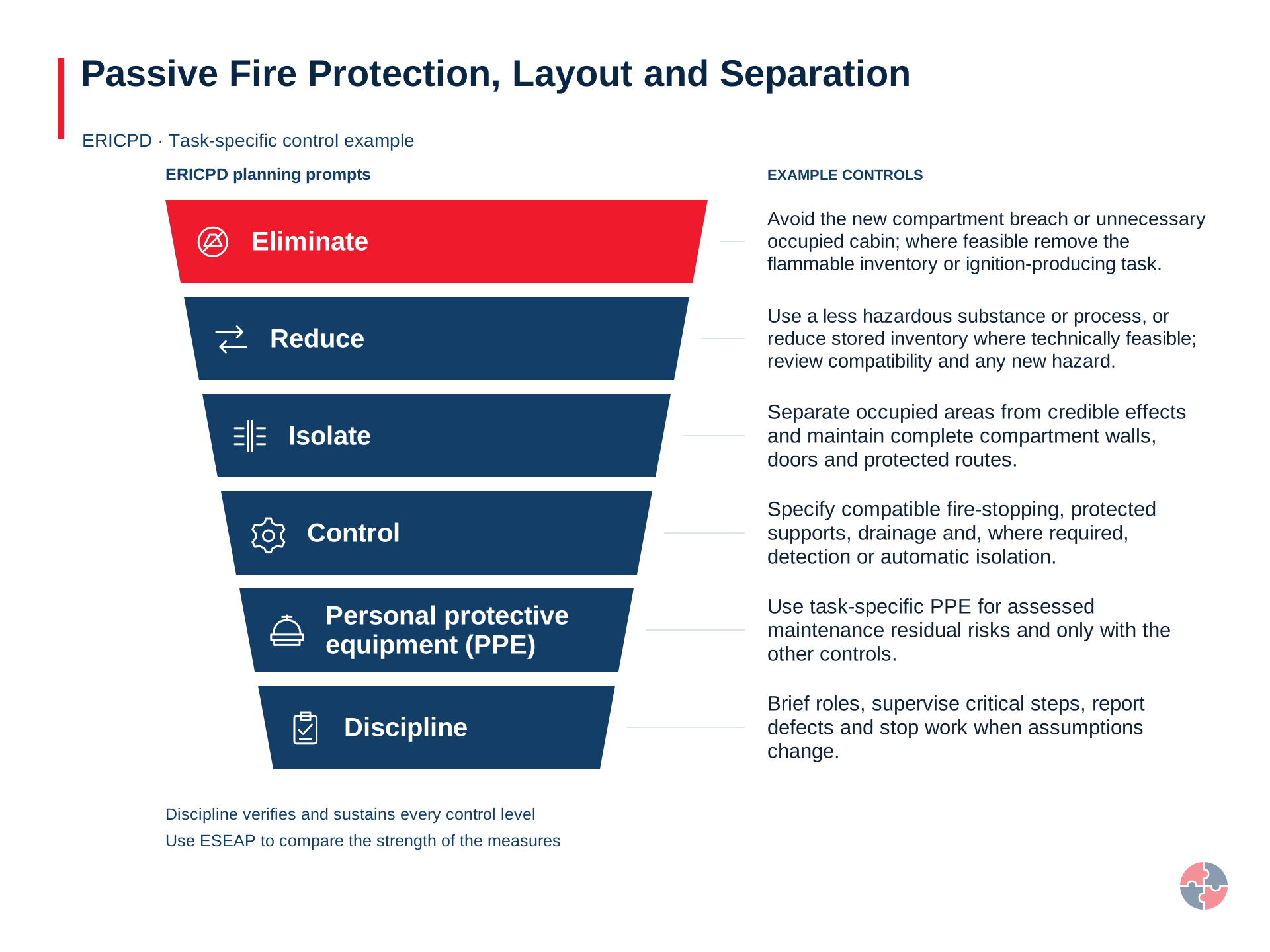
 Recognise the fuel. Read the extinguisher. Protect your escape.