Full public teaching and readers are free without an account. A free learner account is required for saved LMS progress and recorded assessment. Completion and any course-completion certificate depend on the configured LMS conditions. Full course outline and access routes.
Lesson 1
A refused load must not trap the attendant
Plan safe public contact, assistance and withdrawal when a visitor becomes threatening.
The worker locates the lower back; the separate side view enlarges its bones, discs, nerve roots and nearby muscle.
Locate the lower back. How could the load, reach, route, equipment or work pattern be changed for the task in this lesson?
educational illustration · healthy anatomy; enlarged details and teaching colours.
Photorealistic illustrative UK workplace scene. Review checks: Setting: Resolve bookings and entry at an evening leisure-centre reception with a growing queue. Act: Confirm peak cover, waiting information, access control, safe staff route and emergency roles. Hold / review: Pause service, withdraw to staff space and call 999 if violence is happening or danger is immediate.
A refused load must not trap the attendant
A recycling attendant can face threats when explaining that a load cannot be accepted. The trigger is predictable, so the work arrangement should anticipate it. Clear acceptance information before arrival, a consistent refusal process, appropriate staffing and access to support can reduce the conflict. Customer-service skills help, but they cannot guarantee that another person will remain safe or reasonable.
In the model, a visitor threatens an attendant after waste is refused. Maintain a safe position, use the site assistance and withdrawal arrangements and avoid being trapped between the person, vehicle or container. Do not follow the visitor into an isolated part of the yard to continue the argument. Where immediate danger requires emergency help, follow the site's emergency arrangements and contact the appropriate services.
The team needs an agreed communication method and a response that actually arrives. Check alarms or radios through the approved routine and know where to withdraw. Design the enquiry space so the worker has a safe exit and can maintain separation. A lone worker with a radio that nobody monitors does not have an effective assistance system, even if the equipment switches on.
After the immediate danger is controlled, support the affected people, obtain appropriate care and preserve relevant facts through the incident process. Record behaviour and circumstances accurately without making a diagnosis or circulating unnecessary personal details. Review whether the refusal arrangement, queue, signage, staffing or response contributed. Requiring workers simply to tolerate threats can suppress reporting and leave the same exposure in place.
For practice, make a fictional refusal briefing: accepted boundary, calm explanation, safe position, assistance trigger and withdrawal route. Add a failed-radio card and decide what must change before contact continues. Do not practise physical restraint or pursue a real visitor. The useful outcome is a service arrangement that protects staff and the public while a waste decision remains consistent with the site's authorised acceptance requirements.
When should a worker withdraw or call emergency services?
Withdraw to an agreed safe place whenever the worker feels unsafe, controls fail or violence may occur; call 999 when a crime is in progress or someone is in immediate danger, and use online reporting or 101 for non-emergencies.
Do not block or confront the aggressor, pursue them, resist a robbery, recover cash or property, enforce a ban or collect footage while danger continues. Life comes before property and evidence. Withdraw immediately when unsafe; no worker needs permission or a failed de-escalation attempt before leaving. Use a duress alarm only if it can be activated safely. If leaving is impossible, follow the local shelter or lockdown plan and provide location and threat information to emergency services when safe. NI uses NI police 999 for emergencies and 101 or online routes for non-emergencies. Local emergency plans must define responders, safe areas and accessibility. See GOV.UK Contact the police.
Any specialist security or physical-intervention duty must be separately authorised under applicable law, a task-specific risk assessment, defined duties, demonstrated competence and a specific approved procedure. This page does not authorise restraint, confrontation, pursuit, property recovery or physical intervention.
Trigger
Immediate action
Attack, credible imminent threat, weapon or immediate danger
What staffing and communication arrangements are needed?
Staffing must match the foreseeable event and response, with clear roles, rapid help, handover of material risk information and no pressure to continue unsafe contact alone.
Set who leads, who calls emergency services, who supports other people, who meets responders and who preserves records. Cover breaks, arrivals, closures, remote areas, temporary and agency staff, language or communication needs and likely responder travel time. A second person who is untrained, unavailable or unable to intervene safely is not an effective two-person control. Test radios, coded messages and handovers in realistic noise and coverage conditions.
An attendant is threatened beside a container, with the visitor blocking the usual route back to the office.
Decision and explanation
Withdrawing by the safe available route and using the site assistance/emergency arrangements.
Personal safety and effective assistance come first. De-escalation is not a guarantee and does not justify remaining trapped or pursuing the person.
Lesson 2
A lower container changes the fall consequence
Assess unloading edges and maintain effective barriers without transferring risk to visitors.
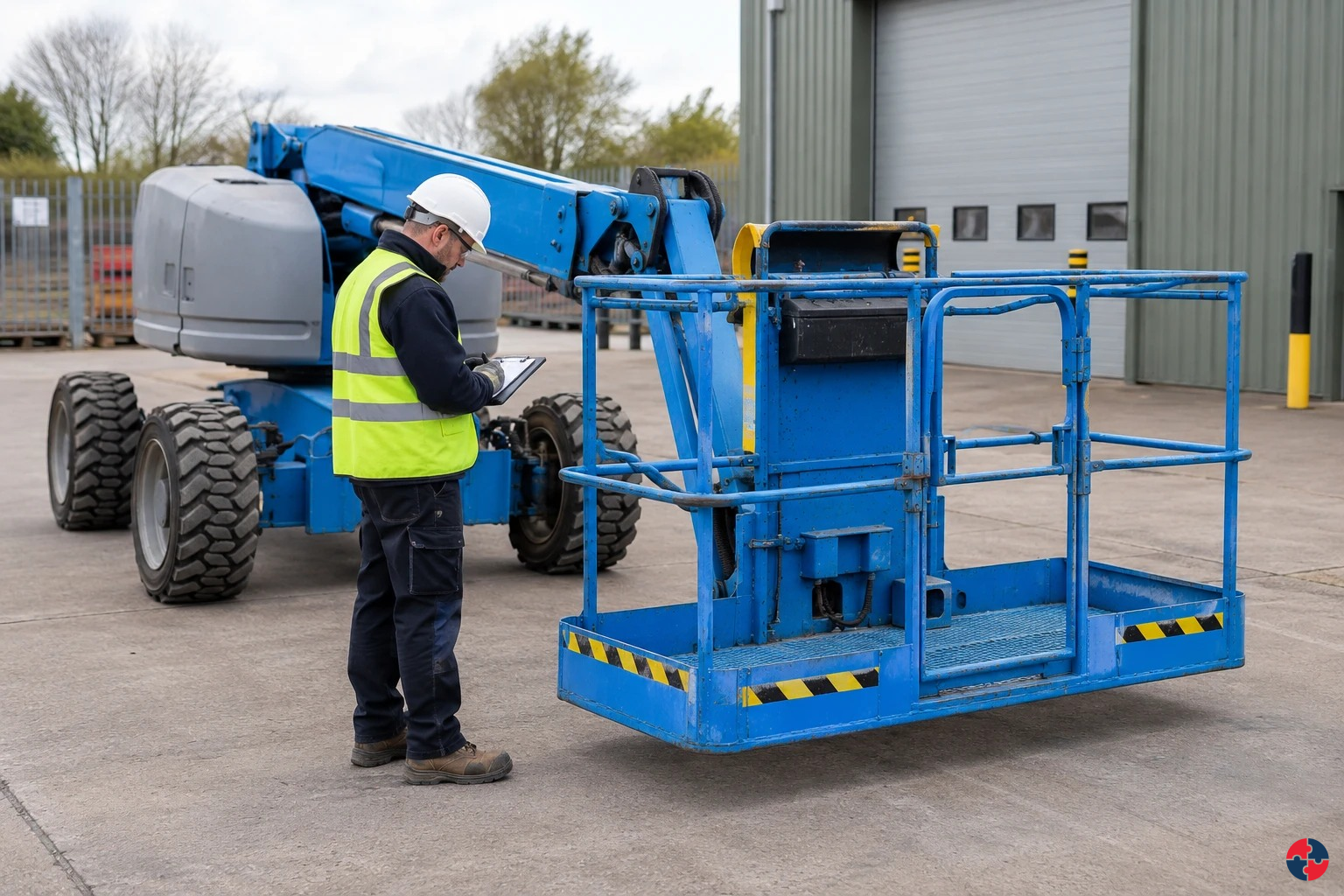
Photorealistic illustrative UK workplace scene. Review checks: Setting: Inspect ageing rooflights without stepping on a suspect roof. Act: Review fragility and whether an internal or MEWP method can reach the task; exclude people below. Hold / review: Hold if roof strength, route or protection is uncertain or wind exceeds the equipment limit.
A lower container changes the fall consequence
An unloading platform can place a person beside an edge with a substantial drop into a container. The visitor may be handling a bulky object, concentrating on the opening or using a route for the first time. The arrangement must make the intended disposal possible without an uncontrolled lean or climb. A warning does not physically prevent a person falling through a damaged barrier.
The model shows someone leaning over a defective barrier above a deep skip. Close the affected unloading position and prevent access while suitable protection and the unloading method are assessed. Consider whether people can still approach from another side or move into the closed bay while trying to reach a neighbouring container. An isolated cone may fail to control the actual approach.
The competent site assessment should consider edge protection, openings, container position, load handling and the people using the bay. Different items and user needs can change the task. Do not invent a universal barrier design or assume that a height threshold makes a fall harmless. If material cannot be deposited safely within the intended arrangement, provide an assessed alternative rather than instructing the visitor to stretch further.
Maintenance and container exchanges can alter the protection. A barrier removed for operational access must remain under controlled closure until restored and verified. Inspect its relevant condition and attachments through the suitable competent arrangement. A repaired-looking panel or a contractor's departure does not by itself establish that the entire bay is ready to reopen for public unloading.
For practice, mark the edge, approach, unloading action and possible fall path on the scene. Compare a closed bay with an alternative method that avoids the exposed edge. State what evidence the responsible person needs before reopening and how arrivals are directed meanwhile. Keep the public out of the repair area and do not ask a learner to test the barrier by leaning on it. A usable safe alternative is part of effective closure.
How does the work lead to harm?
A person may step through a rooflight, fall from an unprotected edge or opening, slip from unsuitable access equipment, or be struck by an object dropped from above. Distance, landing surface and obstruction affect injury, but a short fall can still be severe. Deterioration, weather and changed routes can defeat yesterday’s plan; identify the fall path and everyone below before selecting equipment.
Identify the source, route to the person, early signal, strongest practicable control and stop decision. Test that decision in real work and after change.
How does the work lead to harm? decision table
Exposure
Harm route
Control and hold point
Fragile rooflight or sheet
The surface gives way and a person falls through into the space below.
Treat as fragile until a competent check proves otherwise; use protected access and exclusion.
Edge, opening or ladder
A slip or overreach leads to a fall onto a hard or obstructed landing.
Work from ground where possible; otherwise use a suitable guarded platform and stop if edge or access control fails.
Dropped tool or material
A person below is struck even though the worker above remains protected.
Prevent falling objects, segregate the drop zone and stop when exclusion cannot be maintained.
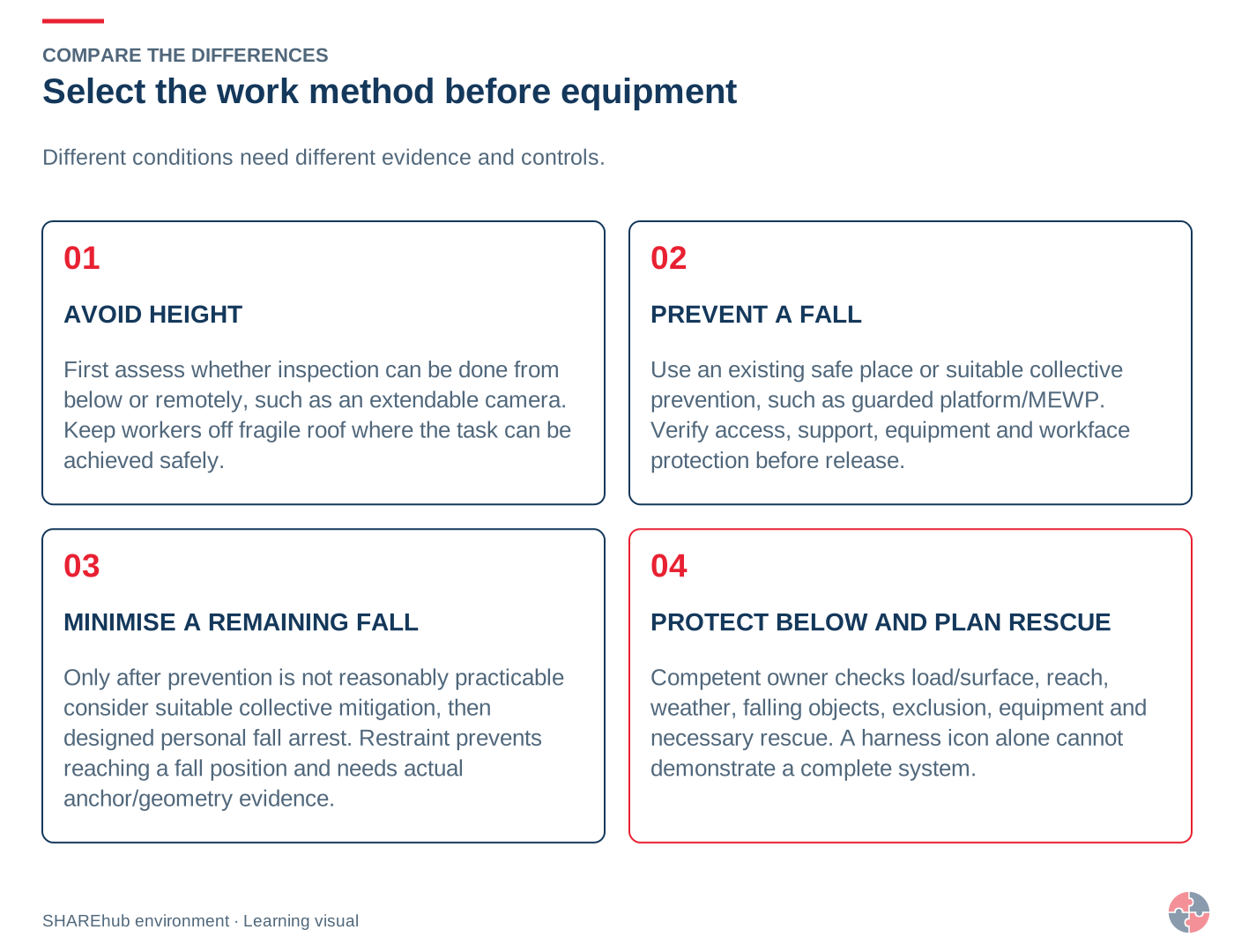
First avoid work at height where reasonably practicable. If it remains, prevent falls using a safe existing place or suitable equipment. Only then minimise the distance and consequences of a remaining fall.
At each level, consider collective protection before personal protection. A short lanyard configured as restraint prevents reaching an edge; fall arrest permits a fall and needs verified clearance and rescue. Neither makes an unsafe roof sound.
Order
Example
Decision test
Avoid
Inspect a roof from below or use extendable tools.
Can the task be done safely without going up?
Prevent, collective
Guarded scaffold, tower or suitable MEWP.
Can everyone at risk be protected without an individual action?
Prevent, personal
Verified work-restraint system.
Is the person unable to reach a fall position?
Minimise, collective
Safety net close below the work.
Is competent installation and inspection possible?
Minimise, personal
Designed fall-arrest system.
Are anchor, compatibility, clearance and timely rescue verified?
A barrier is removed for repair, and visitors can still approach the open edge from the neighbouring bay.
Decision and explanation
The closure does not prevent access to the actual fall hazard.
Effective closure covers the real approach routes until suitable protection and safe unloading are restored and verified.
Lesson 3
The awkward household item needs a different plan
Avoid hazardous manual handling and assess load, access and assistance without a generic weight rule.
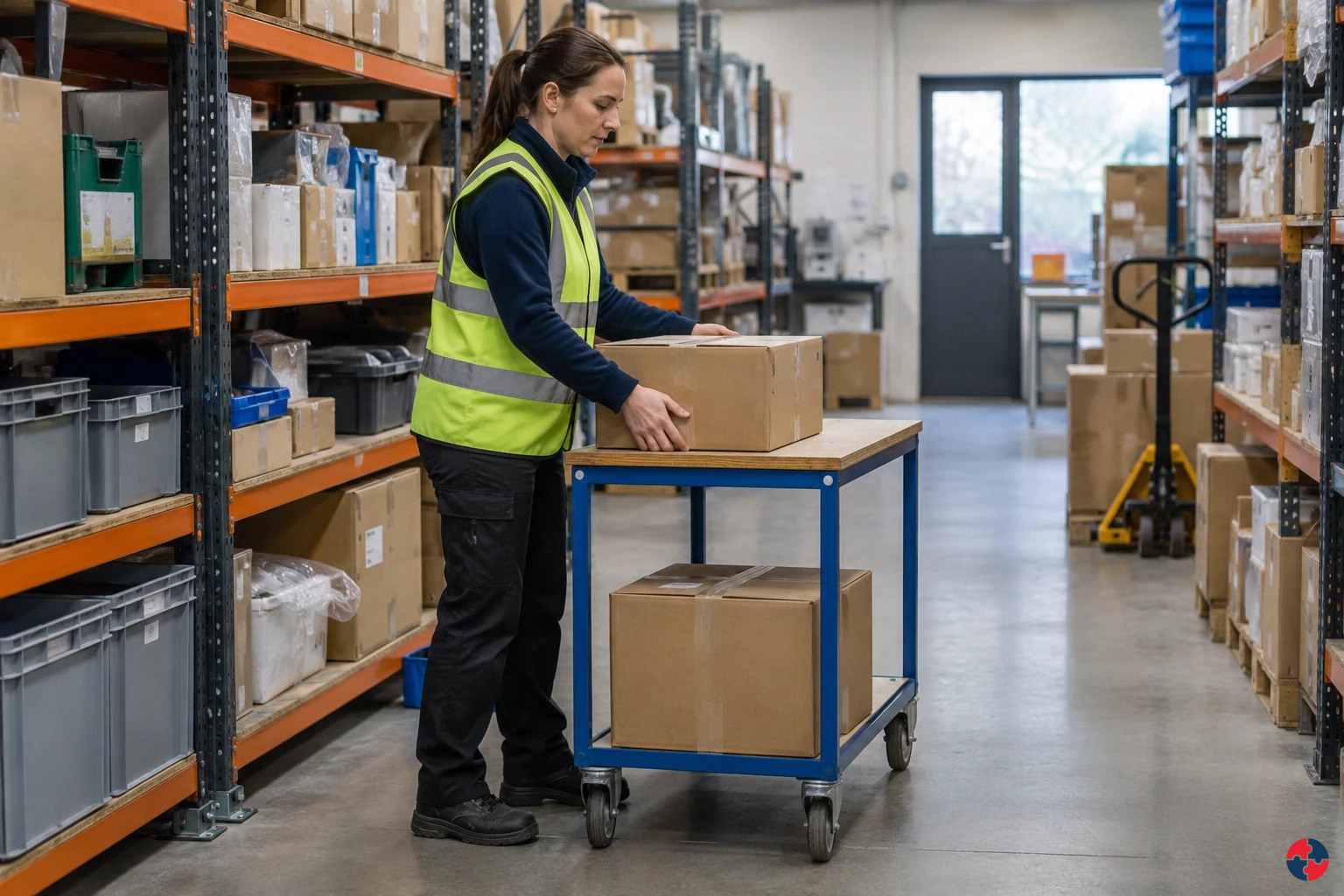
Photorealistic illustrative UK workplace scene. Review checks: Find: Heavy boxes are picked from the floor and twisted into a cage. Change: Raise the pick position, reorient the cage and repair the threshold. Verify: Maintain cage wheels and observe handling during a realistic peak.
The awkward household item needs a different plan
Household waste can be heavier, less stable or harder to grip than its familiar appearance suggests. A waterlogged sofa may sag, shift or release liquid; a high vehicle boot can force awkward reach and sudden lowering. The risk involves the complete handling task, individual capability, load and environment. A remembered weight limit cannot decide whether this particular movement is suitable.
The model shows two visitors struggling to unload a wet sofa. Stop the uncontrolled attempt and establish an assessed assistance option. Do not assume that adding an attendant or shouting a lifting cue makes the task acceptable. First consider avoiding the hazardous manual lift through a suitable handling aid, different access or another planned arrangement. Any mechanical aid introduces its own vehicle, crush and stability risks.
Where manual handling remains necessary, the competent assessment considers the load's shape, centre of gravity, grip, uncertainty and movement, the space and route, frequency and the people involved. Team handling requires coordination and does not divide every risk evenly. Nobody should stand beneath an unstable item or between it and a vehicle while improvising the next move.
The site needs a clear boundary for what staff can assist with, appropriate equipment and a route for cases outside that arrangement. Communicate it early so visitors do not begin a difficult lift while waiting for help. If the item is damaged or its contents uncertain, use the appropriate waste acceptance and handling process rather than opening or dismantling it as a shortcut.
For practice, compare a direct lift, an assessed aid and a changed unloading position using the fictional information. Name the uncertainty each option removes and any new exposure it creates. Document a short task brief with the selected method, people clear, communication and stop trigger. Keep the exercise separate from real handling authorisation. A useful result can be refusing to continue the improvised lift until suitable assistance is available.
How should manual handling be assessed?
Assessment should observe the real task, identify risk factors and choose controls that reduce force, posture, frequency, distance and uncertainty.
A good assessment watches the task happen. It measures or estimates load weight, height, reach, distance, frequency, route, floor condition, team communication and use of aids. It asks workers what actually makes the job difficult, not just what the procedure says. Sources: HSE L23 Manual handling guidance on regulations; HSE manual handling at work
For structured assessment, HSE's Manual Handling Assessment Charts (MAC) support lifting, carrying and team handling. The Risk Assessment of Pushing and Pulling (RAPP) tool supports pushing and pulling. The Assessment of Repetitive Tasks (ART) tool supports repetitive upper-limb tasks. These tools help prioritise risk, but they do not replace judgement or the hierarchy of avoiding and reducing the task. Sources: HSE L23 Manual handling guidance on regulations; HSE manual handling at work
Question
Assessment prompt
Output
Can the handling be avoided?
Can delivery, storage, automation or process flow remove manual movement?
Training supports safe work, but it does not make a poor task design safe.
Manual-handling training often fails when it is used as the main control. Workers may know good technique but still face heavy loads, poor reach, high repetition, slippery floors, damaged trolleys, rushed work, awkward loads or no handling aids. In those conditions, technique cannot remove the risk. Sources: HSE manual handling at work; HSE making the best use of lifting and handling aids
A strong control plan changes the task first: remove handling, reduce load, improve route, improve height, provide aids, maintain aids, reduce frequency, improve grip and plan recovery. Training then explains how to use those controls properly. Sources: HSE manual handling at work; HSE making the best use of lifting and handling aids
Two visitors cannot control the wet sofa as it tips from a high boot. An attendant proposes joining the same uncontrolled lift.
Decision and explanation
Stop the attempt and establish an assessed unloading/assistance method that avoids or reduces the exposure.
More hands do not establish a suitable task. Assess the real load, people and route, prioritising avoidance and appropriate aids.
Use the appropriate manual handling assessment
This additional teaching takes about 2–5 minutes, in addition to the course estimate. Optional reading and workplace assessment take additional time.
Start by asking whether the hazardous handling can be removed or redesigned. Where handling remains, observe the whole operation with the people who do it and choose an assessment that fits the work.
These aids support the activity assessment. Repetitive upper-limb work may need ART; variable or complex tasks may need other HSE tools or a fuller competent assessment. Mechanical lifting, stored energy, equipment safety and health decisions retain their separate controls. A low factor score, a downloaded report or completion of this course does not approve the work.
TILEO: Task, Individual, Load, Environment and Other factors. MAC: Manual Handling Assessment Charts for appropriate lifting, carrying and team handling. RAPP: Risk Assessment of Pushing and Pulling for appropriate manual pushing and pulling.
Read the portable guide to understand selection, limitations, the mixed-task example and company-branded Word/PDF records. Your existing course checks and completion requirements remain separate.
Escaped glass needs controlled removal, not bare-hand sorting
Recognise cuts and secondary exposure at a public disposal opening.
Teaching graphic from the linked SHAREhub source section.
Escaped glass needs controlled removal, not bare-hand sorting
Glass can escape a container or collect on an unloading rim where a person naturally rests a hand. Fragments may be difficult to see, and a falling bottle or attempted clearance can create further breakage. Assess the opening, approach and removal task together. A disposal bay that is acceptable when intact can become unsafe before the container itself is full.
In the model, broken glass lies across the rim. Restrict the affected position and keep visitors away while trained staff apply the suitable removal method. Do not ask a visitor to pick out the larger pieces or use a hand to check whether the edge feels clear. Gloves can be part of the assessed protection, but they do not make uncontrolled handling of sharp fragments safe.
The removal arrangement should provide suitable tools, containment and personal protection for the actual task, with safe access and disposal. Prevent other people approaching from an adjacent opening and consider whether the activity could project fragments or disturb an unstable container. If the work cannot be performed safely within the normal method, maintain closure and obtain the competent assistance required.
Investigate why the material escaped. Container condition, fill state, opening design, item handling and servicing can all matter. Clearing the visible debris without correcting a damaged rim may recreate the same exposure immediately. Conversely, one local fragment does not prove that every glass container on the site is defective. Identify the actual scope and verify the relevant surfaces and approach before reopening.
For the exercise, choose between evidence cards: a safe removal plan, a photograph from a distance, a container-defect record and a completed reopening check. Explain the role of each and what remains unknown. Write a fictional public redirection instruction that avoids sending visitors across commercial traffic. The learning outcome is controlled hazard removal and restoration, not a live instruction to handle glass, improvise PPE or perform first aid beyond your training.
When should manual handling stop or escalate?
Stop or escalate when the load, route, frequency, posture, handling aid, environment or worker capability makes injury likely.
Workers and supervisors should not wait for injury. Stop points should include unknown weight, unstable load, blocked route, damaged trolley, inadequate staffing for team handling, pain or discomfort, poor lighting, slippery floor, fatigue or a task that cannot be done as assessed. Sources: HSE manual handling at work; HSENI manual handling
Escalation should lead to redesign, equipment, staffing, changed delivery, competent assessment or occupational health support where individual restrictions are involved. Sources: HSE manual handling at work; HSENI manual handling
Machine risk includes harmful emissions and the surrounding workplace, not only contact with moving parts. Control each exposure by its own assessment and source-specific measures.
Check noise at the real duty cycle, hand-arm or whole-body vibration where relevant, airborne dust and fumes, hot or cold surfaces, electricity, manual handling, access and slips around the installation. Extraction, enclosure, quiet or low-vibration equipment, maintenance, suitable electrical protection and task redesign may be required. Personal protective equipment (PPE) can address residual exposure but cannot substitute for guarding dangerous parts.
The material matters: wood dust, metal swarf, aerosols, abrasive fragments, waste and packaging create different health, fire and ejection risks. Identify any specialist regime, such as lifting, pressure or electrical safety, rather than applying generic machinery advice to it. HSE Introduction to machinery safety is the starting route; use the relevant specialist HSE guidance for the identified substance or equipment.
Check exposure before harm appears
Absence of visible dust, symptoms or loudness complaints does not prove adequate control. Report damaged extraction, poor capture or changed work to the supervisor; a competent assessor checks extraction performance and exposure, with confidential occupational-health referral where indicated. Do not wait for illness. See HSE: wood dust.
Applied case
Visible glass is removed, but the container rim is damaged and can release more fragments into the hand-rest area.
Decision and explanation
Correction/assessment of the cause and verification of a safe opening and approach.
Debris removal and restoration of the source condition are connected. Queue pressure cannot establish a safe public-use surface.
Lesson 5
Secure the load without climbing an unstable platform
Avoid falls while planning restraint and dispatch access.
Teaching graphic from the linked SHAREhub source section.
Secure the load without climbing an unstable platform
Load security is necessary, but the task of applying restraints must also be safe. A bale load, appliance or trailer side is not automatically a suitable work platform. A person can fall, lose balance as the load shifts or become trapped while reaching for a restraint. Start the loading plan with how the work can be completed from a safe position, rather than solving access after the load is stacked.
The model shows a driver climbing an unstable bale load to attach restraints. Hold the task and establish the suitable access and loading method through the responsible controller. Do not encourage another worker to steady the driver from below. Consider whether the load or securing arrangement can be designed and prepared to avoid climbing, using suitable equipment and safe access where needed.
The actual load, vehicle, restraint system and handling equipment determine the required method. Competent people must establish stability, compatibility and the evidence needed for secure dispatch. This course does not supply a universal number of straps, stack pattern or climbing rule for every vehicle. Use the manufacturer, loading plan and applicable load-security guidance for the operation.
Coordinate loading and access so people are not present where plant, bales or restraints can move unexpectedly. A driver retrieving a strap can become invisible to the lift-truck operator. Define safe waiting and communication and verify clearance before the next movement. If conditions change, such as a damaged binding or shifted load, pause and reassess rather than pulling harder to make the planned restraint fit.
For practice, map the restraint task from preparation to final release. Remove avoidable work at height and identify any remaining access that needs suitable planning. Add a damaged-load card and explain why the original plan no longer demonstrates readiness. Record a fictional hold and the decision owner without signing a real vehicle release. A safe outcome protects the person applying restraints as well as people later exposed to the transported load.
How do you apply avoid, prevent, minimise?
First avoid work at height where reasonably practicable. If it remains, prevent falls using a safe existing place or suitable equipment. Only then minimise the distance and consequences of a remaining fall.
At each level, consider collective protection before personal protection. A short lanyard configured as restraint prevents reaching an edge; fall arrest permits a fall and needs verified clearance and rescue. Neither makes an unsafe roof sound.
Order
Example
Decision test
Avoid
Inspect a roof from below or use extendable tools.
Can the task be done safely without going up?
Prevent, collective
Guarded scaffold, tower or suitable MEWP.
Can everyone at risk be protected without an individual action?
Prevent, personal
Verified work-restraint system.
Is the person unable to reach a fall position?
Minimise, collective
Safety net close below the work.
Is competent installation and inspection possible?
Minimise, personal
Designed fall-arrest system.
Are anchor, compatibility, clearance and timely rescue verified?
Remove the need to climb onto the vehicle where practicable; otherwise provide safe access and a task-specific method.
Ground-level gauges, automatic sheeting and suitable handling equipment can remove routine access. If access is unavoidable, assess platform, steps, handholds, edge protection, footwear, weather and three-point contact where applicable. Do not use a generic height threshold to decide whether a fall matters. Loading and maintenance tasks can create different access needs.
The driver cannot reach a restraint without standing on a shifting bale load.
Decision and explanation
Avoid the hazardous climb and establish suitable loading, restraint and access arrangements.
Securing the load and safe access must be planned together. A stronger restraint does not protect the person climbing to fit it.
Lesson 6
Keep heavy appliances stable and people outside the storage task
Recognise unstable support and plan controlled WEEE handling without assuming ordinary household familiarity.
Photorealistic illustrative UK workplace scene. Review checks: Find: Heavy boxes are picked from the floor and twisted into a cage. Change: Raise the pick position, reorient the cage and repair the threshold. Verify: Maintain cage wheels and observe handling during a realistic peak.
Keep heavy appliances stable and people outside the storage task
A refrigerator or other heavy appliance can topple when stored on damaged support or disturbed during unloading. Its shape and familiar domestic purpose do not make it easy to handle. The centre of gravity, damaged feet, doors and uneven pallets can create an unstable arrangement. Consider the people approaching the bay as well as staff moving the item later.
The model shows a refrigerator leaning on damaged pallets beside the WEEE area. Restrict access to the potential fall space and obtain suitable trained handling assistance. Do not ask a visitor to hold it upright while another person replaces the pallet. A hand placed under a leaning load can become trapped before anyone has time to respond, and pulling at an open door can worsen instability.
Use the site's approved intact-appliance storage and handling arrangement. Suitable support, handling equipment, load compatibility and an accessible stable location matter. Keep public unloading outside the controlled storage operation. Where a unit is damaged or its contents uncertain, use the appropriate acceptance and specialist route; do not puncture, open a circuit or dismantle the appliance as part of this awareness exercise.
A stable individual item can become unstable when adjacent stock is added, struck or removed. Inspect the actual arrangement through the defined system and act on defects. Keep routes clear so staff do not have to squeeze between leaning appliances. A generic pallet check in another area does not demonstrate that the supports beneath this item remain sound.
For practice, compare the observed lean, a storage-method record and a statement that the appliance is probably empty. Decide which evidence addresses the task and which assumption needs challenge. Plan the controlled correction with people clear, appropriate equipment and a named competent owner. Verify stability and restored access before reopening. The course supports recognising the hazard and selecting the escalation boundary; it does not authorise lifting equipment use or refrigerant recovery.
How should manual handling be assessed?
Assessment should observe the real task, identify risk factors and choose controls that reduce force, posture, frequency, distance and uncertainty.
A good assessment watches the task happen. It measures or estimates load weight, height, reach, distance, frequency, route, floor condition, team communication and use of aids. It asks workers what actually makes the job difficult, not just what the procedure says. Sources: HSE L23 Manual handling guidance on regulations; HSE manual handling at work
For structured assessment, HSE's Manual Handling Assessment Charts (MAC) support lifting, carrying and team handling. The Risk Assessment of Pushing and Pulling (RAPP) tool supports pushing and pulling. The Assessment of Repetitive Tasks (ART) tool supports repetitive upper-limb tasks. These tools help prioritise risk, but they do not replace judgement or the hierarchy of avoiding and reducing the task. Sources: HSE L23 Manual handling guidance on regulations; HSE manual handling at work
Question
Assessment prompt
Output
Can the handling be avoided?
Can delivery, storage, automation or process flow remove manual movement?
Coordinate host, haulier and driver before arrival; use a suitable loading area, keep uninvolved people clear and prevent premature vehicle movement.
Check the ground and vehicle stability, access, trailer or deck condition, load shift, safe equipment, load restraint and who is in charge. Agree where the driver waits and how the vehicle is immobilised or released. Avoid working at height where the task can be done from ground level. A load may have shifted in transit; do not open doors or restraints into its path. Use an interlock or robust operating system where early drive-off is credible.
Phase
Decision
Arrival
Vehicle and bay fit; people know the host rules. Source: HSE
Before handling
Vehicle secured, load stable and area controlled. Source: HSE
During
Maintain communication and keep pedestrian access closed. Source: HSE
Release
Secure load, account for people and equipment, then authorise departure. Source: HSE
Illustrative example: the driver receives a departure signal while loading equipment still bridges the vehicle and dock. The host holds departure and tells driver and loader that release is cancelled. The named loading lead verifies people and equipment clear, the agreed restraint/interlock or operating-system state, and load security, then issues one unambiguous release through the agreed communication method. Conflicting signals or an unverified state keep the vehicle held. Select the site-specific system; this does not prescribe universal wheel chocks or key retention.
Applied case
An appliance leans on damaged pallets beside a public route; a visitor offers to hold it while staff change the support.
Decision and explanation
Exclude the danger area and arrange suitable controlled handling and stable storage.
People must not serve as temporary supports. Use a planned competent correction with appropriate equipment and keep public access outside the storage task.
Lesson 7
Aggression over refused waste
Safety and support take priority; granting uncontrolled access can extend the danger to other workers.
Photorealistic illustrative UK workplace scene. Review checks: Setting: Resolve bookings and entry at an evening leisure-centre reception with a growing queue. Act: Confirm peak cover, waiting information, access control, safe staff route and emergency roles. Hold / review: Pause service, withdraw to staff space and call 999 if violence is happening or danger is immediate.
Understand the activity and how harm develops
An attendant refuses a load and the visitor becomes threatening. Refusal is a predictable part of waste reception, so violence prevention belongs in site planning. Physical assault, threats and repeated abuse can affect sleep, confidence and mental health. Staff should not have to trade their safety against keeping the queue moving.
Look at the arrangement around the conversation: distance, escape, barriers, communication and access to colleagues. Clear information before arrival can reduce disputes, but it cannot guarantee reasonable behaviour. A reliable assistance signal, permission to withdraw and supportive reporting give workers practical options. Review repeated incidents for staffing, policy and workload causes instead of treating resilience training as the main control.
Recognise the evidence boundary
Question
Case evidence
What is observed?
A visitor threatens an attendant after a load is refused.
How can harm occur?
The attendant could suffer assault or psychological harm.
What information is needed?
Ask about refusal procedures, available support and escape to safety.
Protect, manage and verify
Purpose
Practical application
Immediate protection
Use the site de-escalation and assistance procedure from a protected position.
Accountable work arrangement
Reduce avoidable conflict through clear acceptance rules, accessible information and a workable complaints route. Provide a protected communication position, escape route and tested means of summoning assistance. Withdraw from threats, obtain trained support and follow the emergency procedure for immediate danger.
Release verification
Confirm staff can summon support and the incident receives follow-up.
Apply this at work
At the next inspection, look for the same failure pathway beyond gatehouse support. Test the assistance call, check lone-working cover and review staff support after incidents. Recheck after changes in waste, staffing, weather, equipment or layout.
When should a worker withdraw or call emergency services?
Withdraw to an agreed safe place whenever the worker feels unsafe, controls fail or violence may occur; call 999 when a crime is in progress or someone is in immediate danger, and use online reporting or 101 for non-emergencies.
Do not block or confront the aggressor, pursue them, resist a robbery, recover cash or property, enforce a ban or collect footage while danger continues. Life comes before property and evidence. Withdraw immediately when unsafe; no worker needs permission or a failed de-escalation attempt before leaving. Use a duress alarm only if it can be activated safely. If leaving is impossible, follow the local shelter or lockdown plan and provide location and threat information to emergency services when safe. NI uses NI police 999 for emergencies and 101 or online routes for non-emergencies. Local emergency plans must define responders, safe areas and accessibility. See GOV.UK Contact the police.
Any specialist security or physical-intervention duty must be separately authorised under applicable law, a task-specific risk assessment, defined duties, demonstrated competence and a specific approved procedure. This page does not authorise restraint, confrontation, pursuit, property recovery or physical intervention.
Trigger
Immediate action
Attack, credible imminent threat, weapon or immediate danger
A visitor threatens an attendant after a load is refused. The following options are fictional decisions for this inspection point.
Decision and explanation
Withdraw to safety and summon support through the site procedure.
Continuing an argument can escalate a threat and delay withdrawal; winning the dispute is not the safety priority. Giving a threatening visitor staff-yard access creates further exposure and weakens the site boundary. Safety and support take priority; granting uncontrolled access can extend the danger to other workers. Verify the arrangement before work resumes.
Lesson 8
Fall into a lower-level container
Waste contents and improvised objects do not provide dependable fall protection.
Teaching graphic from the linked SHAREhub source section.
Understand the activity and how harm develops
Public unloading takes place above a lower-level container. The rim can disguise a substantial drop, particularly when waste partly fills the skip. A damaged barrier changes the safe bay into an exposed edge; leaning farther to drop an item can shift a visitor’s centre of balance beyond their feet.
Design unloading so people can deposit accepted items without climbing, standing on a bumper or leaning over an opening. Consider shorter visitors, children and people carrying awkward loads. The barrier and container arrangement must remain suitable throughout filling and container exchange. Staff observation supports the protection, but an instruction to be careful cannot substitute for a sound physical edge.
Recognise the evidence boundary
Question
Case evidence
What is observed?
A visitor leans over a damaged barrier above a deep skip.
How can harm occur?
A fall could cause serious impact injury inside the container.
What information is needed?
Check barrier integrity and public unloading arrangements.
Protect, manage and verify
Purpose
Practical application
Immediate protection
Close the affected bay and restore suitable fall protection.
Accountable work arrangement
Avoid exposed-edge unloading by using a suitable bay and container arrangement. Maintain effective edge protection compatible with safe depositing and container exchange. Close a defective bay immediately and redirect visitors to a suitable alternative.
Release verification
Confirm safe unloading and effective barriers before reopening.
Apply this at work
At the next inspection, look for the same failure pathway beyond bay edge. Inspect the whole edge and test the intended unloading task before authorised reopening. Recheck after changes in waste, staffing, weather, equipment or layout.
How do you apply avoid, prevent, minimise?
First avoid work at height where reasonably practicable. If it remains, prevent falls using a safe existing place or suitable equipment. Only then minimise the distance and consequences of a remaining fall.
At each level, consider collective protection before personal protection. A short lanyard configured as restraint prevents reaching an edge; fall arrest permits a fall and needs verified clearance and rescue. Neither makes an unsafe roof sound.
Order
Example
Decision test
Avoid
Inspect a roof from below or use extendable tools.
Can the task be done safely without going up?
Prevent, collective
Guarded scaffold, tower or suitable MEWP.
Can everyone at risk be protected without an individual action?
Prevent, personal
Verified work-restraint system.
Is the person unable to reach a fall position?
Minimise, collective
Safety net close below the work.
Is competent installation and inspection possible?
Minimise, personal
Designed fall-arrest system.
Are anchor, compatibility, clearance and timely rescue verified?
A visitor leans over a damaged barrier above a deep skip. The following options are fictional decisions for this inspection point.
Decision and explanation
Close it and restore suitable edge protection before reopening.
Waste contents and improvised objects do not provide dependable fall protection. Verify the arrangement before work resumes. An attendant’s reminder cannot physically stop a fall, especially while the visitor is controlling an awkward load. Loose timber can move or fail and has not been designed or secured as edge protection.
Lesson 9
Heavy awkward household load
More hands do not remove poor access, load uncertainty or vehicle exposure.
Photorealistic illustrative UK workplace scene. Review checks: Find: Heavy boxes are picked from the floor and twisted into a cage. Change: Raise the pick position, reorient the cage and repair the threshold. Verify: Maintain cage wheels and observe handling during a realistic peak.
Understand the activity and how harm develops
A wet sofa is heavier and less predictable than it looks. A high boot lip, poor grip and uneven loading can force visitors to twist while supporting the weight. A sudden loss of grip can injure backs, trap hands or drop the object onto a foot. Two people lifting together can still be exposed to excessive force.
The first question is whether the lift can be avoided or redesigned. Agree the unloading method before the item moves, provide space and use suitable mechanical assistance operated by authorised staff where appropriate. Assess the task, person, load and environment together. A generic weight limit or a short lifting demonstration cannot establish that this particular awkward load is safe.
Recognise the evidence boundary
Question
Case evidence
What is observed?
Two visitors struggle to lift a waterlogged sofa from a high car boot.
How can harm occur?
An uncontrolled lift could strain backs or trap fingers and feet.
What information is needed?
Assess load, access and the safe assistance options available.
Protect, manage and verify
Purpose
Practical application
Immediate protection
Avoid hazardous lifting and provide assessed mechanical or planned assistance.
Accountable work arrangement
Avoid the manual lift by using an appropriate collection or mechanical unloading arrangement. Provide suitable handling aids and a stable unloading area separated from traffic. Plan assistance, grips and communication; stop if the load or access exceeds the assessed method.
Release verification
Confirm the revised unloading method and safe space before handling.
Apply this at work
At the next inspection, look for the same failure pathway beyond unloading. Check the actual aid, route and people involved rather than relying on a generic lifting limit. Recheck after changes in waste, staffing, weather, equipment or layout.
What is the difference between TILE, TILEO and TILEE?
TILE, TILEO and TILEE are practical prompts that help assess the whole handling situation rather than focusing only on load weight.
TILE is the core prompt: Task, Individual, Load and Environment. It reflects the main risk factors HSE expects employers to consider when assessing manual handling. TILEO adds Other factors, such as work organisation, time pressure, communication, PPE, fatigue, team handling, handling aids and recovery. TILEE is used by some organisations as a further extension; the final E should be defined in the organisation's standard, most usefully as Equipment, Ergonomics or Existing controls. Sources: HSE L23 Manual handling guidance on regulations; HSE manual handling at work
The important point is not which acronym is used, but whether the assessment identifies the real risk factors and produces better work design. A TILE/TILEO/TILEE assessment should lead to avoiding the handling where possible, reducing load and reach, improving equipment, changing routes and heights, reducing repetition, supporting individuals and reviewing the work after change. Sources: HSE L23 Manual handling guidance on regulations; HSE manual handling at work
Two visitors struggle to lift a waterlogged sofa from a high car boot. The following options are fictional decisions for this inspection point.
Decision and explanation
Stop the lift and arrange a suitable assessed unloading method.
Catching a heavy moving item from the road creates both handling and vehicle risks. More hands do not remove poor access, load uncertainty or vehicle exposure. Verify the arrangement before work resumes. Adding an unbriefed person can create uneven loading and confusion; it does not solve a poor method.
Lesson 10
Sharp fragments during glass disposal
An actual sharp contact surface needs removal or isolation; a sign does not make touching it safe.
Photorealistic illustrative UK workplace scene. Review checks: Find: Heavy boxes are picked from the floor and twisted into a cage. Change: Raise the pick position, reorient the cage and repair the threshold. Verify: Maintain cage wheels and observe handling during a realistic peak.
Understand the activity and how harm develops
Broken glass on a container rim puts sharp fragments at hand height. A visitor balancing a heavy box may naturally steady it on that surface, while dropping bottles can eject further fragments. Cuts, eye injury and secondary exposure through contaminated wounds are credible outcomes even where the container itself is sound.
Inspect the depositing opening and the approach as a single work area. Overfilling, damage and poor aperture design can allow fragments to accumulate repeatedly. Close the affected bay for trained cleaning with suitable tools; keep hands out of concealed deposits. PPE is selected for the assessed task and supports a method that avoids direct contact. Investigate why fragments escaped before simply repeating cleanup.
Recognise the evidence boundary
Question
Case evidence
What is observed?
Broken glass lies on the rim where visitors rest their hands.
How can harm occur?
Fragments could cut skin or injure eyes during disposal.
What information is needed?
Check container condition and the method for removing escaped glass.
Protect, manage and verify
Purpose
Practical application
Immediate protection
Restrict the bay while trained staff remove fragments using suitable tools.
Accountable work arrangement
Reduce escaped glass through suitable container design, fill management and careful depositing. Repair damaged apertures and maintain a sound rim and contained collection arrangement. Close the bay for tool-assisted cleanup by trained staff, with assessed hand and eye protection.
Release verification
Confirm the rim and approach are safe before public use.
Apply this at work
At the next inspection, look for the same failure pathway beyond glass container. Check the rim, ground and likely hand-contact points before restoring public access. Recheck after changes in waste, staffing, weather, equipment or layout.
What is the difference between TILE, TILEO and TILEE?
TILE, TILEO and TILEE are practical prompts that help assess the whole handling situation rather than focusing only on load weight.
TILE is the core prompt: Task, Individual, Load and Environment. It reflects the main risk factors HSE expects employers to consider when assessing manual handling. TILEO adds Other factors, such as work organisation, time pressure, communication, PPE, fatigue, team handling, handling aids and recovery. TILEE is used by some organisations as a further extension; the final E should be defined in the organisation's standard, most usefully as Equipment, Ergonomics or Existing controls. Sources: HSE L23 Manual handling guidance on regulations; HSE manual handling at work
The important point is not which acronym is used, but whether the assessment identifies the real risk factors and produces better work design. A TILE/TILEO/TILEE assessment should lead to avoiding the handling where possible, reducing load and reach, improving equipment, changing routes and heights, reducing repetition, supporting individuals and reviewing the work after change. Sources: HSE L23 Manual handling guidance on regulations; HSE manual handling at work
Broken glass lies on the rim where visitors rest their hands. The following options are fictional decisions for this inspection point.
Decision and explanation
Close the bay and arrange suitable tool-assisted removal and inspection.
Keeping the bay open leaves people exposed to the actual fragments despite the warning sign. An actual sharp contact surface needs removal or isolation; a sign does not make touching it safe. Verify the arrangement before work resumes. A hand inside a glove is still in the cut path; suitable tools and a controlled cleanup reduce contact.
Lesson 11
Fall while securing a dispatch load
A hard hat or improvised assistance does not prevent a fall from an unstable load.
Teaching graphic from the linked SHAREhub source section.
Understand the activity and how harm develops
Securing a despatch load can expose a driver to a fall if they climb on bales, tyres or vehicle sides. Bales may shift underfoot, and restraints or packaging can create trip and recoil hazards. Familiarity with the trailer does not turn the load into a safe working platform.
Plan loading and securing before the vehicle arrives. Prefer equipment and methods that allow the task from ground level; where access at height remains necessary, provide suitable assessed access and fall prevention. Coordinate loading with the driver so nobody is exposed to a lift truck or moving load during restraint work. The final vehicle release must address load security and safe completion of the securing task.
Recognise the evidence boundary
Question
Case evidence
What is observed?
A driver climbs onto an unstable bale load to attach restraints.
How can harm occur?
The driver could fall from the vehicle or be struck by a shifting bale.
What information is needed?
Check the loading plan and safer restraint-access options.
Protect, manage and verify
Purpose
Practical application
Immediate protection
Use a planned method that avoids climbing on the load.
Accountable work arrangement
Use a ground-level securing method where reasonably practicable. Provide suitable designed access and collective fall protection for unavoidable work above ground. Separate driver restraint work from loading movements and use a briefed loading plan.
Release verification
Confirm secure loading and safe access before vehicle release.
Apply this at work
At the next inspection, look for the same failure pathway beyond loading. Check load security, access equipment and the driver’s safe position before release. Recheck after changes in waste, staffing, weather, equipment or layout.
How do you apply avoid, prevent, minimise?
First avoid work at height where reasonably practicable. If it remains, prevent falls using a safe existing place or suitable equipment. Only then minimise the distance and consequences of a remaining fall.
At each level, consider collective protection before personal protection. A short lanyard configured as restraint prevents reaching an edge; fall arrest permits a fall and needs verified clearance and rescue. Neither makes an unsafe roof sound.
Order
Example
Decision test
Avoid
Inspect a roof from below or use extendable tools.
Can the task be done safely without going up?
Prevent, collective
Guarded scaffold, tower or suitable MEWP.
Can everyone at risk be protected without an individual action?
Prevent, personal
Verified work-restraint system.
Is the person unable to reach a fall position?
Minimise, collective
Safety net close below the work.
Is competent installation and inspection possible?
Minimise, personal
Designed fall-arrest system.
Are anchor, compatibility, clearance and timely rescue verified?
A driver climbs onto an unstable bale load to attach restraints. The following options are fictional decisions for this inspection point.
Decision and explanation
Stop the task and use a planned method with suitable access that avoids climbing on the load.
A hard hat may reduce some head impacts but cannot prevent the fall or load movement. A hard hat or improvised assistance does not prevent a fall from an unstable load. Verify the arrangement before work resumes. Holding an ankle is not fall prevention and can expose the helper to the same unstable load.
Lesson 12
Unstable heavy appliance storage
People must stay out of the fall zone, and this reception task does not authorise appliance treatment.
Photorealistic illustrative UK workplace scene. Review checks: Find: Heavy boxes are picked from the floor and twisted into a cage. Change: Raise the pick position, reorient the cage and repair the threshold. Verify: Maintain cage wheels and observe handling during a realistic peak.
Understand the activity and how harm develops
A refrigerator on damaged pallets can topple as someone passes or as another appliance is added. Doors, loose shelves and uneven mass can change how it moves. An appliance may also contain refrigerant, oils or other components requiring controlled treatment later. Receiving it does not authorise staff to dismantle or depollute it.
Plan intact-appliance handling with suitable equipment and stable support. Keep public depositing separate from staff storage and do not let visitors help prop or stack heavy items. Assess pallet condition, ground, weather and loading method as well as appliance weight. Competent mechanical correction is preferable to people entering the fall zone to steady an unstable unit.
Recognise the evidence boundary
Question
Case evidence
What is observed?
A refrigerator leans on damaged pallets beside the WEEE bay.
How can harm occur?
The appliance could topple and crush someone.
What information is needed?
Check support condition and the intact-appliance storage method.
Protect, manage and verify
Purpose
Practical application
Immediate protection
Secure the area and use suitable handling and stable storage.
Accountable work arrangement
Avoid unstable multi-level storage and reduce unnecessary appliance movements. Use sound support and suitable handling equipment for the actual appliance and storage method. Keep people outside the toppling area and arrange trained handling; maintain the intact-WEEE boundary.
Release verification
Confirm appliances are stable and public access remains outside storage.
Apply this at work
At the next inspection, look for the same failure pathway beyond appliance stack. Inspect supports, stability and public separation after additions or mechanical movements. Recheck after changes in waste, staffing, weather, equipment or layout.
What is the difference between TILE, TILEO and TILEE?
TILE, TILEO and TILEE are practical prompts that help assess the whole handling situation rather than focusing only on load weight.
TILE is the core prompt: Task, Individual, Load and Environment. It reflects the main risk factors HSE expects employers to consider when assessing manual handling. TILEO adds Other factors, such as work organisation, time pressure, communication, PPE, fatigue, team handling, handling aids and recovery. TILEE is used by some organisations as a further extension; the final E should be defined in the organisation's standard, most usefully as Equipment, Ergonomics or Existing controls. Sources: HSE L23 Manual handling guidance on regulations; HSE manual handling at work
The important point is not which acronym is used, but whether the assessment identifies the real risk factors and produces better work design. A TILE/TILEO/TILEE assessment should lead to avoiding the handling where possible, reducing load and reach, improving equipment, changing routes and heights, reducing repetition, supporting individuals and reviewing the work after change. Sources: HSE L23 Manual handling guidance on regulations; HSE manual handling at work
A refrigerator leans on damaged pallets beside the WEEE bay. The following options are fictional decisions for this inspection point.
Decision and explanation
Exclude the fall area and arrange suitable trained handling and stable support.
A visitor holding the appliance stands directly in its fall and crush path. Cutting refrigerant pipework is treatment beyond this receiving task and can introduce chemical and pressure hazards. People must stay out of the fall zone, and this reception task does not authorise appliance treatment. Verify the arrangement before work resumes.
Lesson 13
A public bay closure becomes a handling and contact test
Integrate assistance, falls, sharps, stable storage and staff safety during a busy arrival period.
Teaching graphic from the linked SHAREhub source section.
A public bay closure becomes a handling and contact test
In the fictional public area, a visitor struggles with a waterlogged sofa beside a bay whose barrier is under repair. Broken glass has escaped onto a neighbouring rim. An appliance leans on damaged supports in the WEEE area. A second visitor becomes threatening when a load is refused, while a dispatch driver plans to climb a bale load to fit a restraint. Each cue needs a specific safe response rather than a general instruction to take care.
Begin with immediate protection. Keep visitors outside the defective edge, sharp-fragment and unstable-appliance danger areas. Stop the uncontrolled sofa lift and the proposed climb. The threatened attendant should use a safe position, assistance and withdrawal arrangements, with emergency escalation where needed. Avoid creating another casualty by asking a member of the public to steady a load or help enforce the closure.
Coordinate arrivals so the restrictions remain usable. A closed bay needs a suitable alternative or a clear hold instruction, not a diversion through commercial traffic or the appliance correction area. Explain what is unavailable and where assistance can be obtained. Assign staff roles so one person is not expected simultaneously to control a threat, watch a lift and prevent entry at several openings.
For the sofa, assess the actual load, access, route and available assistance. Prioritise avoiding the hazardous manual lift or using a suitable assessed aid. Adding a person or quoting a weight figure cannot establish a safe method. For the appliance, keep people clear while competent personnel establish controlled handling and stable support. Do not dismantle or open uncertain WEEE as a way to reduce weight.
For the barrier and glass, establish the actual affected approaches and the evidence needed to reopen. Repair or appropriate technical assessment must address the cause, not simply hide a visible cue. Verify the unloading arrangement, safe rim and access conditions after correction. Keep the people carrying out the work protected from traffic, unstable loads and public entry while they restore the area.
For dispatch, plan the load-security task and safe access together. The driver must not use an unstable load as a platform. Establish the suitable vehicle/load/restraint arrangement and maintain separation from handling plant. A later secure load does not excuse an unsafe method of applying the restraint. Actual operating competence and authority remain separate from the course exercise.
Complete a fictional handover listing each restriction, responsible owner, current protection and reopening evidence. Include appropriate support and factual reporting after the threatening incident without unnecessary personal information. A useful review changes the conditions that made the difficult lift, blocked exit or unsafe access predictable. It preserves safe service where it can be demonstrated while refusing to recover the queue by transferring risk to visitors or workers.
How can the ISO 45001 hierarchy of controls avoid hazardous manual handling and reduce remaining strain?
Avoid hazardous manual handling where reasonably practicable, assess what remains and reduce the injury risk. Training and gloves support the chosen method; they cannot make an unsuitable repetitive lift safe.
Illustrative decision: warehouse workers repeatedly lift stock from floor-level pallets to dispatch benches. The manager and workers examine the whole supply-to-dispatch task, including reaching, twisting, pushing, load stability and differing individual capability.
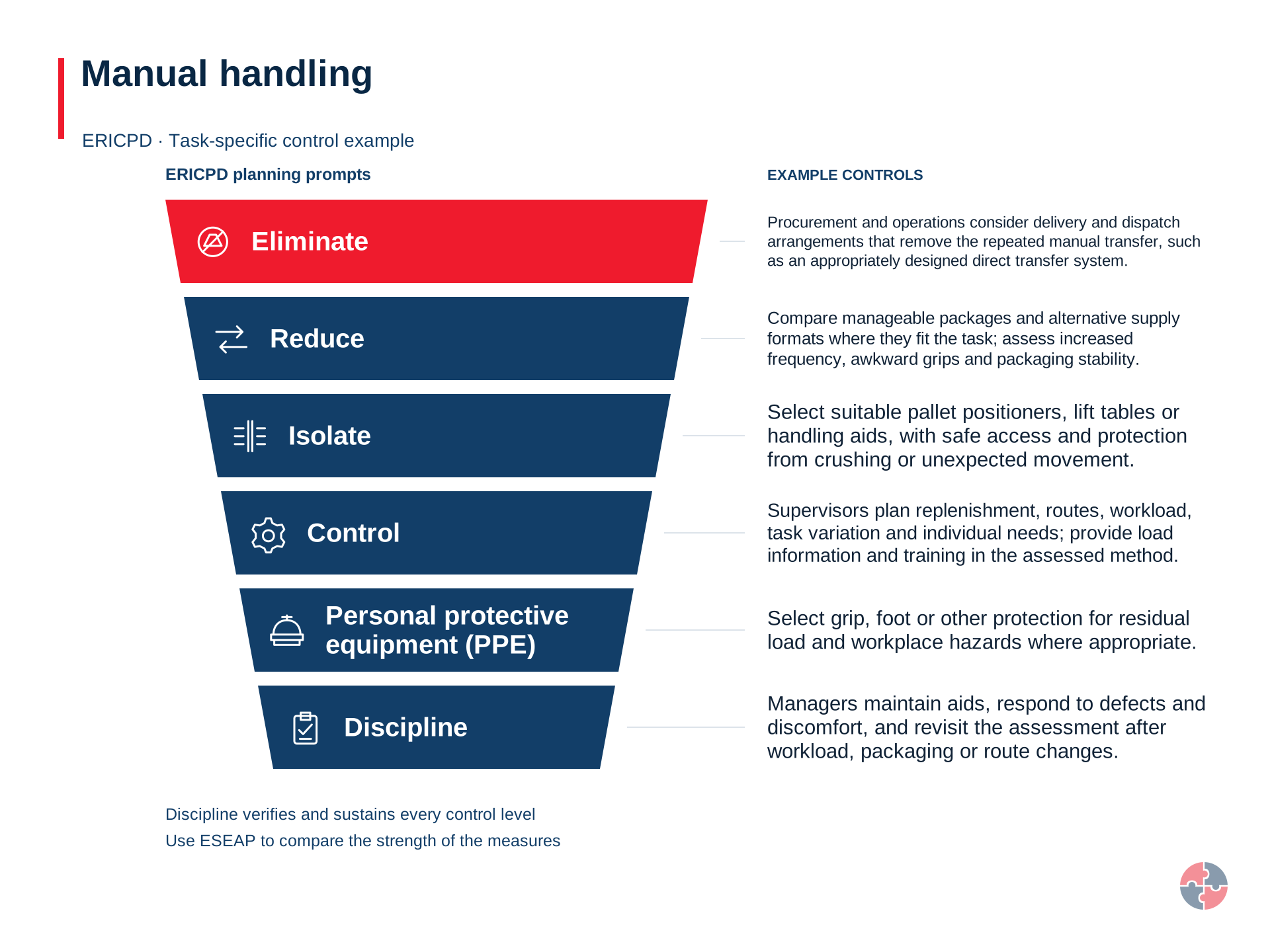
ERICPD means Eliminate, Reduce (including substitution), Isolate, Control, PPE and Discipline. The five-level hierarchy groups measures as elimination, substitution, engineering controls, administrative controls and PPE. They overlap: isolation is usually an engineering measure; control can include engineered and administrative measures. Discipline means maintaining and checking the controls, supervising the method and learning from defects, rather than blaming someone or accepting weaker protection.
How can the ERICPD hierarchy of controls avoid hazardous manual handling and reduce remaining strain?
ERICPD is a planning crossmap. Its prompts do not add a sixth rung or rank Isolate above engineering. Discipline verifies and sustains every control level.
Worked activity: Task application for Manual handling
Activity and release context
ERICPD means Eliminate, Reduce (including substitution), Isolate, Control, PPE and Discipline. The five-level hierarchy groups measures as elimination, substitution, engineering controls, administrative controls and PPE. They overlap: isolation is usually an engineering measure; control can include engineered and administrative measures. Discipline means maintaining and checking the controls, supervising the method and learning from defects, rather than blaming someone or accepting weaker protection.
Procurement and operations consider delivery and dispatch arrangements that remove the repeated manual transfer, such as an appropriately designed direct transfer system.
Observe the complete flow, including replenishment and breakdown recovery. A machine that shifts the lifting burden to another worker has not eliminated the hazardous operation.
Reduce / substitution when replacing a hazard; otherwise engineering or administrative risk reduction
Compare manageable packages and alternative supply formats where they fit the task; assess increased frequency, awkward grips and packaging stability.
Record the total task exposure and worker feedback. No package weight is a universal safe limit; more smaller lifts can still create substantial risk.
Isolate / engineering
Select suitable pallet positioners, lift tables or handling aids, with safe access and protection from crushing or unexpected movement. Design reach and destination heights around the actual task.
Check load capacity, stability, condition, use and the real movement forces. An unsuitable aid or unresolved crush point prevents release of that method.
Control / administrative
Supervisors plan replenishment, routes, workload, task variation and individual needs; provide load information and training in the assessed method.
Watch work at realistic pace and include unusual loads and damaged pallets. A team lift or rotation is not an automatic solution; difficult handling returns to assessment.
PPE / PPE
Select grip, foot or other protection for residual load and workplace hazards where appropriate. Check it does not worsen handling.
Verify fit and condition. Gloves or supportive clothing do not remove musculoskeletal loading or establish a safe lift.
Discipline / sustained engineering and administrative controls
Managers maintain aids, respond to defects and discomfort, and revisit the assessment after workload, packaging or route changes.
Retain task observations and corrective actions. A failed aid or new unstable load requires a safe alternative or pause rather than routine manual workaround.
How can the ISO 45001 hierarchy of controls avoid hazardous manual handling and reduce remaining strain?
The hierarchy of controls in ISO 45001:2018 comes under Clause 8.1.2 (Eliminating hazards and reducing OH&S risks), which is located within Clause 8 ("Operation").
Worked activity: Task application for Manual handling
Activity and release context
ERICPD means Eliminate, Reduce (including substitution), Isolate, Control, PPE and Discipline. The five-level hierarchy groups measures as elimination, substitution, engineering controls, administrative controls and PPE. They overlap: isolation is usually an engineering measure; control can include engineered and administrative measures. Discipline means maintaining and checking the controls, supervising the method and learning from defects, rather than blaming someone or accepting weaker protection.
Procurement and operations consider delivery and dispatch arrangements that remove the repeated manual transfer, such as an appropriately designed direct transfer system.
Observe the complete flow, including replenishment and breakdown recovery. A machine that shifts the lifting burden to another worker has not eliminated the hazardous operation.
Reduce / substitution when replacing a hazard; otherwise engineering or administrative risk reduction
Compare manageable packages and alternative supply formats where they fit the task; assess increased frequency, awkward grips and packaging stability.
Record the total task exposure and worker feedback. No package weight is a universal safe limit; more smaller lifts can still create substantial risk.
Isolate / engineering
Select suitable pallet positioners, lift tables or handling aids, with safe access and protection from crushing or unexpected movement. Design reach and destination heights around the actual task.
Check load capacity, stability, condition, use and the real movement forces. An unsuitable aid or unresolved crush point prevents release of that method.
Control / administrative
Supervisors plan replenishment, routes, workload, task variation and individual needs; provide load information and training in the assessed method.
Watch work at realistic pace and include unusual loads and damaged pallets. A team lift or rotation is not an automatic solution; difficult handling returns to assessment.
PPE / PPE
Select grip, foot or other protection for residual load and workplace hazards where appropriate. Check it does not worsen handling.
Verify fit and condition. Gloves or supportive clothing do not remove musculoskeletal loading or establish a safe lift.
Discipline / sustained engineering and administrative controls
Managers maintain aids, respond to defects and discomfort, and revisit the assessment after workload, packaging or route changes.
Retain task observations and corrective actions. A failed aid or new unstable load requires a safe alternative or pause rather than routine manual workaround.
The comparison is an original illustrative application of the general HSE hierarchy, not a machine-specific method, permit or design approval. The employer must choose measures for the actual work and jurisdiction. Apply the separate Northern Ireland legal route where relevant; the local assessment and competent technical decision govern release.
When should a worker withdraw or call emergency services?
Withdraw to an agreed safe place whenever the worker feels unsafe, controls fail or violence may occur; call 999 when a crime is in progress or someone is in immediate danger, and use online reporting or 101 for non-emergencies.
Do not block or confront the aggressor, pursue them, resist a robbery, recover cash or property, enforce a ban or collect footage while danger continues. Life comes before property and evidence. Withdraw immediately when unsafe; no worker needs permission or a failed de-escalation attempt before leaving. Use a duress alarm only if it can be activated safely. If leaving is impossible, follow the local shelter or lockdown plan and provide location and threat information to emergency services when safe. NI uses NI police 999 for emergencies and 101 or online routes for non-emergencies. Local emergency plans must define responders, safe areas and accessibility. See GOV.UK Contact the police.
Any specialist security or physical-intervention duty must be separately authorised under applicable law, a task-specific risk assessment, defined duties, demonstrated competence and a specific approved procedure. This page does not authorise restraint, confrontation, pursuit, property recovery or physical intervention.
Trigger
Immediate action
Attack, credible imminent threat, weapon or immediate danger
Set the exact task and location, choose the safest practicable method, assign competent people, verify access and controls, protect others and make a workable rescue plan.
A task method should identify equipment and loading, access and egress, overhead services, fragile areas, weather limits, objects, emergency contact, rescue equipment and who can release or stop work. For construction, coordinate sequencing under applicable Construction (Design and Management) Regulations (CDM) duties.
Location and route. Evidence before release: Survey, drawings and walkdown; Hold if: Opening or fragility is unknown.
Equipment and people. Evidence before release: Selection rationale, competence and inspection; Hold if: Platform, anchor or operator status is uncertain.
Interfaces. Evidence before release: Exclusion zone and other-trade coordination; Hold if: People can enter the drop zone.
Emergency. Evidence before release: Site-specific rescue method, people, equipment and practice; Hold if: Only plan is to call emergency services.
Which access method fits the task?
Choose for reach, work position, load, ground, duration, movement and rescue, not for what happens to be nearby.
A ladder may suit a low-risk light task when the risk assessment shows higher-protection equipment is not justified. A guarded platform usually serves extended, forceful or two-handed work better. Specialist scaffold, mast-climbing, suspended or rope systems need competent design and operation.
Several public bays and a dispatch task have distinct hazards; one attendant is also facing a threat. Some unaffected routes remain controlled.
Decision and explanation
Assign specific protection and assistance, control each affected task and verify corrections before reopening.
Coordinate the actual restrictions and resources. Queue pressure cannot substitute for safe handling, fall protection, stable storage or worker assistance.
Lesson 14
Take a verified action into the workplace
Connect one actual task to an owner, evidence and a clear release or escalation decision.
Teaching graphic from the linked SHAREhub source section.
Turn awareness into a practical question
Public-interface and handling awareness. Apply actual GB or NI duties and site arrangements. No live handling method, barrier design, restraint calculation, restraint of people or WEEE specialist work is authorised.
Choose one relevant operation from the course. Describe the person or environment at risk, the mechanism of harm and the exact condition that needs controlling. Separate an observation from a conclusion. A display, signature, badge or clean appearance answers only a limited question.
Use the included practice resources to prepare a fictional task brief, risk review or verification question. Decide which competent role owns the decision and which evidence must be available before work restarts or waste is released. Keep worker protection, public exclusion, waste acceptance and environmental decisions distinct where required.
At work, use your actual approved arrangements. Report uncertainty and preserve the relevant hold, restriction or safe state while it is resolved. Confirm that the action addressed the original harm route and check whether another shift, load, cleaning task or maintenance change could reintroduce it.
Course completion records awareness learning. It does not establish practical competence, certify a waste business, vary a permit, classify an unknown waste or authorise maintenance, chemical work or emergency entry.
How can the ISO 45001 hierarchy of controls avoid hazardous manual handling and reduce remaining strain?
Avoid hazardous manual handling where reasonably practicable, assess what remains and reduce the injury risk. Training and gloves support the chosen method; they cannot make an unsuitable repetitive lift safe.
Illustrative decision: warehouse workers repeatedly lift stock from floor-level pallets to dispatch benches. The manager and workers examine the whole supply-to-dispatch task, including reaching, twisting, pushing, load stability and differing individual capability.
ERICPD means Eliminate, Reduce (including substitution), Isolate, Control, PPE and Discipline. The five-level hierarchy groups measures as elimination, substitution, engineering controls, administrative controls and PPE. They overlap: isolation is usually an engineering measure; control can include engineered and administrative measures. Discipline means maintaining and checking the controls, supervising the method and learning from defects, rather than blaming someone or accepting weaker protection.
How can the ERICPD hierarchy of controls avoid hazardous manual handling and reduce remaining strain?
ERICPD is a planning crossmap. Its prompts do not add a sixth rung or rank Isolate above engineering. Discipline verifies and sustains every control level.
Worked activity: Task application for Manual handling
Activity and release context
ERICPD means Eliminate, Reduce (including substitution), Isolate, Control, PPE and Discipline. The five-level hierarchy groups measures as elimination, substitution, engineering controls, administrative controls and PPE. They overlap: isolation is usually an engineering measure; control can include engineered and administrative measures. Discipline means maintaining and checking the controls, supervising the method and learning from defects, rather than blaming someone or accepting weaker protection.
Procurement and operations consider delivery and dispatch arrangements that remove the repeated manual transfer, such as an appropriately designed direct transfer system.
Observe the complete flow, including replenishment and breakdown recovery. A machine that shifts the lifting burden to another worker has not eliminated the hazardous operation.
Reduce / substitution when replacing a hazard; otherwise engineering or administrative risk reduction
Compare manageable packages and alternative supply formats where they fit the task; assess increased frequency, awkward grips and packaging stability.
Record the total task exposure and worker feedback. No package weight is a universal safe limit; more smaller lifts can still create substantial risk.
Isolate / engineering
Select suitable pallet positioners, lift tables or handling aids, with safe access and protection from crushing or unexpected movement. Design reach and destination heights around the actual task.
Check load capacity, stability, condition, use and the real movement forces. An unsuitable aid or unresolved crush point prevents release of that method.
Control / administrative
Supervisors plan replenishment, routes, workload, task variation and individual needs; provide load information and training in the assessed method.
Watch work at realistic pace and include unusual loads and damaged pallets. A team lift or rotation is not an automatic solution; difficult handling returns to assessment.
PPE / PPE
Select grip, foot or other protection for residual load and workplace hazards where appropriate. Check it does not worsen handling.
Verify fit and condition. Gloves or supportive clothing do not remove musculoskeletal loading or establish a safe lift.
Discipline / sustained engineering and administrative controls
Managers maintain aids, respond to defects and discomfort, and revisit the assessment after workload, packaging or route changes.
Retain task observations and corrective actions. A failed aid or new unstable load requires a safe alternative or pause rather than routine manual workaround.
How can the ISO 45001 hierarchy of controls avoid hazardous manual handling and reduce remaining strain?
The hierarchy of controls in ISO 45001:2018 comes under Clause 8.1.2 (Eliminating hazards and reducing OH&S risks), which is located within Clause 8 ("Operation").
Worked activity: Task application for Manual handling
Activity and release context
ERICPD means Eliminate, Reduce (including substitution), Isolate, Control, PPE and Discipline. The five-level hierarchy groups measures as elimination, substitution, engineering controls, administrative controls and PPE. They overlap: isolation is usually an engineering measure; control can include engineered and administrative measures. Discipline means maintaining and checking the controls, supervising the method and learning from defects, rather than blaming someone or accepting weaker protection.
Procurement and operations consider delivery and dispatch arrangements that remove the repeated manual transfer, such as an appropriately designed direct transfer system.
Observe the complete flow, including replenishment and breakdown recovery. A machine that shifts the lifting burden to another worker has not eliminated the hazardous operation.
Reduce / substitution when replacing a hazard; otherwise engineering or administrative risk reduction
Compare manageable packages and alternative supply formats where they fit the task; assess increased frequency, awkward grips and packaging stability.
Record the total task exposure and worker feedback. No package weight is a universal safe limit; more smaller lifts can still create substantial risk.
Isolate / engineering
Select suitable pallet positioners, lift tables or handling aids, with safe access and protection from crushing or unexpected movement. Design reach and destination heights around the actual task.
Check load capacity, stability, condition, use and the real movement forces. An unsuitable aid or unresolved crush point prevents release of that method.
Control / administrative
Supervisors plan replenishment, routes, workload, task variation and individual needs; provide load information and training in the assessed method.
Watch work at realistic pace and include unusual loads and damaged pallets. A team lift or rotation is not an automatic solution; difficult handling returns to assessment.
PPE / PPE
Select grip, foot or other protection for residual load and workplace hazards where appropriate. Check it does not worsen handling.
Verify fit and condition. Gloves or supportive clothing do not remove musculoskeletal loading or establish a safe lift.
Discipline / sustained engineering and administrative controls
Managers maintain aids, respond to defects and discomfort, and revisit the assessment after workload, packaging or route changes.
Retain task observations and corrective actions. A failed aid or new unstable load requires a safe alternative or pause rather than routine manual workaround.
The comparison is an original illustrative application of the general HSE hierarchy, not a machine-specific method, permit or design approval. The employer must choose measures for the actual work and jurisdiction. Apply the separate Northern Ireland legal route where relevant; the local assessment and competent technical decision govern release.
When should a worker withdraw or call emergency services?
Withdraw to an agreed safe place whenever the worker feels unsafe, controls fail or violence may occur; call 999 when a crime is in progress or someone is in immediate danger, and use online reporting or 101 for non-emergencies.
Do not block or confront the aggressor, pursue them, resist a robbery, recover cash or property, enforce a ban or collect footage while danger continues. Life comes before property and evidence. Withdraw immediately when unsafe; no worker needs permission or a failed de-escalation attempt before leaving. Use a duress alarm only if it can be activated safely. If leaving is impossible, follow the local shelter or lockdown plan and provide location and threat information to emergency services when safe. NI uses NI police 999 for emergencies and 101 or online routes for non-emergencies. Local emergency plans must define responders, safe areas and accessibility. See GOV.UK Contact the police.
Any specialist security or physical-intervention duty must be separately authorised under applicable law, a task-specific risk assessment, defined duties, demonstrated competence and a specific approved procedure. This page does not authorise restraint, confrontation, pursuit, property recovery or physical intervention.
Trigger
Immediate action
Attack, credible imminent threat, weapon or immediate danger
Set the exact task and location, choose the safest practicable method, assign competent people, verify access and controls, protect others and make a workable rescue plan.
A task method should identify equipment and loading, access and egress, overhead services, fragile areas, weather limits, objects, emergency contact, rescue equipment and who can release or stop work. For construction, coordinate sequencing under applicable Construction (Design and Management) Regulations (CDM) duties.
Location and route. Evidence before release: Survey, drawings and walkdown; Hold if: Opening or fragility is unknown.
Equipment and people. Evidence before release: Selection rationale, competence and inspection; Hold if: Platform, anchor or operator status is uncertain.
Interfaces. Evidence before release: Exclusion zone and other-trade coordination; Hold if: People can enter the drop zone.
Emergency. Evidence before release: Site-specific rescue method, people, equipment and practice; Hold if: Only plan is to call emergency services.
Which access method fits the task?
Choose for reach, work position, load, ground, duration, movement and rescue, not for what happens to be nearby.
A ladder may suit a low-risk light task when the risk assessment shows higher-protection equipment is not justified. A guarded platform usually serves extended, forceful or two-handed work better. Specialist scaffold, mast-climbing, suspended or rope systems need competent design and operation.

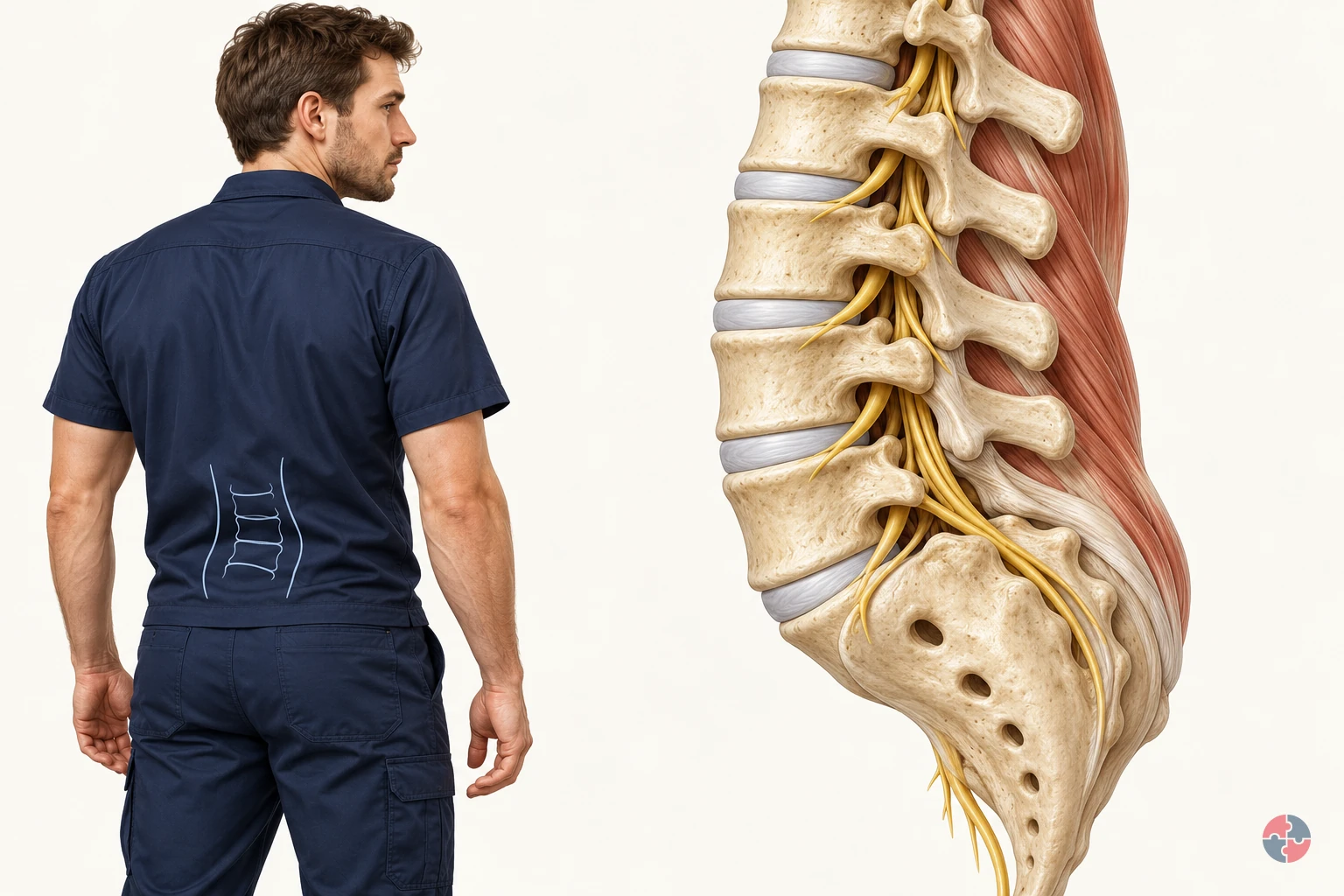 View full detail ↗