
Plant start and stop readiness
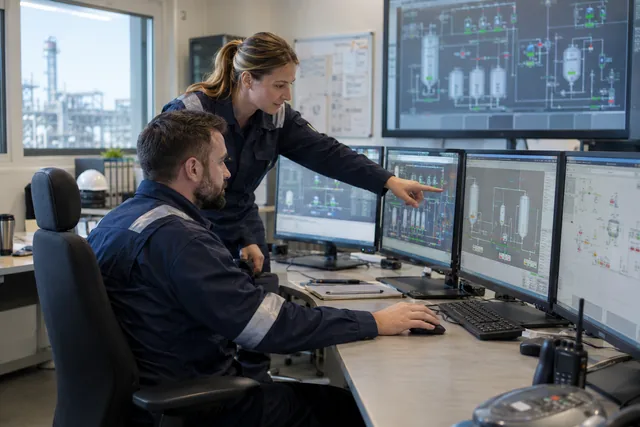

Recognise the evidence needed before a plant transition and the conditions that keep an unresolved start-up or shutdown decision on hold.
Free training · Approx. 75–110 minutes
Public teaching and practice are free. Use a free learner account in Moodle for confirmed saves and recorded assessment. A certificate of completion depends on completing the required learning, scoring at least 80% and answering every critical safety question correctly.
Your practical case
A fictional solvent recovery unit is due to restart after a maintenance outage and a modified instrument connection. Mechanical work is signed complete, but a test is outstanding, a temporary configuration remains and the cooling service has not been handed back. The planned production time is approaching.
Process operators, supervisors, maintenance planners, contractors and managers who need topic awareness.
Independent SHAREhub awareness. This course does not provide a NEBOSH qualification, accreditation or authority to operate, design, isolate, test or maintain plant. Use competent site arrangements for real work.
What you will learn
- Distinguish transition hazards from steady running.
- Separate mechanical completion from operational readiness.
- Identify unresolved safety-critical actions, protective impairments and utility dependencies.
- Explain controlled start/stop authority, hold points and transition handover.
Course outline
Understand the transition
- Transitions are different operating statesRecognise why start-up and shutdown need specific planning.
- Identify the kind of transitionDistinguish planned, unplanned and emergency states.
- Check the change basisConnect modifications to the restart decision.
Assemble the readiness evidence
- Separate completion from readinessDistinguish the purpose of construction, maintenance and operational records.
- Account for the actual configurationRecognise residual work states that affect readiness.
Resolve open conditions
- Prove protective and utility readinessTrace the transition’s dependencies beyond one repaired component.
- Prepare people and instructionsRecognise the organisational conditions of readiness.
- Classify open actions by consequenceDistinguish a safety-critical hold from an administrative follow-up.
Control start and stop decisions
- Plan shutdown interfacesRecognise effects on adjacent plant and shared services.
- Keep hold points active during the transitionRecognise why readiness is not a one-off signature.
Verify and transfer
- Hand over the transition stateCommunicate what is complete, held or not yet verified.
- Make a defensible readiness decisionIntegrate the changed instrument, open test and utility condition.
Practise and test your reasoning
12 lesson decisions and 6 required activities use evidence sorting, matching, sequencing, branching choices and applied checks. Dragging has equivalent labelled controls. The 20-question final assessment requires 80% and every critical answer, after all learning requirements are complete.
Use the linked risk assessment, toolbox talk, policy and assurance resources with their included fictional exercises. Points and module badges help show progress; they do not replace the assessment requirements.
Duration estimates include teaching, activities, checks and assessment. Your pace and retries may vary.
Sources and scope
Independent awareness study · PSM topic 3.2. Independent SHAREhub learning; this is not the NEBOSH qualification.
- Plant modification and change control
- Shift handover
- Operating procedures
- Functional safety
- Utility reliability
Knowledge Hub topic coverage
Presentation and model workshop
Use the same course imagery, worked decisions and historical case in a 28-slide teaching companion. Practise classification, compare explained choices and inspect the linked model case.
Open the interactive presentation workshop · Download PowerPoint
This optional companion does not replace the required course activities or final assessment.