Independent SHAREhub process-safety awareness using fictional cases and a Great Britain baseline; check the applicable Northern Ireland duties and actual site arrangements. This course does not award a NEBOSH qualification, establish specialist competence or authorise hazardous work.
This reader supplies the complete teaching. Use the interactive LMS course for assessed activities, saved progress and completion.
LESSON 1
Do not infer explosibility from a familiar material name
Do not infer explosibility from a familiar material name.
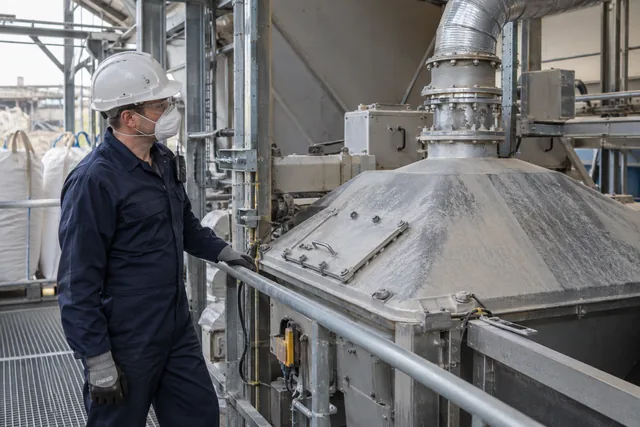
Existing SHAREhub photographic illustration. The written fictional case supplies the condition and decision evidence.
Understand the mechanism and the decision
Everyday materials can form combustible dust when sufficiently fine particles are dispersed under relevant conditions. Product familiarity, food use or the absence of a flammable-liquid label does not establish whether a dust presents an explosion hazard. Actual material properties matter.
Use the relevant substance and process information, with competent testing where necessary. A generic statement about another powder is not a suitable basis for accepting a changed material. Keep health exposure and fire/explosion questions connected but distinct.
Verify the control in the actual task
Obtain the relevant evidence for the actual material and process; awareness does not authorise improvised ignition tests.
What is a dust explosion hazard?
A dust explosion hazard is the potential for combustible dust to ignite and propagate flame through a dust-air mixture.
Dust explosion hazards are not limited to obvious explosives or unusual chemicals. They arise when ordinary combustible solids are broken into fine particles. A block of wood or a pile of sugar may burn slowly, but fine wood flour or sugar dust dispersed in air has a much larger surface area and can burn extremely quickly.
A dust explosion may occur inside process equipment, ducting, a collector, a silo, a room, a suspended ceiling void or a building. The event can rupture equipment, damage structures, injure workers through blast, burns and debris, start fires, disable sprinklers or emergency systems and trigger further releases.
The hazard should be assessed before relying on experience. A site may have worked with a dust for years without incident because one element of the pentagon has not yet aligned. That does not prove the dust is safe; it may only mean the ignition source or dispersion event has not occurred.
Photorealistic illustrative UK workplace scene. Review checks: Avoid / redesign: Remove an unnecessary dust-generating stage or select a process that avoids combustible powder handling where feasible. Control the task: Securely isolate the collector and connected equipment; control stored energy and prevent access to hazardous dust-release zones. Verify before release: If the hazardous step remains, keep it within the task assessment and select the stronger feasible remaining controls.
Understand the mechanism and the decision
A dust explosion involves combustible material dispersed with a suitable oxidising atmosphere and an ignition source, with confinement influencing pressure effects. The pathway connects material generation, escape, dispersion and the surrounding equipment. A powder stored quietly does not represent every condition it can enter during handling.
Use the mechanism to locate prevention opportunities, not as a checklist that proves an event impossible because one condition is not obvious during a walk-round. Dispersion and ignition can arise during an upset, and connected equipment can create a different environment from the open room.
Verify the control in the actual task
Trace where dust is generated, released and dispersed, then check the actual controls and relevant equipment connections.
How does the dust explosion pentagon work?
The dust explosion pentagon explains the five conditions that usually need to align for a damaging dust explosion.
The pentagon helps managers see why different controls work. Remove the fuel, and there is nothing to explode. Prevent dispersion, and settled dust is less likely to form a cloud. Remove confinement, and pressure rise may be reduced. Remove ignition, and the cloud should not ignite. Remove oxygen or inert the atmosphere in specialist systems, and combustion cannot propagate.
Most workplaces cannot remove oxygen, so practical control normally focuses on fuel, dispersion, confinement and ignition. This is why source capture, housekeeping, equipment design and ignition control are core controls.
A first pressure event can lift deposited combustible dust into another cloud. If it ignites, the resulting secondary explosion can extend beyond the original equipment.
Understand the mechanism and the decision
Dust layers can fuel fire and may be dispersed by movement, a primary event or unsuitable cleaning. A first disturbance can therefore involve accumulations away from the initiating point. A clean visible floor does not demonstrate that ledges, enclosed areas or other surfaces are controlled.
An effective accumulation review considers accessible and less visible locations through safe inspection arrangements. Avoid invented universal layer thresholds; the actual material and scenario govern the assessment. Removing recurring deposits without controlling their source can allow the condition to return.
Verify the control in the actual task
Ask how the source is corrected and how all relevant locations are inspected and cleaned without creating another exposure.
Deposits can feed a second, larger event
A first pressure event can lift deposited combustible dust into another cloud. If it ignites, the resulting secondary explosion can extend beyond the original equipment.
Fictional learning example
Separate the evidence from the decision
Part of the picture
What the example establishes
Initial event
A combustible dust cloud ignites in a piece of equipment.
Escalation
Pressure and disturbance lift nearby deposited dust.
Further event
The new cloud may ignite and expose a larger area or connected plant.
Pause and decide: Does cleaning the visible floor alone demonstrate control of this pathway?
Compare the reasoning
No. Review the release source, hidden deposits, suitable cleaning method and connected-system protection. Avoid cleaning that disperses dust into a cloud. Use material-specific data and competent assessment; do not invent a universal safe layer thickness or vent size.
Why are dust clouds and dust layers both important?
Dust clouds are immediate explosive atmospheres, while dust layers are fuel waiting to be dispersed.
A dust cloud may form during tipping, pouring, pneumatic conveying, bag emptying, milling, sanding, drying, filling, cleaning, leaks or abnormal equipment failure. It may be visible as a dense cloud, but it can also be localised inside equipment where workers cannot see it.
A dust layer is not safe just because it is settled. Layers can be disturbed by air movement, vibration, a small fire, a pressure pulse or a primary explosion. The larger the area covered by settled dust, the more fuel may be available for a secondary explosion. Hidden spaces such as suspended ceilings, cable trays, roof steelwork and collector rooms deserve particular attention.
A useful field test is to ask whether the site has a reliable way of seeing and cleaning dust above head height. If not, the risk assessment may be missing the fuel that matters most during escalation.
The floor is cleaned while deposits remain on high ledges and the source continues leaking.
Test the assumption
Only a better floor photograph. This does not establish acceptance. Housekeeping limited to one surface does not establish the whole dust-control condition.
Evidence before acceptance
Ask how the source is corrected and how all relevant locations are inspected and cleaned without creating another exposure.
Test your decision
What is missing from the control decision?
Only a better floor photograph.
Nothing once the walking route is clear.
The recurring release and wider accumulation/dispersion pathways.
Compare the explanation
The recurring release and wider accumulation/dispersion pathways.
Housekeeping limited to one surface does not establish the whole dust-control condition.
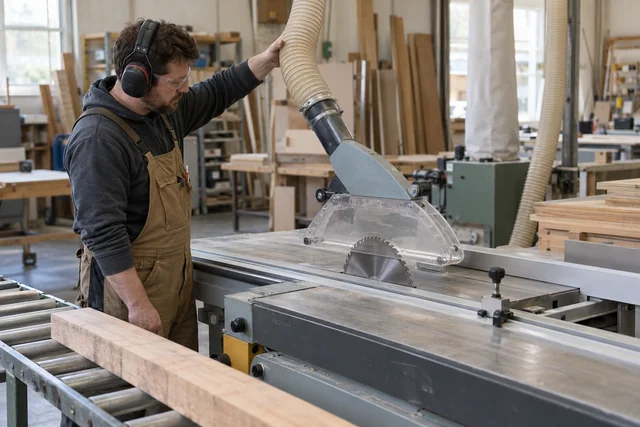
Photorealistic illustrative UK workplace scene. Review checks: Hazard identification: Names wood dust, fine powders and collected dust as potential combustible dust hazards. Design and procurement: Specifies suitable extraction, collection and vacuum systems before purchase. Operational control: Controls sanding, cutting, waste collection, cleaning and hot work.
Understand the mechanism and the decision
Particle characteristics, composition and process conditions can affect dust behaviour. A test result has a defined sample and scope. A supplier or recipe change may alter that basis, particularly where material is milled, dried, blended or recycled during processing.
Testing and interpretation need competent methods. Do not establish explosibility with an informal flame test or assume a result for a different particle distribution transfers unchanged. Relevant technical decisions need data and a justified assessment of the intended service.
Verify the control in the actual task
Identify the changed material characteristics and obtain the responsible technical determination before accepting revised controls.
When is dust explosibility testing needed?
Representative evidence is needed when dust properties are uncertain and the answer affects DSEAR assessment, design or control selection; a competent specialist should decide whether further testing is required.
Testing should be considered when a material is new, changed, finely divided, dried, milled, recycled, contaminated, blended or handled in a way that could generate fines. It is also important where equipment design depends on explosion severity data. Generic assumptions may be misleading because nominally similar powders can behave differently.
Dust test data should be controlled information. It should be linked to the actual material, moisture, particle size and process conditions. If the process changes, the data may no longer be valid. Managers do not need to interpret specialist results unaided, but they should know enough to ask whether the right material was tested and whether the result has been built into design and operating controls.
Appendix A8 of HSE HSG103 (2003 edition) distinguishes cases where cautious use of accumulated natural-product test data may be reliable from cases requiring representative samples of the finest and driest material likely in the process. Its example property table is expressly unsuitable for direct plant design. For example, when a milling change produces finer recovered dust, ask the specialist whether the existing evidence represents that fraction and whether further testing is needed before changing protection arrangements. This is a GB assessment example, not a command to perform every listed test on every powder. HSG103 provides basic guidance, not a design manual; its historical legislation and standards references need current verification.
Dust testing questions - Dust testing questions
Question
Why it matters
Who should advise
Is the dust explosible?
Determines whether DSEAR combustible dust controls may be needed.
Prioritise preventing and containing the dust release
Prioritise preventing and containing the dust release.
Existing SHAREhub photographic illustration. The written fictional case supplies the condition and decision evidence.
Understand the mechanism and the decision
Handling arrangements can generate dust at transfer, filling and other disturbance points. Avoiding unnecessary release, using suitable containment and effective capture can reduce what reaches the workplace. A collector being switched on is not evidence that each source is controlled.
The system must suit the actual material and operation and retain its protective functions. Changes to hoods, flow paths or collection equipment can affect both exposure control and explosion risks. Do not treat ordinary ventilation performance as the complete explosion-protection basis.
Verify the control in the actual task
Report the observed escape and check the required performance/defect evidence through competent maintenance and operating review.
How should dust capture, ventilation and collection be managed?
Dust capture should remove dust at source and collect it in equipment designed for the material and explosion risk.
General room ventilation is rarely enough for combustible dust control because it does not reliably capture dust at the release point. Source capture should focus on transfer points, bag tipping, filling, milling, grinding, sanding, conveying, screening, emptying and waste handling. Hoods, enclosures, local exhaust ventilation and closed transfer systems should be designed around the process, not added as an afterthought.
Dust collection equipment can itself become a high-risk item because it concentrates dust, air movement and possible ignition sources. Collectors, cyclones, filters, silos, bins and ductwork may need explosion relief, suppression, isolation, rotary valves, grounding, monitoring, safe discharge and maintenance access. The design basis should be recorded and protected during changes.
A rotary valve that discharges product is not automatically an explosion choke. Where it is claimed as an isolation barrier, HSE food-industry guidance calls for a type-tested, ATEX-certified valve; a competent designer must verify its function for the actual dust, clearances and plant. A flexible-edged or worn valve may fail to stop flame propagation. HSE food-industry dust explosion guidance gives the specific explosion-choke limitation for food plant.
Workers should know the signs of poor capture: visible dust escaping, damaged hoses, blocked filters, low airflow, dust deposits near hoods, unusual noise, alarms, doors left open, bags overfilled or extraction switched off because it interferes with production. See HSE - Safe handling of combustible dusts HSG103.
Dust capture and collection controls - Dust capture and collection controls
Control
What to check
Evidence
Source capture
Hoods, enclosures or on-tool extraction are close enough and matched to the dust source.
Dust repeatedly escapes at a packing connection although the extraction fan is running.
Test the assumption
Only whether the motor has power. This does not establish acceptance. Fan operation does not establish effective capture or the complete protection function.
Evidence before acceptance
Report the observed escape and check the required performance/defect evidence through competent maintenance and operating review.
Test your decision
What should be assessed?
The source/capture condition and the complete suitable dust-handling/protection arrangement.
Only whether the motor has power.
Whether workers can tolerate the visible dust.
Compare the explanation
The source/capture condition and the complete suitable dust-handling/protection arrangement.
Fan operation does not establish effective capture or the complete protection function.
Photorealistic illustrative UK workplace scene. Review checks: Avoid / redesign: Avoid dusty transfer, buy liquid or pelletised forms, use pre-processed materials or remove redundant dusty plant. Control the task: Enclose dusty processes, segregate dust-handling rooms and locate high-risk plant outside where suitable. Verify before release: Confirm the task has actually been removed before changing the workshop assessment; hold unplanned cutting until assessed.
Understand the mechanism and the decision
Cleaning is needed to manage accumulations, but its method can redisperse dust or introduce ignition. Unreviewed compressed-air blowing, vigorous dry brushing or unsuitable collection equipment can change a settled deposit into another hazardous condition.
Use the authorised method and equipment suitable for the actual dust and environment. An ordinary domestic vacuum or a generic antistatic claim is not an adequate selection basis. Avoid access beyond your competence; difficult locations need a planned safe inspection and cleaning arrangement.
Verify the control in the actual task
Confirm the method, equipment suitability and safe access through the responsible system; do not improvise specialist cleaning from a course example.
What should a good dust housekeeping system include?
A good dust housekeeping system defines where dust may accumulate, how it is removed, who checks it and when action is needed.
The strongest housekeeping systems are specific. They list floors, ledges, beams, roof members, cable trays, light fittings, ductwork, collector areas, mezzanines, conveyors, silo tops, bagging areas and hidden corners. They identify the dust type and cleaning method for each area. They also define trigger conditions: visible layers, leaks, unusual dust fall, filter alarms, spill events, shutdown cleaning and post-maintenance cleaning.
Cleaning must not create the hazard it is trying to remove. Dry sweeping can re-suspend fine dust. Compressed air can create an immediate dust cloud. A suitable industrial vacuum system, selected for the dust and the area, is usually a better control. Where manual cleaning is necessary, it should be planned around isolation, access, work at height, respiratory protection, waste disposal and ignition control.
There is no universal dust-layer thickness that declares every material and plant safe. Set inspection and cleaning action points from the actual dust, surfaces, process, equipment design and competent DSEAR assessment; a visible layer or repeated leakage is a prompt to act, not to wait for a generic number.
Housekeeping inspections should include high-level surfaces because dust above head height is often missed during routine floor cleaning. The inspection should record findings, actions, photographs where helpful, owners and close-out evidence. Repeated dust build-up is a signal that source control, extraction or plant integrity is failing. See HSE - Prevention of dust explosions in the food industry.
The GB HSE food-industry guidance does not authorise unsuitable electrical equipment in hazardous areas. Its discussion of commercial vacuum cleaners assumes a non-hazardous area; it requires ATEX-certified equipment where the area is hazardous and rejects domestic cleaners for flammable dust in commercial premises. For example, do not approve a flour-cleaning machine solely because it has a HEPA filter: confirm the actual dust, location classification, ignition risks and intended use with a competent assessor. Cleaning method and materials matter too; the guidance warns against drawing wet or smouldering material into the cleaner. This is a food-task example, not a universal vacuum specification or permission for wet cleaning of every combustible dust.
Housekeeping programme elements - Housekeeping programme elements
Element
Good standard
Why it matters
Area map
Identify rooms, plant, conveyors, collectors, beams, ledges and hidden surfaces.
Photorealistic illustrative UK workplace scene. Review checks: Change at source: Avoid dusty transfer, buy liquid or pelletised forms, use pre-processed materials or remove redundant dusty plant. Make it observable: Confirm the task has actually been removed before changing the workshop assessment; hold unplanned cutting until assessed. Keep useful evidence: Dust risk register and action log.
Understand the mechanism and the decision
Electrical equipment, hot surfaces, friction, mechanical faults, static and hot work can be relevant ignition routes. The assessment must identify credible sources for the actual process and material. Removing one familiar source does not prove every relevant route is controlled.
Condition monitoring, maintenance and work control need a defined purpose and response. A rising bearing concern or protection fault should not be dismissed because no flame is visible. Workers must recognise and report the trigger and use the authorised abnormal arrangement.
Verify the control in the actual task
Check defect information and the responsible acceptance of equipment condition; do not dismantle or adjust hot equipment as an informal investigation.
How should ignition sources be controlled around combustible dust?
Ignition sources should be identified, eliminated or controlled wherever explosive dust atmospheres may occur.
Ignition control starts with knowing where dust clouds and layers can occur. A DSEAR assessment may identify hazardous zones, but ignition control should also cover abnormal conditions such as leaks, spills, blocked extraction, maintenance, cleaning, start-up and shutdown. Equipment suitable for a clean ordinary area may be unsuitable in a dusty area or inside a dust collector.
Common ignition sources include hot work, hot surfaces, electrical equipment, static electricity, friction heat, overheated bearings, belt slip, impact sparks, smouldering material, portable tools, lighting, vehicles and maintenance activities. Control may include exclusion, zoning, ATEX-rated equipment, earthing and bonding, temperature monitoring, preventive maintenance, permits, tool control and supervision.
Static electricity is often misunderstood. Non-conductive hoses, plastic containers, synthetic clothing, poor bonding and high-velocity powder movement can allow charge to build. Controls should be engineered and verified; do not rely on people remembering to clip a lead without checking that it is effective. See HSE - ATEX and explosive atmospheres.
Assure the complete collector and connected-system protection
Assure the complete collector and connected-system protection.
Photorealistic illustrative UK workplace scene. Review checks: Risk register: Records combustible wood dust scenarios, health exposure scenarios, controls, owners and review triggers. Procurement: Buys extraction-compatible tools, suitable vacuums and collector systems matched to the dust risk. Training: Provides awareness, task-specific and supervisor training with practical checks.
Understand the mechanism and the decision
A collector can concentrate dust and form part of a connected explosion pathway. Its location, construction and protective arrangements need a competent basis. Being outside a building or having a vent does not by itself establish an acceptable discharge or propagation arrangement.
Protection may involve several engineered functions whose suitability and limitations must be verified together. Normal process valves and ordinary filters are not automatically explosion isolation or suppression. Changes to connections and material need review before the original protection is treated as applicable.
Verify the control in the actual task
Keep configuration and protection records current and use the actual impairment process where a required function is unavailable.
Which equipment features matter for dust explosion control?
Equipment should be selected, installed and maintained so that it does not create, spread or worsen a dust explosion.
Dust-handling plant often includes mills, grinders, sieves, conveyors, pneumatic conveying, bucket elevators, silos, collectors, cyclones, filters, rotary valves and packaging systems. These items can generate dust clouds, create confinement and introduce ignition sources through friction, impact, mechanical failure, hot bearings, belt slip or electrical faults.
Good design considers prevention and mitigation. Prevention means avoiding dust escape, controlling ignition sources and keeping equipment within safe operating limits. Mitigation means explosion relief, suppression, containment or isolation so that if ignition occurs the event does not propagate through ducts, silos, collectors or buildings.
HSE food-industry examples illustrate bucket elevators, collectors, silos and vacuum risks. They are not universal equipment specifications for a wood shop or metal powder process: the actual dust properties, zone, plant geometry and manufacturer's instructions need competent design and verification.
The equipment register should identify safety-critical items. Explosion vents, isolation valves, suppression systems, underspeed switches, alignment monitors, earthing, temperature sensors, pressure sensors and interlocks should have owners, inspection intervals, test methods and impairment controls. See HSE - ATEX and explosive atmospheres.
Existing SHAREhub 2D teaching schematic. Use alongside the explanation and fictional case in this lesson.
Understand the mechanism and the decision
An inspection should establish the condition relevant to a control, not merely that someone visited. Look for recurring release, accumulation, equipment damage and open protective limitations within the authorised scope. A checklist must retain unknown results rather than convert them into ticks.
Safe access and competent methods determine what can be inspected. A photograph cannot establish hidden deposits or internal device performance. Repeated findings should lead to source correction and assurance of effectiveness, not a succession of identical cleaning entries.
Verify the control in the actual task
Identify the failed function, responsible action and verification that will show the improvement persists under representative work.
How should dust explosion controls be inspected and assured?
Inspection should prove that dust controls are present, suitable, used, maintained and effective.
A strong assurance programme looks beyond whether a document exists. It checks the actual condition of equipment, visible dust, cleaning records, high-level deposits, extraction performance, alarms, interlocks, zoning drawings, ATEX equipment, hot-work permits, contractor practice and maintenance defects. It should be risk-based, with higher-frequency checks in areas where dust accumulates quickly or ignition risk is higher.
Frontline checks are useful for daily or weekly verification: is the extraction running, are bins emptied, are leaks visible, is cleaning done, is compressed air being misused? Supervisor and HSE checks should look for quality, trends and action close-out. Specialist audits should sample DSEAR assessment assumptions, engineering design, explosion relief, hazardous-area classification and management of change.
Findings should be ranked by potential consequence, not just tidiness. Dust above head height, recurrent leaks, disabled extraction, hot work near dusty plant and unverified changes are higher-value findings than ordinary housekeeping comments. See HSE - Safe handling of combustible dusts HSG103.
Assurance levels for dust explosion controls - Assurance levels for dust explosion controls
Assurance level
Typical checks
Top tip
Frontline verification
Operator checks of leaks, dust layers, extraction, alarms, bins, vacuums and cleaning completion.
The same dust escape is recorded after every clean, yet the action is closed each time on a floor photograph.
Test the assumption
Only a newer photograph of the floor. This does not establish acceptance. Repeated recurrence is evidence that the underlying control question remains open.
Evidence before acceptance
Identify the failed function, responsible action and verification that will show the improvement persists under representative work.
Test your decision
What should closure require?
Only a newer photograph of the floor.
Only the number of completed cleaning sheets.
Resolution and verification of the recurring source and relevant control performance.
Compare the explanation
Resolution and verification of the recurring source and relevant control performance.
Repeated recurrence is evidence that the underlying control question remains open.
Screen changes in material, rate and configuration
Screen changes in material, rate and configuration.
Photorealistic illustrative UK workplace scene. Review checks: Avoid / redesign: Avoid dusty transfer, buy liquid or pelletised forms, use pre-processed materials or remove redundant dusty plant. Control the task: Enclose dusty processes, segregate dust-handling rooms and locate high-risk plant outside where suitable. Verify before release: Confirm the task has actually been removed before changing the workshop assessment; hold unplanned cutting until assessed.
Understand the mechanism and the decision
A new powder, altered particle distribution, changed transfer arrangement or modification to extraction can challenge the existing dust assessment. More throughput can also affect release, accumulation and protective demands. A good product result does not establish a safe changed system.
Change control must connect the actual material data, equipment, operating information, cleaning and protection basis. Temporary arrangements require an accepted scope too. Retain a review hold where the necessary information or verification is missing.
Verify the control in the actual task
Check which assumptions remain valid and how the accepted limits and required actions are communicated to the operating team.
Why does management of change matter for dust explosion controls?
Management of change matters because small changes can alter dust generation, ignition risk, extraction performance or explosion protection.
Combustible dust systems are sensitive to change. A new raw material, finer particle size, different moisture content, faster transfer rate, changed duct route, replacement filter, modified collector, extra machine, temporary hose, different cleaning equipment or software change can affect the DSEAR assessment. Changes that look like productivity improvements can increase dust concentration, static generation, confinement or ignition probability.
Change control should screen for dust explosion implications before the change is made. It should ask whether the material is combustible, whether dust generation or accumulation changes, whether zoning changes, whether equipment remains suitable, whether relief or isolation still works, whether cleaning frequencies change and whether training or procedures need updating.
Temporary changes need the same discipline. A temporary extraction unit, bypassed interlock, disabled fire detection, out-of-service collector or improvised vacuum may remove the barrier being relied on. See HSE - DSEAR in detail.
Dust-related management of change triggers - Dust-related management of change triggers
Change trigger
Dust explosion question
Evidence to update
New material or supplier
Is the dust combustible, finer, drier, more reactive or more ignition sensitive?
Use the abnormal-response plan instead of opening a suspect collector
Use the abnormal-response plan instead of opening a suspect collector.
Existing SHAREhub 2D teaching schematic. Use alongside the explanation and fictional case in this lesson.
Understand the mechanism and the decision
Unexpected heat, smoke, abnormal noise, dust escape or a protection warning can indicate a changed hazardous condition. An awareness learner cannot determine a safe internal state by opening a collector or disturbing deposits. Those actions can introduce exposure, air or dust movement.
Raise the alarm and use the planned protective and emergency arrangements within your role. Keep factual information about the asset, material and known status available to responders. Do not improvise firefighting, cleaning or dismantling as a way to prove the equipment safe.
Verify the control in the actual task
Know the site alarm and protective route before operating. Recovery and re-entry need an authorised assessment and verified plant state.
What are the warning signs that dust explosion hazards are not understood?
Warning signs appear when people treat combustible dust as ordinary dirt, nuisance dust or only an occupational health issue.
A major warning sign is language. If workers say 'it has always been dusty' or managers say 'it is only sawdust/flour/sugar', hazard recognition is weak. If no one knows whether a dust is combustible, whether it has been tested, or whether DSEAR applies, the site is making decisions without key information.
Physical signs include visible dust layers, hidden dust deposits, dust escaping collectors, dry sweeping, compressed air cleaning, hot work near dusty areas, damaged equipment, unreviewed changes and lack of high-level inspection. These can manifest as fire, flash fire, explosion, equipment rupture, burns, blast injury, structural damage, business interruption and emergency responder risk.
Warning signs and likely outcomes - Warning signs and likely outcomes
Warning sign
What it reveals
Potential outcome
No combustible dust inventory
The site does not know which materials can explode.
Distinguish normal readiness from an impaired-plant decision
Distinguish normal readiness from an impaired-plant decision.
Photorealistic illustrative UK workplace scene. Review checks: Change at source: Avoid dusty transfer, buy liquid or pelletised forms, use pre-processed materials or remove redundant dusty plant. Make it observable: Confirm the task has actually been removed before changing the workshop assessment; hold unplanned cutting until assessed. Keep useful evidence: Dust risk register and action log.
Understand the mechanism and the decision
The same physical equipment can have a different acceptable condition when a required control is impaired or material information has changed. A normal checklist cannot silently authorise operation under a different basis. Source control, cleaning, ignition and protection evidence must be reconciled.
The stated line has a changed powder, recurring release and an unresolved protective record. Cleaning the visible floor answers only part of the case. The operating decision needs the required technical review and verification of the accepted arrangement, not a short trial to see whether dust returns.
Verify the control in the actual task
Hand over the actual state, open limitations and responsible acceptance. A learning certificate cannot approve a dust-system design or plant restart.
Capture, containment, suitable cleaning and engineered protection must work together. A signed rota does not establish control where a collector fault produces hidden deposits or a material change alters the basis of the assessment.
Best-practice guide · six simple steps
Best-practice guide: Dust Explosion Controls and Housekeeping
Start with the key actions, then explore value, a workplace example, harm, stronger controls and further help. Choose a step or use Previous and Next; the guide does not advance automatically.
Keep one card or the full set for social sharing, team briefings and learning. Each PDF contains one card per page. Read the full topic for explanations, questions and source links.
Read all six steps as text
1. Choose normal operation or impaired-plant review
Capture, containment, suitable cleaning and engineered protection must work together.
Avoid / redesign: Avoid dusty transfer, buy liquid or pelletised forms, use pre-processed materials or remove redundant dusty plant.
Control the task: Enclose dusty processes, segregate dust-handling rooms and locate high-risk plant outside where suitable.
Verify before release: Confirm the task has actually been removed before changing the workshop assessment; hold unplanned cutting until assessed.
Capture, containment, suitable cleaning and engineered protection must work together. A signed rota does not establish control where a collector fault produces hidden deposits or a material change alters the basis of the assessment. Dust explosion controls and housekeeping are the practical arrangements used to stop combustible dust from forming explosive clouds, accumulating as hazardous layers, finding ignition sources or escalating into secondary explosions.
Apply it: Which part of this plan would you check at the workface before authorising the task?
2. Turn dust explosion controls and housekeeping knowledge into a decision
Use the evidence to improve the actual work arrangement.
Change at source: Avoid dusty transfer, buy liquid or pelletised forms, use pre-processed materials or remove redundant dusty plant.
Make it observable: Confirm the task has actually been removed before changing the workshop assessment; hold unplanned cutting until assessed.
Keep useful evidence: Dust risk register and action log.
Dust explosion controls and housekeeping are the practical arrangements used to stop combustible dust from forming explosive clouds, accumulating as hazardous layers, finding ignition sources or escalating into secondary explosions. The subject sits under DSEAR and process safety because ordinary materials such as flour, grain, sugar, wood, coal, plastics, some chemicals and some metal powders can become dangerous substances when they are finely divided and dispersed in air. Dust risk register and action log.
Apply it: What evidence would show that the change improves this task, rather than only completing a record?
Connect the task, the route to the person and the control that can fail.
Fuel: Combustible dust such as flour, sugar, grain, wood, coal, plastic, chemical or metal powder.
Oxygen: Usually atmospheric oxygen in workrooms, equipment or ducting.
Dispersion: Dust lifted into the air by process movement, cleaning, leaks, pressure waves or vibration.
Fuel: Combustible dust such as flour, sugar, grain, wood, coal, plastic, chemical or metal powder. Oxygen: Usually atmospheric oxygen in workrooms, equipment or ducting. Dispersion: Dust lifted into the air by process movement, cleaning, leaks, pressure waves or vibration.
Apply it: Who could be exposed, including other trades, cleaners, maintainers and people nearby?
5. Choose controls for dust explosion controls and housekeeping
Start with the stronger practicable options and verify their effect.
Eliminate: Avoid dusty transfer, buy liquid or pelletised forms, use pre-processed materials or remove redundant dusty plant.
Reduce: Reduce quantities, transfer rates, drop heights, fines, dustiness and accumulation time.
Isolate: Enclose dusty processes, segregate dust-handling rooms and locate high-risk plant outside where suitable.
Control: Use capture, ventilation, safe collectors, explosion relief, ignition control, hot-work permits and monitoring.
PPE: Use RPE and PPE for health exposure or cleaning residual dust, selected for the task.
Eliminate: Avoid dusty transfer, buy liquid or pelletised forms, use pre-processed materials or remove redundant dusty plant. Reduce: Reduce quantities, transfer rates, drop heights, fines, dustiness and accumulation time. Isolate: Enclose dusty processes, segregate dust-handling rooms and locate high-risk plant outside where suitable. Control: Use capture, ventilation, safe collectors, explosion relief, ignition control, hot-work permits and monitoring. PPE: Use RPE and PPE for health exposure or cleaning residual dust, selected for the task. Read the full control table for qualifications, ownership and verification. Use the actual task and applicable jurisdiction; existing technical approval remains unchanged.
Apply it: Which stronger option can be used here, and who will verify it before accepting the remaining risk?
6. Use the full dust explosion controls and housekeeping lesson
Follow the official sources below and retain the task-specific evidence.
Official guidance: HSE - Safe handling of combustible dusts HSG103
Official guidance: HSE - Prevention of dust explosions in the food industry
Task decision: Dust risk register and action log.
Use the full topic for the decision points, practical examples, detailed control tables and source scope. HSE guidance applies to Great Britain; use HSENI for the Northern Ireland route and the source’s stated jurisdiction. A simplified guide does not change the page’s technical-review or approval status.
Apply it: Which official source and full-topic section will you use to resolve the next decision?
Simplified learning guide. Use the full topic, current official guidance and the actual work arrangements. Workplace scenarios labelled fictional are illustrative examples.
Dust accumulates above a faulty joinery collector
Illustrative example. The routine floor check looks satisfactory but high-level deposits increase.
Decision. Hold affected operation and obtain competent review of capture, deposits, ignition and protection.
Evidence to check. Actual material properties, collector condition, hidden areas and verified restoration.
Hold or escalation point. No universal dust-layer thickness or cleaning frequency releases the impaired system.
Follow-up. Update inspection access, maintenance and change-control arrangements and check that deposits do not recur.
The team proposes restart after floor cleaning while changed material and collector protection remain unresolved.
Test the assumption
Restart briefly to test whether a cloud develops. This does not establish acceptance. A local cleaning result cannot resolve material and protective-system uncertainties.
Evidence before acceptance
Hand over the actual state, open limitations and responsible acceptance. A learning certificate cannot approve a dust-system design or plant restart.
Test your decision
What is the defensible restart decision?
Restart briefly to test whether a cloud develops.
Close the issue because the floor looks clear.
Retain the affected restriction until the changed basis and required controls are reviewed and verified.
Compare the explanation
Retain the affected restriction until the changed basis and required controls are reviewed and verified.
A local cleaning result cannot resolve material and protective-system uncertainties.