Independent SHAREhub process-safety awareness using fictional cases and a Great Britain baseline; check the applicable Northern Ireland duties and actual site arrangements. This course does not award a NEBOSH qualification, establish specialist competence or authorise hazardous work.
This reader supplies the complete teaching. Use the interactive LMS course for assessed activities, saved progress and completion.
LESSON 1
Connect the stored inventory to credible consequences
Connect the stored inventory to credible consequences.
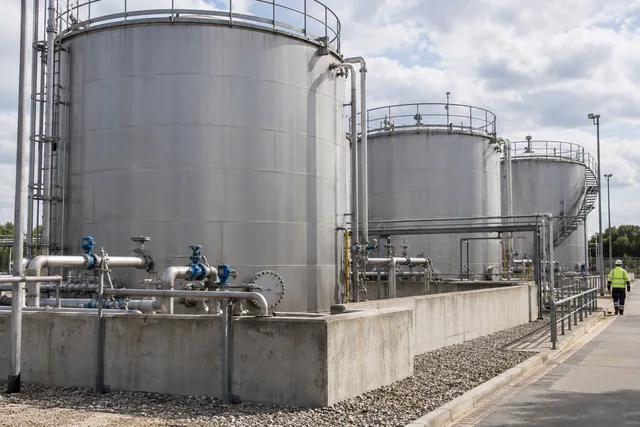
Existing SHAREhub photographic illustration. The written fictional case supplies the condition and decision evidence.
Understand the mechanism and the decision
Bulk storage concentrates material that may be released through tank, pipework, connection or operational failures. The credible consequence depends on the substance, quantity, location and release conditions. A large inventory can also sustain a fire or create effects beyond the immediate task.
The assessment needs the actual scenario and connected barriers. A good personal-injury record or an orderly tank yard does not demonstrate control of overfill, loss of containment or escalation. Begin with what could be released, where it could travel and who could be exposed.
Verify the control in the actual task
Use current material, inventory and plant information and identify the responsible review of prevention and mitigation.
Practical guide: Tank overfill protection is a complete function
Learning point: Show the receipt decision from inventory to final stop action. A normal display cannot establish that a separate protective function is healthy.
INVENTORY: Wrong product, receiving capacity or line-up can challenge the tank before an alarm is ever useful. Verify the actual receipt.
NORMAL CONTROL: A level gauge supports operation, but its normal display does not substitute for required independent overfill protection.
PROTECTIVE FUNCTION: Trace sensing, logic, power and the final stop action. Test/bypass configuration and shared dependencies affect the claimed protection.
CONSEQUENCES: Containment, bunding, ignition control and emergency arrangements address release and escalation. They do not excuse unverified primary protection.
The hazard is not just the chemical name. The same liquid can behave differently depending on flash point, vapour pressure, temperature, fill rate, tank geometry, ventilation, containment, weather, drainage, contamination and ignition sources. Large inventory also means that a slow release can still become a major event if it is not detected or isolated.
Flammable liquids can produce vapours that travel, collect in low areas or form large clouds under some conditions. Toxic or corrosive substances may require additional exposure and emergency controls. Environmentally harmful liquids can spread through drains, soil and watercourses if secondary and tertiary containment fail.
Tank farms also create hazards during maintenance: hot work, confined spaces, sludge, residues, pyrophoric deposits, vapours, cleaning, isolation and simultaneous operations.
Pool fire. Released flammable liquid ignites and burns in a bund, tank top or transfer area. Containment, ignition control, foam, drainage and emergency response.
Vapour cloud explosion. Large flammable vapour cloud forms and ignites after dispersal. Overfill prevention, detection, separation and ignition control.
Tank fire. Floating roof, rim seal, vent, lightning or hot work event ignites vapour. Roof/seal inspection, earthing, fire protection and lightning protection.
Environmental release. Liquid or contaminated firewater escapes bunds or drains. Bunds, valves, interceptors, tertiary containment and emergency drainage.
Structural failure. Corrosion, settlement, brittle fracture or overpressure causes tank failure. Integrity management, inspection, design review and repair control.
Toxic exposure. Toxic vapour, mist or liquid exposes workers/responders/public. COSHH, detection, exclusion zones, RPE and emergency planning.
Applied case
A review accepts a tank operation solely because no one has been injured in the yard.
Test the assumption
Only a brighter personal-safety notice. This does not establish acceptance. Personal-safety history cannot establish control of a major release scenario.
Evidence before acceptance
Use current material, inventory and plant information and identify the responsible review of prevention and mitigation.
Test your decision
Which evidence is missing?
Nothing if injury records are good.
Scenario-specific containment, transfer and escalation-control evidence.
Only a brighter personal-safety notice.
Compare the explanation
Scenario-specific containment, transfer and escalation-control evidence.
Personal-safety history cannot establish control of a major release scenario.
Verify the actual receiving destination and capacity
Verify the actual receiving destination and capacity.
Existing SHAREhub photographic illustration. The written fictional case supplies the condition and decision evidence.
Understand the mechanism and the decision
A transfer needs a confirmed material and destination, including the current receiving condition and suitable capacity. An old plan, a similar tank name or a remembered stock figure may not match the intended operation. An error can introduce overfill or a wrong-material event.
Capacity is a verified task requirement, not a universal fill allowance from training. The operator must use the approved information and checks for the actual system. If evidence conflicts, hold the proposed transfer and reconcile it before connection or release through the site arrangements.
Verify the control in the actual task
Check the source, route, destination and current authorised information together; document the accepted boundary and remaining restrictions.
What should happen when the delivery note and receiver identity disagree?
A discrepancy in product, receiver or available capacity is a hold point before flow. A familiar bay, compatible-looking coupling or verbal assurance cannot settle a conflicting identity. Establish the intended material, destination and route with the people authorised to verify them. Related guidance: Storage of flammable liquids in tanks (HSG176, 2nd edition, 2015).
In an illustrative flammable-liquid delivery, the driver’s paperwork names Tank A while the current site schedule says Tank B. A connection nearby carries an old label. The operator holds connection/start and the supervisor secures the affected bay. They reconcile the delivery, tank identity, pipe route and operating state with competent site information; no small test quantity is transferred to discover the destination. Related guidance: Storage of flammable liquids in tanks (HSG176, 2nd edition, 2015).
The competent operating team verifies capacity using reliable current stock/level information and the planned delivered quantity, with the system’s required allowance. It checks that the intended overfill and shutdown barriers are available, suitable and supported by the specified functional evidence. This page supplies no universal percentage fill limit or permission to bypass an unreliable gauge or protection device. Related guidance: Storage of flammable liquids in tanks (HSG176, 2nd edition, 2015).
Before restart, the site and driver confirm the resolved receiver/product, compatible hose/coupling, applicable bonding/earthing and ignition controls, prevention of vehicle movement, monitoring and the emergency stop route. The technical details must follow the actual system and assessed procedure. HSG176 concerns flammable-liquid tank storage; it is not a universal procedure for every chemical, gas or marine/rail transfer. Related guidance: Storage of flammable liquids in tanks (HSG176, 2nd edition, 2015).
If the discrepancy cannot be resolved, keep the delivery held and communicate the safe waiting or rescheduling decision. Hand-back records the actual transfer state, disconnected/secured interfaces within the site method, remaining restrictions and corrected identification. The manager investigates why obsolete information reached the bay and verifies that the next shift and haulier receive the corrected instruction. Related guidance: Storage of flammable liquids in tanks (HSG176, 2nd edition, 2015).
Treat overfill prevention as a complete protective function
Treat overfill prevention as a complete protective function.
Receiving capacity, correct routing, level information and the specified protective response must work together. Secondary containment limits consequences; it does not authorise overfilling.
Understand the mechanism and the decision
Overfill prevention connects detection, decision and an effective response before the specified limit is exceeded. Different functions may share instruments, power, communications or final elements. Their independence and suitability require the technical basis; two display labels do not establish it.
A failed or inhibited function must be managed through the actual impairment arrangements. Additional watching or verbal reassurance is not automatically an adequate substitute. The responsible review must decide whether the affected transfer is permitted and what restrictions or restoration are required.
Verify the control in the actual task
Verify current protective status, operating restrictions and the acceptance authority before release; this course does not specify level settings or protective-system design.
Overfill prevention is a complete function
Receiving capacity, correct routing, level information and the specified protective response must work together. Secondary containment limits consequences; it does not authorise overfilling.
Fictional learning example
Separate the evidence from the decision
Part of the picture
What the example establishes
Route
The intended receiving tank has been named but the actual line-up is not yet confirmed.
Capacity
The available safe receiving capacity and transfer quantity need reconciliation.
Protection
A high-level indication alone does not establish that the required stop function is available.
Pause and decide: Would an empty-looking bund resolve those missing checks?
Compare the reasoning
No. Complete the specified pre-transfer checks and resolve uncertainty through the responsible roles. Check the whole protection path and dependencies. Preserve the suitable venting, containment, drainage and emergency arrangements for the actual tank and material.
How should overfill prevention be managed?
Overfill prevention should use reliable level information, defined operating limits and independent protection for high-consequence tanks. See HSE Buncefield incident resources
Overfill prevention starts before the pump starts. The operator should know the receiving tank, current level, safe filling limit, expected transfer volume, flow rate, source of material, route, valve line-up, alarm response and emergency stop method. If any of that information is uncertain, the transfer should not be treated as routine.
Normal level gauging is not enough for high-consequence overfill scenarios. Buncefield learning drove attention to independent automatic overfill prevention systems, proof testing and independence from the tank gauging system. The key question is whether the protection would actually stop flow before dangerous loss of containment if the normal system failed.
Alarm response must also be designed. An alarm that nobody hears, understands, trusts or has time to act on is not a strong barrier. It needs a clear set point, priority, response time, trained people and evidence from drills or tests.
Tank capacity check. Confirms the tank has enough ullage for the planned transfer. Pre-transfer checklist and independent verification where required.
Level gauging. Shows normal operating level. Calibration, maintenance and operator checks.
High-level alarm. Warns before a dangerous level is reached. Alarm test, response procedure and alarm rationalisation.
Independent high-high protection. Stops or prevents filling if normal controls fail. Proof testing, independence check and SIL/functional safety records where relevant.
Transfer supervision. Detects abnormal rate, unexpected level change or communication failure. Operator rounds, logs and handover.
Emergency shutdown/isolation. Stops incoming flow quickly. ESD test, valve proof test and drill evidence.
Applied case
A required overfill function is unavailable; a team suggests monitoring the normal level display instead.
Test the assumption
Assume a second person watching creates equivalent protection. This does not establish acceptance. A substitute needs a justified accepted basis, not an assumption of equivalence.
Evidence before acceptance
Verify current protective status, operating restrictions and the acceptance authority before release; this course does not specify level settings or protective-system design.
Test your decision
What is the defensible decision?
Assume a second person watching creates equivalent protection.
Ignore the function because the vessel has not overflowed before.
Obtain the authorised impairment and transfer-readiness decision for the actual protective requirements.
Compare the explanation
Obtain the authorised impairment and transfer-readiness decision for the actual protective requirements.
A substitute needs a justified accepted basis, not an assumption of equivalence.
Photorealistic illustrative UK workplace scene. Review checks: Change at source: Avoid an unnecessary bulk receipt or reduce the inventory by direct supply where the process and supply resilience allow; compare transport frequency and total risk, not just tank volume. Make it observable: Process engineer documents inventory and scenario reduction; stop design approval if off-site or transfer risk is merely displaced. Keep useful evidence: Keep test result, impairment, transfer authorisation, lineup and hand-back.
Understand the mechanism and the decision
A tank may need a designed means to accommodate pressure or vacuum changes during filling, emptying and other conditions. An obstruction, unsuitable modification or impaired component can challenge containment. A tank shell that looks sound does not establish that its venting arrangement is adequate.
The required arrangement depends on the vessel, material and process basis. Awareness learners should report concerns and obtain the responsible inspection or restriction, rather than removing components or inventing a vent modification. Maintenance and replacement must retain the intended function and current technical information.
Verify the control in the actual task
Identify the asset and change, keep its status visible and follow the competent maintenance/change-control route.
How should vents and floating roofs be controlled?
Atmospheric tanks still need venting. Normal breathing, filling, emptying, temperature change and emergency conditions can create pressure or vacuum. Blocked vents, undersized vents, flame-arrester problems or incorrect fittings can damage tanks or release vapour unsafely.
Floating roofs reduce vapour space but introduce their own failure modes: roof sinking, seal damage, pontoon leaks, blocked drains, rim seal fires, lightning vulnerability and inspection access. These are safety-critical where the contents are flammable.
Inspection should focus on the roof, seals, drains, legs, pontoons, vents, emergency relief, corrosion, settlement and any change that affects vapour control.
Normal vents. Pressure/vacuum damage or uncontrolled vapour release. Sizing, inspection and blockage checks.
Emergency vents. Tank failure during fire exposure or abnormal pressure. Design basis and maintenance.
Flame arresters. Blocked flow or ineffective flame protection. Inspection and cleaning schedule.
Floating roof seals. Vapour release and rim seal fire. Seal inspection and repair.
Roof drains. Roof loading, sinking or contamination. Drain inspection and rainfall checks.
Lightning/earthing. Ignition of vapour at tank roof or fittings. Earthing/bonding inspections and lightning protection checks.
Applied case
A temporary cover is fitted over an opening associated with a tank vent, but its acceptance is unconfirmed.
Test the assumption
Only whether the cover keeps rain out. This does not establish acceptance. A weather measure can affect a protective function; an improvised response is not a design basis.
Evidence before acceptance
Identify the asset and change, keep its status visible and follow the competent maintenance/change-control route.
Test your decision
What must be resolved?
Whether a worker can remove it during filling if needed.
The effect on the specified venting function and the authorised operating condition.
Only whether the cover keeps rain out.
Compare the explanation
The effect on the specified venting function and the authorised operating condition.
A weather measure can affect a protective function; an improvised response is not a design basis.
Understand what secondary containment does and does not prove
Understand what secondary containment does and does not prove.
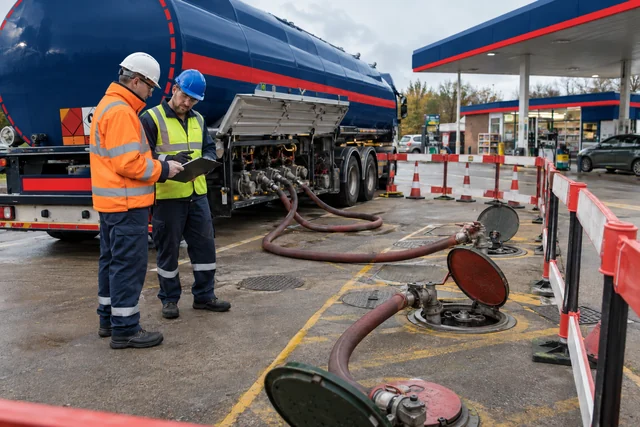
Photorealistic illustrative UK workplace scene. Review checks: Setting: A road tanker is due at a depot tank. Act: Hold unloading, verify product, receiving tank, ullage and all required protection status; quarantine the transfer route if the independent trip is unavailable. Hold / review: Do not begin a high-rate transfer on the gauge alone, an untested trip, unknown tank capacity or an unresolved bypass.
Understand the mechanism and the decision
Secondary containment can limit the spread of a release within its assessed basis. It does not mean the primary containment may be ignored, and it does not remove every vapour, fire or environmental consequence. Its condition and connections matter to its function.
Drains, penetrations, accumulated contents and changes in use can affect the barrier. An open drain may provide a pathway out of the intended containment. The required position, control and verification come from the actual design and site arrangements; do not apply a generic training instruction to operate drainage.
Verify the control in the actual task
Ask what the specified containment must achieve and which current observations, records and acceptance establish that function.
What does a bund prove after a release?
A bund is a secondary containment barrier, not permission to overfill a tank. Check the site-specific capacity basis, integrity, penetrations, drain valve position, rainfall management, material compatibility and whether a spill can bypass containment or spread between tanks. See HSE HSG176 storage of flammable liquids in tanks
Do not assume a single generic percentage is sufficient for every installation or substance. A competent engineer must check the applicable environmental and fire-safety basis, local authority requirements and emergency scenario.
Applied case
A bund drain is open while the proposed transfer-readiness pack assumes containment is available.
Test the assumption
Assume the bund wall alone guarantees containment. This does not establish acceptance. Follow the complete release pathway rather than the visible wall alone.
Evidence before acceptance
Ask what the specified containment must achieve and which current observations, records and acceptance establish that function.
Test your decision
What is the relevant decision?
Resolve the containment impairment and required operating restriction before the affected task is released.
Assume the bund wall alone guarantees containment.
Treat drainage as unrelated because it is outside the transfer hose.
Compare the explanation
Resolve the containment impairment and required operating restriction before the affected task is released.
Follow the complete release pathway rather than the visible wall alone.
Check hose and connection suitability through the specified system
Check hose and connection suitability through the specified system.
Photorealistic illustrative UK workplace scene. Review checks: Avoid / redesign: Avoid unnecessary transfer or redesign to a closed fixed connection. Control the task: Closed hose, correct coupling, earthing/overfill and emergency stop. Verify before release: Process owner reviews feasibility; unassessed change held.
Understand the mechanism and the decision
A transfer hose or connection needs to be suitable for the material and service and remain in the required condition. A matching coupling or recent appearance is not the entire evidence. Routing and support can also expose a hose to movement, impact or unintended loads.
Use the approved inspection and task-readiness checks, including relevant defect and maintenance status. Do not prove integrity by touching a suspected leak or running an unreviewed pressure trial. A damaged or uncertain component needs the defined defect response and responsible assessment.
Verify the control in the actual task
Trace the hose record and actual route, then obtain the responsible decision for any unresolved limitation.
What barriers should be healthy before transfer starts?
A transfer starts only when the product, route, connection, receiver and stop system are independently confirmed.
HSE HSG176 gives specific guidance for flammable liquid tank transfer, including earthing, overfill protection and preventing movement while connected. HSE loading guidance applies to vehicle stability, exclusion and safe load movement. Select the barriers for the product and facility; marine, gas and general pallet handling may require different controls.
At a road-tanker bay, one person verifies the delivery note against tank identity and capacity, another confirms line-up as the method requires, and the operator tests the emergency stop path. Any leak, unexpected level trend, lost earth connection or driver movement attempt stops transfer and triggers the site response.
Prevent the wrong connection rather than detect it after release
Prevent the wrong connection rather than detect it after release.
Photorealistic illustrative UK workplace scene. Review checks: Change at source: Avoid unnecessary transfer or redesign to a closed fixed connection. Make it observable: Process owner reviews feasibility; unassessed change held. Keep useful evidence: Process owner reviews feasibility; unassessed change held.
Understand the mechanism and the decision
Transfers join systems that may otherwise be separate. A wrong connection can send material to an unsuitable receiver or introduce incompatibility. The control needs to address identification and error prevention across the complete source-to-destination route.
A person verifying a route needs reliable current information and access to the required checks. Memory, hose colour or habit may fail after a routing change. The task must not proceed on conflicting information simply because the team expects a familiar result.
Verify the control in the actual task
Compare the connection with the current transfer plan and maintain a clear stop/escalation route if identities or conditions disagree.
Why are loading, unloading and transfer operations high risk?
Transfers combine hazardous inventory, temporary connections, human line-up decisions, vehicles, pressure, static, movement and changing conditions.
Best-practice guide · six simple steps
Best-practice guide: Loading, Unloading and Transfer Operations
Start with the key actions, then explore value, a workplace example, harm, stronger controls and further help. Choose a step or use Previous and Next; the guide does not advance automatically.
Keep one card or the full set for social sharing, team briefings and learning. Each PDF contains one card per page. Read the full topic for explanations, questions and source links.
Read all six steps as text
1. Why are loading, unloading and transfer operations high risk?
Transfers combine hazardous inventory, temporary connections, human line-up decisions, vehicles, pressure, static, movement and changing conditions.
Avoid / redesign: Avoid unnecessary transfer or redesign to a closed fixed connection.
Control the task: Closed hose, correct coupling, earthing/overfill and emergency stop.
Verify before release: Process owner reviews feasibility; unassessed change held.
Transfers combine hazardous inventory, temporary connections, human line-up decisions, vehicles, pressure, static, movement and changing conditions. Loading, unloading and transfer need controls for the actual load and interface.
Apply it: Which part of this plan would you check at the workface before authorising the task?
2. Turn loading, unloading and transfer operations knowledge into a decision
Use the evidence to improve the actual work arrangement.
Change at source: Avoid unnecessary transfer or redesign to a closed fixed connection.
Make it observable: Process owner reviews feasibility; unassessed change held.
Keep useful evidence: Process owner reviews feasibility; unassessed change held.
Loading, unloading and transfer need controls for the actual load and interface. For hazardous-liquid transfer, identify the product, route and receiver, immobilise the vehicle, verify hoses/couplings, level or overfill protection and emergency isolation, then supervise start, steady transfer and shutdown. Process owner reviews feasibility; unassessed change held.
Apply it: What evidence would show that the change improves this task, rather than only completing a record?
Fictional example: a delivery arrives while the unloading bay is occupied.
Find: Pedestrians and vehicles would share the proposed unloading area.
Hold: Keep the load secured while host and driver agree a protected arrangement.
Release: Use the planned unloading method and restore access after hand-back.
The host and driver coordinate the delivery rather than leaving the driver to improvise. Check the load, ground, vehicle, equipment, pedestrian separation and responsibilities before release. Review a changed load or route through the actual task plan.
Apply it: Who controls the unloading area, and what proves pedestrians are separated before the load moves?
Connect the task, the route to the person and the control that can fail.
Vehicle: Unplanned movement can trap or strike people at the loading area.
Load: An unstable or unsecured load can shift, fall or overturn equipment.
Transfer: A failed connection or incompatible product can create a separate substance exposure.
Unplanned movement can trap or strike people at the loading area. An unstable or unsecured load can shift, fall or overturn equipment. A failed connection or incompatible product can create a separate substance exposure. Use the full topic for the detailed mechanism, task limits and source scope.
Apply it: Where is this harm route present in the actual work, and which control breaks it before anyone is exposed?
5. Choose controls for loading, unloading and transfer operations
Start with the stronger practicable options and verify their effect.
Eliminate: Avoid unnecessary transfer or redesign to a closed fixed connection.
Reduce: Use a less hazardous compatible product or smaller batch where possible.
Isolate: Closed hose, correct coupling, earthing/overfill and emergency stop.
Control: Product/route cross-check, driver coordination, exclusion and supervised line-up.
PPE: Product-compatible gloves, eye and other residual splash protection.
Eliminate: Avoid unnecessary transfer or redesign to a closed fixed connection. Reduce: Use a less hazardous compatible product or smaller batch where possible. Isolate: Closed hose, correct coupling, earthing/overfill and emergency stop. Control: Product/route cross-check, driver coordination, exclusion and supervised line-up. PPE: Product-compatible gloves, eye and other residual splash protection. Read the full control table for qualifications, ownership and verification. Use the actual task and applicable jurisdiction; existing technical approval remains unchanged.
Apply it: Which stronger option can be used here, and who will verify it before accepting the remaining risk?
6. Use the full loading, unloading and transfer operations lesson
Follow the official sources below and retain the task-specific evidence.
Official guidance: Storage of flammable liquids in tanks (HSG176, 2nd edition, 2015)
Official guidance: Visiting drivers
Task decision: Process owner reviews feasibility; unassessed change held.
Use the full topic for the decision points, practical examples, detailed control tables and source scope. HSE guidance applies to Great Britain; use HSENI for the Northern Ireland route and the source’s stated jurisdiction. A simplified guide does not change the page’s technical-review or approval status.
Apply it: Which official source and full-topic section will you use to resolve the next decision?
Simplified learning guide. Use the full topic, current official guidance and the actual work arrangements. Workplace scenarios labelled fictional are illustrative examples.
A storage tank, process vessel or pipeline may have fixed safeguards, but transfer operations often depend on temporary hoses, couplings, valves, tanker drivers, loading racks, gantries, paperwork and timing. That makes them vulnerable to wrong connection, overfill, reverse flow, static ignition, hose failure, incompatible materials, vehicle movement, spill spread, vapour cloud formation and delayed emergency response.
For process safety, the question is not only whether someone could be injured during the task. The deeper question is whether a transfer could cause a major accident: loss of containment, flammable vapour cloud, toxic release, fire, explosion, environmental release or escalation to nearby plant. Routine transfers can become dangerous because people become familiar with them and weak signals are normalised.
Before a hazardous transfer, the operator confirms the substance and receiving tank, verifies the line-up, starts flow under supervision, watches level and leak indications, stops on an abnormal signal, then isolates, disconnects and hands back the bay. Each stage has a named owner and a hold point. For ordinary freight, vehicle restraint, stable load and pedestrian segregation are the principal checks.
In this page, LPG means liquefied petroleum gas, IBC means intermediate bulk container, ESD means emergency shutdown, SDS means safety data sheet, MOC means management of change, and SIMOPS means simultaneous operations. Product-specific controls must be chosen from the actual substance and task.
Coordinate vehicle movement with the connected transfer
Coordinate vehicle movement with the connected transfer.
Photorealistic illustrative UK workplace scene. Review checks: Find: Pedestrians and vehicles would share the proposed unloading area. Hold: Keep the load secured while host and driver agree a protected arrangement. Release: Use the planned unloading method and restore access after hand-back.
Understand the mechanism and the decision
A connected vehicle, hose and fixed installation form one task boundary. Movement, access conflicts or simultaneous work can introduce mechanical loads, damage or distraction. A competent driver alone cannot control every interface at the receiving site.
The plan should define responsibilities, communication and the accepted movement state during the task. Protecting an exclusion or access route is a physical arrangement, not simply asking everyone to be careful. Any change needs to be reconciled before the affected operation continues through its authorised arrangements.
Verify the control in the actual task
Verify that the accepted route and communication work under the actual delivery conditions and that all parties know who can stop the task.
Where do transfer operations commonly fail?
Common failures are rarely one-person mistakes; they usually reflect unclear design, weak procedure, poor supervision or degraded barriers.
Wrong connection, overfill and delayed response often happen because the system makes error too easy: similar couplings, unclear line labels, poor lighting, noisy alarms, pressure to unload quickly, driver/operator role confusion, unclear ownership of emergency stop, or procedures that do not match the equipment in the field.
Human factors controls should make the safe action obvious and the unsafe action difficult. That means unique or keyed couplings where practicable, clear labels, physical barriers, independent checks for critical steps, usable transfer logs, realistic staffing, clear alarm response logic and handover standards for interrupted transfers.
Two lines or couplings look alike and the wrong route is selected.
Unique fittings, colour coding, physical segregation and independent check.
Time pressure
Driver or operator rushes line-up, earthing or level checks.
Realistic unloading windows, supervisor challenge and stop-work authority.
Alarm without action
Detector or level alarm sounds but response is delayed or unclear.
Alarm response instruction, training, drills and escalation rules.
Poor handover
Transfer paused and restarted by another person without understanding status.
Handover log, lock/hold point and restart verification.
Procedure drift
People use shortcuts because the written process is too slow or impractical.
Field-verify procedure and redesign the control, not just retrain people.
Applied case
Another delivery requests passage through an area occupied by a connected tanker and its hose route.
Test the assumption
Ask the second driver to squeeze past slowly. This does not establish acceptance. Control the interface through separation and coordination, not shared attention alone.
Evidence before acceptance
Verify that the accepted route and communication work under the actual delivery conditions and that all parties know who can stop the task.
Test your decision
What is the defensible coordination decision?
Hold the conflicting movement and obtain a workable authorised separation arrangement.
Ask the second driver to squeeze past slowly.
Rely on the connected driver noticing every approaching person.
Compare the explanation
Hold the conflicting movement and obtain a workable authorised separation arrangement.
Control the interface through separation and coordination, not shared attention alone.
Make the transfer handover two-way and state-specific
Make the transfer handover two-way and state-specific.
Existing SHAREhub 2D teaching schematic. Use alongside the explanation and fictional case in this lesson.
Understand the mechanism and the decision
A useful handover identifies the material, actual route, receiving state, progress and remaining restrictions. A list of planned tasks is incomplete if it does not explain what has changed or which protective functions are unavailable.
The incoming role must be able to question discrepancies and confirm the accepted state. Signing a form without resolving a difference does not establish agreement. Where the plan has changed, reconcile it with the live information through the responsible system rather than using either account as a guess.
Verify the control in the actual task
State which information is confirmed, what remains open and the authorised next decision; retain the existing restriction until that decision is supported.
What evidence should be available for transfer operations?
Evidence should prove the transfer system is safe today, not just that a procedure exists.
Assurance follows one actual transfer: product and tank identity, vehicle immobilisation, hose test, barrier functional check, start authorisation, level trend, stop event and hand-back. Sample records and observe the bay; a signed form alone does not prove the connection was right.
Evidence
What it should show
Failure to challenge
Transfer procedure
Correct sequence for line-up, transfer, monitoring, abnormal response and handback.
Procedure differs from field equipment.
Barrier register
Critical safeguards, owners, tests, impairments and performance standards.
No owner for overfill or ESD protection.
Hose/coupling register
Compatibility, inspection, testing, service life and defect control.
Hoses stored badly or used beyond inspection date.
dangerous-substances fire/explosion assessment
Explosive atmosphere formation, ignition control and emergency mitigation.
Area classification not matched to actual transfer conditions.
Training and authorisation
Operators, drivers, supervisors and contractors know critical steps.
Generic induction with no transfer-specific assessment.
Incident and weak-signal review
Leaks, drips, alarms, near misses and aborted transfers are trended.
Small leaks normalised as housekeeping problems.
Applied case
The incoming operator has the old tank route while the outgoing team describes a revised destination.
Test the assumption
Choose the newest verbal account without a check. This does not establish acceptance. A two-way exchange must resolve the safety-critical discrepancy.
Evidence before acceptance
State which information is confirmed, what remains open and the authorised next decision; retain the existing restriction until that decision is supported.
Test your decision
What should happen before accepting the next transfer step?
Choose the newest verbal account without a check.
Sign both records and let the next shift decide later.
Reconcile the current route and plant state through the required handover and review.
Compare the explanation
Reconcile the current route and plant state through the required handover and review.
A two-way exchange must resolve the safety-critical discrepancy.
Respect residual material and isolation boundaries
Respect residual material and isolation boundaries.
Existing SHAREhub 2D teaching schematic. Use alongside the explanation and fictional case in this lesson.
Understand the mechanism and the decision
Maintenance and line opening can expose people to trapped pressure, residual liquids or material connected from elsewhere. A stopped pump or closed valve does not prove a complete safe isolation. The condition depends on the actual system and specified verification.
Work-control and competent isolation arrangements need to identify the task boundary and all relevant sources. An awareness learner should recognise a mismatch or missing evidence and obtain the responsible review, not select a generic valve sequence or open a line to discover its contents.
Verify the control in the actual task
Keep the maintenance boundary and operating status explicit in the handover; specialist work authority is separate from this course.
How should tank integrity and maintenance be assured?
Mechanical integrity is a core barrier. Tanks can degrade through internal corrosion, external corrosion, corrosion under insulation, settlement, foundation movement, roof damage, seal failure, nozzle stress, brittle fracture, fatigue, erosion, microbial corrosion, previous poor repair or change of service.
Inspection should be planned by competent people using the tank's contents, age, construction, inspection history, degradation mechanisms and consequence of failure. Deferrals and temporary repairs need risk assessment, expiry dates and authority.
A strong tank integrity system links inspection findings to decisions: keep in service, repair, reduce operating limit, increase monitoring, change inspection interval, decommission or replace. It also keeps corporate memory, so future managers understand why decisions were made.
Tank register. Identity, contents, design, capacity and safety-critical status. Controlled tank inventory.
Existing SHAREhub 2D teaching schematic. Use alongside the explanation and fictional case in this lesson.
Understand the mechanism and the decision
A suspected release can create exposure, ignition, environmental and escalation hazards beyond the visible liquid. The appropriate response depends on the material, source and plant arrangements. A worker cannot establish a safe approach from appearance or odour alone.
Raise the alarm and use the specified protective and emergency arrangements within your role. Do not approach to tighten a live connection, improvise drain operation or remove material to an unassessed route. Responders need clear factual information on location, material, known plant state and people affected.
Verify the control in the actual task
Know the reporting route before the task begins. Recovery and restart need the responsible assessment and verified restoration, not simply a cleaner surface.
How should emergency response be planned for tank farms?
Emergency response should be based on credible tank farm scenarios, not generic fire drills. See HSE COMAH 2015 duties by tier
Tank farm emergencies can require decisions about evacuation, shelter, foam, cooling, isolation, ignition control, environmental containment, mutual aid, public communication and responder safety. A plan that only says “raise alarm and evacuate” is not enough for high-hazard storage.
The emergency plan should consider tank fire, bund fire, vapour cloud, toxic release, overfill, road tanker incident, loss of containment to drainage, escalation between tanks and firewater management. It should include information for emergency services on substances, inventories, layout, isolation points, foam stocks, water supplies and hazards.
Exercises should test decisions, not just attendance. Useful drills ask: who has authority to isolate, when do we evacuate, what if foam is delayed, how do we contain firewater, how do we protect responders, and how do we communicate with neighbours or regulators?
Scenario plan. Specific scenarios for overfill, fire, vapour cloud and environmental release. Emergency plan and scenario register.
Incident command. Clear roles, authority and escalation. Command structure and exercise records.
Foam and water. Suitable supplies, compatibility and deployment routes. Foam stock checks and water supply testing.
Isolation. Known valves, ESD points and remote actions. Isolation maps and drills.
Environmental response. Firewater, drains, interceptors and pollution prevention. Drainage plan and spill response records.
Learning. Exercises produce actions that are tracked and verified. Exercise report and action close-out.
Applied case
Liquid is noticed near a transfer connection while its source and pressure are uncertain.
Test the assumption
Feel around the connection to locate the leak. This does not establish acceptance. An improvised approach or drainage action can increase the consequences.
Evidence before acceptance
Know the reporting route before the task begins. Recovery and restart need the responsible assessment and verified restoration, not simply a cleaner surface.
Test your decision
What should an ordinary worker do?
Use the site alarm and authorised protective response without an unassessed approach.
Feel around the connection to locate the leak.
Open the nearest drain to make the liquid disappear.
Compare the explanation
Use the site alarm and authorised protective response without an unassessed approach.
An improvised approach or drainage action can increase the consequences.
Photorealistic illustrative UK workplace scene. Review checks: Avoid / redesign: Avoid an unnecessary bulk receipt or reduce the inventory by direct supply where the process and supply resilience allow; compare transport frequency and total risk, not just tank volume. Control the task: Specify independent high-level trip separate from routine level indication, suitable venting and intact bund/drain barriers for the receiving tank and transfer rate. Verify before release: Process engineer documents inventory and scenario reduction; stop design approval if off-site or transfer risk is merely displaced.
Understand the mechanism and the decision
Readiness needs a confirmed receiver and route, sufficient receiving capacity, suitable equipment, required protective functions and the intended containment state. Each fact answers a different question. One complete document cannot replace a missing protective function.
In the stated case, a changed receiver conflicts with the handover, overfill protection is impaired and containment evidence does not match the drain condition. The task decision must reconcile those connected limitations. Beginning slowly is not a valid way to establish that the missing barriers are effective.
Verify the control in the actual task
Hand over the verified state, remaining limitations and responsible next decisions. Do not present a course checklist as an operating acceptance.
What must be true before a flammable-liquid transfer starts?
Confirm the receiving tank and product, usable capacity and safe operating limit, route lineup, level indication, alarm and independent overfill protection status, communication, transfer rate and emergency stop. An operator must know who may authorise start and who can halt transfer. See HSE HSG176 storage of flammable liquids in tanks
If level measurement and independent protection share a failure mode or a protection proof test is overdue, do not treat a healthy-looking display as proof. Restrict or stop transfer until a competent barrier owner verifies the required function or a formally assessed bounded alternative.
Applied case
A delivery is ready while the changed route, impaired overfill function and bund condition remain unresolved.
Test the assumption
Start slowly because the driver is waiting. This does not establish acceptance. The release decision requires the actual control chain, not schedule pressure or one favourable record.
Evidence before acceptance
Hand over the verified state, remaining limitations and responsible next decisions. Do not present a course checklist as an operating acceptance.
Test your decision
What is the defensible release decision?
Start slowly because the driver is waiting.
Accept the route record as proof that all protection is healthy.
Keep the affected transfer unreleased until the integrated review and required verification establish an accepted condition.
Compare the explanation
Keep the affected transfer unreleased until the integrated review and required verification establish an accepted condition.
The release decision requires the actual control chain, not schedule pressure or one favourable record.