
Chilled pie production and food safety / Food safety, receipt, traceability and chilled dispatch
Chilled pie production and food safety · SH-PIE-01Food safety, receipt, traceability and chilled dispatch
Free online training · Approximate learning time: 120–180 minutes · Self-paced
Protect the chain from the arriving ingredient to the released delivery.
Full public teaching and readers are free without an account. A free learner account is required for saved LMS progress and recorded assessment. Completion and any course-completion certificate depend on the configured LMS conditions.
Who this course is for
Goods-in, production, hygiene, storage and dispatch teams and their supervisors.
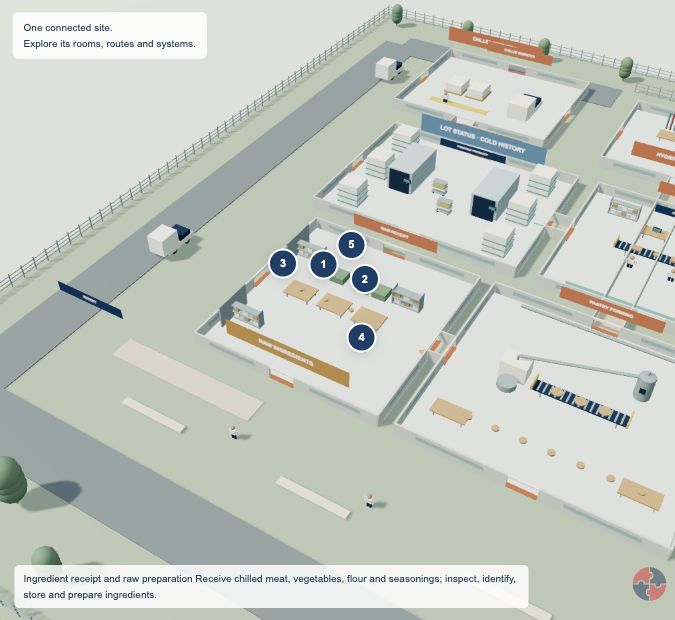
Follow identified ingredients, raw/cooked movements, returned trays and chilled pallets. Use the existing FOOD model to practise observations and decisions, then apply the evidence to receipt, hold and dispatch cases.
Food-manufacturing awareness using a fictional pie factory. No product acceptance, process-validation, withdrawal or recall authority is conferred. Check the nation, product, food-business approval and destination-market requirements with the competent team.
Learning outcomes
- Map contamination, survival and growth through the actual food flow.
- Identify reliable receipt, hygiene-boundary and vehicle-readiness evidence.
- Maintain effective hold and traceability links through a shift change.
- Explain when product remains controlled pending the responsible release or incident decision.
Course outline
Understand the food journey
- Follow the food, then identify the safety decisionMap contamination, survival and growth through the receipt-to-dispatch flow.
- Receive chilled ingredients using evidence, not reassuranceMake a bounded receipt decision when the cold-chain history is incomplete.
Control receipt and hygiene boundaries
- Protect the raw-to-cooked boundary during real movementsTrace indirect contamination routes and restore segregation without overlooking affected product.
- Keep returned trays out of clean circulationUse identification, layout and verified cleaning to control transport-container returns.
Protect clean equipment and chilled stock
- Make the vehicle ready before chilled stock leaves controlCoordinate storage, loading and vehicle readiness without inventing an exposure allowance.
- Make holds and traceability survive a busy handoverReconcile ingredient, finished-lot and dispatch information before release or incident escalation.
- Unverified chilled ingredient deliveryExplain the decision using the observed condition, the harm route and the evidence needed for release.
- Raw-material trolley crosses the cooked boundaryExplain the decision using the observed condition, the harm route and the evidence needed for release.
- Chilled goods staged for an unready vehicleExplain the decision using the observed condition, the harm route and the evidence needed for release.
Trace, hold and communicate
- Held lot released through an incomplete traceExplain the decision using the observed condition, the harm route and the evidence needed for release.
- Dirty returned transport trays enter clean circulationExplain the decision using the observed condition, the harm route and the evidence needed for release.
Integrate evidence before dispatch
- One delivery, two pallet histories and a disputed releaseDefend a coherent receipt-to-dispatch decision using bounded evidence and named authority.
- Take a verified action into the workplaceConnect one actual task to an owner, evidence and a clear release or escalation decision.
Activities, model practice and assessment
Work through 5 required applied activities and 3 model-practice pauses, with explanatory feedback and independent lesson decisions. Complete 5 distinct model mission sequences across those pauses. Use the actual fictional pie factory model or its equivalent accessible route to complete the required decision sequences; launching the model alone does not complete practice.
The 20-question assessment requires at least 80% plus every designated critical safety answer. Complete the required activities, practice and lesson checks. Points and badges cannot offset a critical safety error.
Use the LMS for confirmed save/resume and recorded results. Any certificate follows its configured passed-completion and grade conditions.
Open the public interactive practice copy; public practice is separate from the LMS record.
Sources and learning provenance
Original fictional cases are paired with public SHAREhub teaching and structured topic records. Use the applicable jurisdiction and primary guidance for live work.
- FSA: managing food safety
- Government: Hazard Analysis and Critical Control Point
- FSA MyHACCP: prerequisite requirements
- FSA: avoiding cross-contamination
- Government: food-business chilling and freezing
Topic sections, source identities and versions
| Public topic | Chunk and version | Jurisdiction and sources |
|---|---|---|
| food-safety · haccp-flow | food-safety--haccp-flow 20261016-letter-review-1 | England, Wales, Northern Ireland, Scotland govuk-food-hygiene-businesses, food-business-guidance-hazard-analysis-and-critical-control-point-haccp, foodstandards-running-a-food-business-food-hygiene, food-business-guidance-allergen-guidance-for-food-businesses |
| food-safety · haccp | food-safety--haccp 20261016-letter-review-1 | England, Wales, Northern Ireland, Scotland food-business-guidance-hazard-analysis-and-critical-control-point-haccp, foodstandards-publications-cooksafe-guide |
| food-safety · temperature | food-safety--temperature 20261016-letter-review-1 | England, Wales, Scotland, Northern Ireland govuk-food-hygiene-businesses-chilling-and-freezing, foodstandards-downloads-guidance-on-temperature-control-legislation-pdf |
| food-safety · records | food-safety--records 20261016-letter-review-1 | England, Wales, Northern Ireland, Scotland govuk-food-hygiene-businesses, food-business-guidance-hazard-analysis-and-critical-control-point-haccp, foodstandards-running-a-food-business-food-hygiene, food-business-guidance-allergen-guidance-for-food-businesses |
| food-safety · controls | food-safety--controls 20261016-letter-review-1 | England, Wales, Northern Ireland, Scotland food-business-guidance-hazard-analysis-and-critical-control-point-haccp, food-business-guidance-allergen-guidance-for-food-businesses, foodstandards-running-a-food-business-food-hygiene |
| personal-hygiene-and-wellbeing · contamination-pathways | personal-hygiene-and-wellbeing--contamination-pathways 2.0 | Great Britain source-hse_coshh, source-hse_skin_at_work, source-hse_workplace_facilities |
| occupational-foodborne-illness · evidence-pack | occupational-foodborne-illness--evidence-pack 2.3 | Great Britain, Northern Ireland fsa-fitness, gov-food-hygiene, gov-traceability |
Course SH-PIE-01 · version 2026.10.20.1. .
Questions about this course
Is this training free?
Full public teaching and readers are free without an account. A free learner account is required for saved LMS progress and recorded assessment. Completion and any course-completion certificate depend on the configured LMS conditions.
How long should I allow?
Approximately 120–180 minutes, including teaching, lesson checks, required activities, model or accessible practice and one assessment attempt. Individual pace, review and retries vary. Save and resume in the LMS.
Can I learn without a 3D-capable browser?
Yes. The complete HTML reader provides the teaching. Required model practice has an equivalent accessible decision route in the interactive course. Use the LMS route for recorded learning.
What is required to pass?
Complete the required learning, activities, practice and lesson decisions. The 20-question final assessment requires at least 80% plus every designated critical safety answer. Points cannot compensate for a critical safety error. Follow the feedback before retrying.
Does this authorise factory operations?
Food-manufacturing awareness using a fictional pie factory. No product acceptance, process-validation, withdrawal or recall authority is conferred. Check the nation, product, food-business approval and destination-market requirements with the competent team. This independent course does not award an external qualification or replace competent task assessment, practical training or site authorisation.