Full public teaching and readers are free without an account. A free learner account is required for saved LMS progress and recorded assessment. Completion and any course-completion certificate depend on the configured LMS conditions. Open the course overview.
Lesson 1
The work description sets the evidence boundary
Check that asbestos information covers the actual intrusive work before it starts.
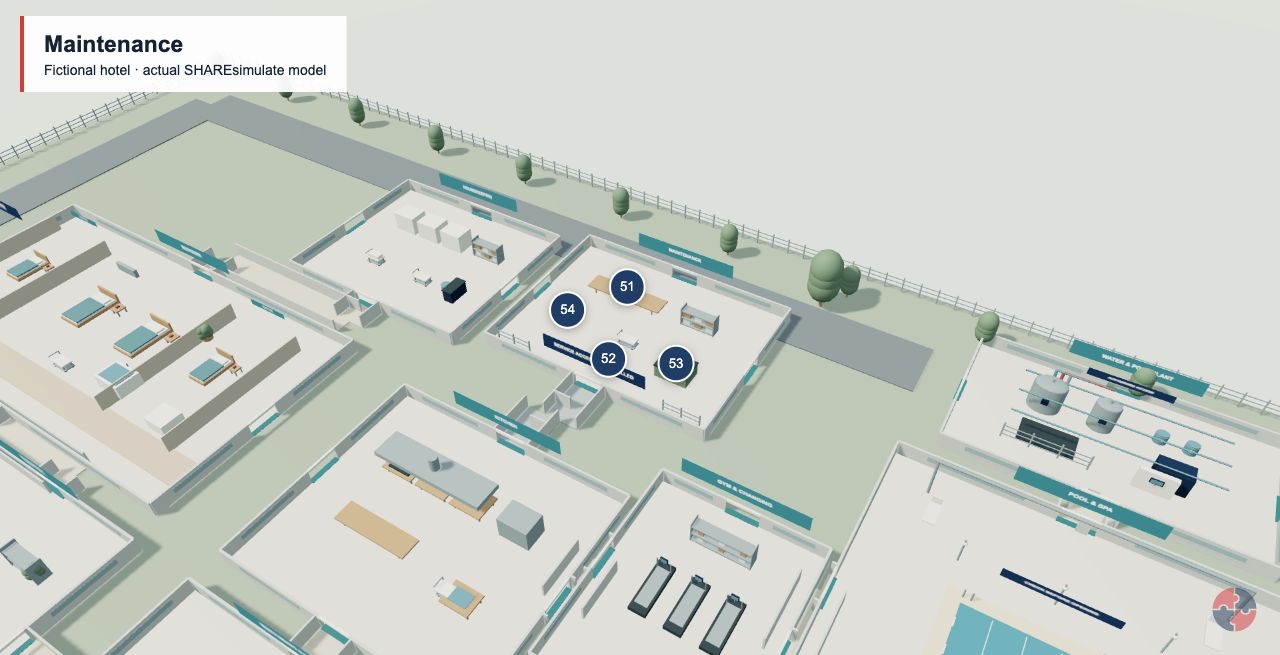
Actual fictional SHAREsimulate hotel model: Maintenance. The stated case supplies the conditions; the image does not prove a defect or control state.
Check exactly what will be disturbed or accessed
Replace a fitting can describe very different work: a surface adjustment, drilling a hidden substrate or opening an inaccessible void. Establish the location, materials, tools, access and foreseeable disturbance before deciding which surveys, isolations, permits or competent contractors are needed.
An asbestos survey has a purpose and coverage. A general management survey or a report with inaccessible areas does not automatically cover intrusive work behind the surface. Stop unconfirmed disturbance, identify the information gap and use the competent asbestos-management route. Awareness training gives no permission to sample or work on suspect material.
Short duration does not make unsuitable access equipment safe. Plan reach, stability, the working position, handling of tools and the space below. Follow the assessed access method and competence requirements; do not improvise from furniture because a guest needs the room quickly.
Work through this separate hotel case
A contractor plans to drill a wall panel that was listed as inaccessible in the available survey.
Apply the same control test whenever the activity, users, product, staffing or conditions change. Use a task-matched asbestos information and survey gate before disturbance, with competent work categorisation, contractor arrangements and controlled hand-back. Check connected areas: Contractor work, building information, maintenance access and waste collection.
Evidence to establish: Compare the precise work footprint and fabric with survey coverage and exclusions. Authorise work only against adequate scope-specific information and verified controls. Compare the proposed exact workface and disturbance with survey coverage, exclusions and sampling evidence; resolve gaps before authorising work.
How should work be planned so asbestos dust is not created?
Planning should identify or presume asbestos before work starts and prevent uncontrolled disturbance.
The best asbestos dust control is a hold point before intrusive work. Drilling, chasing, sanding, cutting, fixing, ceiling access, floor lifting, plant stripping and demolition should not start until the asbestos information matches the actual work area and method. A management survey may support normal occupation, but intrusive refurbishment or demolition work needs more intrusive survey information.
Planning should also decide what happens if the work moves outside the planned area. A common failure is survey creep: the surveyed room is clear, but the cable route moves into an unsurveyed riser or the repair expands behind boxing. Stop-work triggers should be written into the method, permit or supervisor briefing.
Where asbestos work is planned, the method needs to be specific. It should identify material type, condition, work category, controls, equipment, respiratory protective equipment, personal protective equipment, cleaning, decontamination, waste route, supervision, emergency action and records.
Planning controls to prevent asbestos dust release - Planning controls to prevent asbestos dust release
Planning control
What it should achieve
Evidence to keep
Survey scope check
Confirm that asbestos information covers the exact work area, void, route, plant or fabric to be disturbed.
Survey brief, report limitations review, marked-up drawings and approval hold point.
Register check
Make known and presumed asbestos information available before work starts.
Register extract, photos, room reference and contractor briefing.
Work-category decision
Decide whether work is no asbestos work, non-licensed, NNLW or licensed.
Competent decision record, plan of work and contractor competence evidence.
Method selection
Choose methods that avoid dry disturbance and prevent fibre spread.
RAMS, task sheet reference, wetting/extraction plan and waste route.
Access control
Keep unauthorised people away from the work and potential contamination area.
Barriers, signage, permits, briefing and supervisor checks.
Stop-work trigger
Make it clear that unexpected suspect material, dust or scope change pauses the job.
Toolbox talk, permit condition and supervisor observation.
A contractor plans to drill a wall panel that was listed as inaccessible in the available survey.
Decision and explanation
Stop intrusive work until suitable competent investigation and task controls are available.
A completed survey does not resolve an excluded workface. Match the survey scope to the disturbance and close the information gap. This can release fibres and is not a safe identification method. Stop and obtain competent asbestos assessment. This controls the relevant exposure rather than relying on appearance or reassurance. Compare the proposed exact workface and disturbance with survey coverage, exclusions and sampling evidence; resolve gaps before authorising work.
Lesson 2
An occupied hotel needs a shared work plan
Coordinate contractor activity with occupied guest routes and emergency arrangements.
Actual fictional SHAREsimulate hotel model: Maintenance. The stated case supplies the conditions; the image does not prove a defect or control state.
Coordinate access, restrictions and handback
A contractor controls the technical task while the hotel controls bookings, guest movement, staff routines and adjacent services. These interfaces need an agreed plan, including who can change a barrier or route and how new conditions are reported. A technical permit does not by itself direct an unfamiliar guest safely past the work.
Check the complete temporary arrangement: physical segregation, accessibility, fire routes, noise or dust exposure and any service affected by isolation. If the agreed boundary cannot be maintained, hold the relevant work or use and obtain an authorised change. Avoid promising that unaffected areas are safe without evidence.
Handback is a verification step. Confirm the work is complete, guards and services are restored as specified, waste and tools are removed, inspections or tests are accepted and the appropriate person releases the area. Keep outstanding restrictions visible across departments and shifts.
Work through this separate hotel case
A contractor removes a barrier to bring equipment through the lobby while guests continue arriving.
Apply the same control test whenever the activity, users, product, staffing or conditions change. Separate occupied areas from the work, coordinate shutdowns and access, and maintain clear authority for changes, emergency arrangements and release. Check connected areas: Contractor work, building information, maintenance access and waste collection.
Evidence to establish: Check the live work boundary, access method and occupied interfaces. Inspect the boundary during actual contractor movement and brief relevant staff. Walk both the guest journey and contractor route during actual work and check boundaries, communication, restrictions and hand-back evidence.
What minimum content should a high-risk handover include?
Minimum content should cover current state, abnormal conditions, risk controls, decisions and next actions.
The content should be based on the information needs of the incoming person, not the habits of the outgoing person. Handover should be brief enough to use but complete enough to prevent wrong assumptions. See HSE shift handover for the relevant source and scope.
The more hazardous the work, the more explicit the handover should be about what is not normal.
Content area
What to include
Why it matters
Plant or task state
Running, stopped, isolated, depressurised, open, energised, occupied or restricted.
A contractor removes a barrier to bring equipment through the lobby while guests continue arriving.
Decision and explanation
Maintain suitable separation and coordinate changes with hotel operations.
This controls the relevant exposure rather than relying on appearance or reassurance. Walk both the guest journey and contractor route during actual work and check boundaries, communication, restrictions and hand-back evidence. The actual interface has changed. Control the opening, people and movement before proceeding and update the agreed method if needed. Verbal warnings do not replace a suitable separated route and protection from the work's actual exposures.
Lesson 3
Define intrusive work before choosing the evidence
Match survey coverage and the work method to the actual material and location.
Actual fictional SHAREsimulate hotel model: Maintenance. The stated case supplies the conditions; the image does not prove a defect or control state.
Define intrusive work before choosing the evidence
Intrusive work must be described precisely enough to identify the information it needs. Drilling a ceiling, opening a service void and replacing a surface fitting can disturb different materials even in the same room. A report titled “asbestos survey” does not prove coverage of every location or depth. Check the actual scope, exclusions and limitations against the proposed work and refer uncertainty through the competent arrangements.
Keep the task held where suitable information or controls are missing. Do not rely on a short duration, an old building label or a claim that another contractor has worked there before. Coordinate the affected area with hotel operations so guests and other staff do not enter a work boundary or unknowingly alter the arrangement. Awareness training does not authorise sampling, removal or disturbance of suspect material.
In the fictional hotel, a cable route passes through a void excluded from the available survey. The responsible decision is to resolve the task-specific information and competent work arrangement before disturbance. Record the exact work and restriction, and confirm that any revised method really avoids or controls the relevant disturbance. A generic contractor induction cannot fill the information gap.
How should work be planned so asbestos dust is not created?
Planning should identify or presume asbestos before work starts and prevent uncontrolled disturbance.
The best asbestos dust control is a hold point before intrusive work. Drilling, chasing, sanding, cutting, fixing, ceiling access, floor lifting, plant stripping and demolition should not start until the asbestos information matches the actual work area and method. A management survey may support normal occupation, but intrusive refurbishment or demolition work needs more intrusive survey information.
Planning should also decide what happens if the work moves outside the planned area. A common failure is survey creep: the surveyed room is clear, but the cable route moves into an unsurveyed riser or the repair expands behind boxing. Stop-work triggers should be written into the method, permit or supervisor briefing.
Where asbestos work is planned, the method needs to be specific. It should identify material type, condition, work category, controls, equipment, respiratory protective equipment, personal protective equipment, cleaning, decontamination, waste route, supervision, emergency action and records.
Planning controls to prevent asbestos dust release - Planning controls to prevent asbestos dust release
Planning control
What it should achieve
Evidence to keep
Survey scope check
Confirm that asbestos information covers the exact work area, void, route, plant or fabric to be disturbed.
Survey brief, report limitations review, marked-up drawings and approval hold point.
Register check
Make known and presumed asbestos information available before work starts.
Register extract, photos, room reference and contractor briefing.
Work-category decision
Decide whether work is no asbestos work, non-licensed, NNLW or licensed.
Competent decision record, plan of work and contractor competence evidence.
Method selection
Choose methods that avoid dry disturbance and prevent fibre spread.
RAMS, task sheet reference, wetting/extraction plan and waste route.
Access control
Keep unauthorised people away from the work and potential contamination area.
Barriers, signage, permits, briefing and supervisor checks.
Stop-work trigger
Make it clear that unexpected suspect material, dust or scope change pauses the job.
Toolbox talk, permit condition and supervisor observation.
The proposed drill point is on the plan, but the void beyond it was excluded from the survey.
Decision and explanation
Suitable task-specific information and competent arrangements for the actual disturbance.
Suitable task-specific information and competent arrangements for the actual disturbance. In the fictional hotel, a cable route passes through a void excluded from the available survey. The responsible decision is to resolve the task-specific information and competent work arrangement before disturbance. Record the exact work and restriction, and confirm that any revised method really avoids or controls the relevant disturbance. A generic contractor induction cannot fill the information gap.
Lesson 4
Identify every relevant energy and service interface
Recognise why a switch position or one isolation point may be insufficient.
Actual fictional SHAREsimulate hotel model: Maintenance. The stated case supplies the conditions; the image does not prove a defect or control state.
Identify every relevant energy and service interface
Maintenance can expose hazards not present during ordinary use. Identify the actual equipment and connected services, who may be affected and how the work changes access to energy. Electrical supply is one possibility; pressure, heat, movement, stored energy and other connections may also matter. The competent isolation method must address the relevant task rather than assuming that one switch makes every condition safe.
Hotel operation adds interfaces. Another person may try to restart equipment, a guest may enter an affected room or a connected service may remain in use elsewhere. Coordinate restrictions and authorisation so the work boundary survives a shift change. The responsible people must establish and verify the safe state through the actual procedure. This course does not supply an electrical test method or authorise maintenance.
At handback, confirm the work performed, the equipment and service condition, safeguards, relevant checks and any continuing restriction. Prevent an unsupported message such as “power restored” from becoming approval for every connected activity. A useful release states what is available, what remains held and who accepted the evidence. Check that operating staff understand the return to use.
What minimum content should a high-risk handover include?
Minimum content should cover current state, abnormal conditions, risk controls, decisions and next actions.
The content should be based on the information needs of the incoming person, not the habits of the outgoing person. Handover should be brief enough to use but complete enough to prevent wrong assumptions. See HSE shift handover for the relevant source and scope.
The more hazardous the work, the more explicit the handover should be about what is not normal.
Content area
What to include
Why it matters
Plant or task state
Running, stopped, isolated, depressurised, open, energised, occupied or restricted.
A contractor turns off a local control but cannot confirm the equipment’s other connected energy sources.
Decision and explanation
Hold the intervention until competent task-specific isolation and verification address the relevant sources.
Hold the intervention until competent task-specific isolation and verification address the relevant sources. At handback, confirm the work performed, the equipment and service condition, safeguards, relevant checks and any continuing restriction. Prevent an unsupported message such as “power restored” from becoming approval for every connected activity. A useful release states what is available, what remains held and who accepted the evidence. Check that operating staff understand the return to use.
Lesson 5
Choose access equipment for the task and place
Consider reach, duration, loading and surrounding activity when planning work at height.
Actual fictional SHAREsimulate hotel model: Maintenance. The stated case supplies the conditions; the image does not prove a defect or control state.
Choose access equipment for the task and place
The correct access arrangement depends on the work, location and conditions. Start by considering whether work at height can be avoided. Where it cannot, plan a suitable method and equipment for the task, with the competent people and checks it requires. Do not treat a familiar ladder as the automatic choice for every short hotel job or use furniture as an improvised access platform.
Examine the whole activity: the working position, reach, tools and materials, duration, floor or ground, nearby doors and the people who may pass below. An arrangement suitable in an empty service room may be unsuitable in a busy guest corridor. Control the surrounding work so a guest, trolley or opening door cannot destabilise the task or enter the danger area. Weather can alter an external access decision.
In the fictional hotel, a maintenance worker proposes using a chair while reception keeps the route open. Hold that method and obtain a suitable planned arrangement. Verify equipment condition, competent use and the effective work boundary before starting, and review if the task changes. Awareness learning supports the planning questions; it does not certify an operator or approve a particular access system.
How do you apply avoid, prevent, minimise?
First avoid work at height where reasonably practicable. If it remains, prevent falls using a safe existing place or suitable equipment. Only then minimise the distance and consequences of a remaining fall.
At each level, consider collective protection before personal protection. A short lanyard configured as restraint prevents reaching an edge; fall arrest permits a fall and needs verified clearance and rescue. Neither makes an unsafe roof sound.
Order
Example
Decision test
Avoid
Inspect a roof from below or use extendable tools.
Can the task be done safely without going up?
Prevent, collective
Guarded scaffold, tower or suitable MEWP.
Can everyone at risk be protected without an individual action?
Prevent, personal
Verified work-restraint system.
Is the person unable to reach a fall position?
Minimise, collective
Safety net close below the work.
Is competent installation and inspection possible?
Minimise, personal
Designed fall-arrest system.
Are anchor, compatibility, clearance and timely rescue verified?
A light fitting is within reach from a chair placed beside a door used by guests.
Decision and explanation
A suitable planned access method and protected work area for the actual task.
A suitable planned access method and protected work area for the actual task. In the fictional hotel, a maintenance worker proposes using a chair while reception keeps the route open. Hold that method and obtain a suitable planned arrangement. Verify equipment condition, competent use and the effective work boundary before starting, and review if the task changes. Awareness learning supports the planning questions; it does not certify an operator or approve a particular access system.
Lesson 6
Make contractor handback a verified interface
Separate completion of work from release of the hotel service.
Actual fictional SHAREsimulate hotel model: Maintenance. The stated case supplies the conditions; the image does not prove a defect or control state.
Make contractor handback a verified interface
A contractor can finish the contracted task while the hotel still needs to verify the affected service. Define the handback before work starts: what information will be provided, which safeguards and checks matter, who will receive it and who has authority to release the area. Include cleaning, removed tools, temporary protections and any altered equipment or operating instruction where relevant.
Use evidence that relates to the actual work. A completion email or invoice may show a commercial milestone, but it does not by itself prove that a ceiling is safe, an isolation is correctly restored or a guest route is ready. Where information is incomplete, retain the necessary restriction and resolve the gap with the responsible competent people. Do not let a booking commitment silently override it.
After release, communicate the status to reception, housekeeping and the next shift as appropriate. Explain remaining limitations and what change would trigger another review. In the fictional hotel, returning a room to the booking system is the end of a justified release process, not a substitute for it. The training exercise does not sign a real handback or accept work on behalf of an employer.
What should a fire emergency plan include?
The plan should describe actions, roles, communications, assistance, shutdowns, information and review.
A good plan is specific enough to work on the day. It names roles, deputies, call-out arrangements, assembly points, vulnerable-person support, contractor and visitor arrangements, high-risk areas, fire service information, emergency contacts and post-incident decision routes.
It should be tested through drills and reviewed after changes, near misses, false alarms, building works, occupancy changes, enforcement findings or lessons from incidents.
Fire emergency plan contents
Plan area
What to define
Evidence
Plan areaAlarm action
What to defineWhat people do when alarm sounds.
EvidenceProcedure and drill record.
Plan areaRoles
What to defineWardens, deputies, incident lead and reception/security roles.
EvidenceRole list and training.
Plan areaVulnerable people
What to definePEEPs or general assistance arrangements.
EvidencePrivate plan and review.
Plan areaShutdowns
What to defineOnly planned safe shutdowns and competent isolation.
EvidenceShutdown instruction.
Plan areaFire service information
What to definePlans, hazards, utilities, access and contacts.
EvidencePremises information pack.
Plan areaRecovery
What to defineWho authorises re-entry and restart.
The contractor has left and emailed “complete”, but no one has checked the room boundary or received the required test evidence.
Decision and explanation
The agreed task-specific handback evidence and an authorised release of the affected service.
The agreed task-specific handback evidence and an authorised release of the affected service. After release, communicate the status to reception, housekeeping and the next shift as appropriate. Explain remaining limitations and what change would trigger another review. In the fictional hotel, returning a room to the booking system is the end of a justified release process, not a substitute for it. The training exercise does not sign a real handback or accept work on behalf of an employer.
Lesson 7
Intrusive work relies on an incomplete asbestos survey
Stop intrusive work where the relevant information is inadequate. A competent survey scope should match the work, including hidden areas, and the outcome should inform the appropriate contractor and work method. Never ask general maintenance staff to take a casual sample or disturb material to find out.
Actual fictional SHAREsimulate hotel model: Maintenance. The stated case supplies the conditions; the image does not prove a defect or control state.
Understand the activity and how harm develops
An asbestos survey must cover the material and location that the planned work will disturb. A management survey or an inaccessible-area caveat may not answer the question for drilling, opening a void or refurbishment. A clean-looking wall is not evidence that asbestos is absent behind or within it.
Stop intrusive work where the relevant information is inadequate. A competent survey scope should match the work, including hidden areas, and the outcome should inform the appropriate contractor and work method. Never ask general maintenance staff to take a casual sample or disturb material to find out.
Maintenance takes place within an occupied hospitality environment. Survey information, contractor boundaries, guest routes and equipment selection must match the exact work. Treat an excluded area or an unexpected condition as a reason to stop and resolve the gap rather than extending an earlier approval to a different task.
Recognise the evidence boundary
Question
Case evidence
What is observed?
For the selected older-building variant, the drilling location is outside the survey's accessed scope.
How can harm occur?
Intrusive work may disturb hidden asbestos and expose workers and occupants.
What information is needed?
Compare the precise work footprint and fabric with survey coverage and exclusions.
Protect, manage and verify
Purpose
Practical application
Immediate protection
Stop intrusive work until suitable competent investigation and task controls are available.
Accountable work arrangement
Stop intrusive work until suitable competent investigation and task controls are available. Use a task-matched asbestos information and survey gate before disturbance, with competent work categorisation, contractor arrangements and controlled hand-back. Choose suitable task design, equipment and product or material controls for the actual exposure. Agree the responsible person and safe interim arrangement for survey workface. Reopen or restart only when the relevant verification below has been accepted.
Release verification
Authorise work only against adequate scope-specific information and verified controls.
Apply this at work
Apply the same control test whenever the activity, users, product, staffing or conditions change. Use a task-matched asbestos information and survey gate before disturbance, with competent work categorisation, contractor arrangements and controlled hand-back. Check connected areas: Contractor work, building information, maintenance access and waste collection.
How should work be planned so asbestos dust is not created?
Planning should identify or presume asbestos before work starts and prevent uncontrolled disturbance.
The best asbestos dust control is a hold point before intrusive work. Drilling, chasing, sanding, cutting, fixing, ceiling access, floor lifting, plant stripping and demolition should not start until the asbestos information matches the actual work area and method. A management survey may support normal occupation, but intrusive refurbishment or demolition work needs more intrusive survey information.
Planning should also decide what happens if the work moves outside the planned area. A common failure is survey creep: the surveyed room is clear, but the cable route moves into an unsurveyed riser or the repair expands behind boxing. Stop-work triggers should be written into the method, permit or supervisor briefing.
Where asbestos work is planned, the method needs to be specific. It should identify material type, condition, work category, controls, equipment, respiratory protective equipment, personal protective equipment, cleaning, decontamination, waste route, supervision, emergency action and records.
Planning controls to prevent asbestos dust release - Planning controls to prevent asbestos dust release
Planning control
What it should achieve
Evidence to keep
Survey scope check
Confirm that asbestos information covers the exact work area, void, route, plant or fabric to be disturbed.
Survey brief, report limitations review, marked-up drawings and approval hold point.
Register check
Make known and presumed asbestos information available before work starts.
Register extract, photos, room reference and contractor briefing.
Work-category decision
Decide whether work is no asbestos work, non-licensed, NNLW or licensed.
Competent decision record, plan of work and contractor competence evidence.
Method selection
Choose methods that avoid dry disturbance and prevent fibre spread.
RAMS, task sheet reference, wetting/extraction plan and waste route.
Access control
Keep unauthorised people away from the work and potential contamination area.
Barriers, signage, permits, briefing and supervisor checks.
Stop-work trigger
Make it clear that unexpected suspect material, dust or scope change pauses the job.
Toolbox talk, permit condition and supervisor observation.
A contractor plans to drill a wall panel that was listed as inaccessible in the available survey.
Decision and explanation
Stop intrusive work until suitable competent investigation and task controls are available.
A completed survey does not resolve an excluded workface. Match the survey scope to the disturbance and close the information gap. This can release fibres and is not a safe identification method. Stop and obtain competent asbestos assessment. This controls the relevant exposure rather than relying on appearance or reassurance. Compare the proposed exact workface and disturbance with survey coverage, exclusions and sampling evidence; resolve gaps before authorising work.
Lesson 8
Contractor access intersects occupied guest space
Define the work boundary, delivery route, isolation, timing and hand-back with competent parties. Consider construction duties where the work falls within them. Keep reception informed about room and route restrictions and check the physical boundary during occupation, rather than relying only on a signed method statement.
Actual fictional SHAREsimulate hotel model: Maintenance. The stated case supplies the conditions; the image does not prove a defect or control state.
Understand the activity and how harm develops
Contractor work can expose guests to tools, dust, noise, openings and changes to access. A barrier protecting the worker may still leave an unsafe diversion or allow children into the workface. The hotel's continuing operation and the contractor's method must be planned as one interface.
Define the work boundary, delivery route, isolation, timing and hand-back with competent parties. Consider construction duties where the work falls within them. Keep reception informed about room and route restrictions and check the physical boundary during occupation, rather than relying only on a signed method statement.
Maintenance takes place within an occupied hospitality environment. Survey information, contractor boundaries, guest routes and equipment selection must match the exact work. Treat an excluded area or an unexpected condition as a reason to stop and resolve the gap rather than extending an earlier approval to a different task.
Recognise the evidence boundary
Question
Case evidence
What is observed?
The contractor uses a barriered route and controlled access agreed with reception.
How can harm occur?
Guests can enter a work zone or be struck by tools and materials.
What information is needed?
Check the live work boundary, access method and occupied interfaces.
Protect, manage and verify
Purpose
Practical application
Immediate protection
Maintain suitable separation and coordinate changes with hotel operations.
Accountable work arrangement
Maintain suitable separation and coordinate changes with hotel operations. Separate occupied areas from the work, coordinate shutdowns and access, and maintain clear authority for changes, emergency arrangements and release. Choose suitable task design, equipment and product or material controls for the actual exposure. Agree the responsible person and safe interim arrangement for contractor boundary. Reopen or restart only when the relevant verification below has been accepted.
Release verification
Inspect the boundary during actual contractor movement and brief relevant staff.
Apply this at work
Apply the same control test whenever the activity, users, product, staffing or conditions change. Separate occupied areas from the work, coordinate shutdowns and access, and maintain clear authority for changes, emergency arrangements and release. Check connected areas: Contractor work, building information, maintenance access and waste collection.
What minimum content should a high-risk handover include?
Minimum content should cover current state, abnormal conditions, risk controls, decisions and next actions.
The content should be based on the information needs of the incoming person, not the habits of the outgoing person. Handover should be brief enough to use but complete enough to prevent wrong assumptions. See HSE shift handover for the relevant source and scope.
The more hazardous the work, the more explicit the handover should be about what is not normal.
Content area
What to include
Why it matters
Plant or task state
Running, stopped, isolated, depressurised, open, energised, occupied or restricted.
A contractor removes a barrier to bring equipment through the lobby while guests continue arriving.
Decision and explanation
Maintain suitable separation and coordinate changes with hotel operations.
The actual interface has changed. Control the opening, people and movement before proceeding and update the agreed method if needed. Verbal warnings do not replace a suitable separated route and protection from the work's actual exposures. This controls the relevant exposure rather than relying on appearance or reassurance. Walk both the guest journey and contractor route during actual work and check boundaries, communication, restrictions and hand-back evidence.
Lesson 9
Waste compound threatens building safety
Arrange suitable collection frequency, compatible containers and an assessed compound location. Consider the building fabric, openings, ignition sources and access requirements rather than assuming one universal separation distance fits every site. Keep escape discharge and firefighting access clear and maintain security proportionately.
Actual fictional SHAREsimulate hotel model: Maintenance. The stated case supplies the conditions; the image does not prove a defect or control state.
Understand the activity and how harm develops
Waste close to the building can add fuel for a fire and create a route for fire spread into the premises. Poor layout may also obstruct exits or access for responders. Overflowing or unsecured waste can attract unauthorised access and encourage repeated temporary storage in unsafe locations.
Arrange suitable collection frequency, compatible containers and an assessed compound location. Consider the building fabric, openings, ignition sources and access requirements rather than assuming one universal separation distance fits every site. Keep escape discharge and firefighting access clear and maintain security proportionately.
Maintenance takes place within an occupied hospitality environment. Survey information, contractor boundaries, guest routes and equipment selection must match the exact work. Treat an excluded area or an unexpected condition as a reason to stop and resolve the gap rather than extending an earlier approval to a different task.
Recognise the evidence boundary
Question
Case evidence
What is observed?
Combustible waste is accumulating beside a service door and an escape route.
How can harm occur?
A waste fire can spread toward the building or obstruct people leaving.
What information is needed?
Check waste type, storage location, ignition sources and collection arrangements.
Protect, manage and verify
Purpose
Practical application
Immediate protection
Remove hazardous accumulation to the assessed secure storage area.
Accountable work arrangement
Remove hazardous accumulation to the assessed secure storage area. Provide secure suitable waste storage, control ignition and accumulation, and maintain the assessed separation from buildings and emergency routes. Maintain the assessed detection, compartmentation, fire doors and usable escape routes. Agree the responsible person and safe interim arrangement for waste store. Reopen or restart only when the relevant verification below has been accepted.
Release verification
Verify the escape route, building separation and reliable collection arrangements.
Apply this at work
Apply the same control test whenever the activity, users, product, staffing or conditions change. Provide secure suitable waste storage, control ignition and accumulation, and maintain the assessed separation from buildings and emergency routes. Check connected areas: Contractor work, building information, maintenance access and waste collection.
What should a fire emergency plan include?
The plan should describe actions, roles, communications, assistance, shutdowns, information and review.
A good plan is specific enough to work on the day. It names roles, deputies, call-out arrangements, assembly points, vulnerable-person support, contractor and visitor arrangements, high-risk areas, fire service information, emergency contacts and post-incident decision routes.
It should be tested through drills and reviewed after changes, near misses, false alarms, building works, occupancy changes, enforcement findings or lessons from incidents.
Fire emergency plan contents
Plan area
What to define
Evidence
Plan areaAlarm action
What to defineWhat people do when alarm sounds.
EvidenceProcedure and drill record.
Plan areaRoles
What to defineWardens, deputies, incident lead and reception/security roles.
EvidenceRole list and training.
Plan areaVulnerable people
What to definePEEPs or general assistance arrangements.
EvidencePrivate plan and review.
Plan areaShutdowns
What to defineOnly planned safe shutdowns and competent isolation.
EvidenceShutdown instruction.
Plan areaFire service information
What to definePlans, hazards, utilities, access and contacts.
EvidencePremises information pack.
Plan areaRecovery
What to defineWho authorises re-entry and restart.
Overflowing bins are moved against the hotel wall beside a final exit before a weekend function.
Decision and explanation
Remove hazardous accumulation to the assessed secure storage area.
This may compromise escape rather than resolving storage. Protect the route and relocate or control the waste appropriately. The fire and escape exposure exists throughout the weekend. Restore suitable storage and collection arrangements now. This controls the relevant exposure rather than relying on appearance or reassurance. Inspect at peak accumulation and before collection, checking actual placement, exits, building openings and the action taken on repeated overflow.
Lesson 10
Unsafe access for a short maintenance job
First consider whether the task can be completed from ground level. If work at height remains, select suitable equipment and collective protection where practicable, taking account of the task, duration, surface and surroundings. Prevent access beneath the work and plan safe retrieval and emergency assistance as appropriate.
Actual fictional SHAREsimulate hotel model: Maintenance. The stated case supplies the conditions; the image does not prove a defect or control state.
Understand the activity and how harm develops
A short job can still involve a serious fall, particularly when a person stands on furniture or overreaches near a stair. Tool handling and public movement add distraction and falling-object risks. Duration is only one factor in selecting suitable access; it is not an exemption from planning.
First consider whether the task can be completed from ground level. If work at height remains, select suitable equipment and collective protection where practicable, taking account of the task, duration, surface and surroundings. Prevent access beneath the work and plan safe retrieval and emergency assistance as appropriate.
Maintenance takes place within an occupied hospitality environment. Survey information, contractor boundaries, guest routes and equipment selection must match the exact work. Treat an excluded area or an unexpected condition as a reason to stop and resolve the gap rather than extending an earlier approval to a different task.
Recognise the evidence boundary
Question
Case evidence
What is observed?
A worker proposes standing on a chair to reach a maintenance fitting.
How can harm occur?
Loss of balance can cause a fall and falling tools can injure others.
What information is needed?
Assess the task, access height, duration and condition of available equipment.
Protect, manage and verify
Purpose
Practical application
Immediate protection
Avoid the height task where possible or use suitable assessed access equipment.
Accountable work arrangement
Avoid the height task where possible or use suitable assessed access equipment. Avoid the height exposure where possible; otherwise select inspected suitable access equipment and a controlled work area with competent users. Use suitable window protection or collective fall protection and properly selected access equipment. Agree the responsible person and safe interim arrangement for access equipment. Reopen or restart only when the relevant verification below has been accepted.
Release verification
Confirm stable setup, competent use and protection of people below.
Apply this at work
Apply the same control test whenever the activity, users, product, staffing or conditions change. Avoid the height exposure where possible; otherwise select inspected suitable access equipment and a controlled work area with competent users. Check connected areas: Contractor work, building information, maintenance access and waste collection.
How do you apply avoid, prevent, minimise?
First avoid work at height where reasonably practicable. If it remains, prevent falls using a safe existing place or suitable equipment. Only then minimise the distance and consequences of a remaining fall.
At each level, consider collective protection before personal protection. A short lanyard configured as restraint prevents reaching an edge; fall arrest permits a fall and needs verified clearance and rescue. Neither makes an unsafe roof sound.
Order
Example
Decision test
Avoid
Inspect a roof from below or use extendable tools.
Can the task be done safely without going up?
Prevent, collective
Guarded scaffold, tower or suitable MEWP.
Can everyone at risk be protected without an individual action?
Prevent, personal
Verified work-restraint system.
Is the person unable to reach a fall position?
Minimise, collective
Safety net close below the work.
Is competent installation and inspection possible?
Minimise, personal
Designed fall-arrest system.
Are anchor, compatibility, clearance and timely rescue verified?
A worker plans to stand on a banquet chair to change a high lobby light before guests arrive.
Decision and explanation
Avoid the height task where possible or use suitable assessed access equipment.
A brief exposure can still result in a serious fall. Select a suitable planned method and equipment for the task. Holding unsuitable furniture does not turn it into suitable access equipment or address overreach and falling objects. This controls the relevant exposure rather than relying on appearance or reassurance. Check the selected equipment and working position against the real task, including reach, stability, tools and public access beneath it.
Lesson 11
A busy hotel shift: justify each release
Choose suitable access and waste controls, then verify the handback before reopening.
Actual fictional SHAREsimulate hotel model: Maintenance. The stated case supplies the conditions; the image does not prove a defect or control state.
Resolve the connected hotel case
A contractor proposes drilling above an occupied corridor using a short ladder. The survey excludes the ceiling void, the proposed barrier diverts guests toward a service route and waste has accumulated near an exit discharge. Define what must stop and the evidence required for a coordinated handback.
Separate the affected activities before deciding what may proceed. For each, state the observed condition, people who could be harmed, mechanism of harm and the control actually available. Do not assume that resolving one concern releases a different task. Identify uncertainty explicitly and preserve the relevant restriction while the responsible competent person resolves it.
Compare the reasoning below with the facts in the combined case. These are teaching examples with their own stated conditions; they do not add unstated defects or measurements to the case. Use the same evidence questions to decide which controls matter and what must be verified.
In the fictional hotel, a cable route passes through a void excluded from the available survey. The responsible decision is to resolve the task-specific information and competent work arrangement before disturbance. Record the exact work and restriction, and confirm that any revised method really avoids or controls the relevant disturbance. A generic contractor induction cannot fill the information gap.
At handback, confirm the work performed, the equipment and service condition, safeguards, relevant checks and any continuing restriction. Prevent an unsupported message such as “power restored” from becoming approval for every connected activity. A useful release states what is available, what remains held and who accepted the evidence. Check that operating staff understand the return to use.
In the fictional hotel, a maintenance worker proposes using a chair while reception keeps the route open. Hold that method and obtain a suitable planned arrangement. Verify equipment condition, competent use and the effective work boundary before starting, and review if the task changes. Awareness learning supports the planning questions; it does not certify an operator or approve a particular access system.
After release, communicate the status to reception, housekeeping and the next shift as appropriate. Explain remaining limitations and what change would trigger another review. In the fictional hotel, returning a room to the booking system is the end of a justified release process, not a substitute for it. The training exercise does not sign a real handback or accept work on behalf of an employer.
Build a release and handover decision for each issue. Name the responsible role, immediate protection, information still needed and objective condition for release. Explain what remains held to the people controlling the next use. A signed form, completed course or commercial deadline cannot manufacture the missing evidence. Where the relevant control has been verified, record precisely what that decision covers and what change would trigger another review.
Control and verification for the assigned activities
Intrusive work relies on an incomplete asbestos survey: Stop intrusive work until suitable competent investigation and task controls are available. Verification: Authorise work only against adequate scope-specific information and verified controls.
Contractor access intersects occupied guest space: Maintain suitable separation and coordinate changes with hotel operations. Verification: Inspect the boundary during actual contractor movement and brief relevant staff.
Waste compound threatens building safety: Remove hazardous accumulation to the assessed secure storage area. Verification: Verify the escape route, building separation and reliable collection arrangements.
Unsafe access for a short maintenance job: Avoid the height task where possible or use suitable assessed access equipment. Verification: Confirm stable setup, competent use and protection of people below.
How should work be planned so asbestos dust is not created?
Planning should identify or presume asbestos before work starts and prevent uncontrolled disturbance.
The best asbestos dust control is a hold point before intrusive work. Drilling, chasing, sanding, cutting, fixing, ceiling access, floor lifting, plant stripping and demolition should not start until the asbestos information matches the actual work area and method. A management survey may support normal occupation, but intrusive refurbishment or demolition work needs more intrusive survey information.
Planning should also decide what happens if the work moves outside the planned area. A common failure is survey creep: the surveyed room is clear, but the cable route moves into an unsurveyed riser or the repair expands behind boxing. Stop-work triggers should be written into the method, permit or supervisor briefing.
Where asbestos work is planned, the method needs to be specific. It should identify material type, condition, work category, controls, equipment, respiratory protective equipment, personal protective equipment, cleaning, decontamination, waste route, supervision, emergency action and records.
Planning controls to prevent asbestos dust release - Planning controls to prevent asbestos dust release
Planning control
What it should achieve
Evidence to keep
Survey scope check
Confirm that asbestos information covers the exact work area, void, route, plant or fabric to be disturbed.
Survey brief, report limitations review, marked-up drawings and approval hold point.
Register check
Make known and presumed asbestos information available before work starts.
Register extract, photos, room reference and contractor briefing.
Work-category decision
Decide whether work is no asbestos work, non-licensed, NNLW or licensed.
Competent decision record, plan of work and contractor competence evidence.
Method selection
Choose methods that avoid dry disturbance and prevent fibre spread.
RAMS, task sheet reference, wetting/extraction plan and waste route.
Access control
Keep unauthorised people away from the work and potential contamination area.
Barriers, signage, permits, briefing and supervisor checks.
Stop-work trigger
Make it clear that unexpected suspect material, dust or scope change pauses the job.
Toolbox talk, permit condition and supervisor observation.
First avoid work at height where reasonably practicable. If it remains, prevent falls using a safe existing place or suitable equipment. Only then minimise the distance and consequences of a remaining fall.
At each level, consider collective protection before personal protection. A short lanyard configured as restraint prevents reaching an edge; fall arrest permits a fall and needs verified clearance and rescue. Neither makes an unsafe roof sound.
Order
Example
Decision test
Avoid
Inspect a roof from below or use extendable tools.
Can the task be done safely without going up?
Prevent, collective
Guarded scaffold, tower or suitable MEWP.
Can everyone at risk be protected without an individual action?
Prevent, personal
Verified work-restraint system.
Is the person unable to reach a fall position?
Minimise, collective
Safety net close below the work.
Is competent installation and inspection possible?
Minimise, personal
Designed fall-arrest system.
Are anchor, compatibility, clearance and timely rescue verified?
A contractor proposes drilling above an occupied corridor using a short ladder. The survey excludes the ceiling void, the proposed barrier diverts guests toward a service route and waste has accumulated near an exit discharge. Define what must stop and the evidence required for a coordinated handback.
Decision and explanation
Separate the affected tasks, maintain necessary restrictions and verify each release with its responsible competent owner.
One resolved issue does not release another. Match actual controls and evidence to each task and preserve the restriction and release conditions through handover.
Lesson 12
Take a verified action into the workplace
Connect one actual task to an owner, evidence and a clear release or escalation decision.
Actual fictional SHAREsimulate hotel model: Maintenance. The stated case supplies the conditions; the image does not prove a defect or control state.
Turn awareness into a practical question
Independent hotel, pool and leisure awareness using the fictional Riverside model. GB workplace guidance; apply corresponding NI and nation-specific arrangements. England-specific fire guidance is labelled. Learning does not establish practical competence, clinical advice, specialist work or operational authority.
Choose one relevant operation from the course. Describe the people at risk, the mechanism of harm and the exact condition that needs controlling. Separate an observation from a conclusion. A display, signature, badge or clean appearance answers only a limited question.
Use the included practice resources to prepare a fictional task brief, risk review or verification question. Decide which competent role owns the decision and which evidence must be available before the affected activity is released. Keep guest protection and staff protection as distinct decisions where both apply.
At work, use your actual approved arrangements. Report uncertainty and preserve the relevant hold, restriction or safe state while it is resolved. Confirm that the action addressed the original harm route and check whether another shift, product, cleaning task or maintenance change could reintroduce it.
Course completion records awareness learning. It does not establish practical competence, authorise pool operation, intrusive maintenance, chemical dosing or emergency entry.
How should work be planned so asbestos dust is not created?
Planning should identify or presume asbestos before work starts and prevent uncontrolled disturbance.
The best asbestos dust control is a hold point before intrusive work. Drilling, chasing, sanding, cutting, fixing, ceiling access, floor lifting, plant stripping and demolition should not start until the asbestos information matches the actual work area and method. A management survey may support normal occupation, but intrusive refurbishment or demolition work needs more intrusive survey information.
Planning should also decide what happens if the work moves outside the planned area. A common failure is survey creep: the surveyed room is clear, but the cable route moves into an unsurveyed riser or the repair expands behind boxing. Stop-work triggers should be written into the method, permit or supervisor briefing.
Where asbestos work is planned, the method needs to be specific. It should identify material type, condition, work category, controls, equipment, respiratory protective equipment, personal protective equipment, cleaning, decontamination, waste route, supervision, emergency action and records.
Planning controls to prevent asbestos dust release - Planning controls to prevent asbestos dust release
Planning control
What it should achieve
Evidence to keep
Survey scope check
Confirm that asbestos information covers the exact work area, void, route, plant or fabric to be disturbed.
Survey brief, report limitations review, marked-up drawings and approval hold point.
Register check
Make known and presumed asbestos information available before work starts.
Register extract, photos, room reference and contractor briefing.
Work-category decision
Decide whether work is no asbestos work, non-licensed, NNLW or licensed.
Competent decision record, plan of work and contractor competence evidence.
Method selection
Choose methods that avoid dry disturbance and prevent fibre spread.
RAMS, task sheet reference, wetting/extraction plan and waste route.
Access control
Keep unauthorised people away from the work and potential contamination area.
Barriers, signage, permits, briefing and supervisor checks.
Stop-work trigger
Make it clear that unexpected suspect material, dust or scope change pauses the job.
Toolbox talk, permit condition and supervisor observation.
First avoid work at height where reasonably practicable. If it remains, prevent falls using a safe existing place or suitable equipment. Only then minimise the distance and consequences of a remaining fall.
At each level, consider collective protection before personal protection. A short lanyard configured as restraint prevents reaching an edge; fall arrest permits a fall and needs verified clearance and rescue. Neither makes an unsafe roof sound.
Order
Example
Decision test
Avoid
Inspect a roof from below or use extendable tools.
Can the task be done safely without going up?
Prevent, collective
Guarded scaffold, tower or suitable MEWP.
Can everyone at risk be protected without an individual action?
Prevent, personal
Verified work-restraint system.
Is the person unable to reach a fall position?
Minimise, collective
Safety net close below the work.
Is competent installation and inspection possible?
Minimise, personal
Designed fall-arrest system.
Are anchor, compatibility, clearance and timely rescue verified?